NTA JEE Main 10th April 2019 Shift 1
For the following questions answer them individually
NTA JEE Main 10th April 2019 Shift 1 - Question 11
The displacement of a damped harmonic oscillator is given by $$x(t) = e^{-0.1t}\cos(10\pi t + \varphi)$$. Here t is in seconds. The time taken for its amplitude of vibration to drop to half of its initial value is close to:
NTA JEE Main 10th April 2019 Shift 1 - Question 12
A stationary source emits sound waves of frequency 500 Hz. Two observers moving along a line passing through the source detect sound to be of frequencies 480 Hz and 530 Hz. Their respective speeds are, in m s$$^{-1}$$,
(Given speed of sound = 300 m/s)
NTA JEE Main 10th April 2019 Shift 1 - Question 13
A uniformly charged ring of radius 3a and total charge q is placed in x-y plane centred at origin. A point charge q is moving towards the ring along the z-axis and has speed v at z = 4a. The minimum value of v such that it crosses the origin is:

NTA JEE Main 10th April 2019 Shift 1 - Question 14
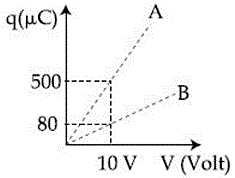
Figure shows charge (q) versus voltage (V) graph for series and parallel combination of two given capacitors. The capacitances are:
NTA JEE Main 10th April 2019 Shift 1 - Question 15
A current of 5 A passes through a copper conductor (resistivity = $$1.7 \times 10^{-8}$$ Ω m) of radius of cross-section 5 mm. Find the mobility of the charges if their drift velocity is $$1.1 \times 10^{-3}$$ ms$$^{-1}$$.
NTA JEE Main 10th April 2019 Shift 1 - Question 16
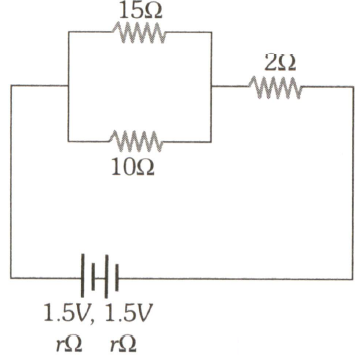
In the given circuit, an ideal voltmeter connected across the 10 Ω resistance reads 2 V. The internal resistance r, of each cell is:
NTA JEE Main 10th April 2019 Shift 1 - Question 17
A moving coil galvanometer allows a full scale current of $$10^{-4}$$ A. A series resistance of $$2 \times 10^4$$ Ω is required to convert the galvanometer into a voltmeter of range 0 - 5 V. Therefore, the value of shunt resistance required to convert the above galvanometer into an ammeter of range 0 - 10 mA is:
NTA JEE Main 10th April 2019 Shift 1 - Question 18
In an experiment, the resistance of a material is plotted as a function of temperature (in some range). As shown in the figure, it is a straight line.
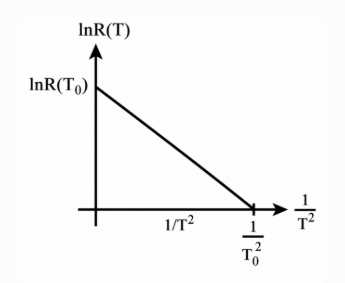
One may conclude that
NTA JEE Main 10th April 2019 Shift 1 - Question 19
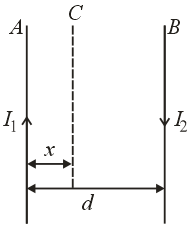
Two wires A & B are carrying currents I$$_1$$ and I$$_2$$ as shown in the figure. The separation between them is d. A third wire C carrying a current I is to be kept parallel to them at a distance x from A such that the net force acting on it is zero. The possible values of x are:
NTA JEE Main 10th April 2019 Shift 1 - Question 20
A proton, an electron, and a Helium nucleus, have the same energy. They are in circular orbits in a plane due to magnetic field perpendicular to the plane. Let $$r_p$$, $$r_e$$ and $$r_{He}$$ be their respective radii, then,