
Join Our JEE Preparation Group
Prep with like-minded aspirants; Get access to free daily tests and study material.
Sign in
Please select an account to continue using cracku.in
↓ →
Join Our JEE Preparation Group
Prep with like-minded aspirants; Get access to free daily tests and study material.
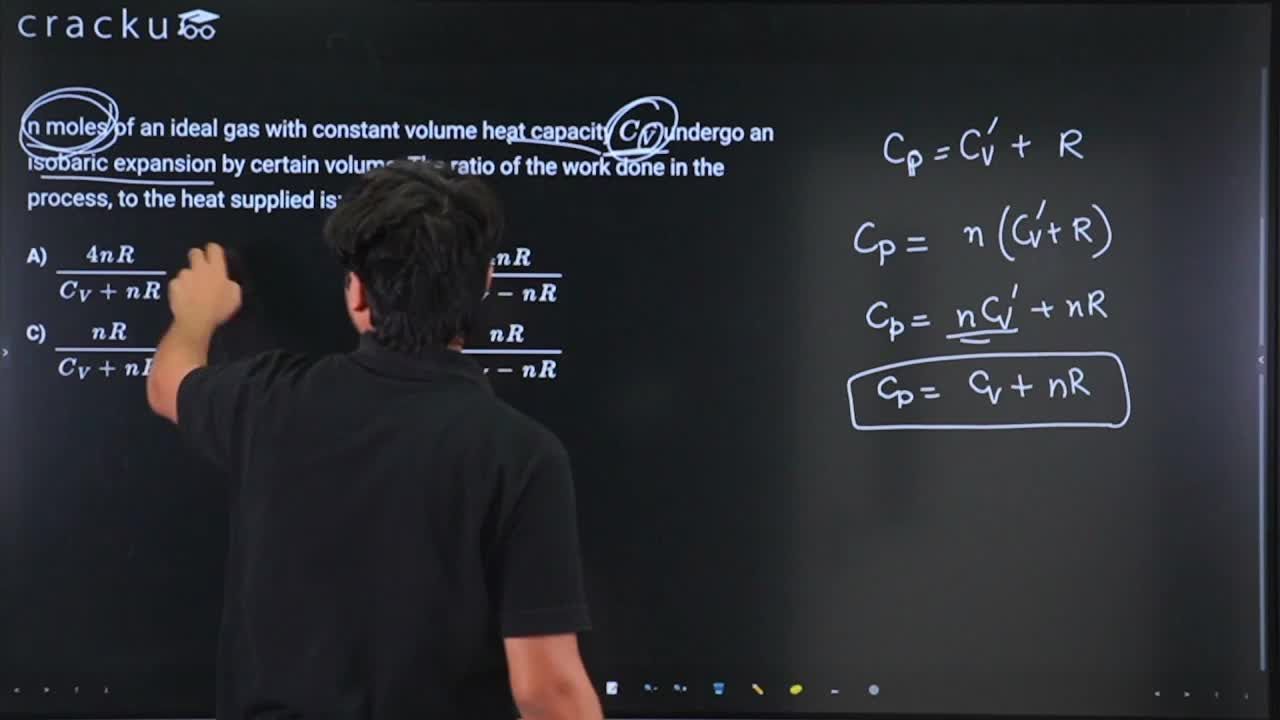
n moles of an ideal gas with constant volume heat capacity $$C_V$$ undergo an isobaric expansion by certain volume. The ratio of the work done in the process, to the heat supplied is:
We have an isobaric (constant pressure) expansion of $$n$$ moles of an ideal gas. Let the constant-volume heat capacity of these $$n$$ moles be $$C_V$$. For an ideal gas the molar relation $$C_P=C_V+R$$ holds; therefore for the whole sample the constant-pressure heat capacity is
$$C_P^{(\text{total})}=C_V+nR.$$
During any infinitesimal change the first law of thermodynamics gives
$$\delta Q=\delta U+\delta W.$$
For a finite isobaric process we shall determine separately the work $$W$$ and the heat supplied $$Q$$, and finally take their ratio.
Work done: At constant pressure the work is
$$W=P\Delta V.$$
The ideal-gas equation is $$PV=nRT$$. Differentiating it while keeping $$P$$ constant we get
$$P\,\mathrm dV=nR\,\mathrm dT \;\;\Longrightarrow\;\; P\Delta V=nR\Delta T.$$
Substituting this into the expression for work,
$$W=P\Delta V=nR\Delta T.$$
Heat supplied: For a constant-pressure process the heat absorbed is
$$Q=C_P^{(\text{total})}\,\Delta T.$$
Using the total constant-pressure heat capacity written above, we have
$$Q=(C_V+nR)\,\Delta T.$$
Ratio of work done to heat supplied:
$$\frac{W}{Q}=\frac{nR\Delta T}{(C_V+nR)\Delta T}=\frac{nR}{\,C_V+nR\,}.$$
The factor $$\Delta T$$ cancels out algebraically, leaving us with the desired dimensionless ratio.
Hence, the correct answer is Option 3.
Was this solution helpful?
Click on the Email ☝️ to Watch the Video Solution
Create a FREE account and get:
_1.webp)

Educational materials for JEE preparation

Ask our AI anything

AI can make mistakes. Please verify important information.
AI can make mistakes. Please verify important information.
