
Join Our JEE Preparation Group
Prep with like-minded aspirants; Get access to free daily tests and study material.
Sign in
Please select an account to continue using cracku.in
↓ →
Join Our JEE Preparation Group
Prep with like-minded aspirants; Get access to free daily tests and study material.
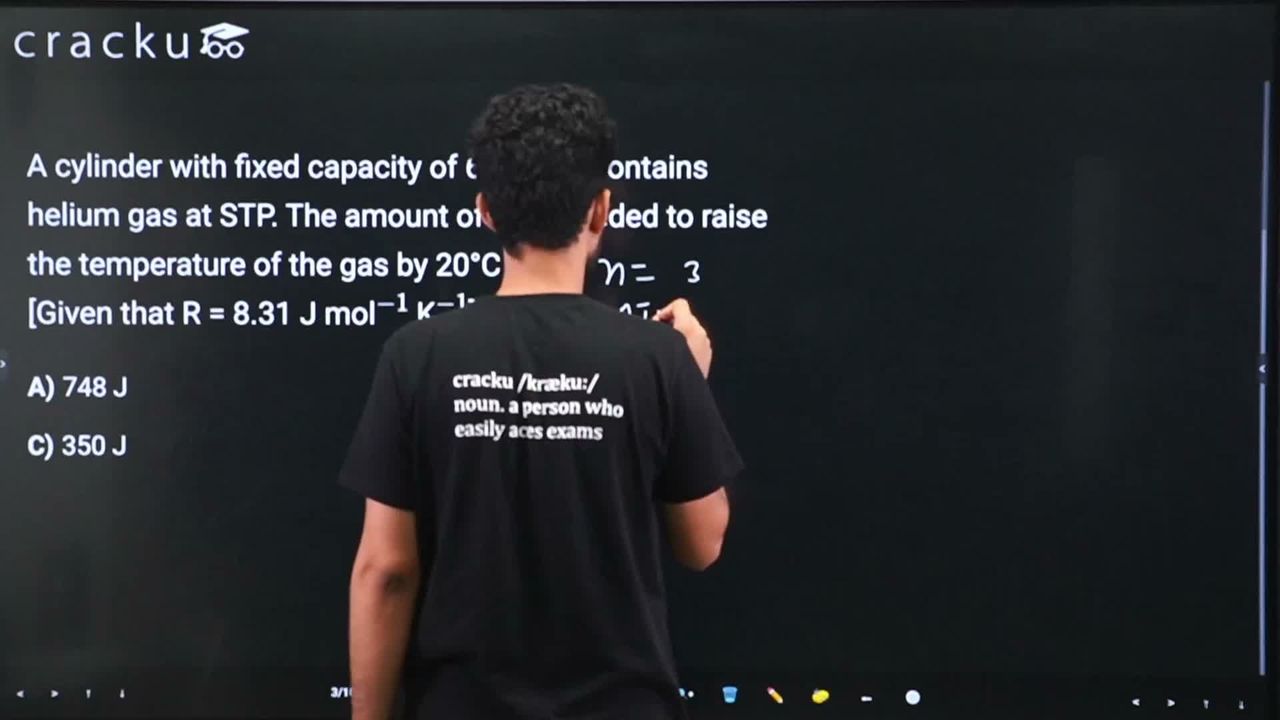
A cylinder with fixed capacity of 67.2 litre contains helium gas at STP. The amount of heat needed to raise the temperature of the gas by 20°C is:
[Given that R = 8.31 J mol$$^{-1}$$ K$$^{-1}$$]
First, let us translate the data into symbols. The capacity of the cylinder is given as 67.2 L, and the gas inside is helium at S.T.P. (Standard Temperature and Pressure).
At S.T.P. the temperature is $$T_0 = 273\ \text{K}$$ and the pressure is $$P_0 = 1\ \text{atm}$$. For an ideal gas, the well-known molar volume relation at S.T.P. is
$$V_m = 22.4\ \text{L mol}^{-1}.$$
We have a total volume $$V = 67.2\ \text{L}.$$ Using $$n = \dfrac{V}{V_m}$$ we find the number of moles present:
$$n = \dfrac{67.2\ \text{L}}{22.4\ \text{L mol}^{-1}} = 3.0\ \text{mol}.$$
The cylinder is rigid, so the volume of gas cannot change; the heating therefore occurs at constant volume. For a process at constant volume, the heat supplied is related to the molar heat capacity at constant volume $$C_V$$ by
$$q = n\,C_V\,\Delta T.$$
Helium is a mono-atomic ideal gas. For such gases the theoretical value of the molar heat capacity is
$$C_V = \dfrac{3}{2}R,$$
where $$R = 8.31\ \text{J mol}^{-1}\,\text{K}^{-1}$$ (given). The required temperature rise is $$\Delta T = 20^{\circ}\text{C} = 20\ \text{K}.$$
Substituting every quantity into the formula, we have
$$q = n\left(\dfrac{3}{2}R\right)\Delta T = 3\ \text{mol} \times \dfrac{3}{2}\,(8.31\ \text{J mol}^{-1}\,\text{K}^{-1}) \times 20\ \text{K}.$$
Proceeding step by step:
$$\dfrac{3}{2} \times 8.31 = 1.5 \times 8.31 = 12.465\ \text{J mol}^{-1}\,\text{K}^{-1},$$
$$12.465 \times 20 = 249.3\ \text{J mol}^{-1},$$
$$3 \times 249.3 = 747.9\ \text{J}.$$
Rounding to the appropriate number of significant digits,
$$q \approx 7.48 \times 10^{2}\ \text{J} \; \approx \; 748\ \text{J}.$$
Hence, the correct answer is Option A.
Was this solution helpful?
Click on the Email ☝️ to Watch the Video Solution
Create a FREE account and get:
_1.webp)

Educational materials for JEE preparation

Ask our AI anything

AI can make mistakes. Please verify important information.
AI can make mistakes. Please verify important information.
