
Join Our JEE Preparation Group
Prep with like-minded aspirants; Get access to free daily tests and study material.
Sign in
Please select an account to continue using cracku.in
↓ →
Join Our JEE Preparation Group
Prep with like-minded aspirants; Get access to free daily tests and study material.
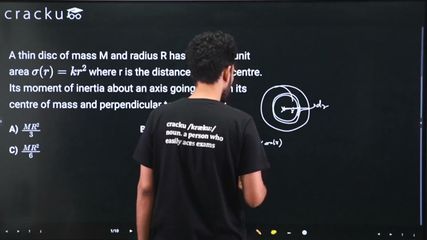
A thin disc of mass M and radius R has mass per unit area $$\sigma(r) = kr^2$$ where r is the distance from its centre. Its moment of inertia about an axis going through its centre of mass and perpendicular to its plane is:
We begin by recalling that for any surface with surface mass density $$\sigma(r)$$, an infinitesimal ring of radius $$r$$ and width $$dr$$ has an area $$dA = 2\pi r\,dr$$ (because the circumference is $$2\pi r$$ and the thickness is $$dr$$). The small mass of this ring is therefore $$dm = \sigma(r)\,dA$$.
The given surface mass density for the disc is $$\sigma(r) = k r^{2}$$, where $$k$$ is a constant that we shall determine from the total mass $$M$$ of the disc.
First, we write the expression for the total mass. By definition,
$$M = \int_{0}^{R} dm = \int_{0}^{R} \sigma(r)\,dA.$$
Substituting $$\sigma(r) = k r^{2}$$ and $$dA = 2\pi r\,dr$$, we get
$$M = \int_{0}^{R} k r^{2}\,(2\pi r\,dr) = 2\pi k \int_{0}^{R} r^{3}\,dr.$$
We now integrate $$r^{3}$$:
$$\int r^{3}\,dr = \frac{r^{4}}{4}.$$ Hence
$$M = 2\pi k\left[\frac{r^{4}}{4}\right]_{0}^{R} = 2\pi k\left(\frac{R^{4}}{4}\right) = \frac{\pi k R^{4}}{2}.$$
Solving this relation for the constant $$k$$ gives
$$k = \frac{2M}{\pi R^{4}}.$$
Now we calculate the moment of inertia about the central axis (perpendicular to the plane). The general formula for a surface is
$$I = \int r^{2}\,dm,$$ where again $$dm = \sigma(r)\,dA.$$ Substituting both $$\sigma(r)$$ and $$dA$$, we obtain
$$I = \int_{0}^{R} r^{2}\,\bigl(k r^{2}\bigr)\,(2\pi r\,dr) = 2\pi k \int_{0}^{R} r^{5}\,dr.$$
We now integrate $$r^{5}$$: $$\int r^{5}\,dr = \frac{r^{6}}{6}.$$ Therefore
$$I = 2\pi k\left[\frac{r^{6}}{6}\right]_{0}^{R} = 2\pi k\left(\frac{R^{6}}{6}\right) = \frac{\pi k R^{6}}{3}.$$
Substituting the value of $$k = \dfrac{2M}{\pi R^{4}}$$ that we found earlier, we get
$$I = \frac{\pi}{3}\left(\frac{2M}{\pi R^{4}}\right)R^{6} = \frac{2M R^{2}}{3}.$$
This simplifies neatly to
$$I = \frac{2 M R^{2}}{3}.$$
Hence, the correct answer is Option D.
Was this solution helpful?
Click on the Email ☝️ to Watch the Video Solution
Create a FREE account and get:
_1.webp)

Educational materials for JEE preparation

Ask our AI anything

AI can make mistakes. Please verify important information.
AI can make mistakes. Please verify important information.
