
Join Our JEE Preparation Group
Prep with like-minded aspirants; Get access to free daily tests and study material.
Sign in
Please select an account to continue using cracku.in
↓ →
Join Our JEE Preparation Group
Prep with like-minded aspirants; Get access to free daily tests and study material.
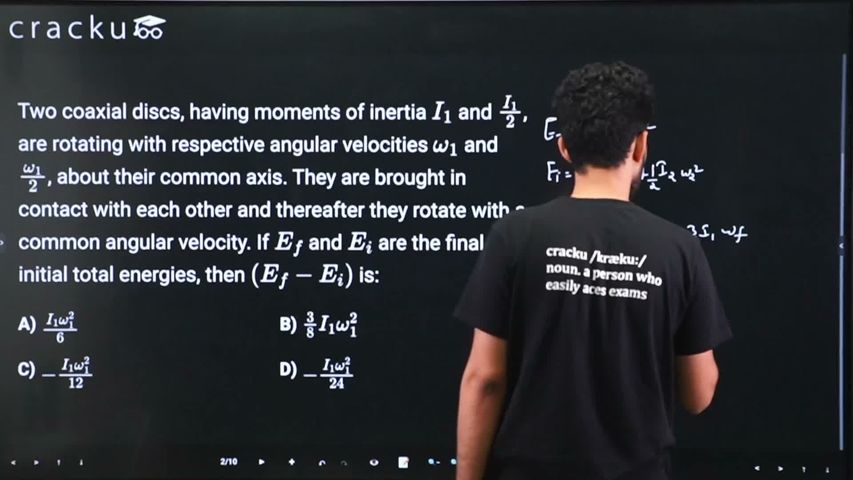
Two coaxial discs, having moments of inertia $$I_1$$ and $$\frac{I_1}{2}$$, are rotating with respective angular velocities $$\omega_1$$ and $$\frac{\omega_1}{2}$$, about their common axis. They are brought in contact with each other and thereafter they rotate with a common angular velocity. If $$E_f$$ and $$E_i$$ are the final and initial total energies, then $$(E_f - E_i)$$ is:
The two discs share the same straight line axis, so while the contact friction brings them to a common speed, no external torque acts about that axis. Therefore the total angular momentum remains conserved, even though some kinetic energy may be lost as heat.
We denote the larger disc by the sub-script 1 and the smaller by 2. Their given data are: $$I_1,\; \omega_1$$ for disc 1 and $$I_2=\dfrac{I_1}{2},\; \omega_2=\dfrac{\omega_1}{2}$$ for disc 2.
First we write the initial angular momentum $$L_i$$ of the system:
$$\begin{aligned} L_i &= I_1\,\omega_1 \;+\; I_2\,\omega_2 \\ &= I_1\,\omega_1 \;+\; \frac{I_1}{2}\,\frac{\omega_1}{2} \\ &= I_1\,\omega_1 \;+\; \frac{I_1\omega_1}{4} \\ &= \frac{5}{4}\,I_1\omega_1. \end{aligned}$$
If $$\omega_f$$ is the final common angular velocity, the final angular momentum $$L_f$$ is
$$L_f \;=\; (I_1 + I_2)\,\omega_f \;=\; \left(I_1 + \frac{I_1}{2}\right)\omega_f \;=\; \frac{3}{2}\,I_1\omega_f.$$
Setting $$L_f = L_i$$ (conservation of angular momentum) gives
$$\frac{3}{2}\,I_1\omega_f \;=\; \frac{5}{4}\,I_1\omega_1,$$
so that
$$\omega_f = \frac{5}{4}\times\frac{2}{3}\,\omega_1 = \frac{5}{6}\,\omega_1.$$
Next we compute the initial kinetic energy $$E_i$$ of the two discs. The rotational kinetic-energy formula is $$E = \tfrac12 I\omega^2.$$ Applying it to each disc and adding, we obtain
$$\begin{aligned} E_i &= \frac12\,I_1\omega_1^2 \;+\; \frac12\,I_2\omega_2^2\\ &= \frac12\,I_1\omega_1^2 \;+\; \frac12\left(\frac{I_1}{2}\right)\left(\frac{\omega_1}{2}\right)^2\\ &= \frac12\,I_1\omega_1^2 \;+\; \frac{I_1}{4}\,\frac{\omega_1^2}{4}\\ &= \frac12\,I_1\omega_1^2 \;+\; \frac{I_1\omega_1^2}{16}\\ &= \frac{8}{16}\,I_1\omega_1^2 \;+\; \frac{1}{16}\,I_1\omega_1^2\\ &= \frac{9}{16}\,I_1\omega_1^2. \end{aligned}$$
After contact the two discs act like a single body of moment of inertia $$I_1 + I_2 = \dfrac{3}{2}I_1$$ rotating with $$\omega_f = \dfrac56\omega_1.$$ Hence the final kinetic energy $$E_f$$ is
$$\begin{aligned} E_f &= \frac12\left(I_1 + I_2\right)\omega_f^2\\ &= \frac12\left(\frac{3}{2}I_1\right)\left(\frac56\omega_1\right)^2\\ &= \frac34\,I_1\;\times\;\frac{25}{36}\,\omega_1^2\\ &= \frac{75}{144}\,I_1\omega_1^2\\ &= \frac{25}{48}\,I_1\omega_1^2. \end{aligned}$$
Now we evaluate the change in kinetic energy:
$$\begin{aligned} E_f - E_i &= \left(\frac{25}{48} - \frac{9}{16}\right)I_1\omega_1^2\\ &= \left(\frac{25}{48} - \frac{27}{48}\right)I_1\omega_1^2\\ &= -\frac{2}{48}\,I_1\omega_1^2\\ &= -\frac{1}{24}\,I_1\omega_1^2. \end{aligned}$$
The quantity $$E_f - E_i$$ is therefore $$-\dfrac{I_1\omega_1^2}{24}$$, meaning that this much mechanical energy is lost (converted into heat) when the discs come to a common angular speed.
Hence, the correct answer is Option D.
Was this solution helpful?
Click on the Email ☝️ to Watch the Video Solution
Create a FREE account and get:
_1.webp)

Educational materials for JEE preparation

Ask our AI anything

AI can make mistakes. Please verify important information.
AI can make mistakes. Please verify important information.
