
Join Our JEE Preparation Group
Prep with like-minded aspirants; Get access to free daily tests and study material.
Sign in
Please select an account to continue using cracku.in
↓ →
Join Our JEE Preparation Group
Prep with like-minded aspirants; Get access to free daily tests and study material.
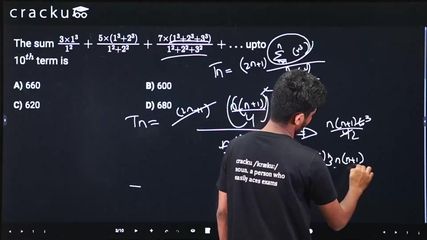
The sum $$\frac{3 \times 1^3}{1^2} + \frac{5 \times (1^3 + 2^3)}{1^2 + 2^2} + \frac{7 \times (1^3 + 2^3 + 3^3)}{1^2 + 2^2 + 3^2} + \ldots$$ upto 10$$^{th}$$ term is
We are asked to evaluate the series
$$\frac{3 \times 1^3}{1^2} \;+\; \frac{5 \times (1^3 + 2^3)}{1^2 + 2^2} \;+\; \frac{7 \times (1^3 + 2^3 + 3^3)}{1^2 + 2^2 + 3^2} \;+\; \cdots$$
up to the tenth term.
First, we write the general (n-th) term. Observe that in the numerator of the n-th term the multiplier is $$2n+1$$ and the cubic sum goes up to $$n$$, while in the denominator the square sum also goes up to $$n$$. Hence the n-th term is
$$T_n \;=\; \frac{(2n+1)\displaystyle\sum_{k=1}^{n}k^{3}}{\displaystyle\sum_{k=1}^{n}k^{2}}.$$
Now we substitute the standard formulas for these two well-known summations. We explicitly state the formulas:
• Sum of cubes: $$\displaystyle\sum_{k=1}^{n}k^{3}\;=\;\left[\frac{n(n+1)}{2}\right]^2.$$
• Sum of squares: $$\displaystyle\sum_{k=1}^{n}k^{2}\;=\;\frac{n(n+1)(2n+1)}{6}.$$
Substituting these into $$T_n$$ we get
$$T_n \;=\; (2n+1)\;\times\;\frac{\left[\dfrac{n(n+1)}{2}\right]^2}{\dfrac{n(n+1)(2n+1)}{6}}.$$
To make the algebra transparent, let us first remove the complex fraction by multiplying numerator and denominator by 6:
$$T_n \;=\; (2n+1)\;\times\;\frac{6\left[\dfrac{n(n+1)}{2}\right]^2}{n(n+1)(2n+1)}.$$
We now notice that the factor $$(2n+1)$$ appears both in the numerator and denominator, so it cancels out completely:
$$T_n \;=\; \frac{6\left[\dfrac{n(n+1)}{2}\right]^2}{n(n+1)}.$$
Next, we expand the squared bracket:
$$\left[\frac{n(n+1)}{2}\right]^2 \;=\;\frac{n^2(n+1)^2}{4}.$$
Placing this back, we have
$$T_n \;=\; \frac{6}{n(n+1)}\;\times\;\frac{n^2(n+1)^2}{4}.$$
Now we cancel one factor of $$n$$ and one factor of $$(n+1)$$ between numerator and denominator:
$$T_n \;=\; \frac{6}{4}\;\times\;n(n+1).$$
The fraction $$\dfrac{6}{4}$$ simplifies to $$\dfrac{3}{2}$$. Hence
$$T_n \;=\; \frac{3}{2}\,n(n+1).$$
Therefore, the entire series up to the tenth term is
$$S \;=\;\sum_{n=1}^{10}T_n \;=\;\frac{3}{2}\sum_{n=1}^{10}n(n+1).$$
We expand $$n(n+1)$$ into $$n^2+n$$ so that the sum splits into two simpler standard sums:
$$\sum_{n=1}^{10}n(n+1) \;=\;\sum_{n=1}^{10}(n^2+n) \;=\;\sum_{n=1}^{10}n^2 \;+\;\sum_{n=1}^{10}n.$$
Again we invoke the formulas:
• $$\displaystyle\sum_{n=1}^{N}n \;=\;\frac{N(N+1)}{2}.$$
• $$\displaystyle\sum_{n=1}^{N}n^2 \;=\;\frac{N(N+1)(2N+1)}{6}.$$
Setting $$N=10$$, we obtain
$$\sum_{n=1}^{10}n \;=\;\frac{10 \times 11}{2}=55,$$
$$\sum_{n=1}^{10}n^2 \;=\;\frac{10 \times 11 \times 21}{6}=385.$$
Thus,
$$\sum_{n=1}^{10}n(n+1) \;=\;385 + 55 = 440.$$
Finally, we multiply by $$\dfrac{3}{2}$$ as dictated earlier:
$$S \;=\;\frac{3}{2}\times 440 \;=\;3 \times 220 \;=\;660.$$
Hence, the correct answer is Option A.
Was this solution helpful?
Click on the Email ☝️ to Watch the Video Solution
Create a FREE account and get:
Educational materials for JEE preparation

Ask our AI anything

AI can make mistakes. Please verify important information.
AI can make mistakes. Please verify important information.

_1.webp)
