
Join Our JEE Preparation Group
Prep with like-minded aspirants; Get access to free daily tests and study material.
Sign in
Please select an account to continue using cracku.in
↓ →
Join Our JEE Preparation Group
Prep with like-minded aspirants; Get access to free daily tests and study material.
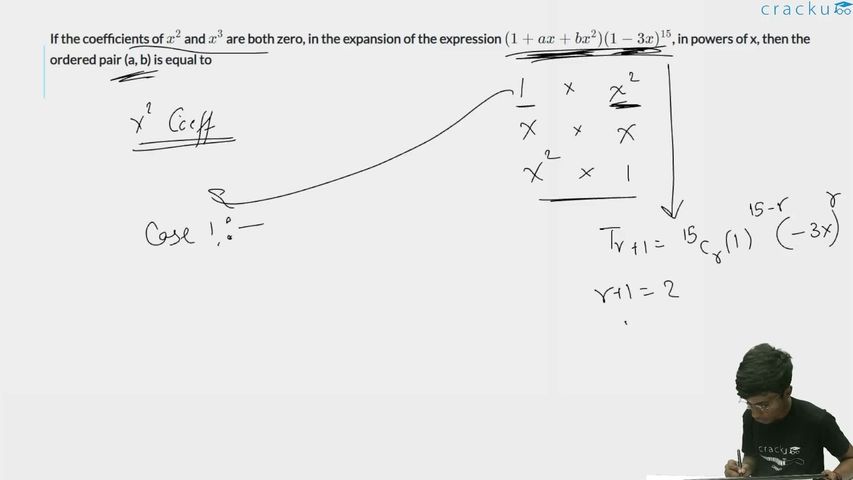
If the coefficients of $$x^2$$ and $$x^3$$ are both zero, in the expansion of the expression $$(1 + ax + bx^2)(1 - 3x)^{15}$$, in powers of x, then the ordered pair (a, b) is equal to
We begin with the given expression
$$\bigl(1 + ax + bx^2\bigr)\,(1 - 3x)^{15}$$
and are told that, when it is expanded in powers of $$x$$, the coefficients of $$x^2$$ and $$x^3$$ are both equal to zero. Our task is to determine the real numbers $$a$$ and $$b$$ satisfying those two conditions.
The expansion of $$(1 - 3x)^{15}$$ is obtained through the Binomial Theorem, which states
$$\bigl(1 + t\bigr)^n \;=\; \sum_{k = 0}^{n} \binom{n}{k}\, t^{\,k}.$$
Here we have $$t = -3x$$ and $$n = 15$$, so we write
$$\bigl(1 - 3x\bigr)^{15} \;=\; \sum_{k = 0}^{15} \binom{15}{k}\,(-3x)^{k} \;=\; \sum_{k = 0}^{15} \binom{15}{k}\,(-3)^{k}\,x^{k}.$$
Thus, for each power $$k$$, the coefficient of $$x^k$$ in $$(1 - 3x)^{15}$$ is
$$\binom{15}{k}\,(-3)^{k}.$$
Next, we multiply this series by $$1 + ax + bx^2$$. The coefficient of any specific power of $$x$$ in the product comes from matching powers whose exponents add up to that specific power. We will impose the conditions for $$x^2$$ and $$x^3$$ in turn.
Coefficient of $$x^2$$
The power $$x^2$$ in the product can arise in exactly three ways:
(1) The factor $$1$$ (from $$1 + ax + bx^2$$) times the $$x^2$$ term of $$(1 - 3x)^{15}$$;
(2) The factor $$ax$$ times the $$x^1$$ term of $$(1 - 3x)^{15}$$;
(3) The factor $$bx^2$$ times the constant term (the $$x^0$$ term) of $$(1 - 3x)^{15}$$.
We compute each required coefficient directly:
$$\text{Coeff}_{x^2}\bigl((1 - 3x)^{15}\bigr) = \binom{15}{2}(-3)^2,$$
$$\text{Coeff}_{x^1}\bigl((1 - 3x)^{15}\bigr) = \binom{15}{1}(-3)^1,$$
$$\text{Coeff}_{x^0}\bigl((1 - 3x)^{15}\bigr) = \binom{15}{0}(-3)^0.$$
Evaluating the numerical values:
$$\binom{15}{2} = 105,\quad (-3)^2 = 9 \;\Longrightarrow\; 105 \times 9 = 945,$$
$$\binom{15}{1} = 15,\quad (-3)^1 = -3 \;\Longrightarrow\; 15 \times (-3) = -45,$$
$$\binom{15}{0} = 1,\quad (-3)^0 = 1 \;\Longrightarrow\; 1 \times 1 = 1.$$
Hence the coefficient of $$x^2$$ in the entire product is
$$945 \;+\; a(-45) \;+\; b(1).$$
Because this coefficient is required to be zero, we obtain our first linear equation:
$$945 \;-\; 45a \;+\; b = 0.$$
Solving for $$b$$ gives
$$b = 45a - 945.$$
Coefficient of $$x^3$$
In an analogous manner, the power $$x^3$$ can arise from:
(1) $$1$$ multiplying the $$x^3$$ term of $$(1 - 3x)^{15}$$;
(2) $$ax$$ multiplying the $$x^2$$ term of $$(1 - 3x)^{15}$$;
(3) $$bx^2$$ multiplying the $$x^1$$ term of $$(1 - 3x)^{15}$$.
We already know the $$x^2$$ and $$x^1$$ coefficients from above; we now find the $$x^3$$ coefficient:
$$\text{Coeff}_{x^3}\bigl((1 - 3x)^{15}\bigr) = \binom{15}{3}(-3)^3.$$
Compute this value carefully:
$$\binom{15}{3} = 455,\quad (-3)^3 = -27 \;\Longrightarrow\; 455 \times (-27) = -12\,285.$$
Therefore the overall $$x^3$$ coefficient in the product equals
$$-12\,285 \;+\; a \cdot 945 \;+\; b \cdot (-45).$$
This must also be zero, giving the second equation:
$$-12\,285 \;+\; 945a \;-\; 45b = 0.$$
Substituting $$b = 45a - 945$$ into the second equation
We write
$$-12\,285 \;+\; 945a \;-\; 45(45a - 945) = 0.$$
Distribute the factor $$-45$$ inside the parentheses:
$$-12\,285 \;+\; 945a \;-\; 45 \cdot 45a \;+\; 45 \cdot 945 = 0.$$
Since $$45 \cdot 45a = 2\,025a$$ and $$45 \cdot 945 = 42\,525$$, the equation becomes
$$-12\,285 \;+\; 945a \;-\; 2\,025a \;+\; 42\,525 = 0.$$
Combine the like terms:
$$(-12\,285 + 42\,525) \;+\; (945a - 2\,025a) = 0,$$
$$30\,240 \;-\; 1\,080a = 0.$$
Rearranging gives
$$-1\,080a = -30\,240 \;\Longrightarrow\; a = \frac{30\,240}{1\,080} = 28.$$
Finding $$b$$ from $$b = 45a - 945$$
Substituting $$a = 28$$:
$$b = 45 \times 28 - 945.$$
Calculate step by step:
$$45 \times 28 = 1\,260,$$
$$1\,260 - 945 = 315.$$
We have now obtained
$$a = 28, \qquad b = 315.$$
Therefore the ordered pair $$\bigl(a,\,b\bigr)$$ equals $$\bigl(28,\,315\bigr).$$
Examining the provided options, this matches Option A.
Hence, the correct answer is Option A.
Was this solution helpful?
Click on the Email ☝️ to Watch the Video Solution
Create a FREE account and get:
_1.webp)

Educational materials for JEE preparation

Ask our AI anything

AI can make mistakes. Please verify important information.
AI can make mistakes. Please verify important information.
