
Join Our JEE Preparation Group
Prep with like-minded aspirants; Get access to free daily tests and study material.
Sign in
Please select an account to continue using cracku.in
↓ →
Join Our JEE Preparation Group
Prep with like-minded aspirants; Get access to free daily tests and study material.
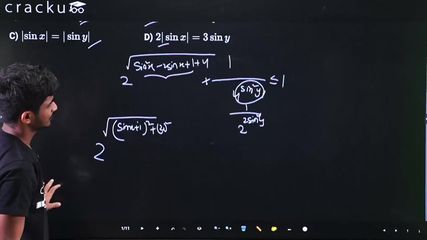
All the pairs (x, y), that satisfy the inequality $$2^{\sqrt{\sin^2 x - 2\sin x + 5}} \cdot \frac{1}{4^{\sin^2 y}} \leq 1$$ also satisfy the equation:
We begin with the inequality
$$2^{\sqrt{\sin^2 x - 2\sin x + 5}}\;\cdot\;\frac{1}{4^{\sin^2 y}}\;\le\;1.$$
The denominator involves a power of $$4$$, and it is useful to rewrite it with the same base $$2$$. Since $$4 = 2^{2}$$, we have the identity
$$4^{\sin^2 y}\;=\;\bigl(2^2\bigr)^{\sin^2 y}\;=\;2^{2\sin^2 y}.$$
Substituting this into the given expression gives
$$2^{\sqrt{\sin^2 x - 2\sin x + 5}}\;\cdot\;2^{-2\sin^2 y}\;\le\;1,$$
which, by the basic rule $$a^m\cdot a^n = a^{m+n}$$, simplifies to
$$2^{\;\sqrt{\sin^2 x - 2\sin x + 5}\;-\;2\sin^2 y}\;\le\;1.$$
Now we recall the fact that for any base $$a \gt 1$$, the inequality
$$a^{k}\;\le\;1\quad\Longleftrightarrow\quad k\;\le\;0.$$
Using this fact with the base $$a=2$$, the exponent must satisfy
$$\sqrt{\sin^2 x - 2\sin x + 5}\;-\;2\sin^2 y\;\le\;0.$$
Thus
$$\sqrt{\sin^2 x - 2\sin x + 5}\;\le\;2\sin^2 y. \quad -(1)$$
We next simplify the quantity under the square-root. Completing the square gives
$$$ \sin^2 x \;-\;2\sin x \;+\;5 \;=\; \bigl(\sin x -1\bigr)^2 \;+\;4. $$$
Hence
$$\sqrt{\sin^2 x - 2\sin x + 5} \;=\; \sqrt{\bigl(\sin x -1\bigr)^2 + 4}.$$
The term $$(\sin x-1)^2$$ is always non-negative, so
$$$ (\sin x -1)^2 + 4 \;\ge\; 4, \quad\text{and therefore}\quad \sqrt{(\sin x -1)^2 + 4}\;\ge\;2. $$$
Returning to inequality (1), we know the left-hand side is at least $$2$$, so the right-hand side must also be at least $$2$$. Thus
$$2\sin^2 y\;\ge\;2 \;\;\Longrightarrow\;\; \sin^2 y\;\ge\;1.$$
But for every real number $$y$$ we have $$\sin^2 y \le 1$$. Combining $$\sin^2 y \ge 1$$ with $$\sin^2 y \le 1$$ forces
$$\sin^2 y = 1,$$ so $$\sin y = \pm 1.$$
With $$\sin^2 y = 1$$ we obtain $$2\sin^2 y = 2$$, and inequality (1) becomes
$$\sqrt{(\sin x -1)^2 + 4}\;\le\;2.$$
Since the square-root is never less than $$2$$, equality must occur:
$$\sqrt{(\sin x -1)^2 + 4} = 2.$$
Squaring both sides yields
$$(\sin x -1)^2 + 4 = 4 \quad\Longrightarrow\quad (\sin x -1)^2 = 0,$$
which simplifies to
$$\sin x - 1 = 0 \quad\Longrightarrow\quad \sin x = 1.$$
Hence every permissible pair $$(x,y)$$ satisfies
$$\sin x = 1,\qquad \sin y = \pm 1,$$ which in turn gives
$$|\sin x| = 1 = |\sin y|.$$
Therefore the common relation that all such pairs obey is
$$|\sin x| = |\sin y|,$$ which is exactly the statement in Option C.
Hence, the correct answer is Option C.
Was this solution helpful?
Click on the Email ☝️ to Watch the Video Solution
Create a FREE account and get:
_1.webp)

Educational materials for JEE preparation

Ask our AI anything

AI can make mistakes. Please verify important information.
AI can make mistakes. Please verify important information.
