
Join Our JEE Preparation Group
Prep with like-minded aspirants; Get access to free daily tests and study material.
Sign in
Please select an account to continue using cracku.in
↓ →
Join Our JEE Preparation Group
Prep with like-minded aspirants; Get access to free daily tests and study material.
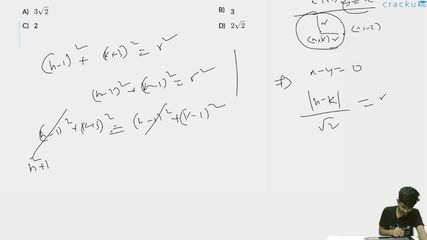
The line $$x = y$$ touches a circle at the point (1, 1). If the circle also passes through the point (1, -3), then its radius is
We have a circle which is tangent to the line $$x = y$$ at the point $$(1,\,1)$$ and which also passes through the point $$(1,\,-3)$$. Our aim is to determine the radius of this circle.
Because a radius drawn to the point of contact is always perpendicular to the tangent line, the centre of the circle must lie on the straight line that is perpendicular to $$x = y$$ at the point $$(1,\,1)$$.
The given tangent $$x = y$$ has slope $$1$$. A line perpendicular to it therefore has slope $$-1$$. Writing the equation of the line with slope $$-1$$ through $$(1,\,1)$$, we start from the point-slope form $$y - y_1 = m\,(x - x_1)$$. Substituting $$m=-1$$ and $$(x_1,\,y_1)=(1,\,1)$$, we get
$$y - 1 = -1\,(x - 1).$$
Simplifying,
$$y - 1 = -x + 1,$$
$$x + y = 2.$$
Hence the centre $$C(h,\,k)$$ of the circle must satisfy the linear relation
$$h + k = 2. \quad -(1)$$
Next, we use the distance formula. The radius $$r$$ is the distance from the centre to any point on the circle. First, taking the point of contact $$(1,\,1)$$, we have
$$r^2 = (h - 1)^2 + (k - 1)^2. \quad -(2)$$
The circle also passes through the point $$(1,\,-3)$$, so the distance from the centre to this point must equal the same radius. Therefore,
$$r^2 = (h - 1)^2 + (k + 3)^2. \quad -(3)$$
Because both right-hand sides equal $$r^2$$, we can equate them directly. Substituting from (2) and (3),
$$(h - 1)^2 + (k + 3)^2 = (h - 1)^2 + (k - 1)^2.$$
The term $$(h - 1)^2$$ appears on both sides, so it cancels, leaving
$$(k + 3)^2 = (k - 1)^2.$$
Now we expand both squares step by step:
$$k^2 + 6k + 9 = k^2 - 2k + 1.$$
Subtracting $$k^2$$ from each side eliminates the quadratic terms:
$$6k + 9 = -2k + 1.$$
Adding $$2k$$ to both sides gathers the $$k$$ terms together:
$$8k + 9 = 1.$$
Subtracting $$9$$ from both sides,
$$8k = -8.$$
Dividing by $$8$$, we find
$$k = -1.$$
Using relation (1), $$h + k = 2$$, we substitute $$k = -1$$ to get
$$h + (-1) = 2,$$
$$h = 3.$$
Thus the centre of the circle is $$C(3,\,-1).$$
Finally, we compute the radius using the distance from the centre to $$(1,\,1)$$. By the distance formula,
$$r = \sqrt{(3 - 1)^2 + (-1 - 1)^2}.$$
Calculating the squares explicitly,
$$r = \sqrt{(2)^2 + (-2)^2} = \sqrt{4 + 4} = \sqrt{8}.$$
Since $$\sqrt{8} = 2\sqrt{2},$$ we have
$$r = 2\sqrt{2}.$$
Hence, the correct answer is Option D.
Was this solution helpful?
Click on the Email ☝️ to Watch the Video Solution
Create a FREE account and get:
_1.webp)

Educational materials for JEE preparation

Ask our AI anything

AI can make mistakes. Please verify important information.
AI can make mistakes. Please verify important information.
