
Join Our JEE Preparation Group
Prep with like-minded aspirants; Get access to free daily tests and study material.
Sign in
Please select an account to continue using cracku.in
↓ →
Join Our JEE Preparation Group
Prep with like-minded aspirants; Get access to free daily tests and study material.
If the circles $$x^2 + y^2 + 5Kx + 2y + K = 0$$ and $$2(x^2 + y^2) + 2Kx + 3y - 1 = 0$$, (K ∈ R), intersect at the points P and Q, then the line $$4x + 5y - K = 0$$, passes through P and Q, for:
We begin by naming the two given circles
$$S_1 : x^2 + y^2 + 5Kx + 2y + K = 0,$$
$$S_2 : 2(x^2 + y^2) + 2Kx + 3y - 1 = 0.$$
Their common points P and Q satisfy both $$S_1 = 0$$ and $$S_2 = 0$$ simultaneously. A standard fact from coordinate geometry states:
“Every equation of the form $$S_1 + \lambda S_2 = 0$$ also passes through the same intersection points, whatever real number $$\lambda$$ we choose.”
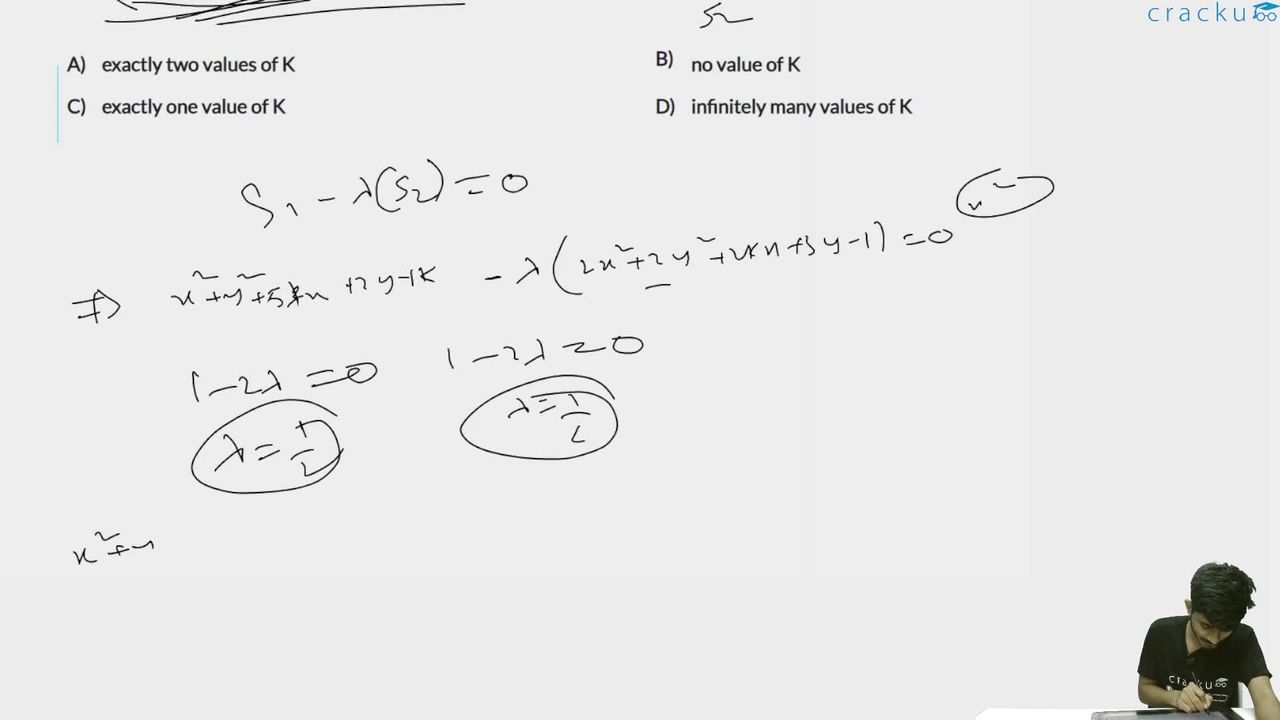
We need a straight line (first-degree equation) through those points. Therefore we must pick $$\lambda$$ so that every second-degree term ($$x^2$$ and $$y^2$$) cancels out in $$S_1 + \lambda S_2$$.
First expand $$S_2$$ completely:
$$S_2 = 2x^2 + 2y^2 + 2Kx + 3y - 1.$$
Now write
$$S_1 + \lambda S_2 = 0.$$
Look at the $$x^2$$-term:
$$1 + 2\lambda = 0 \;\;\Longrightarrow\;\; \lambda = -\dfrac12.$$
Check that the $$y^2$$-term gives the same condition:
$$1 + 2\lambda = 1 + 2\!\left(-\dfrac12\right) = 0,$$
so $$x^2$$ and $$y^2$$ indeed vanish together. Substitute $$\lambda = -\dfrac12$$ in $$S_1 + \lambda S_2$$ and simplify every coefficient.
Coefficient of $$x$$:
$$5K + 2\lambda K = 5K + 2\!\left(-\dfrac12\right)K = 5K - K = 4K.$$ Hence the $$x$$-term is $$4Kx$$.
Coefficient of $$y$$:
$$2 + 3\lambda = 2 + 3\!\left(-\dfrac12\right) = 2 - \dfrac32 = \dfrac12.$$ Hence the $$y$$-term is $$\dfrac12\,y.$$
Constant term:
$$K + \lambda(-1) = K - \left(-\dfrac12\right) = K + \dfrac12.$$ So the constant part is $$K + \dfrac12.$$
Putting these three results together we get the radical axis (the required straight line through P and Q):
$$4Kx + \dfrac12\,y + \left(K + \dfrac12\right) = 0.$$
The problem says that the line $$L : 4x + 5y - K = 0$$ passes through the same two points. Thus the two linear equations must represent the same line. Equality of lines means that every coefficient is proportional by one common non-zero factor. Let that factor be $$\mu.$$ Write the proportionality:
$$4x + 5y - K = \mu\!\left(4Kx + \dfrac12\,y + K + \dfrac12\right).$$
Now compare coefficients one by one.
From the $$x$$-terms:
$$4 = \mu\,(4K) \;\;\Longrightarrow\;\; \mu = \dfrac4{4K} = \dfrac1K.$$
From the $$y$$-terms:
$$5 = \mu\!\left(\dfrac12\right) = \dfrac1K\!\left(\dfrac12\right) = \dfrac1{2K}.$$
Multiply both sides by $$2K$$:
$$10K = 1 \;\;\Longrightarrow\;\; K = \dfrac1{10}.$$
Finally check the constant terms. They must be in the same ratio $$\mu = \dfrac1K.$$ Hence
$$-K = \mu\!\left(K + \dfrac12\right) = \dfrac1K\!\left(K + \dfrac12\right).$$
Multiply both sides by $$K$$ to clear the denominator:
$$-K^2 = K + \dfrac12.$$
Bring everything to the left:
$$-K^2 - K - \dfrac12 = 0 \;\;\Longrightarrow\;\; K^2 + K + \dfrac12 = 0.$$
The discriminant of this quadratic is
$$\Delta = 1^2 - 4\!\left(1\right)\!\left(\dfrac12\right) = 1 - 2 = -1 \lt 0.$$
A negative discriminant means no real value of $$K$$ satisfies the constant-term condition. Consequently there is no real $$K$$ for which all three sets of coefficients can be proportional at the same time.
Therefore the given straight line cannot pass through both points of intersection of the two circles for any real $$K$$.
Hence, the correct answer is Option B.
Was this solution helpful?
Click on the Email ☝️ to Watch the Video Solution
Create a FREE account and get:
_1.webp)

Educational materials for JEE preparation

Ask our AI anything

AI can make mistakes. Please verify important information.
AI can make mistakes. Please verify important information.
