
Join Our JEE Preparation Group
Prep with like-minded aspirants; Get access to free daily tests and study material.
Sign in
Please select an account to continue using cracku.in
↓ →
Join Our JEE Preparation Group
Prep with like-minded aspirants; Get access to free daily tests and study material.
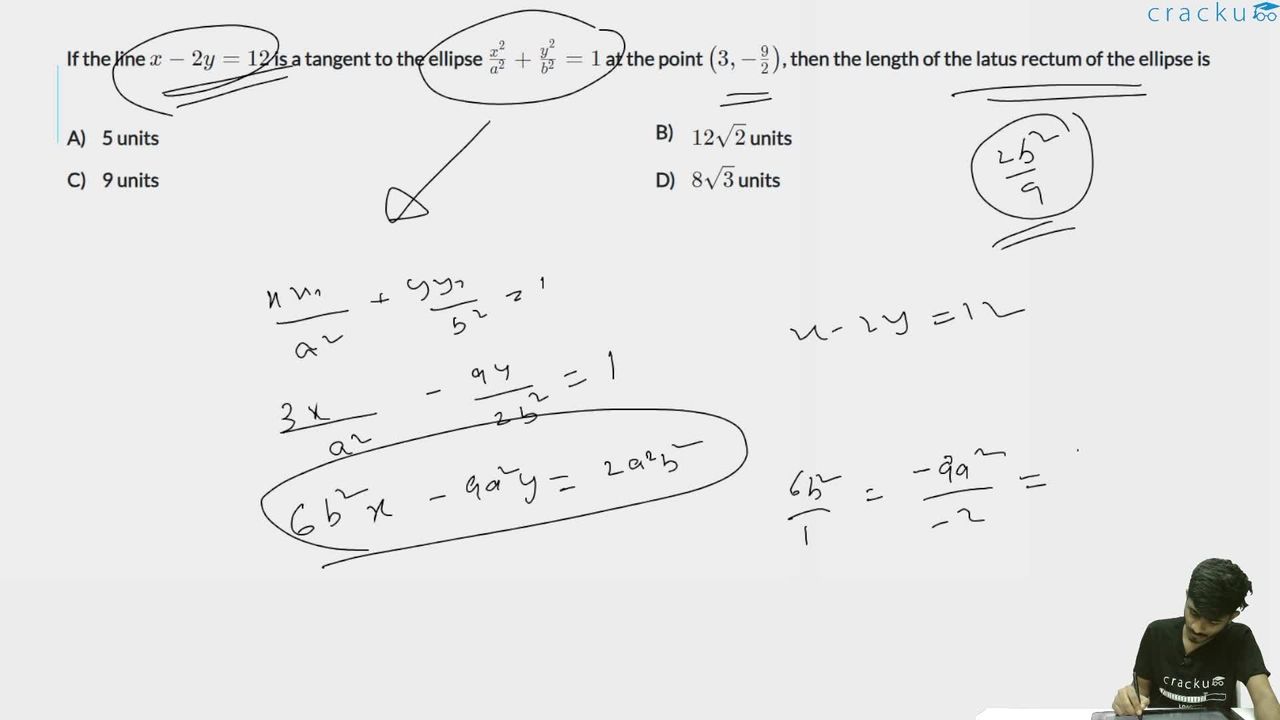
If the line $$x - 2y = 12$$ is a tangent to the ellipse $$\frac{x^2}{a^2} + \frac{y^2}{b^2} = 1$$ at the point $$\left(3, -\frac{9}{2}\right)$$, then the length of the latus rectum of the ellipse is
We have the ellipse whose canonical equation is $$\frac{x^{2}}{a^{2}}+\frac{y^{2}}{b^{2}}=1.$$
The line $$x-2y=12$$ is given to be a tangent to this ellipse at the point $$\left(3,\,-\frac{9}{2}\right).$$
First, we recall (state) the standard tangent-line formula for an ellipse. For the ellipse $$\frac{x^{2}}{a^{2}}+\frac{y^{2}}{b^{2}}=1,$$ the tangent at any point $$(x_{1},y_{1})$$ on the ellipse is
$$\frac{xx_{1}}{a^{2}}+\frac{yy_{1}}{b^{2}}=1.$$
Here the point of contact is $$(x_{1},y_{1})=\left(3,\,-\dfrac{9}{2}\right).$$ Substituting these coordinates into the tangent formula, we obtain
$$\frac{3x}{a^{2}}+\frac{\left(-\dfrac{9}{2}\right)y}{b^{2}}=1 \;\Longrightarrow\; \frac{3x}{a^{2}}-\frac{9y}{2b^{2}}=1.$$
This is the same straight line as the given tangent $$x-2y=12,$$ so both must represent exactly the same set of points in the plane. Two linear equations represent the same line if their corresponding coefficients are proportional. To make the comparison easy, we rewrite the given tangent with a right-hand side equal to $$1$$ (just like the equation above) by dividing every term by $$12$$:
$$\frac{x}{12}-\frac{2y}{12}=1 \;\Longrightarrow\; \frac{x}{12}-\frac{y}{6}=1.$$
Now we equate corresponding coefficients.
Coefficient of $$x:$$ $$\frac{3}{a^{2}}=\frac{1}{12}\quad\Longrightarrow\quad 3\cdot12=a^{2}\quad\Longrightarrow\quad a^{2}=36.$$
Coefficient of $$y:$$ $$-\frac{9}{2b^{2}}=-\frac{1}{6}\quad\Longrightarrow\quad\frac{9}{2b^{2}}=\frac{1}{6} \quad\Longrightarrow\quad 9\cdot6=2b^{2} \quad\Longrightarrow\quad 54=2b^{2} \quad\Longrightarrow\quad b^{2}=27.$$
We now know $$a^{2}=36,\; b^{2}=27,$$ and clearly $$a^{2}>b^{2},$$ so the major axis is along the $$x$$-direction.
For an ellipse with semi-major axis $$a$$ (along the $$x$$-axis) and semi-minor axis $$b,$$ the length of the latus rectum (denoted $$L$$) is given by the formula
$$L=\frac{2b^{2}}{a}.$$
Substituting $$b^{2}=27$$ and $$a=\sqrt{36}=6,$$ we get
$$L=\frac{2\,(27)}{6} =\frac{54}{6} =9\;\text{units}.$$
Hence, the correct answer is Option C.
Was this solution helpful?
Click on the Email ☝️ to Watch the Video Solution
Create a FREE account and get:
_1.webp)

Educational materials for JEE preparation

Ask our AI anything

AI can make mistakes. Please verify important information.
AI can make mistakes. Please verify important information.
