
Join Our JEE Preparation Group
Prep with like-minded aspirants; Get access to free daily tests and study material.
Sign in
Please select an account to continue using cracku.in
↓ →
Join Our JEE Preparation Group
Prep with like-minded aspirants; Get access to free daily tests and study material.
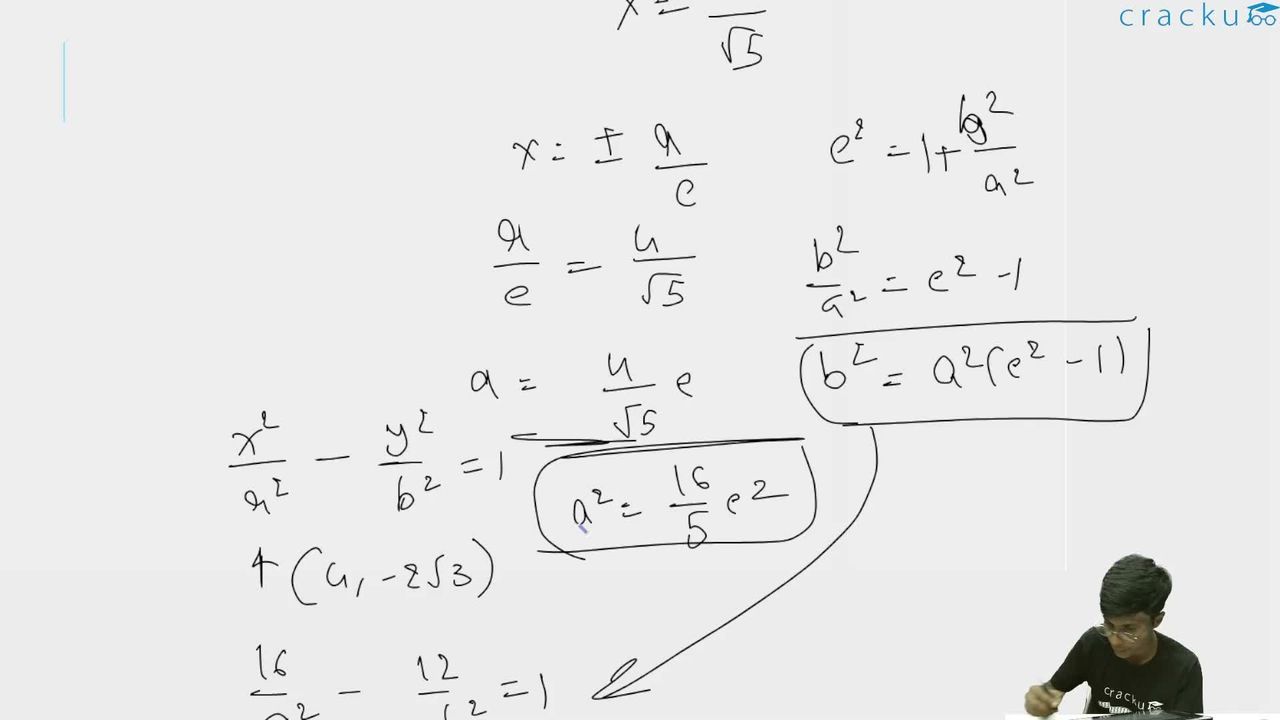
If a directrix of a hyperbola centered at the origin and passing through the point $$(4, -2\sqrt{3})$$ is $$5x = 4\sqrt{5}$$ and its eccentricity is e, then:
We start by choosing the standard form of a hyperbola whose centre is at the origin and whose transverse axis is along the $$x$$-axis. Hence we write
$$\frac{x^{2}}{a^{2}}-\frac{y^{2}}{b^{2}}=1.$$
For this form of hyperbola the two directrices are the vertical lines
$$x=\pm\frac{a}{e},$$
where $$e$$ is the eccentricity. One of the directrices is given in the statement as
$$5x = 4\sqrt{5}\;\;\Longrightarrow\;\;x=\frac{4\sqrt{5}}{5}.$$
Comparing, we must have
$$\frac{a}{e}=\frac{4\sqrt{5}}{5}\quad\Longrightarrow\quad a=\frac{4\sqrt{5}}{5}\,e.$$
Squaring for later convenience gives
$$a^{2}=\left(\frac{4\sqrt{5}}{5}\right)^{2}e^{2} =\frac{16}{5}\,e^{2}.$$
Next, recall the relationship between the semi-axes and the eccentricity of a hyperbola. By definition
$$e=\frac{c}{a},\qquad\text{and}\qquad c^{2}=a^{2}+b^{2}.$$
Eliminating $$c$$ we get
$$e^{2}=1+\frac{b^{2}}{a^{2}} \;\;\Longrightarrow\;\;b^{2}=a^{2}(e^{2}-1).$$
The hyperbola is known to pass through the point $$\bigl(4,\,-2\sqrt{3}\bigr)$$. Substituting $$x=4$$ and $$y=-2\sqrt{3}$$ (note that the sign of $$y$$ is irrelevant because it is squared) in the standard equation gives
$$\frac{4^{2}}{a^{2}}-\frac{(-2\sqrt{3})^{2}}{b^{2}} =1 \;\;\Longrightarrow\;\; \frac{16}{a^{2}}-\frac{12}{b^{2}}=1.$$
Now replace $$b^{2}$$ by $$a^{2}(e^{2}-1)$$:
$$\frac{16}{a^{2}}-\frac{12}{a^{2}(e^{2}-1)}=1.$$
Multiply through by $$a^{2}$$ to clear the denominators:
$$16-\frac{12}{e^{2}-1}=a^{2}.$$
But we already have $$a^{2}=\dfrac{16}{5}e^{2}$$, so equate the two expressions for $$a^{2}$$:
$$\frac{16}{5}e^{2}=16-\frac{12}{e^{2}-1}.$$
Multiply every term by $$5$$ to remove the fraction on the left:
$$16e^{2}=80-\frac{60}{e^{2}-1}.$$
Shift the constant term to the left so that the right side is a single fraction:
$$16e^{2}-80=-\frac{60}{e^{2}-1}.$$
Notice that $$16e^{2}-80=16(e^{2}-5)$$; using that factorisation and multiplying both sides by $$(e^{2}-1)$$ gives
$$16(e^{2}-5)(e^{2}-1)=-60.$$
Expand the product inside the parentheses:
$$(e^{2}-5)(e^{2}-1)=e^{4}-e^{2}-5e^{2}+5=e^{4}-6e^{2}+5.$$
So
$$16\bigl(e^{4}-6e^{2}+5\bigr)=-60.$$
Distribute $$16$$:
$$16e^{4}-96e^{2}+80=-60.$$
Move everything to the left-hand side:
$$16e^{4}-96e^{2}+80+60=0,$$
which simplifies to
$$16e^{4}-96e^{2}+140=0.$$
Finally, divide the whole equation by $$4$$ to make the coefficients smaller:
$$4e^{4}-24e^{2}+35=0.$$
This is the required polynomial equation satisfied by the eccentricity $$e$$. Comparing with the options, we see that this matches Option B.
Hence, the correct answer is Option B.
Was this solution helpful?
Click on the Email ☝️ to Watch the Video Solution
Create a FREE account and get:
_1.webp)

Educational materials for JEE preparation

Ask our AI anything

AI can make mistakes. Please verify important information.
AI can make mistakes. Please verify important information.
