
Join Our JEE Preparation Group
Prep with like-minded aspirants; Get access to free daily tests and study material.
Sign in
Please select an account to continue using cracku.in
↓ →
Join Our JEE Preparation Group
Prep with like-minded aspirants; Get access to free daily tests and study material.
We begin by recalling the basic facts about starch. Starch, which is the principal storage polysaccharide of plants, is made of two structurally different components - amylose and amylopectin. Amylose is an unbranched polymer, whereas amylopectin is a highly branched polymer. Our task is to identify the nature of the monosaccharide units and the type of glycosidic linkages present in amylopectin.
First, we note the type of monosaccharide. Both amylose and amylopectin are built only from glucose units, not from any other hexose. Moreover, the ring form involved in starch is the α-anomer of D-glucose. That is, every glucose residue appears in the $$\alpha$$-D-glucopyranose configuration rather than the $$\beta$$-form.
Now, let us remind ourselves of the linkages. In an unbranched chain (the straight portion of the polymer), each glucose joins to the next through a glycosidic bond formed between the anomeric carbon $$C_1$$ of one residue and the $$C_4$$ hydroxyl of the next. This is written symbolically as a $$C_1 - C_4$$ or $$1 \rightarrow 4$$ linkage, and because the anomeric carbon is in the $$\alpha$$-orientation, we call it an $$\alpha(1 \rightarrow 4)$$ glycosidic bond.
Because amylopectin is branched, there must be additional linkages at branch points. Experimentally it is known that the branch arises when the anomeric carbon of one glucose connects to the $$C_6$$ hydroxyl of another glucose unit. This second type of bond is therefore an $$\alpha(1 \rightarrow 6)$$ linkage, often stated as a $$C_1 - C_6$$ linkage.
Putting these facts together we can summarise: amylopectin consists exclusively of $$\alpha$$-D-glucose units, with straight-chain segments held by $$\alpha(1 \rightarrow 4)$$ or $$C_1 - C_4$$ linkages, and branch points introduced via $$\alpha(1 \rightarrow 6)$$ or $$C_1 - C_6$$ linkages.
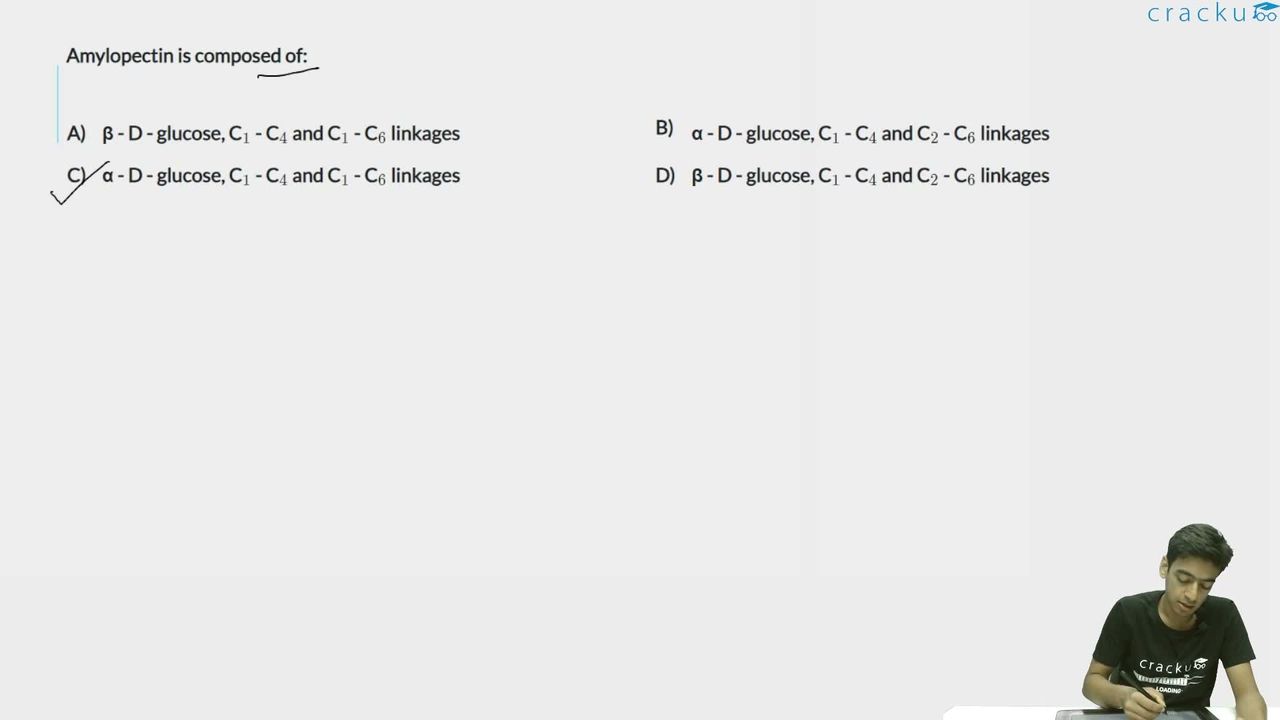
We now compare this conclusion with the four options given in the question. Option C reads: “$$\alpha$$-D-glucose, $$C_1 - C_4$$ and $$C_1 - C_6$$ linkages.” That matches exactly with the description we have just derived.
Hence, the correct answer is Option C.
Was this solution helpful?
Click on the Email ☝️ to Watch the Video Solution
Create a FREE account and get:
_1.webp)

Educational materials for JEE preparation

Ask our AI anything

AI can make mistakes. Please verify important information.
AI can make mistakes. Please verify important information.
