
Join Our JEE Preparation Group
Prep with like-minded aspirants; Get access to free daily tests and study material.
Sign in
Please select an account to continue using cracku.in
↓ →
Join Our JEE Preparation Group
Prep with like-minded aspirants; Get access to free daily tests and study material.
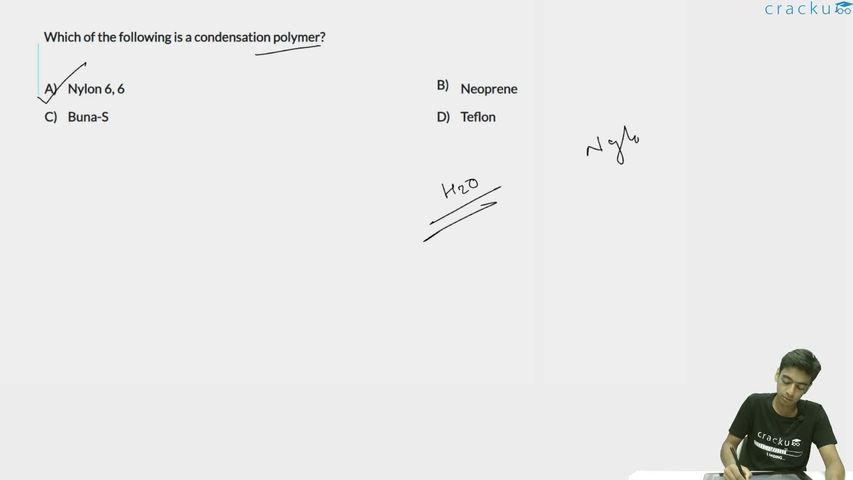
We begin by recalling the definition of a condensation polymer. A condensation polymer is produced when monomer molecules join together with the simultaneous elimination of small molecules such as water, $$\mathrm{HCl}$$, methanol, etc. This is in contrast to an addition polymer, where the monomers add together without the loss of any small molecule.
Now we look at each option in turn and relate it to the definition.
First, consider Option A, Nylon 6,6. Nylon 6,6 is prepared from two different monomers: hexamethylenediamine, $$\mathrm{H_2N{-}(CH_2)_6{-}NH_2}$$, and adipic acid, $$\mathrm{HOOC{-}(CH_2)_4{-}COOH}$$. When these react, each -COOH group of adipic acid combines with an -NH2 group of the diamine, eliminating a molecule of water. Stating the general reaction,
$$\mathrm{H_2N{-}(CH_2)_6{-}NH_2 \;+\; HOOC{-}(CH_2)_4{-}COOH \;\longrightarrow\; -NH{-}(CH_2)_6{-}NHCO{-}(CH_2)_4{-}CO- \;+\; H_2O}$$
Because water is eliminated at every step while the chain grows, the process clearly fits the definition of condensation polymerisation. So Nylon 6,6 is a condensation polymer.
Next, look at Option B, Neoprene. Neoprene is obtained by the free-radical polymerisation of chloroprene, $$\mathrm{CH_2=CCl{-}CH=CH_2}$$. No small molecule is released during this process, so it is an addition polymer, not a condensation polymer.
Option C, Buna-S, is produced by copolymerising 1,3-butadiene, $$\mathrm{CH_2=CH{-}CH=CH_2}$$, with styrene, $$\mathrm{C_6H_5CH=CH_2}$$. Again, no small molecule is eliminated; therefore Buna-S is an addition polymer.
Finally, Option D, Teflon (polytetrafluoroethylene), is formed by the polymerisation of tetrafluoroethene, $$\mathrm{CF_2=CF_2}$$, without the loss of any by-product. Hence, Teflon is also an addition polymer.
Summarising, only Nylon 6,6 among the given choices satisfies the criterion for a condensation polymer because its synthesis involves the stepwise elimination of water molecules.
Hence, the correct answer is Option A.
Was this solution helpful?
Click on the Email ☝️ to Watch the Video Solution
Create a FREE account and get:
_1.webp)

Educational materials for JEE preparation

Ask our AI anything

AI can make mistakes. Please verify important information.
AI can make mistakes. Please verify important information.
