The wavelength of spectral line obtained in the spectrum of $$Li^{2+}$$ ion, when the transition takes place between two levels whose sum is 4 and difference is 2, is
JEE Atomic Structure Questions
We need to find the wavelength of a spectral line in $$Li^{2+}$$ for a transition where the sum of levels is 4 and difference is 2.
First, we find the energy levels by solving $$n_1 + n_2 = 4$$ and $$n_2 - n_1 = 2$$, which gives $$n_2 = 3, n_1 = 1$$.
Next, we use the Rydberg formula for $$Li^{2+}$$ (Z = 3):
$$\frac{1}{\lambda} = RZ^2\left(\frac{1}{n_1^2} - \frac{1}{n_2^2}\right) = R \times 9 \times \left(1 - \frac{1}{9}\right) = 9R \times \frac{8}{9} = 8R$$
Here, $$R = 1.097 \times 10^5 \text{ cm}^{-1}$$. Substituting this value gives $$\frac{1}{\lambda} = 8 \times 1.097 \times 10^5 = 8.776 \times 10^5 \text{ cm}^{-1}$$, and hence $$\lambda = \frac{1}{8.776 \times 10^5} = 1.14 \times 10^{-6} \text{ cm}$$.
Therefore, the wavelength is Option 3: $$1.14 \times 10^{-6}$$ cm.
Arrange the following atomic orbitals of multi electron atoms in order of increasing energy.
A. $$n = 3, l = 2, m = +1$$
B. $$n = 4, l = 0, m = 0$$
C. $$n = 6, l = 1, m = 0$$
D. $$n = 5, l = 1, m = +1$$
E. $$n = 2, l = 1, m = +1$$
Choose the correct answer from the options given below:
If shortest wavelength of hydrogen atom in Lyman series is $$x$$, then longest wavelength in Balmer series of He$$^-$$ is:
The Bohr radius of a hydrogen like species is 70.53 pm. The species and the stationary state (n) are respectively (Given : Hydrogen atom Bohr radius is 52.9 pm)
The species having identical radii according to the Bohr's theory are:
A. H (first orbit)
B. He$$^+$$ (first orbit)
C. He$$^+$$ (Second orbit)
D. Li$$^{2+}$$ (first orbit)
E. Be$$^{3+}$$ (Second orbit)
Choose the correct answer from the options given below:
For a hydrogen-like species (only one electron), Bohr’s radius formula is
$$r_n = a_0\,\frac{n^{2}}{Z}$$
where $$a_0 = 0.529\ \text{Å}$$ is the Bohr radius, $$n$$ is the principal quantum number (orbit number) and $$Z$$ is the nuclear charge.
Calculate $$r_n$$ for every species mentioned:
Case A: $$\text{H (1st orbit)}$$ ⇒ $$Z = 1,\ n = 1$$
$$r = a_0\,\frac{1^{2}}{1} = a_0$$
Case B: $$\text{He}^+ \text{ (1st orbit)}$$ ⇒ $$Z = 2,\ n = 1$$
$$r = a_0\,\frac{1^{2}}{2} = \frac{a_0}{2}$$
Case C: $$\text{He}^+ \text{ (2nd orbit)}$$ ⇒ $$Z = 2,\ n = 2$$
$$r = a_0\,\frac{2^{2}}{2} = 2a_0$$
Case D: $$\text{Li}^{2+} \text{ (1st orbit)}$$ ⇒ $$Z = 3,\ n = 1$$
$$r = a_0\,\frac{1^{2}}{3} = \frac{a_0}{3}$$
Case E: $$\text{Be}^{3+} \text{ (2nd orbit)}$$ ⇒ $$Z = 4,\ n = 2$$
$$r = a_0\,\frac{2^{2}}{4} = a_0$$
Comparing the radii:
• Case A gives $$r = a_0$$.
• Case E also gives $$r = a_0$$.
No other cases match each other.
Hence the species having identical radii are H (1st orbit) and Be$$^{3+}$$ (2nd orbit).
Option B which is: A, E Only
The wavelength of photon ' A' is 400 nm. The frequency of photon ' B' is $$10^{16}s^{-1}$$. The wave number of photon 'C is $$10^{4}cm^{-1}$$.The correct order of energy of these photons is :
The energy of a photon is given by $$E = h\nu$$, where $$h$$ is Planck’s constant and $$\nu$$ is the frequency. Since $$h$$ is constant, the energy is proportional to the frequency. Therefore, we need to find the frequencies of photons A, B, and C to compare their energies.
We have photon A with wavelength $$\lambda_A = 400 \text{ nm}$$, photon B with frequency $$\nu_B = 10^{16} \text{ s}^{-1}$$, and photon C with wave number $$\bar{\nu}_C = 10^4 \text{ cm}^{-1}$$.
First, we convert all quantities to SI units. For photon A, $$\lambda_A = 400 \text{ nm} = 400 \times 10^{-9} \text{ m} = 4 \times 10^{-7} \text{ m}$$. For photon C, since $$1 \text{ cm} = 0.01 \text{ m}$$, we have $$\bar{\nu}_C = 10^4 \text{ cm}^{-1} = 10^4 \times 100 \text{ m}^{-1} = 10^6 \text{ m}^{-1}$$.
Next, using the speed of light $$c = 3 \times 10^8 \text{ m/s}$$, the frequency relates to wavelength and wave number by $$\nu = \frac{c}{\lambda}$$ and $$\nu = c\,\bar{\nu}$$. For photon A, $$\nu_A = \frac{c}{\lambda_A} = \frac{3 \times 10^8}{4 \times 10^{-7}} = \frac{3}{4} \times 10^{15} = 7.5 \times 10^{14} \text{ Hz}$$. Photon B has $$\nu_B = 10^{16} \text{ Hz}$$ directly. For photon C, $$\nu_C = c \times \bar{\nu}_C = (3 \times 10^8) \times (10^6) = 3 \times 10^{14} \text{ Hz}$$.
The frequencies are $$\nu_A = 7.5 \times 10^{14} \text{ Hz}$$, $$\nu_B = 10^{16} \text{ Hz} = 100 \times 10^{14} \text{ Hz}$$, and $$\nu_C = 3 \times 10^{14} \text{ Hz}$$. Comparing the numerical coefficients gives $$100 > 7.5 > 3$$, so $$\nu_B > \nu_A > \nu_C$$.
Since energy $$E \propto \nu$$, the order of energy is the same as the order of frequency: $$E_B > E_A > E_C$$, giving B > A > C, which corresponds to option A.
What is the energy (in J atom$$^{-1}$$) required for the following process? $$\text{Li}^{2+}(g) \rightarrow \text{Li}^{3+}(g) + e^-$$ (Take the ionization energy for the H atom in the ground state as $$2.18 \times 10^{-18}$$ J atom$$^{-1}$$)
The species $$\mathrm{Li^{2+}}$$ has only one electron, so it is a hydrogen-like ion with nuclear charge $$Z = 3$$.
For any hydrogen-like species, the energy of an electron in the ground state $$\left(n = 1\right)$$ is
$$E_1 = -\,Z^2 R_H$$
where $$R_H = 2.18 \times 10^{-18}\ \text{J atom}^{-1}$$ is the ionization energy of the hydrogen atom.
The ionization process
$$\mathrm{Li^{2+}(g) \;\rightarrow\; Li^{3+}(g) + e^-}$$
removes this electron from $$n = 1$$ to $$n = \infty$$, so the required energy equals the magnitude of $$E_1$$:
$$\text{Ionization energy of } \mathrm{Li^{2+}} = Z^2 R_H$$
Substituting $$Z = 3$$:
$$Z^2 R_H = 3^2 \times 2.18 \times 10^{-18}$$
$$= 9 \times 2.18 \times 10^{-18}$$
$$= 19.62 \times 10^{-18}$$
Rewriting with one non-zero digit before the decimal point:
$$19.62 \times 10^{-18} = 1.962 \times 10^{-17} \ \text{J atom}^{-1}$$
Therefore, the energy required is $$1.962 \times 10^{-17}\ \text{J atom}^{-1}$$.
Option C which is: $$1.962 \times 10^{-17}$$
What is the ratio of wave number of first line (lowest energy line) of Balmer series of H atomic spectrum to first line of its Brackett series?
For any line of the hydrogen spectrum, the wave number (reciprocal wavelength) is given by the Rydberg formula
$$\tilde{\nu}=R\left(\frac1{n_f^2}-\frac1{n_i^2}\right)$$
where
• $$n_f$$ = quantum number of the lower (final) level,
• $$n_i$$ = quantum number of the higher (initial) level,
• $$R$$ = Rydberg constant.
Balmer series (first line)
Balmer series has $$n_f=2$$.
The first (lowest-energy) line corresponds to the transition $$n_i=3 \rightarrow n_f=2$$.
Therefore
$$\tilde{\nu}_{\text{Balmer}} = R\left(\frac1{2^2}-\frac1{3^2}\right)
=R\left(\frac14-\frac19\right)
=R\left(\frac{9-4}{36}\right)
=\frac{5R}{36}\,.$$
Brackett series (first line)
Brackett series has $$n_f=4$$.
Its first line comes from $$n_i=5 \rightarrow n_f=4$$.
Hence
$$\tilde{\nu}_{\text{Brackett}} = R\left(\frac1{4^2}-\frac1{5^2}\right)
=R\left(\frac1{16}-\frac1{25}\right)
=R\left(\frac{25-16}{400}\right)
=\frac{9R}{400}\,.$$
Required ratio
$$\frac{\tilde{\nu}_{\text{Balmer}}}{\tilde{\nu}_{\text{Brackett}}}
=\frac{\dfrac{5R}{36}}{\dfrac{9R}{400}}
=\frac{5}{36}\times\frac{400}{9}
=\frac{2000}{324}
=\frac{500}{81}\approx6.17.$$
Express this ratio with the first term taken as $$5$$:
Let the ratio be written as $$5:x$$. Then
$$\frac{5}{x}=6.17 \;\Rightarrow\; x\approx\frac{5}{6.17}\approx0.81.$$
Thus the ratio of the wave numbers is $$5:0.81$$.
Option B which is: $$5:0.81$$
Which of the following statement(s) is/are true?
$$\textbf{A.}$$ If two orbitals have the same value of $$(n + l)$$, the orbital with lower value of $$n$$ will have lower energy.
$$\textbf{B.}$$ Energies of the orbitals in the same subshell increase with increase in atomic number.
$$\textbf{C.}$$ The size of $$2p_x$$ orbital is less than the size of $$3p_x$$ orbital.
$$\textbf{D.}$$ Among $$5f$$, $$6s$$, $$4d$$, $$5p$$ and $$5d$$ orbitals, none of the orbitals have 2 radial nodes.
Choose the correct answer from the options given below:
Identify the correct statements from the following:
A. Heisenberg uncertainty principle is applicable to electrons.
B. The size of $$2p_x$$ orbital is less than the size of $$3p_x$$ orbital.
C. The energy of 2s orbital of H atom is equal to the energy of 2s orbital of Li.
D. The electronic configuration of Cr is [Ar] $$3d^5 4s^1$$
Choose the correct answer from the options given below:
Match the LIST-I with LIST-II
| List-I Orbital | List-II Radial nodes and nodal plane | ||
|---|---|---|---|
| A. | 2s | I. | 1 Radial node + two nodal planes |
| B. | 3s | II. | 1 Radial node + one nodal plane |
| C. | 3p | III. | 2 Radial nodes + No nodal plane |
| D. | 4d | IV. | 1 Radial node + No nodal plane |
Choose the correct answer from the options given below:
Which of the following is correct set of 4 quantum numbers of 19th electron in Chromium (Atomic number = 24) in accordance with Aufbau principle?
According to the Aufbau (or $$n+l$$) rule, sub-shells are filled in the increasing order of their $$n+l$$ value; if two sub-shells have the same $$n+l$$ value, the one with lower $$n$$ is filled first.
Following this order we get the filling sequence
$$1s \; (2) \;\rightarrow\; 2s \; (2) \;\rightarrow\; 2p \; (6) \;\rightarrow\; 3s \; (2) \;\rightarrow\; 3p \; (6) \;\rightarrow\; 4s \; (2) \;\rightarrow\; 3d \; (10)\;\dots$$
Chromium has $$24$$ electrons. Up to the Argon core ($$18$$ electrons) the configuration is
$$1s^2\,2s^2\,2p^6\,3s^2\,3p^6 \qquad (\text{total } 18 \text{ e}^-)$$
The 19th electron is therefore the very next one to be accommodated. The next available sub-shell in the Aufbau sequence is $$4s$$.
For a $$4s$$ electron, the quantum numbers are:
• Principal quantum number $$n = 4$$ (fourth shell)
• Azimuthal quantum number $$l = 0$$ (s-sub-shell)
• Magnetic quantum number $$m_l = 0$$ (only one orientation for $$l = 0$$)
• Spin quantum number $$m_s = +\frac{1}{2}$$ (the first electron in any orbital is taken with $$+\frac{1}{2}$$ spin)
Thus the correct set is $$n = 4, \; l = 0, \; m = 0, \; s = +\dfrac{1}{2}$$.
Option D which is: $$n=4, l=0, m=0, s=+\dfrac{1}{2}$$
The energy required by electrons, present in the first Bohr orbit of hydrogen atom to J $$ mol^{-1}C $$ be excited to second Bohr orbit is ______ .
Given $$ R_{H}=2.18\times 10^{-11} $$
Find the energy required (in J/mol) to excite electrons from the first to second Bohr orbit of hydrogen.
$$E_n = -\frac{R_H}{n^2}$$
where $$R_H = 2.18 \times 10^{-18}$$ J (the Rydberg energy constant for hydrogen).
$$\Delta E = E_2 - E_1 = -\frac{R_H}{4} - \left(-\frac{R_H}{1}\right) = R_H\left(1 - \frac{1}{4}\right) = \frac{3}{4}R_H$$
$$\Delta E = \frac{3}{4} \times 2.18 \times 10^{-18} = 1.635 \times 10^{-18} \text{ J per atom}$$
Multiply by Avogadro's number $$N_A = 6.022 \times 10^{23}$$:
$$\Delta E_{\text{mol}} = 1.635 \times 10^{-18} \times 6.022 \times 10^{23}$$
$$= 1.635 \times 6.022 \times 10^{5} = 9.846 \times 10^{5} \approx 9.835 \times 10^5 \text{ J/mol}$$
The correct answer is Option (3): $$9.835 \times 10^5$$.
Given below are two statements:
Statement I : When an electric discharge is passed through gaseous hydrogen, the hydrogen molecules dissociate and the energetically excited hydrogen atoms produce electromagnetic radiation of discrete frequencies.
Statement II: The frequency of second line of Balmer series obtained from He+ is equal to that of first line of Lyman series obtained from hydrogen a tom.
ln the light of the above statements, choose the correct answer from the options given below :
Statement I: Electric discharge through H₂ causes dissociation and excited H atoms emit discrete frequencies. TRUE.
Statement II: 2nd line of Balmer for He⁺: $$\frac{1}{\lambda} = 4R(\frac{1}{4}-\frac{1}{16}) = 4R \times \frac{3}{16} = \frac{3R}{4}$$. 1st line of Lyman for H: $$\frac{1}{\lambda} = R(1-\frac{1}{4}) = \frac{3R}{4}$$. Equal! TRUE.
The answer is Option 2: Both true.
The work functions of two metals ($$M_{A}$$ and $$M_{B}$$ ) are in the 1 : 2 ratio. When these metals are exposed to photons of energy 6 eV, the kinetic energy of liberated electrons of $$M_{A}$$ : $$M_{B}$$ is in the ratio of 2.642 : 1. The work functions (in eV) of $$M_{A}$$ and $$M_{A}$$ are respectively.
The photoelectric effect equation states that the kinetic energy $$K$$ of an emitted electron is given by $$K = h\nu - \phi$$, where $$h\nu$$ is the photon energy and $$\phi$$ is the work function of the metal.
Given that the work functions of metals $$M_A$$ and $$M_B$$ are in the ratio 1:2, let $$\phi_A$$ be the work function of $$M_A$$ and $$\phi_B$$ be the work function of $$M_B$$. Therefore, $$\phi_B = 2\phi_A$$.
The photon energy is 6 eV for both metals. Thus:
For $$M_A$$: $$K_A = 6 - \phi_A$$
For $$M_B$$: $$K_B = 6 - \phi_B = 6 - 2\phi_A$$
The ratio of kinetic energies is given as $$K_A : K_B = 2.642 : 1$$, so:
$$\frac{K_A}{K_B} = \frac{6 - \phi_A}{6 - 2\phi_A} = 2.642$$
Solving for $$\phi_A$$:
$$6 - \phi_A = 2.642 \times (6 - 2\phi_A)$$
$$6 - \phi_A = 2.642 \times 6 - 2.642 \times 2\phi_A$$
$$6 - \phi_A = 15.852 - 5.284\phi_A$$
Bringing like terms together:
$$-\phi_A + 5.284\phi_A = 15.852 - 6$$
$$4.284\phi_A = 9.852$$
$$\phi_A = \frac{9.852}{4.284} \approx 2.3 \text{ eV}$$
Then, $$\phi_B = 2 \times \phi_A = 2 \times 2.3 = 4.6 \text{ eV}$$.
Verifying the kinetic energies:
$$K_A = 6 - 2.3 = 3.7 \text{ eV}$$
$$K_B = 6 - 4.6 = 1.4 \text{ eV}$$
Ratio: $$\frac{K_A}{K_B} = \frac{3.7}{1.4} = 2.642857... \approx 2.642$$
This matches the given ratio.
Thus, the work functions of $$M_A$$ and $$M_B$$ are 2.3 eV and 4.6 eV, respectively.
Comparing with the options:
A. 3.1, 6.2
B. 1.4, 2.8
C. 1.5, 3.0
D. 2.3, 4.6
The correct answer is option D.
Identify the INCORRECT statements from the following:
A. Notation $$_{12}^{24}Mg$$ represents 24 protons and 12 neutrons.
B. Wavelength of a radiation of frequency $$ 4.5\times10^{15}s^{-1} $$ is $$ 6.7\times10^{-8} $$m.
C. One radiation has wavelength =$$\lambda_1(900nm) $$ and energy= $$E_{1}$$. Other radiation has wavelength = $$\lambda_2(300nm) $$ and energy= $$E2 \cdot E1 : E_2= 3 : 1$$.
D. Number of photons of light of wavelength 2000 pm that provides 1 J of
energy is $$1.006 x 10^{16}$$.
Choose the correct answer from the options given below:
We need to identify the INCORRECT statements from the given options about atomic structure.
Notation $$_{12}^{24}Mg$$ represents 24 protons and 12 neutrons. This is INCORRECT. In the notation $$_Z^A X$$, Z (subscript) = atomic number = number of protons = 12, and A (superscript) = mass number = 24. Number of neutrons = A - Z = 24 - 12 = 12. So it represents 12 protons and 12 neutrons, not 24 protons and 12 neutrons. ✗
Wavelength of radiation of frequency $$4.5 \times 10^{15} \, \text{s}^{-1}$$ is $$6.7 \times 10^{-8}$$ m. $$\lambda = c/\nu = 3 \times 10^8 / 4.5 \times 10^{15} = 6.67 \times 10^{-8}$$ m. This is CORRECT. ✓
$$\lambda_1 = 900$$ nm, $$\lambda_2 = 300$$ nm. $$E_1 : E_2 = 3 : 1$$. Since $$E = hc/\lambda$$, we get $$E_1/E_2 = \lambda_2/\lambda_1 = 300/900 = 1/3$$, so $$E_1 : E_2 = 1 : 3$$, not $$3 : 1$$. This is INCORRECT. ✗
Number of photons of wavelength 2000 pm providing 1 J of energy is $$1.006 \times 10^{16}$$. $$E_{\text{photon}} = hc/\lambda = 6.63 \times 10^{-34} \times 3 \times 10^8 / (2000 \times 10^{-12}) = 9.945 \times 10^{-17}$$ J.
$$n = 1 / 9.945 \times 10^{-17} = 1.006 \times 10^{16}$$. This is CORRECT. ✓
Incorrect statements are A and C.
The correct answer is Option (2): A and C Only.
Which of the following statements regarding the energy of the stationary state is true in the following one - electron systems?
Determine which statement about the energy of stationary states is true.
The energy of the $$n$$th orbit in a hydrogen-like atom with atomic number $$Z$$ is given by $$E_n = -13.6 \times \frac{Z^2}{n^2} \text{ eV}$$. Using $$1 \text{ eV} = 1.6 \times 10^{-19} \text{ J}$$, this can be written as $$E_n = -2.18 \times 10^{-18} \times \frac{Z^2}{n^2} \text{ J}$$.
For the third orbit of $$Li^{2+}$$ (where $$Z=3$$ and $$n=3$$), the energy is $$E_3 = -2.18 \times 10^{-18} \times \frac{3^2}{3^2} = -2.18 \times 10^{-18} \text{ J}$$, which matches the value stated in Option A.
Option B refers to the second orbit of hydrogen ($$Z=1$$, $$n=2$$), giving $$E = -2.18 \times 10^{-18}/4 = -0.545 \times 10^{-18}$$ J, not $$-1.09 \times 10^{-18}$$ J. Option C is incorrect because the energy of a bound state is always negative, never positive. Option D is false since the first orbit of $$He^+$$ has energy $$-2.18 \times 10^{-18} \times 4 = -8.72 \times 10^{-18}$$ J, not a positive value.
The correct answer is Option A: $$-2.18 \times 10^{-18}$$ J for the third orbit of $$Li^{2+}$$.
Consider the following spectral lines for atomic hydrogen :
A. First line of Paschen series
B. Second line of Balmer series
C. Third line of Paschen series
D. Fourth line of Bracket series
The correct arrangement of the above lines in ascending order of energy is :
We need to arrange the given spectral lines in ascending order of energy. The energy of a spectral line transition is given by:
$$E = 13.6 \left(\frac{1}{n_f^2} - \frac{1}{n_i^2}\right) \text{ eV}$$ where $$n_f$$ is the lower energy level and $$n_i$$ is the upper energy level.
For the first line of the Paschen series (A) with $$n_f = 3$$ and $$n_i = 4$$,
$$E_A = 13.6\left(\frac{1}{9} - \frac{1}{16}\right) = 13.6 \times \frac{7}{144} = 0.6611 \text{ eV}.$$
For the second line of the Balmer series (B) with $$n_f = 2$$ and $$n_i = 4$$,
$$E_B = 13.6\left(\frac{1}{4} - \frac{1}{16}\right) = 13.6 \times \frac{3}{16} = 2.55 \text{ eV}.$$
For the third line of the Paschen series (C) with $$n_f = 3$$ and $$n_i = 6$$,
$$E_C = 13.6\left(\frac{1}{9} - \frac{1}{36}\right) = 13.6 \times \frac{3}{36} = 13.6 \times \frac{1}{12} = 1.1333 \text{ eV}.$$
For the fourth line of the Brackett series (D) with $$n_f = 4$$ and $$n_i = 8$$,
$$E_D = 13.6\left(\frac{1}{16} - \frac{1}{64}\right) = 13.6 \times \frac{3}{64} = 0.6375 \text{ eV}.$$
Arranging these energies in ascending order gives
$$E_D (0.6375) < E_A (0.6611) < E_C (1.1333) < E_B (2.55),$$
so the order of the spectral lines is D < A < C < B. The correct answer is Option B.
The wave numbers of three spectral lines of H atom are considered. Identify the set of spectral lines belonging to Balmer series.
(R = Rydberg constant)
Balmer series: $$\bar{\nu} = R\left(\frac{1}{4} - \frac{1}{n^2}\right)$$ for n = 3, 4, 5, ...
n=3: $$R(1/4-1/9) = 5R/36$$ ✓
n=4: $$R(1/4-1/16) = 3R/16$$ ✓
n=5: $$R(1/4-1/25) = 21R/100$$ ✓
All three match Option 1.
The answer is Option 1: $$5R/36, 3R/16, 21R/100$$.

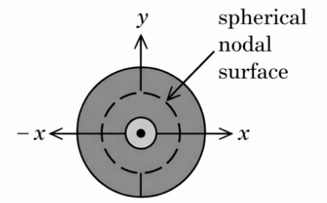
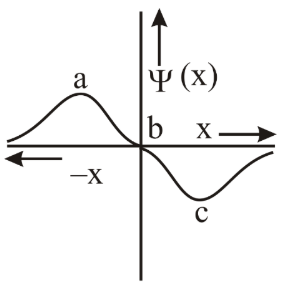
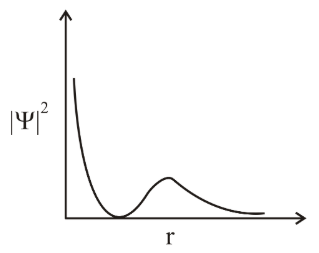
Figure 1. electron probability density for 2s orbital

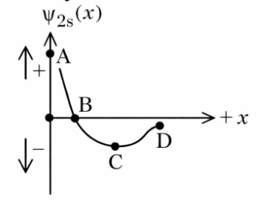
Figure 2. wave function for 2s orbital
Which of the following point in Figure 2 most accurately represents the nodal surface as shown in Figure 1?
The energy of first (lowest) Balmer line of H atom is x J. The energy (in J) of second Balmer line of H atom is :
We need to find the ratio of energies of the second and first Balmer lines of hydrogen.
Balmer series: Transitions to $$n = 2$$.
Energy of a transition: $$E = 13.6 \left(\frac{1}{n_1^2} - \frac{1}{n_2^2}\right)$$ eV.
First Balmer line ($$n = 3 \to 2$$):
$$E_1 = 13.6\left(\frac{1}{4} - \frac{1}{9}\right) = 13.6 \times \frac{9-4}{36} = 13.6 \times \frac{5}{36} = x$$
Second Balmer line ($$n = 4 \to 2$$):
$$E_2 = 13.6\left(\frac{1}{4} - \frac{1}{16}\right) = 13.6 \times \frac{4-1}{16} = 13.6 \times \frac{3}{16}$$
Finding the ratio:
$$\frac{E_2}{E_1} = \frac{3/16}{5/36} = \frac{3}{16} \times \frac{36}{5} = \frac{108}{80} = \frac{27}{20} = 1.35$$
Therefore $$E_2 = 1.35x$$.
The correct answer is Option 2: 1.35x.
Given,
(A) $$n = 5, m_{1} = -1$$
(B) $$n = 3, 1 = 2, m_{1} = -1, m_{2} = +\frac{1}{2}$$
The maximum number of electron(s) in an atom that can have the quantum numbers as given in (A) and (B) respectively are:
(A) n=5, ml=-1: possible in l=1,2,3,4 with ml=-1. Each has 2 electrons: total = 8.
(B) n=3, l=2, ml=-1, ms=+1/2: exactly 1 electron.
The answer is Option 2: 8 and 1.
The surface of sodium metal is irradiated with radiation of wavelength $$x$$ nm. The kinetic energy of ejected electrons is $$2.8 \times 10^{-20}$$ J. The work function of sodium is 2.3 eV. The value of $$x$$ is _____ $$\times 10^2$$ nm. (Nearest integer) (Given: $$h = 6.6 \times 10^{-34}$$ J s; $$1$$ eV $$= 1.6 \times 10^{-19}$$ J; $$c = 3.0 \times 10^8$$ m s$$^{-1}$$)
The photo-electric equation relates the photon energy to the work function and the maximum kinetic energy: $$E_{\text{photon}} = \phi + K_{\text{max}}$$.
Given data:
• Work function of Na, $$\phi = 2.3\ \text{eV}$$
• Kinetic energy of emitted electrons, $$K_{\text{max}} = 2.8 \times 10^{-20}\ \text{J}$$
• Planck constant, $$h = 6.6 \times 10^{-34}\ \text{J s}$$
• Speed of light, $$c = 3.0 \times 10^{8}\ \text{m s}^{-1}$$
• $$1\ \text{eV} = 1.6 \times 10^{-19}\ \text{J}$$
First convert the work function to joules:
$$\phi = 2.3\ \text{eV} \times 1.6 \times 10^{-19}\ \frac{\text{J}}{\text{eV}} = 3.68 \times 10^{-19}\ \text{J}$$
Total photon energy required:
$$E_{\text{photon}} = \phi + K_{\text{max}} = 3.68 \times 10^{-19} + 2.8 \times 10^{-20}$$
$$= 3.68 \times 10^{-19} + 0.28 \times 10^{-19} = 3.96 \times 10^{-19}\ \text{J}$$
For a photon, $$E_{\text{photon}} = \dfrac{hc}{\lambda}$$, so
$$\lambda = \dfrac{hc}{E_{\text{photon}}}$$
$$= \dfrac{(6.6 \times 10^{-34})(3.0 \times 10^{8})}{3.96 \times 10^{-19}}$$
$$= \dfrac{19.8 \times 10^{-26}}{3.96 \times 10^{-19}}$$
$$= 5.0 \times 10^{-7}\ \text{m}$$
Convert metres to nanometres: $$1\ \text{m} = 10^{9}\ \text{nm}$$, hence
$$\lambda = 5.0 \times 10^{-7}\ \text{m} = 5.0 \times 10^{-7} \times 10^{9}\ \text{nm} = 5.0 \times 10^{2}\ \text{nm}$$
The wavelength is therefore $$\mathbf{5 \times 10^2\ \text{nm}}$$. The question asks for the integer multiplying $$10^2\ \text{nm}$$, so the required value is
5.
Consider two radiations of wavelengths
1. $$\lambda_1 = 2000$$ $$\text{\AA}$$
2. $$\lambda_2 = 6000$$ $$\text{\AA}$$
The ratio of the energies of these two radiations $$\left(\frac{E_1}{E_2}\right)$$ is __________ (Nearest integer).
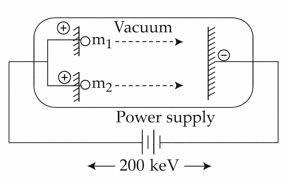
Two positively charged particles m1 and m2 have been accelerated across the same potential difference of 200 keV as shown below.

[Given mass of $$m_{1}$$ = 1amu and $$m_{2}$$ = 4amu]
The deBroglie wavelength of $$m_{1}$$ will be x times of $$m_{2}$$. The value of x is_______(nearest integer)
The hydrogen spectnun consists of several spectral lines in Lyman series ($$L_{1},L_{2},L_{3}....;L_{1}$$ has lowest energy among Lyman series). Similarly it consists of several spectral lines in Balmer series($$B_{1},B_{2},B_{3}....;B_{1}$$ has lowest energy among Balmer lines). The energy of $$L_{1}$$ is x times the energy of $$B_{1}$$. The value of x is_____ $$\times 10^{-1}$$. (Nearest integer)
We need to find the ratio of energy of $$L_1$$ (first Lyman line) to $$B_1$$ (first Balmer line).
In hydrogen, the energy of spectral lines is given by $$E = 13.6 \left(\frac{1}{n_1^2} - \frac{1}{n_2^2}\right) \text{ eV}$$.
For $$L_1$$ in the Lyman series, the transition from n = 2 to n = 1 yields $$E_{L_1} = 13.6\left(\frac{1}{1^2} - \frac{1}{2^2}\right) = 13.6\left(1 - \frac{1}{4}\right) = 13.6 \times \frac{3}{4} = 10.2 \text{ eV}$$.
For $$B_1$$ in the Balmer series, the transition from n = 3 to n = 2 gives $$E_{B_1} = 13.6\left(\frac{1}{2^2} - \frac{1}{3^2}\right) = 13.6\left(\frac{1}{4} - \frac{1}{9}\right) = 13.6 \times \frac{5}{36} = \frac{68}{36} = \frac{17}{9} \text{ eV}$$.
The ratio is then $$x = \frac{E_{L_1}}{E_{B_1}} = \frac{13.6 \times 3/4}{13.6 \times 5/36} = \frac{3/4}{5/36} = \frac{3}{4} \times \frac{36}{5} = \frac{108}{20} = \frac{27}{5} = 5.4$$.
Since $$x = 5.4 = 54 \times 10^{-1}$$, the value is 54.
For hydrogen atom, the orbital/s with lowest energy is/are:$$\text{ (A) } 4s \text{ (B) } 3p_x \text{ (C) } 3d_{x^2-y^2} \text{ (D) } 3d_{z^2} \text{ (E) } 4p_z$$ Choose the correct answer from the options given below:
For hydrogen atom, energy depends only on n (principal quantum number), not on l.
3p, 3d all have n=3 (same energy). 4s has n=4 (higher energy).
So 3px, 3d_{x²-y²}, 3d_{z²} all have the lowest energy among the options (n=3).
The correct answer is Option 1: (B), (C) and (D) only.
Radius of the first excited state of Helium ion is given as : $$a_0\rightarrow$$ radius of first stationary state of hydrogen atom.
We need to find the radius of the first excited state of the Helium ion (He⁺).
The radius of the nth orbit for a hydrogen-like atom is:
$$r_n = \frac{n^2 a_0}{Z}$$
Here, $$a_0$$ is the Bohr radius (the radius of the first orbit of hydrogen) and Z is the atomic number.
For He⁺, Z = 2, and the first excited state corresponds to n = 2. Substituting these values gives
$$r = \frac{(2)^2 \times a_0}{2} = \frac{4a_0}{2} = 2a_0$$
The correct answer is Option 2: $$r = 2a_0$$.
Which of the following postulate of Bohr's model of hydrogen atom is not in agreement with quantum mechanical model of an atom ?
First recall the basic postulates of Bohr for the hydrogen atom:
(i) The electron can revolve only in those circular orbits in which its angular momentum is an integral multiple of $$\hbar$$ and the energy of the atom is constant in each allowed orbit (stationary state).
(ii) While the electron stays in any one stationary state it does not radiate energy.
(iii) Energy is emitted or absorbed only when the electron jumps between two stationary states, the photon frequency being fixed by the energy difference of the two states.
(iv) Inside each stationary state the electron actually follows a definite circular path of radius $$r_n$$ around the nucleus.
Now compare these statements with the principles of the modern quantum-mechanical (wave-mechanical) model:
(a) Quantum mechanics also allows only discrete energies for bound electrons, hence statements about distinct energies and stationary states remain valid.
(b) The time-dependent Schrödinger equation shows that if an electron is in an energy eigen-state (stationary state) its probability density is time-independent, so no radiation is emitted — fully agreeing with Bohr’s “no radiation in a stationary state”.
(c) When an electron undergoes a transition between two energy eigen-states, quantum mechanics predicts emission or absorption of a photon whose energy equals the energy difference — matching Bohr’s third postulate.
(d) However, quantum mechanics does not assign a precise trajectory (circular or otherwise) to the electron. Instead, it gives only a probability distribution described by the wave function $$\psi(\mathbf{r})$$. Hence the idea of the electron moving in a well-defined circular orbit is incompatible with the uncertainty principle and the wave nature of the electron.
Examine each option in light of this comparison:
Option A: “An atom in a stationary state does not emit electromagnetic radiation …” — this is fully consistent with quantum mechanics.
Option B: “An atom can take only certain distinct energies $$E_1, E_2, E_3, …$$” — also consistent with quantum mechanics.
Option C: “When an electron makes a transition … it emits a photon …” — again agrees with quantum mechanics.
Option D: “The electron in a H atom’s stationary state moves in a circle around the nucleus” — this assumes a definite trajectory, which is ruled out by the quantum-mechanical picture.
Therefore, the postulate that contradicts the quantum mechanical model is Option D.
Final Answer: Option D
According to Bohr's model of hydrogen atom, which of the following statement is incorrect?
In Bohr’s model of the hydrogen atom the radius of the $$n^{\text{th}}$$ orbit is
$$r_n = r_1 n^{2}$$
where $$r_1$$ is the radius of the first orbit. Hence the ratio of radii of any two orbits is
$$\frac{r_n}{r_m} = \left(\frac{n}{m}\right)^{2}$$
Using this relation for every option:
Case A:
$$\frac{r_3}{r_1} = \left(\frac{3}{1}\right)^{2} = 9$$.
The radius of the 3rd orbit is nine times that of the 1st orbit.
Statement A is correct.
Case B:
$$\frac{r_8}{r_4} = \left(\frac{8}{4}\right)^{2} = 2^{2} = 4$$.
The radius of the 8th orbit is four times that of the 4th orbit.
Statement B is correct.
Case C:
$$\frac{r_6}{r_4} = \left(\frac{6}{4}\right)^{2} = \left(\frac{3}{2}\right)^{2} = \frac{9}{4} = 2.25$$.
The radius of the 6th orbit is only 2.25 times that of the 4th orbit, not three times.
Statement C is incorrect.
Case D:
$$\frac{r_4}{r_2} = \left(\frac{4}{2}\right)^{2} = 2^{2} = 4$$.
The radius of the 4th orbit is four times that of the 2nd orbit.
Statement D is correct.
Only Statement C contradicts the Bohr radius relation. Therefore the incorrect statement is
Option C.
For electron in '2s' and '2p' orbitals, the orbital angular momentum values, respectively are:
For any electron in an atomic orbital, the magnitude of the orbital angular momentum $$L$$ is given by
$$L = \sqrt{l(l+1)}\,\hbar$$ where $$l$$ is the azimuthal (orbital) quantum number and $$\hbar = \dfrac{h}{2\pi}$$.
Case 1: Electron in the $$2s$$ orbital
For an $$s$$-orbital, $$l = 0$$.
Therefore,
$$L_{2s} = \sqrt{0(0+1)}\,\hbar = 0$$.
Case 2: Electron in the $$2p$$ orbital
For a $$p$$-orbital, $$l = 1$$.
Therefore,
$$L_{2p} = \sqrt{1(1+1)}\,\hbar = \sqrt{2}\,\hbar = \sqrt{2}\,\dfrac{h}{2\pi}$$.
So the orbital angular momenta are 0 for $$2s$$ and $$\sqrt{2}\,\dfrac{h}{2\pi}$$ for $$2p$$.
Hence, the correct option is Option D.
Given below are two statements : Statement (I) : For a given shell, the total number of allowed orbitals is given by $$n^{2}$$. Statement (II) : For any subshell, the spatial orientation of the orbitals is given by -l to +l values including zero. In the light of the above statements, choose the correct answer from the options given below :
Evaluate two statements about atomic orbitals.
Statement I: For a given shell, the total number of allowed orbitals is $$n^2$$.
For shell n, the subshells are l = 0, 1, 2, ..., (n-1). Each subshell has (2l+1) orbitals.
Total = $$\sum_{l=0}^{n-1}(2l+1) = n^2$$. This is TRUE.
Statement II: For any subshell, the spatial orientation is given by -l to +l values including zero.
The magnetic quantum number $$m_l$$ ranges from -l to +l. This gives (2l+1) values representing different spatial orientations. This is TRUE.
The correct answer is Option 3: Both Statement I and Statement II are true.
In a multielectron atom, which of the following orbitals described by three quantum numbers will have same energy in absence of electric and magnetic fields? $$A. n = 1, l = 0, m_{1}=0 B.n = 2,l = 0, m_{1}=0 C.n = 2,l = 1, m_{1}=1 D.n = 3,l = 2, m_{1} = 1 E.n = 3, l = 2, m_{1} = 0$$ Choose the correct answer from the options given below:
In a multi-electron atom (without external fields), we need to identify which orbitals have the same energy.
We start by recalling the energy ordering in multi-electron atoms. In multi-electron atoms, the energy of an orbital depends on both $$n$$ and $$l$$ (unlike hydrogen where it depends only on $$n$$). However, orbitals with the same $$n$$ and $$l$$ but different $$m_l$$ are degenerate (same energy) in the absence of external electric and magnetic fields.
Next, we identify the orbitals: A. $$n=1, l=0, m_l=0$$ — this is the $$1s$$ orbital; B. $$n=2, l=0, m_l=0$$ — this is the $$2s$$ orbital; C. $$n=2, l=1, m_l=1$$ — this is one of the $$2p$$ orbitals; D. $$n=3, l=2, m_l=1$$ — this is one of the $$3d$$ orbitals; E. $$n=3, l=2, m_l=0$$ — this is another $$3d$$ orbital.
Substituting these values, D and E both have $$n = 3$$ and $$l = 2$$ (both are $$3d$$ orbitals), differing only in $$m_l$$; they are degenerate. No other pair shares the same $$(n, l)$$ values.
The correct answer is Option D) D and E Only.
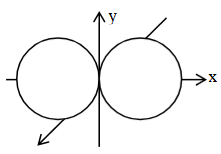
Which of the following statements are true ?
(A) The subsidiary quantum number $$l$$ describes the shape of the orbital occupied by the electron.
(B)

is the boundary diagram of the $$2p_x$$ orbital.
(C) The + and - signs in the wave function of the $$2p_x$$ orbital refer to charge.
(D) The wave function of $$2p_x$$ orbital is zero everywhere in the xy plane.
For hydrogen like species, which of the following graphs provides the most appropriate representation of E vs Z plot for a constant n ? [E: Energy of the stationary state, Z : atomic number, n = principal quantum number]
Given below are two statements about X-ray spectra of elements : Statement (I) : A plot of $$\sqrt{v}$$($$\upsilon$$ = frequency of -rays emitted) vs atomic mass is a straight line. Statement (II) : A plot of $$\upsilon(\upsilon$$ = frequency of -rays emitted) vs atomic number is a straight line. In the light of the above statements, choose the correct answer from the options given below :
Evaluate two statements about X-ray spectra (Moseley's law).
Moseley's law: $$\sqrt{\nu} = a(Z - b)$$, where Z is atomic number, and a, b are constants.
Statement I: A plot of $$\sqrt{\nu}$$ vs atomic mass is a straight line.
Moseley's law relates $$\sqrt{\nu}$$ to atomic number Z, not atomic mass. Since atomic mass and Z don't have a perfectly linear relationship, this is FALSE.
Statement II: A plot of $$\nu$$ vs atomic number is a straight line.
From Moseley's law: $$\sqrt{\nu} = a(Z-b)$$, so $$\nu = a^2(Z-b)^2$$. This is a parabolic (quadratic) relationship, not linear. So this is FALSE.
The correct answer is Option 3: Both Statement I and Statement II are false.
Which of the following is/are not correct with respect to energy of atomic orbitals of hydrogen atom? (A)1s < 2p < 3d < 4s (B) 1s < 2s = 2p < 3s = 3p (C)1s < 2s < 2p < 3s < 3p (D) 1s < 2s < 4s < 3d
Choose the correct answer from the options given below :
Given below are two statements : Statement (I) : A spectral line will be observed for a $$2p_{x}\rightarrow 2p_{y}$$ transition.Statement (II) :$$2p_{x}$$ and $$2p_{y}$$ are degenerate orbitals. In the light of the above statements, choose the correct answer from the options given below :
We are given two statements about atomic orbitals and transitions. We need to evaluate their truth and choose the correct option.
First, consider Statement (II): $$2p_{x}$$ and $$2p_{y}$$ are degenerate orbitals.
Degenerate orbitals have the same energy. In hydrogen-like atoms (without external fields), orbitals with the same principal quantum number $$n$$ and azimuthal quantum number $$l$$ are degenerate. For $$n=2$$ and $$l=1$$ (p-orbitals), the orbitals $$2p_x$$, $$2p_y$$, and $$2p_z$$ all have identical energy. Therefore, $$2p_x$$ and $$2p_y$$ are degenerate.
Thus, Statement (II) is true.
Now, consider Statement (I): A spectral line will be observed for a $$2p_{x}\rightarrow 2p_{y}$$ transition.
Spectral lines arise from transitions between different energy levels, where a photon is emitted or absorbed due to a non-zero energy difference. Since $$2p_x$$ and $$2p_y$$ are degenerate (same energy), the energy difference $$\Delta E = 0$$. Hence, no photon is emitted or absorbed, and no spectral line is observed.
Additionally, electric dipole transitions follow selection rules. The change in azimuthal quantum number must be $$\Delta l = \pm 1$$. Here, both orbitals have $$l=1$$, so $$\Delta l = 0$$, which violates the selection rule. This confirms the transition is forbidden.
Therefore, Statement (I) is false.
In summary:
- Statement (I) is false.
- Statement (II) is true.
The correct option is B: Statement I is false but Statement II is true.
If $$a_{\circ}$$ is denoted as the Bohr radius of hydrogen atom, then what is the de-Broglie wavelength $$(\lambda)$$ of the electron present in the second orbit of hydrogen atom? [n : any integer]
We need to find the de-Broglie wavelength of the electron in the second orbit of hydrogen atom in terms of the Bohr radius $$a_0$$.
We start by recalling the Bohr model relations. From angular momentum quantization: $$mv_n r_n = n\hbar$$, where $$\hbar = h/(2\pi)$$. The Bohr radius of the $$n$$th orbit is given by $$r_n = n^2 a_0$$.
Next, from $$m v_n r_n = n\hbar = \frac{nh}{2\pi}$$, we have $$ m v_n = \frac{nh}{2\pi r_n} = \frac{nh}{2\pi \cdot n^2 a_0} = \frac{h}{2\pi n a_0} $$. This gives the momentum of the electron in the $$n$$th orbit.
Substituting this into the de-Broglie relation $$\lambda = \frac{h}{mv_n}$$ leads to $$ \lambda = \frac{h}{\frac{h}{2\pi n a_0}} = 2\pi n a_0 $$.
Therefore, for the second orbit where $$n = 2$$, $$ \lambda = 2\pi \times 2 \times a_0 = 4\pi a_0 $$. This can also be written as $$\frac{8\pi a_0}{2} = \frac{8\pi a_0}{n}$$.
Looking at the options, Option A gives $$\frac{8\pi a_0}{n}$$, which for $$n = 2$$ becomes $$\frac{8\pi a_0}{2} = 4\pi a_0$$, matching the result.
The correct answer is Option A: $$\frac{8\pi a_0}{n}$$.
Consider the ground state of chromium atom (Z = 24). How many electrons are with Azimuthal quantum number $$l = 1$$ and $$l = 2$$ respectively?
The azimuthal quantum number $$l$$ decides the subshell:
$$l = 0 \;(\text{s}), \; l = 1 \;(\text{p}), \; l = 2 \;(\text{d}), \; l = 3 \;(\text{f})$$
The ground-state electronic configuration of a chromium atom ($$Z = 24$$) is exceptional. Instead of the expected $$3d^4\,4s^2$$, chromium attains extra stability with the half-filled $$3d$$ subshell:
$$\text{Cr} : [\text{Ar}]\,3d^{5}\,4s^{1}$$
Expand the configuration to list all occupied subshells:
$$1s^{2}\;2s^{2}\;2p^{6}\;3s^{2}\;3p^{6}\;3d^{5}\;4s^{1}$$
Case 1: Electrons with $$l = 1$$ (p-electrons)The $$p$$ subshells present are $$2p^{6}$$ and $$3p^{6}$$.
Total $$p$$-electrons $$= 6 + 6 = 12$$.
Case 2: Electrons with $$l = 2$$ (d-electrons)The only $$d$$ subshell present is $$3d^{5}$$.
Total $$d$$-electrons $$= 5$$.
Hence, in the ground state of chromium, the numbers of electrons with $$l = 1$$ and $$l = 2$$ are $$12$$ and $$5$$ respectively.
Therefore the correct option is Option C.
Correct statements for an element with atomic number 9 are :
A. There can be 5 electrons for which $$m_s = +\frac{1}{2}$$ and 4 electrons for which $$m_s = -\frac{1}{2}$$
B. There is only one electron in $$p_z$$ orbital
C. The last electron goes to orbital with $$n = 2$$ and $$l = 1$$
D. The sum of angular nodes of all the atomic orbitals is 1.
Choose the correct answer from the options given below:
The atomic number $$Z = 9$$ corresponds to fluorine. Its ground-state electronic configuration is
$$1s^2\, 2s^2\, 2p^5$$.
Useful facts:
(i) For every electron the set of quantum numbers $$\{n,\,l,\,m_l,\,m_s\}$$ must be unique (Pauli exclusion principle).
(ii) In a given subshell electrons first occupy different orbitals with parallel spins (Hund’s rule) and pairing begins only after every orbital is singly occupied.
Testing statement A
Fluorine has 9 electrons. Split them according to their spin quantum number $$m_s$$.
• $$1s^2$$ : one $$m_s = +\frac12$$ and one $$m_s = -\frac12$$ ⇒ 1 up, 1 down.
• $$2s^2$$ : one up, one down ⇒ +1 up, +1 down (cumulative 2 up, 2 down).
• $$2p^5$$ : first three electrons occupy the three $$2p$$ orbitals with $$m_s = +\frac12$$, next two pair with $$m_s = -\frac12$$.
⇒ 3 up + 2 down (cumulative 5 up, 4 down).
Possible distribution: 5 electrons with $$m_s = +\frac12$$ and 4 electrons with $$m_s = -\frac12$$. Hence statement A is correct.
Testing statement B
The five $$2p$$ electrons are placed as
$$\uparrow\downarrow \; (p_x),\; \uparrow \; (p_y),\; \uparrow \; (p_z).$$
Only one of the three $$2p$$ orbitals ends up doubly occupied; which one is arbitrary because the three orbitals are degenerate. Therefore it is not mandatory that exactly the $$p_z$$ orbital contains a single electron. Statement B is not universally correct and is rejected.
Testing statement C
For the last (ninth) electron the available orbitals in increasing energy order are
$$1s \lt 2s \lt 2p$$.
The $$1s$$ and $$2s$$ orbitals are already full; hence the ninth electron enters an orbital with $$n = 2,\, l = 1$$ (a $$2p$$ orbital). Statement C is correct.
Testing statement D
Angular nodes of an orbital $$= l$$.
List every occupied orbital:
1s : $$l = 0 \Rightarrow 0$$ angular nodes
2s : $$l = 0 \Rightarrow 0$$ angular nodes
2p_x, 2p_y, 2p_z : each has $$l = 1 \Rightarrow 1$$ angular node
Total angular nodes of all five distinct orbitals
$$0 + 0 + 1 + 1 + 1 = 3$$.
Statement D claims the sum is 1, which is incorrect.
Hence only statements A and C are correct.
Correct option: Option B (A and C Only).
Given below are two statements : Statement (I) : It is impossible to specify simultaneously with arbitrary precision, both the linear momentum and the position of a particle. Statement (II) : If the uncertainty in the measurement of position and uncertainty in measurement of momentum are equal for an electron, then the uncertainty in the measurement of velocity is $$\ge \sqrt{\frac{h}{\pi}} \times \frac{1}{2m}$$. In the light of the above statements, choose the correct answer from the options given below :
Statement I: "It is impossible to specify simultaneously with arbitrary precision, both the linear momentum and the position of a particle."
This is a direct statement of the Heisenberg Uncertainty Principle, which says:
$$\Delta x \cdot \Delta p \ge \frac{h}{4\pi}$$
where $$\Delta x$$ is the uncertainty in position and $$\Delta p$$ is the uncertainty in momentum. Since the product of the two uncertainties has a non-zero lower bound, we cannot make both arbitrarily small at the same time.
So Statement I is true.
Statement II: We are told that the uncertainty in position equals the uncertainty in momentum, i.e., $$\Delta x = \Delta p$$. We need to check whether $$\Delta v \ge \sqrt{\frac{h}{\pi}} \times \frac{1}{2m}$$.
Starting from the Heisenberg Uncertainty Principle:
$$\Delta x \cdot \Delta p \ge \frac{h}{4\pi}$$
Since $$\Delta x = \Delta p$$, we substitute:
$$(\Delta p)^2 \ge \frac{h}{4\pi}$$
Taking the square root of both sides:
$$\Delta p \ge \sqrt{\frac{h}{4\pi}} = \frac{1}{2}\sqrt{\frac{h}{\pi}}$$
Now, momentum $$p = mv$$, so the uncertainty in momentum is related to the uncertainty in velocity by:
$$\Delta p = m \cdot \Delta v$$
Substituting:
$$m \cdot \Delta v \ge \frac{1}{2}\sqrt{\frac{h}{\pi}}$$
Dividing both sides by $$m$$:
$$\Delta v \ge \frac{1}{2m}\sqrt{\frac{h}{\pi}}$$
This can be rewritten as:
$$\Delta v \ge \sqrt{\frac{h}{\pi}} \times \frac{1}{2m}$$
This is exactly what Statement II claims. So Statement II is also true.
Since both statements are true, the correct answer is Option C.
Heat treatment of muscular pain involves radiation of wavelength of about 900 nm . Which spectral line of H atom is suitable for this? Given : Rydberg constant $$R_{H}=10^{5} cm^{-1}$$, $$h=6.6 \times 10^{-34}$$ Js,$$c= 3\times 10^{8}$$ m/s
We need to find which spectral line of the hydrogen atom produces radiation of wavelength about 900 nm. The Rydberg formula is:
$$ \frac{1}{\lambda} = R_H \left(\frac{1}{n_1^2} - \frac{1}{n_2^2}\right) $$
Given: $$\lambda = 900$$ nm $$= 9 \times 10^{-5}$$ cm, $$R_H = 10^5$$ cm$$^{-1}$$. Therefore,
$$ \frac{1}{\lambda} = \frac{1}{9 \times 10^{-5}} = \frac{10^5}{9} \text{ cm}^{-1} $$
For the Paschen series (where $$n_1 = 3$$) in the limit $$n_2 \to \infty$$, the formula gives
$$ \frac{1}{\lambda} = R_H \left(\frac{1}{9} - 0\right) = \frac{10^5}{9} \text{ cm}^{-1} $$
Since this matches the calculated value of $$\frac{1}{\lambda}$$, the wavelength 900 nm corresponds to the series limit of the Paschen series ($$\infty \to 3$$). The correct answer is Option 3: Paschen series, $$\infty \rightarrow 3$$.
The extra stability of half-filled subshell is due to :
(A) Symmetrical distribution of electrons
(B) Smaller coulombic repulsion energy
(C) The presence of electrons with the same spin in non-degenerate orbitals
(D) Larger exchange energy
(E) Relatively smaller shielding of electrons by one another
Identify the correct statements
The concept of “extra stability of half-filled subshells” is explained by Hund’s rule. According to this rule, when orbitals of equal energy (degenerate orbitals) are available, electrons occupy them singly with parallel spins before pairing begins. Three physical arguments support the added stability of a half-filled configuration.
1. Symmetrical distribution of charge
For a half-filled subshell, the probability cloud of electrons is distributed as uniformly as possible around the nucleus. This symmetry lowers the potential energy of the atom. Hence Statement (A) is correct.
2. Smaller coulombic repulsion and smaller shielding
When each degenerate orbital holds just one electron, there is no intra-orbital electron-electron repulsion. Inter-orbital repulsion is also reduced because the electrons tend to stay farther apart. Less repulsion means lower potential energy, and the mutual shielding of nuclear charge is also reduced. Thus both Statement (B) (“smaller coulombic repulsion energy”) and Statement (E) (“relatively smaller shielding of electrons by one another”) are correct.
3. Larger exchange energy
If there are $$n$$ electrons with parallel spins in a set of degenerate orbitals, the number of possible exchanges between them is $$\frac{n(n-1)}{2}$$. Each exchange lowers the energy slightly. A half-filled subshell maximises the number of such exchanges, giving the greatest lowering of energy. Therefore Statement (D) is correct.
4. Incorrect wording in Statement (C)
Statement (C) talks about “presence of electrons with the same spin in non-degenerate orbitals”. Hund’s rule applies to degenerate orbitals (same energy), not non-degenerate ones. So Statement (C) is incorrect.
Collecting the valid statements: (A), (B), (D) and (E).
Hence the correct option is Option B.
Which one of the following about an electron occupying the 1s orbital in a hydrogen atom is incorrect? (Bohr's radius is represented by $$a_0$$)
The energy of an electron in first Bohr orbit of H-atom is -13.6 eV. The magnitude of energy value of electron in the first excited state of $$Be^{3+}$$ is _____ eV. (nearest integer value)
For any one-electron (hydrogen-like) species, the Bohr energy expression is
$$E_n = -13.6\,\text{eV}\,\frac{Z^{2}}{n^{2}}$$ where
$$Z$$ = atomic number and $$n$$ = principal quantum number.
Given: energy of the first Bohr orbit of hydrogen $$\bigl(Z = 1,\; n = 1\bigr)$$ is $$-13.6$$ eV, which matches the above formula and confirms its use.
For $$Be^{3+}$$ we have $$Z = 4$$ (beryllium’s atomic number).
The first excited state corresponds to the second orbit, so $$n = 2$$.
Substitute these values:
$$E_{2} = -13.6\,\text{eV}\,\frac{4^{2}}{2^{2}}$$
Compute numerator and denominator:
$$4^{2} = 16,\quad 2^{2} = 4$$
Therefore,
$$E_{2} = -13.6\,\text{eV}\,\frac{16}{4} = -13.6\,\text{eV}\,\times 4 = -54.4\,\text{eV}$$
The question asks for the magnitude (absolute value):
$$|E_{2}| = 54.4\,\text{eV}$$
To the nearest integer, the required energy magnitude is 54 eV.
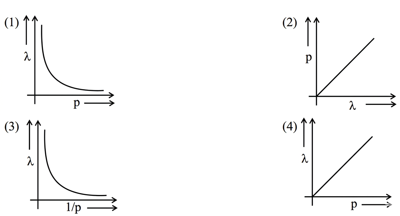
According to the wave-particle duality of matter by de-Broglie, which of the following graph plot presents most appropriate relationship between wavelength of electron $$\lambda$$ and momentum of electron $$p$$? (Four graphs are shown: (1) $$\lambda$$ vs $$p$$ showing a rectangular hyperbola, (2) $$p$$ vs $$\lambda$$ showing a rectangular hyperbola, (3) $$\lambda$$ vs $$1/p$$ showing a straight line through origin, (4) $$\lambda$$ vs $$p$$ showing a straight line with negative slope)
Compare the energies of following sets of quantum numbers for multielectron system. (A) $$n = 4, l = 1$$ (B) $$n = 4, l = 2$$ (C) $$n = 3, l = 1$$ (D) $$n = 3, l = 2$$ (E) $$n = 4, l = 0$$. Choose the correct answer from the options given below :
We need to compare the energies of orbitals in a multi-electron system using the $$(n + l)$$ rule.
For multi-electron atoms, orbital energy increases with $$(n + l)$$. If two orbitals have the same $$(n + l)$$, the one with lower $$n$$ has lower energy.
Calculate $$(n + l)$$ for each:
(A) $$n = 4, l = 1$$: $$n + l = 5$$ (4p orbital)
(B) $$n = 4, l = 2$$: $$n + l = 6$$ (4d orbital)
(C) $$n = 3, l = 1$$: $$n + l = 4$$ (3p orbital)
(D) $$n = 3, l = 2$$: $$n + l = 5$$ (3d orbital)
(E) $$n = 4, l = 0$$: $$n + l = 4$$ (4s orbital)
Order by increasing energy:
$$n + l = 4$$: C (3p, $$n = 3$$) and E (4s, $$n = 4$$). Since both have $$n + l = 4$$, lower $$n$$ means lower energy: C < E
$$n + l = 5$$: D (3d, $$n = 3$$) and A (4p, $$n = 4$$). D < A
$$n + l = 6$$: B (4d)
So the increasing order of energy is: $$C < E < D < A < B$$
This matches Option D: (C) < (E) < (D) < (A) < (B).
The correct answer is Option D.
Given below are two statements:
Statement-I: The orbitals having same energy are called as degenerate orbitals.
Statement-II: In hydrogen atom, $$3p$$ and $$3d$$ orbitals are not degenerate orbitals.
In the light of the above statements, choose the most appropriate answer from the options given
Statement I: "The orbitals having same energy are called as degenerate orbitals."
This is the correct definition of degenerate orbitals. Orbitals that have the same energy are called degenerate. Statement I is TRUE.
Statement II: "In hydrogen atom, $$3p$$ and $$3d$$ orbitals are not degenerate orbitals."
In a hydrogen atom (single-electron system), the energy of an orbital depends only on the principal quantum number $$n$$, not on the azimuthal quantum number $$l$$. Therefore, all orbitals with the same $$n$$ have the same energy.
Since $$3p$$ ($$n=3, l=1$$) and $$3d$$ ($$n=3, l=2$$) both have $$n = 3$$, they have the same energy in a hydrogen atom and are degenerate.
(Note: In multi-electron atoms, $$3p$$ and $$3d$$ would NOT be degenerate due to electron-electron repulsion and shielding effects. But in hydrogen atom specifically, they are degenerate.)
Statement II is FALSE.
The correct answer is: Statement-I is true but Statement-II is false.
The correct set of four quantum numbers for the valence electron of rubidium atom $$(Z = 37)$$ is:
We need to find the four quantum numbers for the valence electron of rubidium ($$Z = 37$$).
Determine the electronic configuration of Rb.
Rubidium has 37 electrons. Its electronic configuration is:
$$Rb: 1s^2 \, 2s^2 \, 2p^6 \, 3s^2 \, 3p^6 \, 3d^{10} \, 4s^2 \, 4p^6 \, 5s^1$$
Or equivalently: $$[Kr] \, 5s^1$$
The valence (outermost) electron is in the $$5s$$ orbital.
Assign the quantum numbers.
For an electron in the $$5s$$ orbital:
- Principal quantum number ($$n$$): $$n = 5$$ (the electron is in the 5th shell)
- Azimuthal quantum number ($$l$$): $$l = 0$$ (for an s-orbital, $$l$$ is always 0)
- Magnetic quantum number ($$m_l$$): $$m_l = 0$$ (for $$l = 0$$, the only possible value is 0)
- Spin quantum number ($$m_s$$): $$m_s = +\frac{1}{2}$$ (for the first electron in an orbital, by convention)
The set of quantum numbers is: $$5, 0, 0, +\frac{1}{2}$$.
The correct answer is Option (1): $$5, 0, 0, +\frac{1}{2}$$.
The electronic configuration for Neodymium is: [Atomic Number for Neodymium 60]
Neodymium (Nd) has atomic number 60. It is a lanthanide element. The noble gas core is Xenon (Xe, Z=54). After Xe, the electron filling order is: 6s, then 4f.
$$60 - 54 = 6$$ electrons to fill after Xe core.
First, 6s is filled: 2 electrons → $$6s^2$$ (4 remaining)
Then, 4f is filled: 4 electrons → $$4f^4$$
Electronic configuration: $$[Xe]\,4f^4\,6s^2$$.
The correct answer is Option 1: $$[Xe]\,4f^4\,6s^2$$.
The number of radial node/s for 3p orbital is:
Find the number of radial nodes for a 3p orbital.
The number of radial nodes (spherical nodes) in an orbital is given by:
$$ \text{Radial nodes} = n - l - 1 $$
where $$n$$ is the principal quantum number and $$l$$ is the azimuthal quantum number.
For the 3p orbital: $$n = 3$$ and $$l = 1$$ (since p corresponds to $$l = 1$$).
$$ \text{Radial nodes} = 3 - 1 - 1 = 1 $$
The correct answer is Option A: 1.
In case of isoelectronic species the size of $$F^-$$, $$Ne$$ and $$Na^+$$ is affected by:
In isoelectronic species $$F^-$$, $$Ne$$, and $$Na^+$$, all three have 10 electrons, corresponding to the electron configuration 1s$$^2$$ 2s$$^2$$ 2p$$^6$$. They therefore share the same principal quantum number $$n = 2$$ for their outermost electrons and experience identical electron-electron repulsion.
Their distinguishing feature is the nuclear charge $$Z$$: $$Z_{F^-} = 9$$, $$Z_{Ne} = 10$$, and $$Z_{Na^+} = 11$$. A higher nuclear charge pulls the same number of electrons closer to the nucleus, reducing the ionic or atomic radius.
Consequently, $$F^-$$ (Z = 9) has the weakest attraction and the largest size, $$Ne$$ (Z = 10) is intermediate, and $$Na^+$$ (Z = 11) has the strongest attraction and the smallest size, giving the order: $$F^- > Ne > Na^+$$.
The factor that affects the size of these isoelectronic species is the nuclear charge $$Z$$. The correct answer is Option D: Nuclear charge $$Z$$.
The electronic configuration of Einsteinium is : (Given atomic number of Einsteinium $$= 99$$)
Einsteinium has atomic number $$Z = 99$$. The closest noble gas preceding it is Radon (Rn) with $$Z = 86$$, so we represent the core as $$[Rn]$$ and calculate $$99 - 86 = 13$$ electrons remaining.
Following Radon, the orbitals fill in the order $$7s \rightarrow 5f \rightarrow 6d \rightarrow 7p$$. In the actinide series (elements 89-103), the general electronic configuration is $$[Rn] 5f^n 6d^0 7s^2$$, though one $$5f$$ electron may occasionally shift to $$6d$$.
Of the 13 electrons beyond the Radon core, two fill the $$7s$$ orbital to give $$7s^2$$, leaving eleven electrons to enter $$5f$$ as $$5f^{11}$$, with $$6d^0$$ remaining empty. Verifying that $$11 + 0 + 2 = 13$$ confirms that the total $$86 + 13 = 99$$ matches Einsteinium’s atomic number.
Therefore, the electronic configuration of Einsteinium is $$[Rn] 5f^{11} 6d^0 7s^2$$. The correct answer is Option 3: $$[Rn]5f^{11}6d^0 7s^2$$.
The four quantum numbers for the electron in the outer most orbital of potassium (atomic no. 19) are
We need to find the four quantum numbers for the outermost electron of potassium (K, atomic number 19).
The four quantum numbers that describe an electron are the principal quantum number $$n$$, which determines the energy level or shell; the azimuthal quantum number $$l$$, which determines the subshell ($$l = 0$$ for s, $$l = 1$$ for p, $$l = 2$$ for d); the magnetic quantum number $$m$$, which ranges from $$-l$$ to $$+l$$; and the spin quantum number $$s$$, which can be either $$+\frac{1}{2}$$ or $$-\frac{1}{2}$$.
Following the Aufbau principle (filling order by increasing energy), the electron configuration of potassium (Z = 19) is $$\text{K}: 1s^2 \, 2s^2 \, 2p^6 \, 3s^2 \, 3p^6 \, 4s^1$$, which can also be written as $$[\text{Ar}] \, 4s^1$$ because the 4s subshell (n + l = 4 + 0 = 4) has a lower energy than the 3d subshell (n + l = 3 + 2 = 5).
Therefore, the outermost (valence) electron occupies the $$4s$$ orbital, for which the principal quantum number is $$n = 4$$, the azimuthal quantum number is $$l = 0$$, the magnetic quantum number is $$m = 0$$ (the only possible value when $$l = 0$$), and the spin quantum number is $$s = +\frac{1}{2}$$ (by convention, the first electron in an orbital has spin +1/2).
The correct answer is Option (2): $$n = 4, l = 0, m = 0, s = +\frac{1}{2}$$.
Among the following the correct statement(s) for electrons in an atom is(are)
The question asks which statements about the behaviour of electrons in an atom are correct. We examine each option one by one, quoting the pertinent theoretical result before judging the statement.
Option A
Heisenberg’s Uncertainty Principle states $$\Delta x \,\Delta p \,\ge \,\frac{h}{4\pi}$$. Because the position $$x$$ and linear momentum $$p$$ of an electron cannot be known simultaneously with arbitrary accuracy, it is impossible to trace out a precise trajectory (definite path) for the electron as one does for macroscopic particles. Therefore the existence of well-defined orbits is ruled out.
Hence, Option A is correct.
Option B
In quantum‐mechanical (or even Bohr) treatment, the reference level of energy is taken to be zero for an electron at an infinite distance from the nucleus. Any electron bound to the nucleus has an energy that is negative (lower than zero). A 2s electron is certainly bound, so $$E_{2s} \lt 0$$, whereas $$E_{\infty}=0$$. Thus the energy of an electron in the 2s orbital is lower than that of an electron infinitely far away.
Hence, Option B is correct.
Option C
Bohr derived the energy of the electron in a hydrogenic atom as
$$E_n = -\frac{13.6\,\text{eV}\,Z^{2}}{n^{2}}$$.
Because the expression is inversely proportional to $$n^{2}$$ and carries a negative sign, the most negative (lowest) energy occurs at the smallest possible principal quantum number, $$n = 1$$. Lower (more negative) energy means greater stability, so the $$n = 1$$ orbit is the most stable.
Hence, Option C is correct.
Option D
Bohr also obtained the speed of the electron in the $$n^{\text{th}}$$ orbit:
$$v_n = \frac{2.18\times10^{6}\,\text{m s}^{-1}}{n}\;Z$$.
For a fixed nucleus ($$Z$$ constant), $$v_n$$ is inversely proportional to $$n$$, i.e. as $$n$$ increases, the magnitude of velocity decreases. The statement that velocity increases with $$n$$ is therefore wrong.
Hence, Option D is incorrect.
Therefore the correct statements are:
Option A, Option B, and Option C.
Final answer: Option A (Uncertainty principle rules out the existence of definite paths for electrons.), Option B (The energy of an electron in 2s orbital of an atom is lower than the energy of an electron that is infinitely far away from the nucleus.), Option C (According to Bohr's model, the most negative energy value for an electron is given by $$n = 1$$, which corresponds to the most stable orbit.)
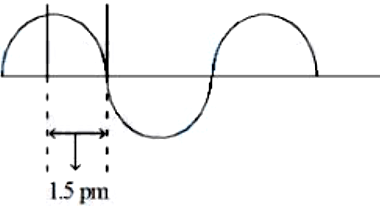
A hypothetical electromagnetic wave is shown below. The frequency of the wave is $$x \times 10^{19}$$ Hz. $$x =$$ ______ (nearest integer)
1. Identify the Wavelength ($$\lambda$$)
Looking at the diagram, the distance of 1.5 pm represents the distance from a peak (crest) to a zero-crossing (node).
- A full wavelength ($$\lambda$$) consists of four such segments (peak to node, node to trough, trough to node, and node back to peak).
- Therefore, the wavelength is:
$$\lambda = 4 \times 1.5 \text{ pm} = 6.0 \text{ pm}$$ - Converting picometers to meters:
$$\lambda = 6.0 \times 10^{-12} \text{ m}$$
2. Relate Speed, Frequency, and Wavelength
Since this is an electromagnetic wave, it travels at the speed of light ($$c \approx 3 \times 10^8 \text{ m/s}$$). We use the standard wave equation:
$$c = \nu \lambda$$
Where:
- $$c$$ is the speed of light ($$3 \times 10^8 \text{ m/s}$$)
- $$\nu$$ is the frequency (Hz)
- $$\lambda$$ is the wavelength (m)
3. Calculate the Frequency ($$\nu$$)
Rearranging the formula to solve for frequency:
$$\nu = \frac{c}{\lambda} = \frac{3 \times 10^8 \text{ m/s}}{6 \times 10^{-12} \text{ m}}$$
Now, simplify the powers of ten:
$$\nu = 0.5 \times 10^{8 - (-12)} = 0.5 \times 10^{20} \text{ Hz}$$
$$\nu = 5 \times 10^{19} \text{ Hz}$$
Based on Heisenberg's uncertainty principle, the uncertainty in the velocity of the electron to be found within an atomic nucleus of diameter $$10^{-15} \text{ m}$$ is ______ $$\times 10^9 \text{ ms}^{-1}$$ (nearest integer) [Given : mass of electron $$= 9.1 \times 10^{-31} \text{ kg}$$, Planck's constant $$(h) = 6.626 \times 10^{-34} \text{ Js}$$] (Value of $$\pi = 3.14$$)
By Heisenberg's uncertainty principle: $$\Delta x \cdot \Delta p \geq \frac{h}{4\pi}$$.
$$\Delta v = \frac{h}{4\pi m \Delta x} = \frac{6.626 \times 10^{-34}}{4 \times 3.14 \times 9.1 \times 10^{-31} \times 10^{-15}}$$
$$= \frac{6.626 \times 10^{-34}}{114.296 \times 10^{-46}} = \frac{6.626}{114.296} \times 10^{12} = 0.05798 \times 10^{12} = 5.798 \times 10^{10}$$
$$= 57.98 \times 10^9 \approx 58 \times 10^9$$ m/s.
The answer is $$\boxed{58}$$.
Frequency of the de-Broglie wave of electron in Bohr's first orbit of hydrogen atom is _______ $$\times 10^{13}$$ Hz (nearest integer). [Given : $$R_H$$ (Rydberg constant) $$= 2.18 \times 10^{-18}$$ J, $$h$$ (Planck's constant) $$= 6.6 \times 10^{-34}$$ J.s.]
We wish to determine the frequency of the de-Broglie wave of the electron in Bohr’s first orbit of hydrogen. In de-Broglie’s theory, the wavelength is given by $$\lambda = \frac{h}{mv}$$, which yields a frequency $$\nu = \frac{v}{\lambda} = \frac{mv^2}{h}\,.$$ Noting that $$mv^2 = 2\times KE$$ and that the kinetic energy in the first orbit is $$|E_1| = R_H = 2.18\times10^{-18}$$ J, we have:
$$\nu = \frac{mv^2}{h} = \frac{2\times KE}{h} = \frac{2\times 2.18\times10^{-18}}{6.6\times10^{-34}}$$
$$= \frac{4.36\times10^{-18}}{6.6\times10^{-34}} = 6.606\times10^{15}\text{ Hz}$$
Expressed in the form $$\_\_\_ \times 10^{13}$$ Hz, this becomes $$\nu = 660.6\times10^{13}\approx661\times10^{13}$$ Hz. The answer is 661.
In an atom, total number of electrons having quantum numbers $$n = 4$$, $$|m_l| = 1$$ and $$m_s = -\frac{1}{2}$$ is ______
We need to find the total number of electrons with quantum numbers $$n = 4$$, $$|m_l| = 1$$, and $$m_s = -\frac{1}{2}$$.
For $$n = 4$$, the possible subshells are $$4s$$ ($$l = 0$$), $$4p$$ ($$l = 1$$), $$4d$$ ($$l = 2$$), and $$4f$$ ($$l = 3$$). We require $$|m_l| = 1$$, which corresponds to $$m_l = +1$$ or $$m_l = -1$$. In each subshell the allowed $$m_l$$ values range from $$-l$$ to $$+l$$.
In the $$4s$$ subshell ($$l = 0$$) the only value of $$m_l$$ is 0, so there are no orbitals with $$|m_l| = 1$$. In the $$4p$$ subshell ($$l = 1$$) the values of $$m_l$$ are $$-1, 0, +1$$, giving two orbitals with $$m_l = +1$$ and $$m_l = -1$$. Similarly, in the $$4d$$ subshell ($$l = 2$$) with $$m_l = -2, -1, 0, +1, +2$$ there are two orbitals with $$|m_l| = 1$$, and in the $$4f$$ subshell ($$l = 3$$) with $$m_l = -3, -2, -1, 0, +1, +2, +3$$ there are also two such orbitals.
The total number of orbitals satisfying $$|m_l| = 1$$ across all subshells is $$0 + 2 + 2 + 2 = 6$$. Since each orbital can accommodate one electron with $$m_s = -\frac{1}{2}$$, the total number of electrons is $$6$$.
The answer is 6.
Number of spectral lines obtained in $$He^+$$ spectra, when an electron makes transition from fifth excited state to first excited state will be
In He$$^+$$, transition from 5th excited state (n = 6) to first excited state (n = 2).
Number of spectral lines from transitions between levels n = 6 to n = 2:
Number of levels involved = 6 - 2 + 1 = 5 (levels 2, 3, 4, 5, 6).
Number of spectral lines = $$\frac{n(n-1)}{2} = \frac{5 \times 4}{2} = 10$$.
Therefore, the answer is $$\boxed{10}$$.
The de-Broglie's wavelength of an electron in the 4th orbit is ______ $$\pi a_0$$. ($$a_0$$ = Bohr's radius)
For the nth orbit, the de Broglie condition states:
$$2\pi r_n = n\lambda$$
For n = 4: $$\lambda = \frac{2\pi r_4}{4}$$
The radius of the nth orbit: $$r_n = n^2 a_0$$, so $$r_4 = 16a_0$$
$$\lambda = \frac{2\pi \times 16a_0}{4} = 8\pi a_0$$
The answer is 8.
The maximum number of orbitals which can be identified with $$n = 4$$ and $$m_l = 0$$ is ______
Find the maximum number of orbitals with $$n = 4$$ and $$m_l = 0$$.
For $$n = 4$$, the subshells correspond to $$l = 0, 1, 2, 3$$, that is, the 4s, 4p, 4d, and 4f subshells.
Next, check which subshells have $$m_l = 0$$. Every subshell has exactly one orbital with $$m_l = 0$$:
- $$l = 0$$: $$m_l = 0$$ → 1 orbital (4s)
- $$l = 1$$: $$m_l \in \{-1, 0, 1\}$$ → $$m_l = 0$$ exists → 1 orbital (4p)
- $$l = 2$$: $$m_l \in \{-2, -1, 0, 1, 2\}$$ → $$m_l = 0$$ exists → 1 orbital (4d)
- $$l = 3$$: $$m_l \in \{-3, ..., 3\}$$ → $$m_l = 0$$ exists → 1 orbital (4f)
In total, there are 4 orbitals.
The correct answer is 4.
Wavenumber for a radiation having wavelength $$5800 \text{ Å}$$ is $$x \times 10 \text{ cm}^{-1}$$. The value of $$x$$ is _____.
We need to find the wavenumber for radiation with wavelength $$5800 \text{ \AA}$$. Since the wavenumber is defined as $$\bar{\nu} = \frac{1}{\lambda}$$, we first convert the wavelength to centimeters, giving $$\lambda = 5800 \text{ \AA} = 5800 \times 10^{-8} \text{ cm} = 5.8 \times 10^{-5} \text{ cm}$$.
Substituting this into the expression for the wavenumber yields $$\bar{\nu} = \frac{1}{5.8 \times 10^{-5}} = \frac{10^5}{5.8} = 17241.4 \text{ cm}^{-1}$$.
Since $$\bar{\nu} = x \times 10 \text{ cm}^{-1}$$, it follows that $$x = \frac{17241.4}{10} = 1724.14$$.
Therefore, rounding to the nearest integer gives $$x = \boxed{1724}$$.
For hydrogen atom, energy of an electron in first excited state is $$-3.4 \text{ eV}$$, K.E. of the same electron of hydrogen atom is $$x \text{ eV}$$. Value of $$x$$ is ___________ $$\times 10^{-1} \text{ eV}$$. (Nearest integer)
We need to find the kinetic energy of the electron in the first excited state of hydrogen, expressed as $$x \times 10^{-1}$$ eV. For a hydrogen atom, the total energy, kinetic energy, and potential energy are related by $$E_n = -\frac{13.6}{n^2} \, \text{eV}$$, $$KE_n = -E_n = \frac{13.6}{n^2} \, \text{eV}$$, and $$PE_n = 2E_n = -\frac{27.2}{n^2} \, \text{eV}$$. The kinetic energy is always positive and equals the magnitude of the total energy, which follows from the virial theorem for a Coulomb potential: $$KE = -E$$ and $$PE = 2E$$.
Since the first excited state corresponds to $$n = 2$$, we have $$E_2 = -3.4 \, \text{eV}$$. Substituting into the expression for kinetic energy gives $$KE = -E_2 = -(-3.4) = 3.4 \, \text{eV}$$. Expressing this value in the form $$x \times 10^{-1}\, \text{eV}$$ yields $$3.4 \, \text{eV} = 34 \times 10^{-1} \, \text{eV}$$, so $$x = 34$$.
Option 34
The ionization energy of sodium in $$kJ \text{ mol}^{-1}$$, if electromagnetic radiation of wavelength $$242$$ nm is just sufficient to ionize sodium atom is ______. (nearest integer)
We need to find the energy (in kJ/mol) corresponding to a wavelength of 242 nm.
Using $$E = \frac{hc}{\lambda}$$:
$$ E = \frac{6.626 \times 10^{-34} \times 3 \times 10^8}{242 \times 10^{-9}} $$
$$ E = \frac{19.878 \times 10^{-26}}{242 \times 10^{-9}} = \frac{19.878 \times 10^{-26}}{2.42 \times 10^{-7}} $$
$$ E = 8.214 \times 10^{-19} \text{ J} $$
Multiply by Avogadro's number ($$N_A = 6.022 \times 10^{23}$$):
$$ E_{mol} = 8.214 \times 10^{-19} \times 6.022 \times 10^{23} = 49.46 \times 10^{4} \text{ J/mol} $$
$$ E_{mol} = 494.6 \text{ kJ/mol} \approx 494 \text{ kJ/mol} $$
The answer is $$\boxed{494}$$ kJ/mol.
The number of electrons present in all the completely filled subshells having $$n = 4$$ and $$s = +\frac{1}{2}$$ is ______ (Where $$n$$ = principal quantum number and $$s$$ = spin quantum number)
For $$n = 4$$, the possible subshells are: $$4s, 4p, 4d, 4f$$.
The completely filled subshells for $$n = 4$$ are:
- $$4s$$: 2 electrons (completely filled)
- $$4p$$: 6 electrons (completely filled)
- $$4d$$: 10 electrons (completely filled)
- $$4f$$: 14 electrons (completely filled)
Total electrons in all completely filled subshells with $$n = 4$$: $$2 + 6 + 10 + 14 = 32$$
Now, electrons with $$s = +\frac{1}{2}$$: In each completely filled subshell, exactly half the electrons have $$s = +\frac{1}{2}$$ and the other half have $$s = -\frac{1}{2}$$.
Number of electrons with $$s = +\frac{1}{2}$$: $$\frac{32}{2} = 16$$
The answer is $$\boxed{16}$$.
The value of Rydberg constant $$(R_H)$$ is $$2.18 \times 10^{-18} \text{ J}$$. The velocity of electron having mass $$9.1 \times 10^{-31} \text{ kg}$$ in Bohr's first orbit of hydrogen atom $$=$$ ______ $$\times 10^5 \text{ ms}^{-1}$$ (nearest integer).
We need to find the velocity of the electron in Bohr's first orbit of the hydrogen atom, given the Rydberg constant and electron mass.
Recall the energy relation in Bohr's model.
In Bohr's model, for the hydrogen atom in the first orbit ($$n = 1$$), the total energy is:
$$ E_1 = -R_H $$
where $$R_H = 2.18 \times 10^{-18}$$ J is the Rydberg constant (energy).
The total energy is the sum of kinetic and potential energies. For a circular orbit under Coulomb's law:
$$ E = -KE = \frac{PE}{2} $$
This gives us: $$KE = -E = R_H$$
Set up the kinetic energy equation.
$$ KE = \frac{1}{2}mv^2 = R_H $$
$$ \frac{1}{2} \times 9.1 \times 10^{-31} \times v^2 = 2.18 \times 10^{-18} $$
Solve for $$v^2$$.
$$ v^2 = \frac{2 \times 2.18 \times 10^{-18}}{9.1 \times 10^{-31}} $$
$$ v^2 = \frac{4.36 \times 10^{-18}}{9.1 \times 10^{-31}} $$
$$ v^2 = \frac{4.36}{9.1} \times 10^{-18+31} = 0.4791 \times 10^{13} = 4.791 \times 10^{12} \text{ m}^2\text{s}^{-2} $$
Calculate $$v$$.
$$ v = \sqrt{4.791 \times 10^{12}} $$
$$ v = \sqrt{4.791} \times 10^6 $$
$$ v \approx 2.189 \times 10^6 \text{ m/s} $$
Express in the required form.
$$ v = 2.189 \times 10^6 = 21.89 \times 10^5 \text{ m/s} $$
Rounding to the nearest integer: $$v \approx 22 \times 10^5$$ m/s.
The answer is $$\boxed{22}$$.
Total number of ions from the following with noble gas configuration is
$$Sr^{2+}$$ (Z = 38), $$Cs^+$$ (Z = 55), $$La^{2+}$$ (Z = 57), $$Pb^{2+}$$ (Z = 82), $$Yb^{2+}$$ (Z = 70) and $$Fe^{2+}$$ (Z = 26)
We need to determine how many of the given ions have noble gas configuration.
A noble gas configuration means the ion's electron configuration matches that of a noble gas (He, Ne, Ar, Kr, Xe, Rn).
$$Sr^{2+}$$ (Z = 38): $$Sr$$ has configuration $$[Kr]5s^2$$. Removing 2 electrons gives $$[Kr]$$ — 36 electrons. This is the krypton noble gas configuration. Yes.
$$Cs^+$$ (Z = 55): $$Cs$$ has configuration $$[Xe]6s^1$$. Removing 1 electron gives $$[Xe]$$ — 54 electrons. This is the xenon noble gas configuration. Yes.
$$La^{2+}$$ (Z = 57): $$La$$ has configuration $$[Xe]5d^1 6s^2$$. Removing 2 electrons gives $$[Xe]5d^1$$ — 55 electrons. This is NOT a noble gas configuration (it has one extra d-electron beyond Xe). No.
$$Pb^{2+}$$ (Z = 82): $$Pb$$ has configuration $$[Xe]4f^{14}5d^{10}6s^2 6p^2$$. Removing 2 electrons (from 6p) gives $$[Xe]4f^{14}5d^{10}6s^2$$ — 80 electrons. This is NOT a noble gas configuration. No.
$$Yb^{2+}$$ (Z = 70): $$Yb$$ has configuration $$[Xe]4f^{14}6s^2$$. Removing 2 electrons gives $$[Xe]4f^{14}$$ — 68 electrons. This is NOT a noble gas configuration. No.
$$Fe^{2+}$$ (Z = 26): $$Fe$$ has configuration $$[Ar]3d^6 4s^2$$. Removing 2 electrons gives $$[Ar]3d^6$$ — 24 electrons. This is NOT a noble gas configuration. No.
Only $$Sr^{2+}$$ and $$Cs^+$$ have noble gas configurations.
The answer is 2.
A Hydrogen-like atom has atomic number $$Z$$. Photons emitted in the electronic transitions from level $$n = 4$$ to level $$n = 3$$ in these atoms are used to perform photoelectric effect experiment on a target metal. The maximum kinetic energy of the photoelectrons generated is 1.95 eV. If the photoelectric threshold wavelength for the target metal is 310 nm, the value of $$Z$$ is ______.
[Given: $$hc = 1240$$ eV-nm and $$Rhc = 13.6$$ eV, where $$R$$ is the Rydberg constant, $$h$$ is the Planck's constant and $$c$$ is the speed of light in vacuum]
The photon that strikes the metal comes from the electronic transition $$n = 4 \rightarrow n = 3$$ in a hydrogen-like ion of atomic number $$Z$$.
Step 1 : Energy of the photon
For a hydrogen-like ion, the energy of level $$n$$ is $$E_n = -\,\dfrac{Z^{2} \, 13.6\ \text{eV}}{n^{2}}$$. Hence for the transition $$4 \rightarrow 3$$
$$\Delta E \;=\; Z^{2}\,13.6\left(\dfrac{1}{3^{2}}-\dfrac{1}{4^{2}}\right) = Z^{2}\,13.6\Bigl(\dfrac{1}{9}-\dfrac{1}{16}\Bigr) = Z^{2}\,13.6\Bigl(\dfrac{16-9}{144}\Bigr) = Z^{2}\,13.6 \times \dfrac{7}{144}$$
Compute the numerical factor:
$$13.6 \times \dfrac{7}{144}= \dfrac{95.2}{144}=0.661111\;\text{eV}$$
Therefore the photon energy is
$$E_{\text{photon}} = 0.661111\,Z^{2}\ \text{eV} \qquad -(1)$$
Step 2 : Work function of the target metal
Threshold wavelength $$\lambda_0 = 310\ \text{nm}$$ gives the work function
$$\Phi = \dfrac{hc}{\lambda_0} = \dfrac{1240\ \text{eV·nm}}{310\ \text{nm}} = 4.00\ \text{eV}$$
Step 3 : Use photoelectric equation
Maximum kinetic energy of emitted electrons is $$K_{\max}=1.95\ \text{eV}$$. Hence
$$E_{\text{photon}} = \Phi + K_{\max} = 4.00 + 1.95 = 5.95\ \text{eV} \qquad -(2)$$
Step 4 : Equate $$E_{\text{photon}}$$ from (1) and (2)
$$0.661111\,Z^{2} = 5.95$$
$$Z^{2} = \dfrac{5.95}{0.661111} \approx 9.00$$
$$\Rightarrow\; Z \approx 3$$
Thus the atomic number of the hydrogen-like ion is 3.
Final Answer: $$Z = 3$$
Given below are two statements
Statement I : According to Bohr's model of hydrogen atom, the angular momentum of an electron in a given stationary state is quantised.
Statement II : The concept of electron in Bohr's orbit, violates the Heisenberg uncertainty principle. In the light of the above statements, choose the most appropriate answer from the options given below
Statement I: According to Bohr's model, the angular momentum is quantized: $$L = n\hbar$$. This is correct.
Statement II: In Bohr's model, the electron has a definite orbit with known position and momentum simultaneously. This violates the Heisenberg uncertainty principle (which states that position and momentum cannot both be precisely known). This is correct.
Both statements are correct.
This matches option 2.
If the radius of the first orbit of hydrogen atom is $$a_0$$, then de Broglie's wavelength of electron in 3$$^{rd}$$ orbit is
The radius of the $$n$$th orbit of hydrogen atom is:
$$ r_n = n^2 a_0 $$
For the 3rd orbit: $$r_3 = 9a_0$$.
By Bohr's quantization condition, the circumference of the orbit equals $$n$$ times the de Broglie wavelength:
$$ 2\pi r_n = n\lambda $$
For $$n = 3$$:
$$ 2\pi(9a_0) = 3\lambda $$
$$ \lambda = \frac{18\pi a_0}{3} = 6\pi a_0 $$
The de Broglie wavelength of the electron in the 3rd orbit is $$6\pi a_0$$.
The radius of the 2$$^{nd}$$ orbit of Li$$^{2+}$$ is $$x$$. The expected radius of the 3$$^{rd}$$ orbit of Be$$^{3+}$$ is
The radius of the nth orbit in a hydrogen-like atom is:
$$r_n = \frac{n^2 a_0}{Z}$$
where $$a_0$$ is the Bohr radius and $$Z$$ is the atomic number.
For Li²⁺ (Z = 3), 2nd orbit:
$$x = r_2 = \frac{4a_0}{3}$$
For Be³⁺ (Z = 4), 3rd orbit:
$$r_3 = \frac{9a_0}{4}$$
Ratio:
$$\frac{r_3}{x} = \frac{9a_0/4}{4a_0/3} = \frac{9a_0}{4} \times \frac{3}{4a_0} = \frac{27}{16}$$
So $$r_3 = \frac{27}{16}x$$
The correct answer is Option 3: $$\frac{27}{16}x$$.
The shortest wavelength of hydrogen atom in Lyman series is $$\lambda$$. The longest wavelength in Balmer series of He$$^+$$ is
We are given that $$\lambda$$ is the shortest wavelength in the Lyman series of hydrogen and we need the longest wavelength in the Balmer series of He$$^+$$.
The shortest wavelength in the Lyman series corresponds to the series limit (transition from $$n = \infty$$ to $$n = 1$$):
$$\frac{1}{\lambda} = R_H\left(\frac{1}{1^2} - \frac{1}{\infty^2}\right) = R_H$$
So $$\lambda = \frac{1}{R_H}$$.
Now, the longest wavelength in the Balmer series of He$$^+$$ corresponds to the transition from $$n = 3$$ to $$n = 2$$. For He$$^+$$ with $$Z = 2$$:
$$\frac{1}{\lambda'} = R_H \times 4 \times \left(\frac{1}{4} - \frac{1}{9}\right) = R_H \times 4 \times \frac{5}{36} = \frac{20R_H}{36} = \frac{5R_H}{9}$$
Hence $$\lambda' = \frac{9}{5R_H} = \frac{9}{5} \times \frac{1}{R_H} = \frac{9\lambda}{5}$$.
Hence, the correct answer is Option 2: $$\frac{9\lambda}{5}$$.
Which one of the following sets of ions represents a collection of isoelectronic species?
(Given: Atomic Number: F: 9, Cl: 17, Na = 11, Mg = 12, Al = 13, K = 19, Ca = 20, Sc = 21)
We need to identify which set of ions represents a collection of isoelectronic species (species with the same number of electrons).
Given atomic numbers: F = 9, Cl = 17, Na = 11, Mg = 12, Al = 13, K = 19, Ca = 20, Sc = 21.
Count electrons for each option.
Option A: $$Li^+, Na^+, Mg^{2+}, Ca^{2+}$$
$$Li^+ : 3 - 1 = 2$$ electrons
$$Na^+ : 11 - 1 = 10$$ electrons
$$Mg^{2+} : 12 - 2 = 10$$ electrons
$$Ca^{2+} : 20 - 2 = 18$$ electrons
Electron counts: 2, 10, 10, 18 — Not isoelectronic.
Option B: $$Ba^{2+}, Sr^{2+}, K^+, Ca^{2+}$$
$$Ba^{2+} : 56 - 2 = 54$$ electrons
$$Sr^{2+} : 38 - 2 = 36$$ electrons
$$K^+ : 19 - 1 = 18$$ electrons
$$Ca^{2+} : 20 - 2 = 18$$ electrons
Electron counts: 54, 36, 18, 18 — Not isoelectronic.
Option C: $$N^{3-}, O^{2-}, F^-, S^{2-}$$
$$N^{3-} : 7 + 3 = 10$$ electrons
$$O^{2-} : 8 + 2 = 10$$ electrons
$$F^- : 9 + 1 = 10$$ electrons
$$S^{2-} : 16 + 2 = 18$$ electrons
Electron counts: 10, 10, 10, 18 — Not isoelectronic.
Option D: $$K^+, Cl^-, Ca^{2+}, Sc^{3+}$$
$$K^+ : 19 - 1 = 18$$ electrons
$$Cl^- : 17 + 1 = 18$$ electrons
$$Ca^{2+} : 20 - 2 = 18$$ electrons
$$Sc^{3+} : 21 - 3 = 18$$ electrons
Electron counts: 18, 18, 18, 18 — All isoelectronic!
Conclusion.
All four ions in Option D have 18 electrons each, making them isoelectronic with the noble gas Argon (Ar, atomic number 18). They all have the electron configuration $$1s^2 2s^2 2p^6 3s^2 3p^6$$.
The correct answer is Option D: $$K^+, Cl^-, Ca^{2+}, Sc^{3+}$$.
Which transition in the hydrogen spectrum would have the same wavelength as the Balmer type transition from n = 4 to n = 2 of He$$^+$$ spectrum
Given below are two statement : one is labelled as Assertion A and the other is labelled as Reason R
Assertion A : 5f electron can participate in bonding to a far greater extent than 4f electrons
Reason R : 5f orbitals are not as buried as 4f orbitals
In the light of the above statements, choose the correct answer from the options given below
Assertion A: 5f electrons can participate in bonding to a far greater extent than 4f electrons — True.
Reason R: 5f orbitals are not as buried as 4f orbitals — True. Since 5f orbitals extend further from the nucleus, they can overlap more effectively with other orbitals, enabling bonding.
Both A and R are true and R is the correct explanation of A.
Given below are two statements: one is labelled as Assertion A and the other is labelled as Reason R:
Assertion A: In the photoelectric effect, the electrons are ejected from the metal surface as soon as the beam of light of frequency greater than threshold frequency strikes the surface.
Reason R: When the photon of any energy strikes an electron in the atom, transfer of energy from the photon to the electron takes place.
In the light of the above statements, choose the most appropriate answer from the options given below:
Assertion A: In the photoelectric effect, electrons are ejected from the metal surface as soon as the beam of light of frequency greater than threshold frequency strikes the surface.
This is correct. The photoelectric effect is instantaneous when the frequency of incident light exceeds the threshold frequency.
Reason R: When the photon of any energy strikes an electron in the atom, transfer of energy from the photon to the electron takes place.
This is incorrect. Not any photon can cause energy transfer to eject electrons. The photon must have energy greater than or equal to the work function ($$h\nu \geq \phi$$) for the photoelectric effect to occur. Photons with energy less than the work function cannot eject electrons regardless of their intensity.
Therefore, A is correct but R is not correct.
Henry Moseley studied characteristic X-ray spectra of elements. The graph which represents his observation correctly is
Given $$\nu$$ = Frequency of X-ray emitted, $$Z$$ = Atomic number
as per Henry moseley $$\sqrt{\ V}$$ proportional to atomic number of elements
The number of atomic orbitals from the following having 5 radial nodes is
7s, 7p, 6s, 8p, 8d
We need to find how many atomic orbitals from the list $$7s, 7p, 6s, 8p, 8d$$ have exactly 5 radial nodes. The number of radial nodes in an atomic orbital is given by
$$\text{Number of radial nodes} = n - l - 1$$where $$n$$ is the principal quantum number and $$l$$ is the azimuthal quantum number.
For 7s: $$n = 7$$, $$l = 0$$, so radial nodes $$= 7 - 0 - 1 = 6$$.
For 7p: $$n = 7$$, $$l = 1$$, so radial nodes $$= 7 - 1 - 1 = 5$$. This one qualifies.
For 6s: $$n = 6$$, $$l = 0$$, so radial nodes $$= 6 - 0 - 1 = 5$$. This one qualifies.
For 8p: $$n = 8$$, $$l = 1$$, so radial nodes $$= 8 - 1 - 1 = 6$$.
For 8d: $$n = 8$$, $$l = 2$$, so radial nodes $$= 8 - 2 - 1 = 5$$. This one qualifies.
The orbitals with exactly 5 radial nodes are 7p, 6s, and 8d. Hence, the answer is $$3$$.
Given below are two statements, one is labelled as Assertion A and the other is labelled as Reason R.
Assertion A: Loss of electron from hydrogen atom results in nucleus of ~$$1.5 \times 10^{-3}$$ pm size.
Reason R: Proton H$$^+$$ always exists in combined form.
In the light of the above statements, choose the most appropriate answer from the options given below:
Assertion A: Loss of electron from hydrogen atom results in nucleus of ~$$1.5 \times 10^{-3}$$ pm size.
When hydrogen loses its only electron, we are left with just a proton (H⁺). The size of a proton is approximately $$1.5 \times 10^{-3}$$ pm (= 1.5 femtometers). This is correct.
Reason R: Proton H⁺ always exists in combined form.
A bare proton (H⁺) is extremely small and has very high charge density. In aqueous solution, it immediately combines with water to form hydronium ion (H₃O⁺) or other hydrated species. It never exists as a free proton in solution. This is correct.
However, R does not explain A. The small size of the proton (A) is due to the nuclear dimensions, not because of its tendency to combine with other species (R). These are two independent facts.
The correct answer is Both A and R are correct but R is NOT the correct explanation of A.
The correct molecular orbital diagram for F$$_2$$ molecule in the ground state is
The relative energies of the molecular orbitals (MOs) formed from the 2s- and 2p-orbitals depend on the atomic number of the two atoms.
For $$Z \ge 8$$ (that is, for $$O_2,\,F_2,\,Ne_2$$) the order is
$$\sigma_{2s}\;,\;\sigma^{*}_{2s}\;,\;\sigma_{2p_z}\;,\;\pi_{2p_x}=\pi_{2p_y}\;,\;\pi^{*}_{2p_x}=\pi^{*}_{2p_y}\;,\;\sigma^{*}_{2p_z} \quad -(1)$$
Fluorine has $$Z = 9$$, so $$F_2$$ must follow the sequence given in $$(1)$$.
Each fluorine atom supplies 7 valence electrons. Total valence electrons in $$F_2$$:
$$7 + 7 = 14$$
Placing these 14 electrons into the MOs of $$(1)$$:
$$\sigma_{2s}^2\,\sigma^{*}_{2s}^2\,\sigma_{2p_z}^2\,\pi_{2p_x}^2\,\pi_{2p_y}^2\,\pi^{*}_{2p_x}^2\,\pi^{*}_{2p_y}^2\,\sigma^{*}_{2p_z}^0$$
Number of bonding electrons $$N_b = 8$$ (those in $$\sigma_{2s},\,\sigma_{2p_z},\,\pi_{2p_x},\,\pi_{2p_y}$$).
Number of antibonding electrons $$N_a = 6$$ (those in $$\sigma^{*}_{2s},\,\pi^{*}_{2p_x},\,\pi^{*}_{2p_y}$$).
Bond order
$$\text{B.O.} = \frac{N_b - N_a}{2} = \frac{8 - 6}{2} = 1$$
All electrons are paired, so $$F_2$$ is diamagnetic.
The diagram that shows the energy sequence of $$(1)$$, with $$\pi^{*}_{2p_x}$$ and $$\pi^{*}_{2p_y}$$ completely filled, $$\sigma^{*}_{2p_z}$$ empty, and no unpaired electrons, is Option C.
Therefore, the correct molecular orbital diagram for $$F_2$$ in its ground state is given by Option C.
The number of s-electrons present in an ion with 55 protons in its unipositive state is
Atoms of metals x, y, and z form face-centred cubic (fcc) unit cell of edge length $$L_x$$, body-centred cubic (bcc) unit cell of edge length $$L_y$$, and simple cubic unit cell of edge length $$L_z$$, respectively.
If $$r_z = \frac{\sqrt{3}}{2}r_y$$; $$r_y = \frac{8}{\sqrt{3}}r_x$$; $$M_z = \frac{3}{2}M_y$$ and $$M_z = 3M_x$$, then the correct statement(s) is (are)
[Given: $$M_x$$, $$M_y$$, and $$M_z$$ are molar masses of metals x, y, and z, respectively. $$r_x$$, $$r_y$$, and $$r_z$$ are atomic radii of metals x, y, and z, respectively.]
For every cubic lattice the density, edge length and packing efficiency depend on three basic data: number of atoms per unit cell ($$Z$$), atomic radius ($$r$$) and molar mass ($$M$$).
We tabulate the standard relations first:
Face-centred cubic (fcc, metal $$x$$):
• $$Z_x = 4$$ • contact along a face diagonal ⇒ $$\sqrt{2}\,L_x = 4\,r_x$$ ⇒ $$r_x = \dfrac{L_x}{2\sqrt{2}}$$.
Body-centred cubic (bcc, metal $$y$$):
• $$Z_y = 2$$ • contact along a body diagonal ⇒ $$\sqrt{3}\,L_y = 4\,r_y$$ ⇒ $$r_y = \dfrac{\sqrt{3}}{4}\,L_y$$.
Simple cubic (sc, metal $$z$$):
• $$Z_z = 1$$ • contact along an edge ⇒ $$L_z = 2\,r_z$$ ⇒ $$r_z = \dfrac{L_z}{2}$$.
The question gives the inter-relations
$$r_z = \frac{\sqrt{3}}{2}\,r_y,\qquad r_y = \frac{8}{\sqrt{3}}\,r_x,\qquad M_z = \frac{3}{2}\,M_y,\qquad M_z = 3\,M_x.$$
From the last two equalities
$$M_x = \frac{1}{3}M_z,\qquad M_y = \frac{2}{3}M_z \;\;\Longrightarrow\;\; \frac{M_x}{M_y} = \frac12.$$
1. Comparison of edge lengths
Using $$r_y = \dfrac{8}{\sqrt{3}}\,r_x$$ in $$L_y = \dfrac{4\,r_y}{\sqrt{3}}$$:
$$L_y = \frac{4}{\sqrt{3}}\left(\frac{8}{\sqrt{3}}\,r_x\right)
= \frac{32}{3}\,r_x.$$
Using $$r_z = \frac{\sqrt{3}}{2}\,r_y = \frac{\sqrt{3}}{2}\left(\frac{8}{\sqrt{3}}\,r_x\right)=4\,r_x$$ in $$L_z=2\,r_z$$:
$$L_z = 8\,r_x.$$
For fcc, $$L_x = 2\sqrt{2}\,r_x.$$
Numerically (in units of $$r_x$$):
$$L_x = 2.828\,r_x,\qquad
L_y = 10.667\,r_x,\qquad
L_z = 8\,r_x.$$
Therefore $$L_y \gt L_z \gt L_x$$ and hence Option B ($$L_y \gt L_z$$) is correct, while Option C ($$L_x \gt L_y$$) is incorrect.
2. Packing efficiencies
Standard values are: fcc = 74 %, bcc = 68 %, sc = 52.4 %.
Thus$$\text{fcc (}x\text{)} \gt \text{bcc (}y\text{)} \gt \text{sc (}z\text{)},$$so Option A is correct.
3. Density comparison of $$x$$ and $$y$$
For any cubic lattice $$\rho = \dfrac{Z\,M}{N_A\,L^3}.$$ Taking the ratio $$ \frac{\rho_x}{\rho_y} = \frac{Z_x M_x L_y^{\,3}}{Z_y M_y L_x^{\,3}} = \left(\frac{4}{2}\right) \left(\frac{M_x}{M_y}\right) \left(\frac{L_y}{L_x}\right)^{3} = 2\left(\frac12\right)\left(\frac{L_y}{L_x}\right)^{3} = \left(\frac{L_y}{L_x}\right)^{3}. $$ We already have $$\dfrac{L_y}{L_x} = \dfrac{32/3}{2\sqrt{2}} = \dfrac{16}{3\sqrt{2}} \approx 3.772,$$ so $$\frac{\rho_x}{\rho_y} \approx 3.772^{3} \approx 53.7 \gt 1.$$ Hence $$\rho_x \gt \rho_y,$$ making Option D correct.
Final verdict:
Correct statements: Option A, Option B, Option D.
Nd$$^{2+}$$ = ______
Neodymium (Nd) has atomic number 60.
Electronic configuration of Nd:
$$ \text{Nd} = [\text{Xe}] \; 4f^4 \; 6s^2 $$
For Nd$$^{2+}$$, two electrons are removed. In lanthanides, the $$6s$$ electrons are removed first (as they are in the outermost shell):
$$ \text{Nd}^{2+} = [\text{Xe}] \; 4f^4 $$
For He$$^+$$, a transition takes place from the orbit of radius 105.8 pm to the orbit of radius 26.45 pm. The wavelength (in nm) of the emitted photon during the transition is ____.
[Use: Bohr radius, $$a = 52.9$$ pm; Rydberg constant, $$R_H = 2.2 \times 10^{-18}$$ J; Planck's constant, $$h = 6.6 \times 10^{-34}$$ J s; Speed of light, $$c = 3 \times 10^8$$ m s$$^{-1}$$]
For a hydrogen-like ion, the radius of the $$n^{\text{th}}$$ Bohr orbit is given by
$$r_n = \frac{n^2 a_0}{Z}$$ where $$a_0 = 52.9 \text{ pm}$$ is the Bohr radius and $$Z$$ is the atomic number.
For $$\text{He}^+$$ the nuclear charge is $$Z = 2$$.
First identify the quantum numbers corresponding to the two given radii.
Initial orbit (larger radius):
$$r_i = 105.8 \text{ pm}$$
$$n_i^2 = \frac{r_i Z}{a_0} = \frac{105.8 \times 2}{52.9} = 4$$
$$\Rightarrow \; n_i = 2$$
Final orbit (smaller radius):
$$r_f = 26.45 \text{ pm}$$
$$n_f^2 = \frac{r_f Z}{a_0} = \frac{26.45 \times 2}{52.9} = 1$$
$$\Rightarrow \; n_f = 1$$
The transition is therefore $$n = 2 \rightarrow n = 1$$.
For a hydrogen-like species, the energy of the $$n^{\text{th}}$$ orbit is
$$E_n = -\frac{Z^2 R_H}{n^2}$$ where the Rydberg constant in energy units is $$R_H = 2.2 \times 10^{-18}\,\text{J}$$.
Compute the energy difference:
$$E_2 = -\frac{(2)^2 R_H}{2^2} = -R_H$$
$$E_1 = -\frac{(2)^2 R_H}{1^2} = -4R_H$$
Energy of the emitted photon:
$$\Delta E = E_1 - E_2 = (-4R_H) - (-R_H) = -3R_H$$
Magnitude: $$|\Delta E| = 3R_H = 3 \times 2.2 \times 10^{-18} = 6.6 \times 10^{-18}\,\text{J}$$
Relate the photon energy to its wavelength $$\lambda$$ using $$E = \frac{hc}{\lambda}$$:
$$\lambda = \frac{hc}{E}$$
With $$h = 6.6 \times 10^{-34}\,\text{J s}$$ and $$c = 3.0 \times 10^{8}\,\text{m s}^{-1}$$,
$$hc = 6.6 \times 10^{-34} \times 3.0 \times 10^{8} = 1.98 \times 10^{-25}\,\text{J m}$$
$$\lambda = \frac{1.98 \times 10^{-25}}{6.6 \times 10^{-18}} = 3.0 \times 10^{-8}\,\text{m}$$
Convert metres to nanometres (1 nm = $$10^{-9}$$ m):
$$\lambda = 30\,\text{nm}$$
Hence, the wavelength of the emitted photon is 30 nm.
Assume that the radius of the first Bohr orbit of hydrogen atom is $$0.6$$ $$\text{\AA}$$. The radius of the third Bohr orbit of He$$^+$$ is ______ picometer. (Nearest Integer)
We need to find the radius of the third Bohr orbit of $$\text{He}^+$$ given that the radius of the first Bohr orbit of hydrogen is $$0.6 \, \text{\AA}$$.
The Bohr radius formula is $$r_n = \dfrac{n^2}{Z} \cdot a_0$$.
In this formula, $$n$$ is the orbit number, $$Z$$ is the atomic number, and $$a_0$$ is the first Bohr radius of hydrogen.
For $$\text{He}^+$$, we have $$Z = 2$$, $$n = 3$$, and $$a_0 = 0.6 \, \text{\AA}$$.
Substituting these values into the formula gives $$r_3 = \dfrac{3^2}{2} \times 0.6 = \dfrac{9}{2} \times 0.6 = 4.5 \times 0.6 = 2.7 \, \text{\AA}$$.
Since $$1 \, \text{\AA} = 100 \, \text{pm}$$, we find $$r_3 = 2.7 \times 100 = 270 \, \text{pm}$$.
The radius of the third Bohr orbit of $$\text{He}^+$$ is $$\boxed{270}$$ picometers.
The electron in the n$$^{th}$$ orbit of Li$$^{2+}$$ is excited to (n+1) orbit using the radiation of energy $$1.47 \times 10^{-17}$$ J (as shown in the diagram). The value of n is _______ Given: $$R_H = 2.18 \times 10^{-18}$$ J
For Li²⁺ (Z=3), energy levels: $$E_n = -R_H \frac{Z^2}{n^2} = -\frac{9R_H}{n^2}$$
Energy for transition n → n+1:
$$\Delta E = 9R_H\left(\frac{1}{n^2} - \frac{1}{(n+1)^2}\right) = 1.47 \times 10^{-17}$$
$$\frac{1}{n^2} - \frac{1}{(n+1)^2} = \frac{1.47 \times 10^{-17}}{9 \times 2.18 \times 10^{-18}} = \frac{1.47}{1.962} = 0.75$$
Try n=1: $$1 - 1/4 = 0.75$$ ✓
The value of n is 1.
Values of work function ($$W_0$$) for a few metals are given below
| Metal | Li | Na | K | Mg | Cu | Ag |
|---|---|---|---|---|---|---|
| $$\frac{W_0}{eV}$$ | 2.42 | 2.3 | 2.25 | 3.7 | 4.8 | 4.3 |
The number of metals which will show photoelectric effect when light of wavelength $$400$$ nm falls on it is _____.
Given: $$h = 6.6 \times 10^{-34}$$ J s, $$c = 3 \times 10^8$$ ms$$^{-1}$$, $$e = 1.6 \times 10^{-19}$$ C
Energy of the incident photons is obtained from the Planck relation $$E = \dfrac{hc}{\lambda}$$.
Given: $$h = 6.6 \times 10^{-34}\,\text{J s}$$, $$c = 3.0 \times 10^{8}\,\text{m s}^{-1}$$, $$\lambda = 400\,\text{nm} = 400 \times 10^{-9}\,\text{m}$$.
Substituting, $$E = \dfrac{6.6 \times 10^{-34} \times 3.0 \times 10^{8}}{400 \times 10^{-9}}$$.
$$E = \dfrac{19.8 \times 10^{-26}}{4.0 \times 10^{-7}} = 4.95 \times 10^{-19}\,\text{J}$$.
Convert this energy to electron-volts using $$1\,\text{eV} = 1.6 \times 10^{-19}\,\text{J}$$:
$$E = \dfrac{4.95 \times 10^{-19}}{1.6 \times 10^{-19}} \,\text{eV} = 3.09\,\text{eV}\;(\text{approximately }3.1\,\text{eV}).$$
Photoelectric emission occurs when $$E \ge W_0$$. Compare $$3.1\,\text{eV}$$ with the given work functions:
Li : $$2.4\,\text{eV} \lt 3.1\,\text{eV}$$ ✅ emits
Na : $$2.3\,\text{eV} \lt 3.1\,\text{eV}$$ ✅ emits
K : $$2.25\,\text{eV} \lt 3.1\,\text{eV}$$ ✅ emits
Mg : $$3.7\,\text{eV} \gt 3.1\,\text{eV}$$ ❌ no emission
Cu : $$4.8\,\text{eV} \gt 3.1\,\text{eV}$$ ❌ no emission
Ag : $$4.3\,\text{eV} \gt 3.1\,\text{eV}$$ ❌ no emission
Therefore, only Li, Na, and K will show the photoelectric effect.
Total number of metals that emit electrons = $$3$$.
Answer : 3
Electrons in a cathode ray tube have been emitted with a velocity of 1000 ms$$^{-1}$$. The number of following statements which is/are true about the emitted radiation is
Given: h = 6 $$\times$$ 10$$^{-34}$$Js, m$$_e$$ = 9 $$\times$$ 10$$^{-31}$$ kg
(A) The deBroglie wavelength of the electron emitted is 666.67 nm
(B) The characteristic of electrons emitted depend upon the material of the electrodes of the cathode ray tube.
(C) The cathode rays start from cathode and move towards anode.
(D) The nature of the emitted electrons depends on the nature of the gas present in cathode ray tube..
We have velocity of electrons $$v = 1000$$ m/s, $$h = 6 \times 10^{-34}$$ Js, $$m_e = 9 \times 10^{-31}$$ kg.
(A) The de Broglie wavelength of the electron emitted is 666.67 nm.
$$\lambda = \frac{h}{m_e v} = \frac{6 \times 10^{-34}}{9 \times 10^{-31} \times 1000} = \frac{6 \times 10^{-34}}{9 \times 10^{-28}} = 6.67 \times 10^{-7} \text{ m} = 666.7 \text{ nm}$$
This is TRUE.
(B) The characteristics of electrons emitted depend upon the material of the electrodes. This is FALSE — the properties of cathode rays (electrons) are independent of the electrode material, since electrons are fundamental particles with the same properties regardless of the source.
(C) The cathode rays start from cathode and move towards anode. This is TRUE — cathode rays are streams of electrons emitted from the cathode and accelerated towards the anode.
(D) The nature of the emitted electrons depends on the nature of the gas present. This is FALSE — the properties of electrons are independent of the gas used in the cathode ray tube.
So, the number of true statements is 2 (A and C). Hence, the answer is $$2$$.
The number of correct statements from the following is _______
A. For 1s orbital, the probability density is maximum at the nucleus
B. For 2s orbital, the probability density first increases to maximum and then decreases sharply to zero.
C. Boundary surface diagrams of the orbitals encloses a region of 100% probability of finding the electron.
D. p and d-orbitals have 1 and 2 angular nodes respectively
E. probability density of p-orbital is zero at the nucleus
Analyzing each statement:
A. For 1s orbital, probability density is maximum at the nucleus — True. The radial probability density $$|\psi|^2$$ for 1s is maximum at r = 0.
B. For 2s orbital, probability density first increases then decreases sharply to zero — False. The 2s orbital has a radial node where probability density goes to zero, then increases again.
C. Boundary surface diagrams enclose 100% probability — False. They typically enclose about 90-95% probability.
D. p and d orbitals have 1 and 2 angular nodes respectively — True. Angular nodes = l (l=1 for p, l=2 for d).
E. Probability density of p orbital is zero at the nucleus — True. The p orbital has a node at the nucleus.
Correct statements: A, D, E = 3
The number of following statement/s which is/are incorrect is ______
A) Line emission spectra are used to study the electronic structure
B) The emission spectra of atoms in the gas phase show a continuous spread of wavelength from red to violet.
C) An absorption spectrum is like the photographic negative of an emission spectrum
D) The element helium was discovered in the sun by spectroscopic method
Analyzing each statement about atomic spectra:
A) Line emission spectra are used to study the electronic structure.
This is correct. Line spectra reveal the energy levels and electronic structure of atoms.
B) The emission spectra of atoms in the gas phase show a continuous spread of wavelength from red to violet.
This is incorrect. Atoms in the gas phase produce line spectra (discrete wavelengths), not continuous spectra. Continuous spectra are produced by hot solids or dense gases.
C) An absorption spectrum is like the photographic negative of an emission spectrum.
This is correct. Where emission spectra show bright lines against a dark background, absorption spectra show dark lines at the same wavelengths against a bright background.
D) The element helium was discovered in the sun by spectroscopic method.
This is correct. Helium was first identified in the solar spectrum by Lockyer and Janssen in 1868, before being found on Earth.
Only statement B is incorrect.
The number of incorrect statements is 1.
The number of given orbitals which have electron density along the axis is
p$$_x$$, p$$_y$$, p$$_z$$, d$$_{xy}$$, d$$_{yz}$$, d$$_{xz}$$, d$$_z^2$$, d$$_{x^2-y^2}$$
The wavelength of an electron of kinetic energy $$4.50 \times 10^{-29}$$ J is ______ $$\times 10{-5}$$ m. (Nearest integer)
Given: mass of electron is $$9 \times 10{-31}$$ kg, h = $$6.6 \times 10{-34}$$ Js
The de Broglie wavelength is given by:
$$\lambda = \frac{h}{\sqrt{2mK}}$$
where $$h = 6.6 \times 10^{-34}$$ Js, $$m = 9 \times 10^{-31}$$ kg, and $$K = 4.50 \times 10^{-29}$$ J.
We have $$2mK = 2 \times 9 \times 10^{-31} \times 4.50 \times 10^{-29} = 81 \times 10^{-60} = 8.1 \times 10^{-59}$$.
So $$\sqrt{2mK} = \sqrt{8.1 \times 10^{-59}} = 9 \times 10^{-30}$$ kg m/s.
Now the wavelength is:
$$\lambda = \frac{6.6 \times 10^{-34}}{9 \times 10^{-30}} = 0.733 \times 10^{-4} = 7.33 \times 10^{-5}\;\text{m}$$
Rounding to the nearest integer, $$\lambda \approx 7 \times 10^{-5}$$ m. So, the answer is $$7$$.
The number of incorrect statement/s about the black body from the following is _______.
(A) Emit or absorb energy in the form of electromagnetic radiation.
(B) Frequency distribution of the emitted radiation depends on temperature.
(C) At a given temperature, intensity vs frequency curve passes through a maximum value.
(D) The maximum of the intensity vs frequency curve is at a higher frequency at higher temperature compared to that at lower temperature.
Let us verify each statement about a black body:
(A) A black body emits and absorbs energy in the form of electromagnetic radiation. Correct.
(B) The frequency distribution of emitted radiation depends on temperature. Correct (Planck's law shows the spectral distribution changes with temperature).
(C) At a given temperature, the intensity vs frequency curve passes through a maximum value. Correct (Wien's displacement law).
(D) The maximum of the intensity vs frequency curve shifts to higher frequency at higher temperatures. Correct (Wien's displacement law: $$\nu_{max} \propto T$$).
All four statements are correct. The number of incorrect statements is 0.
Given below are two statements : one is labelled as Assertion and the other is labelled as Reason.
Assertion: The ionic radii of $$O^{2-}$$ and $$Mg^{2+}$$ are same.
Reason: Both $$O^{2-}$$ and $$Mg^{2+}$$ are isoelectronic species.
We need to evaluate the Assertion-Reason statement about $$O^{2-}$$ and $$Mg^{2+}$$.
First, we check whether they are isoelectronic. $$O^{2-}$$ has 10 electrons (8 + 2), and $$Mg^{2+}$$ also has 10 electrons (12 - 2), so the Reason is true.
Next, we examine whether their ionic radii are the same. Since both species have 10 electrons but different nuclear charges (Z = 8 for $$O^{2-}$$ and Z = 12 for $$Mg^{2+}$$), the one with the greater nuclear charge pulls the electron cloud more tightly and has a smaller ionic radius. Therefore, $$r(O^{2-}) > r(Mg^{2+})$$, and the Assertion is false.
In conclusion, the Assertion is false but the Reason is true.
The correct answer is Option D.
Identify the incorrect statement from the following.
Let us analyze each statement:
Statement A: "A circular path around the nucleus in which an electron moves is proposed as Bohr's orbit."
This is correct. In Bohr's model, electrons move in fixed circular orbits around the nucleus.
Statement B: "An orbital is the one electron wave function."
This is correct. In quantum mechanics, an atomic orbital is described by the wave function \(\psi\), which is a one-electron wave function.
Statement C: "The existence of Bohr's orbits is supported by hydrogen spectrum."
This is correct. Bohr's model successfully explained the hydrogen emission spectrum and the energy levels matched the observed spectral lines.
Statement D: "Atomic orbital is characterised by the quantum numbers n and l only."
This is incorrect. An atomic orbital is characterised by three quantum numbers: the principal quantum number \(n\), the azimuthal quantum number \(l\), and the magnetic quantum number \(m_l\). The magnetic quantum number \(m_l\) determines the orientation of the orbital in space, and different values of \(m_l\) correspond to different orbitals (e.g., \(p_x, p_y, p_z\)).
Therefore, the correct answer is Option D.
The correct decreasing order of energy, for the orbitals having following set of quantum numbers:
(A) $$n = 3, l = 0, m = 0$$
(B) $$n = 4, l = 0, m = 0$$
(C) $$n = 3, l = 1, m = 0$$
(D) $$n = 3, l = 2, m = 1$$
To determine the decreasing order of energy for the given orbitals, we apply the (n + l) rule and first identify each orbital by calculating its (n + l) value. For (A), $$n = 3, l = 0$$ corresponds to the 3s orbital, giving $$n + l = 3$$. For (B), $$n = 4, l = 0$$ corresponds to the 4s orbital, yielding $$n + l = 4$$. For (C), $$n = 3, l = 1$$ corresponds to the 3p orbital, yielding $$n + l = 4$$. Finally, for (D), $$n = 3, l = 2$$ corresponds to the 3d orbital, giving $$n + l = 5$$.
Since higher (n + l) values indicate higher energy, orbital D (with $$n + l = 5$$) has the highest energy, while orbital A (with $$n + l = 3$$) has the lowest. Orbitals B and C both have $$n + l = 4$$, so we compare their n values. Substituting these values shows that B has $$n = 4$$ whereas C has $$n = 3$$, and therefore orbital B lies above orbital C in energy.
From the above, the decreasing order of energy is (D) > (B) > (C) > (A). Thus, the correct answer is Option A: (D) > (B) > (C) > (A).
The correct order of ionic size of $$N^{3-}, Na^+, F^-, Mg^{2+}$$ and $$O^{2-}$$ is :
Identify the species and their isoelectronic nature.
All the given ions are isoelectronic with 10 electrons each:
$$N^{3-}$$ (7 + 3 = 10 e$$^-$$), $$O^{2-}$$ (8 + 2 = 10 e$$^-$$), $$F^-$$ (9 + 1 = 10 e$$^-$$), $$Na^+$$ (11 - 1 = 10 e$$^-$$), $$Mg^{2+}$$ (12 - 2 = 10 e$$^-$$).
Apply the rule for isoelectronic species.
For isoelectronic species, the ionic radius decreases as the nuclear charge (atomic number) increases. This is because a higher nuclear charge pulls the same number of electrons closer to the nucleus.
Arrange in order of increasing ionic size.
Nuclear charges: $$Mg^{2+}$$ (Z=12) > $$Na^+$$ (Z=11) > $$F^-$$ (Z=9) > $$O^{2-}$$ (Z=8) > $$N^{3-}$$ (Z=7)
Therefore, ionic size increases as:
$$Mg^{2+} < Na^+ < F^- < O^{2-} < N^{3-}$$
This matches Option A.
The answer is $$\boxed{\text{Option A}}$$.
The minimum energy that must be possessed by photons in order to produce the photoelectric effect with platinum metal is:
[Given: The threshold frequency of platinum is $$1.3 \times 10^{15}$$ s$$^{-1}$$ and $$h = 6.6 \times 10^{-34}$$ Js]
Threshold frequency of platinum: $$\nu_0 = 1.3 \times 10^{15}$$ s$$^{-1}$$
Planck's constant: $$h = 6.6 \times 10^{-34}$$ Js
The minimum energy required equals the work function, which is the energy corresponding to the threshold frequency:
$$E = h\nu_0$$
$$E = 6.6 \times 10^{-34} \times 1.3 \times 10^{15}$$
$$E = 6.6 \times 1.3 \times 10^{-34+15}$$
$$E = 8.58 \times 10^{-19} \text{ J}$$
Hence, the correct answer is Option A.
The number of radial and angular nodes in $$4d$$ orbital are, respectively
We need to find the number of radial and angular nodes in the $$4d$$ orbital.
For the $$4d$$ orbital: principal quantum number $$n = 4$$, azimuthal quantum number $$l = 2$$.
Number of angular nodes = $$l = 2$$
Number of radial nodes = $$n - l - 1 = 4 - 2 - 1 = 1$$
Total number of nodes = $$n - 1 = 3$$
Angular + Radial = $$2 + 1 = 3$$ ✓
The number of radial and angular nodes are $$1$$ and $$2$$, respectively.
The correct answer is Option A: $$1$$ & $$2$$.
The pair, in which ions are isoelectronic with $$Al^{3+}$$ is
To find the pair of ions isoelectronic with $$Al^{3+}$$, note that aluminium (Al) has atomic number 13, so $$Al^{3+}$$ has $$13 - 3 = 10$$ electrons.
In Option A, $$Br^-$$ has $$35 + 1 = 36$$ electrons and $$Be^{2+}$$ has $$4 - 2 = 2$$ electrons, so neither has 10. In Option B, $$Cl^-$$ has $$17 + 1 = 18$$ electrons and $$Li^+$$ has $$3 - 1 = 2$$ electrons, so neither has 10. In Option C, $$S^{2-}$$ has $$16 + 2 = 18$$ electrons and $$K^+$$ has $$19 - 1 = 18$$ electrons, so neither has 10.
In Option D, $$O^{2-}$$ has $$8 + 2 = 10$$ electrons and $$Mg^{2+}$$ has $$12 - 2 = 10$$ electrons, so both have 10 electrons.
Since both $$O^{2-}$$ and $$Mg^{2+}$$ have the same number of electrons as $$Al^{3+}$$, they are isoelectronic. The correct answer is Option D.
Consider the following pairs of electrons
(A) (a) $$n = 3, l = 1, m_l = 1, m_s = +\frac{1}{2}$$
(b) $$n = 3, l = 2, m_l = 1, m_s = +\frac{1}{2}$$
(B) (a) $$n = 3, l = 2, m_l = -2, m_s = -\frac{1}{2}$$
(b) $$n = 3, l = 2, m_l = -1, m_s = -\frac{1}{2}$$
(C) (a) $$n = 4, l = 2, m_l = 2, m_s = +\frac{1}{2}$$
(b) $$n = 3, l = 2, m_l = 2, m_s = +\frac{1}{2}$$
The pairs of electrons present in degenerate orbitals is/are
We need to identify which pairs of electrons are in degenerate orbitals. Degenerate orbitals are orbitals that have the same energy. In a hydrogen-like atom, orbitals with the same $$n$$ are degenerate, but in multi-electron atoms, orbitals with the same $$n$$ and $$l$$ are degenerate (due to shielding effects).
Pair (A):
(a) $$n = 3, l = 1$$ → 3p orbital
(b) $$n = 3, l = 2$$ → 3d orbital
These are in different subshells (3p vs 3d). In a multi-electron atom, 3p and 3d have different energies. Not degenerate.
Pair (B):
(a) $$n = 3, l = 2, m_l = -2$$ → one of the 3d orbitals
(b) $$n = 3, l = 2, m_l = -1$$ → another of the 3d orbitals
Both electrons are in 3d orbitals (same $$n$$ and same $$l$$). Orbitals with the same $$n$$ and $$l$$ but different $$m_l$$ are degenerate. Degenerate.
Pair (C):
(a) $$n = 4, l = 2$$ → 4d orbital
(b) $$n = 3, l = 2$$ → 3d orbital
These have different principal quantum numbers (4d vs 3d). They have different energies. Not degenerate.
Only pair (B) has electrons in degenerate orbitals.
The correct answer is Option B: Only (B).
Consider the following statements:
(A) The principal quantum number 'n' is a positive integer with values of 'n' = 1, 2, 3, ...
(B) The azimuthal quantum number 'l' for a given 'n' (principal quantum number) can have values as 'l' = 0, 1, 2, ... n has $$(2n + 1)$$ values.
(C) Magnetic orbital quantum number 'm' for a particular 'l' (azimuthal quantum number) has $$(2l + 1)$$ values.
(D) $$\pm \frac{1}{2}$$ are the two possible orientations of electron spin.
(E) For $$l = 5$$, there will be a total of 9 orbital.
Which of the above statements are correct?
Let us analyze each statement.
Statement (A): "The principal quantum number 'n' is a positive integer with values of $$n = 1, 2, 3, \dots$$." This is correct. The principal quantum number is always a positive integer.
Statement (B): "The azimuthal quantum number 'l' for a given 'n' can have values as $$l = 0, 1, 2, \dots, n$$ and has $$(2n + 1)$$ values." This is incorrect because the azimuthal quantum number $$l$$ ranges from $$0$$ to $$(n - 1)$$, giving $$n$$ values, not $$(2n + 1)$$ values, and $$l$$ goes up to $$(n - 1)$$, not $$n$$.
Statement (C): "Magnetic orbital quantum number 'm' for a particular 'l' has $$(2l + 1)$$ values." This is correct. The magnetic quantum number $$m_l$$ ranges from $$-l$$ to $$+l$$, giving $$(2l + 1)$$ values.
Statement (D): "$$\pm \frac{1}{2}$$ are the two possible orientations of electron spin." This is correct. The spin quantum number $$m_s$$ can be $$+\frac{1}{2}$$ or $$-\frac{1}{2}$$.
Statement (E): "For $$l = 5$$, there will be a total of 9 orbitals." This is incorrect because for $$l = 5$$, the number of orbitals is $$(2l + 1) = 2(5) + 1 = 11$$, not $$9$$.
The correct statements are (A), (C) and (D).
Hence, the correct answer is Option C.
Given below are two statements. One is labelled as Assertion A and the other is labelled as Reason R.
Assertion A: Energy of $$2s$$ orbital of hydrogen atom is greater than that of $$2s$$ orbital of lithium.
Reason R: Energies of the orbitals in the same subshell decrease with increase in the atomic number.
In the light of the above statements, choose the correct answer from the options given below
We need to evaluate the assertion and reason about orbital energies of hydrogen and lithium.
The assertion (A) states that the energy of the $$2s$$ orbital of hydrogen atom is greater than that of the $$2s$$ orbital of lithium. The reason (R) given is that energies of the orbitals in the same subshell decrease with increase in the atomic number.
For hydrogen ($$Z = 1$$), the energy of the $$2s$$ orbital is:
$$E = -\frac{13.6}{n^2} = -\frac{13.6}{4} = -3.4 \text{ eV}$$
For lithium ($$Z = 3$$), the effective nuclear charge experienced by the $$2s$$ electron is greater than 1 due to incomplete shielding. The $$2s$$ electron in lithium is more tightly bound (has more negative energy) than the $$2s$$ electron in hydrogen. Since the energy of the $$2s$$ orbital in hydrogen is less negative (higher/greater) than that in lithium, the assertion is true.
As atomic number increases, the nuclear charge increases. For the same subshell, the increased nuclear charge (even after accounting for shielding) pulls the electrons closer to the nucleus, making the energy more negative (lower). So the energy of orbitals in the same subshell decreases (becomes more negative) with increasing atomic number, and the reason is true.
The increased nuclear attraction in lithium directly explains why the $$2s$$ energy in hydrogen (lower $$Z$$) is higher (less negative) than in lithium (higher $$Z$$), so the reason correctly explains the assertion. The correct answer is Option A: Both A and R are true and R is the correct explanation of A.
The energy of one mole of photons of radiation of wavelength $$300$$ nm is (Given :
$$h = 6.63 \times 10^{-34}$$ J s, $$N_A = 6.02 \times 10^{23}$$ mol$$^{-1}$$, $$c = 3 \times 10^{8}$$ m s$$^{-1}$$)
We need to find the energy of one mole of photons of radiation with wavelength $$\lambda = 300$$ nm; here $$h = 6.63 \times 10^{-34}$$ J s, $$N_A = 6.02 \times 10^{23}$$ mol$$^{-1}$$, and $$c = 3 \times 10^8$$ m/s.
The energy of a single photon is given by:
$$E = \frac{hc}{\lambda}$$
Since the wavelength is provided in nanometres, we convert:
$$\lambda = 300 \text{ nm} = 300 \times 10^{-9} \text{ m} = 3 \times 10^{-7} \text{ m}$$
Substituting into the formula leads to:
$$E = \frac{6.63 \times 10^{-34} \times 3 \times 10^8}{3 \times 10^{-7}}$$
This simplifies to:
$$E = \frac{19.89 \times 10^{-26}}{3 \times 10^{-7}}$$
and so:
$$E = 6.63 \times 10^{-19} \text{ J}$$
Now, multiplying by Avogadro's number gives the energy per mole of photons:
$$E_{mole} = N_A \times E = 6.02 \times 10^{23} \times 6.63 \times 10^{-19} \text{ J}$$
From this we obtain:
$$E_{mole} = 6.02 \times 6.63 \times 10^{23-19} \text{ J}$$
which yields:
$$E_{mole} = 39.9126 \times 10^{4} \text{ J}$$
and therefore:
$$E_{mole} = 3.99 \times 10^{5} \text{ J} = 399 \text{ kJ/mol}$$
Therefore, the correct option is Option C: 399 kJ mol$$^{-1}$$.
Which of the following is the correct plot for the probability density $$\psi^2(r)$$ as a function of distance 'r' of the electron form the nucleus for 2s orbital?
Which of the following sets of quantum numbers is not allowed?
The rules for quantum numbers are:
- Principal quantum number: $$n = 1, 2, 3, \ldots$$
- Azimuthal quantum number: $$l = 0, 1, 2, \ldots, (n-1)$$
- Magnetic quantum number: $$m_l = -l, -(l-1), \ldots, 0, \ldots, (l-1), l$$
- Spin quantum number: $$s = +\dfrac{1}{2} \text{ or } -\dfrac{1}{2}$$
Let us check each option:
Option A: $$n = 3, l = 2, m_l = 0, s = +\dfrac{1}{2}$$ — Valid. For $$n = 3$$, $$l$$ can be 0, 1, or 2. For $$l = 2$$, $$m_l$$ can range from $$-2$$ to $$+2$$.
Option B: $$n = 3, l = 2, m_l = -2, s = +\dfrac{1}{2}$$ — Valid. Same reasoning as above.
Option C: $$n = 3, l = 3, m_l = -3, s = -\dfrac{1}{2}$$ — Not allowed. For $$n = 3$$, the maximum value of $$l$$ is $$n - 1 = 2$$. So $$l = 3$$ is not permitted.
Option D: $$n = 3, l = 0, m_l = 0, s = -\dfrac{1}{2}$$ — Valid. For $$l = 0$$, $$m_l$$ must be 0.
Therefore, the correct answer is Option C.
Given below are the quantum numbers for 4 electrons.
A. $$n=3, l=2, m_l=1, m_s=+\frac{1}{2}$$
B. $$n=4, l=1, m_l=0, m_s=+\frac{1}{2}$$
C. $$n=4, l=2, m_l=-2, m_s=-\frac{1}{2}$$
D. $$n=3, l=1, m_l=-1, m_s=+\frac{1}{2}$$
The correct order of increasing energy is
We need to arrange the four electrons in order of increasing energy using the (n+l) rule. When two orbitals have the same (n+l) value, the one with the lower n has lower energy.
Electron A: $$n=3, l=2$$ — this is a 3d electron. We have $$n+l = 3+2 = 5$$.
Electron B: $$n=4, l=1$$ — this is a 4p electron. We have $$n+l = 4+1 = 5$$.
Electron C: $$n=4, l=2$$ — this is a 4d electron. We have $$n+l = 4+2 = 6$$.
Electron D: $$n=3, l=1$$ — this is a 3p electron. We have $$n+l = 3+1 = 4$$.
Now arranging by increasing (n+l): D has $$n+l = 4$$ (lowest), then A and B both have $$n+l = 5$$. Among A (n=3) and B (n=4), A has a lower n, so A has lower energy than B. Finally, C has $$n+l = 6$$ (highest).
The correct order of increasing energy is: $$D < A < B < C$$.
Hence, the correct answer is Option B.
Hydrogen has three isotopes: protium ($$^1$$H), deuterium ($$^2$$H or D) and tritium ($$^3$$H or T). They have nearly same chemical properties but different physical properties. They differ in
Hydrogen has three isotopes: Protium ($$^1$$H) with mass number 1 (1 proton, 0 neutrons), Deuterium ($$^2$$H or D) with mass number 2 (1 proton, 1 neutron), and Tritium ($$^3$$H or T) with mass number 3 (1 proton, 2 neutrons).
Since they are isotopes of the same element (hydrogen), they have the same number of protons (1 each) — so Option A is incorrect; the same atomic number ($$Z = 1$$) — so Option B is incorrect; and the same electronic configuration ($$1s^1$$) — so Option C is incorrect.
They differ in the number of neutrons, which means they have different mass numbers and therefore different atomic masses.
This is why isotopes have nearly the same chemical properties (determined by electronic configuration) but different physical properties (affected by mass).
Hence, the correct answer is Option D (Atomic mass).
Atom X occupies the fcc lattice sites as well as alternate tetrahedral voids of the same lattice. The packing efficiency (in %) of the resultant solid is closest to
Let the edge length of the fcc unit cell be $$a$$ and the radius of every atom (both on lattice points and in the voids) be $$r$$.
Step 1 - Find the shortest centre-to-centre distance.
In an fcc lattice a tetrahedral void is situated, for example, at $$\left(\tfrac14,\tfrac14,\tfrac14\right)$$ while the nearest lattice atom is at the corner $$\left(0,0,0\right)$$. Their separation is
$$d_{\text{tv-fcc}} = a\sqrt{\left(\tfrac14\right)^2+\left(\tfrac14\right)^2+\left(\tfrac14\right)^2}
= a\frac{\sqrt3}{4} \;$$
The next smaller distance is between two lattice atoms (corner to face-centre): $$d_{\text{fcc-fcc}} = \frac{a}{\sqrt2}$$ Since $$\dfrac{a}{\sqrt2}\gt\dfrac{a\sqrt3}{4}$$, the shortest distance in the occupied arrangement is $$d_{\text{tv-fcc}} = a\sqrt3/4$$.
Step 2 - Relate $$r$$ to $$a$$.
For closest packing we let the atoms in a tetrahedral void just touch the nearest lattice atom:
$$2r = \frac{a\sqrt3}{4}\;\Rightarrow\; r = \frac{a\sqrt3}{8}$$
Step 3 - Count the number of atoms per unit cell.
• fcc lattice sites: 8 corners $$\times$$ $$\frac18$$ + 6 faces $$\times$$ $$\frac12$$ = 4 atoms.
• Tetrahedral voids in one unit cell = 8; only alternate (half) are filled ⇒ 4 atoms.
Total atoms in the cell $$n = 4 + 4 = 8$$.
Step 4 - Volume occupied by all atoms.
Volume of one sphere $$= \frac43\pi r^{3}$$, therefore
$$V_{\text{atoms}} = 8 \times \frac43\pi r^{3}
= \frac{32}{3}\pi r^{3}$$
Substituting $$r = \dfrac{a\sqrt3}{8}$$:
$$V_{\text{atoms}}
= \frac{32}{3}\pi\left(\frac{a\sqrt3}{8}\right)^{3}
= \frac{32}{3}\pi a^{3}\frac{(\sqrt3)^{3}}{8^{3}}
= \frac{32}{3}\pi a^{3}\frac{3\sqrt3}{512}
= \frac{\pi\sqrt3}{16}\,a^{3}$$
Step 5 - Packing efficiency.
Unit-cell volume $$= a^{3}$$.
Packing efficiency
$$\eta = \frac{V_{\text{atoms}}}{a^{3}}\times100\%
= \frac{\pi\sqrt3}{16}\times100\%
\approx \frac{3.1416\times1.732}{16}\times100\%
\approx 34\%$$
The value calculated (≈34 %) is closest to 35 %.
Hence, Option B which is: 35 %
Consider an imaginary ion $$_{22}^{48}X^{3-}$$. The nucleus contains '$$a$$' $$\%$$ more neutrons than the number of electrons in the ion. The value of '$$a$$' is ______.
We are given an imaginary ion $$_{22}^{48}X^{3-}$$ and need to find the percentage ‘a’ by which neutrons exceed the number of electrons.
Since the atomic number (Z) = 22, the number of protons is 22. Furthermore, the mass number (A) = 48 implies that the number of neutrons is A − Z = 48 − 22 = 26. Because the ion carries a charge of 3−, the total number of electrons is 22 + 3 = 25.
Since the nucleus contains ‘a’ % more neutrons than the number of electrons, we set up $$\text{Number of neutrons} = \text{Number of electrons} + \frac{a}{100} \times \text{Number of electrons}$$.
Substituting the known values yields $$26 = 25 + \frac{a}{100} \times 25$$.
Rearranging gives $$26 - 25 = \frac{25a}{100}$$, which simplifies to $$1 = \frac{25a}{100}$$.
Solving for a, we find $$a = \frac{100}{25} = 4$$.
Therefore, the value of $$a$$ is 4.
If the uncertainty in velocity and position of a minute particle in space are, $$2.4 \times 10^{-26}$$ (ms$$^{-1}$$) and $$10^{-7}$$ (m) respectively. The mass of the particle in g is ______ (Nearest integer)
(Given : $$h = 6.626 \times 10^{-34}$$ Js)
We use the Heisenberg uncertainty principle to find the mass of the particle.
The Heisenberg uncertainty principle states:
$$\Delta x \cdot m \cdot \Delta v \geq \frac{h}{4\pi}$$
where $$\Delta x$$ is the uncertainty in position, $$\Delta v$$ is the uncertainty in velocity, $$m$$ is the mass, and $$h$$ is Planck's constant. The known values are $$\Delta v = 2.4 \times 10^{-26}$$ m/s, $$\Delta x = 10^{-7}$$ m, and $$h = 6.626 \times 10^{-34}$$ Js.
Rearranging the formula for mass and taking equality for minimum uncertainty gives:
$$m = \frac{h}{4\pi \cdot \Delta x \cdot \Delta v}$$
Substituting the given values, we have:
$$m = \frac{6.626 \times 10^{-34}}{4 \times 3.14 \times 10^{-7} \times 2.4 \times 10^{-26}}$$
Calculating the denominator step by step, note that $$4 \times 3.14 = 12.56$$ and $$12.56 \times 2.4 = 30.144$$. The combined power of ten in the denominator is $$10^{-7} \times 10^{-26} = 10^{-33}$$, so the denominator becomes $$30.144 \times 10^{-33}$$.
Thus,
$$m = \frac{6.626 \times 10^{-34}}{30.144 \times 10^{-33}}$$
$$m = \frac{6.626}{30.144} \times 10^{-34+33}$$
$$m = 0.2198 \times 10^{-1}$$ kg, which simplifies to $$m = 0.02198$$ kg.
Converting this mass into grams yields $$m = 0.02198 \times 1000 = 21.98$$ g, and rounding to the nearest integer gives $$m \approx 22$$ g.
Hence, the mass of the particle is 22 g.
If the work function of a metal is $$6.63 \times 10^{-19}$$ J, the maximum wavelength of the photon required to remove a photoelectron from the metal is ______ nm. Nearest integer
[Given : $$h = 6.63 \times 10^{-34}$$ J s, and $$c = 3 \times 10^{8}$$ m s$$^{-1}$$]
We need to find the maximum wavelength of a photon required to remove a photoelectron from a metal with work function $$\phi = 6.63 \times 10^{-19}$$ J. The photoelectric effect requires the photon energy to be at least equal to the work function of the metal; the minimum energy corresponds to the maximum wavelength since energy and wavelength are inversely related. At the threshold (minimum energy = work function), $$E_{photon} = \phi$$.
The energy of a photon is given by $$E = \frac{hc}{\lambda}$$, so at threshold $$\frac{hc}{\lambda_{max}} = \phi$$. Solving for $$\lambda_{max}$$ gives $$\lambda_{max} = \frac{hc}{\phi}$$.
Using $$h = 6.63 \times 10^{-34}$$ J s, $$c = 3 \times 10^8$$ m/s, and $$\phi = 6.63 \times 10^{-19}$$ J, we get $$\lambda_{max} = \frac{6.63 \times 10^{-34} \times 3 \times 10^8}{6.63 \times 10^{-19}}$$, which simplifies to $$\lambda_{max} = \frac{6.63 \times 3 \times 10^{-34+8}}{6.63 \times 10^{-19}}$$, then to $$\lambda_{max} = \frac{3 \times 10^{-26}}{10^{-19}}$$, and hence $$\lambda_{max} = 3 \times 10^{-7} \text{ m}$$.
Converting to nanometers: $$\lambda_{max} = 3 \times 10^{-7} \text{ m} = 300 \times 10^{-9} \text{ m} = 300 \text{ nm}$$. The correct answer is 300 nm.
The minimum uncertainty in the speed of an electron in one dimensional region of length $$2a_0$$ (Where $$a_0$$ = Bohr radius = 52.9 pm) is _____ km s$$^{-1}$$ (Nearest integer) (Given: Mass of electron $$= 9.1 \times 10^{-31}$$ kg, Planck's constant $$h = 6.63 \times 10^{-34}$$ Js)
We need to find the minimum uncertainty in the speed of an electron confined to a one-dimensional region of length $$2a_0$$, where $$a_0 = 52.9$$ pm is the Bohr radius.
We use the Heisenberg Uncertainty Principle in one dimension:
$$\Delta x \cdot \Delta p \geq \frac{h}{4\pi}$$
Here, the uncertainty in position $$\Delta x = 2a_0$$. For the minimum uncertainty, we take the equality:
$$\Delta p = \frac{h}{4\pi \cdot \Delta x} = \frac{h}{4\pi \cdot 2a_0}$$
Since $$\Delta p = m \cdot \Delta v$$, we have:
$$\Delta v = \frac{h}{4\pi \cdot 2a_0 \cdot m}$$
Now we substitute the values. We have $$h = 6.63 \times 10^{-34}$$ J s, $$a_0 = 52.9$$ pm $$= 52.9 \times 10^{-12}$$ m, and $$m = 9.1 \times 10^{-31}$$ kg.
$$\Delta v = \frac{6.63 \times 10^{-34}}{4\pi \times 2 \times 52.9 \times 10^{-12} \times 9.1 \times 10^{-31}}$$
Let us compute the denominator step by step. We have $$4\pi \approx 12.566$$, and:
$$12.566 \times 2 \times 52.9 \times 10^{-12} \times 9.1 \times 10^{-31}$$
$$= 12.566 \times 105.8 \times 10^{-12} \times 9.1 \times 10^{-31}$$
$$= 12.566 \times 962.78 \times 10^{-43}$$
$$= 12101.4 \times 10^{-43}$$
$$= 1.21014 \times 10^{-39}$$
Now dividing:
$$\Delta v = \frac{6.63 \times 10^{-34}}{1.21014 \times 10^{-39}} = \frac{6.63}{1.21014} \times 10^{5}$$
$$= 5.479 \times 10^{5} \text{ m s}^{-1}$$
Converting to km/s: $$\Delta v = 547.9 \approx 548$$ km s$$^{-1}$$.
Hence, the correct answer is 548.
Consider the following set of quantum numbers.
A: n=3, l=3, m$$_{1}$$=-3
B: n=3, l=2, m$$_{1}$$=-2
C: n=2, l=1, m$$_{1}$$=+1
D: n=2, l=2, m$$_{1}$$=+2
The number of correct sets of quantum numbers is ______
We need to determine how many of the given sets of quantum numbers are valid.
Key Rules for Quantum Numbers: 1. Principal quantum number: $$n = 1, 2, 3, ...$$; 2. Azimuthal quantum number: $$l = 0, 1, 2, ..., (n-1)$$; 3. Magnetic quantum number: $$m_l = -l, -(l-1), ..., 0, ..., (l-1), l$$.
For set A ($$n = 3, l = 3, m_l = -3$$), for $$n = 3$$ the allowed values of $$l$$ are 0, 1, 2 (i.e., $$l$$ ranges from 0 to $$n - 1 = 2$$). Here $$l = 3$$ is NOT allowed since $$l$$ must be less than $$n$$. Hence, set A is invalid.
For set B ($$n = 3, l = 2, m_l = -2$$), $$l$$ can be 0, 1, 2 so $$l = 2$$ is valid. For $$l = 2$$, $$m_l$$ can be $$-2, -1, 0, +1, +2$$ so $$m_l = -2$$ is valid. Hence, set B is valid.
For set C ($$n = 2, l = 1, m_l = +1$$), $$l$$ can be 0, 1 so $$l = 1$$ is valid. For $$l = 1$$, $$m_l$$ can be $$-1, 0, +1$$ so $$m_l = +1$$ is valid. Hence, set C is valid.
For set D ($$n = 2, l = 2, m_l = +2$$), $$l$$ can be 0, 1 (i.e., $$l$$ ranges from 0 to $$n - 1 = 1$$). Here $$l = 2$$ is NOT allowed since $$l$$ must be less than $$n$$. Hence, set D is invalid.
Only sets B and C are valid. The number of correct sets of quantum numbers is 2.
If the wavelength for an electron emitted from $$H^-$$ atom is $$3.3 \times 10^{-10}$$ m, then energy absorbed by the electron in its ground state compared to minimum energy required for its escape from the atom, is _____ times. [Given: $$h = 6.626 \times 10^{-34}$$ Js, Mass of electron $$= 9.1 \times 10^{-31}$$ kg]
We are given that an electron emitted from a hydrogen atom has a de Broglie wavelength of $$\lambda = 3.3 \times 10^{-10}$$ m. We need to find how many times the energy absorbed by the electron in the ground state is, compared to the minimum energy required for its escape (ionization energy).
The minimum energy required for the electron to escape from the hydrogen atom in the ground state is the ionization energy of hydrogen:
$$E_{min} = 13.6 \text{ eV} = 13.6 \times 1.6 \times 10^{-19} = 2.176 \times 10^{-18} \text{ J}$$
Now, let us find the kinetic energy of the emitted electron using its de Broglie wavelength. From the de Broglie relation $$\lambda = \frac{h}{mv}$$, the kinetic energy is:
$$KE = \frac{1}{2}mv^2 = \frac{h^2}{2m\lambda^2}$$
Substituting the given values:
$$KE = \frac{(6.626 \times 10^{-34})^2}{2 \times 9.1 \times 10^{-31} \times (3.3 \times 10^{-10})^2}$$
Computing the numerator: $$(6.626)^2 = 43.90$$, so the numerator is $$43.90 \times 10^{-68}$$.
Computing the denominator: $$2 \times 9.1 \times (3.3)^2 = 2 \times 9.1 \times 10.89 = 198.2$$, with units $$10^{-31} \times 10^{-20} = 10^{-51}$$, so the denominator is $$198.2 \times 10^{-51}$$.
$$KE = \frac{43.90 \times 10^{-68}}{198.2 \times 10^{-51}} = 0.2215 \times 10^{-17} = 2.215 \times 10^{-18} \text{ J}$$
By the photoelectric effect principle, the total energy absorbed by the electron equals the minimum escape energy plus the kinetic energy of the emitted electron:
$$E_{absorbed} = E_{min} + KE = 2.176 \times 10^{-18} + 2.215 \times 10^{-18} = 4.391 \times 10^{-18} \text{ J}$$
Now we find the ratio of energy absorbed to the minimum escape energy:
$$\frac{E_{absorbed}}{E_{min}} = \frac{4.391 \times 10^{-18}}{2.176 \times 10^{-18}} \approx 2.02 \approx 2$$
So the energy absorbed by the electron is approximately 2 times the minimum energy required for its escape from the atom.
Hence, the correct answer is 2.
When the excited electron of a H atom from $$n = 5$$ drops to the ground state, the maximum number of emission lines observed are ______.
We need to find the maximum number of emission lines when an electron drops from $$n = 5$$ to the ground state ($$n = 1$$).
Use the formula for maximum emission lines
When an electron transitions from level $$n$$ to the ground state, the maximum number of spectral lines is given by:
$$\text{Number of lines} = \frac{n(n-1)}{2}$$
where $$n$$ is the initial energy level.
Substitute $$n = 5$$
$$\text{Number of lines} = \frac{5(5-1)}{2} = \frac{5 \times 4}{2} = 10$$
List all possible transitions
The 10 possible transitions are:
$$5 \rightarrow 4, \; 5 \rightarrow 3, \; 5 \rightarrow 2, \; 5 \rightarrow 1$$
$$4 \rightarrow 3, \; 4 \rightarrow 2, \; 4 \rightarrow 1$$
$$3 \rightarrow 2, \; 3 \rightarrow 1$$
$$2 \rightarrow 1$$
The answer is 10.
The wavelength of an electron and a neutron will become equal when the velocity of the electron is $$x$$ times the velocity of neutron. The value of $$x$$ is ______ (the nearest integer) (Mass of electron is $$9.1 \times 10^{-31} \text{ kg}$$ and mass of neutron is $$1.6 \times 10^{-27} \text{ kg}$$)
We need to find the value of $$x$$ such that the velocity of the electron is $$x$$ times the velocity of the neutron when their de Broglie wavelengths are equal.
The de Broglie wavelength is given by:
$$\lambda = \frac{h}{mv}$$
where $$h$$ is Planck's constant, $$m$$ is the mass, and $$v$$ is the velocity of the particle.
For the electron and neutron to have the same wavelength:
$$\lambda_e = \lambda_n$$
$$\frac{h}{m_e v_e} = \frac{h}{m_n v_n}$$
Cancelling $$h$$ from both sides:
$$\frac{1}{m_e v_e} = \frac{1}{m_n v_n}$$
$$m_n v_n = m_e v_e$$
$$\frac{v_e}{v_n} = \frac{m_n}{m_e}$$
$$m_e = 9.1 \times 10^{-31} \text{ kg}$$
$$m_n = 1.6 \times 10^{-27} \text{ kg}$$
$$x = \frac{v_e}{v_n} = \frac{m_n}{m_e} = \frac{1.6 \times 10^{-27}}{9.1 \times 10^{-31}}$$
$$x = \frac{1.6}{9.1} \times 10^{-27-(-31)} = \frac{1.6}{9.1} \times 10^{4}$$
$$= 0.17582 \times 10^{4}$$
$$= 1758.2$$
Rounding to the nearest integer: $$x = 1758$$
Hence, the value of $$x$$ is 1758.
The longest wavelength of light that can be used for the ionisation of lithium ion $$Li^{2+}$$ is $$x \times 10^{-8}$$ m. The value of $$x$$ is ______ (Nearest Integer)
(Given : Energy of the electron in the first shell of the hydrogen atom is $$-2.2 \times 10^{-18}$$ J; $$h = 6.63 \times 10^{-34}$$ Js and $$c = 3 \times 10^{8}$$ ms$$^{-1}$$)
We need to find the longest wavelength of light that can ionise $$Li^{2+}$$ from its ground state. The longest wavelength corresponds to the minimum energy required for ionisation.
$$Li^{2+}$$ is a hydrogen-like ion with atomic number $$Z = 3$$ and a single electron. For such ions, the Bohr model applies directly. The energy of the electron in the $$n$$-th shell is $$E_n = E_1^{(H)} \times \frac{Z^2}{n^2}$$, where $$E_1^{(H)} = -2.2 \times 10^{-18}$$ J is the energy of the electron in the first shell of the hydrogen atom.
For the ground state of $$Li^{2+}$$, $$n = 1$$ and $$Z = 3$$: $$E_1 = -2.2 \times 10^{-18} \times \frac{9}{1} = -19.8 \times 10^{-18}$$ J.
The ionisation energy equals $$|E_1| = 19.8 \times 10^{-18}$$ J (energy to go from $$n = 1$$ to $$n = \infty$$).
Using the relation $$E = \frac{hc}{\lambda}$$, the longest wavelength of light that can ionise $$Li^{2+}$$ is $$\lambda = \frac{hc}{E}$$.
Substituting: $$\lambda = \frac{6.63 \times 10^{-34} \times 3 \times 10^{8}}{19.8 \times 10^{-18}}$$.
Numerator: $$6.63 \times 3 = 19.89$$, so the numerator is $$19.89 \times 10^{-26}$$.
Therefore: $$\lambda = \frac{19.89 \times 10^{-26}}{19.8 \times 10^{-18}} = \frac{19.89}{19.8} \times 10^{-26+18} = 1.0045 \times 10^{-8}$$ m.
Thus $$x \approx 1$$ (nearest integer).
So, the answer is $$1$$.
According to Bohr's atomic theory:
(A) Kinetic energy of electron is $$\propto \frac{Z^2}{n^2}$$.
(B) The product of velocity (v) of electron and principal quantum number (n), $$'vn' \propto Z^2$$.
(C) Frequency of revolution of electron in an orbit is $$\propto \frac{Z^3}{n^3}$$.
(D) Coulombic force of attraction on the electron is $$\propto \frac{Z^3}{n^4}$$.
Choose the most appropriate answer from the options given below:
To evaluate these statements based on Bohr's atomic model, we must first establish the fundamental proportionalities for an electron's velocity ($v$) and its orbital radius ($r$):
$$v \propto \frac{Z}{n}$$
$$r \propto \frac{n^2}{Z}$$
Every other physical quantity regarding the electron can be derived entirely by combining these two basic mathematical relationships.
Looking at the first statement regarding kinetic energy ($KE$), we know that $KE = \frac{1}{2}mv^2$. Since the mass ($m$) is constant, the kinetic energy is directly proportional to the square of the velocity. By substituting our established velocity proportionality, we get:
$$KE \propto v^2 \propto \left(\frac{Z}{n}\right)^2 \propto \frac{Z^2}{n^2}$$
This perfectly aligns with the given statement, making statement (A) correct.
The second statement asks us to evaluate the product of the electron's velocity ($v$) and its principal quantum number ($n$). Based on our foundational rule, we multiply the velocity expression by $n$:
$$v \cdot n \propto \left(\frac{Z}{n}\right) \cdot n \propto Z$$
The $n$ in the numerator completely cancels out the one in the denominator, leaving the product strictly proportional to $Z$. The statement suggests this product is proportional to $Z^2$, rendering statement (B) incorrect.
For the third statement involving the frequency of revolution ($f$), we calculate it by dividing the orbital velocity by the circumference of the orbit ($2\pi r$). Because circumference is directly tied to the radius, frequency is proportional to velocity divided by radius:
$$f \propto \frac{v}{r} \propto \frac{\frac{Z}{n}}{\frac{n^2}{Z}} \propto \frac{Z^2}{n^3}$$
The statement provided incorrectly lists the numerator as $Z^3$, making statement (C) a false claim.
Finally, the fourth statement examines the Coulombic force ($F$) of attraction between the positively charged nucleus and the negatively charged electron. According to Coulomb's law, this electrostatic force is directly proportional to the atomic number ($Z$) and inversely proportional to the square of the distance, or radius ($r^2$):
$$F \propto \frac{Z}{r^2} \propto \frac{Z}{\left(\frac{n^2}{Z}\right)^2} \propto \frac{Z}{\frac{n^4}{Z^2}} \propto \frac{Z^3}{n^4}$$
This confirms that the electrostatic force is indeed proportional to $Z^3$ divided by $n^4$, making statement (D) completely accurate. Therefore, only statements (A) and (D) represent correct applications of Bohr's theory.
Given below are two statements:
Statement I : According to Bohr's model of an atom, qualitatively the magnitude of velocity of electron increases with decrease in positive charges on the nucleus as there is no strong hold on the electron by the nucleus.
Statement II : According to Bohr's model of an atom, qualitatively the magnitude of velocity of electron increases with decrease in principle quantum number.
In the light of the above statements, choose the most appropriate answer from the options given below:
First we recall the basic relations of Bohr’s model for a hydrogen-like (one-electron) species of nuclear charge $$+Ze$$.
Bohr postulated that in the stationary orbit of principal quantum number $$n$$, the necessary centripetal force for circular motion of the electron is provided by the Coulombic attraction between the nucleus and the electron. Hence we write
$$\frac{m\,v_n^{\,2}}{r_n}= \frac{1}{4\pi\varepsilon_0}\;\frac{Z\,e^{2}}{r_n^{\,2}},$$
where $$m$$ is the electron mass, $$v_n$$ its speed in the $$n^{\text{th}}$$ orbit and $$r_n$$ the radius of that orbit.
Rearranging the above expression, we get
$$m\,v_n^{\,2}= \frac{1}{4\pi\varepsilon_0}\;\frac{Z\,e^{2}}{r_n}.$$
Bohr also gave the radius of the $$n^{\text{th}}$$ orbit as
$$r_n = \frac{\varepsilon_0\,h^{2}}{\pi\,m\,e^{2}}\; \frac{n^{2}}{Z},$$
where $$h$$ is Planck’s constant.
Substituting this $$r_n$$ into the previous force balance, we obtain
$$m\,v_n^{\,2}= \frac{1}{4\pi\varepsilon_0}\; \frac{Z\,e^{2}}{ \dfrac{\varepsilon_0\,h^{2}}{\pi\,m\,e^{2}}\; \dfrac{n^{2}}{Z}}.$$ Cancelling and simplifying step by step, we have
$$m\,v_n^{\,2}= \frac{1}{4\pi\varepsilon_0}\; \frac{Z^{2}e^{4}\pi\,m}{\varepsilon_0\,h^{2}\,n^{2}}.$$
Dividing both sides by $$m$$,
$$v_n^{\,2}= \frac{1}{4\pi\varepsilon_0}\; \frac{Z^{2}e^{4}\pi}{\varepsilon_0\,h^{2}\,n^{2}}.$$
Taking square root,
$$v_n = \frac{Z\,e^{2}}{2\varepsilon_0\,h}\;\frac{1}{n}.$$
Thus we have derived the well-known proportionality
$$v_n \propto \frac{Z}{n}.$$ Now we analyse the two statements in the light of the above relation.
• For Statement I we examine the dependence on $$Z$$. The formula shows that when $$Z$$ decreases (we move to a nucleus with fewer positive charges), the numerator $$Z$$ becomes smaller, so $$v_n$$ becomes smaller. Therefore the magnitude of velocity actually decreases with a decrease in positive nuclear charge. Hence Statement I is false.
• For Statement II we examine the dependence on $$n$$. Because velocity is inversely proportional to $$n$$, a decrease in the principal quantum number (i.e., moving to an inner orbit) makes $$n$$ smaller and hence $$v_n$$ larger. Therefore the magnitude of velocity indeed increases with decrease in $$n$$. Hence Statement II is true.
We have found that Statement I is false while Statement II is true. Among the given choices, this corresponds to Option A.
Hence, the correct answer is Option A.
Given below are two statements:
Statement I : Bohr's theory accounts for the stability and line spectrum of Li$$^+$$ ion.
Statement II : Bohr's theory was unable to explain the splitting of spectral lines in the presence of a magnetic field.
In the light of the above statements, choose the most appropriate answer from the options given below:
Statement I says that Bohr's theory accounts for the stability and line spectrum of $$\text{Li}^+$$. The ion $$\text{Li}^+$$ has atomic number 3 and charge +1, meaning it retains 2 electrons. Since Bohr's theory applies only to single-electron (hydrogen-like) species such as $$\text{H}$$, $$\text{He}^+$$, and $$\text{Li}^{2+}$$, it cannot explain the spectrum of the two-electron $$\text{Li}^+$$ ion. Statement I is false.
Statement II says that Bohr's theory was unable to explain the splitting of spectral lines in the presence of a magnetic field, known as the Zeeman effect. This is correct — Bohr's model lacks the quantum numbers needed to account for this splitting. Statement II is true.
Since Statement I is false and Statement II is true, the correct answer is option (2).
Given below are two statements:
Statement I : Rutherford's gold foil experiment cannot explain the line spectrum of hydrogen atom.
Statement II : Bohr's model of hydrogen atom contradicts Heisenberg's uncertainty principle.
In the light of the above statements, choose the most appropriate answer from the options given below:
We begin by recalling what Rutherford’s nuclear model proposed. In this model electrons were pictured as orbiting the tiny, massive nucleus just as planets orbit the Sun. There was no assumption of quantisation of either radius or energy. According to classical electrodynamics, a charged particle moving in a curved path must continuously radiate energy, so an electron in Rutherford’s orbit would lose energy steadily and spiral into the nucleus. The radiation produced during this continuous energy loss would itself be continuous in wavelength. Hydrogen, however, actually shows a set of sharply defined spectral lines, for example the Balmer series. Rutherford’s model therefore fails to account for the line spectrum.
So, for Statement I we observe that Rutherford’s gold-foil experiment - and the atomic model derived from it - indeed cannot explain the observed discrete spectral lines of hydrogen. Hence Statement I is true.
Next, let us recall Bohr’s postulates. Bohr assumed that the electron in a hydrogen atom moves in a circular orbit of fixed radius $$r_n$$ with a definite linear momentum $$p_n = m v_n$$ such that the angular momentum is quantised:
$$m v_n r_n = n \hbar, \qquad n = 1,2,3,\dots$$
Knowing $$r_n$$ and $$v_n$$ simultaneously means we can in principle know the electron’s position and momentum with arbitrary precision. But quantum mechanics sets a fundamental limit given by Heisenberg’s uncertainty principle:
$$\Delta x \,\Delta p \ge \frac{h}{4\pi}.$$
In Bohr’s picture, $$\Delta x \to 0$$ (because the orbit radius is fixed) and $$\Delta p \to 0$$ (because the speed is fixed), making the product $$\Delta x\,\Delta p \to 0$$, which violates the inequality. Therefore the idealised circular-orbit picture of Bohr is incompatible with the uncertainty principle discovered later. Hence Statement II is also true.
Since both statements are correct, the option that asserts the truth of both is selected.
Hence, the correct answer is Option D.
If the Thomson model of the atom was correct, then the result of Rutherford's gold foil experiment would have been:
In the Thomson “plum-pudding’’ model the atom is imagined as a sphere of positive charge whose magnitude is spread out uniformly over the whole atomic volume, while the negatively charged electrons are embedded like small “plums’’ inside this continuous positive “pudding”.
Because the positive charge is not concentrated at a point but is smeared out uniformly, an incoming $$\alpha$$-particle (which itself carries a positive charge $$+2e$$) would experience two effects:
1. All along its path inside the atom it would feel the repulsive electrostatic force due to this diffuse positive charge. Since the force acts continuously, the $$\alpha$$-particle would lose a little kinetic energy throughout the traversal, therefore its speed would become slightly less on emerging from the foil.
2. The direction of the electrostatic force would keep changing gradually as the $$\alpha$$-particle moves, because at each instant the net electric field inside the uniform positive sphere points toward the centre (this follows from Gauss’s law for a uniformly charged sphere). Consequently, instead of one sharp “kick’’ the particle would suffer a series of tiny deflections that, when summed, amount to only a small overall angular deviation from its original straight-line path.
Mathematically, inside a uniformly charged sphere of radius $$R$$ and total positive charge $$+Ze$$, Gauss’s law gives the magnitude of the electric field at a distance $$r<R$$ from the centre as
$$E(r)=\frac{1}{4\pi\varepsilon_0}\,\frac{Z e\, r}{R^3},$$
which is directly proportional to $$r$$. Hence the force on an $$\alpha$$-particle of charge $$+2e$$ is
$$F(r)=2e\,E(r)=\frac{1}{4\pi\varepsilon_0}\,\frac{2 Z e^{2}\, r}{R^{3}}.$$
This force always points radially outward, so while the $$\alpha$$-particle traverses the atom it is slowed down (its kinetic energy decreases) and its trajectory bends slightly outward, but because the field grows only linearly with $$r$$ the maximum force it ever feels is modest. Therefore the cumulative deflection angle is small, and there is no possibility of a large-angle ( >$$90^\circ$$ ) scattering or a full $$180^\circ$$ rebound.
Putting the two conclusions together, the Thomson model predicts that:
• every $$\alpha$$-particle will pass through the gold foil;
• each particle will be deflected only by a small angle;
• each particle will emerge with a speed a little less than the incident speed because of the continual but weak electrostatic repulsion inside the diffuse positive charge.
This description is precisely what is stated in Option D: “$$\alpha$$-particles pass through the gold foil deflected by small angles and with reduced speed.” The other options conflict with one or more of the above inferences. In particular, Option A ignores the expected slight energy loss, Option B speaks of large-angle scattering, and Option C predicts total back-scattering—none of which align with the consequences of a diffuse positive charge distribution.
Hence, the correct answer is Option D.
The plots of radial distribution functions for various orbitals of hydrogen atom against 'r' are given below. The correct plot for 3s orbital is:
A radial node is strictly defined as a point at a finite distance from the nucleus where the radial probability density drops to exactly zero. Mathematically, it is a place where the electron's actual wavefunction changes sign (crossing from positive to negative, or vice versa). There are $$n-l-1$$ radial nodes. The total nodes for $$3s=$$ $$3 - 0 -1=2$$. Therefore the right option is C.
The number of neutrons and electrons, respectively, present in the radioactive isotope of hydrogen is:
We start by recalling that every isotope is written in the form $$\;^{A}_{Z}\text{X}\;$$ where $$A$$ is the mass number (total protons + neutrons) and $$Z$$ is the atomic number (only protons, which equals the number of electrons in a neutral atom).
The radioactive isotope of hydrogen is tritium, written as $$\;^{3}_{1}\text{H}\;$$ because hydrogen has atomic number $$Z=1$$ and tritium has mass number $$A=3$$.
We now apply the formula for neutrons:
Number of neutrons $$=A-Z$$
Substituting $$A=3$$ and $$Z=1$$, we get
$$\text{Neutrons}=3-1=2$$
Since the atom is neutral, the number of electrons equals the atomic number:
$$\text{Electrons}=Z=1$$
So, tritium contains $$2$$ neutrons and $$1$$ electron.
Among the given options, this corresponds to Option C.
Hence, the correct answer is Option C.
Isotope(s) of hydrogen which emits low energy $$\beta^-$$ particles with $$t_{1/2}$$ value > 12 years is/are
Hydrogen has three isotopes: protium ($$^1\text{H}$$), deuterium ($$^2\text{H}$$), and tritium ($$^3\text{H}$$). Among these, protium and deuterium are stable and non-radioactive, so they do not emit any radioactive particles.
Tritium ($$^3\text{H}$$) is radioactive. It undergoes $$\beta^-$$ decay: $$^3_1\text{H} \to \, ^3_2\text{He} + \beta^- + \bar{\nu}_e$$. The $$\beta^-$$ particles emitted by tritium have a very low maximum energy of about 18.6 keV, making them low-energy $$\beta^-$$ emitters. The half-life of tritium is approximately 12.3 years, which is greater than 12 years.
Therefore, the isotope of hydrogen that emits low-energy $$\beta^-$$ particles with a half-life greater than 12 years is tritium.
The answer is option (2).
Electromagnetic radiation of wavelength 663 nm is just sufficient to ionise the atom of metal A. The ionization energy of metal A in kJ mol$$^{-1}$$ is ______. (Rounded-off to the nearest integer)
[$$h = 6.63 \times 10^{-34}$$ Js, $$c = 3.00 \times 10^8$$ ms$$^{-1}$$, $$N_A = 6.02 \times 10^{23}$$ mol$$^{-1}$$]
The ionization energy of metal A equals the energy of the photon with wavelength 663 nm that is just sufficient to ionise the atom. The energy of a single photon is given by $$E = \frac{hc}{\lambda}$$.
Substituting the given values: $$E = \frac{6.63 \times 10^{-34} \times 3.00 \times 10^8}{663 \times 10^{-9}}$$.
Computing the numerator: $$6.63 \times 10^{-34} \times 3.00 \times 10^8 = 19.89 \times 10^{-26} = 1.989 \times 10^{-25}$$ J.
Computing the energy per atom: $$E = \frac{1.989 \times 10^{-25}}{663 \times 10^{-9}} = \frac{1.989 \times 10^{-25}}{6.63 \times 10^{-7}} = 3.00 \times 10^{-19}$$ J.
To convert to kJ mol$$^{-1}$$, we multiply by Avogadro's number and divide by 1000: $$IE = \frac{3.00 \times 10^{-19} \times 6.02 \times 10^{23}}{1000}$$.
$$IE = \frac{1.806 \times 10^{5}}{1000} = 180.6$$ kJ mol$$^{-1}$$.
Rounding to the nearest integer, the ionization energy is $$\boxed{181}$$ kJ mol$$^{-1}$$.
Ge (Z = 32) in its ground state electronic configuration has x completely filled orbitals with m$$_l$$ = 0. The value of x is _________.
The magnetic quantum number $$m_l$$ tells us the orientation of an orbital.
For any subshell with azimuthal quantum number $$l$$, the possible $$m_l$$ values are $$-l,\;-(l-1),\dots ,0,\dots ,+(l-1),\; +l$$.
Hence every subshell that has $$l \ge 0$$ always contains exactly one orbital with $$m_l = 0$$.
The question asks for the number of such $$m_l = 0$$ orbitals that are completely filled (contain two electrons) in the ground-state configuration of germanium $$(Z = 32)$$.
Step 1: Write the ground-state electronic configuration of Ge (using the Aufbau, Hund and Pauli rules).
$$\text{Ge}: 1s^2\,2s^2\,2p^6\,3s^2\,3p^6\,4s^2\,3d^{10}\,4p^2$$
Step 2: Examine each occupied subshell.
For every subshell, decide whether its $$m_l = 0$$ orbital is fully occupied (2 electrons) or not.
s-subshell ⇒ $$l = 0$$ ⇒ only one orbital ($$m_l = 0$$). It has 2 e⁻ ⇒ count 1.
Case 2: $$2s^2$$Same reasoning ⇒ count 1 more (total 2).
Case 3: $$2p^6$$p-subshell ⇒ three orbitals ($$m_l = -1,0,+1$$). Six electrons fill all three, so the $$m_l = 0$$ orbital is filled ⇒ count 1 (total 3).
Case 4: $$3s^2$$s-subshell ⇒ count 1 (total 4).
Case 5: $$3p^6$$p-subshell completely filled ⇒ count 1 (total 5).
Case 6: $$4s^2$$s-subshell ⇒ count 1 (total 6).
Case 7: $$3d^{10}$$d-subshell ⇒ five orbitals ($$m_l = -2,-1,0,+1,+2$$). Ten electrons fill all five, so the $$m_l = 0$$ orbital is filled ⇒ count 1 (total 7).
Case 8: $$4p^2$$This subshell contains only two electrons. According to Hund’s rule they occupy two different orbitals with parallel spins, leaving the third orbital half-filled. Thus the $$m_l = 0$$ orbital holds at most one electron and is not completely filled ⇒ do not count.
Step 3: Add all contributions.
Total completely filled $$m_l = 0$$ orbitals $$= 7$$.
Hence, $$x = 7$$.
The Azimuthal quantum number for the valence electrons of Ga$$^+$$ ion is (Atomic number of Ga = 31)
Gallium (Ga) has atomic number 31. Its ground state electronic configuration is [Ar] 3d¹⁰ 4s² 4p¹.
Ga⁺ ion is formed by removal of one electron from the neutral Ga atom. The electron is removed from the outermost subshell, which is 4p¹. So the configuration of Ga⁺ is [Ar] 3d¹⁰ 4s².
The valence electrons of Ga⁺ are those in the outermost (valence) shell, which is the 4th shell. The electrons present in the 4th shell are the 4s² electrons. The 3d electrons, though filled after 3p, are considered inner (core) electrons once the 4s is filled, but for Ga⁺ the outermost subshell with electrons is 4s.
For the 4s electrons, the azimuthal (angular momentum) quantum number $$\ell = 0$$.
Therefore, the azimuthal quantum number for the valence electrons of Ga⁺ is $$\ell = 0$$.
The value of magnetic quantum number of the outermost electron of Zn$$^+$$ ion is _________. (Integer answer)
We begin by recalling the atomic number of zinc. Elemental zinc has $$Z = 30$$, therefore a neutral zinc atom possesses $$30$$ electrons.
The ground-state electronic configuration of a neutral zinc atom, written in the usual energy order $$1s \rightarrow 2s \rightarrow 2p \rightarrow 3s \rightarrow 3p \rightarrow 4s \rightarrow 3d$$, is
$$\text{Zn} : [\text{Ar}]\,3d^{10}\,4s^{2}$$
where $$[\text{Ar}]$$ represents the filled inner core $$1s^{2}2s^{2}2p^{6}3s^{2}3p^{6}$$.
Now we form the ion $$\text{Zn}^{+}$$. Making a cation means removing electrons, and in transition-metal atoms the electrons are always lost first from the subshell with the highest principal quantum number $$n$$. Here the $$4s$$ electrons (with $$n = 4$$) are removed before any $$3d$$ electrons (with $$n = 3$$).
Consequently, removing one electron from the neutral zinc atom takes away one of the two $$4s$$ electrons:
$$\text{Zn}^{+} : [\text{Ar}]\,3d^{10}\,4s^{1}$$
The single remaining outermost electron therefore resides in the $$4s$$ orbital.
For an $$s$$ subshell we know the azimuthal (orbital) quantum number is
$$l = 0$$
The magnetic quantum number $$m_l$$ can take all integer values from $$-l$$ to $$+l$$, inclusive. Stating the rule explicitly:
$$ m_l = -l,\, -(l-1),\,\dots,\,0,\,\dots,\,(l-1),\, +l $$
When $$l = 0$$ we have only one possible value, because the range collapses to a single integer:
$$m_l = 0$$
This sole value characterises every $$s$$ orbital, including the $$4s$$ orbital that contains the outermost electron of $$\text{Zn}^{+}$$.
Hence, the correct answer is Option 0.
A 50 watt bulb emits monochromatic red light of wavelength of 795 nm. The number of photons emitted per second by the bulb is $$x \times 10^{20}$$. The value of x is _________. (Nearest integer)
[Given: h = $$6.63 \times 10^{-34}$$ Js and c = $$3.0 \times 10^8$$ ms$$^{-1}$$]
We have a bulb whose power is given as $$P = 50 \text{ W}$$. Power tells us the energy supplied per unit time, that is $$1 \text{ W} = 1 \text{ J s}^{-1}$$, so the bulb emits $$50 \text{ J}$$ of energy every second.
The light is monochromatic with wavelength $$\lambda = 795 \text{ nm}$$. First convert the wavelength into metres:
$$\lambda = 795 \text{ nm} = 795 \times 10^{-9} \text{ m} = 7.95 \times 10^{-7} \text{ m}.$$
The energy of a single photon is obtained from the Planck-Einstein relation, which we state explicitly:
Energy of one photon: $$E = \dfrac{h c}{\lambda},$$ where $$h = 6.63 \times 10^{-34} \text{ J s}$$ is Planck’s constant and $$c = 3.0 \times 10^{8} \text{ m s}^{-1}$$ is the speed of light.
Substituting the given values, we get
$$E = \dfrac{(6.63 \times 10^{-34}) (3.0 \times 10^{8})}{7.95 \times 10^{-7}} = \dfrac{1.989 \times 10^{-25}}{7.95 \times 10^{-7}}.$$
Now divide the mantissas and handle the powers of ten separately:
$$\dfrac{1.989}{7.95} = 0.25,$$ $$10^{-25} \div 10^{-7} = 10^{-25 + 7} = 10^{-18}.$$
So
$$E = 0.25 \times 10^{-18} \text{ J} = 2.5 \times 10^{-19} \text{ J}.$$
Let $$N$$ be the number of photons emitted per second. The total energy emitted in one second is the power $$P$$, so
$$P = N E \quad \Longrightarrow \quad N = \dfrac{P}{E}.$$
Substituting $$P = 50 \text{ J s}^{-1}$$ and $$E = 2.5 \times 10^{-19} \text{ J},$$ we get
$$N = \dfrac{50}{2.5 \times 10^{-19}} = \left(\dfrac{50}{2.5}\right) \times 10^{19} = 20 \times 10^{19} = 2.0 \times 10^{20}.$$
The question writes the result as $$x \times 10^{20}$$, so we compare:
$$N = 2.0 \times 10^{20} \; \Longrightarrow \; x = 2.$$
So, the answer is $$2$$.
A ball weighing 10 g is moving with a velocity of 90 m s$$^{-1}$$. If the uncertainty in its velocity is 5%, then the uncertainty in its position is ______ $$\times 10^{-33}$$ m. (Rounded off to the nearest integer)
[Given: h = $$6.63 \times 10^{-34}$$ Js]
We use the Heisenberg uncertainty principle: $$\Delta x \cdot \Delta p \geq \frac{h}{4\pi}$$, which gives $$\Delta x = \frac{h}{4\pi \cdot m \cdot \Delta v}$$.
The mass of the ball is $$m = 10$$ g $$= 0.01$$ kg. The velocity is 90 m/s and the uncertainty in velocity is 5%, so $$\Delta v = 0.05 \times 90 = 4.5$$ m/s.
Substituting the values: $$\Delta x = \frac{6.63 \times 10^{-34}}{4 \times 3.14 \times 0.01 \times 4.5}$$.
Computing the denominator: $$4 \times 3.14 \times 0.01 \times 4.5 = 4 \times 3.14 \times 0.045 = 4 \times 0.1413 = 0.5652$$.
Therefore $$\Delta x = \frac{6.63 \times 10^{-34}}{0.5652} = 11.73 \times 10^{-34} = 1.173 \times 10^{-33}$$ m.
Rounded off to the nearest integer, the uncertainty in position is $$1 \times 10^{-33}$$ m, so the answer is $$1$$.
A source of monochromatic radiation wavelength 400 nm provides 1000 J of energy in 10 seconds. When this radiation falls on the surface of sodium, $$x \times 10^{20}$$ electrons are ejected per second. Assume that wavelength 400 nm is sufficient for ejection of electron from the surface of sodium metal. The value of x is ___. (Nearest integer)
h = 6.626 $$\times 10^{-34}$$ Js
We begin by noting the data given in the problem. The source supplies a total energy of 1000 J in 10 s, therefore the energy delivered each second (the power) is
$$P \;=\; \frac{1000\ \text{J}}{10\ \text{s}} \;=\; 100\ \text{J s}^{-1}.$$
This means that every second, 100 J of radiant energy strike the sodium surface.
Next we must find the energy carried by one photon of the monochromatic light. For a photon of wavelength $$\lambda$$ the energy is given by the Planck relation
$$E_{\text{photon}} \;=\; \frac{h\,c}{\lambda},$$
where $$h = 6.626 \times 10^{-34}\ \text{J s}$$ and $$c = 3.00 \times 10^{8}\ \text{m s}^{-1}.$$ The wavelength is
$$\lambda \;=\; 400\ \text{nm} \;=\; 400 \times 10^{-9}\ \text{m}.$$
Substituting these numbers,
$$E_{\text{photon}} = \frac{(6.626 \times 10^{-34}\,\text{J s}) (3.00 \times 10^{8}\,\text{m s}^{-1})} {400 \times 10^{-9}\,\text{m}}.$$
Simplifying step by step, first multiply the numerators:
$$6.626 \times 10^{-34} \times 3.00 \times 10^{8} = 19.878 \times 10^{-26}\ \text{J m}.$$
Rewrite the denominator clearly:
$$400 \times 10^{-9}\ \text{m} = 4.00 \times 10^{2} \times 10^{-9}\ \text{m} = 4.00 \times 10^{-7}\ \text{m}.$$
Now divide:
$$E_{\text{photon}} = \frac{19.878 \times 10^{-26}}{4.00 \times 10^{-7}} = 4.9695 \times 10^{-19}\ \text{J}.$$
Thus, each photon carries approximately
$$E_{\text{photon}} \;\approx\; 4.97 \times 10^{-19}\ \text{J}.$$
The number of photons incident every second is then
$$N_{\text{photon\;per\;sec}} = \frac{\text{energy per second}}{\text{energy per photon}} = \frac{100\ \text{J s}^{-1}}{4.97 \times 10^{-19}\ \text{J}} = 2.01 \times 10^{20}\ \text{photons s}^{-1}.$$
The wavelength is sufficient for photo-emission, and we assume a one-to-one correspondence between photons absorbed and electrons ejected. Therefore
$$N_{\text{electron\;per\;sec}} = N_{\text{photon\;per\;sec}} \approx 2.01 \times 10^{20}\ \text{electrons s}^{-1}.$$
This can be written in the form $$x \times 10^{20}$$ electrons per second, giving
$$x \;\approx\; 2.01.$$
Rounding to the nearest integer, $$x = 2.$$
So, the answer is $$2$$.
An accelerated electron has a speed of $$5 \times 10^6$$ ms$$^{-1}$$ with an uncertainty of 0.02%. The uncertainty in finding its location while in motion is $$x \times 10^{-9}$$ m. The value of $$x$$ is _________. (Nearest integer)
[Use mass of electron = $$9.1 \times 10^{-31}$$ kg, h = $$6.63 \times 10^{-34}$$ Js, $$\pi$$ = 3.14]
We have an electron of mass $$m = 9.1 \times 10^{-31}\,{\rm kg}$$ moving with a speed $$v = 5 \times 10^{6}\,{\rm m\,s^{-1}}$$. The problem states that the speed is known only to within an uncertainty of 0.02 %. First we convert this percentage uncertainty into an absolute uncertainty in speed.
Since $$0.02\% = \dfrac{0.02}{100} = 0.0002,$$ the uncertainty in speed is
$$\Delta v = 0.0002 \times v = 0.0002 \times 5 \times 10^{6} = 1.0 \times 10^{3}\,{\rm m\,s^{-1}}.$$
Next, we connect this speed uncertainty to the momentum uncertainty. Momentum is defined by $$p = mv,$$ so its uncertainty is
$$\Delta p = m \,\Delta v = 9.1 \times 10^{-31}\,{\rm kg}\; \times 1.0 \times 10^{3}\,{\rm m\,s^{-1}} = 9.1 \times 10^{-28}\,{\rm kg\,m\,s^{-1}}.$$
To find the corresponding position uncertainty we invoke the Heisenberg uncertainty principle, which in its standard form reads
$$\Delta x\,\Delta p \;\ge\; \frac{h}{4\pi},$$
where $$h = 6.63 \times 10^{-34}\,{\rm J\,s}$$ and $$\pi = 3.14.$$ Assuming the minimum allowed product (equality case) gives
$$\Delta x = \frac{h}{4\pi\,\Delta p}.$$
Substituting the known numbers,
$$\Delta x = \frac{6.63 \times 10^{-34}} {4 \times 3.14 \times 9.1 \times 10^{-28}} = \frac{6.63 \times 10^{-34}} {12.56 \times 9.1 \times 10^{-28}}.$$
First multiply the constants in the denominator:
$$12.56 \times 9.1 = 114.296.$$
Hence,
$$\Delta x = \frac{6.63 \times 10^{-34}} {1.14296 \times 10^{-26}} = \left(\frac{6.63}{1.14296}\right) \times 10^{(-34) - (-26)} = 5.8 \times 10^{-8}\,{\rm m}.$$
To express this in the requested form $$x \times 10^{-9}\,{\rm m},$$ rewrite
$$5.8 \times 10^{-8}\,{\rm m} = 58 \times 10^{-9}\,{\rm m}.$$
So the nearest integer value of $$x$$ is $$58$$.
Hence, the correct answer is Option 58.
Number of electrons that Vanadium (Z = 23) has in p-orbitals is equal to:
Vanadium has atomic number $$Z = 23$$. Its electronic configuration is $$1s^2\, 2s^2\, 2p^6\, 3s^2\, 3p^6\, 3d^3\, 4s^2$$.
The electrons in p-orbitals come from the $$2p$$ and $$3p$$ subshells. The $$2p$$ subshell holds 6 electrons and the $$3p$$ subshell holds 6 electrons, giving a total of $$6 + 6 = 12$$ electrons in p-orbitals.
The answer is $$12$$.
The number of orbitals with $$n = 5$$, $$m_l = +2$$ is ________. (Round off to the Nearest Integer).
We need to find the number of orbitals with principal quantum number $$n = 5$$ and magnetic quantum number $$m_l = +2$$.
For a given value of $$n$$, the azimuthal quantum number $$l$$ can take values from $$0$$ to $$n - 1$$. For $$n = 5$$, we have $$l = 0, 1, 2, 3, 4$$.
The magnetic quantum number $$m_l$$ ranges from $$-l$$ to $$+l$$. For $$m_l = +2$$ to be valid, we need $$l \geq 2$$. So the allowed values of $$l$$ are $$l = 2$$ (d-orbital), $$l = 3$$ (f-orbital), and $$l = 4$$ (g-orbital).
Each combination of $$(n, l, m_l)$$ corresponds to one unique orbital. Therefore, there are 3 orbitals with $$n = 5$$ and $$m_l = +2$$: the $$5d$$, $$5f$$, and $$5g$$ orbitals (each with $$m_l = +2$$).
The answer is $$3$$.
The number of photons emitted by a monochromatic (single frequency) infrared range finder of power 1 mW and wavelength of 1000 nm, in 0.1 second is $$x \times 10^{13}$$. The value of x is _________. (Nearest integer)
(h = $$6.63 \times 10^{-34}$$ Js, c = $$3.00 \times 10^8$$ ms$$^{-1}$$)
We have been given a monochromatic infrared source whose power is $$P = 1\ \text{mW}$$. First, we convert this power into SI units. Since $$1\ \text{mW} = 10^{-3}\ \text{W}$$, we can write $$P = 1 \times 10^{-3}\ \text{W}$$.
The device is operated for a time interval of $$t = 0.1\ \text{s}$$. In physics, the total energy $$E_{\text{total}}$$ radiated in a given time is obtained from the very definition of power, which states
$$P = \frac{\text{Energy}}{\text{Time}} \; \Longrightarrow \; \text{Energy} = P \times t.$$
Substituting the numerical values, we get
$$E_{\text{total}} = \bigl(1 \times 10^{-3}\ \text{W}\bigr)\,\bigl(0.1\ \text{s}\bigr) = 1 \times 10^{-4}\ \text{J}.$$
Next, we calculate the energy carried by a single photon. The well-known Einstein-Planck relation gives the energy $$E_{\text{photon}}$$ of one photon as
$$E_{\text{photon}} = h \, \nu = \frac{h\,c}{\lambda},$$
where $$h = 6.63 \times 10^{-34}\ \text{J\,s}$$ is Planck’s constant, $$c = 3.00 \times 10^{8}\ \text{m\,s}^{-1}$$ is the speed of light in vacuum, and $$\lambda$$ is the wavelength. The given wavelength is $$\lambda = 1000\ \text{nm}$$. First we express this wavelength in metres:
$$1000\ \text{nm} = 1000 \times 10^{-9}\ \text{m} = 1 \times 10^{-6}\ \text{m}.$$
Now we substitute all values into the photon-energy formula:
$$E_{\text{photon}} = \frac{\bigl(6.63 \times 10^{-34}\ \text{J\,s}\bigr)\,\bigl(3.00 \times 10^{8}\ \text{m\,s}^{-1}\bigr)}{1 \times 10^{-6}\ \text{m}}.$$
Multiplying the numerators and then handling the powers of ten carefully, we obtain
$$E_{\text{photon}} = \frac{6.63 \times 3.00 \times 10^{-34 + 8}}{1 \times 10^{-6}}\ \text{J} = \frac{19.89 \times 10^{-26}}{10^{-6}}\ \text{J}.$$
Dividing by $$10^{-6}$$ is equivalent to multiplying by $$10^{6}$$, so
$$E_{\text{photon}} = 19.89 \times 10^{-26 + 6}\ \text{J} = 19.89 \times 10^{-20}\ \text{J}.$$
For convenience we rewrite this in standard scientific notation by keeping only one non-zero digit before the decimal:
$$E_{\text{photon}} = 1.989 \times 10^{-19}\ \text{J}.$$
Now, the number of photons $$N$$ emitted is the ratio of the total energy radiated to the energy of one photon:
$$N = \frac{E_{\text{total}}}{E_{\text{photon}}} = \frac{1 \times 10^{-4}\ \text{J}}{1.989 \times 10^{-19}\ \text{J}}.$$
Carrying out the division step by step, we first divide the numerical coefficients:
$$\frac{1}{1.989} \approx 0.503.$$
Next we subtract the exponents of ten: $$10^{-4} / 10^{-19} = 10^{(-4) - (-19)} = 10^{15}.$$ Combining these two parts, we get
$$N \approx 0.503 \times 10^{15} = 5.03 \times 10^{14}.$$
The question asks us to express this answer in the form $$x \times 10^{13}$$. Notice that
$$5.03 \times 10^{14} = 50.3 \times 10^{13}.$$
Rounding $$50.3$$ to the nearest integer gives $$50$$. Therefore,
$$x = 50.$$
So, the answer is $$50$$.
A certain orbital has $$n = 4$$ and $$m_l = -3$$. The number of radial nodes in this orbital is ________. (Round off to the Nearest Integer).
We are given $$n = 4$$ and $$m_l = -3$$. Since the magnetic quantum number $$m_l$$ ranges from $$-l$$ to $$+l$$, having $$m_l = -3$$ requires $$l \geq 3$$. For $$n = 4$$, the allowed values of $$l$$ are 0, 1, 2, and 3, so the minimum (and only possible) value is $$l = 3$$. This corresponds to the 4f orbital.
The number of radial nodes is given by the formula $$n - l - 1$$. Substituting the values, we get $$4 - 3 - 1 = 0$$.
Therefore, the 4f orbital has 0 radial nodes.
The number of $$f$$ electrons in the ground state electronic configuration of Np (Z = 93) is _________. (Integer answer)
We have to find how many electrons of neptunium (atomic number $$Z=93$$) occupy any subshell of type $$f$$ in its ground-state electronic configuration. To do this we first write the complete configuration and then simply count the electrons that sit in all the $$f$$ subshells that appear.
The rule governing the order in which subshells are filled is called the Aufbau principle. It can be expressed through the $$(n+\ell)$$ rule:
For two subshells, the one with smaller }(n+\ell)\text{ is filled first. If }(n+\ell)\text{ is the same, the subshell with the smaller }n\text{ is filled first.
Using this filling order we proceed step by step, allotting a total of $$93$$ electrons.
We start with the lowest available subshells:
$$1s^2$$, $$\;2s^2$$, $$\;2p^6$$, $$\;3s^2$$, $$\;3p^6$$, $$\;4s^2$$, $$\;3d^{10}$$, $$\;4p^6$$, $$\;5s^2$$, $$\;4d^{10}$$, $$\;5p^6$$, $$\;6s^2$$, $$\;4f^{14}$$, $$\;5d^{10}$$, $$\;6p^6$$, $$\;7s^2$$
Up to this point the number of electrons already assigned is
$$2+2+6+2+6+2+10+6+2+10+6+2+14+10+6+2=86.$$
The first $$86$$ electrons complete the configuration of radon, so we write
$$\text{Neptunium}: [\mathrm{Rn}]\,\cdots$$
Now there are $$93-86 = 7$$ electrons still to be placed. According to the same $$(n+\ell)$$ rule the next subshells in line are $$5f$$, then $$6d$$.
Following experimental evidence for the actinide series, the most stable (ground-state) distribution for neptunium is
$$5f^4\,6d^1\,7s^2.$$
Combining this with the radon core gives the full ground-state configuration:
$$\boxed{[\mathrm{Rn}]\,5f^{4}\,6d^{1}\,7s^{2}}.$$
Now we count all electrons that reside in any $$f$$ subshell:
- The $$4f$$ subshell is completely filled inside the radon core, so it contains $$14$$ electrons.
- The $$5f$$ subshell just written contains $$4$$ electrons.
Adding these, the total number of $$f$$ electrons is
$$14 + 4 = 18.$$
Hence, the correct answer is Option 18.
When light of wavelength 248 nm falls on a metal of threshold energy 3.0 eV, the de-Broglie wavelength of emitted electrons is ________ $$\mathring{A}$$ (angstrom). (Round off to the Nearest Integer).
[Use: $$\sqrt{3} = 1.73$$, $$h = 6.63 \times 10^{-34}$$ Js; $$m_e = 9.1 \times 10^{-31}$$ kg; $$c = 3.0 \times 10^{8}$$ ms$$^{-1}$$; $$1$$ eV $$= 1.6 \times 10^{-19}$$ J]
We are given that light of wavelength $$\lambda = 248$$ nm falls on a metal with threshold energy (work function) $$\phi = 3.0$$ eV. We need to find the de-Broglie wavelength of the emitted electrons.
First, we calculate the energy of the incident photon. Using $$E = \frac{hc}{\lambda}$$, we get $$E = \frac{6.63 \times 10^{-34} \times 3.0 \times 10^{8}}{248 \times 10^{-9}}$$. The numerator is $$6.63 \times 3.0 \times 10^{-34+8} = 19.89 \times 10^{-26}$$ J m. Dividing by $$248 \times 10^{-9}$$ m gives $$E = \frac{19.89 \times 10^{-26}}{248 \times 10^{-9}} = 0.08020 \times 10^{-17} = 8.02 \times 10^{-19}$$ J.
Converting this to electron volts: $$E = \frac{8.02 \times 10^{-19}}{1.6 \times 10^{-19}} = 5.01 \approx 5.0$$ eV.
By Einstein's photoelectric equation, the maximum kinetic energy of the emitted electrons is $$KE = E - \phi = 5.0 - 3.0 = 2.0$$ eV. Converting to joules: $$KE = 2.0 \times 1.6 \times 10^{-19} = 3.2 \times 10^{-19}$$ J.
Now, the de-Broglie wavelength is given by $$\lambda_{dB} = \frac{h}{p}$$, where $$p = m_e v$$ is the momentum of the electron. Since $$KE = \frac{p^2}{2m_e}$$, we have $$p = \sqrt{2 \times m_e \times KE}$$.
Substituting the values: $$p = \sqrt{2 \times 9.1 \times 10^{-31} \times 3.2 \times 10^{-19}}$$. Computing the product inside the square root: $$2 \times 9.1 \times 3.2 = 58.24$$, so $$p = \sqrt{58.24 \times 10^{-50}}$$. We can write this as $$p = \sqrt{58.24} \times 10^{-25}$$.
To evaluate $$\sqrt{58.24}$$, we note that $$58.24 = 4 \times 14.56 = 4 \times 3 \times 4.853$$. Alternatively, $$7.6^2 = 57.76$$ and $$7.63^2 \approx 58.22$$. So $$\sqrt{58.24} \approx 7.63$$. Therefore $$p \approx 7.63 \times 10^{-25}$$ kg m s$$^{-1}$$.
The de-Broglie wavelength is $$\lambda_{dB} = \frac{h}{p} = \frac{6.63 \times 10^{-34}}{7.63 \times 10^{-25}} = \frac{6.63}{7.63} \times 10^{-34+25} = 0.8689 \times 10^{-9}$$ m $$= 8.689 \times 10^{-10}$$ m $$= 8.689$$ angstrom.
Rounding off to the nearest integer, the de-Broglie wavelength of the emitted electrons is $$\mathbf{9}$$ angstrom.
The kinetic energy of an electron in the second Bohr orbit of a hydrogen atom is equal to $$\frac{h^2}{x \cdot m a_0^2}$$. The value of 10x is _________. ($$a_0$$ is radius of Bohr's orbit)
(Nearest integer)
[Given: $$\pi = 3.14$$]
For an electron moving in the $$n^{\text{th}}$$ Bohr orbit of a hydrogen atom, two standard relations are used repeatedly:
1. (Coulomb’s law equals centripetal force) $$\frac{e^{2}}{4\pi\varepsilon_{0}r_{n}^{2}}=\frac{m v_{n}^{2}}{r_{n}}$$
2. (Bohr’s quantisation of angular momentum) $$m v_{n} r_{n}=n\frac{h}{2\pi}$$
Eliminating $$v_{n}$$ from these two equations gives the well-known expression for the radius of the $$n^{\text{th}}$$ orbit,
$$r_{n}=n^{2}a_{0},$$
where the Bohr radius $$a_{0}$$ is
$$a_{0}= \frac{\varepsilon_{0}h^{2}}{\pi m e^{2}}.$$
We need the kinetic energy in the second orbit ($$n=2$$). From mechanics,
$$\text{K.E.}=\frac{1}{2}m v_{n}^{2}.$$
First we find $$v_{n}^{2}$$ from the force balance. Using the first relation,
$$\frac{e^{2}}{4\pi\varepsilon_{0}r_{n}^{2}}=\frac{m v_{n}^{2}}{r_{n}} \;\;\Longrightarrow\;\; v_{n}^{2}= \frac{e^{2}}{4\pi\varepsilon_{0}m r_{n}}.$$
Now substitute $$r_{n}=n^{2}a_{0}$$:
$$v_{n}^{2}= \frac{e^{2}}{4\pi\varepsilon_{0}m n^{2}a_{0}}.$$
Hence the kinetic energy is
$$\text{K.E.}= \frac12 m v_{n}^{2} =\frac12 m\left(\frac{e^{2}}{4\pi\varepsilon_{0}m n^{2}a_{0}}\right) =\frac{e^{2}}{8\pi\varepsilon_{0} n^{2} a_{0}}.$$
To convert the factor $$\dfrac{e^{2}}{4\pi\varepsilon_{0}}$$ into a form containing $$h^{2}$$ and $$a_{0}$$, we use the definition of $$a_{0}$$ written above. Starting with
$$a_{0}= \frac{\varepsilon_{0}h^{2}}{\pi m e^{2}},$$
rearrange to obtain
$$e^{2}= \frac{\varepsilon_{0}h^{2}}{\pi m a_{0}} \;\;\Longrightarrow\;\; \frac{e^{2}}{4\pi\varepsilon_{0}} =\frac{h^{2}}{4\pi^{2} m a_{0}}.$$
Insert this expression into the kinetic‐energy formula:
$$\text{K.E.}= \frac{1}{2 n^{2} a_{0}} \left(\frac{e^{2}}{4\pi\varepsilon_{0}}\right) = \frac{1}{2 n^{2} a_{0}} \left(\frac{h^{2}}{4\pi^{2} m a_{0}}\right) =\frac{h^{2}}{8\pi^{2} n^{2} m a_{0}^{2}}.$$
For the second orbit, $$n=2\;$$ so $$n^{2}=4$$:
$$\text{K.E.}= \frac{h^{2}}{8\pi^{2}(4) m a_{0}^{2}} =\frac{h^{2}}{32\pi^{2} m a_{0}^{2}}.$$
This matches the required form $$\text{K.E.}= \frac{h^{2}}{x\,m a_{0}^{2}},$$ so
$$x = 32\pi^{2}.$$
Using $$\pi = 3.14$$ (as given),
$$\pi^{2}=3.14^{2}=9.8596,$$
$$x = 32 \times 9.8596 = 315.5072.$$
Now the question asks for $$10x$$ and its nearest integer value:
$$10x = 10 \times 315.5072 = 3155.072 \approx 3155.$$\
Hence, the correct answer is Option 3155.
For the Balmer series, in the spectrum of H atom, $$\bar{v} = R_H\left\{\frac{1}{n_1^2} - \frac{1}{n_2^2}\right\}$$, the correct statements among (I) to (IV) are,
(I) As wavelength decreases, the lines in the series converge.
(II) The integer $$n_1$$ is equal to 2.
(III) The lines of the longest wavelength correspond to $$n_2 = 3$$.
(IV) The ionization energy of hydrogen can be calculated from the wave number of these lines.
We recall the general Rydberg-Balmer relation for any line in the emission spectrum of hydrogen:
$$\bar v \;=\; R_H\left\{ \frac1{n_1^{\,2}} - \frac1{n_2^{\,2}}\right\},\qquad n_2 \gt n_1,\; n_1 = 1,2,3,\ldots$$
In the particular case of the Balmer series we always have the lower, or stationary, level fixed at $$n_1 = 2$$ while the upper level can have the successive integral values $$n_2 = 3,4,5,\ldots$$ Substituting this fixed value of $$n_1$$ in the formula we obtain
$$\bar v_{\text{Balmer}} = R_H \left\{ \frac1{2^{\,2}} - \frac1{n_2^{\,2}}\right\} \;=\; R_H\left\{ \frac14 - \frac1{n_2^{\,2}}\right\}.$$
Now we test the four given statements one by one.
Statement (I): “As wavelength decreases, the lines in the series converge.”
Because $$n_2$$ appears in the denominator, increasing $$n_2$$ makes $$\dfrac1{n_2^{\,2}}$$ steadily smaller, so the bracket $$\left\{\dfrac14 - \dfrac1{n_2^{\,2}}\right\}$$ becomes larger and hence $$\bar v$$ (the wave number) increases. Since wavelength $$\lambda$$ is the reciprocal of wave number $$\bar v$$, viz. $$\lambda = 1/\bar v,$$ an increase in $$\bar v$$ implies a decrease in $$\lambda$$. Meanwhile the difference in $$\bar v$$ between successive $$n_2$$ values keeps shrinking, so the spectral lines crowd together. Thus the lines do indeed converge as the wavelength becomes shorter. Statement (I) is correct.
Statement (II): “The integer $$n_1$$ is equal to 2.”
We have already substituted $$n_1 = 2$$ for the Balmer series, so Statement (II) is correct.
Statement (III): “The lines of the longest wavelength correspond to $$n_2 = 3.$$”
The longest wavelength means the smallest wave number. Inspection of $$\bar v = R_H\!\left\{\dfrac14 - \dfrac1{n_2^{\,2}}\right\}$$ shows that the smallest possible value of $$\bar v$$ occurs for the smallest allowable $$n_2$$, which is $$n_2 = 3$$. Therefore the first Balmer line (from $$n_2=3$$ to $$n_1=2$$) has the greatest wavelength. Statement (III) is correct.
Statement (IV): “The ionization energy of hydrogen can be calculated from the wave number of these lines.”
The ionization energy is the energy required to remove the electron completely from the ground state $$n=1$$ to $$n=\infty$$. Its value is
$$E_{\text{ion}} = h c R_H.$$ Indeed, one can find $$R_H$$ if the ground-state Lyman lines (with $$n_1 = 1$$) or the series limit of any complete series are available. However, the Balmer series deals with transitions that start from $$n_1 = 2$$, so the Balmer data alone do not yield the energy gap between $$n=1$$ and $$n=\infty$$ unless additional information is supplied. Hence Statement (IV) is not correct when only Balmer lines are considered.
Summarising, the true statements are (I), (II) and (III), while (IV) is false.
Hence, the correct answer is Option B.
The average molar mass of chlorine is $$35.5\,\text{g mol}^{-1}$$. The ratio of $$^{35}\text{Cl}$$ to $$^{37}\text{Cl}$$ in naturally occurring chlorine is close to:
We know that naturally occurring chlorine is a mixture of two stable isotopes, $$^{35}\text{Cl}$$ and $$^{37}\text{Cl}$$. Their atomic (isotopic) masses are, to a very good approximation, $$35\,\text{u}$$ and $$37\,\text{u}$$ respectively.
The weighted (average) molar mass that appears on the periodic table is obtained by taking a mole-weighted mean of the individual isotopic masses. The general formula for the average molar mass $$\overline{M}$$ of a two-isotope mixture is
$$\overline{M}=\frac{n_{1}M_{1}+n_{2}M_{2}}{n_{1}+n_{2}},$$
where
$$n_{1},\,n_{2}\;=\;$$ number of moles (or any proportional measure) of the two isotopes $$,$$
$$M_{1},\,M_{2}\;=\;$$ their respective molar masses $$.$$
In our case
$$M_{1}=35\;\text{g mol}^{-1},$$ $$M_{2}=37\;\text{g mol}^{-1},$$ $$\overline{M}=35.5\;\text{g mol}^{-1}.$$
Let the amount of $$^{35}\text{Cl}$$ be $$n_{1}$$ and that of $$^{37}\text{Cl}$$ be $$n_{2}$$. Substituting the known values into the formula gives
$$35.5=\frac{35\,n_{1}+37\,n_{2}}{n_{1}+n_{2}}.$$
Because only the ratio is required, we may set $$n_{2}=1$$ (any convenient reference) and denote $$n_{1}=r$$, so that the sought ratio $$^{35}\text{Cl}:^{37}\text{Cl}=r:1$$. Rewriting the equation with these symbols, we have
$$35.5=\frac{35\,r+37\cdot1}{r+1}.$$
Now we clear the denominator by multiplying both sides by $$r+1$$:
$$35.5\,(r+1)=35\,r+37.$$
Expanding the left side,
$$35.5\,r+35.5=35\,r+37.$$
Next we collect like terms, bringing all expressions involving $$r$$ to the left and constants to the right:
$$35.5\,r-35\,r=37-35.5.$$
The left side simplifies to $$0.5\,r$$ and the right side to $$1.5$$, so
$$0.5\,r=1.5.$$
Dividing both sides by $$0.5$$ yields
$$r=\frac{1.5}{0.5}=3.$$
Therefore the ratio of $$^{35}\text{Cl}$$ to $$^{37}\text{Cl}$$ is
$$^{35}\text{Cl}:^{37}\text{Cl}=3:1.$$
Among the options provided, the ratio $$3:1$$ corresponds to Option B.
Hence, the correct answer is Option B.
The correct statement about probability density (except at infinite distance from nucleus) is:
We begin with the definition of probability density in quantum mechanics. For any hydrogen-like orbital, the probability density at a point in space is given by the square of the magnitude of the wave-function:
$$\text{Probability density}=|\Psi_{n,l,m}(r,\theta,\phi)|^{2}.$$
Because we are squaring an absolute value, we immediately obtain the inequality
$$|\Psi_{n,l,m}|^{2}\;\ge\;0,$$
so the probability density can never be negative at any finite point in space.
Next we recall the nodal rules for hydrogen-like orbitals. The total number of nodes possessed by an orbital with quantum numbers $$n$$ and $$l$$ is $$n-1.$$ These nodes are of two kinds:
• Radial (spherical) nodes, counted by the well-known formula
$$\text{Number of radial nodes}=n-l-1,$$
• Angular (planar/conical) nodes, whose number equals $$l.$$ At every node the wave-function $$\Psi$$ changes sign, so its value is exactly zero; consequently the probability density, being $$|\Psi|^{2},$$ is also zero at that position.
We now examine each option one by one, using the above facts.
Option A: 1s orbital has $$n=1,\;l=0.$$ The number of radial nodes is $$1-0-1 = 0,$$ and the number of angular nodes is $$0.$$ Thus, except at $$r\to\infty,$$ the wave-function is never zero, so the probability density is never zero within finite space. Hence Option A is incorrect.
Option B: We have already proved that $$|\Psi|^{2}$$ can never be negative, because it is a squared modulus. Therefore probability density cannot be negative for a 2p orbital or for any other orbital. Option B is incorrect.
Option C: 3p orbital has $$n=3,\;l=1.$$ First we compute the radial nodes: $$n-l-1 = 3-1-1 = 1.$$ In addition, because $$l=1,$$ there is $$1$$ angular node (a nodal plane). Both the radial node and the angular node are genuine points (or surfaces) where $$\Psi=0,$$ so the probability density $$|\Psi|^{2}$$ is zero there. Thus, for a 3p orbital, the probability density can indeed be zero at finite distances from the nucleus. Option C is correct.
Option D: 2s orbital has $$n=2,\;l=0.$$ The number of radial nodes is $$2-0-1 = 1,$$ so there exists a spherical surface inside which $$\Psi=0,$$ making the probability density zero on that surface. Therefore the statement that it can “never be zero” is false, and Option D is incorrect.
Out of the four alternatives, only Option C survives careful scrutiny.
Hence, the correct answer is Option C.
The de Broglie wavelength of an electron in the $$4^{th}$$ Bohr orbit is:
For an electron moving in a Bohr orbit, the de Broglie hypothesis tells us that its orbital circumference must accommodate an integral number of wavelengths. Mathematically, this statement is written as $$2\pi r_n = n\lambda,$$ where $$r_n$$ is the radius of the $$n^{\text{th}}$$ orbit, $$\lambda$$ is the de Broglie wavelength, and $$n$$ is the principal quantum number.
We want an explicit expression for $$\lambda,$$ so we solve the above equation for $$\lambda$$ by dividing both sides by $$n$$:
$$\lambda = \frac{2\pi r_n}{n}.$$
Next, we must substitute the Bohr‐model formula for the radius of the $$n^{\text{th}}$$ orbit of a hydrogen-like atom. That formula is $$r_n = n^2 a_0,$$ where $$a_0$$ is the Bohr radius (a universal constant for hydrogen).
Substituting $$r_n = n^2 a_0$$ into the wavelength expression, we obtain
$$\lambda = \frac{2\pi(n^2 a_0)}{n}.$$
We simplify the fraction by cancelling one factor of $$n$$ in the numerator and the denominator:
$$\lambda = 2\pi n a_0.$$
Now we place the electron specifically in the $$4^{\text{th}}$$ Bohr orbit, which means we set $$n = 4.$$ Putting this value into the simplified formula gives
$$\lambda = 2\pi(4)a_0 = 8\pi a_0.$$
Thus the de Broglie wavelength of an electron in the fourth Bohr orbit is $$8\pi a_0.$$
Hence, the correct answer is Option D.
The difference between the radii of 3rd and 4th orbits of $$\text{Li}^{2+}$$ is $$\Delta R_1$$. The difference between the radii of 3rd and 4th orbits of $$\text{He}^+$$ is $$\Delta R_2$$. Ratio $$\Delta R_1 : \Delta R_2$$ is:
For any hydrogen-like species, Bohr’s model gives the radius of the $$n^{\text{th}}$$ orbit as
$$r_n=\frac{n^{2}a_0}{Z}$$
where $$a_0$$ is the Bohr radius and $$Z$$ is the atomic number of the nucleus.
We first apply this formula to the ion $$\text{Li}^{2+}$$. For lithium, $$Z=3$$. Therefore
$$r_n(\text{Li}^{2+})=\frac{n^{2}a_0}{3}.$$
Putting $$n=4$$, we get
$$r_4(\text{Li}^{2+})=\frac{4^{2}a_0}{3}=\frac{16a_0}{3}.$$
Putting $$n=3$$, we get
$$r_3(\text{Li}^{2+})=\frac{3^{2}a_0}{3}=\frac{9a_0}{3}=3a_0.$$
Now the required difference for lithium is
$$\Delta R_1=r_4-r_3=\frac{16a_0}{3}-3a_0=\frac{16a_0}{3}-\frac{9a_0}{3}=\frac{7a_0}{3}.$$
Next we turn to the ion $$\text{He}^+$$. For helium, $$Z=2$$. The same formula gives
$$r_n(\text{He}^+)=\frac{n^{2}a_0}{2}.$$
Putting $$n=4$$, we get
$$r_4(\text{He}^+)=\frac{4^{2}a_0}{2}=\frac{16a_0}{2}=8a_0.$$
Putting $$n=3$$, we get
$$r_3(\text{He}^+)=\frac{3^{2}a_0}{2}=\frac{9a_0}{2}=4.5a_0.$$
The required difference for helium is therefore
$$\Delta R_2=r_4-r_3=8a_0-4.5a_0=3.5a_0=\frac{7a_0}{2}.$$
To find the desired ratio, we write
$$\frac{\Delta R_1}{\Delta R_2}=\frac{\dfrac{7a_0}{3}}{\dfrac{7a_0}{2}}=\frac{7a_0}{3}\times\frac{2}{7a_0}=\frac{2}{3}.$$
Hence
$$\Delta R_1:\Delta R_2=2:3.$$
Hence, the correct answer is Option C.
The figure that is not a direct manifestation of the quantum nature of atom is:
The number of subshells associated with $$n = 4$$ and $$m = -2$$ quantum numbers is:
We begin by recalling the ranges allowed by the quantum-number rules of the hydrogen-like atom.
First, the azimuthal quantum number $$l$$ can take all integral values from $$0$$ up to $$n-1$$. In symbols, we write the rule
$$0 \le l \le n-1.$$
Second, the magnetic quantum number $$m_l$$ (here simply written as $$m$$) can take every integral value from $$-l$$ to $$+l$$. That rule is written as
$$-l \le m \le +l.$$
Now we substitute the principal quantum number given in the question, namely $$n = 4$$. Using the first rule we obtain every permissible $$l$$ value for this $$n$$:
$$l = 0, \; 1, \; 2, \; 3.$$ (We have four possibilities because $$l$$ must be less than $$n = 4$$.)
The question also specifies the magnetic quantum number $$m = -2$$. From the second rule we know that a particular $$l$$ value is acceptable only if it satisfies
$$|m| \le l.$$
Here $$|m| = |-2| = 2$$, so we must have $$l \ge 2$$. Looking back at the list $$l = 0, 1, 2, 3$$, the values that satisfy $$l \ge 2$$ are
$$l = 2 \quad\text{and}\quad l = 3.$$
Each distinct pair $$(n, l)$$ corresponds to one subshell (for example, $$l = 2$$ with $$n = 4$$ is the $$4d$$ subshell, and $$l = 3$$ with $$n = 4$$ is the $$4f$$ subshell). Because we have exactly two qualifying $$l$$ values, we have two distinct subshells that can possess the magnetic quantum number $$m = -2$$ while still belonging to principal shell $$n = 4$$.
Hence the total number of subshells associated with $$n = 4$$ and $$m = -2$$ is
$$2.$$
Hence, the correct answer is Option B.
The region in the electromagnetic spectrum where the Balmer series lines appear is:
We begin by recalling the general formula for the wavelength of any spectral line in the hydrogen atom. For a transition that ends in an energy level of principal quantum number $$n_l$$ and starts from a higher level $$n_h$$ (where $$n_h > n_l$$), the well-known Balmer-Rydberg formula is stated as
$$\frac{1}{\lambda}=R\left(\frac{1}{n_l^{\,2}}-\frac{1}{n_h^{\,2}}\right),$$
where $$\lambda$$ is the wavelength of the emitted photon and $$R$$ is the Rydberg constant $$R\approx1.097\times10^{7}\,\text{m}^{-1}.$$
Balmer himself chose $$n_l = 2$$, so every line of the Balmer series corresponds to electrons falling to the second orbit. Therefore, for the Balmer series we have
$$\frac{1}{\lambda}=R\left(\frac{1}{2^{2}}-\frac{1}{n_h^{\,2}}\right)=R\left(\frac{1}{4}-\frac{1}{n_h^{\,2}}\right),\qquad n_h = 3,4,5,\ldots$$
Now let us see what orders of magnitude for $$\lambda$$ this formula yields. We may take a few values of $$n_h$$ just to convince ourselves numerically:
For $$n_h = 3$$ (the first Balmer line, called Hα):
$$\frac{1}{\lambda}=R\left(\frac{1}{4}-\frac{1}{9}\right)=R\left(\frac{9-4}{36}\right)=R\left(\frac{5}{36}\right).$$
Substituting $$R=1.097\times10^{7}\,\text{m}^{-1}$$, we get
$$\frac{1}{\lambda}=1.097\times10^{7}\times\frac{5}{36}=1.523\times10^{6}\,\text{m}^{-1},$$
so
$$\lambda=\frac{1}{1.523\times10^{6}}=6.57\times10^{-7}\,\text{m}=657\,\text{nm}.$$
This is clearly inside the range $$400 \text{ nm} \le \lambda \le 700 \text{ nm}$$, which we recognize as the visible region.
For $$n_h = 4$$ (Hβ):
$$\frac{1}{\lambda}=R\left(\frac{1}{4}-\frac{1}{16}\right)=R\left(\frac{4-1}{16}\right)=R\left(\frac{3}{16}\right).$$
So
$$\frac{1}{\lambda}=1.097\times10^{7}\times\frac{3}{16}=2.055\times10^{6}\,\text{m}^{-1},$$
yielding
$$\lambda=\frac{1}{2.055\times10^{6}}=4.87\times10^{-7}\,\text{m}=486\,\text{nm},$$
again comfortably in the visible band.
Proceeding to still higher $$n_h$$ values only pushes the wavelength a little further toward the violet end but always within or very near the visible limits before merging into the ultraviolet convergence limit at $$\lambda\approx364\,\text{nm}$$. The main intense Balmer lines lie wholly in the visible window.
Because the Balmer series wavelengths fall between roughly $$364\,\text{nm}$$ and $$656\,\text{nm}$$, the region of the electromagnetic spectrum in which these lines are observed is indeed the visible region.
Hence, the correct answer is Option A.
The shortest wavelength of H atom in the Lyman series is $$\lambda_1$$. The longest wavelength in the Balmer series of He$$^+$$ is:
For any hydrogen-like species, the line-spectrum obeys the Rydberg formula
$$\frac{1}{\lambda}=R\,Z^{2}\left(\frac{1}{n_{1}^{2}}-\frac{1}{n_{2}^{2}}\right),\qquad n_{2}>n_{1},$$
where $$R$$ is the Rydberg constant, $$Z$$ is the atomic number, $$n_{1}$$ is the lower level and $$n_{2}$$ is the upper level.
We first connect this formula with the given quantity $$\lambda_{1}$$, the shortest wavelength of the Lyman series of the hydrogen atom (H, so $$Z=1$$). In the Lyman series $$n_{1}=1$$, and the shortest wavelength arises when $$n_{2}\rightarrow\infty$$, because the term $$\frac{1}{n_{2}^{2}}$$ then vanishes:
$$\frac{1}{\lambda_{1}}=R\,(1)^{2}\left(\frac{1}{1^{2}}-\frac{1}{\infty^{2}}\right)=R\,(1-0)=R.$$
Thus we have the handy relation
$$R=\frac{1}{\lambda_{1}}.$$
Next we deal with the Balmer series of the singly ionised helium atom He$$^{+}$$, whose nuclear charge is $$Z=2$$. For the Balmer series $$n_{1}=2$$. The longest wavelength in any series corresponds to the smallest energy (and hence wavenumber) difference, which occurs for the transition having the smallest possible $$n_{2}$$, i.e. $$n_{2}=3$$.
Substituting $$Z=2,\;n_{1}=2,\;n_{2}=3$$ in the Rydberg formula we obtain
$$\frac{1}{\lambda_{\,\text{Balmer}}}=R\,(2)^{2}\left(\frac{1}{2^{2}}-\frac{1}{3^{2}}\right).$$
Carrying out every arithmetic step,
$$\frac{1}{\lambda_{\,\text{Balmer}}}=R\cdot4\left(\frac{1}{4}-\frac{1}{9}\right).$$
Inside the brackets, bring to a common denominator 36:
$$\frac{1}{4}-\frac{1}{9}=\frac{9}{36}-\frac{4}{36}=\frac{5}{36}.$$
So
$$\frac{1}{\lambda_{\,\text{Balmer}}}=4R\left(\frac{5}{36}\right)=\frac{20R}{36}=\frac{5R}{9}.$$
Now replace $$R$$ by $$\dfrac{1}{\lambda_{1}}$$ using the earlier relation:
$$\frac{1}{\lambda_{\,\text{Balmer}}}=\frac{5}{9}\,\frac{1}{\lambda_{1}}.$$
Taking reciprocals on both sides gives the required wavelength explicitly in terms of $$\lambda_{1}$$:
$$\lambda_{\,\text{Balmer}}=\frac{9\,\lambda_{1}}{5}.$$
This matches Option C.
Hence, the correct answer is Option C.
Consider the hypothetical situation where the azimuthal quantum number, $$\ell$$, takes values 0, 1, 2, ......... n + 1. Where n is the principal quantum number. Then, the element with atomic number:
In the sixth period, the orbitals that are filled are:
First, let us recall the Aufbau principle, which states that electrons occupy the available orbitals in the order of increasing $$(n+l)$$ value, and if two orbitals have the same $$(n+l)$$ value, then the one with the lower $$n$$ (principal quantum number) is filled first.
Now, we list all the orbitals in the increasing order of $$(n+l)$$ up to the region where the sixth period ends (i.e., up to the noble-gas element radon, $$Z = 86$$):
$$1s,\, 2s,\, 2p,\, 3s$$, $$3p,\, 4s,\, 3d,\, 4p$$, $$5s,\, 4d,\, 5p,\, 6s$$, $$4f,\, 5d,\, 6p,\, 7s,\ldots$$
We see that the very first orbital whose principal quantum number is $$6$$ is $$6s$$. So, after finishing $$5p$$ (which completes the fifth period at xenon, $$Z = 54$$), the next orbital to receive electrons is $$6s$$.
After filling the $$6s$$ orbital with two electrons, we check the next entry in our ordered list of orbitals. That orbital is $$4f$$. Although its principal quantum number $$n = 4$$ is numerically less than 6, its $$(n+l)$$ value $$=4+3=7$$ is larger than that of $$6s$$ $$\big(n+l = 6+0=6\big)$$, so, according to the Aufbau ordering, $$4f$$ comes directly after $$6s$$. Hence, as we progress through the sixth period (elements $$Z = 57$$ to $$Z = 70$$, the lanthanoids), the $$4f$$ subshell gets filled.
Once $$4f$$ is completely filled with its $$14$$ electrons, the next orbital in the list is $$5d$$. Thus, elements $$Z = 71$$ to $$Z = 80$$ (the sixth-period transition elements) add electrons to $$5d$$.
When $$5d$$ reaches its capacity of $$10$$ electrons, the sequence finally moves on to $$6p$$. The $$6p$$ orbitals are filled across the last part of the sixth period, ending with radon, $$Z = 86$$.
Putting all these steps together, the orbitals that receive electrons in the sixth period are, in chronological order, $$6s \rightarrow 4f \rightarrow 5d \rightarrow 6p$$.
Comparing this list with the supplied options, we observe that Option A lists the orbitals exactly as $$6s,\,4f,\,5d,\,6p$$, which matches our derived sequence.
Hence, the correct answer is Option A.
The number of orbitals associated with quantum numbers $$n = 5$$, $$m_s = +\frac{1}{2}$$ is:
We have been told that the principal quantum number is $$n = 5$$. The principal quantum number determines the main shell of the electron and, very importantly, fixes the possible values of the azimuthal quantum number $$\ell$$.
First, recall the rule for $$\ell$$: for any fixed $$n$$, $$\ell$$ can take all integral values from $$0$$ up to $$n-1$$. Therefore, when $$n = 5$$ we write
$$\ell = 0, 1, 2, 3, 4.$$
Now, for each specific value of $$\ell$$, the magnetic quantum number $$m_\ell$$ is allowed to vary from $$-\ell$$ to $$+\ell$$ in steps of one. Thus the total number of distinct $$m_\ell$$ values for a given $$\ell$$ is
$$2\ell + 1.$$
If we want the total number of orbitals for a fixed $$n$$, we must add up all the $$m_\ell$$ values for every possible $$\ell$$. Symbolically, that total is
$$\sum_{\ell = 0}^{n-1} (2\ell + 1) = n^{2}.$$
We now substitute $$n = 5$$ to get
$$\text{Number of orbitals for } n = 5 = 5^{2} = 25.$$
Each of these orbitals may be occupied by electrons having either of the two possible spin quantum numbers $$m_s = +\tfrac{1}{2}$$ or $$m_s = -\tfrac{1}{2}$$. The question explicitly fixes $$m_s = +\tfrac{1}{2}$$. When we restrict ourselves to a single spin orientation, we do not change the count of orbitals; we merely say that, out of the two spin possibilities for every orbital, we are picking just one.
Therefore, the number of orbitals that possess the principal quantum number $$n = 5$$ and the spin quantum number $$m_s = +\tfrac{1}{2}$$ remains
$$25.$$
Hence, the correct answer is Option B.
The radius of the second Bohr orbit, in terms of the Bohr radius, $$a_0$$, in Li$$^{2+}$$ is:
For any one-electron species, Bohr’s model gives the radius of the $$n^{\text{th}}$$ orbit as
$$r_n=\frac{n^2h^2\varepsilon_0}{\pi m_e e^2Z}.$$
In hydrogen, where $$Z=1$$ and $$n=1$$, this radius is called the Bohr radius $$a_0$$, so we write
$$a_0=\frac{h^2\varepsilon_0}{\pi m_e e^2}.$$
Dividing the two expressions term by term, the constant factors cancel, and we obtain the general relation
$$r_n=\frac{n^2a_0}{Z}.$$
For the doubly-ionised lithium ion, $$\text{Li}^{2+}$$, the nuclear charge is $$Z=3$$ because the nucleus has three protons. The question asks for the radius of the second Bohr orbit, so we put $$n=2$$. Substituting these values into the formula just derived gives
$$r_2=\frac{(2)^2a_0}{3}=\frac{4a_0}{3}.$$
This matches Option C.
Hence, the correct answer is Option C.
Hydrogen has three isotopes (A), (B) and (C). If the number of neutron(s) in (A), (B) and (C) respectively, are (x), (y) and (z), the sum of (x), (y) and (z) is
For any nucleus, the relation between mass number and the numbers of protons and neutrons is stated first:
$$A \;=\; Z \;+\; N,$$
where $$A$$ is the mass number (total nucleons), $$Z$$ is the atomic number (number of protons) and $$N$$ is the number of neutrons.
In every isotope of hydrogen, the atomic number is the same, $$Z = 1,$$ because each hydrogen atom possesses one proton. The three isotopes differ only in their mass numbers, so we now examine them one by one.
Isotope (A) is protium and has mass number $$A = 1.$$ Substituting in the formula, we have
$$N = A - Z = 1 - 1 = 0.$$ So, $$x = 0.$$
Isotope (B) is deuterium and its mass number is $$A = 2.$$ Again, using the same formula,
$$N = A - Z = 2 - 1 = 1.$$ Hence, $$y = 1.$$
Isotope (C) is tritium with mass number $$A = 3.$$ Applying the formula once more,
$$N = A - Z = 3 - 1 = 2.$$ Therefore, $$z = 2.$$
We now add the three neutron numbers:
$$x + y + z = 0 + 1 + 2 = 3.$$
Thus, the required sum is $$3.$$
Hence, the correct answer is Option A.
The atomic number of Unnilunium is______.
To determine the atomic number of the element whose temporary IUPAC name is “Unnilunium”, we recall the systematic naming convention introduced by the International Union of Pure and Applied Chemistry (IUPAC) for elements whose permanent names were not yet assigned.
According to this convention, the name of an element is built from three-letter Latin/Greek numerical prefixes that denote each digit of its atomic number, read from left to right, and finished with the ending “-ium”. The officially adopted prefixes are:
$$\text{un} = 1, \qquad \text{bi} = 2, \qquad \text{tri} = 3,$$
$$\text{quad} = 4, \qquad \text{pent} = 5, \qquad \text{hex} = 6,$$
$$\text{sept} = 7, \qquad \text{oct} = 8, \qquad \text{enn} = 9,$$
$$\text{nil} = 0.$$
In the given name “Unnilunium” we can clearly identify three numerical prefixes followed by the suffix “-ium”. We write them one after another:
$$\text{un} \;+\; \text{nil} \;+\; \text{un} \;+\; \text{ium}$$
Now we translate each prefix into the corresponding digit:
$$\text{un} \rightarrow 1, \qquad \text{nil} \rightarrow 0, \qquad \text{un} \rightarrow 1.$$
Placing these digits in the same order, we obtain the three-digit sequence
$$101.$$
So, the temporary systematic name “Unnilunium” represents the element whose atomic number is $$101$$. Historically, once the element received its permanent name, it became known as Mendelevium (symbol $$\text{Md}$$).
Hence, the correct answer is Option C.
For emission line of atomic hydrogen from $$n_i = 8$$ to $$n_f = n$$, the plot of wave number $$\bar{\nu}$$ against $$\frac{1}{n^2}$$ will be: (The Rydberg constant, $$R_H$$ is in wave number unit)
We begin with the well-known Rydberg formula for the spectrum of atomic hydrogen. In terms of wave number (the reciprocal of wavelength) the formula is stated as
$$\bar{\nu}=R_H\left(\dfrac{1}{n_f^{\,2}}-\dfrac{1}{n_i^{\,2}}\right)$$Here $$n_i$$ is the principal quantum number of the initial (higher) level and $$n_f$$ is that of the final (lower) level. For the emission line mentioned in the problem we have the fixed initial level $$n_i = 8$$ and the variable final level $$n_f = n$$, where obviously $$n<8$$ because energy is being released.
Substituting $$n_i = 8$$ into the formula we get
$$\bar{\nu}=R_H\left(\dfrac{1}{n^{2}}-\dfrac{1}{8^{2}}\right)$$Since $$8^{2}=64$$, the expression simplifies step by step as follows:
$$\bar{\nu}=R_H\left(\dfrac{1}{n^{2}}-\dfrac{1}{64}\right)$$ $$\bar{\nu}=R_H\left(\dfrac{1}{n^{2}}\right)-R_H\left(\dfrac{1}{64}\right)$$ $$\bar{\nu}=R_H\left(\dfrac{1}{n^{2}}\right)-\dfrac{R_H}{64}$$Let us now introduce the variable
$$x=\dfrac{1}{n^{2}}$$Re-writing the result in terms of this new variable gives
$$\bar{\nu}=R_H\,x-\dfrac{R_H}{64}$$We can see clearly that the right-hand side is of the form $$y=mx+c$$, where the dependent variable is $$y=\bar{\nu}$$, the independent variable is $$x=\dfrac{1}{n^{2}}$$, the slope (or gradient) is $$m=R_H$$, and the y-intercept is $$c=-\dfrac{R_H}{64}$$.
Thus, the graph of $$\bar{\nu}$$ versus $$\dfrac{1}{n^{2}}$$ is a straight line (i.e. linear), and the slope of this straight line is positive and equal to $$R_H$$.
Hence, the correct answer is Option C.
The 71$$^{st}$$ electron of an element X with an atomic number of 71 enters the orbital:
We have to decide where the very last (71st) electron of the element with atomic number $$Z = 71$$ will go. For this we apply the Aufbau (building-up) principle, which states:
Rule stated first: “Electrons occupy orbitals in the increasing order of $$n+\ell$$. When two orbitals have the same $$n+\ell$$ value, the one with the lower principal quantum number $$n$$ is filled first.”
Listing the subshells in the sequence dictated by this rule gives the familiar order
$$ 1s \;\rightarrow\; 2s \;\rightarrow\; 2p \;\rightarrow\; 3s \;\rightarrow\; 3p \;\rightarrow\; 4s \;\rightarrow\; 3d \;\rightarrow\; 4p \;\rightarrow\; 5s \;\rightarrow\; 4d \;\rightarrow\; 5p \;\rightarrow\; 6s \;\rightarrow\; 4f \;\rightarrow\; 5d \;\rightarrow\; 6p \;\rightarrow\; 7s \;\ldots $$
Now we successively place electrons until we reach the 71st one, keeping track of the capacity of each subshell ($$s:2,\; p:6,\; d:10,\; f:14$$):
$$ \begin{aligned} 1s^2 &\quad (\text{total }2)\\ 2s^2 &\quad (\text{total }4)\\ 2p^6 &\quad (\text{total }10)\\ 3s^2 &\quad (\text{total }12)\\ 3p^6 &\quad (\text{total }18)\\ 4s^2 &\quad (\text{total }20)\\ 3d^{10} &\quad (\text{total }30)\\ 4p^6 &\quad (\text{total }36)\\ 5s^2 &\quad (\text{total }38)\\ 4d^{10} &\quad (\text{total }48)\\ 5p^6 &\quad (\text{total }54)\; \Bigl(\text{configuration of }^{54}\text{Xe}\Bigr)\\[4pt] 6s^2 &\quad (\text{total }56)\\ 4f^{14} &\quad (\text{total }70) \end{aligned} $$
At this stage we have accommodated 70 electrons. We still need to place one more—the 71st electron.
The next subshell in the Aufbau list after $$4f$$ is $$5d$$ because $$5d$$ has $$n+\ell = 5+2 = 7$$, which is the same as $$6p$$ ( $$6+1 = 7$$ ), but its principal quantum number $$n = 5$$ is smaller than that of $$6p$$ ($$n = 6$$). Therefore $$5d$$ is lower in energy than $$6p$$ and is filled first.
So the 71st electron must enter the $$5d$$ subshell, giving the outer portion of the configuration
$$\boxed{6s^2\,4f^{14}\,5d^1}$$
Hence, the correct answer is Option A.
The quantum number of four electrons are given below:
I. $$n = 4, l = 2, m_l = -2, m_s = -1/2$$
II. $$n = 3, l = 2, m_l = 1, m_s = +1/2$$
III. $$n = 4, l = 1, m_l = 0, m_s = +1/2$$
IV. $$n = 3, l = 1, m_l = 1, m_s = -1/2$$
The correct order of their increasing energies will be:
First we recall the empirical (n + l) rule, also called the Madelung rule, which states: “For multi-electron atoms the sub-shell having smaller $$n + l$$ value possesses lower energy. If two sub-shells have the same $$n + l$$ value, the one with smaller principal quantum number $$n$$ is lower in energy.”
Now we evaluate the quantity $$n + l$$ for every given electron:
For electron I we have $$n = 4$$ and $$l = 2$$. So $$ n + l = 4 + 2 = 6. $$
For electron II we have $$n = 3$$ and $$l = 2$$. So $$ n + l = 3 + 2 = 5. $$
For electron III we have $$n = 4$$ and $$l = 1$$. So $$ n + l = 4 + 1 = 5. $$
For electron IV we have $$n = 3$$ and $$l = 1$$. So $$ n + l = 3 + 1 = 4. $$
Next we arrange the sub-shells in ascending order of their $$n + l$$ values:
Electron IV has $$n + l = 4$$, the smallest of all, so it is the lowest in energy.
Electrons II and III both have $$n + l = 5$$. For such a tie we compare their principal quantum numbers $$n$$. Electron II has $$n = 3$$ while electron III has $$n = 4$$. Because the smaller $$n$$ corresponds to lower energy, electron II precedes electron III.
Electron I has the largest value, $$n + l = 6$$, so it is the highest in energy.
Collecting all these comparisons we obtain the increasing energy order:
$$\text{IV} \;<\; \text{II} \;<\; \text{III} \;<\; \text{I}.$$
This sequence matches exactly with Option B.
Hence, the correct answer is Option B.
What is the work function of the metal if the light of wavelength 4000 $$\mathring{A}$$ generates photoelectrons of velocity $$6 \times 10^5$$ ms$$^{-1}$$ from it? (Mass of electron $$= 9 \times 10^{-31}$$ kg, velocity of light $$= 3 \times 10^8$$ ms$$^{-1}$$, Planck's constant $$= 6.626 \times 10^{-34}$$ Js, Charge of electron $$= 6.626 \times 10^{-34}$$ Js)
First, recall Einstein’s photo-electric equation, which links the energy of the incident photon to the kinetic energy of the emitted electron and the work function $$\phi$$ of the metal:
$$h\nu = \dfrac{1}{2} m v^{2} + \phi$$
Here $$h$$ is Planck’s constant, $$\nu$$ is the frequency of the light, $$m$$ is the mass of the electron, and $$v$$ is the speed with which the photo-electron emerges.
Because the wavelength $$\lambda$$ of the light is given, we first change it to frequency using the relation $$\nu = \dfrac{c}{\lambda}$$. Stating the values supplied in the question, we have
$$h = 6.626 \times 10^{-34}\ \text{J s}, \quad c = 3.0 \times 10^{8}\ \text{m s}^{-1}, \quad \lambda = 4000\ \text{\AA} = 4000 \times 10^{-10}\ \text{m} = 4.0 \times 10^{-7}\ \text{m}. $$
So the frequency is
$$ \nu = \dfrac{c}{\lambda} = \dfrac{3.0 \times 10^{8}}{4.0 \times 10^{-7}} = 0.75 \times 10^{15}\ \text{s}^{-1} = 7.5 \times 10^{14}\ \text{s}^{-1}. $$
The photon energy $$h\nu$$ is therefore
$$ h\nu = (6.626 \times 10^{-34})(7.5 \times 10^{14}) = 4.9695 \times 10^{-19}\ \text{J}. $$
Next we calculate the kinetic energy of the photo-electron. The electron’s mass is given as $$m = 9.0 \times 10^{-31}\ \text{kg}$$ and its speed as $$v = 6.0 \times 10^{5}\ \text{m s}^{-1}$$. Writing the classical kinetic-energy formula,
$$ \text{K.E.} = \dfrac{1}{2} m v^{2} = \dfrac{1}{2}(9.0 \times 10^{-31}) (6.0 \times 10^{5})^{2}. $$
We square the velocity first:
$$ (6.0 \times 10^{5})^{2} = 36 \times 10^{10} = 3.6 \times 10^{11}. $$
Substituting this value,
$$ \text{K.E.} = \dfrac{1}{2}(9.0 \times 10^{-31})(3.6 \times 10^{11}) = 4.5 \times 10^{-31} \times 3.6 \times 10^{11} = 16.2 \times 10^{-20}\ \text{J} = 1.62 \times 10^{-19}\ \text{J}. $$
Now we insert $$h\nu$$ and the kinetic energy into Einstein’s equation to isolate the work function $$\phi$$:
$$ \phi = h\nu - \text{K.E.} = 4.9695 \times 10^{-19}\ \text{J} - 1.62 \times 10^{-19}\ \text{J} = 3.3495 \times 10^{-19}\ \text{J}. $$
To express $$\phi$$ in electron-volts (eV), we use the definition $$1\ \text{eV} = 1.602 \times 10^{-19}\ \text{J}$$. Dividing by this factor gives
$$ \phi = \dfrac{3.3495 \times 10^{-19}}{1.602 \times 10^{-19}}\ \text{eV} \approx 2.09\ \text{eV}. $$
Rounding to the usual one-decimal accuracy used in the options, we write
$$ \phi \approx 2.1\ \text{eV}. $$
Hence, the correct answer is Option D.
Among the following, the energy of 2s orbital is lowest in:
To decide in which atom the $$2s$$ orbital possesses the lowest (most negative) energy, we compare how strongly the nucleus attracts an electron in that same $$2s$$ orbital for each element.
First recall the general principle that governs one-electron energies in multi-electron atoms: the energy of a given subshell becomes more negative as the effective nuclear charge $$Z_{\text{eff}}$$ felt by the electron increases. The mathematical statement is that, after accounting for shielding, the approximate one-electron energy varies as
$$E_{n,\ell}\;\propto\;-\dfrac{\left(Z_{\text{eff}}\right)^{2}}{n^{2}},$$
where $$n$$ is the principal quantum number and $$\ell$$ the azimuthal quantum number. For all the atoms listed the quantum numbers of the orbital of interest are the same: $$n = 2$$ and $$\ell = 0$$ (because it is an $$s$$ orbital). Hence, the only factor that can change the energy is $$Z_{\text{eff}}$$.
Now $$Z_{\text{eff}}$$ increases with the actual nuclear charge $$Z$$ but is slightly reduced by shielding from the inner electrons. Even after shielding, a higher $$Z$$ still means a larger $$Z_{\text{eff}}$$ and therefore a more negative energy.
Let us list the atomic numbers:
$$\begin{aligned} \text{H}: &\; Z = 1,\\ \text{Li}: &\; Z = 3,\\ \text{Na}: &\; Z = 11,\\ \text{K}: &\; Z = 19. \end{aligned}$$
As we move from hydrogen to potassium, $$Z$$ clearly increases. Shielding does grow because more inner shells appear (for example, Na has the complete $$1s^{2}2s^{2}2p^{6}$$ core; K has even more inner electrons), yet the growth of nuclear charge is still greater than the added shielding. Consequently, the net $$Z_{\text{eff}}$$ experienced by a $$2s$$ electron rises in the order
$$\text{H} \lt \text{Li} \lt \text{Na} \lt \text{K}.$$
Because the energy is proportional to $$-Z_{\text{eff}}^{2}$$, a larger $$Z_{\text{eff}}$$ makes the energy more negative, i.e. lower. Thus the $$2s$$ orbital is most stabilised in potassium.
Hence, the correct answer is Option A.
For any given series of spectral lines of atomic hydrogen, let $$\Delta\bar{v} = \bar{v}_{max} - \bar{v}_{min}$$ be the difference in maximum and minimum wave number in cm$$^{-1}$$. The ratio $$\Delta\bar{v}_{Lyman}/\Delta\bar{v}_{Balmer}$$ is:
We recall the general Rydberg formula for hydrogen:
$$\bar{v}=R\left(\frac{1}{n_1^{\,2}}-\frac{1}{n_2^{\,2}}\right),\qquad n_2>n_1,$$
where $$\bar{v}$$ is the wave-number, $$R$$ is the Rydberg constant and $$n_1$$ is fixed for a given spectral series while $$n_2$$ varies.
For any series, the maximum wave-number $$\bar{v}_{\text{max}}$$ occurs when the electron is removed to infinity, i.e. $$n_2\to\infty$$. In that limit $$1/n_2^{\,2}\to0$$, so
$$\bar{v}_{\text{max}}=R\left(\frac{1}{n_1^{\,2}}-0\right)=\frac{R}{n_1^{\,2}}.$$
The minimum wave-number $$\bar{v}_{\text{min}}$$ occurs for the first possible transition in that series, i.e. when $$n_2=n_1+1$$. Therefore
$$\bar{v}_{\text{min}}=R\left(\frac{1}{n_1^{\,2}}-\frac{1}{(n_1+1)^{2}}\right).$$
We define $$\Delta\bar{v}=\bar{v}_{\text{max}}-\bar{v}_{\text{min}}$$. Substituting the two expressions just written, we get
$$\Delta\bar{v}= \frac{R}{n_1^{\,2}}-R\left(\frac{1}{n_1^{\,2}}-\frac{1}{(n_1+1)^{2}}\right) = R\left[\frac{1}{n_1^{\,2}}-\frac{1}{n_1^{\,2}}+\frac{1}{(n_1+1)^{2}}\right] = \frac{R}{(n_1+1)^{2}}.$$
Thus in every series the difference $$\Delta\bar{v}$$ depends only on $$n_1+1$$:
$$\Delta\bar{v}=\frac{R}{(n_1+1)^{2}}.$$
Lyman series. Here $$n_1=1$$, so $$n_1+1=2$$. Therefore
$$\Delta\bar{v}_{\text{Lyman}}=\frac{R}{2^{2}}=\frac{R}{4}.$$
Balmer series. Here $$n_1=2$$, so $$n_1+1=3$$. Hence
$$\Delta\bar{v}_{\text{Balmer}}=\frac{R}{3^{2}}=\frac{R}{9}.$$
We now form the required ratio:
$$\frac{\Delta\bar{v}_{\text{Lyman}}}{\Delta\bar{v}_{\text{Balmer}}} =\frac{R/4}{R/9} =\frac{9}{4}.$$
Therefore the ratio is $$9:4$$.
Hence, the correct answer is Option D.
Heat treatment of muscular pain involves radiation of wavelength of about 900 nm. Which spectral line of H atom is suitable for this purpose? [$$R_H = 1 \times 10^5 \text{ cm}^{-1}$$, $$h = 6.6 \times 10^{-34}$$ Js, $$c = 3 \times 10^8 \text{ ms}^{-1}$$]
We are told that the therapeutic radiation used for heat treatment has a wavelength of about $$900\ \text{nm}$$. Our task is to look among the listed hydrogen‐atom spectral lines and find the one whose wavelength matches this value.
For the hydrogen atom, the wavenumber (that is, the reciprocal of the wavelength in centimetres) of any spectral line is given by the Rydberg formula, which we first state clearly:
$$\bar\nu = R_H\!\left(\dfrac1{n_1^{\,2}} - \dfrac1{n_2^{\,2}}\right)$$
Here
$$n_2 \gt n_1,\qquad R_H = 1 \times 10^{5}\ \text{cm}^{-1},$$
and
$$\bar\nu = \dfrac1{\lambda}\quad(\text{with }\lambda\text{ expressed in cm}).$$
The four options involve four different pairs of $$n_1$$ and $$n_2$$. We shall examine each one in turn, calculating its wavelength step by step, and then compare it with the required $$900\ \text{nm}$$.
Option A: Paschen, $$\infty \to 3$$
For a transition that starts from $$n_2 = \infty$$ and ends at $$n_1 = 3$$, the term $$1/n_2^{\,2}$$ becomes $$0$$. Substituting into the Rydberg formula we have
$$\bar\nu_A = R_H\!\left(\dfrac1{3^{2}} - 0\right) = 1 \times 10^{5}\ \text{cm}^{-1}\!\left(\dfrac1{9}\right) = \dfrac{1 \times 10^{5}}{9}\ \text{cm}^{-1}.$$
Carrying out the division,
$$\bar\nu_A = 1.1111 \times 10^{4}\ \text{cm}^{-1}.$$
Now the wavelength in centimetres is the reciprocal:
$$\lambda_A = \dfrac1{\bar\nu_A} = \dfrac1{1.1111 \times 10^{4}}\ \text{cm} = 9.000 \times 10^{-5}\ \text{cm}.$$
To convert this to nanometres we note that $$1\ \text{cm} = 10^{7}\ \text{nm}$$, so
$$\lambda_A = 9.000 \times 10^{-5}\ \text{cm}\ \times 10^{7}\ \dfrac{\text{nm}}{\text{cm}} = 9.000 \times 10^{2}\ \text{nm} = 900\ \text{nm}.$$
This is exactly the required $$900\ \text{nm}$$. Nevertheless, for completeness, we shall still evaluate the other three options.
Option B: Paschen, $$5 \to 3$$
Here $$n_2 = 5$$ and $$n_1 = 3$$. Using the Rydberg formula:
$$\bar\nu_B = R_H\!\left(\dfrac1{3^{2}} - \dfrac1{5^{2}}\right) = 1 \times 10^{5}\ \text{cm}^{-1} \left(\dfrac1{9} - \dfrac1{25}\right).$$
Calculating the bracket first,
$$\dfrac1{9} - \dfrac1{25} = \dfrac{25 - 9}{225} = \dfrac{16}{225}.$$
Hence
$$\bar\nu_B = 1 \times 10^{5}\ \text{cm}^{-1}\ \times \dfrac{16}{225} = \dfrac{1.6 \times 10^{6}}{225}\ \text{cm}^{-1} = 7.111 \times 10^{3}\ \text{cm}^{-1}.$$
The wavelength is therefore
$$\lambda_B = \dfrac1{7.111 \times 10^{3}}\ \text{cm} = 1.406 \times 10^{-4}\ \text{cm} = 1.406 \times 10^{-4}\ \text{cm}\ \times 10^{7}\ \dfrac{\text{nm}}{\text{cm}} = 1.406 \times 10^{3}\ \text{nm} = 1406\ \text{nm}.$$
This is far larger than $$900\ \text{nm}$$, hence Option B cannot be the required line.
Option C: Balmer, $$\infty \to 2$$
Here $$n_2 = \infty$$ and $$n_1 = 2$$, so
$$\bar\nu_C = R_H\!\left(\dfrac1{2^{2}} - 0\right) = 1 \times 10^{5}\ \text{cm}^{-1}\!\left(\dfrac1{4}\right) = 2.5 \times 10^{4}\ \text{cm}^{-1}.$$
The corresponding wavelength is
$$\lambda_C = \dfrac1{2.5 \times 10^{4}}\ \text{cm} = 4.0 \times 10^{-5}\ \text{cm} = 4.0 \times 10^{-5}\ \text{cm}\ \times 10^{7}\ \dfrac{\text{nm}}{\text{cm}} = 4.0 \times 10^{2}\ \text{nm} = 400\ \text{nm}.$$
This is in the visible region and again is not close to $$900\ \text{nm}$$.
Option D: Lyman, $$\infty \to 1$$
With $$n_2 = \infty$$ and $$n_1 = 1$$ we obtain
$$\bar\nu_D = R_H\!\left(\dfrac1{1^{2}} - 0\right) = 1 \times 10^{5}\ \text{cm}^{-1}.$$
Thus
$$\lambda_D = \dfrac1{1 \times 10^{5}}\ \text{cm} = 1.0 \times 10^{-5}\ \text{cm} = 1.0 \times 10^{-5}\ \text{cm}\ \times 10^{7}\ \dfrac{\text{nm}}{\text{cm}} = 1.0 \times 10^{2}\ \text{nm} = 100\ \text{nm}.$$
This is in the ultraviolet region and again does not match $$900\ \text{nm}$$.
Only Option A, the Paschen line with transition $$\infty \to 3$$, yields a wavelength of exactly $$900\ \text{nm}$$, which is the requirement for heat treatment of muscular pain.
Hence, the correct answer is Option A.
If the de Broglie wavelength of the electron in $$n^{th}$$ Bohr orbit in a hydrogenic atom is equal to $$1.5\pi a_0$$ ($$a_0$$ is Bohr radius), then the value of $$\frac{n}{z}$$ is:
We begin by recalling the two standard Bohr‐model relations for a hydrogenic (one-electron) atom with nuclear charge $$Z$$.
First, the radius of the $$n^{\text{th}}$$ orbit is given by the well-known formula
$$r_n \;=\; \dfrac{n^{2}a_0}{Z},$$
where $$a_0$$ is the Bohr radius for the hydrogen atom.
Second, de Broglie’s standing-wave condition states that an integral number of wavelengths must fit exactly into the circumference of the circular orbit. Mathematically,
$$2\pi r_n \;=\; n\lambda,$$
where $$\lambda$$ is the de Broglie wavelength of the electron in that orbit.
We are told that this wavelength has the numerical value
$$\lambda \;=\; 1.5\pi a_0 \;=\; \dfrac{3}{2}\pi a_0.$$
Our task is to find the ratio $$\dfrac{n}{Z}$$.
From the standing-wave condition we first isolate $$\lambda$$:
$$\lambda \;=\; \dfrac{2\pi r_n}{n}.$$
Now we substitute the explicit expression for $$r_n$$ from the radius formula:
$$\lambda \;=\; \dfrac{2\pi}{n}\,\Bigl(\dfrac{n^{2}a_0}{Z}\Bigr) \;=\; 2\pi\,\dfrac{n a_0}{Z}.$$
This theoretical value of $$\lambda$$ must equal the given value. Hence we set
$$2\pi\,\dfrac{n a_0}{Z} \;=\; \dfrac{3}{2}\pi a_0.$$
We can now simplify step by step. First cancel the common factors $$\pi$$ and $$a_0$$ on both sides:
$$2\,\dfrac{n}{Z} \;=\; \dfrac{3}{2}.$$
Multiplying both sides by $$Z$$ and, simultaneously, by $$2$$ to clear the fraction, we have
$$4n \;=\; 3Z.$$
Finally, dividing both sides by $$4Z$$ gives the desired ratio:
$$\dfrac{n}{Z} \;=\; \dfrac{3}{4} \;=\; 0.75.$$
Hence, the correct answer is Option 4.
The de Broglie wavelength $$(\lambda)$$ associated with a photoelectron varies with the frequency $$(\nu)$$ of the incident radiation as, [$$\nu_0$$ is threshold frequency]:
We start with Einstein’s photoelectric equation, which relates the energy of the incident photon to the work function and the kinetic energy of the emitted photo-electron:
$$h\nu \;=\; h\nu_0 \;+\; \dfrac12\,m\,v^2$$
Here $$h$$ is Planck’s constant, $$\nu$$ is the frequency of the incident radiation, $$\nu_0$$ is the threshold frequency of the metal, $$m$$ is the mass of the electron and $$v$$ is the speed of the ejected photo-electron.
First we isolate the kinetic energy term:
$$\dfrac12\,m\,v^2 \;=\; h\nu \;-\; h\nu_0$$
Now we solve for $$v^2$$ by multiplying both sides by $$\dfrac{2}{m}$$:
$$v^2 \;=\; \dfrac{2}{m}\,\bigl(h\nu \;-\; h\nu_0\bigr)$$
Taking the square root on both sides gives the speed $$v$$:
$$v \;=\; \sqrt{\dfrac{2}{m}\,\bigl(h\nu \;-\; h\nu_0\bigr)}$$
Next, we recall the de Broglie wavelength formula, which connects a particle’s momentum to its wavelength:
$$\lambda \;=\; \dfrac{h}{p}, \quad\text{where } p = m v$$
Substituting $$p = m v$$ into the formula gives:
$$\lambda \;=\; \dfrac{h}{m v}$$
Now we substitute the expression we have just obtained for $$v$$:
$$\lambda \;=\; \dfrac{h}{m}\;\dfrac{1}{\sqrt{\dfrac{2}{m}\,\bigl(h\nu \;-\; h\nu_0\bigr)}}$$
We rewrite the denominator clearly, keeping the square root intact:
$$\lambda \;=\; \dfrac{h}{m}\;\dfrac{1}{\sqrt{\dfrac{2h}{m}\,(\nu - \nu_0)}}$$
Since $$\dfrac{h}{m}$$ is a constant for the electron, we can collect all the constants together. Inside the square root, both $$2h$$ and $$m$$ are constants as well. Hence, after grouping constants, the wavelength can be seen to have the form
$$\lambda \;=\; \dfrac{\text{constant}}{\sqrt{\nu - \nu_0}}$$
Therefore, the de Broglie wavelength is inversely proportional to the square root of $$\nu - \nu_0$$:
$$\boxed{\lambda \;\propto\; \dfrac{1}{(\nu - \nu_0)^{1/2}}}$$
Among the given choices, this dependence corresponds to Option D.
Hence, the correct answer is Option D.
The electrons are more likely to be found:
The graph between $$|\psi|^2$$ and r (radical distance) is shown below. This represents:
The ground state energy of a hydrogen atom is $$-13.6$$ eV. The energy of second excited state of He$$^+$$ ion in eV is:
We are dealing with hydrogen-like (single-electron) species. For any such species, the energy of an electron in the $$n^{\text{th}}$$ stationary state is given by the well-known expression
$$E_n = -13.6\;{\rm eV}\;\frac{Z^2}{n^2},$$
where $$Z$$ is the atomic number of the nucleus and $$n$$ is the principal quantum number. The factor $$-13.6\;{\rm eV}$$ is the ground-state energy of the hydrogen atom ($$Z = 1,\; n = 1$$) that has been provided in the question.
For the helium ion He$$^+$$ we have only one electron but the nuclear charge is double that of hydrogen, so
$$Z = 2.$$
Next we interpret the phrase “second excited state.” The counting of states goes as follows:
- Ground state → $$n = 1$$
- First excited state → $$n = 2$$
- Second excited state → $$n = 3$$
Hence we must use $$n = 3$$ for our calculation.
Substituting $$Z = 2$$ and $$n = 3$$ into the energy formula gives
$$E_3 = -13.6\;{\rm eV}\;\frac{(2)^2}{(3)^2}.$$
We now carry out the algebra step by step:
$$E_3 = -13.6\;{\rm eV}\;\frac{4}{9}.$$
Multiplying numerator and denominator we get
$$E_3 = -13.6 \times \frac{4}{9}\;{\rm eV}.$$
First compute the product in the numerator:
$$13.6 \times 4 = 54.4.$$
Therefore,
$$E_3 = -\frac{54.4}{9}\;{\rm eV}.$$
Finally, dividing $$54.4$$ by $$9$$ yields
$$E_3 = -6.044\ldots\;{\rm eV} \approx -6.04\;{\rm eV}.$$
Looking at the given options, this value matches Option B.
Hence, the correct answer is Option B.
The ratio of the shortest wavelength of two spectral series of hydrogen spectrum is found to be about 9. The spectral series are:
We have to compare the shortest (limit) wavelengths of two spectral series in hydrogen. For any transition in hydrogen, the Rydberg formula gives
$$\frac{1}{\lambda}=R\left(\frac{1}{n_1^{\,2}}-\frac{1}{n_2^{\,2}}\right),$$
where $$R$$ is the Rydberg constant, $$n_1$$ is the lower (fixed) orbit for the series, and $$n_2$$ is the upper orbit with $$n_2\gt n_1$$.
The “shortest wavelength” (i.e. the series limit) is obtained by letting the electron fall from $$n_2\to\infty$$. In that limit the term $$1/n_2^{\,2}$$ vanishes, so
$$\frac{1}{\lambda_{\min}} = R\left(\frac{1}{n_1^{\,2}}-0\right)=\frac{R}{n_1^{\,2}}.$$
Taking the reciprocal we obtain an explicit expression for the shortest wavelength in a series:
$$\lambda_{\min}= \frac{n_1^{\,2}}{R}.$$
Now we are told that the ratio of the shortest wavelengths of two different series is about $$9$$. Let the two lower quantum numbers be $$n_{1a}$$ and $$n_{1b}$$. Then
$$\frac{\lambda_{\min,a}}{\lambda_{\min,b}} =\frac{\dfrac{n_{1a}^{\,2}}{R}}{\dfrac{n_{1b}^{\,2}}{R}} =\frac{n_{1a}^{\,2}}{n_{1b}^{\,2}} =9.$$
Cancelling the common factor $$R$$ and taking the square root on both sides, we find
$$\frac{n_{1a}}{n_{1b}} = \sqrt{9}=3.$$
Hence the two series must have lower quantum numbers whose ratio is exactly $$3:1$$.
The known values of $$n_1$$ for the named hydrogen series are:
$$\text{Lyman: }n_1=1,\quad \text{Balmer: }n_1=2,\quad \text{Paschen: }n_1=3,\quad \text{Brackett: }n_1=4,\quad \text{Pfund: }n_1=5.$$
To satisfy $$n_{1a}/n_{1b}=3$$, the only possible pair from this list is $$n_1=3$$ (Paschen) and $$n_1=1$$ (Lyman). Indeed,
$$\frac{\lambda_{\min,\text{Paschen}}}{\lambda_{\min,\text{Lyman}}} =\frac{3^{2}/R}{1^{2}/R}=9,$$
exactly as required.
Therefore, the two spectral series are Lyman and Paschen.
Hence, the correct answer is Option C.
Which of the following combination of statements is true regarding the interpretation of the atomic orbitals?
(A) An electron in an orbital of high angular momentum stays away from the nucleus than an electron in the orbital of lower angular momentum.
(B) For a given value of the principal quantum number, the size of the orbit is inversely proportional to the azimuthal quantum number.
(C) According to wave mechanics, the ground state angular momentum is equal to $$\frac{h}{2\pi}$$.
(D) The plot of $$\psi$$ Vs $$r$$ for various azimuthal quantum numbers, shows peak shifting towards higher $$r$$ value.
First, recall that in quantum mechanics four quantum numbers -$$n,\,l,\,m_l,\,m_s$$- describe an electron in an atom. Out of these, the principal quantum number $$n$$ mainly controls the general size (average distance from the nucleus), while the azimuthal or orbital angular-momentum quantum number $$l$$ decides the shape and the angular momentum of the orbital.
For the magnitude of orbital angular momentum, wave mechanics gives the exact formula
$$L=\sqrt{l(l+1)}\,\hbar,$$
where $$\hbar=\dfrac{h}{2\pi}$$ is the reduced Planck constant. We now examine each given statement in the light of this accepted theory.
Examining statement (A): “An electron in an orbital of high angular momentum stays away from the nucleus than an electron in the orbital of lower angular momentum.”
When $$l$$ is larger (for the same $$n$$) the centrifugal term in the Schrödinger radial equation, $$\dfrac{l(l+1)\hbar^{2}}{2mr^{2}},$$ becomes larger. This term pushes the electron probability density outward; equivalently, the most probable radius $$r_{mp}$$ increases with $$l$$. Therefore electrons in p, d … orbitals (larger $$l$$) are on the average farther from the nucleus than electrons in an s orbital ($$l=0$$). So statement (A) is true.
Examining statement (B): “For a given value of the principal quantum number, the size of the orbit is inversely proportional to the azimuthal quantum number.”
As just reasoned, when $$l$$ increases, $$r_{mp}$$ also increases; there is no inverse proportionality such as $$r\propto\dfrac1l$$. Instead, the trend is the opposite (direct, not inverse). Hence statement (B) is false.
Examining statement (C): “According to wave mechanics, the ground-state angular momentum is equal to $$\dfrac{h}{2\pi}$$.”
In the ground state of hydrogen (and hydrogen-like atoms) we have $$n=1$$ and, by quantum rules, $$l=0$$. Substituting $$l=0$$ in the angular-momentum formula gives
$$L=\sqrt{0(0+1)}\,\hbar=0.$$
Thus wave mechanics predicts zero orbital angular momentum for the ground state, not $$\hbar=\dfrac{h}{2\pi}$$. The quoted value corresponds to the Bohr model, not to the Schrödinger description. Therefore statement (C) is false.
Examining statement (D): “The plot of $$\psi$$ vs $$r$$ for various azimuthal quantum numbers shows peak shifting towards higher $$r$$ value.”
For a fixed principal quantum number $$n$$, increasing $$l$$ moves the maximum of the radial wave function $$R_{nl}(r)$$ outward, as discussed for (A). Hence the peak of $$\psi$$ (or of the radial probability distribution) indeed shifts toward a larger $$r$$. Statement (D) is true.
Combining our results:
$$\text{(A) = True},$$ $$\text{(B) = False},$$ $$\text{(C) = False},$$ $$\text{(D) = True}.$$
The only option that lists statements (A) and (D) together is Option 4.
Hence, the correct answer is Option D.
Which one of the following about an electron occupying the 1s orbital in a hydrogen atom is incorrect? (The Bohr radius is represented by a$$_0$$).
We need to identify which statement about an electron in the 1s orbital of a hydrogen atom is incorrect.
Option A: "The total energy of the electron is maximum when it is at a distance $$a_0$$ from the nucleus."
For the hydrogen atom, the most probable distance of the electron from the nucleus in the 1s orbital is the Bohr radius $$a_0$$. At this distance, the electron is in its ground state (n = 1), which is the state of minimum total energy (most negative energy), not maximum. The total energy at this distance is $$E_1 = -13.6$$ eV, which is the lowest possible energy. Therefore, this statement is incorrect.
Option B: "The electron can be found at a distance $$2a_0$$ from the nucleus."
The probability density function $$|\psi_{1s}|^2$$ for the 1s orbital is non-zero for all distances $$r > 0$$. Although the probability decreases exponentially with distance, there is still a non-zero probability of finding the electron at $$r = 2a_0$$. This statement is correct.
Option C: "The probability density of finding the electron is maximum at the nucleus."
For the 1s orbital, $$\psi_{1s} = \frac{1}{\sqrt{\pi}}\left(\frac{1}{a_0}\right)^{3/2} e^{-r/a_0}$$. The probability density $$|\psi_{1s}|^2$$ is maximum at $$r = 0$$ (at the nucleus), since $$e^{-r/a_0}$$ is maximum when $$r = 0$$. Note: the radial probability distribution $$4\pi r^2|\psi|^2$$ peaks at $$r = a_0$$, but the probability density itself is maximum at the nucleus. This statement is correct.
Option D: "The magnitude of the potential energy is double that of its kinetic energy on an average."
By the virial theorem for a Coulombic potential, $$\langle V \rangle = 2\langle E \rangle$$ and $$\langle T \rangle = -\langle E \rangle$$. Therefore $$|\langle V \rangle| = 2|\langle T \rangle|$$. The magnitude of the average potential energy is indeed double the average kinetic energy. This statement is correct.
The incorrect statement is Option A.
If p is the momentum of the fastest electron ejected from a metal surface after the irradiation of light having wavelength $$\lambda$$, then for 1.5 p momentum of the photoelectron, the wavelength of the light should be: (Assume kinetic energy of ejected photoelectron to be very high in comparison to work function)
For a photon of wavelength $$\lambda$$ incident on a metal surface, the energy carried by that photon is obtained from the Planck-Einstein relation
$$E_{\text{photon}}=\dfrac{hc}{\lambda}.$$
According to the photoelectric equation, this energy is used to do two things: overcome the work function $$\phi$$ of the metal and provide kinetic energy $$K$$ to the ejected electron:
$$\dfrac{hc}{\lambda}=K+\phi.$$
In the present question we are told that the kinetic energy of the electron is “very high in comparison to the work function.” Hence $$K\gg\phi$$, so we may safely neglect $$\phi$$ in comparison with $$K$$. The entire photon energy is therefore effectively converted into kinetic energy:
$$K\;\approx\;\dfrac{hc}{\lambda}.$$
The kinetic energy of a non-relativistic particle is related to its linear momentum $$p$$ by the classical formula
$$K=\dfrac{p^{2}}{2m},$$
where $$m$$ is the electron mass. Equating this expression for $$K$$ with the photon energy we have
$$\dfrac{p^{2}}{2m}=\dfrac{hc}{\lambda}.$$ Multiplying both sides by $$2m$$ gives
$$p^{2}=2m\,\dfrac{hc}{\lambda}.$$
Now, imagine we want the ejected electron to have a momentum equal to $$1.5p$$. Let the new wavelength required to achieve that larger momentum be $$\lambda'$$. Repeating the same energy-momentum relationship for this new situation, we write
$$\dfrac{(1.5p)^{2}}{2m}=\dfrac{hc}{\lambda'}.$$
Expanding the square on the left side,
$$(1.5p)^{2}=2.25\,p^{2},$$
so the equation becomes
$$\dfrac{2.25\,p^{2}}{2m}=\dfrac{hc}{\lambda'}.$$
But from our earlier work we already know that $$\dfrac{p^{2}}{2m}=\dfrac{hc}{\lambda}$$. Substituting this into the new equation yields
$$2.25\;\dfrac{hc}{\lambda}=\dfrac{hc}{\lambda'}.$$
We can cancel the common factor $$hc$$ on both sides:
$$2.25\;\dfrac{1}{\lambda}=\dfrac{1}{\lambda'}.$$
Taking reciprocals of both sides gives
$$\lambda'=\dfrac{\lambda}{2.25}.$$
Recognising that $$2.25=2\!\!.25=\dfrac{9}{4},$$ we rewrite the fraction clearly:
$$\lambda'=\dfrac{4}{9}\,\lambda.$$
Hence, the correct answer is Option A.
The isoelectronic set of ions is:
We recall that species are said to be isoelectronic when each of them possesses exactly the same total number of electrons.
For any neutral atom the number of electrons equals its atomic number $$Z$$. When the species is an ion, we adjust this count as follows:
For a cation having charge $$+n$$, the ion has lost $$n$$ electrons, so
$$\text{electrons in cation}=Z-n.$$
For an anion carrying charge $$-n$$, the ion has gained $$n$$ electrons, therefore
$$\text{electrons in anion}=Z+n.$$
Now we write the atomic numbers of all the elements that appear in the four options:
$$\begin{aligned} Z(\text{Li})&=3,\\ Z(\text{N}) &=7,\\ Z(\text{O}) &=8,\\ Z(\text{F}) &=9,\\ Z(\text{Na})&=11,\\ Z(\text{Mg})&=12. \end{aligned}$$
Using the above relationships we calculate the electron count for every ion mentioned in the options:
$$\begin{aligned} \text{Li}^+ &: 3-1=2,\\[2pt] \text{N}^{3-}&: 7+3=10,\\[2pt] \text{O}^{2-}&: 8+2=10,\\[2pt] \text{F}^- &: 9+1=10,\\[2pt] \text{Na}^+ &: 11-1=10,\\[2pt] \text{Mg}^{2+}&: 12-2=10. \end{aligned}$$
With these values in hand we examine each option one by one.
Option A: $$\text{F}^- (10),\; \text{Li}^+ (2),\; \text{Na}^+ (10),\; \text{Mg}^{2+} (10)$$ — the value $$2$$ for $$\text{Li}^+$$ breaks the equality, so the set is not isoelectronic.
Option B: $$\text{N}^{3-} (10),\; \text{Li}^+ (2),\; \text{Mg}^{2+} (10),\; \text{O}^{2-} (10)$$ — again the $$2$$ electrons of $$\text{Li}^+$$ cause a mismatch.
Option C: $$\text{N}^{3-} (10),\; \text{O}^{2-} (10),\; \text{F}^- (10),\; \text{Na}^+ (10)$$ — every ion here has exactly $$10$$ electrons, so all four are indeed isoelectronic.
Option D: $$\text{Li}^+ (2),\; \text{Na}^+ (10),\; \text{O}^{2-} (10),\; \text{F}^- (10)$$ — the presence of $$\text{Li}^+$$ with only $$2$$ electrons destroys the uniformity.
Clearly, only Option C satisfies the requirement that each species in the list contain the same number of electrons.
Hence, the correct answer is Option C.
The isotopes of hydrogen are:
We begin by recalling the basic definition of an isotope. Two or more atoms are called isotopes of the same element when they possess the same atomic number $$Z$$ (same number of protons, thus belonging to the same element) but different mass numbers $$A$$ because their nuclei contain different numbers of neutrons.
Hydrogen has atomic number $$Z = 1$$, meaning every hydrogen nucleus must contain exactly one proton. However, the number of neutrons present in the nucleus can vary, and this leads to three distinct nuclides (nuclear species):
1. We have the nuclide with one proton and zero neutrons. Its mass number is
$$A = Z + \text{(number of neutrons)} = 1 + 0 = 1.$$
This isotope is written as $$^1_1\text{H}$$ and is traditionally called protium.
2. Next, we consider the nuclide that again has one proton but now possesses one neutron. Its mass number is
$$A = 1 + 1 = 2.$$
This isotope is written as $$^2_1\text{H}$$ and is called deuterium.
3. Finally, there is the nuclide with one proton and two neutrons. Its mass number becomes
$$A = 1 + 2 = 3.$$
This isotope is written as $$^3_1\text{H}$$ and is called tritium.
Thus, hydrogen naturally exists in three isotopic forms: protium, deuterium and tritium. No other combinations of neutron numbers are stable or commonly listed for hydrogen in introductory chemistry.
Looking at the options, only Option A lists all three—protium, deuterium and tritium—together, matching exactly with the set we have just derived.
Hence, the correct answer is Option A.
The total number of isotopes of hydrogen and number of radioactive isotopes among them, respectively, are:
First, we recall the definition of isotopes: isotopes are nuclides that have the same atomic number $$Z$$ (same number of protons) but different mass numbers $$A$$ (different total number of protons and neutrons). In nuclear notation an isotope is written as $$^{A}_{Z}\text{X}$$, where $$\text{X}$$ is the chemical symbol of the element.
Hydrogen has atomic number $$Z = 1$$, so all of its isotopes must contain exactly one proton. The known naturally occurring isotopes of hydrogen are:
1. $$^{1}_{1}\text{H}$$, called protium. 2. $$^{2}_{1}\text{H}$$, called deuterium and sometimes written as $$\text{D}$$. 3. $$^{3}_{1}\text{H}$$, called tritium and sometimes written as $$\text{T}$$.
Now we count the total number of distinct isotopes listed above. We have clearly enumerated three different mass numbers: $$A = 1, 2, 3$$. So the total number of hydrogen isotopes is
$$\text{Total isotopes} = 3.$$
Next, we determine which of these isotopes are radioactive. A radioactive isotope is one whose nucleus is unstable and undergoes spontaneous decay, emitting radiation. We know from experimental nuclear data that
• Protium $$\left(^{1}_{1}\text{H}\right)$$ is perfectly stable. • Deuterium $$\left(^{2}_{1}\text{H}\right)$$ is also stable. • Tritium $$\left(^{3}_{1}\text{H}\right)$$ is unstable (radioactive) with a half-life of about $$12.3$$ years, undergoing $$\beta^{-}$$ decay to form helium-3.
Therefore, the number of radioactive isotopes among hydrogen’s three isotopes is
$$\text{Radioactive isotopes} = 1.$$
So we arrive at the ordered pair $$\bigl($$ total number of isotopes $$,\;$$ number of radioactive isotopes $$\bigr) = (3,\,1).$$
Looking at the options given in the question, Option C states “3 and 1,” which exactly matches our derived pair.
Hence, the correct answer is Option C.
Ejection of the photoelectron from metal in the photoelectric effect experiment can be stopped by applying 0.5 V when the radiation of 250 nm is used. The work function of the metal is:
For photoelectric emission, we always begin with Einstein’s photoelectric equation, which states:
$$h\nu \;=\; \phi \;+\; K_{\text{max}}$$
Here $$h\nu$$ is the energy of the incident photon, $$\phi$$ is the work-function of the metal, and $$K_{\text{max}}$$ is the maximum kinetic energy of the emitted electron.
First we calculate the photon energy. The wavelength of the radiation is given as $$\lambda = 250\ \text{nm} = 250 \times 10^{-9}\ \text{m}.$$ The frequency $$\nu$$ is related to the wavelength by $$\nu = \dfrac{c}{\lambda},$$ so the photon energy is
$$E_{\text{photon}} = h\nu = \dfrac{hc}{\lambda}.$$
Substituting the values $$h = 6.626 \times 10^{-34}\ \text{J\,s},\; c = 3.00 \times 10^{8}\ \text{m/s},\; \lambda = 250 \times 10^{-9}\ \text{m},$$ we obtain
$$E_{\text{photon}} = \dfrac{(6.626 \times 10^{-34})(3.00 \times 10^{8})}{250 \times 10^{-9}}\ \text{J}.$$
Now we multiply the two numbers in the numerator:
$$6.626 \times 3.00 = 19.878,$$ so
$$E_{\text{photon}} = \dfrac{19.878 \times 10^{-26}}{250 \times 10^{-9}}\ \text{J}.$$
Express the denominator in scientific notation: $$250 \times 10^{-9} = 2.5 \times 10^{-7}.$$ Hence
$$E_{\text{photon}} = \dfrac{19.878 \times 10^{-26}}{2.5 \times 10^{-7}}\ \text{J} = \left(\dfrac{19.878}{2.5}\right) \times 10^{-19}\ \text{J} = 7.951 \times 10^{-19}\ \text{J}.$$
To convert this energy to electron-volts we use $$1\ \text{eV} = 1.602 \times 10^{-19}\ \text{J}.$$ Thus
$$E_{\text{photon}} = \dfrac{7.951 \times 10^{-19}}{1.602 \times 10^{-19}}\ \text{eV} \approx 4.96\ \text{eV}.$$
Next we compute the maximum kinetic energy of the emitted photoelectrons. It is stopped by a potential of $$V_s = 0.5\ \text{V},$$ and the stopping potential is related to kinetic energy by the formula
$$K_{\text{max}} = eV_s,$$
where $$e = 1.602 \times 10^{-19}\ \text{C}$$ is the elementary charge. Therefore
$$K_{\text{max}} = (1.602 \times 10^{-19}\ \text{C})(0.5\ \text{V}) = 0.801 \times 10^{-19}\ \text{J}.$$
Converting this to electron-volts as before:
$$K_{\text{max}} = \dfrac{0.801 \times 10^{-19}}{1.602 \times 10^{-19}}\ \text{eV} = 0.500\ \text{eV}.$$
Now we apply Einstein’s equation in electron-volts:
$$\phi = E_{\text{photon}} - K_{\text{max}} = 4.96\ \text{eV} - 0.50\ \text{eV} = 4.46\ \text{eV}.$$
On rounding to the usual significant figures, the work function is $$\phi \approx 4.5\ \text{eV}.$$
Hence, the correct answer is Option C.
The de-Broglie's wavelength of electron present in first Bohr orbit of 'H' atom is:
We begin with the de-Broglie relation, which states that the wavelength associated with a moving particle is given by
$$\lambda=\frac{h}{p},$$
where $$h$$ is Planck’s constant and $$p=mv$$ is the linear momentum of the particle of mass $$m$$ moving with speed $$v$$.
For an electron revolving around the nucleus in a Bohr orbit we additionally have Bohr’s angular-momentum quantisation condition, stated as
$$mvr=\frac{nh}{2\pi},$$
where $$r$$ is the radius of the orbit and $$n$$ is the principal quantum number (an integer).
Rearranging this Bohr condition to express the momentum $$mv$$ gives
$$mv=\frac{nh}{2\pi r}.$$
We now substitute this value of $$mv$$ into the de-Broglie formula. Doing every algebraic step explicitly we get
$$\lambda=\frac{h}{mv} =\frac{h}{\displaystyle\frac{nh}{2\pi r}} =h \times \frac{2\pi r}{nh} =\frac{2\pi r}{n}.$$
We are interested in the first Bohr orbit, so we put $$n=1$$. This immediately yields
$$\lambda=\frac{2\pi r}{1}=2\pi r_1,$$
where $$r_1$$ is the radius of the first Bohr orbit.
The well-known expression for the Bohr radius is
$$r_1=a_0=0.529\ \text{Å},$$
with $$1\ \text{Å}=10^{-10}\ \text{m}$$. No unit conversion is necessary because the options are already expressed in ångströms.
Substituting $$r_1=0.529\ \text{Å}$$ into the wavelength expression we obtain
$$\lambda = 2\pi \times 0.529\ \text{Å}.$$
This result matches exactly with Option B.
Hence, the correct answer is Option 2.
Which of the following statements is false?
We begin by recalling the precise scientific facts that correspond to each option and then comparing them with the sentences given in the question. The statement that does not agree with accepted theory will be the false one.
Option A speaks about the splitting of spectral lines when an external electric field is applied. The well-known name for this phenomenon is indeed the Stark effect. Hence the sentence in Option A is in complete accordance with established spectroscopy and is therefore true.
Option B concerns the radiation emitted by a black body as its temperature changes. According to Wien’s displacement law we have
$$\lambda_{\text{max}}\,T = b,$$
where $$\lambda_{\text{max}}$$ is the wavelength at which the emission is most intense, $$T$$ is the absolute temperature and $$b$$ is a universal constant. Rearranging gives
$$\lambda_{\text{max}} = \frac{b}{T}.$$
So, as $$T$$ increases, $$\lambda_{\text{max}}$$ decreases; put in words, the peak of the spectrum shifts from longer to shorter wavelengths, i.e. toward the violet end of the spectrum, or equivalently to higher frequencies. The sentence in Option B says that the “frequency of emitted radiation … goes from a higher wavelength to lower wavelength as the temperature increases.” Although the wording mixes “frequency” and “wavelength” in one clause, its physical content is that the radiation peak moves from longer to shorter wavelengths as temperature rises, which matches Wien’s law. Therefore Option B is also true.
Option C asserts that a photon possesses both momentum and wavelength. The de Broglie relation for a photon is
$$p = \frac{h}{\lambda},$$
where $$p$$ is the momentum, $$h$$ is Planck’s constant and $$\lambda$$ is the wavelength. This clearly endows the photon with a definite momentum whenever its wavelength is finite. Hence Option C is true as well.
Option D states that the Rydberg constant has the unit of energy. To check this, recall the Rydberg formula for the wavenumbers of hydrogen spectral lines:
$$\bar{\nu} = \frac{1}{\lambda} = R\!\left(\frac{1}{n_1^{2}} - \frac{1}{n_2^{2}}\right),$$
where $$\bar{\nu}$$ is the wavenumber, $$\lambda$$ is the wavelength, $$n_1$$ and $$n_2$$ are positive integers with $$n_2 > n_1$$, and $$R$$ is the Rydberg constant. In this equation the term inside the parentheses is dimensionless because it involves only the reciprocals of squared integers. Consequently, the dimensions of $$R$$ must be exactly the same as those of $$\bar{\nu}$$, namely the reciprocal of length:
$$[R] = \frac{1}{\text{length}} = \text{m}^{-1}.$$
A quantity that carries the dimension $$\text{m}^{-1}$$ cannot simultaneously possess the dimension of energy $$\text{(kg·m}^2\text{/s}^2)$$. Therefore the assertion in Option D that “Rydberg constant has unit of energy” is wrong.
Since Options A, B and C are all true and Option D is false, the false statement demanded by the question is Option D.
Hence, the correct answer is Option D.
If the shortest wavelength in Lyman series of hydrogen atom is $$A$$, then the longest wavelength in Paschen series of He$$^+$$ is:
For hydrogen-like atoms we use the Rydberg formula, stated first:
$$\frac{1}{\lambda}=RZ^{2}\left(\frac{1}{n_{1}^{2}}-\frac{1}{n_{2}^{2}}\right)$$
Here $$R$$ is the Rydberg constant, $$Z$$ is the atomic number, $$n_{1}$$ is the lower (final) orbit and $$n_{2}$$ is the higher (initial) orbit.
We are told that the shortest wavelength in the Lyman series of the hydrogen atom has the value $$A$$. In the Lyman series the electron always falls to $$n_{1}=1$$. The shortest wavelength occurs when the initial level is infinitely high, that is $$n_{2}\rightarrow\infty$$. Substituting $$Z=1,\,n_{1}=1,\,n_{2}\rightarrow\infty$$ we have
$$\frac{1}{\lambda_{\text{min(Lyman, H)}}}=R\cdot1^{2}\left(\frac{1}{1^{2}}-\frac{1}{\infty^{2}}\right) =R\left(1-0\right)=R.$$
Thus
$$\lambda_{\text{min(Lyman, H)}}=\frac{1}{R}=A.$$
So we immediately obtain
$$R=\frac{1}{A}.$$
Now we turn to the Paschen series of the singly ionised helium atom $$\text{He}^{+}$$. This ion is hydrogen-like with nuclear charge $$Z=2$$. In the Paschen series the electron finally falls to $$n_{1}=3$$. The longest wavelength in any series corresponds to the smallest energy (and hence smallest frequency) transition within that series. Therefore, for Paschen, the initial level must be the next higher orbit, i.e. $$n_{2}=4$$. Using the same Rydberg formula with $$Z=2,\,n_{1}=3,\,n_{2}=4$$ we have
$$\frac{1}{\lambda_{\text{max(Paschen, He}^{+})}}=R\,(2)^{2}\left(\frac{1}{3^{2}}-\frac{1}{4^{2}}\right).$$
Now we evaluate the brackets first:
$$\frac{1}{3^{2}}-\frac{1}{4^{2}}=\frac{1}{9}-\frac{1}{16} =\frac{16-9}{144}=\frac{7}{144}.$$
Multiplying by $$Z^{2}=4$$:
$$4\left(\frac{7}{144}\right)=\frac{28}{144}=\frac{7}{36}.$$
Hence
$$\frac{1}{\lambda_{\text{max(Paschen, He}^{+})}}=R\cdot\frac{7}{36}.$$
Substituting $$R=\dfrac{1}{A}$$ obtained earlier, we get
$$\frac{1}{\lambda_{\text{max(Paschen, He}^{+})}}=\frac{1}{A}\cdot\frac{7}{36} =\frac{7}{36A}.$$
Taking the reciprocal to find the wavelength:
$$\lambda_{\text{max(Paschen, He}^{+})}=\frac{36A}{7}.$$
Hence, the correct answer is Option B.
The electron in the hydrogen atom undergoes transition from higher orbitals to orbital of radius 211.6 pm. This transition is associated with
For any hydrogenic atom, Bohr’s model gives the radius of the $$n^{\text{th}}$$ orbit as
$$r_n = n^2 a_0,$$
where $$a_0$$ is the Bohr radius. Numerically,
$$a_0 = 0.529\;\text{Å} = 0.529 \times 10^{-10}\;\text{m} = 52.9\;\text{pm}.$$
We are told that after the electron finishes its transition, it is found in an orbit whose radius is
$$r_n = 211.6\;\text{pm}.$$
Using the formula $$r_n = n^2 a_0$$, we can solve for $$n$$:
$$n^2 = \dfrac{r_n}{a_0}.$$
Substituting the numerical values, we have
$$n^2 = \dfrac{211.6\;\text{pm}}{52.9\;\text{pm}}.$$
Carrying out the division,
$$n^2 = \dfrac{211.6}{52.9} = 4.00.$$
So,
$$n = \sqrt{4.00} = 2.$$
This means the electron finally lands in the second orbit (the $$n = 2$$ level) after completing its transition.
In the hydrogen spectrum, all transitions that terminate at $$n = 2$$ constitute the Balmer series. Therefore, the radiation observed from this transition belongs to the Balmer region.
Hence, the correct answer is Option B.
The radius of the second Bohr orbit for hydrogen atom is
(Planck's constant, (h) = $$6.6262 \times 10^{-34}$$ Js; mass of electron = $$9.1091 \times 10^{-31}$$ kg; charge of electron = $$1.60210 \times 10^{-19}$$ C; permittivity of vacuum, ($$\epsilon_{0}$$) = $$8.854185 \times 10^{-12}$$ kg$$^{-1}$$ m$$^{-3}$$ A$$^{2}$$)
We begin with Bohr’s postulate for the stationary orbits of the hydrogen atom. The radius of the $$n^{\text{th}}$$ orbit is given by the expression
$$ r_n \;=\; \frac{\varepsilon_0 h^2 n^2}{\pi m e^2}, $$
where
$$\varepsilon_0 = 8.854185 \times 10^{-12}\;\text{kg}^{-1}\,\text{m}^{-3}\,\text{A}^2,$$
$$h = 6.6262 \times 10^{-34}\;\text{J\,s},$$
$$m = 9.1091 \times 10^{-31}\;\text{kg},$$
$$e = 1.60210 \times 10^{-19}\;\text{C},$$
and $$n$$ is the principal quantum number.
For the first orbit ($$n = 1$$) this radius is usually denoted by $$a_0$$ and called the Bohr radius. Setting $$n = 1$$ in the above formula, we have
$$ a_0 \;=\; \frac{\varepsilon_0 h^2}{\pi m e^2}. $$
Now we substitute all the given constants one by one:
$$ a_0 \;=\; \frac{(8.854185 \times 10^{-12}) \,(6.6262 \times 10^{-34})^2}{\pi \,(9.1091 \times 10^{-31})\,(1.60210 \times 10^{-19})^2}. $$
First, we square Planck’s constant:
$$ h^2 \;=\; (6.6262 \times 10^{-34})^2 \;=\; 43.893 \times 10^{-68} \;=\; 4.3893 \times 10^{-67}\;\text{J}^2\text{s}^2. $$
Next, we square the electronic charge:
$$ e^2 \;=\; (1.60210 \times 10^{-19})^2 \;=\; 2.5667 \times 10^{-38}\;\text{C}^2. $$
Now we multiply $$\varepsilon_0$$ and $$h^2$$ in the numerator:
$$ \varepsilon_0 h^2 \;=\; (8.854185 \times 10^{-12}) \times (4.3893 \times 10^{-67}) \;=\; 3.885 \times 10^{-78}. $$
In the denominator we have $$\pi m e^2$$, so we first multiply $$m$$ and $$e^2$$:
$$ m e^2 \;=\; (9.1091 \times 10^{-31}) \times (2.5667 \times 10^{-38}) \;=\; 2.337 \times 10^{-68}. $$
Then we multiply by $$\pi$$:
$$ \pi m e^2 \;=\; 3.1416 \times 2.337 \times 10^{-68} \;=\; 7.343 \times 10^{-68}. $$
Forming the ratio gives
$$ a_0 \;=\; \frac{3.885 \times 10^{-78}}{7.343 \times 10^{-68}} \;=\; 5.292 \times 10^{-11}\;\text{m}. $$
We recognize that $$1\;\text{Å} = 10^{-10}\;\text{m}$$, so
$$ a_0 \;=\; 5.292 \times 10^{-11}\;\text{m} \;=\; 0.529\;\text{Å}. $$
Thus the first Bohr radius is $$0.529$$ Å. For the second Bohr orbit we set $$n = 2$$ in the general formula. Because $$r_n = a_0 n^2$$, we have
$$ r_2 \;=\; a_0 (2)^2 \;=\; a_0 \times 4. $$
Substituting the value of $$a_0$$ we just calculated:
$$ r_2 \;=\; 4 \times 0.529\;\text{Å} \;=\; 2.116\;\text{Å}. $$
Rounding appropriately, we obtain
$$ r_2 \approx 2.12\;\text{Å}. $$
The option that matches this value is 2.12 Å.
Hence, the correct answer is Option C.
Aqueous solution of which of the following salts will not contain ions with the electronic configuration $$1s^2 2s^2 2p^6 3s^2 3p^6$$?
First, let us write clearly the electronic configuration given in the question:
$$1s^2\,2s^2\,2p^6\,3s^2\,3p^6$$
This configuration contains a total of $$2+2+6+2+6 = 18$$ electrons. Thus any ion that possesses exactly eighteen electrons will have this noble-gas (argon) configuration.
To decide which salt does not give any ion with 18 electrons, we must examine every ion produced by each salt on dissolution in water and count its electrons one by one. We recall the simple fact:
Number of electrons in an ion $$=$$ atomic number of the element $$\pm$$ charge on the ion.
If the ion is positive (cation), we subtract electrons; if it is negative (anion), we add electrons.
Salt A $$\bigl({\rm NaF}\bigr)$$
On dissolving $$NaF$$ we obtain $$Na^+$$ and $$F^-$$.
For $$Na^+$$: atomic number of Na is $$11$$, charge $$+1$$ ⇒ electrons $$= 11-1 = 10$$.
For $$F^-$$: atomic number of F is $$9$$, charge $$-1$$ ⇒ electrons $$= 9+1 = 10$$.
Neither ion possesses $$18$$ electrons.
Salt B $$\bigl({\rm KBr}\bigr)$$
Dissolution gives $$K^+$$ and $$Br^-$$.
For $$K^+$$: atomic number $$19$$, charge $$+1$$ ⇒ electrons $$= 19-1 = 18$$.
We already obtain an 18-electron ion here, so $$KBr$$ does furnish the required configuration.
Salt C $$\bigl({\rm NaCl}\bigr)$$
Dissolution gives $$Na^+$$ and $$Cl^-$$.
For $$Cl^-$$: atomic number $$17$$, charge $$-1$$ ⇒ electrons $$= 17+1 = 18$$.
Thus $$NaCl$$ also supplies an ion with the argon configuration.
Salt D $$\bigl({\rm CaI_2}\bigr)$$
Dissolution gives $$Ca^{2+}$$ and two $$I^-$$ ions.
For $$Ca^{2+}$$: atomic number $$20$$, charge $$+2$$ ⇒ electrons $$= 20-2 = 18$$.
So $$CaI_2$$ likewise produces an 18-electron ion.
Let us summarise:
$$\begin{array}{lcl} NaF &:& \;10\;{\rm e^-,\;}10\;{\rm e^-} \\ KBr &:& \;18\;{\rm e^-} \\ NaCl &:& \;18\;{\rm e^-} \\ CaI_2 &:& \;18\;{\rm e^-} \end{array}$$
Only the aqueous solution of $$NaF$$ fails to contain any ion with $$18$$ electrons.
Hence, the correct answer is Option A.
A stream of electrons from a heat filament was passed between two charge plates kept at a potential difference V esu. If e and m are charge and mass of an electron, respectively, then the value of $$\frac{h}{\lambda}$$ (where $$\lambda$$ is wavelength associated with the electron wave) is given by:
First, recall the de-Broglie relation, which connects the momentum $$p$$ of any particle with its wavelength $$\lambda$$ by the formula
$$\lambda \;=\;\frac{h}{p}\;.$$
From this same relation, it follows directly that
$$\frac{h}{\lambda}\;=\;p\;.$$
Therefore, in order to find $$\dfrac{h}{\lambda}$$ for the electron beam, we only need to calculate the magnitude of the momentum $$p$$ that each electron acquires after being accelerated through the given potential difference $$V$$.
When an electron of charge $$e$$ is accelerated from rest through an electric potential difference $$V$$ (expressed here in electrostatic units, i.e. esu), the work done by the electric field becomes its kinetic energy. Hence we can write
$$eV \;=\; \text{kinetic energy of the electron}.$$
For a particle of mass $$m$$ moving with speed $$v$$, the classical kinetic-energy formula is
$$\text{K.E.}\;=\;\frac{1}{2}\,m v^{2}.$$
Equating the electrical work to the kinetic energy, we have
$$eV \;=\;\frac{1}{2}\,m v^{2}\;.$$
Now we solve step-by-step for the velocity $$v$$. Multiplying both sides by $$2$$ gives
$$2\,eV \;=\;m v^{2}\;.$$
Dividing both sides by $$m$$, we obtain
$$v^{2} \;=\;\frac{2\,eV}{m}\;.$$
Taking the positive square root (since speed is positive), we get
$$v \;=\;\sqrt{\frac{2\,eV}{m}}\;.$$
The linear momentum $$p$$ of the electron is given by the basic definition
$$p \;=\;m v\;.$$
Substituting the expression for $$v$$ that we have just derived, we find
$$p \;=\;m \,\sqrt{\frac{2\,eV}{m}} \;=\;\sqrt{m^{2}}\,\sqrt{\frac{2\,eV}{m}} \;=\;\sqrt{m}\,\sqrt{\frac{2\,eV\,m}{m}} \;=\;\sqrt{2\,m\,eV}\;.$$
(In the third step above, the mass $$m$$ inside and outside the square roots was combined so that all factors lie neatly under a single radical.) Thus the magnitude of the momentum acquired by each electron is
$$p \;=\;\sqrt{2\,m\,eV}\;.$$
But earlier we noted that $$\dfrac{h}{\lambda}=p$$. Therefore, substituting the value of $$p$$ obtained here, we finally have
$$\frac{h}{\lambda}\;=\;\sqrt{2\,m\,eV}\;.$$
Among the four listed options, the expression $$\sqrt{2\,meV}$$ matches exactly with the result we have derived.
Hence, the correct answer is Option B.
The total number of orbitals associated with the principal quantum number 5 is:
The question asks for the total number of orbitals that correspond to the principal quantum number $$n = 5$$. To find this, we will recall how quantum numbers determine orbitals and then add up every possibility one by one.
First, remember that the principal quantum number $$n$$ fixes the value of the azimuthal (or orbital‐angular‐momentum) quantum number $$l$$. The rule is:
$$l = 0,1,2,\dots,(n-1).$$
So, when $$n = 5$$ we have the following possible $$l$$ values:
$$l = 0,\;1,\;2,\;3,\;4.$$
Now, for each value of $$l$$ there is a magnetic quantum number $$m_l$$ that can take on integer values from $$-l$$ to $$+l$$ in steps of one. The total number of possible $$m_l$$ values (and hence the number of orbitals) for a given $$l$$ equals $$2l + 1$$. We will list them and add them all up.
For $$l = 0$$ (this is the 5s subshell):
Number of orbitals $$= 2(0) + 1 = 1.$$
For $$l = 1$$ (this is the 5p subshell):
Number of orbitals $$= 2(1) + 1 = 3.$$
For $$l = 2$$ (this is the 5d subshell):
Number of orbitals $$= 2(2) + 1 = 5.$$
For $$l = 3$$ (this is the 5f subshell):
Number of orbitals $$= 2(3) + 1 = 7.$$
For $$l = 4$$ (this is the 5g subshell):
Number of orbitals $$= 2(4) + 1 = 9.$$
Now we add them all together to get the total number of orbitals for the shell where $$n = 5$$:
$$1 + 3 + 5 + 7 + 9 = 25.$$
There is another quicker formula that gives the same result directly: the total number of orbitals in any shell with principal quantum number $$n$$ is $$n^2$$. Substituting $$n = 5$$ gives
$$n^2 = 5^2 = 25,$$
which matches the detailed counting above.
Hence, the correct answer is Option B.
If the principal quantum number n = 6, the correct sequence of filling of electrons will be:
The question asks for the correct sequence of filling electrons when the principal quantum number $$ n = 6 $$. According to the Aufbau principle, electrons fill subshells in order of increasing energy, determined by the $$ (n + l) $$ rule, where $$ n $$ is the principal quantum number and $$ l $$ is the azimuthal quantum number. If two subshells have the same $$ (n + l) $$ value, the subshell with the lower $$ n $$ is filled first.
For $$ n = 6 $$, the relevant subshells and their notations are:
- $$ ns $$ corresponds to $$ 6s $$
- $$ (n-1)d $$ corresponds to $$ (6-1)d = 5d $$
- $$ (n-2)f $$ corresponds to $$ (6-2)f = 4f $$
- $$ np $$ corresponds to $$ 6p $$
Now, calculate the $$ (n + l) $$ values for each subshell:
- For $$ 6s $$: $$ n = 6 $$, $$ l = 0 $$ (since s orbital has $$ l = 0 $$), so $$ n + l = 6 + 0 = 6 $$.
- For $$ 4f $$: $$ n = 4 $$, $$ l = 3 $$ (since f orbital has $$ l = 3 $$), so $$ n + l = 4 + 3 = 7 $$.
- For $$ 5d $$: $$ n = 5 $$, $$ l = 2 $$ (since d orbital has $$ l = 2 $$), so $$ n + l = 5 + 2 = 7 $$.
- For $$ 6p $$: $$ n = 6 $$, $$ l = 1 $$ (since p orbital has $$ l = 1 $$), so $$ n + l = 6 + 1 = 7 $$.
Comparing the $$ (n + l) $$ values:
- The $$ 6s $$ subshell has the lowest $$ (n + l) = 6 $$, so it is filled first.
- The subshells $$ 4f $$, $$ 5d $$, and $$ 6p $$ all have $$ (n + l) = 7 $$. Since they have the same $$ (n + l) $$ value, we compare their $$ n $$ values: $$ 4f $$ has $$ n = 4 $$, $$ 5d $$ has $$ n = 5 $$, and $$ 6p $$ has $$ n = 6 $$. The subshell with the smallest $$ n $$ is filled first, so $$ 4f $$ is filled before $$ 5d $$, and $$ 5d $$ is filled before $$ 6p $$.
Therefore, the sequence of filling is: $$ 6s \rightarrow 4f \rightarrow 5d \rightarrow 6p $$.
In terms of the given notations:
- $$ 6s $$ is $$ ns $$
- $$ 4f $$ is $$ (n-2)f $$
- $$ 5d $$ is $$ (n-1)d $$
- $$ 6p $$ is $$ np $$
So the sequence becomes: $$ ns \rightarrow (n-2)f \rightarrow (n-1)d \rightarrow np $$.
Now, comparing this with the options:
- Option A: $$ ns \rightarrow (n-1)d \rightarrow (n-2)f \rightarrow np $$ corresponds to $$ 6s \rightarrow 5d \rightarrow 4f \rightarrow 6p $$, which is incorrect because $$ 4f $$ should come before $$ 5d $$.
- Option B: $$ ns \rightarrow np \rightarrow (n-1)d \rightarrow (n-2)f $$ corresponds to $$ 6s \rightarrow 6p \rightarrow 5d \rightarrow 4f $$, which is incorrect because $$ 6p $$ should be last.
- Option C: $$ ns \rightarrow (n-2)f \rightarrow np \rightarrow (n-1)d $$ corresponds to $$ 6s \rightarrow 4f \rightarrow 6p \rightarrow 5d $$, which is incorrect because $$ 5d $$ should come before $$ 6p $$.
- Option D: $$ ns \rightarrow (n-2)f \rightarrow (n-1)d \rightarrow np $$ corresponds to $$ 6s \rightarrow 4f \rightarrow 5d \rightarrow 6p $$, which matches the correct sequence.
Hence, the correct answer is Option D.
Which of the following is the energy of a possible excited state of hydrogen?
We recall that in the Bohr model of the hydrogen atom the allowed (quantised) total energies of the electron are given by the well-known expression
$$E_n = -\dfrac{13.6\ \text{eV}}{n^2},$$
where $$n$$ is the principal quantum number and can take only positive integer values $$n = 1,2,3,\dots$$. The negative sign shows that the electron is bound to the nucleus; its energy is less than that of a free electron, which is taken to be zero.
Now we list the first few energies by substituting successive integer values of $$n$$ into the formula.
For the ground state we put $$n = 1$$. We have
$$E_1 = -\dfrac{13.6\ \text{eV}}{1^2} = -13.6\ \text{eV}.$$
For the first excited state we put $$n = 2$$. So
$$E_2 = -\dfrac{13.6\ \text{eV}}{2^2} = -\dfrac{13.6\ \text{eV}}{4} = -3.4\ \text{eV}.$$
For the second excited state we put $$n = 3$$. Thus
$$E_3 = -\dfrac{13.6\ \text{eV}}{3^2} = -\dfrac{13.6\ \text{eV}}{9} \approx -1.51\ \text{eV}.$$
We observe an important point: every legitimate energy level obtained from the formula is negative. Positive values like $$+6.8\ \text{eV}$$ or $$+13.6\ \text{eV}$$ cannot correspond to any bound state of hydrogen.
Next, let us inspect the proposed options one by one and compare them with the allowed values we have just derived.
A. $$+6.8\ \text{eV}$$ – This is positive, whereas all allowed energies are negative. Hence this cannot be an energy level.
B. $$+13.6\ \text{eV}$$ – Again positive, so not permissible.
C. $$-6.8\ \text{eV}$$ – This is negative, but we test whether it fits the formula. Setting
$$-6.8 = -\dfrac{13.6}{n^2}$$
gives $$n^2 = \dfrac{13.6}{6.8} = 2$$ and therefore $$n = \sqrt{2}$$, which is not an integer. Because $$n$$ must be an integer, $$-6.8\ \text{eV}$$ is not an allowed level.
D. $$-3.4\ \text{eV}$$ – We already found that for $$n = 2$$ the energy is exactly $$-3.4\ \text{eV}$$. Thus this value satisfies the quantisation condition and represents the first excited state.
Among the given choices, only $$-3.4\ \text{eV}$$ corresponds to an allowed excited state of hydrogen.
Hence, the correct answer is Option 4.
The ionization energy of gaseous Na atoms is 495.5 kJ mol$$^{-1}$$. The lowest possible frequency of light that ionizes a sodium atom is (h = $$6.626 \times 10^{-34}$$ Js, N$$_A$$ = $$6.022 \times 10^{23}$$ mol$$^{-1}$$)
The ionization energy given is 495.5 kJ mol⁻¹ for gaseous Na atoms. This energy is required to remove an electron from one mole of sodium atoms. However, to find the lowest frequency of light that ionizes a single sodium atom, we need the ionization energy per atom.
First, convert the ionization energy from kJ mol⁻¹ to J mol⁻¹. Since 1 kJ = 1000 J, multiply by 1000:
$$495.5 \text{kJ mol}^{-1} = 495.5 \times 1000 \text{J mol}^{-1} = 495500 \text{J mol}^{-1}.$$
Now, to find the energy per atom, divide by Avogadro's number, $$N_A = 6.022 \times 10^{23}$$ mol⁻¹, which gives the number of atoms per mole:
$$\text{Energy per atom} = \frac{495500 \text{J mol}^{-1}}{6.022 \times 10^{23} \text{atoms mol}^{-1}}.$$
Simplify the expression:
$$\text{Energy per atom} = \frac{495500}{6.022 \times 10^{23}} \text{J atom}^{-1}.$$
Calculate the numerical value. First, express 495500 in scientific notation: $$495500 = 4.955 \times 10^5$$. Then:
$$\text{Energy per atom} = \frac{4.955 \times 10^5}{6.022 \times 10^{23}} = \frac{4.955}{6.022} \times 10^{5 - 23} = \frac{4.955}{6.022} \times 10^{-18}.$$
Divide 4.955 by 6.022:
$$\frac{4.955}{6.022} \approx 0.8225.$$
So,
$$\text{Energy per atom} \approx 0.8225 \times 10^{-18} \text{J atom}^{-1} = 8.225 \times 10^{-19} \text{J atom}^{-1}.$$
The lowest frequency of light that can ionize the atom corresponds to a photon with energy equal to the ionization energy per atom. The energy of a photon is given by $$E = h\nu$$, where $$h$$ is Planck's constant and $$\nu$$ is the frequency. Therefore,
$$\nu = \frac{E}{h}.$$
Given $$h = 6.626 \times 10^{-34}$$ J s, substitute the values:
$$\nu = \frac{8.225 \times 10^{-19}}{6.626 \times 10^{-34}} \text{s}^{-1}.$$
Simplify:
$$\nu = \frac{8.225}{6.626} \times 10^{-19 - (-34)} = \frac{8.225}{6.626} \times 10^{15}.$$
Divide 8.225 by 6.626:
$$\frac{8.225}{6.626} \approx 1.2413.$$
So,
$$\nu \approx 1.2413 \times 10^{15} \text{s}^{-1}.$$
Rounding to three significant figures, as in the options, gives $$1.24 \times 10^{15}$$ s⁻¹.
Comparing with the options:
A. $$1.24 \times 10^{15}$$ s⁻¹
B. $$7.50 \times 10^4$$ s⁻¹
C. $$4.76 \times 10^{14}$$ s⁻¹
D. $$3.15 \times 10^{15}$$ s⁻¹
The value $$1.24 \times 10^{15}$$ s⁻¹ matches option A.
Hence, the correct answer is Option A.
If $$m$$ and $$e$$ are the mass and charge of the revolving electron in the orbit of radius $$r$$ for hydrogen atom, the total energy of the revolving electron will be:
To find the total energy of the electron revolving in a hydrogen atom, we consider the Bohr model where the electron moves in a circular orbit of radius $$r$$ around the proton. The electron has mass $$m$$ and charge $$e$$, while the proton has charge $$+e$$. The electrostatic force of attraction provides the necessary centripetal force for circular motion.
The electrostatic force between the electron and proton is given by Coulomb's law. Since the charges are opposite, the magnitude is $$\frac{1}{4\pi\epsilon_0} \frac{e \cdot e}{r^2} = \frac{1}{4\pi\epsilon_0} \frac{e^2}{r^2}$$. This force acts as the centripetal force, which is $$\frac{mv^2}{r}$$, where $$v$$ is the orbital speed of the electron.
Setting these equal:
$$\frac{mv^2}{r} = \frac{1}{4\pi\epsilon_0} \frac{e^2}{r^2}$$
Multiply both sides by $$r$$ to simplify:
$$mv^2 = \frac{1}{4\pi\epsilon_0} \frac{e^2}{r}$$
Solve for $$v^2$$:
$$v^2 = \frac{1}{4\pi\epsilon_0} \frac{e^2}{m r}$$
The kinetic energy $$K$$ of the electron is $$\frac{1}{2} m v^2$$. Substitute the expression for $$v^2$$:
$$K = \frac{1}{2} m \left( \frac{1}{4\pi\epsilon_0} \frac{e^2}{m r} \right)$$
The $$m$$ cancels out:
$$K = \frac{1}{2} \cdot \frac{1}{4\pi\epsilon_0} \frac{e^2}{r}$$
The potential energy $$U$$ for the electrostatic attraction is negative and given by $$-\frac{1}{4\pi\epsilon_0} \frac{e^2}{r}$$.
The total energy $$E$$ is the sum of kinetic and potential energy:
$$E = K + U = \left( \frac{1}{2} \cdot \frac{1}{4\pi\epsilon_0} \frac{e^2}{r} \right) + \left( -\frac{1}{4\pi\epsilon_0} \frac{e^2}{r} \right)$$
Factor out $$\frac{1}{4\pi\epsilon_0} \frac{e^2}{r}$$:
$$E = \frac{1}{4\pi\epsilon_0} \frac{e^2}{r} \left( \frac{1}{2} - 1 \right)$$
Simplify the term in parentheses:
$$\frac{1}{2} - 1 = -\frac{1}{2}$$
So:
$$E = \frac{1}{4\pi\epsilon_0} \frac{e^2}{r} \times \left( -\frac{1}{2} \right) = -\frac{1}{2} \cdot \frac{1}{4\pi\epsilon_0} \frac{e^2}{r}$$
In atomic physics, it is common to use units where the constant $$\frac{1}{4\pi\epsilon_0}$$ is set to 1 (as in cgs units). Thus, the expression simplifies to:
$$E = -\frac{1}{2} \frac{e^2}{r}$$
Comparing with the options, this matches option D.
Hence, the correct answer is Option D.
The correct set of four quantum numbers for the valence electrons of rubidium atom ($$Z = 37$$) is:
We begin by recalling that any electron in an atom is completely described by four quantum numbers: the principal quantum number $$n$$, the azimuthal (orbital‐angular‐momentum) quantum number $$l$$, the magnetic quantum number $$m_l$$ and the spin quantum number $$m_s$$.
The principal quantum number $$n$$ tells us the main energy level (or shell) to which the electron belongs. The azimuthal quantum number $$l$$ takes integral values from $$0$$ to $$(n-1)$$ and designates the subshell: $$l = 0$$ corresponds to an $$s$$ subshell, $$l = 1$$ to a $$p$$ subshell, $$l = 2$$ to a $$d$$ subshell, and so on. For any fixed $$l$$, the magnetic quantum number $$m_l$$ can assume all integral values from $$-l$$ through $$0$$ to $$+l$$. Finally, the spin quantum number $$m_s$$ can be either $$+\dfrac{1}{2}$$ or $$-\dfrac{1}{2}$$, representing the two possible spin orientations.
Now, rubidium has atomic number $$Z = 37$$. To locate its valence electron, we must write the complete ground-state electronic configuration, building it up step by step according to the Aufbau (energy‐ordering) principle, the Pauli exclusion principle and Hund’s rule:
$$1s^2\;2s^2\;2p^6\;3s^2\;3p^6\;4s^2\;3d^{10}\;4p^6\;5s^1$$
Up to krypton $$[Kr]$$, which accounts for $$36$$ electrons, we have filled all lower subshells. The $$37^{\text{th}}$$ electron of rubidium therefore enters the next available subshell, which is the $$5s$$ subshell, giving the outer-electronic configuration $$[Kr]\,5s^1$$. Hence the valence (outermost) electron of rubidium occupies a $$5s$$ orbital.
For this $$5s$$ electron:
• The principal quantum number is simply the shell number: $$n = 5$$.
• Because it is in an $$s$$ subshell, we use the correspondence $$s \rightarrow l = 0$$. So we have $$l = 0$$.
• For any $$s$$ orbital (where $$l = 0$$), the only possible magnetic quantum number is $$m_l = 0$$, because $$m_l$$ ranges from $$-l$$ to $$+l$$ and that gives only one value when $$l = 0$$.
• The spin quantum number can be either $$+\dfrac{1}{2}$$ or $$-\dfrac{1}{2}$$. Conventionally, in listing a single electron we choose the $$+\dfrac{1}{2}$$ value, although the other value would also represent an allowed state. Here, every option in the question specifies $$+\dfrac{1}{2}$$, so we select $$m_s = +\dfrac{1}{2}$$.
Collecting these results, the complete set of quantum numbers for the valence electron of rubidium is
$$n = 5,\; l = 0,\; m_l = 0,\; m_s = +\dfrac{1}{2}.$$
We now inspect the given options:
A. $$5,\;0,\;0,\;+\dfrac{1}{2}$$
B. $$5,\;1,\;0,\;+\dfrac{1}{2}$$
C. $$5,\;1,\;1,\;+\dfrac{1}{2}$$
D. $$5,\;0,\;1,\;+\dfrac{1}{2}$$
Only Option A matches the required set $$\left(5,\;0,\;0,\;+\dfrac{1}{2}\right)$$ exactly. The other options are incorrect because they assign either an inappropriate azimuthal quantum number $$l$$ or an impossible magnetic quantum number $$m_l$$ for the $$s$$ subshell.
Hence, the correct answer is Option A.
Based on the equation: $$\Delta E = -2.0 \times 10^{-18}$$ J $$\left(\frac{1}{n_2^2} - \frac{1}{n_1^2}\right)$$, the wavelength of the light that must be absorbed to excite hydrogen electron from level n = 1 to level n = 2 will be: (h = $$6.625 \times 10^{-34}$$ Js, C = $$3 \times 10^8$$ ms$$^{-1}$$)
The given equation is $$\Delta E = -2.0 \times 10^{-18} \, \text{J} \left( \frac{1}{n_2^2} - \frac{1}{n_1^2} \right)$$. This represents the change in energy when an electron transitions from an initial energy level $$n_1$$ to a final level $$n_2$$. For absorption, energy is absorbed to move the electron from a lower level to a higher level. Here, the electron is excited from $$n_1 = 1$$ to $$n_2 = 2$$.
Substitute $$n_1 = 1$$ and $$n_2 = 2$$ into the equation:
$$\Delta E = -2.0 \times 10^{-18} \left( \frac{1}{2^2} - \frac{1}{1^2} \right) = -2.0 \times 10^{-18} \left( \frac{1}{4} - 1 \right)$$
Compute the expression inside the parentheses:
$$\frac{1}{4} - 1 = \frac{1}{4} - \frac{4}{4} = -\frac{3}{4}$$
Now substitute back:
$$\Delta E = -2.0 \times 10^{-18} \times \left( -\frac{3}{4} \right) = 2.0 \times 10^{-18} \times \frac{3}{4}$$
Calculate the multiplication:
$$2.0 \times 10^{-18} \times \frac{3}{4} = \frac{2.0 \times 3}{4} \times 10^{-18} = \frac{6.0}{4} \times 10^{-18} = 1.5 \times 10^{-18} \, \text{J}$$
The energy absorbed, $$\Delta E = 1.5 \times 10^{-18} \, \text{J}$$, corresponds to the energy of the photon absorbed. The energy of a photon is given by $$E = \frac{hc}{\lambda}$$, where $$h$$ is Planck's constant, $$c$$ is the speed of light, and $$\lambda$$ is the wavelength. Therefore,
$$\Delta E = \frac{hc}{\lambda}$$
Solving for $$\lambda$$:
$$\lambda = \frac{hc}{\Delta E}$$
Given $$h = 6.625 \times 10^{-34} \, \text{Js}$$ and $$c = 3 \times 10^8 \, \text{ms}^{-1}$$, substitute the values:
$$\lambda = \frac{(6.625 \times 10^{-34}) \times (3 \times 10^8)}{1.5 \times 10^{-18}}$$
First, multiply the numerator:
$$6.625 \times 10^{-34} \times 3 \times 10^8 = 6.625 \times 3 \times 10^{-34 + 8} = 19.875 \times 10^{-26}$$
Now divide by the denominator:
$$\lambda = \frac{19.875 \times 10^{-26}}{1.5 \times 10^{-18}} = \frac{19.875}{1.5} \times 10^{-26 - (-18)} = \frac{19.875}{1.5} \times 10^{-8}$$
Compute $$\frac{19.875}{1.5}$$:
$$19.875 \div 1.5 = 13.25$$
So,
$$\lambda = 13.25 \times 10^{-8} \, \text{m} = 1.325 \times 10^{-7} \, \text{m}$$
Comparing with the options, $$1.325 \times 10^{-7} \, \text{m}$$ corresponds to option A.
Hence, the correct answer is Option A.
The energy of an electron in first Bohr's orbit of H atom is $$-13.6$$ eV. The energy value of electron in the first excited state of Li$$^{2+}$$ is:
The energy of an electron in a hydrogen-like atom is given by the formula:
$$ E_n = -\frac{13.6 Z^2}{n^2} \text{ eV} $$
where $$ E_n $$ is the energy in electron volts (eV), $$ Z $$ is the atomic number, and $$ n $$ is the principal quantum number.
For the hydrogen atom (H), the given energy in the first Bohr's orbit (where $$ n = 1 $$) is -13.6 eV. Since hydrogen has $$ Z = 1 $$, this matches the formula: $$ E_1 = -\frac{13.6 \times 1^2}{1^2} = -13.6 \text{ eV} $$.
Now, we need to find the energy for the Li²⁺ ion. Lithium (Li) has an atomic number $$ Z = 3 $$. The Li²⁺ ion has lost two electrons, leaving only one electron, so it is a hydrogen-like system. Therefore, we can use the same energy formula.
The question asks for the energy in the first excited state. The first excited state corresponds to the second orbit, so $$ n = 2 $$.
Substituting $$ Z = 3 $$ and $$ n = 2 $$ into the formula:
$$ E_2 = -\frac{13.6 \times (3)^2}{(2)^2} $$
First, calculate $$ (3)^2 $$:
$$ (3)^2 = 3 \times 3 = 9 $$
Next, calculate $$ (2)^2 $$:
$$ (2)^2 = 2 \times 2 = 4 $$
Now substitute these values:
$$ E_2 = -\frac{13.6 \times 9}{4} $$
Multiply 13.6 by 9:
$$ 13.6 \times 9 = 122.4 $$
Now divide by 4:
$$ \frac{122.4}{4} = 30.6 $$
So the expression becomes:
$$ E_2 = -30.6 \text{ eV} $$
Therefore, the energy value of the electron in the first excited state of Li²⁺ is -30.6 eV.
Comparing with the options:
A. 27.2 eV
B. -30.6 eV
C. 30.6 eV
D. -27.2 eV
The value -30.6 eV corresponds to option B.
Hence, the correct answer is Option B.
Excited hydrogen atom emits light in the ultraviolet region at $$2.47 \times 10^{15}$$ Hz. With this frequency, the energy of a single photon is: (h = $$6.63 \times 10^{-34}$$ Js)
The energy of a single photon is calculated using the formula $$E = h\nu$$, where $$h$$ is Planck's constant and $$\nu$$ is the frequency of the light.
Given:
- Frequency, $$\nu = 2.47 \times 10^{15}$$ Hz
- Planck's constant, $$h = 6.63 \times 10^{-34}$$ J s
Substitute the values into the formula: $$$ E = (6.63 \times 10^{-34}) \times (2.47 \times 10^{15}) $$$
First, multiply the coefficients: $$$ 6.63 \times 2.47 $$$
Break it down step by step: $$$ 6.63 \times 2.47 = 6.63 \times (2 + 0.4 + 0.07) $$$ $$$ = (6.63 \times 2) + (6.63 \times 0.4) + (6.63 \times 0.07) $$$ $$$ = 13.26 + 2.652 + 0.4641 $$$ $$$ = 16.3761 $$$
Now, multiply the powers of 10: $$$ 10^{-34} \times 10^{15} = 10^{-34 + 15} = 10^{-19} $$$
Combine the results: $$$ E = 16.3761 \times 10^{-19} \text{ J} $$$
Convert to standard scientific notation by adjusting the decimal: $$$ 16.3761 \times 10^{-19} = 1.63761 \times 10^1 \times 10^{-19} = 1.63761 \times 10^{-18} \text{ J} $$$
Consider significant figures. Both given values ($$6.63$$ and $$2.47$$) have three significant figures. Round $$1.63761 \times 10^{-18}$$ to three significant figures:
- The third digit is $$3$$ (in $$1.63$$), and the next digit $$7 \geq 5$$, so round up: $$1.64 \times 10^{-18}$$ J.
Compare with the options:
- A: $$8.041 \times 10^{-40}$$ J
- B: $$2.680 \times 10^{-19}$$ J
- C: $$1.640 \times 10^{-18}$$ J
- D: $$6.111 \times 10^{-17}$$ J
Hence, the correct answer is Option C.
In an atom how many orbital(s) will have the quantum numbers; $$n = 3$$, $$l = 2$$ and $$m_l = +2$$?
For a $$d$$-subshell ($$l = 2$$), there are $$2l + 1 = 5$$ possible orbitals. These are represented by the magnetic quantum numbers:
$$m_l = -2, -1, 0, +1, +2$$
Each unique value of $$m_l$$ corresponds to exactly one specific orbital. Since the question specifies a unique value for $$m_l$$ ($$+2$$), it refers to only one orbital within the $$3d$$ subshell.
The de Broglie wavelength of a car of mass 1000 kg and velocity 36 km/hr is :
The de Broglie wavelength $$\lambda$$ is given by the formula $$\lambda = \frac{h}{m v}$$, where $$h$$ is Planck's constant, $$m$$ is the mass, and $$v$$ is the velocity.
Given: mass $$m = 1000 \text{kg}$$, velocity $$v = 36 \text{km/hr}$$.
First, convert velocity from $$\text{km/hr}$$ to $$\text{m/s}$$ because SI units are required. We know that $$1 \text{km} = 1000 \text{m}$$ and $$1 \text{hour} = 3600 \text{seconds}$$. So,
$$v = 36 \frac{\text{km}}{\text{hr}} \times \frac{1000 \text{m}}{1 \text{km}} \times \frac{1 \text{hr}}{3600 \text{s}}$$
Simplify the conversion:
$$v = 36 \times \frac{1000}{3600} \text{m/s}$$
Reduce the fraction $$\frac{1000}{3600}$$ by dividing numerator and denominator by 200:
$$\frac{1000 \div 200}{3600 \div 200} = \frac{5}{18}$$
So,
$$v = 36 \times \frac{5}{18} \text{m/s}$$
Now, $$36 \div 18 = 2$$, so:
$$v = 2 \times 5 = 10 \text{m/s}$$
Now, Planck's constant $$h = 6.626 \times 10^{-34} \text{J s}$$, and $$1 \text{J} = 1 \text{kg m}^2 \text{s}^{-2}$$, so $$h = 6.626 \times 10^{-34} \text{kg m}^2 \text{s}^{-1}$$.
Substitute the values into the de Broglie formula:
$$\lambda = \frac{h}{m v} = \frac{6.626 \times 10^{-34}}{1000 \times 10}$$
First, compute the denominator:
$$m v = 1000 \times 10 = 10000 = 10^4$$
So,
$$\lambda = \frac{6.626 \times 10^{-34}}{10^4}$$
Dividing by $$10^4$$ is equivalent to multiplying by $$10^{-4}$$:
$$\lambda = 6.626 \times 10^{-34} \times 10^{-4}$$
When multiplying powers of 10, add the exponents:
$$10^{-34} \times 10^{-4} = 10^{-34 + (-4)} = 10^{-38}$$
Therefore,
$$\lambda = 6.626 \times 10^{-38} \text{m}$$
Comparing with the options:
- A. $$6.626 \times 10^{-34} \text{m}$$
- B. $$6.626 \times 10^{-38} \text{m}$$
- C. $$6.626 \times 10^{-31} \text{m}$$
- D. $$6.626 \times 10^{-30} \text{m}$$
The calculated wavelength matches option B.
Hence, the correct answer is Option B.
The wave number of the first emission line in the Balmer series of H-Spectrum is : (R = Rydberg constant)
The wave number for a spectral line in the hydrogen spectrum is given by the Rydberg formula:
$$\bar{\nu} = R \left( \frac{1}{n_1^2} - \frac{1}{n_2^2} \right)$$
where $$\bar{\nu}$$ is the wave number, $$R$$ is the Rydberg constant, $$n_1$$ is the lower energy level, and $$n_2$$ is the higher energy level.
For the Balmer series, the electron transitions end at the $$n = 2$$ level. Therefore, $$n_1 = 2$$. The first emission line corresponds to the smallest energy transition, which is from the next higher level, $$n_2 = 3$$, down to $$n_1 = 2$$.
Substituting $$n_1 = 2$$ and $$n_2 = 3$$ into the formula:
$$\bar{\nu} = R \left( \frac{1}{2^2} - \frac{1}{3^2} \right)$$
Calculate the squares: $$2^2 = 4$$ and $$3^2 = 9$$, so:
$$\bar{\nu} = R \left( \frac{1}{4} - \frac{1}{9} \right)$$
To subtract these fractions, find a common denominator. The least common multiple of 4 and 9 is 36. Rewrite each fraction:
$$\frac{1}{4} = \frac{9}{36}, \quad \frac{1}{9} = \frac{4}{36}$$
Now subtract:
$$\frac{9}{36} - \frac{4}{36} = \frac{5}{36}$$
Therefore:
$$\bar{\nu} = R \times \frac{5}{36} = \frac{5}{36}R$$
Comparing with the options, $$\frac{5}{36}R$$ corresponds to option A.
Hence, the correct answer is Option A.
Given (A) n = 5, $$m_l$$ = +1 (B) n = 2, $$l$$ = 1, $$m_l$$ = -1, $$m_s$$ = -1/2. The maximum number of electron(s) in an atom that can have the quantum numbers as given in (A) and (B) are respectively:
To solve this problem, we need to determine the maximum number of electrons in an atom that can have the quantum numbers specified in parts (A) and (B). Quantum numbers describe the properties of atomic orbitals and the electrons within them. The principal quantum number $$n$$ indicates the shell, the azimuthal quantum number $$l$$ indicates the subshell (where $$l$$ ranges from 0 to $$n-1$$), the magnetic quantum number $$m_l$$ indicates the orbital (where $$m_l$$ ranges from $$-l$$ to $$+l$$), and the spin quantum number $$m_s$$ indicates the electron spin (either $$+\frac{1}{2}$$ or $$-\frac{1}{2}$$).
Starting with part (A): given $$n = 5$$ and $$m_l = +1$$. We are not given $$l$$ or $$m_s$$, so we must consider all possible values of $$l$$ for $$n = 5$$. Since $$n = 5$$, $$l$$ can be 0, 1, 2, 3, or 4.
For each $$l$$, we check if $$m_l = +1$$ is possible. The value of $$m_l$$ must satisfy $$-l \leq m_l \leq +l$$:
- If $$l = 0$$, $$m_l$$ can only be 0. So $$m_l = +1$$ is not possible.
- If $$l = 1$$, $$m_l$$ can be $$-1, 0, +1$$. So $$m_l = +1$$ is possible.
- If $$l = 2$$, $$m_l$$ can be $$-2, -1, 0, +1, +2$$. So $$m_l = +1$$ is possible.
- If $$l = 3$$, $$m_l$$ can be $$-3, -2, -1, 0, +1, +2, +3$$. So $$m_l = +1$$ is possible.
- If $$l = 4$$, $$m_l$$ can be $$-4, -3, -2, -1, 0, +1, +2, +3, +4$$. So $$m_l = +1$$ is possible.
Thus, $$m_l = +1$$ is possible for $$l = 1, 2, 3, 4$$. For each of these $$l$$ values, there is exactly one orbital with $$m_l = +1$$. Each orbital can hold up to 2 electrons (one with $$m_s = +\frac{1}{2}$$ and one with $$m_s = -\frac{1}{2}$$). Therefore:
- For $$l = 1$$, the orbital with $$m_l = +1$$ can hold 2 electrons.
- For $$l = 2$$, the orbital with $$m_l = +1$$ can hold 2 electrons.
- For $$l = 3$$, the orbital with $$m_l = +1$$ can hold 2 electrons.
- For $$l = 4$$, the orbital with $$m_l = +1$$ can hold 2 electrons.
Adding these together: $$2 + 2 + 2 + 2 = 8$$ electrons. Hence, the maximum number of electrons with $$n = 5$$ and $$m_l = +1$$ is 8.
Now for part (B): given $$n = 2$$, $$l = 1$$, $$m_l = -1$$, and $$m_s = -\frac{1}{2}$$. Here, all four quantum numbers are specified. This uniquely identifies a specific orbital (defined by $$n$$, $$l$$, and $$m_l$$) and a specific spin state ($$m_s$$).
For $$n = 2$$ and $$l = 1$$, the possible $$m_l$$ values are $$-1, 0, +1$$. The orbital with $$m_l = -1$$ is one specific orbital. Each orbital can hold a maximum of 2 electrons, but they must have different spins: one with $$m_s = +\frac{1}{2}$$ and one with $$m_s = -\frac{1}{2}$$. Since we are specifying $$m_s = -\frac{1}{2}$$, there can be only one electron in this atom that has exactly these quantum numbers: $$n = 2$$, $$l = 1$$, $$m_l = -1$$, and $$m_s = -\frac{1}{2}$$.
Therefore, the maximum number of electrons for part (B) is 1.
Combining the results, the maximum number of electrons for (A) is 8 and for (B) is 1. Comparing with the options:
- A. 25 and 1
- B. 8 and 1
- C. 2 and 4
- D. 4 and 1
Hence, the correct answer is Option B.
Energy of an electron is given by $$E = -2.178 \times 10^{-18}\left(\frac{Z^2}{n^2}\right)$$ J. Wavelength of light required to excite an electron in a hydrogen atom from level n=1 to n=2 will be :
$$(h = 6.62 \times 10^{-34}$$ Js and $$c = 3.0 \times 10^8$$ ms$$^{-1})$$
The energy of an electron in a hydrogen-like atom is given in the statement as
$$E = -2.178 \times 10^{-18}\left(\frac{Z^{2}}{n^{2}}\right)\,\text{J}.$$
For the hydrogen atom we have $$Z = 1$$, so the formula simplifies to
$$E = -2.178 \times 10^{-18}\left(\frac{1}{n^{2}}\right)\,\text{J}.$$
The electron is to be promoted from the ground level $$n = 1$$ to the first excited level $$n = 2$$. Let us calculate the energy of each level separately.
For $$n = 1$$:
$$E_{1} = -2.178 \times 10^{-18}\left(\frac{1}{1^{2}}\right) = -2.178 \times 10^{-18}\ \text{J}.$$
For $$n = 2$$:
$$E_{2} = -2.178 \times 10^{-18}\left(\frac{1}{2^{2}}\right) = -2.178 \times 10^{-18}\left(\frac{1}{4}\right) = -\frac{2.178}{4} \times 10^{-18}\ \text{J} = -5.445 \times 10^{-19}\ \text{J}.$$
The energy that must be absorbed is the difference between the two levels:
$$\Delta E = E_{2} - E_{1}.$$
Substituting the values we have just obtained,
$$\Delta E = \left(-5.445 \times 10^{-19}\right) - \left(-2.178 \times 10^{-18}\right)$$ $$\Delta E = -5.445 \times 10^{-19} + 2.178 \times 10^{-18}$$ $$\Delta E = \left(2.178 - 0.5445\right) \times 10^{-18}$$ $$\Delta E = 1.6335 \times 10^{-18}\ \text{J}.$$
(A more rounded value, $$1.634 \times 10^{-18}\ \text{J}$$, will give the same final wavelength.)
According to the Planck-Einstein relation, the energy of a photon is connected to its frequency by
$$\Delta E = h\nu,$$
and the frequency and wavelength are related through the speed of light:
$$\nu = \frac{c}{\lambda}.$$
Combining the two relations gives the wavelength directly:
$$\Delta E = h\frac{c}{\lambda}\quad\Longrightarrow\quad \lambda = \frac{hc}{\Delta E}.$$
Now substitute the given constants $$h = 6.62 \times 10^{-34}\ \text{J\,s}$$ and $$c = 3.0 \times 10^{8}\ \text{m\,s}^{-1}$$ together with $$\Delta E = 1.6335 \times 10^{-18}\ \text{J}$$:
$$\lambda = \frac{\left(6.62 \times 10^{-34}\right)\left(3.0 \times 10^{8}\right)}{1.6335 \times 10^{-18}}.$$
Multiplying the numerator:
$$6.62 \times 3.0 = 19.86,$$ so $$h\,c = 19.86 \times 10^{-26}\ \text{J\,m} = 1.986 \times 10^{-25}\ \text{J\,m}.$$
Now divide:
$$\lambda = \frac{1.986 \times 10^{-25}}{1.6335 \times 10^{-18}} = 1.216 \times 10^{-7}\ \text{m}.$$
This is essentially the same as $$1.214 \times 10^{-7}\ \text{m}$$ when rounded to three significant figures, which matches one of the options.
Hence, the correct answer is Option C.
The numbers of protons, electrons and neutrons in a molecule of heavy water are respectively :
First, we need to understand what heavy water is. Heavy water is deuterium oxide, which is represented as $$ \text{D}_2\text{O} $$. This means one molecule of heavy water consists of two deuterium atoms and one oxygen atom.
Deuterium is an isotope of hydrogen. The atomic number of hydrogen is $$ 1 $$, which means it has $$ 1 $$ proton in its nucleus. Deuterium has a mass number of $$ 2 $$, so it has $$ 1 $$ proton and $$ 1 $$ neutron (since mass number = protons + neutrons, so neutrons = mass number - protons = $$ 2 - 1 = 1 $$). As a neutral atom, deuterium also has $$ 1 $$ electron.
Oxygen has an atomic number of $$ 8 $$, so it has $$ 8 $$ protons in its nucleus. The most common isotope of oxygen in heavy water is oxygen-16, with a mass number of $$ 16 $$. Therefore, it has $$ 16 - 8 = 8 $$ neutrons. As a neutral atom, oxygen has $$ 8 $$ electrons.
Now, for a molecule of heavy water, $$ \text{D}_2\text{O} $$, we calculate the total number of protons, electrons, and neutrons by adding the contributions from the two deuterium atoms and the one oxygen atom.
Total protons: Protons are in the nucleus and do not change when atoms form a molecule. Each deuterium atom has $$ 1 $$ proton, so two deuterium atoms contribute $$ 2 \times 1 = 2 $$ protons. The oxygen atom has $$ 8 $$ protons. Therefore, total protons = $$ 2 + 8 = 10 $$.
Total neutrons: Neutrons are also in the nucleus and do not change. Each deuterium atom has $$ 1 $$ neutron, so two deuterium atoms contribute $$ 2 \times 1 = 2 $$ neutrons. The oxygen atom has $$ 8 $$ neutrons. Therefore, total neutrons = $$ 2 + 8 = 10 $$.
Total electrons: In a neutral molecule, the total number of electrons equals the total number of protons, which is $$ 10 $$. We can also calculate it by adding the electrons from each atom. Each deuterium atom contributes $$ 1 $$ electron, so two deuterium atoms contribute $$ 2 \times 1 = 2 $$ electrons. The oxygen atom contributes $$ 8 $$ electrons. Therefore, total electrons = $$ 2 + 8 = 10 $$.
So, the numbers of protons, electrons, and neutrons in a molecule of heavy water are $$ 10 $$, $$ 10 $$, and $$ 10 $$ respectively.
Now, comparing with the options:
A. 8, 10, 11
B. 10, 10, 10
C. 10, 11, 10
D. 11, 10, 10
Option B matches our calculation.
Hence, the correct answer is Option B.
The electrons identified by quantum numbers $$n$$ and $$l$$: (a) $$n=4, l=1$$ (b) $$n=4, l=0$$ (c) $$n=3, l=2$$ (d) $$n=3, l=1$$ Can be placed in order of increasing energy as:
The following sets of quantum numbers represent four electrons in an atom. (i) $$n = 4, l = 1$$ (ii) $$n = 4, l = 0$$ (iii) $$n = 3, l = 2$$ (iv) $$n = 3, l = 1$$. The sequence representing increasing order of energy, is
If the kinetic energy of an electron is increased four times, the wavelength of the de-Broglie wave associated with it would become
If the radius of first orbit of H atom is $$a_0$$, the deBroglie wavelength of an electron in the third orbit is
The limiting line in Balmer series will have a frequency of (Rydberg constant, $$R_\infty = 3.29 \times 10^{15}\ \text{cycles/s}$$)
A gas absorbs a photon of $$355 \, \text{nm}$$ and emits at two wavelengths. If one of the emissions is at $$680 \, \text{nm}$$, the other is at:
Ionisation energy of $$\text{He}^+$$ is $$19.6 \times 10^{-18}$$ Jatom$$^{-1}$$. The energy of the first stationary state ($$n = 1$$) of $$\text{Li}^{2+}$$ is
The energy required to break one mole of Cl$$-$$Cl bonds in $$\text{Cl}_2$$ is $$242$$ kJ mol$$^{-1}$$. The longest wavelength of light capable of breaking a single Cl$$-$$Cl bond is ($$c = 3 \times 10^8$$ ms$$^{-1}$$ and $$N_A = 6.02 \times 10^{23}$$ mol$$^{-1}$$)
In an atom, an electron is moving with a speed of $$600$$ m/s with an accuracy of $$0.005\%$$. Certainity with which the position of the electron can be located is ($$h = 6.6 \times 10^{-34}$$ kg m$$^2$$ s$$^{-1}$$, mass of electron, $$e_m = 9.1 \times 10^{-31}$$ kg)
Calculate the wavelength (in nanometer) associated with a proton moving at $$1.0 \times 10^3$$ ms$$^{-1}$$ (Mass of proton $$= 1.67 \times 10^{-27}$$ kg and h $$= 6.63 \times 10^{-34}$$ Js):
The ionization enthalpy of hydrogen atom is $$1.312 \times 10^6\ J\ mol^{-1}$$. The energy required to excite the electron in the atom from $$n = 1$$ to $$n = 2$$ is
Which of the following sets of quantum numbers represents the highest energy of an atom?
Which of the following nuclear reactions will generate an isotope?
According to Bohr's theory, the angular momentum of an electron in $$5^{th}$$ orbit is
Uncertainty in the position of an electron (mass $$= 9.1 \times 10^{-31}\,kg$$) moving with a velocity $$300\,ms^{-1}$$, accurate upto $$0.001\%$$, will be
Hydrogen bomb is based on the principle of
In a multi-electron atom, which of the following orbitals described by the three quantum numbers will have the same energy in the absence of magnetic acid and electric fields? (a) $$n = 1, l = 0, m = 0$$ (b) $$n = 2, l = 0, m = 0$$ (c) $$n = 2, l = 1, m = 1$$ (d) $$n = 3, l = 2, m = 1$$ (e) $$n = 3, l = 2, m = 0$$
Of the following sets which one does NOT contain isoelectronic species?
Which of the following statements in relation to the hydrogen atom is correct?
The photon of hard gamma radiation knocks a proton out of $$^{24}_{12}$$Mg nucleus to form
Which of the following sets of quantum numbers is correct for an electron in $$4f$$ orbital?
Consider the ground state of Cr atom $$(Z = 24)$$. The number of electrons with the azimuthal quantum numbers $$l = 1$$ and $$2$$ are respectively
The wavelength of the radiation emitted, when in hydrogen atom electron falls from infinity to stationary state $$1$$, would be (Rydberg constant $$= 1.097 \times 10^7$$ m$$^{-1}$$)
Consider the following nuclear reactions $$_{92}^{238}M \rightarrow {}_y^x N + {}_2^4 He$$; $$_y^N N \rightarrow {}_B^{A} L + 2\beta^+$$. The number of neutrons in the element $$L$$ is