
Join Our JEE Preparation Group
Prep with like-minded aspirants; Get access to free daily tests and study material.
Sign in
Please select an account to continue using cracku.in
↓ →
Join Our JEE Preparation Group
Prep with like-minded aspirants; Get access to free daily tests and study material.
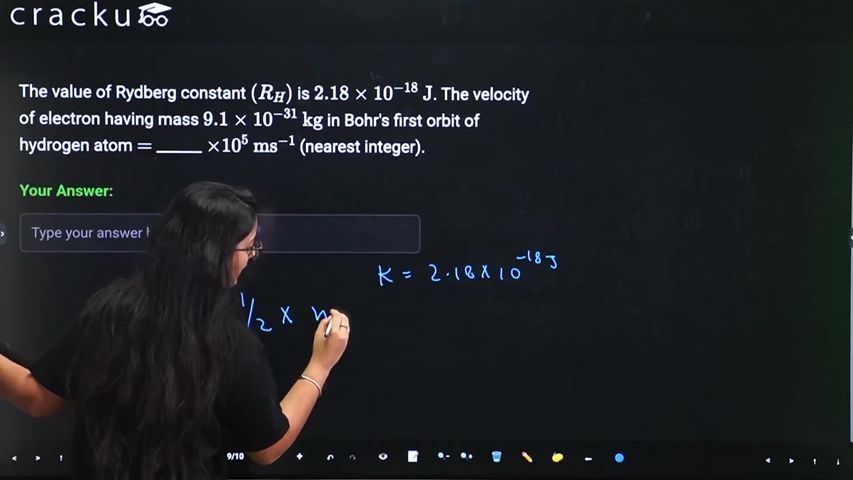
The value of Rydberg constant $$(R_H)$$ is $$2.18 \times 10^{-18} \text{ J}$$. The velocity of electron having mass $$9.1 \times 10^{-31} \text{ kg}$$ in Bohr's first orbit of hydrogen atom $$=$$ ______ $$\times 10^5 \text{ ms}^{-1}$$ (nearest integer).
Correct Answer: 22
We need to find the velocity of the electron in Bohr's first orbit of the hydrogen atom, given the Rydberg constant and electron mass.
Recall the energy relation in Bohr's model.
In Bohr's model, for the hydrogen atom in the first orbit ($$n = 1$$), the total energy is:
$$ E_1 = -R_H $$
where $$R_H = 2.18 \times 10^{-18}$$ J is the Rydberg constant (energy).
The total energy is the sum of kinetic and potential energies. For a circular orbit under Coulomb's law:
$$ E = -KE = \frac{PE}{2} $$
This gives us: $$KE = -E = R_H$$
Set up the kinetic energy equation.
$$ KE = \frac{1}{2}mv^2 = R_H $$
$$ \frac{1}{2} \times 9.1 \times 10^{-31} \times v^2 = 2.18 \times 10^{-18} $$
Solve for $$v^2$$.
$$ v^2 = \frac{2 \times 2.18 \times 10^{-18}}{9.1 \times 10^{-31}} $$
$$ v^2 = \frac{4.36 \times 10^{-18}}{9.1 \times 10^{-31}} $$
$$ v^2 = \frac{4.36}{9.1} \times 10^{-18+31} = 0.4791 \times 10^{13} = 4.791 \times 10^{12} \text{ m}^2\text{s}^{-2} $$
Calculate $$v$$.
$$ v = \sqrt{4.791 \times 10^{12}} $$
$$ v = \sqrt{4.791} \times 10^6 $$
$$ v \approx 2.189 \times 10^6 \text{ m/s} $$
Express in the required form.
$$ v = 2.189 \times 10^6 = 21.89 \times 10^5 \text{ m/s} $$
Rounding to the nearest integer: $$v \approx 22 \times 10^5$$ m/s.
The answer is $$\boxed{22}$$.
Was this solution helpful?
Click on the Email ☝️ to Watch the Video Solution
Create a FREE account and get:
_1.webp)

Educational materials for JEE preparation

Ask our AI anything

AI can make mistakes. Please verify important information.
AI can make mistakes. Please verify important information.
