
Join Our JEE Preparation Group
Prep with like-minded aspirants; Get access to free daily tests and study material.
Sign in
Please select an account to continue using cracku.in
↓ →
Join Our JEE Preparation Group
Prep with like-minded aspirants; Get access to free daily tests and study material.
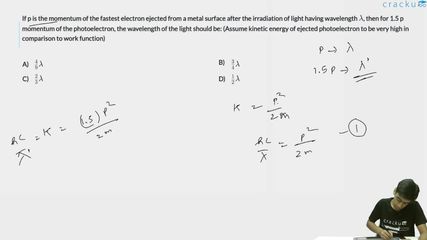
If p is the momentum of the fastest electron ejected from a metal surface after the irradiation of light having wavelength $$\lambda$$, then for 1.5 p momentum of the photoelectron, the wavelength of the light should be: (Assume kinetic energy of ejected photoelectron to be very high in comparison to work function)
For a photon of wavelength $$\lambda$$ incident on a metal surface, the energy carried by that photon is obtained from the Planck-Einstein relation
$$E_{\text{photon}}=\dfrac{hc}{\lambda}.$$
According to the photoelectric equation, this energy is used to do two things: overcome the work function $$\phi$$ of the metal and provide kinetic energy $$K$$ to the ejected electron:
$$\dfrac{hc}{\lambda}=K+\phi.$$
In the present question we are told that the kinetic energy of the electron is “very high in comparison to the work function.” Hence $$K\gg\phi$$, so we may safely neglect $$\phi$$ in comparison with $$K$$. The entire photon energy is therefore effectively converted into kinetic energy:
$$K\;\approx\;\dfrac{hc}{\lambda}.$$
The kinetic energy of a non-relativistic particle is related to its linear momentum $$p$$ by the classical formula
$$K=\dfrac{p^{2}}{2m},$$
where $$m$$ is the electron mass. Equating this expression for $$K$$ with the photon energy we have
$$\dfrac{p^{2}}{2m}=\dfrac{hc}{\lambda}.$$ Multiplying both sides by $$2m$$ gives
$$p^{2}=2m\,\dfrac{hc}{\lambda}.$$
Now, imagine we want the ejected electron to have a momentum equal to $$1.5p$$. Let the new wavelength required to achieve that larger momentum be $$\lambda'$$. Repeating the same energy-momentum relationship for this new situation, we write
$$\dfrac{(1.5p)^{2}}{2m}=\dfrac{hc}{\lambda'}.$$
Expanding the square on the left side,
$$(1.5p)^{2}=2.25\,p^{2},$$
so the equation becomes
$$\dfrac{2.25\,p^{2}}{2m}=\dfrac{hc}{\lambda'}.$$
But from our earlier work we already know that $$\dfrac{p^{2}}{2m}=\dfrac{hc}{\lambda}$$. Substituting this into the new equation yields
$$2.25\;\dfrac{hc}{\lambda}=\dfrac{hc}{\lambda'}.$$
We can cancel the common factor $$hc$$ on both sides:
$$2.25\;\dfrac{1}{\lambda}=\dfrac{1}{\lambda'}.$$
Taking reciprocals of both sides gives
$$\lambda'=\dfrac{\lambda}{2.25}.$$
Recognising that $$2.25=2\!\!.25=\dfrac{9}{4},$$ we rewrite the fraction clearly:
$$\lambda'=\dfrac{4}{9}\,\lambda.$$
Hence, the correct answer is Option A.
Was this solution helpful?
Click on the Email ☝️ to Watch the Video Solution
Create a FREE account and get:
_1.webp)

Educational materials for JEE preparation

Ask our AI anything

AI can make mistakes. Please verify important information.
AI can make mistakes. Please verify important information.


