
Join Our JEE Preparation Group
Prep with like-minded aspirants; Get access to free daily tests and study material.
Sign in
Please select an account to continue using cracku.in
↓ →
Join Our JEE Preparation Group
Prep with like-minded aspirants; Get access to free daily tests and study material.
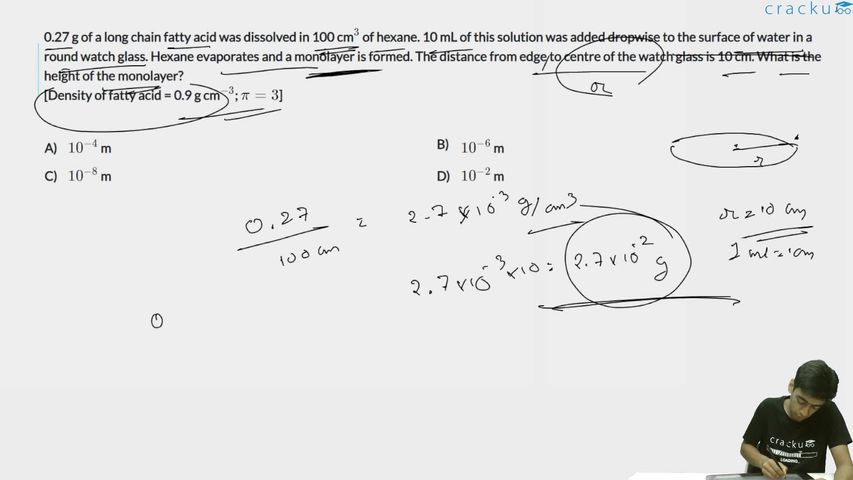
0.27 g of a long chain fatty acid was dissolved in 100 cm$$^3$$ of hexane. 10 mL of this solution was added dropwise to the surface of water in a round watch glass. Hexane evaporates and a monolayer is formed. The distance from edge to centre of the watch glass is 10 cm. What is the height of the monolayer?
[Density of fatty acid = 0.9 g cm$$^{-3}$$; $$\pi = 3$$]
We have a solution in which $$0.27\ \text{g}$$ of the long-chain fatty acid is dissolved in $$100\ \text{cm}^3$$ (that is, $$100\ \text{mL}$$) of hexane.
First we calculate the concentration of fatty acid in the solution. By definition
$$\text{Concentration}=\frac{\text{mass of solute}}{\text{volume of solution}} =\frac{0.27\ \text{g}}{100\ \text{cm}^3}=0.0027\ \text{g cm}^{-3}.$$
Now, only $$10\ \text{mL}=10\ \text{cm}^3$$ of this solution is taken. The mass of fatty acid present in this aliquot is therefore
$$m=\left(0.0027\ \text{g cm}^{-3}\right)\left(10\ \text{cm}^3\right)=0.027\ \text{g}.$$
When the hexane evaporates, this entire mass spreads out on the water surface to form a monomolecular layer. To find the thickness (height) of this layer, we first need the volume it occupies. Using the relation
$$\text{Volume}=\frac{\text{mass}}{\text{density}},$$
and the given density $$\rho =0.9\ \text{g cm}^{-3},$$ we get
$$V=\frac{0.027\ \text{g}}{0.9\ \text{g cm}^{-3}}=0.03\ \text{cm}^3.$$
Next we determine the area over which the fatty acid spreads. The watch glass has a circular water surface whose radius is the distance from edge to centre, namely $$r=10\ \text{cm}.$$ The area of a circle is given by
$$A=\pi r^{2}.$$
With the approximation $$\pi =3,$$ we have
$$A=3\,(10\ \text{cm})^{2}=3\times100\ \text{cm}^2=300\ \text{cm}^2.$$
The thickness (height) $$h$$ of the monolayer is the volume divided by the area:
$$h=\frac{V}{A}=\frac{0.03\ \text{cm}^3}{300\ \text{cm}^2}=0.0001\ \text{cm}=1\times10^{-4}\ \text{cm}.$$
To express this height in metres we use $$1\ \text{cm}=10^{-2}\ \text{m},$$ so
$$h=1\times10^{-4}\ \text{cm}\times10^{-2}\ \text{m cm}^{-1}=1\times10^{-6}\ \text{m}.$$
Hence, the correct answer is Option B.
Was this solution helpful?
Click on the Email ☝️ to Watch the Video Solution
Create a FREE account and get:
_1.webp)

Educational materials for JEE preparation

Ask our AI anything

AI can make mistakes. Please verify important information.
AI can make mistakes. Please verify important information.


