
Join Our JEE Preparation Group
Prep with like-minded aspirants; Get access to free daily tests and study material.
Sign in
Please select an account to continue using cracku.in
↓ →
Join Our JEE Preparation Group
Prep with like-minded aspirants; Get access to free daily tests and study material.
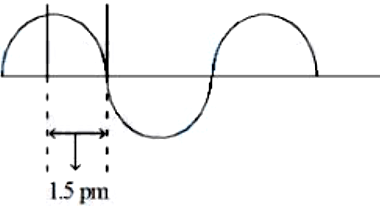
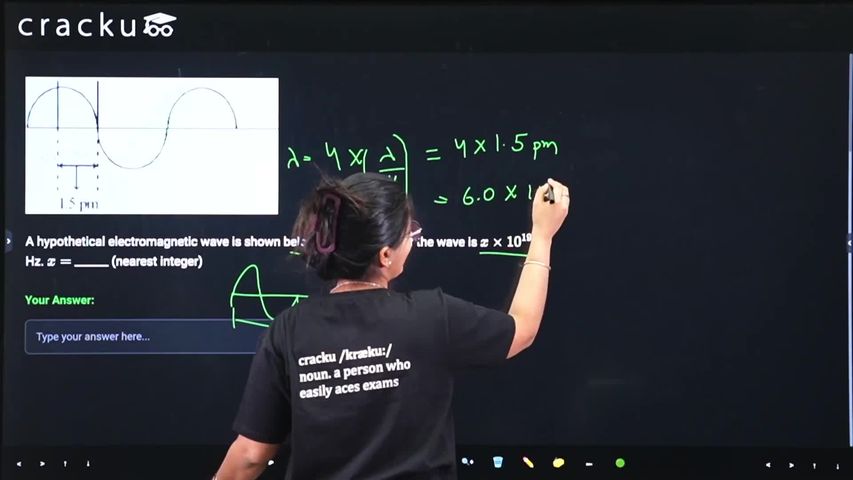
A hypothetical electromagnetic wave is shown below. The frequency of the wave is $$x \times 10^{19}$$ Hz. $$x =$$ ______ (nearest integer)
Correct Answer: 5
Looking at the diagram, the distance of 1.5 pm represents the distance from a peak (crest) to a zero-crossing (node).
Since this is an electromagnetic wave, it travels at the speed of light ($$c \approx 3 \times 10^8 \text{ m/s}$$). We use the standard wave equation:
$$c = \nu \lambda$$
Where:
Rearranging the formula to solve for frequency:
$$\nu = \frac{c}{\lambda} = \frac{3 \times 10^8 \text{ m/s}}{6 \times 10^{-12} \text{ m}}$$
Now, simplify the powers of ten:
$$\nu = 0.5 \times 10^{8 - (-12)} = 0.5 \times 10^{20} \text{ Hz}$$
$$\nu = 5 \times 10^{19} \text{ Hz}$$
Was this solution helpful?
Click on the Email ☝️ to Watch the Video Solution
Create a FREE account and get:
_1.webp)

Educational materials for JEE preparation

Ask our AI anything

AI can make mistakes. Please verify important information.
AI can make mistakes. Please verify important information.
