Join Our JEE Preparation Group
Prep with like-minded aspirants; Get access to free daily tests and study material.
Sign in
Please select an account to continue using cracku.in
↓ →
Join Our JEE Preparation Group
Prep with like-minded aspirants; Get access to free daily tests and study material.
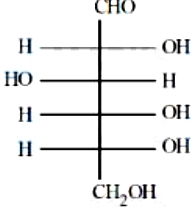
The given open-chain structure is that of an aldo-hexose, specifically $$D$$-glucose:
$$CHO{-}CH(OH){-}CH(OH){-}CH(OH){-}CH(OH){-}CH_2OH$$
In $$D$$-glucose, the aldehydic carbon is $$C_1$$, the primary alcohol is at $$C_6$$ and the internal carbons $$C_2$$ to $$C_5$$ each bear an $$OH$$ group.
We now examine every statement.
Statement A: “can be oxidized to a dicarboxylic acid with $$Br_2$$ water”
Bromine water is a mild and selective oxidising agent. It converts the $$-CHO$$ group of an aldose to $$-COOH$$ giving an aldonic acid, but it does not oxidise the terminal primary alcohol $$-CH_2OH$$. Hence glucose is changed to gluconic acid (only one $$-COOH$$), not to the dicarboxylic glucaric (saccharic) acid. Therefore Statement A is incorrect.
Statement B: “will coexist in equilibrium with 2 other cyclic structure”
In aqueous solution the open-chain form of glucose undergoes intramolecular hemi-acetal formation between $$C_1$$ and $$C_5$$ producing two anomers: $$\alpha$$-D-glucopyranose and $$\beta$$-D-glucopyranose. Thus three forms (open + 2 cyclic) are simultaneously present. So Statement B is correct.
Statement C: “despite the presence of -CHO does not give Schiff’s test”
Schiff’s reagent reacts only with a free aldehyde group. In solution the aldehyde of glucose is locked in the hemi-acetal ring; ring opening is slow under the very mild conditions of Schiff’s test, hence glucose gives a negative result. Statement C is correct.
Statement D: “has 4 asymmetric carbon atom”
The chiral centres in the open form are $$C_2, C_3, C_4,$$ and $$C_5$$ ⇒ four asymmetric carbons. Statement D is correct.
Only Statement A is wrong.
Option A which is: can be oxidized to a dicarboxylic acid with $$Br_2$$ water
Was this solution helpful?
Create a FREE account and get:
_1.webp)

Educational materials for JEE preparation

Ask our AI anything

AI can make mistakes. Please verify important information.
AI can make mistakes. Please verify important information.