Join WhatsApp Icon JEE WhatsApp Group
Question 52

Number of molecules from the following which are exceptions to octet rule is ______ $$CO_2$$, $$NO_2$$, $$H_2SO_4$$, $$BF_3$$, $$CH_4$$, $$SiF_4$$, $$ClO_2$$, $$PCl_5$$, $$BeF_2$$, $$C_2H_6$$, $$CHCl_3$$, $$CBr_4$$


Correct Answer: 6
image


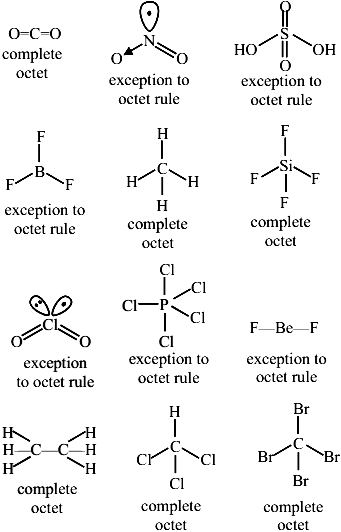
1. Complete Octet (8 Electrons)

These central atoms follow the standard rule by sharing electrons until they reach a stable count of 8.

  • $$\text{CO}_2$$ (Carbon): Carbon has 4 valence electrons and forms two double bonds with Oxygen. $$4 + 4 = 8$$ electrons.
  • $$\text{CH}_4$$ (Carbon): Carbon forms 4 single bonds with Hydrogen. $$4 \times 2 = 8$$ electrons.
  • $$\text{SiF}_4$$ (Silicon): Like Carbon, Silicon is in Group 14 and forms 4 single bonds. $$4 \times 2 = 8$$ electrons.
  • $$\text{C}_2\text{H}_6$$ (Carbons): Each Carbon forms 3 bonds with Hydrogen and 1 bond with the other Carbon. $$4 \times 2 = 8$$ electrons.
  • $$\text{CHCl}_3$$ & $$\text{CBr}_4$$ (Carbon): Carbon forms 4 single bonds with halogens. $$4 \times 2 = 8$$ electrons.

2. Exceptions: Incomplete Octet (< 8 Electrons)

These central atoms are stable even though they lack a full shell of 8 electrons.

  • $$\text{BF}_3$$ (Boron): Boron is in Group 13. It shares its 3 valence electrons to form 3 single bonds.
    • Total: 6 electrons.
  • $$\text{BeF}_2$$ (Beryllium): Beryllium is in Group 2. It shares its 2 valence electrons to form 2 single bonds.
    • Total: 4 electrons.

3. Exceptions: Expanded Octet (> 8 Electrons)

Elements in Period 3 or below have empty $$d$$-orbitals that allow them to hold more than 8 electrons.

  • $$\text{H}_2\text{SO}_4$$ (Sulfur): Sulfur forms 6 bonds (two double bonds with Oxygen, two single bonds with -OH).
    • Total: 12 electrons.
  • $$\text{PCl}_5$$ (Phosphorus): Phosphorus forms 5 single bonds with Chlorine.
    • Total: 10 electrons.
  • $$\text{ClO}_2$$ (Chlorine): Chlorine is bonded to two oxygens and retains lone pairs/unpaired electrons. In many Lewis representations, it exceeds 8 to reduce formal charge.

4. Exceptions: Odd-Electron Molecules

  • $$\text{NO}_2$$ (Nitrogen): Nitrogen has 5 valence electrons. Because 5 is an odd number, it is impossible to pair every electron.
    • Total: Nitrogen ends up with 7 valence electrons (one unpaired electron). This makes it a free radical.

Get AI Help

Video Solution

video

Create a FREE account and get:

  • Free JEE Mains Previous Papers PDF
  • Take JEE Mains paper tests

50,000+ JEE Students Trusted Our Score Calculator

Predict your JEE Main percentile, rank & performance in seconds

Ask AI

Ask our AI anything

AI can make mistakes. Please verify important information.