
Join Our JEE Preparation Group
Prep with like-minded aspirants; Get access to free daily tests and study material.
Sign in
Please select an account to continue using cracku.in
↓ →
Join Our JEE Preparation Group
Prep with like-minded aspirants; Get access to free daily tests and study material.
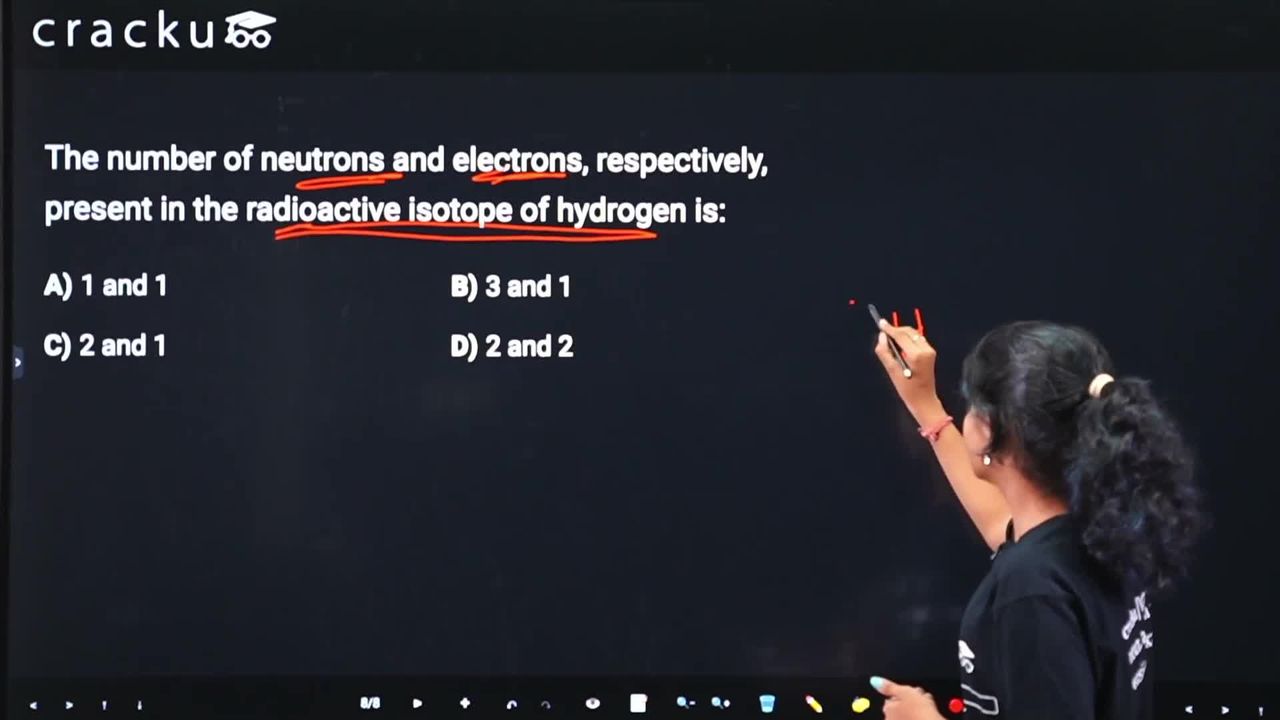
The number of neutrons and electrons, respectively, present in the radioactive isotope of hydrogen is:
We start by recalling that every isotope is written in the form $$\;^{A}_{Z}\text{X}\;$$ where $$A$$ is the mass number (total protons + neutrons) and $$Z$$ is the atomic number (only protons, which equals the number of electrons in a neutral atom).
The radioactive isotope of hydrogen is tritium, written as $$\;^{3}_{1}\text{H}\;$$ because hydrogen has atomic number $$Z=1$$ and tritium has mass number $$A=3$$.
We now apply the formula for neutrons:
Number of neutrons $$=A-Z$$
Substituting $$A=3$$ and $$Z=1$$, we get
$$\text{Neutrons}=3-1=2$$
Since the atom is neutral, the number of electrons equals the atomic number:
$$\text{Electrons}=Z=1$$
So, tritium contains $$2$$ neutrons and $$1$$ electron.
Among the given options, this corresponds to Option C.
Hence, the correct answer is Option C.
Was this solution helpful?
Click on the Email ☝️ to Watch the Video Solution
Create a FREE account and get:
_1.webp)

Educational materials for JEE preparation

Ask our AI anything

AI can make mistakes. Please verify important information.
AI can make mistakes. Please verify important information.
