Join WhatsApp Icon JEE WhatsApp Group

JEE Equilibrium Questions

JEE Equilibrium Questions

Question 1

Consider a weak base 'B' of $$pK_{b}=5.699 $$. 'x' mL of 0.02 M HCI and 'y' mL of 0.02 M weak base 'B' are mixed to make 100 mL of a buffer of pH 9 at 25 °C. The values of 'x' and 'y' respectively are:
[Given: log 2 = 0.3010, log 3 = 0.4771, log 5 = 0.699]

Question 2

The first and second ionization constants of a weak dibasic acid $$H_2A$$ are $$8.1 \times 10^{-8}$$ and $$1.0 \times 10^{-13}$$ respectively. 0.1 mol of $$H_2A$$ was dissolved in 1 L of 0.1 M HCl solution. The concentration of $$HA^-$$ in the resultant solution is :

Question 3

Consider the following gaseous equilibrimn in a closed container of volume 'V' at T(K).
$$P_{2}(g)+Q_{2}(g)\rightleftharpoons 2PQ(g)$$
2 moles each of $$P_{2}(g)$$, $$Q_{2}(g)$$ and PQ(g) are present at equilibrium. Now one mole each of'$$P_{2}$$' and '$$Q_{2}$$' are added to the equilibrium keeping the temperature at T(K). The number of moles of $$P_{2}$$, $$Q_{2}$$ and PQ at the new equilibrium, respectively, are

Question 4

20 mL of a solution of acetic acid required 28.4 mL of 0.1 M NaOH for its neutralization. A solution (X) was prepared by mixing 20 mL of the above acetic acid and 14.2 mL of 0.1 M NaOH solution. What is the pH of the solution (X)? (pK$$_a$$ value of acetic acid is 4.75).

Question 5

At $$T$$(K), the equilibrium constant of $$A_2(g) + B_2(g) \rightleftharpoons C(g)$$ is $$2.7 \times 10^{-5}$$. What is the equilibrium constant for $$\frac{1}{3}A_2(g) + \frac{1}{3}B_2(g) \rightleftharpoons \frac{1}{3}C(g)$$ at the same temperature?

Question 6

Consider the following reactions in which all the reactants and products are present in gaseous state
$$2xy \rightleftharpoons x_2 + y_2 \quad K_1 = 2.5 \times 10^5$$
$$xy + \frac{1}{2}z_2 \rightleftharpoons xyz \quad K_2 = 5 \times 10^{-3}$$
The value of $$K_3$$ for the equilibrium $$\frac{1}{2}x_2 + \frac{1}{2}y_2 + \frac{1}{2}z_2 \rightleftharpoons xyz$$ is :

Question 7

$$M_3A_2$$ is a sparingly soluble salt of molar mass $$y$$ g mol$$^{-1}$$ and solubility $$x$$ g L$$^{-1}$$. The ratio of the molar concentration of the anion ($$A^{3-}$$) to the solubility product of the salt is

Question 8

Arrange the following resultant mixtures in increasing order of their pH values
A. 10 mL 0.2 M Ca(OH)$$_2$$ + 25 mL 0.1 M HCl
B. 10 mL 0.01 M H$$_2$$SO$$_4$$ + 10 mL 0.01 M Ca(OH)$$_2$$
C. 10 mL 0.1 M H$$_2$$SO$$_4$$ + 10 mL 0.1 M KOH
Choose the correct answer from the options given below:

Question 9

At 25°C, 20.0 mL of 0.2 M weak monoprotic acid HX is titrated against 0.2 M NaOH. The pH of the solution (a) at the start of the titration (when NaOH has not been added) and (b) when 10 mL of NaOH is added respectively, are :
Given: $$K_a = 5 \times 10^{-4}$$,
$$pK_a = 3.3$$,
$$\alpha \ll 1$$

Question 10

Given is a concentrated solution of a weak electrolyte $$A_xB_y$$ of concentration 'c' and dissociation constant 'K'. The degree of dissociation is given by :

Question 11

The reaction $$A(g) \rightleftharpoons B(g) + C(g)$$ was initiated with the amount `$$a$$` of $$A(g)$$. At equilibrium it is found that the amount of $$A(g)$$ remaining is $$(a - x)$$ at a total pressure of $$p$$.
The equilibrium constant $$K_p$$ of the reaction can be calculated from the expression:

Question 12

The solubility product constants of Ag$$_2$$CrO$$_4$$ and AgBr are 32x and 4y respectively at 298 K. The value of $$\left(\frac{\text{molarity of Ag}_2\text{CrO}_4}{\text{molarity of AgBr}}\right)$$ can be expressed as :

Question 13

Observe the following equilibrium in a 1 L flask.
$$A(g)\rightleftharpoons B(g)$$
At T(K), the equilibrium concentrations of A and B are 0.5 Mand 0.375 M respectively. 0.1 moles of A is added into the flask and heated to T(K) to establish the equilibrium again. The new equilibrium concentrations (in M) of A and B are respectively

Question 14

One mole each of He and A(g) are taken in a 10 L closed flask and heated to 400 K to establish the following equilibrium.
A(g) $$\rightleftharpoons$$ B(g)
K$$_c$$ for this reaction at 400 K is 4.0. The partial pressures (in atm) of He and B(g) are respectively (at equilibrium)
(Assume He, A(g) and B(g) behave as ideal gases)
(Given: R = 0.082 L atm K$$^{-1}$$ mol$$^{-1}$$)

Question 15

Which of the followmg mixture gives a buffer solution with pH=9.25?
Given : $$pK_{b}$$ $$(NH_{4}OH)$$ = 4.75

Question 16

Consider two Group IV metal ious $$X^{2+}\text{ and }Y^{2+}$$
A solution containing $$0.01 M X^{2+}\text{ and }0.01MY^{2+}$$ is satmated with $$H_{2}S$$. The pH at which the metal sulphide YS will form as a precipitate is __ . (Nearest integer)
$$(Given:K_{sp}(XS)=1\times 10^{-22} \text{ at } 25^{\circ}C,K_{sp}(YS)=4\times 10^{-16} \text{ at } 25^{\circ}C,[H_{2}S]=0.1M\text{ in solution },K_{a1}\times K_{a2}(H_{2}S)=1.0\times 10^{-21},\log{2}=0.30,\log{3}=0.48,\log{5}=0.70)$$

Question 17

Dissociation of a gas $$A_{2}$$ takes place according to the following chemical reaction.
At equilibrium, the total pressure is 1 bar at 300K.

$$A_{2}(g)\rightleftharpoons 2A(g)$$

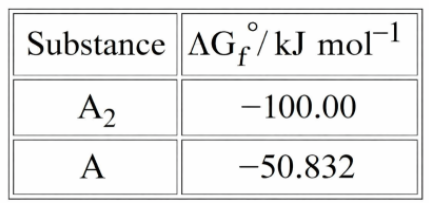
The standard Gibbs energy of formation of the involved substances has been
provided below:

22nd slot 1 72


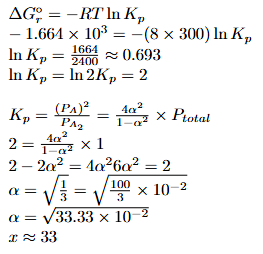
The degree of dissociation of $$A_{2} (g)$$ is given by $$(x\times10^{-2})^{1/2} $$ where $$x$$ =
_____ . (Nearest integer).
[Given: $$R=8 J \text{ }mol^{-1}K^{-1},\log{2}=0.3010, \log {3}=0.48]$$
Assume degree of dissociation is not negligible.

Question 18

The first and second ionization constants of $$H_{2}X$$ are $$2.5 \times 10^{-8}$$ and $$1.0 \times 10^{-13}$$ respectively. The concentration of $$X^{2-}$$ in $$0.1 MH_{2} X$$ solution is _________ $$\times 10^{-15}M$$. (Nearest Integer)

Question 19

$$X_2(g ) + Y_2(g ) \rightleftharpoons 2Z(g)$$

$$X_2(g )$$ and $$Y_2(g )$$ are added to a 1 L flask and it is found that the system attains the above equilibrium at T(K) with the number of moles of $$X_2(g ),\text{ } Y_2(g )$$ and $$Z(g)$$ being 3, 3 and 9 mol respectively (equilibrium moles). Under this condition of equilibrium, 10 mol of $$Z(g$$) is added to the flask and the temperature is maintained at $$T(K)$$. Then the number of moles of $$Z(g)$$ in the flask when the new equilibrium is established is __ . (Nearest integer)

Question 20

For the following gas phase equilibrium reaction at constant temperature,
$$NH_{3}(g)\rightleftharpoons 1/2N_{2}(g)+3/2H_{2}(g)$$
if the to tal pressure is $$\sqrt{3}$$ atm and the pressure equilibrium constant ($$K_{p}$$) is 9 atm, then the degree of dissociation is given as $$(x\times 10^{-2})^{-1/2}$$.The value of x is ______. (nearest integer)

Question 21

Molar conductivity of a weak acid HQ of concentration 0.18 M was found to be 1/30 of the molar conductivity of another weak acid HZ with concentration of 0.02M. If $$\lambda^{\circ}{}_{Q}-$$ happened to be equal with $$\lambda^{\circ}{}_{Z}-$$, then the difference of the $$pK_{a}$$ values of the two weak acids $$(pK_{a}(HQ) - pK_{a}(HZ))$$ is ___ (Nearest integer).
[Given: degree of dissociation ($$\alpha$$) << 1 for both weak acids, $$\lambda^{\circ}$$ : limiting molar conductivity of ions]

Question 22

Consider the dissociation equilibrium of the following weak acid $$HA\rightleftharpoons H^{+}(aq)+A^{-}(aq)$$If the pKa of the acid is 4, then the pH of 10 mM HA solution is __ .(Nearest integer)
[Given: The degree of dissociation can be neglected with respect to unity]

Question 23

In a closed flask at 600 K, one mole of $$X_2Y_4(g)$$ attains equilibrium as given below : $$$X_2Y_4(g) \rightleftharpoons 2XY_2(g)$$$ At equilibrium, 75% $$X_2Y_4(g)$$ was dissociated and the total pressure is 1 atm. The magnitude of $$\Delta_r G^{\ominus}$$ (in kJ mol$$^{-1}$$) at this temperature is __________. (Nearest Integer) (Given : R = 8.3 J mol$$^{-1}$$ K$$^{-1}$$; ln 10 = 2.3, log 2 = 0.3, log 3 = 0.48, log 5 = 0.69, log 7 = 0.84)

Question 24

The pH of a solution obtained by mixing 5 mL of 0.1 M $$\text{NH}_4\text{OH}$$ solution with 250 mL of 0.1 M $$\text{NH}_4\text{Cl}$$ solution is _____ $$\times 10^{-2}$$. (Nearest integer)
Given: $$\text{pK}_b(\text{NH}_4\text{OH}) = 4.74$$, $$\log 2 = 0.30$$, $$\log 3 = 0.48$$, $$\log 5 = 0.70$$

Question 25

Solid carbon, CaO and CaCO$$_3$$ are mixed and allowed to attain equilibrium at T K.
$$\text{CaCO}_3\text{(s)} \rightleftharpoons \text{CaO(s)} + \text{CO}_2\text{(g)} \quad K_{p_1} = 0.08$$ atm
$$\text{C(s)} + \text{CO}_2\text{(g)} \rightleftharpoons 2\text{CO(g)} \quad K_{p_2} = 2$$ atm
The partial pressure of CO is __________ $$\times 10^{-1}$$ atm

50,000+ JEE Students Trusted Our Score Calculator

Predict your JEE Main percentile, rank & performance in seconds