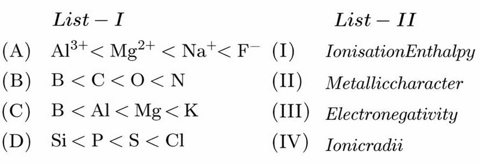
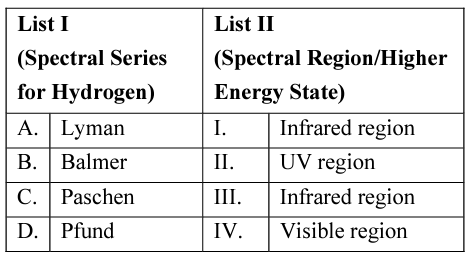
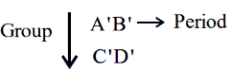
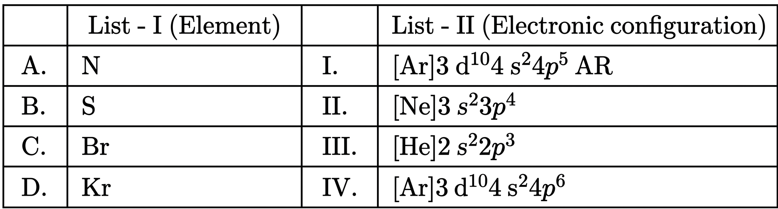
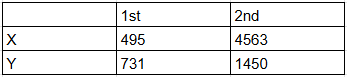
Which of the following represents the correct trend for the mentioned property ?
A.$$F > P > S > B$$ - First Ionization Energy
B.$$Cl > F > S > P$$ - Electron Affinity
C. $$K > Al > Mg > B$$ - Metallic character
D. $$K_{2}O > Na_{2}O > MgO > AL_{2}O_{3}$$ - Basic character
Choose the correct answer from the options given below :
JEE Periodic Table & Periodicity Questions
(A) First Ionization Energy
First ionization energy is the energy required to remove the outermost electron from an isolated gaseous atom.
General trend:
- Increases across a period (left to right)
- Decreases down a group
Exception:
P has higher ionization energy than S due to half-filled stability (P: $$3p³$$, S: $$3p⁴$$ has electron-electron repulsion).
Correct order:
F > P > S > B
Hence, option (A) is correct.
(B) Electron Affinity
Electron affinity is the energy released when an electron is added to an isolated gaseous atom.
General trend:
- Increases across a period
- Decreases down a group
Exception:
Cl has higher electron affinity than F due to lower electron-electron repulsion in the larger size of Cl.
Correct order:
Cl > F > S > P
Hence, option (B) is correct.
(C) Metallic Character
Metallic character is the tendency of an element to lose electrons.
General trend:
- Decreases across a period
- Increases down a group
Correct order should be:
K > Mg > Al > B
Given order (K > Al > Mg > B) is incorrect.
Hence, option (C) is incorrect.
(D) Basic Character of Oxides
Basic character is the tendency of oxides to react with acids.
General trend:
- Increases with metallic character
Correct order:
$$K₂O > Na₂O > MgO > Al₂O₃$$
($$Al₂O₃$$ is amphoteric)
Hence, option (D) is correct.
Final answer: A, B and D are correct
Elements X and Y belong to Group 15 . The difference between the electronegativity values of 'X' and phosphorus is higher than that of the difference between phosphorus and 'Y'. 'X' & 'Y' are respectively
We need to identify elements X and Y from Group 15, where the difference in electronegativity between X and P is greater than the difference between P and Y.
In Group 15, electronegativity generally decreases down the group: N > P > As > Sb > Bi. The Pauling electronegativity values are approximately: N(3.04), P(2.19), As(2.18), Sb(2.05), Bi(2.02).
For the condition to hold, $$|EN_X - EN_P| > |EN_P - EN_Y|$$, we need X to be farther from P in electronegativity than Y.
Check Option (2): X = N, Y = As.
$$|EN_N - EN_P| = |3.04 - 2.19| = 0.85$$
$$|EN_P - EN_{As}| = |2.19 - 2.18| = 0.01$$
$$0.85 > 0.01$$ ✓
This satisfies the given condition. N is much more electronegative than P (large difference), while As has nearly the same electronegativity as P (small difference).
The correct answer is Option (2): N and As.
Given below are two statements :
Statement I : C < 0 < N < F is the correct order in terms of first ionization enthalpy values.
Statement II: S > Se > Te > Po > 0 is the correct order in terms of the magnitude of electron gain enthalpy values.
ln the light of the above statements, choose the correct answer from the options given below:
We need to evaluate two statements about ionization enthalpy and electron gain enthalpy.
Analysis of Statement I: C < O < N < F is the correct order of first ionization enthalpy.
The first ionization enthalpies (in kJ/mol) are approximately: C (1086), O (1314), N (1402), F (1681). The correct increasing order is: C < O < N < F.
Nitrogen has a higher ionization enthalpy than oxygen because nitrogen has a half-filled $$2p^3$$ configuration, which provides extra stability. Removing an electron from this stable configuration requires more energy than removing one from oxygen's $$2p^4$$ configuration (where one orbital has a paired electron, causing electron-electron repulsion).
The order C < O < N < F given in Statement I is correct. Statement I is TRUE.
Analysis of Statement II: S > Se > Te > Po > O is the correct order of magnitude of electron gain enthalpy.
Electron gain enthalpy (magnitude, in kJ/mol): O (141), S (200), Se (195), Te (190), Po (174). Oxygen has an anomalously low electron gain enthalpy due to its small atomic size, causing significant electron-electron repulsion in the compact $$2p$$ orbital.
The correct order is: S > Se > Te > Po > O. This matches Statement II. Statement II is TRUE.
The correct answer is Option 4: Both Statement I and Statement II are true.
Given below are two statements:
Statement I: The second ionisation enthalpy of Na is larger than the corresponding ionisation enthalpy of Mg.
Statement II: The ionic radius of $$O^{2-}$$ is larger than that of $$F^{-}$$.
In the light of the above statements, choose the correct answer from the options given below
We need to evaluate two statements about ionization enthalpy and ionic radius.
Statement I: The second ionisation enthalpy of Na is larger than the corresponding ionisation enthalpy of Mg.
The second ionization involves removing an electron from:
- Na$$^+$$: configuration $$[Ne]$$ ($$1s^2 2s^2 2p^6$$) -- removing an electron from the stable noble gas core requires enormous energy (IE$$_2$$ of Na $$\approx$$ 4562 kJ/mol).
- Mg$$^+$$: configuration $$[Ne] 3s^1$$ -- removing the lone $$3s$$ electron is much easier (IE$$_2$$ of Mg $$\approx$$ 1451 kJ/mol).
Since removing a core electron from Na$$^+$$ requires far more energy than removing a valence electron from Mg$$^+$$, Statement I is TRUE.
Statement II: The ionic radius of $$O^{2-}$$ is larger than that of $$F^-$$.
Both $$O^{2-}$$ and $$F^-$$ are isoelectronic with 10 electrons each. For isoelectronic species, the ion with fewer protons (lower nuclear charge) has a larger radius because the electrons are less tightly held.
- $$O^{2-}$$: 8 protons, 10 electrons
- $$F^-$$: 9 protons, 10 electrons
Since oxygen has fewer protons, $$O^{2-}$$ has a larger ionic radius ($$O^{2-} \approx 1.40$$ angstroms vs $$F^- \approx 1.33$$ angstroms). Statement II is TRUE.
The correct answer is Option 3: Both Statement I and Statement II are true.
In period 4 of the periodic table, the elements with highest and lowest atomic radii are respectively.
We need to identify the elements with the highest and lowest atomic radii in Period 4 of the periodic table.
Key Concept: Trend of Atomic Radius Across a Period
As we move from left to right across a period, the atomic radius generally decreases. This is because:
- The nuclear charge (number of protons) increases with each successive element.
- Electrons are added to the same principal energy level (same shell), so the shielding effect does not increase significantly.
- The increased effective nuclear charge pulls the electron cloud closer to the nucleus, reducing the atomic radius.
Period 4 elements: K, Ca, Sc, Ti, V, Cr, Mn, Fe, Co, Ni, Cu, Zn, Ga, Ge, As, Se, Br, Kr
Highest atomic radius:
Potassium (K) is the first element in Period 4 (Group 1, alkali metal). It has the lowest effective nuclear charge among Period 4 elements and its outermost electron is in the 4s orbital with minimal nuclear attraction. K has the largest atomic radius in Period 4 (approximately 227 pm).
Lowest atomic radius:
Noble gases (Kr) have special considerations - their atomic radii are measured differently (van der Waals radii vs covalent radii). When considering covalent atomic radii, Bromine (Br) is the element with the smallest atomic radius in Period 4, as it is the rightmost element before the noble gas Kr and has the highest effective nuclear charge among the elements that form covalent bonds. Br has a covalent radius of approximately 114 pm.
Note: Options 3 (Na and Cl) and 4 (Rb and Br) include elements not in Period 4. Na and Cl are in Period 3, and Rb is in Period 5. These can be eliminated immediately.
The correct answer is Option 1: K and Br.
The 1$$^{st}$$ ionization enthalpy for Mg is +737 kJ/mol. The most probable estimated value of the 2$$^{nd}$$ ionization enthalpy of Mg is ______.
The atomic configuration of neutral magnesium is $$1s^2\,2s^2\,2p^6\,3s^2$$.
• First ionization enthalpy ($$\Delta_iH_1$$) removes one $$3s$$ electron:
$$Mg(g) \;\xrightarrow{+\;737\;{\rm kJ\;mol^{-1}}}\; Mg^{+}(g) + e^-$$
• The resulting $$Mg^{+}$$ ion now has the configuration $$1s^2\,2s^2\,2p^6\,3s^1$$. The next (second) electron to be removed is the remaining $$3s$$ electron, still situated in the outermost $$n=3$$ shell. Because the effective nuclear charge experienced by this electron is higher (one electron fewer while the nuclear charge is unchanged), a larger energy input is needed, but no shell‐change is involved yet.
Hence the second ionization enthalpy ($$\Delta_iH_2$$) must be:
1. Positive (energy has to be supplied).
2. Greater than $$737\;{\rm kJ\;mol^{-1}}$$ but not astronomically large (huge jump occurs only for the third ionization when the noble-gas core begins to ionize).
Among the given choices, only $$+1450\;{\rm kJ\;mol^{-1}}$$ satisfies both conditions: it is larger than the first ionization enthalpy yet still far below the multi-thousand values typical after the noble-gas core is breached.
Therefore the most probable second ionization enthalpy of magnesium is
Option C which is: $$+1450\;{\rm kJ\;mol^{-1}}$$
A monoatomic anion $$(A^-)$$ has 45 neutrons and 36 electrons. Atomic mass, group in the periodic table and physical state at room temperature of the element $$(A)$$ respectively are :
The monoatomic anion is $$A^-$$ and it is given that it possesses $$36$$ electrons.
For any species,
$$\text{number of electrons} = Z - (\text{charge})$$.
Since the charge on $$A^-$$ is $$-1$$, we have
$$36 = Z + 1 \; \; \Rightarrow \; \; Z = 35$$.
Atomic number $$35$$ corresponds to the element bromine (symbol $$Br$$).
The anion contains $$45$$ neutrons. For any nuclide,
$$\text{mass number } (A) = Z + N$$,
where $$N$$ is the number of neutrons. Hence
$$A = 35 + 45 = 80$$.
Bromine belongs to the halogen family, i.e. Group $$17$$ of the periodic table.
At room temperature (≈298 K), elemental bromine exists as a reddish-brown liquid. It is one of only two elements that are liquids under these conditions (the other being mercury).
Therefore the required set {atomic mass, group, physical state} is $$80, 17, \text{liquid}$$.
Option A which is: $$80, 17, \text{liquid}$$
Given below are two statements :
Statement I : The increasing order of boiling point of hydrogen halides is $$HCl < HBr < HI < HF$$.
Statement II: The increasing order of melting point of hydrogen halides is $$HCl < HBr < HF < HI$$.
In the light of the above statements, choose the correct answer from the options given below :
Statement I: Increasing order of boiling points: HCl < HBr < HI < HF.
Since boiling points are influenced by hydrogen bonding and molecular weight, we recall the values for hydrogen halides.
- HF: 19.5°C (very high due to strong hydrogen bonding)
- HCl: −85°C
- HBr: −66.8°C
- HI: −35.4°C
This gives the trend HCl (−85°C) < HBr (−66.8°C) < HI (−35.4°C) < HF (19.5°C), which confirms the proposed order ✓
Statement I is TRUE.
Statement II: Increasing order of melting points: HCl < HBr < HF < HI.
Substituting the known melting points for these compounds yields:
- HF: −83.6°C
- HCl: −114.2°C
- HBr: −86.8°C
- HI: −50.8°C
From the above, the sequence becomes HCl (−114.2°C) < HBr (−86.8°C) < HF (−83.6°C) < HI (−50.8°C) ✓
Statement II is TRUE.
Note that for melting points, HF does not maintain the highest value despite hydrogen bonding; instead, HI exhibits the highest melting point due to its larger molecular size and stronger van der Waals forces. This difference in trend between boiling and melting points arises because solid-state packing and intermolecular interactions affect melting behavior differently.
The answer is Option A: Both Statement I and Statement II are true.
In a period, the first ionisation enthalpy of the element at extreme left and the negative electron gain enthalpy of the extreme right element, except noble gases, are respectively.
Match List - I with List - II.
List - I (Electronic configuration of neutral atom where n = 2) List - II (1st Ionization Energy in kJ mol$$^{-1}$$)
A. ns$$^2$$ I. 2080
B. ns$$^2$$np$$^1$$ II. 899
C. ns$$^2$$np$$^3$$ III. 800
D. ns$$^2$$np$$^6$$ IV. 1402
Choose the correct answer from the options given below :
Given below are two statements:
Statement I: K > Mg > Al > B is the correct order in terms of metallic character.
Statement II: Atomic radius is always greater than the ionic radius for any element.
In the light of the above statements, choose the correct answer from the options given below
We need to evaluate two statements about periodicity.
Statement I: K > Mg > Al > B is the correct order in terms of metallic character.
Metallic character increases as we go down a group and decreases across a period (left to right). Let us analyze:
- K (Potassium): Group 1, Period 4 - very high metallic character
- Mg (Magnesium): Group 2, Period 3
- Al (Aluminium): Group 13, Period 3
- B (Boron): Group 13, Period 2 - lowest metallic character (B is actually a metalloid)
The order K > Mg > Al > B is correct: K is the most metallic (alkali metal), followed by Mg (alkaline earth), then Al (post-transition metal), and B (metalloid, least metallic).
Statement I is TRUE.
Statement II: Atomic radius is always greater than the ionic radius for any element.
This is FALSE. While it is true that cations (formed by losing electrons) have smaller radii than their parent atoms, anions (formed by gaining electrons) have LARGER radii than their parent atoms. For example:
- Cl atom radius $$\approx 99$$ pm, but Cl$$^-$$ ionic radius $$\approx 181$$ pm (anion is larger)
- O atom radius $$\approx 73$$ pm, but O$$^{2-}$$ ionic radius $$\approx 140$$ pm (anion is larger)
So the statement that atomic radius is ALWAYS greater than ionic radius is incorrect for anions.
The correct answer is Option 1: Statement I is true but Statement II is false.
Given below are two statements : **Statement (I) :** The first ionisation enthalpy of the elements Na, Mg, Cl and Ar follows the order Na > Mg > Cl > Ar. **Statement (II) :** Among Ca, Al, Fe and B, the third ionisation enthalpy is very high for Ca. In the light of the above statements, choose the correct answer from the options given below :
The ionisation enthalpy (IE) is the energy required to remove an electron from a gaseous atom/ion. Across a period: nuclear charge increases, atomic size decreases ⇒ IE usually increases. Down a group: atomic size increases, shielding increases ⇒ IE usually decreases. Extra-stable configurations (filled or half-filled subshells, noble-gas cores) raise IE significantly.
Checking Statement (I)
Elements considered: Na (Z = 11), Mg (12), Cl (17), Ar (18).
Across the third period the general trend is $$\text{IE}(\text{Na}) \lt \text{IE}(\text{Mg}) \lt \dots \lt \text{IE}(\text{Cl}) \lt \text{IE}(\text{Ar})$$ because:
• Mg has higher IE than Na due to greater nuclear charge and similar shielding.
• Ar, a noble gas with completely filled subshells, has the highest IE in the period.
• Cl lies just before Ar, so its IE is lower than that of Ar but higher than those of Mg and Na.
Thus the correct order is $$\text{Na} \lt \text{Mg} \lt \text{Cl} \lt \text{Ar}$$ whereas Statement (I) claims the reverse order $$\text{Na} \gt \text{Mg} \gt \text{Cl} \gt \text{Ar}$$. Hence Statement (I) is false.
Checking Statement (II)
Third ionisation enthalpy, IE₃, means the energy to remove the third electron, i.e.
$$\text{(X}^{2+}) \rightarrow \text{X}^{3+}+e^-$$
Electronic configurations after removal of two electrons:
• Ca (Z = 20): $$\text{Ca}^{2+}:[\text{Ar}]$$ (noble-gas core). Removing a third electron would have to disturb the filled 3p core, so IE₃ becomes extremely large.
• Al (Z = 13): $$\text{Al}^{2+}:[\text{Ne}]\,3s^1$$. The third electron is still a valence 3s electron; removal is easier than breaking into the core.
• Fe (Z = 26): $$\text{Fe}^{2+}:[\text{Ar}]\,3d^6$$. The third electron comes from the 3d subshell, also part of the valence shell, so IE₃ is moderate.
• B (Z = 5): $$\text{B}^{2+}:[\text{He}]\,2s^1$$. Again, the electron removed in IE₃ is a valence 2s electron, not a core electron.
Therefore IE₃ shows a very large jump only for Ca because it requires removing a core (3p) electron after achieving the stable [Ar] configuration. Hence Statement (II) is true.
Summary: Statement (I) is false, Statement (II) is true. Correct option: Option D which is: Statement I is false but Statement II is true.
Given below are two statements :
Statement I : The second ionization enthalpy of B, Al and Ga is in the order of $$B > Al > Ga$$.
Statement II : The correct order in terms of first ionization enthalpy is $$Si < Ge < Pb < Sn$$.
In the light of the above statements, choose the correct answer from the options given below:
First recall the definition: the $$n^{\text{th}}$$ ionization enthalpy is the energy required to remove the $$n^{\text{th}}$$ electron after the previous $$(n-1)$$ electrons have already been removed. Hence for second ionization enthalpy we must look at the species $$M^{+}$$, not the neutral atom.
Statement I: “The second ionization enthalpy of $$B,\;Al$$ and $$Ga$$ is in the order $$B \gt Al \gt Ga$$”.
Electronic configurations and their singly-charged cations are
$$B : 1s^{2}\;2s^{2}\;2p^{1} \;\;\;\; \rightarrow \;\;\; B^{+} : 1s^{2}\;2s^{2}$$
$$Al : [Ne]\;3s^{2}\;3p^{1} \;\;\;\; \rightarrow \;\;\; Al^{+} : [Ne]\;3s^{2}$$
$$Ga : [Ar]\;3d^{10}\;4s^{2}\;4p^{1} \;\;\;\; \rightarrow \;\;\; Ga^{+} : [Ar]\;3d^{10}\;4s^{2}$$
In $$B^{+}$$ the next electron has to be removed from the compact, inner $$2s$$ orbital which experiences a very high effective nuclear charge, giving a very large $$IE_2$$.
In $$Al^{+}$$ the electron is removed from $$3s$$, farther from the nucleus and better shielded, so $$IE_2$$ is lower.
In $$Ga^{+}$$ the electron is taken from $$4s$$, but the presence of the filled $$3d^{10}$$ core gives poor shielding, so its $$IE_2$$ is higher than that of $$Al^{+}$$ but still lower than that of $$B^{+}$$.
Actual experimental values (kJ mol-1): $$IE_2(B)=2427,\; IE_2(Al)=1817,\; IE_2(Ga)=1979$$.
Order: $$B \gt Ga \gt Al$$, not $$B \gt Al \gt Ga$$. Hence Statement I is false.
Statement II: “The correct order of first ionization enthalpy is $$Si \lt Ge \lt Pb \lt Sn$$”.
Move down group 14 (Si, Ge, Sn, Pb): the atomic size increases, so ionization enthalpy generally decreases; however, poor shielding by $$d$$ and $$f$$ electrons causes a small rise from Sn to Pb.
Experimental $$IE_1$$ values (kJ mol-1):
$$Si=786,\; Ge=762,\; Sn=709,\; Pb=715$$
So the increasing (lowest → highest) order is
$$Sn \lt Pb \lt Ge \lt Si$$, while the decreasing (highest → lowest) order is
$$Si \gt Ge \gt Pb \gt Sn$$.
The sequence given in Statement II, $$Si \lt Ge \lt Pb \lt Sn$$, is exactly opposite to the facts, therefore Statement II is also false.
Because both statements are incorrect, the correct choice is:
Option B which is: Both Statement I and Statement II are false.
The correct trend in the first ionization enthalpies of the elements in the $$3^{rd}$$ period of periodic table is:
The elements present in the $$3^{rd}$$ period are $$Na, Mg, Al, Si, P, S, Cl, Ar$$.
First ionization enthalpy (IE$$_1$$) generally increases from left to right across a period because
- atomic size decreases, and
- effective nuclear charge $$Z_{\text{eff}}$$ increases.
There are two characteristic exceptions in this period:
Case 1: $$Mg \gt Al$$ because $$Mg$$ has the stable configuration $$3s^{2}$$, whereas in $$Al$$ the electron is removed from the higher-energy $$3p^{1}$$ subshell, so less energy is needed.
Case 2: $$P \gt S$$ because $$P$$ possesses the half-filled configuration $$3p^{3}$$, which is more stable than the $$3p^{4}$$ configuration of $$S$$. Hence an electron is removed more easily from $$S$$.
Experimental IE$$_1$$ values (in $$\text{kJ mol}^{-1}$$) confirm this trend:
$$IE_1(Na)=496 \lt IE_1(Mg)=738 \gt IE_1(Al)=578 \lt IE_1(Si)=787 \lt IE_1(S)=999 \lt IE_1(P)=1012 \lt IE_1(Cl)=1251 \lt IE_1(Ar)=1521$$.
Keeping only the elements quoted in the options and arranging them in ascending order:
$$Al \lt Si \lt S \lt P \lt Cl$$
This sequence corresponds to Option A.
Hence, the correct trend in first ionization enthalpies for the given elements of the $$3^{rd}$$ period is $$Al \lt Si \lt S \lt P \lt Cl$$; the correct answer is Option A.
Consider the elements N, P, 0, S,Cl and F. The number of valence electrons present in the elements with most and least metallic character from the above list is respectively.
To solve this problem, we need to identify the elements with the most and least metallic character from the list: Nitrogen (N), Phosphorus (P), Oxygen (O), Sulfur (S), Chlorine (Cl), and Fluorine (F). Then, we determine their valence electrons.
First, recall that metallic character decreases from left to right across a period and increases down a group in the periodic table. Valence electrons are the electrons in the outermost shell.
List the elements with their groups and valence electrons:
- N (Nitrogen): Group 15, valence electrons = 5
- P (Phosphorus): Group 15, valence electrons = 5
- O (Oxygen): Group 16, valence electrons = 6
- S (Sulfur): Group 16, valence electrons = 6
- Cl (Chlorine): Group 17, valence electrons = 7
- F (Fluorine): Group 17, valence electrons = 7
Now, compare metallic character:
- Within Group 15: P is below N, so P has higher metallic character than N.
- Within Group 16: S is below O, so S has higher metallic character than O.
- Within Group 17: Cl is below F, so Cl has higher metallic character than F.
Compare across groups and periods:
- In Period 2: Metallic character decreases left to right, so N > O > F.
- In Period 3: Metallic character decreases left to right, so P > S > Cl.
Now, compare all elements:
- P (Period 3, Group 15) has higher metallic character than S and Cl in the same period.
- P also has higher metallic character than N (same group, but P is below N).
- Thus, P has the highest metallic character in the list.
For the least metallic character:
- F is the most non-metallic element due to high electronegativity and top-right position.
- F has lower metallic character than O (same period, but F is to the right) and Cl (same group, but F is above).
- Thus, F has the least metallic character in the list.
Therefore:
- Element with most metallic character: P, valence electrons = 5
- Element with least metallic character: F, valence electrons = 7
The numbers are 5 and 7, corresponding to option B.
Given below are two statements:
Statement I: The correct order in terms of atomic/ionic radii is $$Al >Mg > Mg^{2+} >Al^{3+}$$
Statement II: The correct order in terms of the magnitude of electron gain enthalpy is Cl > Br >S >O.
In the light of the above statements, choose the correct answer from the options given below:
We need to evaluate two statements about atomic/ionic radii and electron gain enthalpy.
Statement I claims the order in terms of atomic/ionic radii is $$Al > Mg > Mg^{2+} > Al^{3+}$$. Comparing atomic radii of Al and Mg shows that Mg (Z = 12) has an atomic radius of about 160 pm, while Al (Z = 13) has an atomic radius of about 143 pm. As one moves from left to right across a period, the atomic radius decreases due to increasing nuclear charge with the same number of electron shells; thus Mg > Al, making the assertion Al > Mg incorrect. For the ionic radii, $$Mg^{2+}$$ (10 electrons, Z = 12) has a radius of approximately 72 pm, and $$Al^{3+}$$ (10 electrons, Z = 13) has a radius of approximately 53.5 pm. Both ions are isoelectronic, but the higher nuclear charge in $$Al^{3+}$$ leads to a smaller radius, so $$Mg^{2+} > Al^{3+}$$ is correct. Since the first part of the statement is wrong, Statement I is false.
Statement II asserts the order of the magnitude of electron gain enthalpy as $$Cl > Br > S > O$$. The electron gain enthalpy $$\Delta_{eg}H$$ represents the enthalpy change when a gaseous atom gains an electron. The magnitudes of the electron gain enthalpies are |-349| = 349 kJ/mol for Cl, |-325| = 325 kJ/mol for Br, |-200| = 200 kJ/mol for S, and |-141| = 141 kJ/mol for O. Oxygen shows a lower magnitude than expected because its small 2p subshell results in significant electron-electron repulsion when an extra electron is added. Therefore, the order $$Cl > Br > S > O$$ is correct, and Statement II is true.
Hence, the correct answer is Option (1): Statement I is false but Statement II is true.
The correct order of C, N, 0 and F in terms of second ionisation potential is
We need to find the correct order of C, N, O, and F in terms of second ionisation potential (IE$$_2$$).
Write the electronic configurations of the singly charged cations.
The second ionization removes an electron from the singly charged cation:
C$$^+$$ (5 electrons): $$1s^2\,2s^2\,2p^1$$ — removing the lone $$2p$$ electron
N$$^+$$ (6 electrons): $$1s^2\,2s^2\,2p^2$$ — removing one of two $$2p$$ electrons
O$$^+$$ (7 electrons): $$1s^2\,2s^2\,2p^3$$ — removing from a half-filled, extra-stable $$2p$$ subshell
F$$^+$$ (8 electrons): $$1s^2\,2s^2\,2p^4$$ — removing one paired $$2p$$ electron
Apply trends and anomalies.
General trend: IE$$_2$$ increases with nuclear charge (left to right in period).
Anomaly: O$$^+$$ has the half-filled $$2p^3$$ configuration, which has extra exchange energy stabilization. Removing an electron from this configuration requires more energy than expected. This makes IE$$_2$$(O) anomalously high, even exceeding IE$$_2$$(F) despite F having a higher nuclear charge.
For F$$^+$$ ($$2p^4$$), the fourth electron is paired, making it relatively easier to remove compared to the half-filled O$$^+$$.
Determine the order.
Standard IE$$_2$$ values (kJ/mol): C (2353) < N (2856) < F (3374) < O (3388)
Order: $$\text{C} < \text{N} < \text{F} < \text{O}$$
The correct answer is Option C: C < N < F < O.
First and second ionization enthalpies of lithium are 520 kJ mol$$^{-1}$$ and 7297 kJ mol$$^{-1}$$ respectively. Energy required to convert 3.5 mg lithium (g) into Li$$^{2+}$$(g) [Li(g) $$\to$$ Li$$^{2+}$$(g)] is _______ kJ mol$$^{-1}$$. (nearest integer)
[Molar mass of Li = 7 g mol$$^{-1}$$]
The incorrect relationship in the following pairs in relation to ionisation enthalpies is :
Ionisation enthalpy (IE) of an ion is the energy required to remove one electron from that ion and convert it into the next higher-charged ion.
Two main points decide the magnitude of an IE:
(i) Higher positive charge on the ion → stronger attraction for the remaining electrons → larger IE.
(ii) Extra stability of half-filled $$d^{5}$$ or completely filled $$d^{10}$$ subshells → larger IE, because removing an electron disturbs that stable configuration.
Let us write the ground-state electronic configurations (after removing the outer $$4s$$ electrons first) and analyse every pair.
Case A:$$Mn^{+} : [Ar]\;3d^{5}\,4s^{1}$$
$$Cr^{+} : [Ar]\;3d^{5}$$
To ionise $$Mn^{+}$$ we remove the remaining $$4s^{1}$$ electron, reaching the very stable $$[Ar]\;3d^{5}$$ state. This is easy.
To ionise $$Cr^{+}$$ we would have to disturb the already stable $$3d^{5}$$ set. This is difficult.
Hence $$IE(Mn^{+}) \lt IE(Cr^{+})$$, the given inequality is correct.
Successive ionisation energies always rise because the nuclear charge experienced per electron increases after each removal. Therefore $$IE(Mn^{2+})$$ (third IE of Mn) is definitely greater than $$IE(Mn^{+})$$ (second IE of Mn).
So $$IE(Mn^{+}) \lt IE(Mn^{2+})$$, the given inequality is correct.
$$Fe^{2+} : [Ar]\;3d^{6}$$
$$Fe^{3+} : [Ar]\;3d^{5}$$ (half-filled, extra stable)
Removing one electron from $$Fe^{2+}$$ produces the very stable half-filled configuration of $$Fe^{3+}$$, so $$IE(Fe^{2+})$$ is comparatively low.
Removing one more electron from $$Fe^{3+}$$ would break that half-filled stability, so $$IE(Fe^{3+})$$ is very high.
Therefore $$IE(Fe^{2+}) \lt IE(Fe^{3+})$$, the given inequality is correct.
$$Mn^{2+} : [Ar]\;3d^{5}$$ (half-filled, highly stable)
$$Fe^{2+} : [Ar]\;3d^{6}$$
To ionise $$Mn^{2+}$$ we would have to disturb the stable $$3d^{5}$$ arrangement, so $$IE(Mn^{2+})$$ is very large.
To ionise $$Fe^{2+}$$ we move from $$3d^{6} \rightarrow 3d^{5}$$, attaining the half-filled stability; this process needs less energy.
Hence $$IE(Mn^{2+}) \gt IE(Fe^{2+})$$.
The statement given in Option D, $$Mn^{2+} \lt Fe^{2+}$$, is opposite to the actual order and is therefore incorrect.
Among the four options, only Option D shows a wrong relationship of ionisation enthalpies.
Final answer: Option D (4).
The property/properties that show irregularity in first four elements of group-17 is/are:
(A) Covalent radius
(B) Electron affinity
(C) Ionic radius
(D) First ionization energy
Choose the correct answer from the options given below:
Group-17 elements in their normal sequence are $$F, Cl, Br, I$$. For each periodic property we compare the numerical values of these four elements and see whether the trend is strictly monotonic (regular) or has an exception (irregular).
Case 1: Covalent radiusGeneral rule along a group: covalent radius increases because each successive element has an extra electron shell.
Experimental values (pm): $$F = 71,\; Cl = 99,\; Br = 114,\; I = 133$$. The values rise smoothly with no reversal. Hence the covalent radius shows a regular trend, not an irregularity.
Case 2: Electron affinityGeneral rule down a group: electron affinity becomes less exothermic (numerical value decreases) as atomic size increases.
Experimental values (kJ mol$$^{-1}$$): $$F = -328,\; Cl = -349,\; Br = -325,\; I = -295$$. Notice the first step $$F \rightarrow Cl$$ is opposite to the expected trend because $$|EA_{Cl}| \gt |EA_{F}|$$. This reversal is due to very small size of $$F$$ causing greater inter-electronic repulsion in the compact $$2p$$ subshell.
Since the trend is not monotonic, electron affinity shows an irregularity in the first four halogens.
Case 3: Ionic radiusFor isoelectronic $$X^-$$ ions, radius increases smoothly with increasing nuclear charge because shielding outweighs attraction. Measured radii (pm): $$F^- = 133,\; Cl^- = 181,\; Br^- = 196,\; I^- = 220$$, a regular rise. Thus ionic radius does not show any irregularity.
Case 4: First ionization energyGeneral rule down a group: first ionization energy decreases because outer electrons are farther from the nucleus and better shielded.
Values (kJ mol$$^{-1}$$): $$F = 1681,\; Cl = 1251,\; Br = 1140,\; I = 1008$$, a smooth decrease with no reversal. Therefore the trend is regular.
Only electron affinity (property B) displays an irregular pattern for the first four Group-17 elements.
Correct choice: Option C - B only.
An element 'E'has the ionisation enthalpy value of $$374 kJ mol^{-1}$$.'E'reacts with elements A, B, C and D with electron gain enthalpy values of −328, −349, −325 and $$-295 kJ mol^{-1}$$, respectively. The correct order of the products EA, EB, EC and ED in terms of ionic character is :
Match the LIST-I with LIST-II.
| LIST-I (Family) | LIST-II (Symbol) | ||
|---|---|---|---|
| A. | Pnicogen (group 15) | I. | Ts |
| B. | Chalcogen | II. | Og |
| C. | Halogen | III. | Lv |
| D. | Noble gas | IV. | Mc |
Choose the correct answer from the options given below :
Group-wise names used in the periodic table:
• Group 15 elements are called pnicogens (pnictogens).
• Group 16 elements are called chalcogens.
• Group 17 elements are called halogens.
• Group 18 elements are called noble gases.
Now locate each super-heavy element given in LIST-II:
Case 1: $$\mathbf{Mc}$$ (Moscovium) has atomic number $$115$$ and lies in Group $$15$$. Hence it belongs to the pnicogen family.
Case 2: $$\mathbf{Lv}$$ (Livermorium) has atomic number $$116$$ and lies in Group $$16$$. Hence it belongs to the chalcogen family.
Case 3: $$\mathbf{Ts}$$ (Tennessine) has atomic number $$117$$ and lies in Group $$17$$. Hence it belongs to the halogen family.
Case 4: $$\mathbf{Og}$$ (Oganesson) has atomic number $$118$$ and lies in Group $$18$$. Hence it belongs to the noble-gas family.
Therefore, the correct matching is:
A. Pnicogen → Mc (IV)
B. Chalcogen → Lv (III)
C. Halogen → Ts (I)
D. Noble gas → Og (II)
Thus the required option is:
Option B: A-IV, B-III, C-I, D-II
The element that does not belong to the same period of the remaining elements (modern periodic table) is:
Let us identify the periods of each element:
- Iridium (Ir): Atomic number 77, Period 6 (6th row, 5d transition metal)
- Platinum (Pt): Atomic number 78, Period 6 (6th row, 5d transition metal)
- Osmium (Os): Atomic number 76, Period 6 (6th row, 5d transition metal)
- Palladium (Pd): Atomic number 46, Period 5 (5th row, 4d transition metal)
Iridium, Platinum, and Osmium all belong to Period 6, while Palladium belongs to Period 5.
The correct answer is Option 4: Palladium.
Which of the following electronegativity order is incorrect?
We need to find which electronegativity order is incorrect.
Key electronegativity values (Pauling scale):
- Mg = 1.31, Be = 1.57, B = 2.04, N = 3.04
- Al = 1.61, Si = 1.90, C = 2.55
- S = 2.58, Cl = 3.16, O = 3.44, F = 3.98
Option A: Mg < Be < B < N. 1.31 < 1.57 < 2.04 < 3.04 ✓ (Correct order)
Option B: S < Cl < O < F. 2.58 < 3.16 < 3.44 < 3.98 ✓ (Correct order)
Option C: Al < Si < C < N. 1.61 < 1.90 < 2.55 < 3.04 ✓ (Correct order)
Option D: Al < Mg < B < N. Claimed: Al (1.61) < Mg (1.31)? But 1.61 > 1.31, so Mg < Al, not Al < Mg. This order is INCORRECT. ✗
The incorrect electronegativity order is Option D: Al < Mg < B < N. The correct order should be Mg < Al < B < N. Therefore, the answer is Option D.
Choose the incorrect trend in the atomic radii (r) of the elements :
Atomic radius decreases from left to right across a period because nuclear charge increases while the principal quantum number $$n$$ remains the same.
Atomic radius increases down a group because a new shell is added, so the outer electrons are farther from the nucleus despite the higher nuclear charge.
We now test each option one by one.
Case A: $$r_{Br} \lt r_{K}$$
Both Br and K lie in the 4th period. K is in Group 1 and Br in Group 17. Moving from Group 1 to Group 17 in the same period, atomic radius must decrease. Hence $$r_{Br} \lt r_{K}$$ is a correct trend.
Case B: $$r_{Mg} \lt r_{Al}$$
Mg and Al are neighbours in the 3rd period (Mg: Group 2, Al: Group 13). Across a period, radius should decrease, so $$r_{Mg} \gt r_{Al}$$ in reality. The given inequality reverses this order, so it is incorrect.
Case C: $$r_{Rb} \lt r_{Cs}$$
Rb and Cs belong to Group 1. Going down the group from Rb (5th period) to Cs (6th period), radius increases, i.e. $$r_{Rb} \lt r_{Cs}$$. This statement is correct.
Case D: $$r_{Al} \lt r_{Cs}$$
Al is in the 3rd period, Cs in the 6th period. Down a group and also across many periods toward the left, Cs becomes much larger than Al, therefore $$r_{Al} \lt r_{Cs}$$ is also correct.
Only Case B shows an inequality opposite to the actual periodic trend, so Case B (Option B) is the incorrect trend.
Final answer: Option B.
Given below are two statements : Statement (I): The radii of isoelectronic species increases in the order. $$Mg^{2+} < Na^{+} < F^{-} < O^{2-}$$ Statement (II): The magnitude of electron gain enthalpy of halogen decreases in the order. Cl > F > Br > I In the light of the above statements, choose the most appropriate answer from the options given below :
The atomic number of the element from the following with lowest 1st ionisation enthalpy is :
The first-ionisation enthalpy is the energy required to remove the most loosely bound electron from a gaseous atom.
Periodic trend:
• Along a period (left → right) the ionisation enthalpy generally increases because nuclear charge increases while the atomic radius decreases.
• Down a group (top → bottom) the ionisation enthalpy generally decreases because atomic size increases and the outer electron is farther from the nucleus with greater shielding.
Therefore, the elements that lie farthest down the periodic table and belong to the extreme left (Group 1) will exhibit the lowest first-ionisation enthalpy.
Identify the elements corresponding to the given atomic numbers:
• $$32$$ → Ge (Group 14, Period 4)
• $$35$$ → Br (Group 17, Period 4)
• $$87$$ → Fr (Group 1, Period 7)
• $$19$$ → K (Group 1, Period 4)
Among these, both K and Fr are Group 1 elements, so they already have a lower ionisation enthalpy than Ge and Br.
Between K and Fr, Francium (Fr) lies lower in the same group (Period 7 vs. Period 4), so its atomic size is larger and the nuclear attraction on the outermost electron is weakest.
Hence the element with the lowest first-ionisation enthalpy is Francium, atomic number $$87$$.
Option C (atomic number 87) is correct.
Which of the following statements are correct?
A. The process of the addition of an electron to a neutral gaseous atom is always exothermic
B. The process of removing an electron from an isolated gaseous atom is always endothermic
C. The 1st ionization energy of the boron is less than that of the beryllium
D. The electronegativity of C is 2.5 in $$CH_4$$ and $$CCl_4$$
E. Li is the most electropositive among elements of group I
Choose the correct answer from the options given below
The periodic properties involved in the five statements are electron affinity, ionisation enthalpy, electronegativity and electropositivity. We examine each one separately.
Case A: “The process of the addition of an electron to a neutral gaseous atom is always exothermic.”
Adding an electron to some atoms (for example $$Be,\,Mg,\,N,\,P$$ and the noble gases) is endothermic because the incoming electron must be placed either in a higher-energy subshell or into a completely new shell that is already shielded. Hence electron-gain enthalpy is not always negative.
Statement A is false.
Case B: “The process of removing an electron from an isolated gaseous atom is always endothermic.”
Ionisation energy (first ionisation enthalpy) is the energy required to pull an electron out of the attraction of the nucleus in the gaseous state. Work must always be done on the system, so the process is always endothermic (positive enthalpy change).
Statement B is true.
Case C: “The 1st ionization energy of boron is less than that of beryllium.”
Electronic configurations:
$$Be: 1s^2\,2s^2$$ ($$2s$$ subshell is fully filled and comparatively stable)
$$B : 1s^2\,2s^2\,2p^1$$ (the outermost electron is in a higher-energy $$2p$$ subshell)
It is easier to remove the lone $$2p$$ electron of boron than a $$2s$$ electron of beryllium, so $$IE_1(B) \lt IE_1(Be)$$.
Statement C is true.
Case D: “The electronegativity of C is 2.5 in $$CH_4$$ and $$CCl_4$$.”
Pauling electronegativity of carbon is quoted as 2.5 (more precisely 2.55). However, electronegativity is an empirical property that can vary slightly with the molecular environment, oxidation state and hybridisation. In $$CCl_4$$, carbon is strongly electron-deficient due to four $$Cl$$ atoms pulling electron density away, so its effective electronegativity is not the same numerical value that is assigned to carbon in non-polar $$CH_4$$. Thus the given fixed value “2.5” for both molecules is not strictly correct.
Statement D is false.
Case E: “Li is the most electropositive among elements of group I.”
Electropositivity (tendency to lose an electron) increases down the group because atomic size grows and ionisation energy decreases. Therefore $$Cs$$ (and then $$Rb,\,K,\,Na$$) are more electropositive than $$Li$$.
Statement E is false.
Only statements B and C are correct. Hence the correct choice is:
Option A: B and C only
Consider the following elements In, Tl, Al, Pb, Sn and Ge . The most stable oxidation states of elements with highest and lowest first ionisation enthalpies, respectively, are
Find the most stable oxidation states of the elements with highest and lowest first ionisation enthalpies among In, Tl, Al, Pb, Sn, Ge.
The elements belong to Groups 13 (Al, In, Tl) and 14 (Ge, Sn, Pb). General trend: IE decreases down a group but with irregularities due to poor shielding by d and f electrons. Among these, Ge has the highest IE (smaller size, Group 14, Period 4) and In or Tl has the lowest (larger size, Group 13). Specifically, Tl has a relatively high IE due to the inert pair effect and poor shielding. In actually has the lowest first IE among these elements.
Ge (highest IE) has electronic config [Ar]3d¹⁰4s²4p². Its most stable oxidation state is +4 (using all 4 valence electrons). The inert pair effect is weak for lighter elements.
In (lowest IE) has config [Kr]4d¹⁰5s²5p¹. Its most stable oxidation state is +3 (using all 3 valence electrons). Unlike Tl, In does not show a strong inert pair effect.
The most stable oxidation states are +4 (highest IE element) and +3 (lowest IE element). The correct answer is Option C: +4 and +3.
Electronic configuration of four elements A, B, C and D are given below :
(A) $$1s^2 2s^2 2p^3$$
(B) $$1s^2 2s^2 2p^4$$
(C) $$1s^2 2s^2 2p^5$$
(D) $$1s^2 2s^2 2p^2$$
Which of the following is the correct order of increasing electronegativity (Pauling's scale) ?
The electronic configurations correspond to atomic numbers as follows:
$$A: 1s^2\,2s^2\,2p^3 \;\;\Rightarrow\;\; Z=7 \;(\text{Nitrogen, }N)$$
$$B: 1s^2\,2s^2\,2p^4 \;\;\Rightarrow\;\; Z=8 \;(\text{Oxygen, }O)$$
$$C: 1s^2\,2s^2\,2p^5 \;\;\Rightarrow\;\; Z=9 \;(\text{Fluorine, }F)$$
$$D: 1s^2\,2s^2\,2p^2 \;\;\Rightarrow\;\; Z=6 \;(\text{Carbon, }C)$$
All four elements lie in Period 2 of the periodic table in the order
$$C\;(Z=6) \;\lt\; N\;(Z=7) \;\lt\; O\;(Z=8) \;\lt\; F\;(Z=9)$$ from left to right.
Pauling’s electronegativity increases left → right across a period because nuclear charge increases while shielding remains nearly constant. Hence
$$\chi_{C} \;\lt\; \chi_{N} \;\lt\; \chi_{O} \;\lt\; \chi_{F}$$
Translating this trend back to the given symbols:
$$D\;(C) \;\lt\; A\;(N) \;\lt\; B\;(O) \;\lt\; C\;(F)$$
Correct order of increasing electronegativity: $$D \lt A \lt B \lt C$$
Therefore, the correct option is Option D.
Given below are the atomic numbers of some group 14 elements. The atomic number of the element with lowest melting point is :
Group 14 elements with the given atomic numbers: C(6), Si(14), Sn(50), Pb(82). Which has the lowest melting point?
Melting points of Group 14 elements:
C (diamond): ~3550°C, Si: 1414°C, Ge: 938°C, Sn: 232°C, Pb: 327°C
Among the given options, Sn (Z=50) has the lowest melting point at 232°C.
The correct answer is Option 4: 50 (Tin/Sn).
Match List-I with List-II.
Choose the correct answer from the options given below :
Which of the following statements are NOT true about the periodic table? A. The properties of elements are function of atomic weights. B. The properties of elements are function of atomic numbers. C. Elements having similar outer electronic configurations are arranged in same period. D. An element's location reflects the quantum numbers of the last filled orbital. E. The number of elements in a period is same as the number of atomic orbitals available in energy level that is being filled. Choose the correct answer from the options given below:
We need to identify which statements are NOT true about the periodic table.
A. The properties of elements are function of atomic weights. This was Mendeleev's original idea but is incorrect. Properties are a function of atomic numbers (modern periodic law). Statement A is NOT true.
B. The properties of elements are function of atomic numbers. This is the modern periodic law. TRUE statement.
C. Elements having similar outer electronic configurations are arranged in same period. Elements with similar outer electronic configurations are in the same GROUP (not period). Elements in the same period have the same principal quantum number. Statement C is NOT true.
D. An element's location reflects the quantum numbers of the last filled orbital. This is true. The period number corresponds to the principal quantum number, and the block/group corresponds to the azimuthal and magnetic quantum numbers. TRUE statement.
E. The number of elements in a period is same as the number of atomic orbitals available in energy level that is being filled. The number of elements in a period equals the number of available orbitals times 2 (since each orbital holds 2 electrons), not just the number of orbitals. For example, Period 2 has 8 elements (4 orbitals × 2). Statement E is NOT true.
Statements that are NOT true: A, C, and E.
The correct answer is Option A: A, C and E Only.
Given below are two statements : Statement (I) : An element in the extreme left of the periodic table forms acidic oxides. Statement (II) : Acid is formed during the reaction between water and oxide of a reactive element present in the extreme right of the periodic table. In the light of the above statements, choose the correct answer from the options given below :
Statement I: An element in the extreme left of the periodic table forms acidic oxides.
Statement II: Acid is formed during the reaction between water and oxide of a reactive element present in the extreme right of the periodic table.
Evaluation of Statement I:
Elements on the extreme left of the periodic table are alkali metals (Group 1) and alkaline earth metals (Group 2). These are highly electropositive metals that form basic oxides (e.g., $$Na_2O + H_2O \rightarrow 2NaOH$$), not acidic oxides. Statement I is false.
Evaluation of Statement II:
Elements on the extreme right of the periodic table (excluding noble gases) are halogens and other non-metals. Non-metals form acidic oxides. For example:
$$SO_3 + H_2O \rightarrow H_2SO_4$$ (sulphuric acid)
$$Cl_2O_7 + H_2O \rightarrow 2HClO_4$$ (perchloric acid)
So acid is indeed formed when water reacts with oxides of reactive non-metals on the right side. Statement II is true.
Statement I is false but Statement II is true, which corresponds to Option 4.
Given below are two statements :
Statement (I) : The first ionisation enthalpy of group 14 elements is higher than the corresponding elements of group 13.
Statement (II) : Melting points and boiling points of group 13 elements are in general much higher than those the corresponding elements of group 14.
In the light of the above statements, choose the most appropriate answer from the options given below :
In each period, the electronic configuration of a group 13 element ends with $$ns^{2}np^{1}$$ whereas that of the adjacent group 14 element ends with $$ns^{2}np^{2}$$.
Because the group 14 atom has one more proton and one more valence-shell electron, its effective nuclear charge ($$Z_{\text{eff}}$$) is higher. A higher $$Z_{\text{eff}}$$ holds the outermost electrons more strongly, so more energy is required to remove the first electron.
Observed first-ionisation enthalpies (in $$\text{kJ mol}^{-1}$$) confirm this:
B 800 < C 1086 Al 577 < Si 786 Ga 579 < Ge 762 In 558 < Sn 709 Tl 589 < Pb 716
Thus, the first ionisation enthalpy of a group 14 element is indeed higher than that of the corresponding group 13 element. Statement I is correct.
Melting and boiling points depend mainly on the type and strength of bonding present. From group 13 to group 14 the bonding becomes more covalent and the lattice (or giant covalent network) becomes much stronger.
Typical melting points (in °C) and boiling points (in °C):
B 2300 / 2550 C 3550 / 4027 Al 660 / 2467 Si 1414 / 3265 Ga 30 / 2403 Ge 938 / 2830 In 156 / 2080 Sn 232 / 2600 Tl 304 / 1473 Pb 327 / 1749
For every pair, the group 14 element has the higher melting and boiling points. Therefore Statement II is incorrect.
Conclusion: Statement I is correct while Statement II is incorrect. Hence the correct option is Option A.
Given below are two statements:
Statement (I): The metallic radius of Al is less than that of Ga.
Statement (II): The ionic radius of Al$$^{3+}$$ is less than that of Ga$$^{3+}$$.
In the light of the above statements, choose the most appropriate answer from the options given below:
The trend of atomic (metallic) radius in a group is governed by two opposing factors.
• Addition of a new shell on moving down the group tends to increase the radius.
• Simultaneous entry of electrons into an inner d-sub-shell offers poor shielding; the increased effective nuclear charge $$\left(Z_{\text{eff}}\right)$$ tends to contract the radius.
For elements just after a transition series the second factor may dominate.
Group 13 illustrates this point. The electronic configurations are
$$\text{Al : }[Ne]\,3s^{2}3p^{1}$$
$$\text{Ga : }[Ar]\,3d^{10}4s^{2}4p^{1}$$
Because the ten $$3d$$ electrons of Ga shield the nuclear charge very poorly, $$Z_{\text{eff}}$$ rises appreciably from Al to Ga. The extra 4-shell is therefore pulled in more strongly than expected and the metallic (atomic) radius of Ga becomes slightly smaller than that of Al.
Typical metallic radii: $$r_{\text{Al}} = 143\,\text{pm}, \; r_{\text{Ga}} = 135\,\text{pm}$$.
Case 1 — Statement (I)
Statement (I) says “the metallic radius of Al is less than that of Ga”.
Actual data show $$r_{\text{Al}} \gt r_{\text{Ga}}$$, so Statement (I) is incorrect.
The ionic radii of the tripositive ions also increase down the group, but here the contraction produced by the 3d electrons is not strong enough to reverse the general increase. Hence
$$r\!\left(\text{Al}^{3+}\right) \approx 53\,\text{pm},\qquad
r\!\left(\text{Ga}^{3+}\right) \approx 62\,\text{pm},\qquad
r\!\left(\text{Al}^{3+}\right) \lt r\!\left(\text{Ga}^{3+}\right).$$
Case 2 — Statement (II)
Statement (II) says “the ionic radius of Al$$^{3+}$$ is less than that of Ga$$^{3+}$$”. As shown above this is correct.
Combining the two cases:
Statement (I) is incorrect while Statement (II) is correct. Therefore the appropriate choice is Option B.
Given below are two statements : Statement (I): According to the Law of Octaves, the elements were arranged in the increasing order of their atomic number. Statement (II): Meyer observed a periodically repeated pattern upon plotting physical properties of certain elements against their respective atomic numbers. In the light of the above statements, choose the correct answer from the options given below :
Statement (I) deals with the Law of Octaves proposed by Newlands. The Law of Octaves states that when elements are arranged in order of increasing atomic weight, every eighth element exhibits properties similar to the first. Therefore Newlands arranged elements by increasing atomic weight, not atomic number. Hence Statement (I) is false.
Statement (II) refers to the work of Lothar Meyer. Meyer plotted the atomic volume of elements against their atomic number and observed a periodically repeating pattern in these physical properties. This demonstrated periodicity when properties are plotted versus atomic number. Hence Statement (II) is true.
Since Statement (I) is false and Statement (II) is true, the correct choice is Option C.
The successive 5 ionisation energies of an element are 800, 2427, 3658, 25024 and 32824 kJ/mol, respectively. By using the above values predict the group in which the above element is present:
We are given five successive ionization energies of an element: 800, 2427, 3658, 25024, and 32824 kJ/mol. We need to predict the group of this element.
The key to determining the group is finding where a dramatic increase occurs between consecutive ionization energies:
- IE$$_1$$ = 800 kJ/mol
- IE$$_2$$ = 2427 kJ/mol (ratio to IE$$_1$$ = 3.0)
- IE$$_3$$ = 3658 kJ/mol (ratio to IE$$_2$$ = 1.5)
- IE$$_4$$ = 25024 kJ/mol (ratio to IE$$_3$$ = 6.8) -- Huge jump!
- IE$$_5$$ = 32824 kJ/mol (ratio to IE$$_4$$ = 1.3)
There is a massive jump between IE$$_3$$ (3658) and IE$$_4$$ (25024) -- nearly a 7-fold increase. This indicates that the first three electrons are relatively easy to remove (valence electrons), while the fourth electron comes from an inner, more stable shell.
An element with 3 valence electrons belongs to Group 13 (the Boron group). The electronic configuration would be of the form $$[\text{noble gas}] \, ns^2 \, np^1$$, giving 3 valence electrons before reaching the noble gas core.
The correct answer is Option 1: Group 13.
The incorrect decreasing order of atomic radii is
The atomic radius decreases across a period (from left to right) and increases down a group. We need to evaluate each option to find the incorrect decreasing order.
Option A: Si > P > Cl > F
Si, P, and Cl are in period 3. Atomic radius decreases across the period: Si (143 pm) > P (110 pm) > Cl (99 pm). F is in period 2 and has a smaller radius (72 pm) than Cl. Thus, Cl > F holds. The order Si > P > Cl > F is correct.
Option B: Be > Mg > Al > Si
Be (period 2, group 2) has an atomic radius of 112 pm. Mg (period 3, group 2) has a larger radius (160 pm) due to increasing principal quantum number down the group. Thus, Mg > Be, so Be > Mg is false. For Mg > Al > Si: Mg (160 pm) > Al (143 pm) > Si (118 pm) is correct across period 3, but the initial Be > Mg is incorrect. Hence, the entire order Be > Mg > Al > Si is incorrect.
Option C: Al > B > N > F
Al (period 3, group 13) has a radius of 143 pm. B (period 2, group 13) has a radius of 85 pm. Since atomic radius increases down the group, Al > B holds. In period 2, radius decreases: B (85 pm) > N (75 pm) > F (72 pm). Thus, Al > B > N > F is correct.
Option D: Mg > Al > C > O
Mg (160 pm) > Al (143 pm) in period 3 is correct. Al (143 pm) > C (77 pm, period 2) holds as period 3 elements have larger radii than period 2. In period 2, C (77 pm) > O (73 pm) is correct. Thus, Mg > Al > C > O is correct.
Option B is the incorrect decreasing order.
Final Answer: B
Given below are two statements:
Statement - I: Along the period, the chemical reactivity of the element gradually increases from group 1 to group 18.
Statement - II: The nature of oxides formed by group 1 element is basic while that of group 17 elements is acidic.
In the light of the above statements, choose the most appropriate from the options given below:
Statement I: Along the period, chemical reactivity does NOT gradually increase from group 1 to group 18. Reactivity first decreases (metals less reactive), then increases for non-metals, and noble gases (group 18) are least reactive. So Statement I is FALSE.
Statement II: Group 1 elements form basic oxides (like Na$$_2$$O, K$$_2$$O) and Group 17 elements form acidic oxides (like Cl$$_2$$O$$_7$$). This is TRUE.
The answer is Option (3): Statement I is false but Statement II is true.
Match List I with List II

Choose the correct answer from the options given below:
Number of elements from the following that CANNOT form compounds with valencies which match with their respective group valencies is ______. B, C, N, S, O, F, P, Al, Si
We need elements that CANNOT form compounds with valencies matching their group valencies.
Group valencies: B(3), C(4), N(5), S(6), O(6), F(7), P(5), Al(3), Si(4)
Elements that cannot exhibit their group valency:
- N (Group 15, valency 5): Cannot form NCl₅ as it lacks d-orbitals. Cannot show valency 5 in covalent compounds. ✓
- O (Group 16, valency 6): Cannot show valency 6 due to lack of d-orbitals. ✓
- F (Group 17, valency 7): Cannot show valency 7 as it's the most electronegative element and has no d-orbitals. ✓
All other elements can exhibit their group valency. So 3 elements cannot.
The correct answer is Option 2: 3.
The correct sequence of electron gain enthalpy of the elements listed below is A. Ar B. Br C. F D. S. Choose the most appropriate from the options given below:
Given below are the two statements: one is labeled as Assertion (A) and the other is labeled as Reason (R).
Assertion (A): There is a considerable increase in covalent radius from $$N$$ to $$P$$. However from $$As$$ to $$Bi$$ only a small increase in covalent radius is observed.
Reason (R): covalent and ionic radii in a particular oxidation state increases down the group.
In the light of the above statement, choose the most appropriate answer from the options given below:
Assertion (A): "There is a considerable increase in covalent radius from $$N$$ to $$P$$. However from $$As$$ to $$Bi$$ only a small increase in covalent radius is observed."
This is TRUE. The covalent radii are approximately: N (70 pm), P (110 pm), As (121 pm), Sb (141 pm), Bi (148 pm). There is a large jump of about 40 pm from N to P (adding a new shell from period 2 to period 3). However, from As to Bi, the increases are much smaller because the addition of d-electrons (and f-electrons for Bi) causes poor shielding, which leads to a higher effective nuclear charge. This partially offsets the increase in radius due to additional shells.
Reason (R): "Covalent and ionic radii in a particular oxidation state increases down the group."
This is TRUE as a general trend. As we go down a group, new electron shells are added, so the atomic/ionic radii generally increase.
Relationship between A and R:
While R states that radii increase down the group (which is correct), it does not explain the specific observation in A -- namely, why the increase is large from N to P but small from As to Bi. The explanation for that requires the concept of poor shielding by d and f electrons, which is not mentioned in R.
Therefore, both (A) and (R) are true, but (R) is NOT the correct explanation of (A).
Given below are two statements : one is labelled as Assertion A and the other is labelled as Reason R:
Assertion A: The first ionisation enthalpy decreases across a period.
Reason R: The increasing nuclear charge outweighs the shielding across the period.
In the light of the above statements, choose the most appropriate from the options given below:
A: IE generally increases across a period (not decreases). A is false.
R: Increasing nuclear charge outweighs shielding across the period. R is true (this is why IE increases).
A is false but R is true. Option (3).
Given below are two statements:
Statement (I): Both metal and non-metal exist in p and d-block elements.
Statement (II): Non-metals have higher ionisation enthalpy and higher electronegativity than the metals.
In the light of the above statements, choose the most appropriate answer from the options given below:
Statement I: Both metals and non-metals exist in p-block and d-block elements.
Analysis: p-block contains both metals (e.g., Al, Ga, Sn, Pb) and non-metals (e.g., C, N, O, F, Cl). However, d-block elements are all metals — there are no non-metals in the d-block.
Statement I is false.
Statement II: Non-metals have higher ionisation enthalpy and higher electronegativity than the metals.
Analysis: This is generally true. Non-metals tend to have higher ionization enthalpies and higher electronegativities compared to metals, as they hold onto their electrons more tightly.
Statement II is true.
The answer is Option B: Statement I is false but Statement II is true.
Given below are two statements : Statement I : The metallic radius of Na is $$1.86$$ Å and the ionic radius of $$Na^+$$ is lesser than $$1.86$$ Å. Statement II : Ions are always smaller in size than the corresponding elements. In the light of the above statements, choose the correct answer from the options given below :
Statement I: The metallic radius of Na is 1.86 A and the ionic radius of $$Na^+$$ is less than 1.86 A.
Statement II: Ions are always smaller in size than the corresponding elements.
Evaluation of Statement I:
When sodium loses an electron to form $$Na^+$$, it loses the entire outermost shell (3s). The resulting ion has the electronic configuration of neon, with a much smaller radius. The ionic radius of $$Na^+$$ is approximately 0.95 A, which is indeed less than 1.86 A. Statement I is correct.
Evaluation of Statement II:
This statement claims ions are always smaller than their parent atoms. This is true for cations (positive ions lose electrons, reducing electron-electron repulsion and the outermost shell). However, for anions (negative ions), the addition of electrons increases electron-electron repulsion and the ionic radius is larger than the atomic radius. For example, $$Cl^-$$ (1.81 A) is larger than Cl (0.99 A). Therefore, Statement II is false.
Statement I is correct but Statement II is false, which corresponds to Option 4.
The correct order of first ionization enthalpy values of the following elements is: (A) O (B) N (C) Be (D) F (E) B. Choose the correct answer from the options given below :
We need to find the correct order of first ionization enthalpy for the elements:
(A) O (Z=8), (B) N (Z=7), (C) Be (Z=4), (D) F (Z=9), (E) B (Z=5)
Electronic configurations:
(E) B: $$1s^2\,2s^2\,2p^1$$
(C) Be: $$1s^2\,2s^2$$
(A) O: $$1s^2\,2s^2\,2p^4$$
(B) N: $$1s^2\,2s^2\,2p^3$$
(D) F: $$1s^2\,2s^2\,2p^5$$
Key points about ionization enthalpy trends:
1. General trend: IE increases across a period (left to right) due to increasing nuclear charge.
2. Anomaly 1: Be ($$2s^2$$, fully filled) has higher IE than B ($$2s^2\,2p^1$$) because removing a $$2p$$ electron is easier than removing a $$2s$$ electron.
3. Anomaly 2: N ($$2p^3$$, half-filled) has higher IE than O ($$2p^4$$) because the half-filled $$2p$$ subshell has extra exchange stability.
Standard IE$$_1$$ values (kJ/mol):
B: 801 < Be: 900 < O: 1314 < N: 1402 < F: 1681
In terms of labels: E < C < A < B < D
The correct answer is Option A: E < C < A < B < D.
The correct order of the first ionization enthalpy is
We need to find the correct order of first ionization enthalpy for Group 13 elements.
The first ionization enthalpies (in kJ/mol, approximate) for Group 13 elements are:
B: 801, Al: 577, Ga: 579, In: 558, Tl: 589
The general trend down a group is decreasing IE due to increasing atomic size and shielding. However, anomalies exist:
Ga vs Al: Ga (579) has slightly higher IE than Al (577) due to poor shielding by the 3d electrons in Ga, leading to higher effective nuclear charge.
Tl vs Ga: Tl (589) has higher IE than Ga (579) due to the poor shielding effect of 4f electrons (lanthanide contraction) and relativistic effects on the 6s electrons.
Among the given options, the order $$Tl > Ga > Al$$ (589 > 579 > 577) is correct.
The correct answer is Option C: $$Tl > Ga > Al$$.
The element having the highest first ionization enthalpy is
We need to determine which element among Si, Al, N, and C has the highest first ionization enthalpy.
The first ionization enthalpies (approximate values) are:
Al (Z = 13): 577 kJ/mol
Si (Z = 14): 786 kJ/mol
C (Z = 6): 1086 kJ/mol
N (Z = 7): 1402 kJ/mol
General trend: Ionization enthalpy increases across a period from left to right. However, there are exceptions due to electronic configuration stability.
Why Nitrogen has the highest IE among these elements:
Nitrogen has the electronic configuration $$1s^2\, 2s^2\, 2p^3$$. The $$2p$$ subshell is exactly half-filled, with one electron in each of the three $$2p$$ orbitals. This half-filled configuration provides extra stability due to:
1. Maximum exchange energy
2. Symmetrical distribution of electrons
This extra stability makes it significantly harder to remove an electron from nitrogen compared to the other elements listed.
The correct answer is Option 3: N (Nitrogen).
Consider the following elements.
Which of the following is/are true about A', B', C' and D'?
A. Order of atomic radii: $$B' < A' < D' < C'$$
B. Order of metallic character: $$B' < A' < D' < C'$$
C. Size of the element: $$D' < C' < B' < A'$$
D. Order of ionic radii: $$B'^{+} < A'^{+} < D'^{+} < C'^{+}$$
Choose the correct answer from the options given below:
Given below are two statements:
Statement I: Fluorine has most negative electron gain enthalpy in its group.
Statement II: Oxygen has least negative electron gain enthalpy in its group.
In the light of the above statements, choose the most appropriate from the options given below.
- Statement I: Fluorine has most negative electron gain enthalpy in its group.
- False. Although Fluorine is the most electronegative element, Chlorine actually has the most negative electron gain enthalpy in Group 17. This is because Fluorine's small size leads to significant inter-electronic repulsions when an extra electron is added, making the process less exothermic than in Chlorine.
- Statement II: Oxygen has least negative electron gain enthalpy in its group.
- True. In Group 16, Oxygen has the least negative (least exothermic) electron gain enthalpy. Similar to Fluorine, its exceptionally small atomic size creates high electron density, resulting in strong repulsions that resist the addition of a new electron compared to larger atoms like Sulfur.
Given below are two statements: Statement I: The correct order of first ionization enthalpy values of Li, Na, F and Cl is $$Na < Li < Cl < F$$. Statement II: The correct order of negative electron gain enthalpy values of Li, Na, F and Cl is $$Na < Li < F < Cl$$. In the light of the above statements, choose the correct answer from the options given below:
We need to verify two statements about ionization enthalpy and electron gain enthalpy.
- Na: 496 kJ/mol
- Li: 520 kJ/mol
- Cl: 1251 kJ/mol
- F: 1681 kJ/mol
Order: Na (496) < Li (520) < Cl (1251) < F (1681) ✓
Statement I is TRUE.
Negative electron gain enthalpy means how exothermic the process of gaining an electron is. A more negative ΔH_eg means a higher tendency to gain an electron.
- Na: −53 kJ/mol
- Li: −60 kJ/mol
- F: −328 kJ/mol
- Cl: −349 kJ/mol
Order of negative electron gain enthalpy (magnitude): Na (53) < Li (60) < F (328) < Cl (349) ✓
Statement II is TRUE.
Note: Chlorine has a more negative electron gain enthalpy than fluorine because fluorine's very small size causes high electron-electron repulsion in its compact 2p orbitals.
The answer is Option D: Both Statement I and Statement II are true.
Match List I with List II:
Choose the correct answer from the options given below:
Count the number of electrons present in the atom. This can be done by remembering the atomic number of the atom.
IUPAC name of following hydrocarbon (X) is :
- Octane: The parent chain has 8 carbons.
- Trimethyl: There are three methyl branches attached to the main chain.
- 2,5,6: This numbering provides the lowest set of numbers for the branches compared to the alternative (3,4,7). IUPAC rules prioritize the lowest number at the first point of difference.
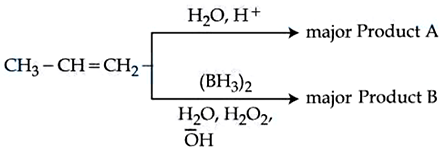
Identify the product A and product B in the following set of reactions.
In normal scenario with direct addition of water in acidic medium markovnikov's rule is followed and hence more stable carbocation is preferred hence, 2-propanol is the major product. In presence of peroxide in basic medium with B2H6 a concerted syn-additon takes place hence, anti-markovnikov's rule is followed leading to the formation of propanol-1.
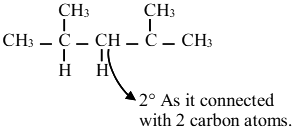
In the given compound, the number of $$2°$$ carbon atom/s is _______.

Given below are two statements :
Statement (I) : The 4f and 5f-series of elements are placed separately in the Periodic table to preserve the principle of classification. Statement (II) : s-block elements can be found in pure form in nature.
In light of the above statements, choose the most appropriate answer from the options given below:
Statement I: The 4f (lanthanides) and 5f (actinides) series are placed separately at the bottom of the Periodic table to preserve the principle of classification and to maintain the structure of the table. This is true.
Statement II: s-block elements (alkali and alkaline earth metals) are highly reactive and are not found in pure (free) form in nature. They always occur in combined forms (as compounds). This is false.
Statement I is true but Statement II is false. The answer corresponds to Option (3).
If IUPAC name of an element is "Unununnium" then the element belongs to $$n$$th group of periodic table. The value of $$n$$ is _______.
The IUPAC systematic naming convention for elements uses the following roots for digits:
0 = nil, 1 = un, 2 = bi, 3 = tri, 4 = quad, 5 = pent, 6 = hex, 7 = sept, 8 = oct, 9 = enn
The name "Unununnium" breaks down as:
$$\text{Un-un-un-ium} = 1\text{-}1\text{-}1 = \text{Element } 111$$
Element 111 is Roentgenium (Rg). To determine its group, we need to find its position in the periodic table.
Element 111 lies in the 7th period. The electron configuration follows the pattern:
$$[Rn]\, 5f^{14}\, 6d^{9}\, 7s^{2}$$
Wait — for element 111, we count from element 87 (Fr, Group 1):
87 (s-block, 2 elements) → 88, then 89-103 (f-block, 15 elements), then 104-111 (d-block).
In the d-block of period 7: element 104 is in Group 4, 105 in Group 5, ..., 111 is in Group $$4 + (111 - 104) = 4 + 7 = 11$$.
So element 111 belongs to Group 11 of the periodic table.
The answer is $$n = 11$$.
Lowest oxidation number of an atom in a compound $$A_2B$$ is $$-2$$. The number of electrons in its valence shell is:
Find the number of valence electrons given that the lowest oxidation number of an atom in compound $$A_2B$$ is $$-2$$.
In the compound $$A_2B$$, the atom with oxidation number $$-2$$ is $$B$$, since it appears once and having the negative charge makes chemical sense for a non-metal. An atom that achieves an oxidation state of $$-2$$ gains 2 electrons to complete its octet, meaning it already has 6 electrons in its valence shell and needs 2 more to reach 8. $$ \text{Valence electrons} = 8 - |-2| = 8 - 2 = 6 $$. Elements with 6 valence electrons belong to Group 16 (e.g., O, S). In compounds like $$Na_2O$$ or $$H_2S$$, oxygen and sulfur have an oxidation state of $$-2$$, consistent with having 6 valence electrons. Also, if $$B$$ is $$-2$$, then in $$A_2B$$: $$2x + (-2) = 0 \implies x = +1$$ for each $$A$$, consistent with alkali metals (1 valence electron) and confirming that $$B$$ has 6 valence electrons.
The answer is 6.
Given below are two statements:
Statement I: The decrease in first ionization enthalpy from B to Al is much larger than that from Al to Ga.
Statement II: The d orbitals in Ga are completely filled.
In the light of the above statements, choose the most appropriate answer from the options given below
We need to evaluate two statements about ionization enthalpy and electron configuration.
Statement I: The decrease in first ionization enthalpy from B to Al is much larger than that from Al to Ga.
The first ionization enthalpies (approximate values in kJ/mol) are:
B $$\approx 801$$, Al $$\approx 577$$, Ga $$\approx 579$$
Decrease from B to Al: $$801 - 577 = 224$$ kJ/mol
Decrease from Al to Ga: $$577 - 579 = -2$$ kJ/mol (actually a slight increase!)
The decrease from B to Al is indeed much larger than from Al to Ga. Statement I is TRUE.
The reason: From Al to Ga, the intervening $$3d$$ electrons provide poor shielding, so the effective nuclear charge increases, counteracting the effect of the additional shell.
Statement II: The d orbitals in Ga are completely filled.
Ga has the electron configuration: $$[\text{Ar}] \, 3d^{10} \, 4s^2 \, 4p^1$$
The $$3d$$ subshell has all 10 electrons, so it is completely filled. Statement II is TRUE.
Conclusion: Both Statement I and Statement II are correct.
The correct answer is Option B: Both the statements I and II are correct.
Match List - I with List - II
| LIST-I (Atomic number) | LIST-II (Block of periodic table) |
|---|---|
| (A) 37 | I. p-block |
| (B) 78 | II. d-block |
| (C) 52 | III. f-block |
| (D) 65 | IV. s-block |
Choose the correct answer from the options given below:
We need to match atomic numbers with their blocks in the periodic table.
(A) Z = 37: This is Rubidium (Rb), which is in Group 1 → s-block (IV)
(B) Z = 78: This is Platinum (Pt), which is a transition metal → d-block (II)
(C) Z = 52: This is Tellurium (Te), which is in Group 16 → p-block (I)
(D) Z = 65: This is Terbium (Tb), which is a lanthanide → f-block (III)
The correct matching is: A-IV, B-II, C-I, D-III.
The correct answer is Option 4.
The correct order of electronegativity for given elements is
The electronegativity values on the Pauling scale are C (Carbon) = 2.55, P (Phosphorus) = 2.19, Br (Bromine) = 2.96, and At (Astatine) ≈ 2.2.
Since electronegativity increases from left to right across a period and from bottom to top in a group, the elements can be ranked by comparing these values.
Ordering from highest to lowest gives $$ Br (2.96) > C (2.55) > At (2.2) > P (2.19) $$. Therefore, the correct order is Br > C > At > P.
For electron gain enthalpies of the elements denoted as $$\Delta_{eg}$$H, the incorrect option is:
Match List I with List II
(A) Slaked lime (I) NaOH
(B) Dead burnt plaster (II) Ca(OH)$$_2$$
(C) Caustic soda (III) Na$$_2$$CO$$_3$$ $$\cdot$$ 10H$$_2$$O
(D) Washing soda (IV) CaSO$$_4$$
Let us match the common names with their chemical formulas:
(A) Slaked lime - Slaked lime is the common name for calcium hydroxide, $$Ca(OH)_2$$ (II). It is produced by adding water to quicklime (CaO).
(B) Dead burnt plaster - Dead burnt plaster is anhydrous calcium sulphate, $$CaSO_4$$ (IV). It is obtained by heating plaster of Paris above 393 K.
(C) Caustic soda - Caustic soda is the common name for sodium hydroxide, $$NaOH$$ (I).
(D) Washing soda - Washing soda is hydrated sodium carbonate, $$Na_2CO_3 \cdot 10H_2O$$ (III).
Therefore, the correct matching is: (A)-II, (B)-IV, (C)-I, (D)-III.
The correct increasing order of the ionic radii is
All the given ions are isoelectronic, i.e. each of them possesses $$18$$ electrons:
$$S^{2-}\;(Z = 16,\; 16 + 2 = 18\ \text{electrons})$$
$$Cl^- \;(Z = 17,\; 17 + 1 = 18\ \text{electrons})$$
$$K^+ \;(Z = 19,\; 19 - 1 = 18\ \text{electrons})$$
$$Ca^{2+}\;(Z = 20,\; 20 - 2 = 18\ \text{electrons})$$
For an isoelectronic series the principal quantum number $$n$$ is the same, so the ionic radius depends mainly on the effective nuclear charge $$Z_{\text{eff}}$$ experienced by the electrons.
Rule: Within an isoelectronic series, ionic radius decreases as the atomic number $$Z$$ (and hence $$Z_{\text{eff}}$$) increases, because the nucleus pulls the same number of electrons more strongly.
Ordering the ions by increasing atomic number:
$$Z = 16 \;(S^{2-}) \lt 17 \;(Cl^-) \lt 19 \;(K^+) \lt 20 \;(Ca^{2+})$$
Therefore the radii follow the opposite trend:
$$\text{smallest radius} \; Ca^{2+} \lt K^+ \lt Cl^- \lt S^{2-} \; \text{largest radius}$$
Writing the ions in increasing order of ionic radii:
$$Ca^{2+} \lt K^+ \lt Cl^- \lt S^{2-}$$
This matches Option D.
Final Answer: Option D
Which one of the following elements will remain as liquid inside pure boiling water?
We need to find which element remains liquid inside pure boiling water (at 100°C).
For an element to be liquid at 100°C, its melting point must be below 100°C and its boiling point must be above 100°C.
Ga (Gallium): Melting point = 29.8°C, Boiling point = 2204°C. At 100°C, Ga is liquid. ✓
Br (Bromine): Melting point = -7.2°C, Boiling point = 58.8°C. At 100°C, Br₂ would be a gas. ✗
Li (Lithium): Melting point = 180.5°C. At 100°C, Li is still a solid. ✗
Cs (Caesium): Melting point = 28.5°C, Boiling point = 671°C. At 100°C, Cs is liquid. However, Cs reacts violently with water, so it would not "remain" as a liquid inside boiling water.
The correct answer is Ga (Gallium).
Choose the correct statement(s):
A. Beryllium oxide is purely acidic in nature.
B. Beryllium carbonate is kept in the atmosphere of CO$$_2$$.
C. Beryllium sulphate is readily soluble in water.
D. Beryllium shows anomalous behavior.
We need to identify the correct statements about Beryllium.
Statement A says Beryllium oxide is purely acidic in nature. This is false — Beryllium oxide (BeO) is actually amphoteric. It reacts with both acids and bases:
$$BeO + 2HCl \rightarrow BeCl_2 + H_2O$$
$$BeO + 2NaOH \rightarrow Na_2BeO_2 + H_2O$$
Statement B says Beryllium carbonate is kept in the atmosphere of CO$$_2$$. This is true — BeCO$$_3$$ is unstable and decomposes readily, so it is kept in an atmosphere of CO$$_2$$ to prevent decomposition.
Statement C says Beryllium sulphate is readily soluble in water. This is true — unlike other alkaline earth metal sulphates (like BaSO$$_4$$), BeSO$$_4$$ is readily soluble in water due to the high hydration energy of the small Be$$^{2+}$$ ion.
Statement D says Beryllium shows anomalous behavior. This is true — Beryllium shows anomalous behavior compared to other members of Group 2 due to its very small size, high ionization energy, and high electronegativity, and it shows a diagonal relationship with aluminium.
So, the correct statements are B, C, and D only.
Given below are two statements: one is labelled as Assertion A and the other is labelled as Reason R.
Assertion A: The energy required to form Mg$$^{2+}$$ from Mg is much higher than that required to produce Mg$$^+$$
Reason R: Mg$$^{2+}$$ is small ion and carry more charge than Mg$$^+$$
In the light of the above statements, choose the correct answer from the options given below.
We need to evaluate both the Assertion and the Reason.
Assertion A: The energy required to form $$Mg^{2+}$$ from $$Mg$$ is much higher than that required to produce $$Mg^{+}$$.
To form $$Mg^{+}$$ from $$Mg$$, we need the first ionization energy ($$IE_1$$):
$$ Mg \rightarrow Mg^{+} + e^{-} \quad (IE_1 = 737.7 \text{ kJ/mol}) $$
To form $$Mg^{2+}$$ from $$Mg$$, we need both the first and second ionization energies ($$IE_1 + IE_2$$):
$$ Mg \rightarrow Mg^{2+} + 2e^{-} \quad (IE_1 + IE_2 = 737.7 + 1450.7 = 2188.4 \text{ kJ/mol}) $$
Since $$IE_1 + IE_2$$ is much greater than $$IE_1$$ alone, the energy required to form $$Mg^{2+}$$ from $$Mg$$ is indeed much higher than that required to form $$Mg^{+}$$. Assertion A is true.
Reason R: $$Mg^{2+}$$ is a smaller ion and carries more charge than $$Mg^{+}$$.
After removing the first electron, $$Mg^{+}$$ has the electronic configuration $$1s^2 2s^2 2p^6 3s^1$$. Removing the second electron from $$Mg^{+}$$ to form $$Mg^{2+}$$ requires more energy because:
- $$Mg^{+}$$ already has a net positive charge, so the remaining electrons experience a greater effective nuclear charge ($$Z_{eff}$$).
- $$Mg^{2+}$$ (with configuration $$1s^2 2s^2 2p^6$$) is smaller in size than $$Mg^{+}$$, meaning the electron being removed is held more tightly by the nucleus.
The fact that $$Mg^{2+}$$ is smaller and carries more charge than $$Mg^{+}$$ directly explains why the second ionization energy is higher, and therefore why forming $$Mg^{2+}$$ requires much more total energy. Reason R is true and is the correct explanation of A.
The correct answer is Option D: Both A and R are true and R is the correct explanation of A.
Match List I with List II
List I (Elements) List II (Colour imparted to the flame)
A. K I. Brick Red
B. Ca II. Violet
C. Sr III. Apple Green
D. Ba IV. Crimson Red
Choose the correct answer from the options given below:
We need to match elements with their flame test colours.
The characteristic flame colours of alkali and alkaline earth metals are:
- K (Potassium) — Violet
- Ca (Calcium) — Brick Red
- Sr (Strontium) — Crimson Red (or Apple Red)
- Ba (Barium) — Apple Green (or Yellow-Green)
A. K → II (Violet)
B. Ca → I (Brick Red)
C. Sr → IV (Crimson Red)
D. Ba → III (Apple Green)
The correct matching is A-II, B-I, C-IV, D-III.
The correct answer is Option C: A-II, B-I, C-IV, D-III.
The compound which does not exist is
We need to identify which compound does not exist among the given options.
Option A: NaO$$_2$$ (Sodium superoxide)
Alkali metals react with oxygen to form different products. Lithium forms Li$$_2$$O (oxide), sodium forms Na$$_2$$O$$_2$$ (peroxide), and potassium/rubidium/cesium form superoxides (KO$$_2$$, RbO$$_2$$, CsO$$_2$$). Sodium does not readily form a stable superoxide NaO$$_2$$ under normal conditions. This compound is considered non-existent or extremely unstable.
Option B: BeH$$_2$$ - Beryllium hydride exists as a polymeric solid.
Option C: PbEt$$_4$$ - Tetraethyl lead exists and was historically used as an anti-knock agent in gasoline.
Option D: NH$$_4$$BeF$$_4$$ - Ammonium tetrafluoroberyllate is a known compound.
The correct answer is Option A: NaO$$_2$$.
Which hydride among the following is less stable?
We need to identify the least stable hydride among BeH$$_2$$, HF, NH$$_3$$, and LiH.
We start by noting that
The stability of a hydride depends on the strength of the bond between the element and hydrogen. Key factors include:
- Higher electronegativity of the bonded atom leads to stronger, more polar bonds with H, increasing stability.
- Higher bond energy means greater stability.
- Electron-deficient hydrides (like those of Group 2 and 13) tend to be less stable.
Next,
HF: Fluorine has the highest electronegativity (3.98). The H-F bond is very strong (bond energy ~568 kJ/mol). HF is very stable.
Nitrogen has high electronegativity (3.04). The N-H bond is strong (bond energy ~391 kJ/mol). NH$$_3$$ is stable.
LiH: This is an ionic hydride (Li$$^+$$ H$$^-$$). Despite the low electronegativity of Li, the ionic bond provides reasonable stability. LiH is moderately stable.
Beryllium has low electronegativity (1.57) and forms an electron-deficient covalent hydride. Be has only 2 valence electrons and forms only 2 bonds with H, leaving empty orbitals. BeH$$_2$$ is a polymeric hydride in solid state (with 3-centre 2-electron bonds) that readily decomposes. It is the least stable.
The least stable hydride is BeH$$_2$$.
The correct answer is Option 1: BeH$$_2$$.
Alkali metal from the following with least melting point is
In alkali metals, the melting point decreases as we go down the group due to increasing atomic size and weakening of metallic bonding.
Order: Li > Na > K > Rb > Cs
Caesium (Cs) has the least melting point (28.4°C) among alkali metals.
For elements B, C, N, Li, Be, O and F, the correct order of first ionisation enthalpy is
Ionisation enthalpy (IE) is the energy required to remove the most loosely bound electron from a gaseous atom.
General periodic trend: Across a period (left → right) the nuclear charge increases while the principal quantum number remains the same, so atomic size decreases and the IE normally increases.
However, two well-known deviations appear in every short period:
Case 1: Be vs B - Be has the configuration $$1s^22s^2$$ (completely filled $$2s$$ subshell) while B is $$1s^22s^22p^1$$. A completely filled subshell is extra-stable, so more energy is required to remove an electron from Be than from B. Therefore $$\text{IE(Be)} \gt \text{IE(B)}$$, opposite to the simple left→right trend.
Case 2: N vs O - N is $$1s^22s^22p^3$$ (exactly half-filled $$2p$$ subshell); O is $$1s^22s^22p^4$$. The half-filled $$2p$$ subshell of N is more stable than the partly filled subshell of O, so $$\text{IE(N)} \gt \text{IE(O)}$$, again reversing the straightforward trend.
Placing the seven given elements in Period 2 and applying these two exceptions:
1. Start at the far left: $$\text{IE(Li)}$$ is the least.
2. Between B and Be, the exception “Be > B” applies, so $$\text{IE(B)} \lt \text{IE(Be)}$$.
3. C follows the normal order, coming after Be.
4. Between N and O, the exception “N > O” applies, so $$\text{IE(O)} \lt \text{IE(N)}$$.
5. F, at the extreme right, has the maximum IE in the period.
Arranging from the smallest to the largest ionisation enthalpy:
$$\text{Li} \lt \text{B} \lt \text{Be} \lt \text{C} \lt \text{O} \lt \text{N} \lt \text{F}$$
This matches Option D.
Answer: Option D
Given below are two statements, one is labelled as Assertion A and the other is labelled as Reason R
Assertion A: The alkali metals and their salts impart characteristic colour to reducing flame.
Reason R: Alkali metals can be detected using flame tests.
In the light of the above statements, choose the most appropriate answer from the options given below
Identify the correct statements about alkali metals.
A. The order of standard reduction potential (M$$^+$$ | M) for alkali metal ions is Na > Rb > Li.
B. CsI is highly soluble in water.
C. Lithium carbonate is highly stable to heat.
D. Potassium dissolved in concentrated liquid ammonia is blue and paramagnetic.
E. All alkali metal hydrides are ionic solids.
Choose the correct answer from the options given below
We need to identify the correct statements about alkali metals.
Statement A: The order of standard reduction potential (M$$^+$$|M) for alkali metal ions is Na > Rb > Li. The standard reduction potentials are approximately: Li at $$-3.04$$ V, Na at $$-2.71$$ V, K at $$-2.93$$ V, Rb at $$-2.98$$ V, and Cs at $$-3.03$$ V. Although Li has the highest ionization energy, its exceptionally high hydration energy (due to the very small Li$$^+$$ ionic radius) makes its reduction potential the most negative. The order Na ($$-2.71$$) > Rb ($$-2.98$$) > Li ($$-3.04$$) is correct.
Statement B: CsI is claimed to be highly soluble in water. CsI consists of two large ions with low lattice energy but also low hydration energies. In the context of JEE, this claim is not considered a standard correct statement. This is incorrect.
Statement C: Lithium carbonate is claimed to be highly stable to heat. However, Li$$_2$$CO$$_3$$ decomposes on heating:
$$\text{Li}_2\text{CO}_3 \xrightarrow{\Delta} \text{Li}_2\text{O} + \text{CO}_2$$The small, highly charged Li$$^+$$ cation strongly polarizes the large carbonate ion, destabilizing it. So Li$$_2$$CO$$_3$$ is the least stable alkali metal carbonate to heat. This is incorrect.
Statement D: Potassium dissolved in concentrated liquid ammonia is claimed to be blue and paramagnetic. However, dilute solutions of alkali metals in ammonia are blue and paramagnetic, while concentrated solutions are bronze and diamagnetic due to pairing of solvated electrons. This is incorrect.
Statement E: All alkali metal hydrides are ionic solids. Indeed, all alkali metals form ionic hydrides MH with M$$^+$$ cations and H$$^-$$ anions, adopting the NaCl-type crystal structure. This is correct.
The correct statements are A and E only. Hence, the correct answer is Option 3.
The correct order of metallic character is
Metallic character increases down a group and from right to left in a period.
K (Group 1, Period 4) > Ca (Group 2, Period 4) > Be (Group 2, Period 2).
The correct answer is Option 4: K > Ca > Be.
Given below are two statements, one is labelled as Assertion A and the other is labelled as Reason R.
Assertion A: Beryllium has less negative value of reduction potential compared to the other alkaline earth metals.
Reason R: Beryllium has large hydration energy due to small size of Be$$^{2+}$$ but relatively large value of atomisation enthalpy.
In the light of the above statements, choose the most appropriate answer from the options given below.
Reaction of BeO with ammonia and hydrogen fluoride gives 'A' which on thermal decomposition gives $$BeF_2$$ and $$NH_4F$$. What is 'A' ?
We need to identify compound 'A' formed when BeO reacts with ammonia and hydrogen fluoride, which on thermal decomposition gives $$BeF_2$$ and $$NH_4F$$.
Analyse the decomposition products.
The thermal decomposition gives $$BeF_2$$ and $$NH_4F$$. Let us work backwards to identify 'A'.
If compound 'A' decomposes to give $$BeF_2 + 2NH_4F$$, then 'A' must contain Be, N, H, and F atoms in the combined ratio. Adding the atoms:
$$BeF_2 + 2NH_4F = Be + 2N + 8H + 4F$$
This corresponds to the formula $$(NH_4)_2BeF_4$$ (ammonium tetrafluoroberyllate).
Verify the formation reaction.
The reaction of BeO with $$NH_3$$ and HF can be written as:
$$BeO + 2NH_3 + 4HF \rightarrow (NH_4)_2BeF_4 + H_2O$$
This is consistent because:
- BeO provides the beryllium
- HF provides the fluorine
- $$NH_3$$ and HF together form $$NH_4^+$$ ions
- The product $$(NH_4)_2BeF_4$$ contains the tetrafluoroberyllate ion $$[BeF_4]^{2-}$$ with two ammonium counterions
Verify the decomposition.
$$(NH_4)_2BeF_4 \xrightarrow{\Delta} BeF_2 + 2NH_4F$$
Atoms balance: Be: 1=1, N: 2=2, H: 8=8, F: 4=2+2=4. Correct.
The correct answer is Option (2): $$(NH_4)_2BeF_4$$.
Which one among the following metals is the weakest reducing agent?
Given below are two statements: one is labelled as Assertion A and the other is labelled as Reason R.
Assertion A: Physical properties of isotopes of hydrogen are different.
Reason R: Mass difference between isotopes of hydrogen is very large.
In the light of the above statements, choose the correct answer from the options given below:
We need to evaluate both the Assertion and the Reason.
Assertion A: Physical properties of isotopes of hydrogen are different.
The three isotopes of hydrogen are:
- Protium ($$^{1}H$$): mass number = 1
- Deuterium ($$^{2}H$$ or D): mass number = 2
- Tritium ($$^{3}H$$ or T): mass number = 3
Physical properties such as boiling point, melting point, and density differ among these isotopes. For example:
- Boiling point of $$H_2O$$ = 100°C, while boiling point of $$D_2O$$ = 101.4°C
- Density of $$H_2O$$ = 1.00 g/mL, while density of $$D_2O$$ = 1.107 g/mL
Assertion A is true.
Reason R: The mass difference between isotopes of hydrogen is very large.
The relative mass differences between hydrogen isotopes are the largest among all elements:
- Deuterium is 2 times as heavy as Protium (ratio = 2:1)
- Tritium is 3 times as heavy as Protium (ratio = 3:1)
For comparison, carbon isotopes $$^{12}C$$ and $$^{13}C$$ have a mass ratio of only 13:12, which is a much smaller relative difference. The exceptionally large relative mass difference in hydrogen isotopes is unique among all elements. Reason R is true.
Explanation of the link: Physical properties depend on the mass of atoms/molecules. Since hydrogen isotopes have the largest relative mass differences, the differences in their physical properties (such as boiling point, melting point, bond energy, and density) are pronounced and measurable. The large mass difference is the direct cause of the significant variation in physical properties.
Therefore, both A and R are true, and R is the correct explanation of A.
The correct answer is Option A: Both A and R are true and R is the correct explanation of A.
Ion having highest hydration enthalpy among the given alkaline earth metal ions is:
Solution Breakdown
Options:
(A) Be2+ (B) Sr2+ (C) Ba2+ (D) Ca2+
Hydration enthalpy is the amount of energy released when one mole of gaseous ions undergoes hydration. It depends heavily on charge density (charge-to-size ratio) of the ion.
All the given options belong to Group 2 (Alkaline Earth Metals): Be, Mg, Ca, Sr, Ba.
Since they are all divalent cations (Be2+, Ca2+, Sr2+, Ba2+), their charge is identical (+2).
As we move down Group 2, extra electron shells are added, meaning the ionic radius increases:
Hydration enthalpy is inversely proportional to the size of the ion:
Smaller ions have a higher concentration of positive charge (higher charge density). This allows them to attract water molecules much more strongly, releasing a larger amount of energy during hydration.
Therefore, hydration enthalpy decreases down the group as size increases:
Be2+ > Ca2+ > Sr2+ > Ba2+
Because Beryllium (Be2+) is the smallest ion in the group, it possesses the maximum charge density and the highest hydration enthalpy.
Match List-I with List-II:
| List-I | List-II | ||
|---|---|---|---|
| A. | K | I. | Thermonuclear reactions |
| B. | KCl | II. | Fertilizer |
| C. | KOH | III. | Sodium potassium pump |
| D. | Li | IV. | Absorbent of CO$$_2$$ |
Let us match each item from List-I with List-II:
A. K (Potassium): Potassium ions play a crucial role in the sodium-potassium pump in biological systems, which maintains the electrochemical gradient across cell membranes. → III. Sodium potassium pump
B. KCl (Potassium chloride): KCl is widely used as a potash fertilizer in agriculture. → II. Fertilizer
C. KOH (Potassium hydroxide): KOH is used as an absorbent of CO$$_2$$ in various applications. → IV. Absorbent of CO$$_2$$
D. Li (Lithium): Lithium is used in thermonuclear reactions (hydrogen bombs), where lithium deuteride serves as the fusion fuel. → I. Thermonuclear reactions
The correct matching is: A(III), B(II), C(IV), D(I).
Which of the following represents the correct order of metallic character of the given elements?
Lime reacts exothermally with water to give 'A' which has low solubility in water. Aqueous solution of 'A' is often used for the test of CO$$_2$$, a test in which insoluble B is formed. If B is further reacted with CO$$_2$$ then soluble compound is formed. 'A' is
Lime (CaO, quicklime) reacts exothermally with water:
$$CaO + H_2O \to Ca(OH)_2$$ (slaked lime)
$$Ca(OH)_2$$ has low solubility in water. Its aqueous solution is lime water.
Test for CO₂: $$Ca(OH)_2 + CO_2 \to CaCO_3 \downarrow + H_2O$$
CaCO₃ (B) is the white insoluble precipitate (milky appearance).
Further reaction with CO₂: $$CaCO_3 + CO_2 + H_2O \to Ca(HCO_3)_2$$ (soluble)
Therefore, 'A' is slaked lime [Ca(OH)₂].
The correct answer is Option 2.
Number of water molecules in washing soda and soda ash respectively are:
We need to find the number of water molecules in washing soda and soda ash respectively.
Washing soda: Washing soda is the common name for hydrated sodium carbonate. Its chemical formula is $$Na_2CO_3 \cdot 10H_2O$$ (sodium carbonate decahydrate). The "deca" prefix indicates 10 water molecules. Washing soda is obtained by recrystallizing soda ash from aqueous solution, and the crystals that form contain 10 molecules of water of crystallization per formula unit. Therefore, washing soda has 10 water molecules.
Soda ash: Soda ash is the common name for anhydrous sodium carbonate, $$Na_2CO_3$$. The term "ash" comes from its historical production by burning plant material and extracting the residue. Being anhydrous, soda ash contains 0 (zero) water molecules. It is essentially the same compound as washing soda but without the water of crystallization.
Key distinction: Both washing soda and soda ash are forms of sodium carbonate ($$Na_2CO_3$$). The difference is that washing soda is the hydrated form ($$Na_2CO_3 \cdot 10H_2O$$) while soda ash is the anhydrous form ($$Na_2CO_3$$). When washing soda is heated, it loses its water of crystallization and becomes soda ash.
The correct answer is Option 3: 10 and 0.
Compound A reacts with NH$$_4$$Cl and forms a compound B. Compound B reacts with H$$_2$$O and excess of CO$$_2$$ to form compound C which on passing through or reaction with saturated NaCl solution forms sodium hydrogen carbonate. Compound A, B and C, are respectively.
This describes the Solvay process for making sodium hydrogen carbonate (NaHCO₃).
Compound A: Ca(OH)₂ (slaked lime). It reacts with NH₄Cl:
$$Ca(OH)_2 + 2NH_4Cl \to CaCl_2 + 2NH_3 + 2H_2O$$
Compound B: NH₃ (ammonia).
NH₃ reacts with H₂O and excess CO₂:
$$NH_3 + H_2O + CO_2 \to NH_4HCO_3$$
Compound C: NH₄HCO₃ (ammonium hydrogen carbonate).
NH₄HCO₃ reacts with saturated NaCl solution:
$$NH_4HCO_3 + NaCl \to NaHCO_3 + NH_4Cl$$
NaHCO₃ precipitates out (being less soluble).
The correct answer is Option 3: Ca(OH)₂, NH₃, NH₄HCO₃.
Given below are two statements: One is labelled as Assertion A and the other is labelled as Reason R.
Assertion A: Sodium is about 30 times as abundant as potassium in the oceans.
Reason R: Potassium is bigger in size than sodium.
In the light of the above statements, choose the correct answer from the options given below
Assertion A: Sodium is about 30 times as abundant as potassium in the oceans.
This statement is true. The concentration of sodium in seawater is approximately 10,800 ppm, while potassium is only about 380 ppm, making sodium roughly 28-30 times more abundant.
Reason R: Potassium is bigger in size than sodium.
This statement is true. Potassium (atomic radius $$\approx 227$$ pm) is larger than sodium (atomic radius $$\approx 186$$ pm), since potassium lies one period below sodium in Group 1.
Connecting A and R:
The larger size of potassium ions ($$K^+$$) allows them to be more readily adsorbed and trapped by clay minerals and silicate structures in rocks and soil. This means potassium is preferentially retained on land rather than being washed into the oceans. Sodium ions ($$Na^+$$), being smaller, are less strongly held by soil particles and are more easily leached into rivers and eventually the oceans.
Thus, R correctly explains A -- the larger size of potassium is the key reason it is less abundant in seawater.
The correct answer is Option A: Both A and R are true and R is the correct explanation of A.
The difference between electron gain enthalpies will be maximum between:
Electron gain enthalpy (EGE) is the energy change when an electron is added to a neutral gaseous atom.
Noble gases (Ne, Ar) have completely filled electron shells, so they have very positive (highly unfavorable) electron gain enthalpies. They strongly resist gaining an electron.
Halogens (F, Cl) have the most negative (highly favorable) electron gain enthalpies. Among halogens, Cl has the most negative EGE (more negative than F, due to the small size of F causing electron-electron repulsion).
Among noble gases, Ne has a more positive EGE than Ar (smaller size, more repulsion).
Therefore, the maximum difference in electron gain enthalpies would be between the species with the most positive EGE (Ne) and the most negative EGE (Cl).
The correct answer is Ne and Cl.
Inert gases have positive electron gain enthalpy. Its correct order is
Noble (inert) gases have positive electron gain enthalpy. They possess completely filled and highly stable electron configurations: He (1s$$^2$$), Ne (2s$$^2$$2p$$^6$$), Ar (3s$$^2$$3p$$^6$$), Kr (4s$$^2$$4p$$^6$$), Xe (5s$$^2$$5p$$^6$$). Adding an extra electron would place it in the next higher principal shell, which is energetically very unfavourable; therefore, the process of electron addition is endothermic (positive electron gain enthalpy).
As we move down the group from He to Xe, the atomic size increases, so the next available shell is farther from the nucleus; the shielding effect increases, making it progressively more difficult to stabilise the incoming electron; and the incoming electron must enter an increasingly higher energy level (n = 2 for He, n = 3 for Ne, n = 4 for Ar, etc.), all of which make the electron gain enthalpy more positive. Therefore, the positive electron gain enthalpy increases as we go down the group.
In increasing order of positive electron gain enthalpy: $$\text{He} < \text{Ne} < \text{Kr} < \text{Xe}$$. He has the least positive electron gain enthalpy and Xe has the most positive.
Answer: Option B
The total number of isoelectronic species from the given set is _____.
O$$^{2-}$$, F$$^-$$, Al, Mg$$^{2+}$$, Na$$^+$$, O$$^+$$, Mg, Al$$^{3+}$$, F
Isoelectronic species have the same number of electrons.
Counting electrons for each species:
- O²⁻: 8 + 2 = 10 electrons
- F⁻: 9 + 1 = 10 electrons
- Al: 13 electrons
- Mg²⁺: 12 - 2 = 10 electrons
- Na⁺: 11 - 1 = 10 electrons
- O⁺: 8 - 1 = 7 electrons
- Mg: 12 electrons
- Al³⁺: 13 - 3 = 10 electrons
- F: 9 electrons
Species with 10 electrons: O²⁻, F⁻, Mg²⁺, Na⁺, Al³⁺ → 5 isoelectronic species
The total number of isoelectronic species is $$\mathbf{5}$$.
Mg(NO$$_3$$)$$_2$$.XH$$_2$$O and Ba(NO$$_3$$)$$_2$$.YH$$_2$$O, represent formula of the crystalline forms of nitrate salts. Sum of X and Y is _______
In the following reaction, the total number of oxygen atoms in X and Y is _______.
Na$$_2$$O + H$$_2$$O $$\to$$ 2X
Cl$$_2$$O$$_7$$ + H$$_2$$O $$\to$$ 2Y
Reaction 1: $$Na_2O + H_2O \to 2NaOH$$
So X = NaOH (1 oxygen atom per molecule)
Reaction 2: $$Cl_2O_7 + H_2O \to 2HClO_4$$
So Y = HClO₄ (4 oxygen atoms per molecule)
Total oxygen atoms in X and Y = 1 + 4 = 5.
Element "E" belongs to the period 4 and group 16 of the periodic table. The valence shell electron configuration of the element, which is just above "E" in the group is
We need to find the valence shell electron configuration of the element just above "E" in group 16. Element "E" is in Period 4, Group 16, which corresponds to Selenium (Se). Therefore, the element just above it in Period 3 is Sulphur (S).
Sulphur (S) has atomic number 16 and an electronic configuration of $$1s^2\, 2s^2\, 2p^6\, 3s^2\, 3p^4$$; hence the valence shell (n = 3) configuration is $$3s^2\, 3p^4$$. Thus, the correct answer is Option C: $$3s^2\, 3p^4$$.
Given two statements below:
Statement I: In $$Cl_2$$ molecule the covalent radius is double of the atomic radius of chlorine.
Statement II: Radius of anionic species is always greater than their parent atomic radius.
Choose the most appropriate answer from options given below
We need to evaluate two statements about atomic and ionic radii.
Statement I: In Cl₂ molecule, the covalent radius is double the atomic radius of chlorine.
This statement is incorrect. In fact, the covalent radius is half the internuclear distance in a Cl₂ molecule. The atomic radius (van der Waals radius) of chlorine is always greater than its covalent radius. The covalent radius of Cl is approximately 99 pm, while its van der Waals radius is about 175 pm. So the covalent radius is NOT double the atomic radius; rather, the covalent radius is less than the atomic radius.
Statement II: Radius of anionic species is always greater than their parent atomic radius.
This statement is correct. When an atom gains electrons to form an anion, the increased electron-electron repulsion causes the electron cloud to expand. Additionally, the same nuclear charge now holds more electrons, leading to a decreased effective nuclear charge per electron. Therefore, anions are always larger than their parent atoms.
For example:
- Cl atom: 99 pm (covalent radius)
- Cl⁻ ion: 181 pm
- O atom: 73 pm
- O²⁻ ion: 140 pm
Since Statement I is incorrect and Statement II is correct, the answer is Option D.
The first ionization enthalpies of $$Be$$, $$B$$, $$N$$ and $$O$$ follow the order
In which of the following pairs, electron gain enthalpies of constituent elements are nearly the same or identical?
(A) Rb and Cs
(B) Na and K
(C) Ar and Kr
(D) I and At
Choose the correct answer from the options given below
We need to identify which pairs of elements have nearly the same or identical electron gain enthalpies.
Pair (A): Rb and Cs
Both rubidium and caesium are alkali metals in the same group. As we go down the group, the electron gain enthalpy becomes less negative but for heavier alkali metals (Rb and Cs), the values become very similar due to the shielding effect and large atomic size. The electron gain enthalpies of Rb and Cs are nearly identical (both around -47 to -46 kJ/mol).
Pair (B): Na and K
Sodium and potassium are also alkali metals, but their electron gain enthalpies differ noticeably. Na has an electron gain enthalpy of about -53 kJ/mol while K has about -48 kJ/mol. These are not nearly the same.
Pair (C): Ar and Kr
Both argon and krypton are noble gases with completely filled electron shells. Noble gases have near-zero (positive) electron gain enthalpies because they resist gaining an extra electron. The electron gain enthalpies of Ar and Kr are nearly identical (both are positive and very close to zero).
Pair (D): I and At
Iodine and astatine are halogens. Their electron gain enthalpies are different — iodine has a much more negative value compared to astatine, which is a larger and more metallic element.
Therefore, the pairs with nearly identical electron gain enthalpies are A (Rb and Cs) and C (Ar and Kr).
The correct answer is Option C: A & C only.
Outermost electronic configurations of four elements A, B, C, D are given below:
(A) $$3s^2$$
(B) $$3s^2 3p^1$$
(C) $$3s^2 3p^3$$
(D) $$3s^2 3p^4$$
The correct order of first ionization enthalpy for them is
Elements of the third period have the principal quantum number $$n = 3$$ for their valence-shell electrons. The four given configurations therefore correspond to
$$A : 3s^{2}\; \Longrightarrow\;$$ magnesium (Mg)
$$B : 3s^{2}\,3p^{1}\; \Longrightarrow\;$$ aluminium (Al)
$$C : 3s^{2}\,3p^{3}\; \Longrightarrow\;$$ phosphorus (P)
$$D : 3s^{2}\,3p^{4}\; \Longrightarrow\;$$ sulphur (S)
In a period, the first ionization enthalpy (I.E.) generally increases from left to right because the nuclear charge increases while the valence shell remains the same. However, two well-known exceptions disturb the smooth rise:
Case 1: The jump from a filled $$s$$ subshell ($$ns^{2}$$) to the first $$p$$ electron ($$ns^{2}np^{1}$$).
Removing an electron from the new, higher-energy $$p$$ subshell needs less energy than removing it from the lower-energy, fully-filled $$s$$ subshell. Hence
$$\text{I.E.}(Al) \lt \text{I.E.}(Mg)$$
Case 2: Half-filled and fully-filled subshell stability.
A half-filled $$p^{3}$$ subshell (as in P) is extra stable. When we move from $$p^{3}$$ to $$p^{4}$$ (S), the added electron must pair up in an already occupied orbital, introducing inter-electronic repulsion and slightly lowering the I.E. Therefore
$$\text{I.E.}(S) \lt \text{I.E.}(P)$$
Combining the normal trend with the two exceptions gives the overall order
$$\text{Al} \lt \text{Mg} \lt \text{S} \lt \text{P}$$
Replacing element symbols with the given letters:
$$B \lt A \lt D \lt C$$
Hence the correct order of first ionization enthalpy is described by Option B.
Answer → Option B \bigl(B < A < D < C\bigr)
The correct decreasing order for metallic character is
We need to find the correct decreasing order of metallic character for the elements Na, Mg, Be, Si, and P.
Metallic character depends on how easily an atom can lose electrons. It increases as we go down a group (larger atomic size, easier to lose outer electrons) and decreases as we go from left to right across a period (increasing nuclear charge holds electrons more tightly).
Let us identify the positions of these elements in the periodic table. Na (sodium) is in Group 1, Period 3. Mg (magnesium) is in Group 2, Period 3. Be (beryllium) is in Group 2, Period 2. Si (silicon) is in Group 14, Period 3. P (phosphorus) is in Group 15, Period 3.
Among the Period 3 elements, the metallic character decreases from left to right: $$Na > Mg > Si > P$$. Now, Be is in the same group as Mg but in a higher period (Period 2), so Be is less metallic than Mg (since metallic character increases going down the group).
Comparing Be with Si and P: Be is in Group 2 (a metal), while Si is a metalloid and P is a non-metal. So Be is more metallic than both Si and P.
Putting it all together, the decreasing order of metallic character is $$Na > Mg > Be > Si > P$$.
Hence, the correct answer is Option A.
The first ionization enthalpy of Na and Mg, respectively, are: 496, 737 and 786 kJ mol$$^{-1}$$. The first ionization enthalpy (kJ mol$$^{-1}$$) of Al is
We are given the first ionization enthalpies: Na = 496 kJ/mol, Mg = 737 kJ/mol, and we need to find the first ionization enthalpy of Al. The question also mentions 786 kJ/mol, but the standard known values are Na = 496, Mg = 737, and Al = 577 kJ/mol.
In the periodic table, as we move from left to right across a period, the ionization enthalpy generally increases due to increasing nuclear charge. However, Al (electronic configuration: $$[Ne] 3s^2 3p^1$$) has a lower first ionization enthalpy than Mg ($$[Ne] 3s^2$$). This is because the outermost electron of Al is in the 3p orbital, which is higher in energy and better shielded by the 3s electrons compared to Mg's 3s electron. The 3p electron is easier to remove than a paired 3s electron.
Among the given options, 577 kJ/mol correctly reflects this trend — it is lower than Mg's 737 kJ/mol but higher than Na's 496 kJ/mol, consistent with the anomalous dip at Al in the ionization energy trend across Period 3.
Hence, the correct answer is Option C.
The metal that has very low melting point and its periodic position is closer to a metalloid is
We need to identify a metal with a very low melting point whose position in the periodic table is closer to a metalloid.
Analyzing the options:
Option A: Al (Aluminium) - Melting point is $$660°C$$, which is relatively high. It is close to metalloids but does not have a very low melting point.
Option B: Ga (Gallium) - Gallium has an exceptionally low melting point of $$29.76°C$$ (it melts in your hand). In the periodic table, Gallium is in Group 13, Period 4, and is adjacent to the metalloid Germanium (Ge). This makes it close to the metal-metalloid boundary.
Option C: Se (Selenium) - Selenium is itself a non-metal/metalloid, not a metal.
Option D: In (Indium) - Indium has a melting point of $$156.6°C$$, which is low but not as remarkably low as Gallium. It is also farther from the metalloid boundary compared to Gallium.
Gallium perfectly fits both criteria: it has a very low melting point and its periodic position is close to metalloids.
The correct answer is Option B.
What is the correct order of electron gain enthalpy of Cl, F, Te, Po
We need to determine the correct order of electron gain enthalpy (in terms of magnitude, more negative = more exothermic = higher tendency to gain electron) for Cl, F, Te, and Po.
Among halogens, chlorine has the most negative electron gain enthalpy (not fluorine). This is because fluorine is very small and has high electron-electron repulsion in its compact 2p orbitals, making it slightly less favorable to add an electron compared to chlorine.
So: $$Cl > F$$ (in terms of magnitude of electron gain enthalpy)
Te and Po belong to Group 16. As we go down the group, the electron gain enthalpy generally decreases in magnitude due to increasing atomic size and shielding effects.
So: $$Te > Po$$
Halogens (Group 17) generally have more negative electron gain enthalpies than chalcogens (Group 16) of similar periods because halogens need just one electron to complete their octet.
So: $$Cl > F > Te > Po$$
Hence, the correct answer is Option B.
Which of the following is a metalloid?
We need to identify which of the given elements is a metalloid.
The commonly recognized metalloids are: Boron (B), Silicon (Si), Germanium (Ge), Arsenic (As), Antimony (Sb), Tellurium (Te), and Polonium (Po).
Option A: Sc (Scandium) — This is a transition metal.
Option B: Pb (Lead) — This is a metal (post-transition metal in Group 14).
Option C: Bi (Bismuth) — This is a metal (post-transition metal in Group 15).
Option D: Te (Tellurium) — This is a metalloid (Group 16).
The correct answer is Option D: Te.
Given below are two statements. One is labelled as Assertion A and the other is labelled as Reason R.
Assertion A: The first ionization enthalpy for oxygen is lower than that of nitrogen.
Reason R: The four electrons in 2p orbitals of oxygen experience more electron-electron repulsion.
In the light of the above statements, choose the correct answer from the options given below.
We need to evaluate the Assertion-Reason statement about ionization enthalpies of oxygen and nitrogen. The first ionization enthalpy of oxygen (1314 kJ/mol) is indeed lower than that of nitrogen (1402 kJ/mol), which is a well-known exception in the periodic trend; thus Assertion A is correct.
Nitrogen has the electronic configuration 1s² 2s² 2p³, corresponding to half-filled 2p orbitals that confer extra stability, whereas oxygen has 1s² 2s² 2p⁴. In oxygen, the fourth electron in the 2p subshell must pair with one of the existing electrons, leading to increased electron-electron repulsion. This makes it easier to remove an electron from oxygen compared to nitrogen; therefore, Reason R is correct.
The reason directly explains why oxygen has a lower ionization enthalpy—the extra electron-electron repulsion due to pairing in the 2p orbital makes the electron easier to remove. Hence, R is the correct explanation of A.
Option A: Both A and R are correct and R is the correct explanation of A.
Metals generally melt at very high temperatures, Among the following which one has the highest melting point?
Silver is a transition metal. Transition metals generally have high melting points because their atomic structure allows for strong metallic bonding. They have a large number of delocalized electrons (from both s and d orbitals) that act like a strong "glue" holding the crystal lattice together. Breaking these strong bonds requires a significant amount of heat energy.
In contrast, the other three options are famous exceptions in the metal family due to their unusually weak metallic bonds:
- Mercury (Hg) is a liquid at room temperature.
- Gallium (Ga) and Cesium (Cs) have such low melting points that they will actually melt from the ambient heat of your hand.
The incorrect statement is
We need to identify the incorrect statement about first ionization enthalpies.
Option A: The first ionization enthalpy of K is less than that of Na and Li
In Group 1 (alkali metals), ionization enthalpy decreases down the group: Li > Na > K. So the ionization enthalpy of K is indeed less than both Na and Li. This statement is correct.
Option B: Xe does not have the lowest first ionization enthalpy in its group
In Group 18 (noble gases), the ionization enthalpy generally decreases down the group, but Radon (Rn) is below Xe and has a lower ionization enthalpy. However, due to relativistic effects and the stability of the filled shells, the trend holds that Rn has the lowest. So Xe does NOT have the lowest ionization enthalpy in Group 18. This statement is correct.
Option C: The first ionization enthalpy of element with atomic number 37 is lower than that of element with atomic number 38
Element 37 is Rubidium (Rb, Group 1) and element 38 is Strontium (Sr, Group 2). As we move from Rb to Sr, the nuclear charge increases and the electron is being removed from the same shell. Group 2 elements generally have higher ionization enthalpy than Group 1 elements in the same period. So IE of Rb < IE of Sr. This statement is correct.
Option D: The first ionization enthalpy of Ga is higher than that of the d-block element with atomic number 30
Element with atomic number 30 is Zinc (Zn). Gallium (Ga, Z = 31) has a lower ionization enthalpy than Zinc. This is because Zn has a completely filled $$3d^{10}4s^2$$ configuration which is extra stable, and its ionization enthalpy (906 kJ/mol) is higher than that of Ga (579 kJ/mol). So Ga does NOT have higher ionization enthalpy than Zn.
This statement is incorrect.
The correct answer is Option D.
The IUPAC nomenclature of an element with electronic configuration $$[Rn] 5f^{14} 6d^1 7s^2$$ is
The electronic configuration is $$[Rn] 5f^{14} 6d^1 7s^2$$.
Radon (Rn) has atomic number $$Z = 86$$.
The configuration contributes $$5f^{14}$$ (14) + $$6d^1$$ (1) + $$7s^2$$ (2) = 17 electrons, giving $$Z = 86 + 17 = 103$$, which corresponds to the element Lawrencium (Lr).
For element 103, the IUPAC systematic name uses the roots for each digit:
- 1 → un
- 0 → nil
- 3 → tri
Adding the suffix "-ium": Unniltrium
Therefore, the correct answer is Option C: Unniltrium.
Addition of $$H_2SO_4$$ to $$BaO_2$$ produces
We need to determine the products when $$H_2SO_4$$ is added to $$BaO_2$$ (barium peroxide). $$BaO_2$$ is barium peroxide, which contains the peroxide ion $$O_2^{2-}$$.
When barium peroxide reacts with dilute sulfuric acid, it undergoes a double displacement reaction:
$$BaO_2 + H_2SO_4 \rightarrow BaSO_4 + H_2O_2$$
The $$Ba^{2+}$$ ion combines with $$SO_4^{2-}$$ to form the insoluble salt $$BaSO_4$$. The peroxide ion $$O_2^{2-}$$ combines with $$2H^+$$ to form $$H_2O_2$$ (hydrogen peroxide). This is actually one of the historical methods for producing hydrogen peroxide.
The correct answer is Option D.
Which one of the following alkaline earth metal ions has the highest ionic mobility in its aqueous solution?
Ionic mobility in aqueous solution depends on the hydrated ionic radius, with a smaller hydrated radius corresponding to higher ionic mobility. Among alkaline earth metal ions, the smaller bare ions (like $$Be^{2+}$$ and $$Mg^{2+}$$) have higher charge density, attracting more water molecules and thus forming a larger hydrated radius. In contrast, larger bare ions (like $$Sr^{2+}$$) have lower charge density, attract fewer water molecules, and therefore exhibit a smaller hydrated radius.
The order of hydrated ionic radii is $$Be^{2+} > Mg^{2+} > Ca^{2+} > Sr^{2+}$$. Since ionic mobility is inversely related to the hydrated ionic radius, the mobility order becomes $$\text{Ionic mobility: } Sr^{2+} > Ca^{2+} > Mg^{2+} > Be^{2+}$$. Hence, $$Sr^{2+}$$ has the highest ionic mobility in aqueous solution due to its smallest hydrated radius among the given options. The correct answer is Option A.
An element A of group 1 shows similarity to an element B belonging to group 2. If A has maximum hydration enthalpy in group 1, then B is
Since element A belongs to Group 1 and shows similarity to element B in Group 2, and given that A has the maximum hydration enthalpy in Group 1, we first identify the member of Group 1 with the highest hydration enthalpy.
In Group 1 (alkali metals: Li, Na, K, Rb, Cs), hydration enthalpy decreases down the group because the ionic size increases. Therefore, Lithium (Li), having the smallest ionic radius, exhibits the maximum hydration enthalpy.
Furthermore, elements in the periodic table often display diagonal relationships, whereby an element resembles the one diagonally below and to the right. Consequently, Lithium (Group 1, Period 2) shows a diagonal relationship with Magnesium (Group 2, Period 3).
This similarity between Li and Mg arises from their comparable charge densities (charge/size ratio), electronegativity values, and polarizing powers.
Hence, element B is Mg, and the correct answer is Option A: Mg.
$$BeCl_2$$ reacts with $$LiAlH_4$$ to give
Boiling of hard water is helpful in removing the temporary hardness by converting calcium hydrogen carbonate and magnesium hydrogen carbonate to
We need to determine the products formed when temporary hard water is boiled.
Temporary hardness is caused by the presence of calcium hydrogen carbonate $$Ca(HCO_3)_2$$ and magnesium hydrogen carbonate $$Mg(HCO_3)_2$$.
For calcium hydrogen carbonate:
$$Ca(HCO_3)_2 \xrightarrow{\Delta} CaCO_3 \downarrow + H_2O + CO_2 \uparrow$$
Calcium hydrogen carbonate decomposes to give insoluble calcium carbonate.
For magnesium hydrogen carbonate:
$$Mg(HCO_3)_2 \xrightarrow{\Delta} Mg(OH)_2 \downarrow + 2CO_2 \uparrow$$
Magnesium hydrogen carbonate, on prolonged boiling, gives magnesium hydroxide (not magnesium carbonate), because $$MgCO_3$$ is more soluble and further decomposes.
The products are $$CaCO_3$$ and $$Mg(OH)_2$$.
The correct answer is Option A: $$CaCO_3$$ and $$Mg(OH)_2$$.
Which of the following statements are correct?
(A) Both LiCl and MgCl$$_2$$ are soluble in ethanol.
(B) The oxides Li$$_2$$O and MgO combine with excess of oxygen to give superoxide.
(C) LiF is less soluble in water than other alkali metal fluorides.
(D) Li$$_2$$O is more soluble in water than other alkali metal oxides.
Choose the most appropriate answer from the options given below
This question is about the diagonal relationship between Lithium (Li) and Magnesium (Mg). Let us analyze each statement.
Statement (A): Both LiCl and MgCl$$_2$$ are soluble in ethanol.
Due to the diagonal relationship, both Li and Mg form compounds with significant covalent character. LiCl and MgCl$$_2$$ are both covalent enough to be soluble in organic solvents like ethanol. This is correct.
Statement (B): The oxides Li$$_2$$O and MgO combine with excess of oxygen to give superoxide.
Lithium forms only the normal oxide ($$Li_2O$$) when burned in excess oxygen — it does not form peroxide or superoxide due to the small size of the $$Li^+$$ ion, which cannot stabilize the large superoxide ion $$O_2^-$$. Similarly, MgO does not form superoxides. Only heavier alkali metals like K, Rb, and Cs form superoxides. This is incorrect.
Statement (C): LiF is less soluble in water than other alkali metal fluorides.
LiF has a very high lattice energy due to the small sizes of both $$Li^+$$ and $$F^-$$ ions. The high lattice energy makes it difficult to dissolve, so LiF is the least soluble among alkali metal fluorides. This is correct.
Statement (D): Li$$_2$$O is more soluble in water than other alkali metal oxides.
Actually, alkali metal oxides generally react with water rather than simply dissolving. Among alkali metal oxides, $$Li_2O$$ reacts less vigorously with water compared to $$Na_2O$$, $$K_2O$$, etc. The solubility of alkali metal oxides increases down the group. So $$Li_2O$$ is NOT more soluble than other alkali metal oxides. This is incorrect.
The correct statements are (A) and (C) only.
The correct answer is Option A: (A) and (C) only.
Choose the correct order of density of the alkali metals
The densities of alkali metals are:
- Lithium (Li): $$0.534 \text{ g cm}^{-3}$$
- Sodium (Na): $$0.971 \text{ g cm}^{-3}$$
- Potassium (K): $$0.862 \text{ g cm}^{-3}$$
- Rubidium (Rb): $$1.532 \text{ g cm}^{-3}$$
- Caesium (Cs): $$1.873 \text{ g cm}^{-3}$$
Arranging in increasing order of density:
$$Li \lt K \lt Na \lt Rb \lt Cs$$
$$0.534 \lt 0.862 \lt 0.971 \lt 1.532 \lt 1.873$$
Note: The general trend in alkali metals is that density increases down the group, but potassium is an anomaly — it is less dense than sodium. This is because the increase in atomic volume of potassium is disproportionately larger compared to its increase in atomic mass.
Therefore, the correct answer is Option A: $$Li \lt K \lt Na \lt Rb \lt Cs$$.
Given below are two statements:one is labelled as Assertion A and the other is labelled as Reason R.
Assertion A: LiF is sparingly soluble in water.
Reason R: The ionic radius of $$Li^+$$ ion is smallest among its group members, hence has least hydration enthalpy.
In the light of the above statements, choose the most appropriate answer from the options given below.
Analyzing Assertion A:
LiF is indeed sparingly soluble in water. This is because both $$Li^+$$ and $$F^-$$ are very small ions, resulting in a very high lattice energy. The high lattice energy makes it difficult for water molecules to overcome the strong electrostatic attraction between the ions, leading to low solubility. This statement is true.
Analyzing Reason R:
The reason states that $$Li^+$$ has the smallest ionic radius among its group members and hence has the least hydration enthalpy. This is false. According to the relationship between ionic size and hydration enthalpy, a smaller ion has a higher charge density, which attracts water molecules more strongly. Therefore, $$Li^+$$ actually has the highest (most negative) hydration enthalpy among the alkali metal cations, not the least.
The order of hydration enthalpy (magnitude) is:
$$Li^+ > Na^+ > K^+ > Rb^+ > Cs^+$$
The actual reason LiF is sparingly soluble is that its very high lattice energy (due to both small ions) outweighs the hydration enthalpy, making dissolution energetically unfavorable.
Since Assertion A is true but Reason R is false, the correct answer is Option C.
Lithium nitrate and sodium nitrate, when heated separately, respectively, give
We need to determine the thermal decomposition products of lithium nitrate and sodium nitrate when heated separately.
Lithium, being the smallest alkali metal, has a very high charge density. Due to its strong polarising power, lithium nitrate decomposes differently from the nitrates of other alkali metals. When heated, $$LiNO_3$$ decomposes completely into the oxide:
$$4LiNO_3 \xrightarrow{\Delta} 2Li_2O + 4NO_2 + O_2$$
This happens because the small $$Li^+$$ ion strongly polarises the large nitrate ion, destabilising it and causing it to break down entirely into the oxide rather than just the nitrite.
Now, sodium nitrate behaves like a typical alkali metal nitrate (Na, K, Rb, Cs). These metals have lower polarising power, so their nitrates decompose only partially — losing one oxygen to form the nitrite:
$$2NaNO_3 \xrightarrow{\Delta} 2NaNO_2 + O_2$$
Hence, lithium nitrate gives $$Li_2O$$ and sodium nitrate gives $$NaNO_2$$ upon heating.
Hence, the correct answer is Option C: $$Li_2O$$ and $$NaNO_2$$.
s-block element which cannot be qualitatively confirmed by the flame test is
We need to identify which s-block element cannot be qualitatively confirmed by the flame test.
Option A: Li — Gives a crimson red flame.
Option B: Na — Gives a golden yellow flame.
Option C: Rb — Gives a red/violet flame.
Option D: Be — Does not give a characteristic flame color.
Beryllium and magnesium have very high ionization energies compared to other s-block elements. The energy of the flame is insufficient to excite their electrons to higher energy levels, so they do not produce a characteristic flame color. Therefore, Be cannot be confirmed by the flame test.
The correct answer is Option D: Be.
The correct order of density is
We need to determine the correct order of density among the alkaline earth metals Be, Mg, Ca, and Sr.
Recall that the densities of alkaline earth metals (Group 2) are:
$$Be = 1.85 \text{ g/cm}^3$$
$$Mg = 1.74 \text{ g/cm}^3$$
$$Ca = 1.55 \text{ g/cm}^3$$
$$Sr = 2.63 \text{ g/cm}^3$$
Arranging these values in decreasing order gives:
$$Sr (2.63) > Be (1.85) > Mg (1.74) > Ca (1.55)$$
Although atomic mass increases down the group from Be to Ca, the atomic radius increases more rapidly, causing the density to decrease. However, Sr has a significantly higher atomic mass while the increase in volume is not as large, so its density is the highest among these four.
Hence, the correct order of density is $$Sr > Be > Mg > Ca$$, which corresponds to Option C.
Which of the following statement is incorrect?
Let us analyze each statement:
Option A: "Low solubility of LiF in water is due to its small hydration enthalpy."
This statement is incorrect. LiF has low solubility in water despite having a very high hydration enthalpy (since both Li$$^+$$ and F$$^-$$ are small ions with high charge density). The actual reason for its low solubility is its very high lattice enthalpy, which exceeds the hydration enthalpy. So the statement incorrectly attributes the low solubility to small hydration enthalpy, when in fact LiF has a high hydration enthalpy — its lattice enthalpy is simply even higher.
Option B: "$$KO_2$$ is paramagnetic."
This is correct. Potassium superoxide ($$KO_2$$) contains the superoxide ion $$O_2^-$$, which has one unpaired electron, making it paramagnetic.
Option C: "Solution of sodium in liquid ammonia is conducting in nature."
This is correct. When sodium dissolves in liquid ammonia, it forms solvated electrons ($$Na^+$$ and $$e^-_{(amm)}$$), which are responsible for the electrical conductivity and the characteristic blue colour of the solution.
Option D: "Sodium metal has higher density than potassium metal."
This is correct. Sodium has a density of 0.97 g/cm$$^3$$ while potassium has a density of 0.86 g/cm$$^3$$. As we go down the alkali metal group, despite increasing atomic mass, the atomic volume increases more rapidly, causing potassium to have a lower density than sodium.
Therefore, the incorrect statement is Option A.
Which one of the following compounds is used as a chemical in certain type of fire extinguishers
We need to identify which compound is used as a chemical in certain types of fire extinguishers. Let us examine each option:
Option A: Washing soda ($$Na_2CO_3 \cdot 10H_2O$$) - Used in cleaning and water softening, not in fire extinguishers.
Option B: Baking soda ($$NaHCO_3$$) - Sodium bicarbonate is used in soda-acid type fire extinguishers. When heated or mixed with acid, it decomposes as: $$2NaHCO_3 \to Na_2CO_3 + H_2O + CO_2$$. The $$CO_2$$ gas released helps extinguish the fire by cutting off the oxygen supply.
Option C: Caustic soda ($$NaOH$$) - Used in soap making and industrial processes, not in fire extinguishers.
Option D: Soda ash ($$Na_2CO_3$$) - Anhydrous washing soda, used in glass manufacturing, not in fire extinguishers.
The correct answer is Option B: Baking soda.
Among the following, basic oxide is
Let us classify each oxide:
$$SO_3$$ (Sulfur trioxide): Sulfur is a non-metal. $$SO_3$$ reacts with water to form sulfuric acid: $$SO_3 + H_2O \rightarrow H_2SO_4$$. Therefore, $$SO_3$$ is an acidic oxide.
$$SiO_2$$ (Silicon dioxide): Silicon is a metalloid. $$SiO_2$$ reacts with bases (e.g., $$NaOH$$) but not with acids. Therefore, $$SiO_2$$ is an acidic oxide.
$$CaO$$ (Calcium oxide): Calcium is an alkaline earth metal. $$CaO$$ reacts with water to form calcium hydroxide: $$CaO + H_2O \rightarrow Ca(OH)_2$$, which is a strong base. Therefore, $$CaO$$ is a basic oxide.
$$Al_2O_3$$ (Aluminium oxide) reacts with both acids and bases. Therefore, $$Al_2O_3$$ is an amphoteric oxide.
Hence, the correct answer is Option C (CaO).
Amongst baking soda, caustic soda and washing soda carbonate anion is present in:
We need to identify which among baking soda, caustic soda, and washing soda contains the carbonate anion (CO₃²⁻). Writing the chemical formulae, baking soda is NaHCO₃ (sodium bicarbonate) which contains the bicarbonate ion HCO₃⁻, not the carbonate ion. Caustic soda is NaOH (sodium hydroxide) containing the hydroxide ion OH⁻, and washing soda is Na₂CO₃·10H₂O (sodium carbonate decahydrate) which contains the carbonate ion CO₃²⁻.
Only washing soda contains the carbonate anion (CO₃²⁻). Note: baking soda contains bicarbonate (HCO₃⁻), which is different from carbonate (CO₃²⁻).
The answer is Option A: Washing Soda only.
Statement I: An alloy of lithium and magnesium is used to make aircraft plates.
Statement II: The magnesium ions are important for cell-membrane integrity.
In the light of the above statements, choose the correct answer from the options given below
We need to evaluate both statements about lithium-magnesium alloy and magnesium ions.
Statement I: "An alloy of lithium and magnesium is used to make aircraft plates."
This statement is actually about lithium-aluminium alloys, not lithium-magnesium alloys. Lithium-aluminium alloys (Al-Li alloys) are widely used in aerospace applications because they are lightweight and have high strength. While lithium-magnesium alloys do exist, they are not the standard alloys used for aircraft body/plates. So Statement I is false.
Statement II: "The magnesium ions are important for cell-membrane integrity."
Magnesium ions ($$Mg^{2+}$$) are not primarily associated with cell-membrane integrity. It is calcium ions ($$Ca^{2+}$$) that play a key role in maintaining cell-membrane integrity and stability. Magnesium ions are mainly important as cofactors in enzymatic reactions, ATP metabolism, and nucleic acid chemistry. So Statement II is also false.
Since both statements are incorrect, the correct answer is that both Statement I and Statement II are false.
Hence, the correct answer is Option B.
Dihydrogen reacts with CuO to give
We need to determine the product when dihydrogen ($$H_2$$) reacts with copper(II) oxide ($$CuO$$). Hydrogen gas is a reducing agent; when it reacts with metal oxides, it reduces the metal oxide, so this redox reaction involves $$H_2$$ acting as a reducing agent and $$CuO$$ getting reduced.
$$CuO(s) + H_2(g) \xrightarrow{\Delta} Cu(s) + H_2O(l)$$
Copper in $$CuO$$ has an oxidation state of +2, hydrogen reduces $$Cu^{2+}$$ to $$Cu^0$$ (metallic copper) and is itself oxidized from 0 to +1 in $$H_2O$$. This reaction is used as a standard test for the reducing property of hydrogen gas. When $$H_2$$ is passed over heated $$CuO$$ (black), the black powder turns reddish-brown as metallic copper ($$Cu$$) is formed.
Other possible products such as $$Cu(OH)_2$$ would require an aqueous base environment rather than a direct reaction of $$H_2$$ with $$CuO$$; $$Cu_2O$$ would indicate partial reduction, but $$H_2$$ completely reduces $$CuO$$ to metallic $$Cu$$; and copper hydride ($$CuH_2$$) is not formed under these conditions.
Therefore, the correct answer is Option B: $$Cu(s)$$.
In the industrial production of which of the following, molecular hydrogen is obtained as a bye product.
We need to identify the industrial process that produces molecular hydrogen ($$H_2$$) as a by-product.
Option A: $$Na_2CO_3$$ - Sodium carbonate is manufactured by the Solvay process, which involves $$NaCl$$, $$NH_3$$, and $$CO_2$$. No $$H_2$$ is produced as a by-product.
Option B: $$NaOH$$ - Sodium hydroxide is manufactured by the Chlor-alkali process, which involves the electrolysis of concentrated brine (NaCl solution): $$2NaCl(aq) + 2H_2O(l) \xrightarrow{\text{electrolysis}} 2NaOH(aq) + Cl_2(g) + H_2(g)$$ In this process, $$H_2$$ gas is liberated at the cathode as a by-product, along with $$Cl_2$$ at the anode. The main product is $$NaOH$$.
Option C: Na metal - Sodium metal is produced by the Downs process (electrolysis of molten NaCl). No water is involved, so no $$H_2$$ is produced.
Option D: $$NaHCO_3$$ - Sodium bicarbonate is produced in the Solvay process. No $$H_2$$ is produced.
The correct answer is Option B: $$NaOH$$.
In the metallurgical extraction of copper, following reaction is used:
$$\text{FeO} + \text{SiO}_2 \rightarrow \text{FeSiO}_3$$
FeO and FeSiO$$_3$$ respectively are.
In the metallurgical extraction of copper, the reaction is: $$\text{FeO} + \text{SiO}_2 \rightarrow \text{FeSiO}_3$$.
In metallurgy, gangue refers to the earthy impurities (unwanted material) associated with the ore, flux is a substance added to remove gangue by combining with it, and slag is the fusible product formed when flux reacts with gangue.
In copper extraction, the ore is copper pyrite (CuFeS$$_2$$). During smelting, FeS is converted to FeO, which is the unwanted impurity (gangue) that needs to be removed. SiO$$_2$$ (silica) is added as flux to combine with the gangue (FeO), producing FeSiO$$_3$$ (iron silicate) as the slag, which is easily separable.
Answer: FeO is the gangue and FeSiO$$_3$$ is the slag; hence, the correct answer is Option D.
Match List I with List II.
List I With Ore List II Composition
(A) Siderite (I) FeCO$$_3$$
(B) Malachite (II) CuCO$$_3$$ · Cu(OH)$$_2$$
(C) Sphalerite (III) ZnS
(D) Calamine (IV) ZnCO$$_3$$
Choose the correct answer from the options given below:
We need to match each ore with its correct composition.
Recall the compositions of each ore. Siderite is an iron ore with the formula FeCO₃, which corresponds to (I). Malachite is a copper ore with the formula CuCO₃·Cu(OH)₂ (basic copper carbonate), matching (II). Sphalerite, also called zinc blende, is a zinc ore with the formula ZnS and corresponds to (III). Calamine is a zinc ore with the formula ZnCO₃, matching (IV).
Therefore, the matching is A-I, B-II, C-III, D-IV. The answer is Option A: A-I, B-II, C-III, D-IV.
In the flame test of a mixture of salts, a green flame with blue centre was observed. Which one of the following cations may be present?
In the flame test, different metal cations produce characteristic flame colours. We are told that a green flame with blue centre was observed.
The characteristic flame colours of the given cations are:
Option A: Calcium ($$Ca^{2+}$$) - Produces a brick-red (orange-red) flame.
Option B: Copper ($$Cu^{2+}$$) - Produces a green flame with a blue centre. This is the characteristic flame colour of copper salts, especially copper(II) chloride.
Option C: Barium ($$Ba^{2+}$$) - Produces an apple green or yellowish-green flame (without a blue centre).
Option D: Strontium ($$Sr^{2+}$$) - Produces a crimson red flame.
The description of a green flame with a blue centre specifically matches copper.
The correct answer is Option B: Copper.
BeO reacts with HF in presence of ammonia to give [A] which on thermal decomposition produces [B] and ammonium fluoride. Oxidation state of Be in [A] is ______
We need to find the oxidation state of Be in compound [A], which is formed when BeO reacts with HF in the presence of ammonia. When BeO reacts with HF in the presence of $$NH_3$$, it forms ammonium tetrafluoroberyllate: $$BeO + 4HF + 2NH_3 \rightarrow (NH_4)_2[BeF_4] + H_2O$$ So compound [A] is $$(NH_4)_2[BeF_4]$$.
On thermal decomposition, compound [A] gives compound [B] and ammonium fluoride: $$(NH_4)_2[BeF_4] \xrightarrow{\Delta} BeF_2 + 2NH_4F$$ So compound [B] is $$BeF_2$$. This is consistent with the information given.
In $$(NH_4)_2[BeF_4]$$, $$NH_4^+$$ has a charge of +1 each (two of them contribute +2) and $$[BeF_4]^{2-}$$ has a charge of -2. In the $$[BeF_4]^{2-}$$ ion, each F has an oxidation state of -1, so 4 fluorine atoms contribute $$4 \times (-1) = -4$$. Let the oxidation state of Be be $$x$$; then $$x + (-4) = -2$$, giving $$x = +2$$.
The oxidation state of Be in compound [A] is +2.
Consider the elements Mg, Al, S, P and Si, the correct increasing order of their first ionisation enthalpy is:
We need to arrange Mg, Al, S, P, and Si in increasing order of their first ionisation enthalpy.
These elements belong to the third period. The general trend is that ionisation enthalpy increases across a period from left to right. However, there are two well-known exceptions in the third period.
First, Al (group 13) has a lower ionisation enthalpy than Mg (group 2). This is because Mg has a fully filled 3s orbital ($$3s^2$$), which is extra stable. Al loses an electron from the 3p orbital, which is easier to remove.
Second, S (group 16) has a lower ionisation enthalpy than P (group 15). This is because P has a half-filled 3p orbital ($$3p^3$$), which is extra stable. S has one paired electron in a 3p orbital, and the electron-electron repulsion makes it easier to remove.
So the correct increasing order is: $$Al < Mg < Si < S < P$$.
Hence, the correct answer is Option 1.
Given below are two statements : one is labelled as Assertion (A) and the other is labelled as Reason (R).
Assertion (A) : Metallic character decreases and non-metallic character increases on moving from left to right in a period.
Reason (R): It is due to increase in ionisation enthalpy and decrease in electron gain enthalpy, when one moves from left to right in a period.
In the light of the above statements, choose the most appropriate answer from the options given below:
We have to judge each statement separately and then see whether the Reason really explains the Assertion.
First let us look at the trend of metallic and non-metallic character within one period of the modern periodic table. On moving from the extreme left (alkali metals) to the extreme right (halogens and noble gases) the effective nuclear charge $$Z_{\text{eff}}$$ experienced by the outer electrons keeps on increasing because the atomic number increases but the additional electrons enter the same valence shell. Due to this higher $$Z_{\text{eff}}$$ the attraction between the nucleus and the valence electrons becomes stronger. A stronger attraction naturally makes it harder for an atom to lose electrons; therefore the metallic character, which is the tendency to lose electrons and form positive ions, decreases. Simultaneously, the stronger nuclear pull favours the gain of electrons; thus the non-metallic character, which is the tendency to gain electrons and form negative ions, increases. Hence the statement
$$\text{Metallic character} \downarrow \quad\text{and}\quad \text{Non-metallic character} \uparrow\quad \text{from left to right in a period}$$
is correct. So, Assertion (A) is true.
Now we examine the Reason (R), which cites two energetic quantities:
(i) Ionisation enthalpy $$\Delta_{\text{i}}H$$ : the energy required to remove one mole of electrons from one mole of gaseous atoms.
(ii) Electron gain enthalpy (electron affinity) $$\Delta_{\text{eg}}H$$ : the enthalpy change when one mole of electrons is added to one mole of gaseous atoms.
Across a period, because $$Z_{\text{eff}}$$ increases, the outer electrons are held more tightly, so
$$\Delta_{\text{i}}H \uparrow \quad \bigl(\text{ionisation enthalpy increases}\bigr).$$
For electron gain enthalpy the convention is that a more negative value indicates a greater tendency to accept an electron. Across a period the attraction for an extra electron normally becomes stronger; thus the magnitude of $$\Delta_{\text{eg}}H$$ increases, making the value more negative. In words, electron gain enthalpy becomes more negative, or its magnitude increases; it does not decrease. Therefore the statement in the Reason
“... and decrease in electron gain enthalpy”
is incorrect because the trend is actually the opposite. So, Reason (R) is false.
Since the Assertion is correct but the Reason is wrong, the Reason cannot possibly be the correct explanation of the Assertion.
Hence, the correct answer is Option D.
Identify the elements X and Y using the ionization energy values given below:
Ionization energy (kJ/mol):
Element X has a 1st ionization energy of 495 kJ/mol and a very high 2nd ionization energy of 4563 kJ/mol. The huge jump between the 1st and 2nd ionization energies indicates that X has only 1 valence electron. This is characteristic of sodium (Na), which has the configuration $$[Ne]3s^1$$. After removing the single valence electron, the next electron must come from the stable noble gas core, requiring much more energy.
Element Y has a 1st ionization energy of 731 kJ/mol and a 2nd ionization energy of 1450 kJ/mol. The ratio of the 2nd to 1st IE is roughly 2, with no dramatic jump. This suggests Y has more than one valence electron. Magnesium (Mg) with configuration $$[Ne]3s^2$$ has two valence electrons and shows a gradual increase in successive ionization energies, consistent with these values.
Therefore, X = Na and Y = Mg, which corresponds to option (1).
Outermost electronic configuration of a group 13 element, E, is 4s$$^2$$, 4p$$^1$$. The electronic configuration of an element of p-block period-five placed diagonally to element, E is:
Element E has outermost configuration $$4s^2 4p^1$$, which places it in group 13, period 4. This is Gallium (Ga).
The diagonal relationship in the periodic table occurs between elements that are one period down and one group to the right. The element diagonally related to Ga (period 4, group 13) in the p-block of period 5 would be in period 5, group 14 — this is Tin (Sn).
The electronic configuration of Tin (Sn, Z = 50) is [Kr] $$4d^{10}5s^2 5p^2$$.
This matches option 4: [Kr] $$4d^{10}5s^2 5p^2$$.
The absolute value of the electron gain enthalpy of halogens satisfies:
The electron gain enthalpy (electron affinity) of halogens measures the energy released when a neutral atom gains an electron. Among the halogens, the general trend is that electron gain enthalpy becomes less negative as we go down the group due to increasing atomic size.
However, fluorine is an exception. Despite being the smallest halogen, fluorine has a smaller electron gain enthalpy (in absolute value) than chlorine. This is because fluorine's very small size leads to strong electron-electron repulsion in the compact 2p orbitals, making it less favorable to add an electron compared to chlorine.
The correct order of absolute values of electron gain enthalpy is: $$Cl > F > Br > I$$. The approximate values are: Cl ($$-349$$ kJ/mol), F ($$-328$$ kJ/mol), Br ($$-325$$ kJ/mol), and I ($$-295$$ kJ/mol).
This matches option (C): $$Cl > F > Br > I$$.
The correct order of electron gain enthalpy is:
We need to determine the correct order of electron gain enthalpy ($$\Delta_{eg}H$$) for the Group 16 elements: O, S, Se, and Te. Electron gain enthalpy is the energy change when an electron is added to a neutral gaseous atom to form a negative ion: $$X(g) + e^- \to X^-(g)$$. A more negative value indicates a greater tendency to accept an electron.
As we move down Group 16 from S to Se to Te, the atomic size increases progressively. The incoming electron enters orbitals that are farther from the nucleus, so the effective nuclear attraction on the added electron decreases. Consequently, the electron gain enthalpy becomes less negative in the order $$S > Se > Te$$.
Oxygen, despite being at the top of the group with the smallest atomic size, does not follow the expected trend. The 2p orbitals of oxygen are very compact, and adding an extra electron to the already electron-rich 2p subshell causes severe electron-electron repulsion. This repulsion makes it energetically less favorable for oxygen to accept an additional electron compared to sulfur. As a result, oxygen has a less negative electron gain enthalpy than sulfur.
The experimentally determined electron gain enthalpies are approximately: $$S \approx -200 \text{ kJ/mol}$$, $$O \approx -141 \text{ kJ/mol}$$, $$Se \approx -195 \text{ kJ/mol}$$, and $$Te \approx -190 \text{ kJ/mol}$$. This gives the order (from most negative to least negative): $$S > Se > Te > O$$.
Therefore, the correct order of electron gain enthalpy is $$S > Se > Te > O$$, which corresponds to Option (3).
The correct order of ionic radii for the ions, P$$^{3-}$$, S$$^{2-}$$, Ca$$^{2+}$$, K$$^+$$, Cl$$^-$$ is:
First, let us note the atomic numbers of the parent atoms: $$\text P\,(Z=15),\; \text S\,(Z=16),\; \text{Cl}\,(Z=17),\; \text K\,(Z=19),\; \text{Ca}\,(Z=20).$$
Now we write the electronic population of each given ion. We subtract or add electrons according to the charge:
$$\begin{aligned} \text P^{3-}: &\; 15+3 = 18 \text{ electrons},\\ \text S^{2-}: &\; 16+2 = 18 \text{ electrons},\\ \text{Cl}^-: &\; 17+1 = 18 \text{ electrons},\\ \text K^+: &\; 19-1 = 18 \text{ electrons},\\ \text{Ca}^{2+}: &\; 20-2 = 18 \text{ electrons}. \end{aligned}$$
So every species possesses exactly $$18$$ electrons. Such a group is called an isoelectronic series.
For an isoelectronic series, we apply the rule: “When the number of electrons is the same, the ionic radius decreases as the nuclear charge $$Z$$ increases.” The reason is that a greater positive charge in the nucleus pulls the same electron cloud more strongly, producing a smaller radius. Symbolically we can write
$$\text{larger } Z \;\Longrightarrow\; \text{larger } Z_{\text{eff}} \;\Longrightarrow\; \text{smaller radius}.$$
Hence we simply arrange the ions in order of increasing atomic number (increasing $$Z$$) to obtain decreasing radius. Starting with the smallest atomic number 15 and moving upward:
$$Z=15 \;(\text P^{3-}) \gt Z=16 \;(\text S^{2-}) \gt Z=17 \;(\text{Cl}^-) \gt Z=19 \;(\text K^+) \gt Z=20 \;(\text{Ca}^{2+}).$$
Thus the descending order of ionic radii is
$$\text P^{3-} \gt \text S^{2-} \gt \text{Cl}^- \gt \text K^+ \gt \text{Ca}^{2+}.$$
When we match this sequence with the listed alternatives, we see that it coincides exactly with Option A.
Hence, the correct answer is Option A.
The ionic radii of K$$^+$$, Na$$^+$$, Al$$^{3+}$$ and Mg$$^{2+}$$ are in the order:
We have to arrange the ions $$\text{K}^+ ,\; \text{Na}^+ ,\; \text{Al}^{3+} ,\; \text{Mg}^{2+}$$ in increasing order of their ionic radii. The key idea from chemical periodicity is: for species having the same number of electrons (they are called isoelectronic), a larger nuclear charge ($$Z$$, the atomic number) pulls the electron cloud more strongly toward the nucleus, so the ionic radius becomes smaller. Mathematically one writes
$$Z_{\text{effective}} \propto Z$$
and
$$\text{Greater } Z_{\text{effective}} \; \Longrightarrow \; \text{Smaller radius}.$$
Let us first note the atomic numbers and the total electrons after ionisation:
$$ \begin{aligned} \text{Na}^+ &: Z = 11,\; \text{electrons} = 11 - 1 = 10, \\ \text{Mg}^{2+} &: Z = 12,\; \text{electrons} = 12 - 2 = 10, \\ \text{Al}^{3+} &: Z = 13,\; \text{electrons} = 13 - 3 = 10, \\ \text{K}^+ &: Z = 19,\; \text{electrons} = 19 - 1 = 18. \\ \end{aligned} $$
We see that $$\text{Na}^+ ,\; \text{Mg}^{2+},\; \text{Al}^{3+}$$ all possess $$10$$ electrons, hence they form an isoelectronic series. For this trio the order of $$Z$$ is
$$Z(\text{Al}^{3+}) = 13 \; > \; Z(\text{Mg}^{2+}) = 12 \; > \; Z(\text{Na}^+) = 11.$$
Therefore, applying the earlier rule, their radii follow the reverse order:
$$r(\text{Al}^{3+}) \; < \; r(\text{Mg}^{2+}) \; < \; r(\text{Na}^+).$$
Now let us compare $$\text{Na}^+$$ with $$\text{K}^+$$. These two ions are not isoelectronic: $$\text{Na}^+$$ has $$10$$ electrons (configuration $$1s^2 2s^2 2p^6$$), while $$\text{K}^+$$ has $$18$$ electrons (configuration $$1s^2 2s^2 2p^6 3s^2 3p^6$$). Because $$\text{K}^+$$ possesses electrons in the third shell ($$n = 3$$), its electron cloud is farther from the nucleus than that of $$\text{Na}^+$$ whose electrons reside only up to the second shell ($$n = 2$$). Hence
$$r(\text{K}^+) \; > \; r(\text{Na}^+).$$
Combining both deductions we obtain the full ascending sequence of radii:
$$r(\text{Al}^{3+}) \; < \; r(\text{Mg}^{2+}) \; < \; r(\text{Na}^+) \; < \; r(\text{K}^+).$$
Expressed simply, the order is
$$\text{Al}^{3+} \; < \; \text{Mg}^{2+} \; < \; \text{Na}^+ \; < \; \text{K}^+.$$
Comparing this with the given options, we find that Option C exactly matches this order.
Hence, the correct answer is Option C.
Which one of the following statements for D.I. Mendeleeff, is incorrect?
Let us examine each statement about Mendeleev.
Statement (1): He authored the textbook "Principles of Chemistry" — this is correct. Mendeleev did write this famous textbook in which he developed the periodic law.
Statement (2): "At the time he proposed the Periodic Table, the structure of atom was known" — this is incorrect. Mendeleev proposed his Periodic Table in 1869. The internal structure of the atom (discovery of the electron by J.J. Thomson) was not established until 1897, and Rutherford's nuclear model came in 1911. Therefore, atomic structure was completely unknown when Mendeleev proposed his table.
Statement (3): Element with atomic number 101 is named after him (Mendelevium) — this is correct.
Statement (4): He invented the accurate barometer — this is incorrect as a factual matter (the barometer was invented by Torricelli), but this is a distractor. The question asks for a statement about Mendeleev that is "incorrect," and statement (2) is the most clearly incorrect claim.
The incorrect statement is option (2): atomic structure was not known at the time Mendeleev proposed the Periodic Table.
Match List - I with List - II:
List-I List-II
(a) NaOH (i) Acidic
(b) Be(OH)$$_2$$ (ii) Basic
(c) Ca(OH)$$_2$$ (iii) Amphoteric
(d) B(OH)$$_3$$
(e) Al(OH)$$_3$$
Choose the most appropriate answer from the options given below:
We begin by recalling the usual definitions.
• A hydroxide that produces $$\text{OH}^-$$ ions readily in water and neutralises acids is called basic.
• A hydroxide that donates $$\text{H}^+$$ (or accepts $$\text{OH}^-$$) and neutralises bases is called acidic.
• A hydroxide that can behave both as an acid and as a base is called amphoteric.
Now we examine each hydroxide one by one, using periodic trends and well-known reactions to justify its behaviour.
For sodium hydroxide, $$\text{NaOH}$$:
Sodium belongs to Group 1. Alkali-metal hydroxides are strongly basic because they dissociate completely:
$$\text{NaOH} \rightarrow \text{Na}^+ + \text{OH}^-$$
The liberation of $$\text{OH}^-$$ makes the solution strongly basic. Hence $$\text{NaOH}$$ → Basic ⇒ (ii).
For beryllium hydroxide, $$\text{Be(OH)}_2$$:
Beryllium sits at the top of Group 2 and possesses a very high charge density. Owing to this high polarising power its hydroxide neither dissociates completely as a base nor remains strictly acidic; instead it can react with both acids and bases:
$$\text{Be(OH)}_2 + 2\,\text{HCl} \rightarrow \text{BeCl}_2 + 2\,\text{H}_2\text{O}$$
$$\text{Be(OH)}_2 + 2\,\text{OH}^- \rightarrow [\text{Be(OH)}_4]^{2-}$$
Because it shows dual behaviour, $$\text{Be(OH)}_2$$ is amphoteric ⇒ (iii).
For calcium hydroxide, $$\text{Ca(OH)}_2$$:
Calcium is lower down the same Group 2. The larger ionic size reduces polarising power, so its hydroxide acts predominantly as a base:
$$\text{Ca(OH)}_2 \rightarrow \text{Ca}^{2+} + 2\,\text{OH}^-$$
Therefore $$\text{Ca(OH)}_2$$ is basic ⇒ (ii).
For boric acid written as $$\text{B(OH)}_3$$:
Boron is a typical non-metal. The molecule accepts $$\text{OH}^-$$ ions (acts as a Lewis acid) forming $$\text{[B(OH)}_4]^-$$. Experimentally its aqueous solution has $$\text{pH}<7$$. So $$\text{B(OH)}_3$$ behaves as an acid ⇒ (i).
For aluminium hydroxide, $$\text{Al(OH)}_3$$:
Like beryllium, aluminium has appreciable charge density and shows dual behaviour:
With acid: $$\text{Al(OH)}_3 + 3\,\text{HCl} \rightarrow \text{AlCl}_3 + 3\,\text{H}_2\text{O}$$
With base: $$\text{Al(OH)}_3 + \text{OH}^- \rightarrow [\text{Al(OH)}_4]^-$$
Thus $$\text{Al(OH)}_3$$ is amphoteric ⇒ (iii).
Collecting all the matches we have
$$(a)\;\text{NaOH}\; \rightarrow\; (ii)\quad\text{Basic}$$
$$(b)\;\text{Be(OH)}_2\; \rightarrow\; (iii)\quad\text{Amphoteric}$$
$$(c)\;\text{Ca(OH)}_2\; \rightarrow\; (ii)\quad\text{Basic}$$
$$(d)\;\text{B(OH)}_3\; \rightarrow\; (i)\quad\text{Acidic}$$
$$(e)\;\text{Al(OH)}_3\; \rightarrow\; (iii)\quad\text{Amphoteric}$$
Comparing with the given options, the sequence (ii, iii, ii, i, iii) corresponds to Option B.
Hence, the correct answer is Option B.
The characteristics of elements X, Y and Z with atomic numbers, respectively, 33, 53 and 83 are:
We identify the elements by their atomic numbers: X has atomic number 33, Y has atomic number 53, and Z has atomic number 83.
Element X (Z = 33) is Arsenic (As). Arsenic is located in Group 15, Period 4. It is classified as a metalloid, as it exhibits properties intermediate between metals and non-metals.
Element Y (Z = 53) is Iodine (I). Iodine is located in Group 17, Period 5. It is classified as a non-metal (a halogen).
Element Z (Z = 83) is Bismuth (Bi). Bismuth is located in Group 15, Period 6. It is classified as a metal, being the heaviest stable element in its group where metallic character increases going down the group.
Therefore, X is a metalloid, Y is a non-metal, and Z is a metal, which corresponds to option (2).
The CORRECT order of first ionisation enthalpy is:
We recall the general rule that the first ionisation enthalpy, symbolised as $$IE_1$$, increases from left to right across a period because the nuclear charge increases while the principal quantum number $$n$$ remains the same. This means the outermost electrons are held more tightly, so more energy is required to remove one electron.
Moving through the third period we therefore expect $$IE_1(\text{Na}) < IE_1(\text{Mg}) < IE_1(\text{Al}) < IE_1(\text{Si}) < IE_1(\text{P}) < IE_1(\text{S}) \dots$$, but two well-known exceptions disturb this smooth rise. These exceptions arise from extra stability associated with completely filled and half-filled subshells.
First we compare magnesium and aluminium.
We write their electronic configurations in the ground state:
$$\text{Mg : } 1s^22s^22p^63s^2$$
$$\text{Al : } 1s^22s^22p^63s^23p^1$$
Magnesium has a completely filled $$3s$$ subshell ($$3s^2$$). Aluminium’s outer electron is the first electron in the $$3p$$ subshell ($$3p^1$$). A completely filled subshell is especially stable because there is no other orbital of the same energy available to lower the electron-electron repulsion. Removing an electron from magnesium would destroy this stable configuration, so comparatively more energy is required. In contrast, removing the single $$3p$$ electron from aluminium is easier because it restores the stable $$3s^2$$ core. Thus
$$IE_1(\text{Al}) < IE_1(\text{Mg}).$$
Next we compare phosphorus and sulfur. Their configurations are
$$\text{P : } 1s^22s^22p^63s^23p^3$$
$$\text{S : } 1s^22s^22p^63s^23p^4$$
Phosphorus has a half-filled $$3p$$ subshell ($$3p^3$$). A half-filled set of degenerate $$p$$ orbitals is of extra stability because each electron occupies a separate orbital with parallel spins, minimising electron-electron repulsion. Sulfur, on the other hand, already has one of its $$3p$$ orbitals doubly occupied ($$3p^4$$), increasing repulsion. Therefore it is slightly easier to remove an electron from sulfur than from phosphorus. Consequently
$$IE_1(\text{S}) < IE_1(\text{P}).$$
Combining these two anomalies with the usual left-to-right increase gives the order (from lowest to highest) as
$$IE_1(\text{Al}) < IE_1(\text{Mg}) < IE_1(\text{S}) < IE_1(\text{P}).$$
Translating this inequality back into the required arrangement we obtain
Al < Mg < S < P.
This sequence exactly matches Option C in the list provided.
Hence, the correct answer is Option C.
The first ionization energy of magnesium is smaller, as compared to that of elements X and Y, but higher than that of Z. The elements X, Y and Z, respectively, are :
The first ionization energy of magnesium (Mg) is 737.7 kJ/mol. We need elements X and Y with higher ionization energies and element Z with a lower ionization energy than Mg.
The relevant ionization energies are approximately: Ar (1520.6 kJ/mol), Cl (1251.2 kJ/mol), Ne (2080.7 kJ/mol), Li (520.2 kJ/mol), and Na (495.8 kJ/mol). Both Ar and Cl have higher IE than Mg, while Na has a lower IE.
Option (3) gives X = Ar, Y = Cl, Z = Na. Both Ar and Cl have ionization energies greater than Mg, and Na has a lower ionization energy. This satisfies all the given conditions.
The correct answer is option (3): argon, chlorine and sodium.
The ionic radii of F$$^-$$ and O$$^{2-}$$ respectively are 1.33 A and 1.4A, while the covalent radius of N is 0.74A. The correct statement for the ionic radius of N$$^{3-}$$ from the following is:
We have to compare the ionic radius of the nitride ion $$\mathrm{N^{3-}}$$ with the already-given radii of $$\mathrm{F^-}$$ and $$\mathrm{O^{2-}}$$ and with the covalent radius of neutral nitrogen.
First, notice that $$\mathrm{N^{3-}},\; \mathrm{O^{2-}},\; \mathrm{F^-},$$ and $$\mathrm{Ne}$$ all possess the same total number of electrons:
$$\begin{aligned} \mathrm{N^{3-}} &:& 7 + 3 = 10 \text{ electrons},\\ \mathrm{O^{2-}} &:& 8 + (-2) = 10 \text{ electrons},\\ \mathrm{F^-} &:& 9 + (-1) = 10 \text{ electrons},\\ \mathrm{Ne} &:& 10 \text{ electrons}. \end{aligned}$$
Species holding the same electron count form what is called an isoelectronic series. In such a series, all ions (or atoms) have an identical electronic cloud, but their nuclear charge $$Z$$ differs. The rule for an isoelectronic series is stated as follows:
Rule. Within an isoelectronic series, the ionic radius decreases as the nuclear charge $$Z$$ increases, because more‐positive nuclei pull the same electron cloud closer.
Now, list the atomic numbers (nuclear charges):
$$\begin{aligned} Z(\mathrm{N}) &= 7,\\ Z(\mathrm{O}) &= 8,\\ Z(\mathrm{F}) &= 9,\\ Z(\mathrm{Ne}) &= 10. \end{aligned}$$
Hence, for the isoelectronic sequence
$$\mathrm{N^{3-}} \; (\!Z=7) \; \lt \; \mathrm{O^{2-}} \; (\!Z=8) \; \lt \; \mathrm{F^-} \; (\!Z=9) \; \lt \; \mathrm{Ne} \; (\!Z=10)$$
the magnitude of the radii follows the opposite order:
$$r(\mathrm{N^{3-}}) \; \gt \; r(\mathrm{O^{2-}}) \; \gt \; r(\mathrm{F^-}) \; \gt \; r(\mathrm{Ne}).$$
We are given the actual experimental values
$$r(\mathrm{O^{2-}}) = 1.40\;\text{Å}, \qquad r(\mathrm{F^-}) = 1.33\;\text{Å},$$
so by the above ordering we must have
$$r(\mathrm{N^{3-}}) \; \gt \; 1.40\;\text{Å}.$$
Consequently $$r(\mathrm{N^{3-}})$$ is certainly larger than both $$r(\mathrm{O^{2-}})$$ and $$r(\mathrm{F^-})$$. In addition, the covalent radius of neutral nitrogen is only $$0.74\;\text{Å},$$ so $$r(\mathrm{N^{3-}})$$ is also larger than that.
Therefore, the correct qualitative statement is: “It is bigger than $$\mathrm{O^{2-}}$$ and $$\mathrm{F^-}$$.” This corresponds to Option B.
Hence, the correct answer is Option B.
Which pair of oxides is acidic in nature?
We need to identify the pair of oxides that are both acidic in nature.
$$B_2O_3$$ (boron trioxide) is a well-known acidic oxide. It reacts with water to form boric acid and with bases to form borates.
$$SiO_2$$ (silicon dioxide) is also an acidic oxide. It reacts with strong bases to form silicates, though it does not dissolve in water readily.
CaO (calcium oxide) and BaO (barium oxide) are basic oxides, as they are oxides of Group 2 metals. $$N_2O$$ (nitrous oxide) is a neutral oxide.
Therefore, the pair of oxides that are both acidic is $$B_2O_3$$ and $$SiO_2$$.
The correct answer is Option (4).
Deuterium resembles hydrogen in properties but:
We recall that deuterium, symbolised as $$^2\text{H}$$ or $$\text{D}$$, is an isotope of ordinary hydrogen, written as $$^1\text{H}$$. Both isotopes possess one proton in the nucleus, so their chemical properties, which largely depend on electronic configuration, are almost identical. However, there is an important difference: deuterium contains one neutron in addition to the single proton, whereas protium (ordinary hydrogen) does not.
This extra neutron doubles the mass of the nucleus. Consequently, the atomic mass of deuterium is $$2\,\text{u}$$ while that of protium is $$1\,\text{u}$$. The heavier mass influences the velocity of the atoms or molecules in a gas at a given temperature. According to the kinetic-theory relation $$\dfrac{1}{2}m v^2 = \dfrac{3}{2}kT,$$ where $$m$$ is the mass of a particle, $$v$$ its root-mean-square speed, $$k$$ Boltzmann’s constant and $$T$$ absolute temperature, we observe that for a fixed $$T$$ the speed $$v$$ is inversely proportional to the square root of the mass $$m$$:
$$v \propto \dfrac{1}{\sqrt{m}}.$$
Substituting $$m = 1\,\text{u}$$ for protium and $$m = 2\,\text{u}$$ for deuterium, we immediately see that
$$\dfrac{v_{\text{D}}}{v_{\text{H}}} = \sqrt{\dfrac{m_{\text{H}}}{m_{\text{D}}}} = \sqrt{\dfrac{1}{2}} = \dfrac{1}{\sqrt{2}} \lt 1.$$
Thus deuterium atoms move more slowly than ordinary hydrogen atoms at the same temperature. Reaction rates for gases depend on collision frequency, which in turn depends on molecular speed. Because $$v_{\text{D}}$$ is smaller, the number of effective collisions per unit time is reduced. Therefore reactions involving deuterium proceed more slowly than analogous reactions with protium. This phenomenon is known as the “isotope effect”.
Now let us match this reasoning with the given options:
A. “reacts vigorously than hydrogen” - contradicts the isotope effect.
B. “reacts just as hydrogen” - ignores the mass-dependent rate difference.
C. “emits $$\beta^+$$ particles” - refers to radioactive decay, but deuterium is stable and does not undergo $$\beta^+$$ emission.
D. “reacts slower than hydrogen” - exactly expresses the isotope effect we have explained.
Hence, the correct answer is Option D.
Given below are two statements:
Statement I : None of the alkaline earth metal hydroxides dissolve in alkali.
Statement II : Solubility of alkaline earth metal hydroxides in water increases down the group.
In the light of the above statements, choose the most appropriate answer from the options given below:
We begin by recalling that the hydroxides of the alkaline-earth metals have the general formula $$M(OH)_2,$$ where $$M$$ stands for $$\mathrm{Be,\,Mg,\,Ca,\,Sr,\,Ba}.$$
The first point concerns their behaviour toward a concentrated external base (alkali). A hydroxide will dissolve in an alkali only if it is amphoteric, i.e. if it can react further with hydroxide ion $$\mathrm{OH^-}$$ to give a complex anion. The relevant amphoteric equilibrium is stated here:
$$M(OH)_2(s)+2\,\mathrm{OH^-}(aq)\;\rightleftharpoons\;[M(OH)_4]^{2-}(aq).$$
Experimentally, only $$\mathrm{Be(OH)_2}$$ is sufficiently amphoteric to undergo this reaction. The other hydroxides - $$\mathrm{Mg(OH)_2},\,\mathrm{Ca(OH)_2},\,\mathrm{Sr(OH)_2},\,\mathrm{Ba(OH)_2}$$ - are purely basic; they do not form the above complex and therefore do not dissolve in excess alkali. Hence the blanket statement “None of the alkaline-earth metal hydroxides dissolve in alkali” is false because $$\mathrm{Be(OH)_2}$$ is a clear counter-example.
Next we discuss the solubility of these hydroxides in water. Lattice energy ($$U_L$$) decreases more rapidly than hydration energy ($$H_h$$) when we go down the group, because the cationic radius increases markedly while the anionic radius (that of $$\mathrm{OH^-}$$) remains constant. The condition for dissolution is stated as
$$\lvert H_h\rvert \; >\; U_L.$$
As $$U_L$$ falls down the group, this inequality becomes progressively easier to satisfy, causing solubility to rise in the order
$$\mathrm{Be(OH)_2}<\mathrm{Mg(OH)_2}<\mathrm{Ca(OH)_2}<\mathrm{Sr(OH)_2}<\mathrm{Ba(OH)_2}.$$
Therefore the statement “Solubility of alkaline earth metal hydroxides in water increases down the group” is true.
Summarising, Statement I is incorrect whereas Statement II is correct. This matches Option B in the given list.
Hence, the correct answer is Option B.
Match List-I with List-II
| (a) Ba | (i) Organic solvent soluble compounds |
| (b) Ca | (ii) Outer electronic configuration 6s$$^2$$ |
| (c) Li | (iii) Oxalate insoluble in water |
| (d) Na | (iv) Formation of very strong monoacidic base |
Choose the correct answer from the options given below:
We match each element with its characteristic property.
(a) Ba (Barium): Barium belongs to Group 2 (alkaline earth metals), period 6. Its outer electronic configuration is $$6s^2$$ — matching (ii).
(b) Ca (Calcium): Calcium sulphate and calcium oxalate are both sparingly soluble in water. Specifically, calcium oxalate (CaC$$_2$$O$$_4$$) is insoluble in water and is used in the gravimetric estimation of calcium — matching (iii).
(c) Li (Lithium): Lithium, unlike other alkali metals, forms organic solvent-soluble organolithium compounds (e.g., butyllithium dissolves in hydrocarbons). This diagonal relationship with Mg means its salts (like LiCl) are often soluble in organic solvents — matching (i).
(d) Na (Sodium): Sodium hydroxide (NaOH) is a very strong monoacidic base. It is a strong base that fully dissociates in water and is monoacidic (one OH$$^-$$ per formula unit) — matching (iv).
The correct matching is (a)-(ii), (b)-(iii), (c)-(i) and (d)-(iv), which is option (1).
Which one of the following statements is incorrect?
We have to examine each statement and decide which one does not agree with the accepted facts about dihydrogen.
Let us start with the fundamental equilibrium for the thermal dissociation of dihydrogen:
$$\mathrm{H_2(g)} \;\rightleftharpoons\; 2\,\mathrm{H(g)}$$
For this reaction the equilibrium constant in terms of pressure is
$$K_p \;=\;\frac{(p_{\mathrm H})^{2}}{p_{\mathrm{H_2}}}$$
where $$p_{\mathrm H}$$ and $$p_{\mathrm{H_2}}$$ are the partial pressures of the atom and the molecule respectively.
Suppose we begin with 1 mol of $$\mathrm{H_2}$$ at 1 bar. After reaching equilibrium at 2000 K, let the degree of dissociation be $$\alpha$$. Then
• moles of $$\mathrm{H_2}$$ become $$1-\alpha$$,
• moles of $$\mathrm{H}$$ become $$2\alpha$$,
• total moles $$=\;1+\alpha$$.
Hence the mole fractions are
$$x_{\mathrm{H_2}}=\frac{1-\alpha}{1+\alpha}, \qquad x_{\mathrm{H}}=\frac{2\alpha}{1+\alpha}.$$
Because the total pressure is 1 bar, the partial pressures equal these mole fractions, so
$$K_p \;=\;\frac{(x_{\mathrm H})^{2}}{x_{\mathrm{H_2}}}$$
Substituting the expressions for the mole fractions, we get
$$K_p=\frac{\left(\dfrac{2\alpha}{1+\alpha}\right)^2}{\dfrac{1-\alpha}{1+\alpha}} =\;4\alpha^{2}\,\frac{1+\alpha}{1-\alpha}.$$
At 2000 K the tabulated value is $$K_p\approx1.6\times10^{-4}$$. Because $$\alpha$$ is very small, we can safely put $$1+\alpha\approx1$$ and $$1-\alpha\approx1$$, giving
$$K_p\;\approx\;4\alpha^{2}$$
and hence
$$\alpha\;\approx\;\frac{1}{2}\sqrt{K_p} =\;\frac{1}{2}\sqrt{1.6\times10^{-4}} =\;\frac{1}{2}\times\,1.26\times10^{-2} \approx6.3\times10^{-3}.$$
This is
$$\alpha\times100\;\approx\;0.63\%,$$
that is, only about $$0.63\%$$ of the molecular hydrogen splits into atoms. The value quoted in the NCERT text is even smaller, $$0.081\%.$$ In either case the dissociation is far below $$8.1\%.$$ Therefore, the statement “At around 2000 K, the dissociation of dihydrogen into its atoms is nearly 8.1 %” is incorrect.
Now we briefly justify the other three statements:
• Atomic hydrogen can indeed be produced by subjecting hot $$\mathrm{H_2}$$ to ultraviolet radiation, so statement A is correct.
• The bond dissociation enthalpy of $$\mathrm{H_2}$$ (about 436 kJ mol-1) is the highest among all diatomic molecules having a single bond; hence statement C is correct.
• Zinc, being amphoteric, liberates $$\mathrm{H_2}$$ both with dilute acids such as $$\mathrm{HCl}$$ and with strong bases such as $$\mathrm{NaOH(aq)}$$, so statement D is also correct.
Since only statement B is wrong, it is the incorrect option.
Hence, the correct answer is Option B.
Given below are two statements: one is labelled as Assertion A and the other is labelled as Reason R.
Assertion A: Hydrogen is the most abundant element in the Universe, but it is not the most abundant gas in the troposphere.
Reason R: Hydrogen is the lightest element.
In the light of the above statements, choose the correct answer from the options given below:
Assertion A states that hydrogen is the most abundant element in the Universe, but it is not the most abundant gas in the troposphere. This is true because while hydrogen constitutes about 75% of the elemental mass in the Universe (mostly in stars), the most abundant gas in Earth's troposphere is nitrogen ($$N_2$$, about 78%), followed by oxygen ($$O_2$$, about 21%). Hydrogen gas is present in only trace amounts in the troposphere.
Reason R states that hydrogen is the lightest element. This is true, as hydrogen has an atomic mass of approximately 1 u, making it the lightest of all elements.
The reason R correctly explains assertion A. Because hydrogen is the lightest element, hydrogen molecules have the highest average molecular speed at any given temperature. At Earth's temperatures, a significant fraction of hydrogen molecules can exceed the escape velocity of Earth's gravitational field. Over geological timescales, most of the free hydrogen has escaped from the troposphere into space. This is why, despite being the most abundant element in the Universe, hydrogen is not the most abundant gas in the troposphere.
Therefore, the correct answer is Option (2): Both A and R are true and R is the correct explanation of A.
Match List - I with List II:
List-I List-II
a. Li i. photoelectric cell
b. Na ii. absorbent of CO$$_2$$
c. K iii. coolant in fast breeder nuclear reactor
d. Cs iv. treatment of cancer
v. bearings for motor engines
Choose the correct answer from the options given below:
We begin with the metal $$\text{Li}$$, lithium. Lithium is extraordinarily light and, when alloyed with other metals or when converted to lithium-based greases, it provides a low-friction, high-melting lubricant. Such greases are packed inside high-speed bearings of motor engines. Hence lithium corresponds to $$\text{bearings for motor engines}$$, i.e. entry $$v$$.
Now we consider $$\text{Na}$$, sodium. A very important property of liquid sodium is its exceptionally high thermal conductivity and its low neutron-absorption cross-section. Because of these two facts, liquid sodium is circulated through the core in many fast breeder nuclear reactors to remove heat. Therefore sodium must be matched with $$\text{coolant in fast breeder nuclear reactor}$$, i.e. entry $$iii$$.
Next comes $$\text{K}$$, potassium. Potassium hydroxide, $$\text{KOH}$$, readily reacts with carbon dioxide according to the equation $$\text{2 KOH + CO}_2 \longrightarrow \text{K}_2\text{CO}_3 + \text{H}_2\text{O}.$$ Because of this ready absorption, potassium compounds are widely used in air-purifying canisters and other devices as an $$\text{absorbent of CO}_2$$. So potassium matches with entry $$ii$$.
Finally, for $$\text{Cs}$$, caesium, we recall its very low ionisation enthalpy. When a caesium-coated surface is exposed to light, electrons are emitted even under weak illumination. This makes caesium ideal for constructing $$\text{photoelectric cells}$$, which convert light directly into electric current. Thus caesium corresponds to entry $$i$$.
Collecting all the matches we have obtained:
$$\begin{aligned} \text{Li} &\rightarrow v \\ \text{Na} &\rightarrow iii \\ \text{K} &\rightarrow ii \\ \text{Cs} &\rightarrow i \end{aligned}$$
This sequence corresponds exactly to Option D in the given list.
Hence, the correct answer is Option D.
The set of elements that differ in mutual relationship from those of the other sets is:
The first three options represent diagonal relationships in the periodic table: Li-Mg (Group 1, Period 2 with Group 2, Period 3), Be-Al (Group 2, Period 2 with Group 13, Period 3), and B-Si (Group 13, Period 2 with Group 14, Period 3). Diagonal relationships arise because moving diagonally across the periodic table results in similar charge-to-size ratios, leading to similar chemical properties.
However, Li-Na are both elements in Group 1 (alkali metals). This is not a diagonal relationship but rather a relationship within the same group. While elements in the same group share some properties, this is a fundamentally different type of relationship compared to the diagonal pairs listed in the other options.
Therefore, Li-Na differs in its mutual relationship from the other sets, which are all diagonal pairs.
What are the products formed in sequence when excess of CO$$_2$$ is passed in slaked lime?
First, recall that slaked lime is chemically represented as $$\text{Ca(OH)}_2$$.
When carbon dioxide gas $$\text{CO}_2$$ is bubbled through slaked lime, the very first reaction that takes place is the formation of calcium carbonate. We state the reaction:
$$\text{Ca(OH)}_2 \;+\; \text{CO}_2 \;\longrightarrow\; \text{CaCO}_3 \;+\; \text{H}_2\text{O}$$
Here, the hydroxide ion $$\text{OH}^-$$ of calcium hydroxide combines with the acidic oxide $$\text{CO}_2$$ to give the neutral salt calcium carbonate $$\text{CaCO}_3$$ along with water $$\text{H}_2\text{O}$$. So the first solid product deposited in the medium is calcium carbonate.
Now we are told in the problem that an excess of carbon dioxide is passed. Once all the available $$\text{Ca(OH)}_2$$ has changed to $$\text{CaCO}_3$$, the additional $$\text{CO}_2$$ does not remain idle; it reacts further with the freshly formed calcium carbonate in the presence of water. The well-known carbonation reaction is:
$$\text{CaCO}_3 \;+\; \text{CO}_2 \;+\; \text{H}_2\text{O} \;\longrightarrow\; \text{Ca(HCO}_3)_2$$
This equation shows that calcium carbonate absorbs another molecule of carbon dioxide and one molecule of water to produce calcium hydrogen carbonate, written as $$\text{Ca(HCO}_3)_2$$. Hydrogen carbonate is soluble in water, so the white precipitate of $$\text{CaCO}_3$$ gradually disappears as it converts into the soluble bicarbonate.
Thus, in chronological order, the sequence of products obtained is
$$\boxed{\text{First: } \text{CaCO}_3 \quad\longrightarrow\quad \text{Then: } \text{Ca(HCO}_3)_2}$$
Comparing this sequence with the options provided, we find that Option C lists exactly this order: “CaCO$$_3$$, Ca(HCO$$_3$$)$$_2$$”.
Hence, the correct answer is Option C.
A s-block element (M) reacts with oxygen to form an oxide of the formula MO$$_2$$. The oxide is pale yellow in colour and paramagnetic. The element (M) is:
We are told that an s-block element M reacts with oxygen to form an oxide of formula MO$$_2$$, which is pale yellow in colour and paramagnetic.
Among s-block elements, when reacted with excess oxygen: lithium forms Li$$_2$$O (normal oxide), sodium forms Na$$_2$$O$$_2$$ (peroxide), potassium forms KO$$_2$$ (superoxide), rubidium and caesium also form superoxides. Calcium, barium, and strontium can form peroxides CaO$$_2$$, BaO$$_2$$, etc., and magnesium forms MgO.
The formula MO$$_2$$ with M being an s-block element points to either a peroxide (like Na$$_2$$O$$_2$$, CaO$$_2$$) or a superoxide (KO$$_2$$, RbO$$_2$$). A superoxide KO$$_2$$ has the formula MO$$_2$$ where M is K (potassium, atomic mass ~39), and potassium is indeed an s-block element. Superoxides contain the O$$_2^-$$ ion, which has an unpaired electron, making it paramagnetic. KO$$_2$$ is also known to be pale yellow in colour.
In contrast, peroxides like Na$$_2$$O$$_2$$ have a different formula (M$$_2$$O$$_2$$, not MO$$_2$$) and CaO$$_2$$ is a peroxide that is white and diamagnetic. Superoxides contain O$$_2^-$$ with one unpaired electron, explaining the paramagnetism. The pale yellow colour is characteristic of KO$$_2$$.
Therefore, element M is potassium (K), which is option 4.
Given below are two statements: one is labelled as Assertion (A) and the other is labelled as Reason (R).
Assertion (A): Barium carbonate is insoluble in water and is highly stable.
Reason (R): The thermal stability of the carbonates increases with increasing cationic size.
Choose the most appropriate answer from the options given below:
We have the Assertion (A): “Barium carbonate is insoluble in water and is highly stable.” To analyse this, we recall the general solubility trend of group-2 carbonates. As we move down the alkaline-earth metal column from $$\mathrm{Mg^{2+}}$$ to $$\mathrm{Ba^{2+}},$$ the lattice energy decreases more slowly than the hydration energy, causing the net energy change for dissolution to become more positive. Consequently, $$\mathrm{BaCO_3}$$ does not obtain sufficient hydration enthalpy to break its crystal lattice, so it remains practically insoluble in water. Furthermore, its large, low-charge-density cation $$\mathrm{Ba^{2+}}$$ exerts only weak polarising power on the carbonate ion $$\mathrm{CO_3^{2-}},$$ making the salt reluctant to decompose when heated. Hence, barium carbonate is indeed highly thermally stable. Therefore, statement (A) is true.
Now we examine the Reason (R): “The thermal stability of the carbonates increases with increasing cationic size.” The thermal decomposition of any group-2 carbonate may be represented as
$$\mathrm{MCO_3(s) \;\xrightarrow{\Delta}\; MO(s) + CO_2(g)}$$
where $$\mathrm{M^{2+}}$$ is the alkaline-earth metal ion. The enthalpy change for this reaction depends largely on the lattice energies of the carbonate and the oxide produced. As we descend the group, the ionic radius of $$\mathrm{M^{2+}}$$ increases. Because a larger cation has lower polarising power, it disturbs the electron cloud of the carbonate ion less, so the bond between $$\mathrm{C}$$ and $$\mathrm{O}$$ in $$\mathrm{CO_3^{2-}}$$ is less weakened. Consequently, more heat is required to break the carbonate lattice, and the decomposition temperature rises. Thus, the trend “larger cation → greater thermal stability” is correct. Therefore, statement (R) is also true.
We further notice that (R) directly provides the underlying principle that explains why $$\mathrm{BaCO_3}$$ in (A) is highly stable: barium has the largest cationic size among the common alkaline-earth metals, so its carbonate possesses the greatest thermal stability. Hence, the truth of (R) supports and rationalises the truth of (A).
Because both (A) and (R) are true, the most appropriate choice is Option B.
Hence, the correct answer is Option B.
Match list-I with list-II :
| (a) | Be | (i) | Treatment of cancer |
| (b) | Mg | (ii) | Extraction of metals |
| (c) | Ca | (iii) | Incendiary bombs and signals |
| (d) | Ra | (iv) | Windows of X-ray tubes |
| (v) | Bearings for motor engines |
Choose the most appropriate answer, the option given below :
We match each alkaline earth metal with its well-known application.
Beryllium (Be) is transparent to X-rays due to its low atomic number and low X-ray absorption. It is used to make windows of X-ray tubes. This matches (iv).
Magnesium (Mg) burns with a brilliant white light in air. This property makes it useful in incendiary bombs and signal flares. This matches (iii).
Calcium (Ca) is a strong reducing agent and is used in the extraction of metals through metallothermic reduction, for example in extracting uranium, vanadium, and chromium from their compounds. This matches (ii).
Radium (Ra) is radioactive and emits alpha, beta, and gamma radiation. It was historically used in the treatment of cancer via radiation therapy (brachytherapy). This matches (i).
The correct matching is a - iv, b - iii, c - ii, d - i, which corresponds to Option B.
Match List - I with List - II:
List - I (Metal ion) List - II (Group in Qualitative analysis)
(a) Mn$$^{2+}$$ (i) Group - III
(b) As$$^{3+}$$ (ii) Group - IIA
(c) Cu$$^{2+}$$ (iii) Group - IV
(d) Al$$^{3+}$$ (iv) Group - IIB
Choose the most appropriate answer from the options given below:
In the scheme of qualitative inorganic analysis, metal cations are separated group-wise by taking advantage of differences in the solubility of their salts. The sequence of groups and the reagents employed are fixed, so each radical always appears in the same group. Before matching, let us recall the standard group distribution:
We have
Group I: insoluble chlorides with dilute $$\mathrm{HCl},$$ which contains $$\mathrm{Ag^+,\; Pb^{2+},\; Hg_2^{2+}}.$$
Next,
Group II: sulphides precipitated by passing } \mathrm{H_2S} \text{ in acidic medium. This group is split into two sub-groups:
Group IIA (Cu group): $$\mathrm{Cu^{2+},\; Cd^{2+},\; Pb^{2+},\; Bi^{3+},\; Hg^{2+}},$$
Group IIB (As group): $$\mathrm{As^{3+/5+},\; Sb^{3+/5+},\; Sn^{2+/4+}}.$$
Then, on adding $$\mathrm{NH_4Cl}$$ and excess $$\mathrm{NH_4OH},$$ the cations whose hydroxides are insoluble are brought down as follows:
Group III: $$\mathrm{Fe^{3+},\; Al^{3+},\; Cr^{3+}}.$$
If any cations still remain in solution, bubbling $$\mathrm{H_2S}$$ through the alkaline filtrate (containing $$\mathrm{NH_4OH}$$ and $$\mathrm{NH_4Cl}$$) precipitates sulphides of
Group IV: $$\mathrm{Zn^{2+},\; Mn^{2+},\; Co^{2+},\; Ni^{2+}}.$$
Using this standard information, let us place each ion from List - I into its correct qualitative group from List - II.
(a) $$\mathrm{Mn^{2+}}$$
From the above summary, $$\mathrm{Mn^{2+}}$$ is precipitated as $$\mathrm{MnS}$$ in the alkaline medium of Group IV.
So, $$\mathrm{Mn^{2+}} \longrightarrow \text{Group IV} \; (iii).$$
(b) $$\mathrm{As^{3+}}$$
Arsenic belongs to the As sub-group; its sulphide $$\mathrm{As_2S_3}$$ is precipitated by $$\mathrm{H_2S}$$ in acid medium and is soluble in yellow ammonium sulphide, a characteristic of Group IIB.
Thus, $$\mathrm{As^{3+}} \longrightarrow \text{Group IIB} \; (iv).$$
(c) $$\mathrm{Cu^{2+}}$$
Copper falls in the Cu sub-group; its black sulphide $$\mathrm{CuS}$$ precipitates directly with $$\mathrm{H_2S}$$ in acid medium and does not dissolve in yellow ammonium sulphide, placing it firmly in Group IIA.
Hence, $$\mathrm{Cu^{2+}} \longrightarrow \text{Group IIA} \; (ii).$$
(d) $$\mathrm{Al^{3+}}$$
Aluminium hydroxide $$\mathrm{Al(OH)_3}$$ is gelatinous and precipitates on adding $$\mathrm{NH_4OH}$$ in the presence of $$\mathrm{NH_4Cl},$$ i.e. during Group III testing.
Therefore, $$\mathrm{Al^{3+}} \longrightarrow \text{Group III} \; (i).$$
Collecting all the pairings, we obtain
$$(a)-(iii)$$, $$\; (b)-(iv)$$, $$\; (c)-(ii)$$, $$\; (d)-(i).$$
This sequence corresponds exactly to Option A in the given choices.
Hence, the correct answer is Option A.
Match List - I with List - II.
| List-I (Salt) | List-II (Flame colour wavelength) |
|---|---|
| (a) LiCl | (i) 455.5 nm |
| (b) NaCl | (ii) 670.8 nm |
| (c) RbCl | (iii) 780.0 nm |
| (d) CsCl | (iv) 589.2 nm |
Choose the correct answer from the options given below:
Alkali metals and their salts produce characteristic flame colours when heated. The flame colour corresponds to specific wavelengths of light emitted when excited electrons return to lower energy levels. The key flame colours and their wavelengths for alkali metal chlorides are as follows.
Lithium chloride (LiCl) produces a crimson red flame, which corresponds to a wavelength of approximately $$670.8$$ nm. Sodium chloride (NaCl) produces the well-known intense yellow flame, corresponding to the sodium D-line at approximately $$589.2$$ nm. Rubidium chloride (RbCl) produces a red to red-violet flame at approximately $$780.0$$ nm (near the infrared boundary). Caesium chloride (CsCl) produces a blue-violet flame at approximately $$455.5$$ nm.
Matching the salts with their flame colour wavelengths: (a) LiCl matches with (ii) 670.8 nm, (b) NaCl matches with (iv) 589.2 nm, (c) RbCl matches with (iii) 780.0 nm, and (d) CsCl matches with (i) 455.5 nm.
Therefore, the correct answer is Option (4): (a)-(ii), (b)-(iv), (c)-(iii), (d)-(i).
In stratosphere most of the ozone formation is assisted by:
We begin by recalling how ozone $$(\mathrm{O_3})$$ is naturally produced in the Earth’s stratosphere. Molecular oxygen $$(\mathrm{O_2})$$ absorbs electromagnetic radiation of a suitable energy and undergoes a process called photodissociation, breaking into two oxygen atoms:
$$\mathrm{O_2}\;+\;h\nu\;\longrightarrow\;2\,\mathrm{O}$$
Here $$h\nu$$ denotes a photon whose energy is $$E = h\nu$$, where $$h$$ is Planck’s constant and $$\nu$$ is the frequency of the radiation.
Now, each oxygen atom that has just been formed is highly reactive. It quickly combines with another molecule of oxygen to yield ozone:
$$\mathrm{O}\;+\;\mathrm{O_2}\;+\;M\;\longrightarrow\;\mathrm{O_3}\;+\;M$$
In the above step $$M$$ represents a third body (often $$\mathrm{N_2}$$ or $$\mathrm{O_2}$$ itself) which carries away the excess energy and stabilises the newly formed ozone molecule.
The crucial point is the wavelength or, equivalently, the energy of the radiation that can split $$\mathrm{O_2}$$. Only photons whose energy exceeds the bond dissociation energy of $$\mathrm{O_2}$$ can accomplish this. The bond dissociation energy of $$\mathrm{O_2}$$ is approximately $$498\;\text{kJ mol}^{-1}$$. Converting this energy to wavelength using the relation $$E = h c/\lambda$$, we get
$$\lambda \;=\;\frac{h\,c}{E}$$
Substituting $$h = 6.626\times10^{-34}\,\text{J s}$$, $$c = 3.00\times10^{8}\,\text{m s}^{-1}$$, and $$E = 498\times10^{3}\,\text{J mol}^{-1}\Big/\;N_\text{A}$$ where $$N_\text{A} = 6.022\times10^{23}\,\text{mol}^{-1}$$, the calculated wavelength comes out to be roughly $$\lambda \approx 240\;\text{nm}$$.
A wavelength of about $$240\;\text{nm}$$ lies squarely in the ultraviolet (UV) region of the electromagnetic spectrum, which spans roughly $$10\;\text{nm} \lt \lambda \lt 400\;\text{nm}$$. Hence, ultraviolet radiation has exactly the right amount of energy to break the $$\mathrm{O_2}$$ bond and initiate ozone formation.
Neither $$\gamma$$-rays nor cosmic rays are required for this routine atmospheric chemistry; they are far more energetic and occur much less frequently in the stratosphere. Visible light, on the other hand, does not possess sufficient energy to cleave the $$\mathrm{O_2}$$ bond.
So, the dominant agent that assists ozone formation in the stratosphere is ultraviolet radiation.
Hence, the correct answer is Option D.
Which one of the following metals forms interstitial hydride easily?
We begin by recalling that transition metals, especially those belonging to the earlier part of the d-block, can absorb hydrogen atoms into the voids (interstices) of their metallic lattices, thereby giving what are called interstitial hydrides. In such hydrides, the small $$H$$ atoms occupy the tetrahedral or octahedral holes of the metal lattice without markedly disturbing the close-packed metal framework.
The general representation of an interstitial hydride is written as
$$M + \dfrac{x}{2}\,H_2 \;\longrightarrow\; MH_x,$$
where $$M$$ stands for the metal and $$x$$ is a non-stoichiometric, often fractional, value because the exact number of hydrogen atoms accommodated depends on temperature, pressure and the radius of the interstices.
For the formation of such hydrides two main factors are crucial:
1. The metal lattice must possess sufficiently large holes so that the radius ratio $$\dfrac{r_H}{r_M}$$ is small enough (about 0.4 or less) to let the hydrogen atoms slip in.
2. The metal should have a relatively low electronegativity so that the bonding is predominantly metallic with a partial $$M \, \delta^{+}$$ and $$H \, \delta^{-}$$ character.
Metals situated toward the left of the first transition series (Sc, Ti, V, Cr, etc.) meet these requirements better than the later members (Fe, Co, Ni, Cu, Zn) because their atomic radii are larger and their lattices provide more spacious interstitial sites.
Among the four given choices—$$\text{Cr}$$, $$\text{Fe}$$, $$\text{Mn}$$ and $$\text{Co}$$—chromium is the earliest element in the series, lying in Group 6 with a comparatively large atomic radius (128 pm) and a bcc lattice that can readily take up hydrogen. Text-book data show that chromium forms non-stoichiometric hydrides approximately of composition $$\text{CrH}_{0.8}$$ under moderate conditions, whereas manganese, iron and cobalt require much more severe pressures and still absorb less hydrogen.
So, when ease of hydride formation is compared, chromium stands out:
$$\text{Cr} + x\,H_2 \;\longrightarrow\; \text{CrH}_x \quad\text{(occurs most readily)}.$$
Hence, the correct answer is Option A.
Match List I with List II:
List-I (Elements) List-II (Properties)
(a) Li (i) Poor water solubility of I$$^-$$ salt
(b) Na (ii) Most abundant element in cell fluid
(c) K (iii) Bicarbonate salt used in fire extinguisher
(d) Cs (iv) Carbonate salt decomposes easily on heating
Choose the correct answer from the options given below:
We have four alkali-metal elements in List I: $$\text{Li},\; \text{Na},\; \text{K},\; \text{Cs}$$ and four characteristic properties in List II that must be matched one-to-one.
First, recall two fundamental periodic facts.
1. Down the group, hydration energy falls much faster than lattice energy. Consequently the heavier alkali-metal halides (especially those with large anions such as $$I^-$$) become progressively less soluble in water.
2. Only lithium compounds often show behaviour resembling the alkaline-earth metals because the small $$\text{Li}^+$$ ion has an abnormally high polarising power. Hence compounds such as $$\text{Li}_2\text{CO}_3$$ decompose readily on heating, a trait not shared by the carbonates of the heavier group members.
Now we examine each property one by one and attach it to the most appropriate element.
Property (iv) “Carbonate salt decomposes easily on heating.” The thermal decomposition reaction is $$\text{M}_2\text{CO}_3 \;\overset{\Delta}{\rightarrow}\; \text{M}_2\text{O}+ \text{CO}_2.$$ Among the alkali metals, only $$\text{Li}_2\text{CO}_3$$ executes this reaction at a moderate temperature; $$\text{Na}_2\text{CO}_3,\,\text{K}_2\text{CO}_3$$ and $$\text{Cs}_2\text{CO}_3$$ are heat-stable. So property (iv) must be allotted to $$\text{Li}.$$
Property (iii) “Bicarbonate salt used in fire extinguisher.” The well-known soda-acid and dry-powder extinguishers employ sodium bicarbonate: $$\text{NaHCO}_3 + \text{H}^+ \longrightarrow \text{Na}^+ + \text{H}_2\text{O} + \text{CO}_2 \uparrow.$$ Thus property (iii) belongs to $$\text{Na}.$$
Property (ii) “Most abundant element in cell fluid.” Physiology tells us that the intracellular fluid of animals and plants is rich in $$\text{K}^+$$ ions; sodium predominates outside the cell. Therefore property (ii) must match $$\text{K}.$$
Property (i) “Poor water solubility of $$I^-$$ salt.” Because hydration energy is smallest for the largest alkali-metal ion, $$\text{Cs}^+$$, its iodide $$\text{CsI}$$ is the least soluble of the series (while still appreciably soluble, it is markedly less so than $$\text{LiI}, \text{NaI}, \text{KI}$$). Hence property (i) is assigned to $$\text{Cs}.$$
Summarising the matches we obtained:
$$\begin{aligned} \text{Li} &\rightarrow (iv)\\ \text{Na} &\rightarrow (iii)\\ \text{K} &\rightarrow (ii)\\ \text{Cs} &\rightarrow (i) \end{aligned}$$
Looking at the given options, the sequence $$(a)-(iv),\;(b)-(iii),\;(c)-(ii),\;(d)-(i)$$ corresponds exactly to Option A.
Hence, the correct answer is Option A.
Match List-I with List-II:
List-I (Name of ore/mineral) List-II (Chemical formula)
(a) Calamine (i) ZnS
(b) Malachite (ii) FeCO$$_3$$
(c) Siderite (iii) ZnCO$$_3$$
(d) Sphalerite (iv) CuCO$$_3$$.Cu(OH)$$_2$$
Choose the most appropriate answer from the options given below:
We begin by recalling the standard chemical formulas of the common ores mentioned.
First, calamine is a zinc ore. The most familiar zinc carbonate ore carries the formula $$\text{ZnCO}_3$$. Therefore,
$$\text{Calamine} \;=\; \text{ZnCO}_3$$
Now, malachite is the well-known basic carbonate of copper. In books it is always written as a double formula combining one molecule of copper(II) carbonate with one molecule of copper(II) hydroxide:
$$\text{Malachite} \;=\; \text{CuCO}_3\cdot\text{Cu(OH)}_2$$
Next, siderite is an iron ore. The very name comes from the Greek word for iron. Siderite is nothing but iron(II) carbonate, so its formula is
$$\text{Siderite} \;=\; \text{FeCO}_3$$
Finally, sphalerite is another important zinc ore, but unlike calamine it is the sulphide, not the carbonate. The sulphide of zinc is written symbolically as:
$$\text{Sphalerite} \;=\; \text{ZnS}$$
We now match each mineral with the correct formula from List-II:
$$(a)\;\text{Calamine}\;\longrightarrow\;(iii)\;\text{ZnCO}_3 (b)\;\text{Malachite}\;\longrightarrow\;(iv)\;\text{CuCO}_3\cdot\text{Cu(OH)}_2 (c)\;\text{Siderite}\;\longrightarrow\;(ii)\;\text{FeCO}_3 (d)\;\text{Sphalerite}\;\longrightarrow\;(i)\;\text{ZnS$$
Scanning the four answer choices, the one that lists the very same sequence—(a) with (iii), (b) with (iv), (c) with (ii) and (d) with (i)—is Option D.
Hence, the correct answer is Option D.
Which refining process is generally used in the purification of low melting metals?
We first recall that a refining process is selected by comparing the physical or chemical properties of the required metal with those of its common impurities. One such important physical property is the melting point.
The method called liquation is based on the principle that, if a metal melts at a much lower temperature than its accompanying solid impurities, then gentle heating can melt the metal while leaving the impurities unmelted. The molten metal can then be separated from the solid residue by simple flow or by skimming.
Mathematically we say that the refining will work well when
$$T_{\text{m,\,metal}} \;<\; T_{\text{m,\,impurities}}$$
where $$T_{\text{m}}$$ denotes the melting point. Because the inequality $$T_{\text{m,\,metal}}\;<\;T_{\text{m,\,impurities}}$$ is satisfied for low-melting metals like Sn, Pb and Bi, these metals are purified economically by liquation.
On the other hand,
• The chromatographic method exploits differences in adsorption, not melting points.
• Electrolysis relies on differences in electrode potentials.
• Zone refining uses repeated melting and solidification in a moving zone; it is best suited for very high-purity, high-melting semiconductors such as Si or Ge.
Hence, for metals whose melting points are low, the generally used refining process is liquation, which corresponds to Option D.
Hence, the correct answer is Option D.
Calamine and Malachite, respectively, are the ores of:
First, let us recall the basic fact that different naturally occurring minerals serve as the chief sources (ores) of various metals. An ore is a mineral from which the metal can be extracted economically.
We have the mineral Calamine. Chemically, calamine is represented as $$\text{ZnCO}_3$$, that is, zinc carbonate. Because the formula contains the metal zinc (Zn), it is classified as the principal ore of zinc.
Now we consider Malachite. The chemical formula of malachite is $$\text{CuCO}_3\cdot\text{Cu(OH)}_2$$, often written more compactly as $$\text{Cu}_2(\text{OH})_2\text{CO}_3$$. In both notations, the symbol Cu stands for copper. Thus malachite is a carbonate-hydroxide ore of copper.
So, summarising the identifications:
$$\text{Calamine} \; ( \text{ZnCO}_3 ) \longrightarrow \text{Ore of Zinc}$$
$$\text{Malachite} \; ( \text{Cu}_2(\text{OH})_2\text{CO}_3 ) \longrightarrow \text{Ore of Copper}$$
Looking at the options, the pair “Zinc and Copper” appears in Option B, which exactly matches the order of the ores given in the question (“Calamine and Malachite, respectively”).
Hence, the correct answer is Option B.
Match List I with List II: (Both having metallurgical terms)
List-I List-II
(a) Concentration of Ag ore (i) Reverberatory furnace
(b) Blast furnace (ii) Pig iron
(c) Blister copper (iii) Leaching with dilute NaCN solution
(d) Froth floatation method (iv) Sulfide ores
Choose the correct answer from the options given below:
We begin by recalling the common metallurgical processes and the furnaces or techniques associated with them. We shall compare every item of List I with the most appropriate item of List II.
First, we look at item (a) of List I: “Concentration of Ag ore”. In metallurgy, silver (Ag) is frequently extracted from its ores such as argentite, $$Ag_{2}S$$, by the Mac-Arthur-Forrest cyanide process. In that process the ore is leached with a dilute aqueous solution of sodium cyanide, $$NaCN$$, which selectively dissolves silver according to the reaction
$$Ag_{2}S + 4NaCN \rightarrow 2Na[Ag(CN)2] + Na_{2}S.$$
Thus, concentration of Ag ore is correctly matched with “Leaching with dilute NaCN solution”, i.e. List-II item (iii).
Now we consider item (b) of List I: “Blast furnace”. A blast furnace is the tall shaft furnace used for the smelting of iron oxide ores. Inside the furnace, iron oxide is reduced to molten iron that contains about $$4\%$$ carbon and many other impurities. This impure molten iron solidifies to give what metallurgists call pig iron. Hence, the blast furnace is associated with “Pig iron”, i.e. List-II item (ii).
Next we move to item (c) of List I: “Blister copper”. Blister copper (so called because of its blister-like surface caused by escaping $$SO_{2}$$) is produced by melting copper matte in a reverberatory furnace. In this furnace, the charge is heated by hot gases which “reverberate” from the roof onto the ore, aiding oxidation of $$FeS$$ and $$Cu_{2}S$$ to yield almost pure copper. Therefore, blister copper matches with “Reverberatory furnace”, i.e. List-II item (i).
Finally we study item (d) of List I: “Froth flotation method”. The principle of froth flotation is based on the preferential wettability of ore and gangue particles. It is widely used for the concentration of sulphide ores such as $$ZnS$$, $$PbS$$, etc. Hence, “Froth flotation method” corresponds to “Sulfide ores”, i.e. List-II item (iv).
Collecting all the established matches, we have
$$\begin{aligned} (a) &\rightarrow (iii),\\ (b) &\rightarrow (ii),\\ (c) &\rightarrow (i),\\ (d) &\rightarrow (iv). \end{aligned}$$
Comparing this sequence with the options provided, we find that Option A exactly reproduces the same set of pairings.
Hence, the correct answer is Option A.
Given below are two statements : one is labelled as Assertion (A) and the other is labelled as Reason (R).
Assertion (A) : Aluminium is extracted from bauxite by the electrolysis of molten mixture of Al$$_2$$O$$_3$$ with cryolite.
Reason (R) : The oxidation state of Al in cryolite is +3.
In the light of the above statements, choose the most appropriate answer from the options given below:
Assertion (A): Aluminium is obtained industrially by the electrolysis of a molten mixture containing $$\text{Al}_2\text{O}_3$$ (alumina) dissolved in cryolite ($$\text{Na}_3\text{AlF}_6$$). This statement is TRUE because alumina alone has a very high melting point (about $$2050^\circ\text{C}$$). Adding cryolite lowers the melting point to nearly $$950^\circ\text{C}$$ and increases the electrical conductivity, making large-scale electrolysis feasible. Hence, (A) is correct.
Reason (R): In cryolite, $$\text{Na}_3\text{AlF}_6$$, let the oxidation state of Al be $$x$$.
Total charge on six fluoride ions $$=6(-1)=-6$$.
Total charge contributed by three sodium ions $$=3(+1)=+3$$.
The compound is electrically neutral, so
$$x + (+3) + (-6) = 0 \Longrightarrow x -3 = 0 \Longrightarrow x = +3$$.
Therefore the oxidation state of aluminium in cryolite is indeed $$+3$$. Hence, (R) is also correct.
Link between (A) and (R): The reason for introducing cryolite during electrolysis is to lower the melting point and improve conductivity, not because aluminium happens to be in the $$+3$$ oxidation state (Al is already in the $$+3$$ state in alumina as well). Thus, while (R) is a true statement, it does not explain why cryolite is mixed with alumina.
Therefore, both (A) and (R) are correct, but (R) is not the correct explanation of (A).
Option C is the most appropriate choice.
To an aqueous solution containing ions such as Al$$^{3+}$$, Zn$$^{2+}$$, Ca$$^{2+}$$, Fe$$^{3+}$$, Ni$$^{2+}$$, Ba$$^{2+}$$ and Cu$$^{2+}$$ was added conc. HCl, followed by H$$_2$$S. The total number of cations precipitated during this reaction is/are:
First we note the classical qualitative analysis scheme for metal cations. The cations are divided into analytical groups according to the reagent that first causes their precipitation. We recall the two steps involved here:
Step 1 - Addition of concentrated HCl. The reagent supplies a very high concentration of $$\text{Cl}^-$$ ions. According to the scheme, only the “Group I” cations—Ag}^+,\,$$\text{Pb}^{2+}$$,\,$$\text{Hg}_2^{2+—form$$ practically insoluble chlorides and precipitate at this stage:
Ag $$^+ + \text{Cl}^- \longrightarrow \text{AgCl}\downarrow$$
Pb $$^{2+} + 2\text{Cl}^- \longrightarrow \text{PbCl}_2\downarrow$$
None of the ions present in the given mixture—Al}^{3+},\,$$\text{Zn}^{2+}$$,\,$$\text{Ca}^{2+}$$,\,$$\text{Fe}^{3+}$$,\,$$\text{Ni}^{2+}$$,\,$$\text{Ba}^{2+}$$,\,$$\text{Cu}^{2+—belong$$ to this chloride group. Hence after adding conc. HCl no precipitate forms so far; every ion remains in solution.
Step 2 - Passing H$$_2$$S through the strongly acidic solution. We first state the relevant equilibrium that controls the availability of sulfide ions:
H $$_2\text{S}\rightleftharpoons\text{H}^+ + \text{HS}^- \quad\text{and}\quad \text{HS}^- \rightleftharpoons \text{H}^+ + \text{S}^{2-}$$
Because concentrated HCl supplies a large $$[\text{H}^+]$$, the above equilibria lie far to the left, so the actual concentration of $$\text{S}^{2-}$$ ions in the solution is extremely low. Therefore, only those metal sulfides whose solubility product $$K_{sp}$$ is exceedingly small (Group II cations) can satisfy
$$[$$ M $$^{n+}]\,[$$ S $$^{2-}] \gt K_{sp}$$
and precipitate in this acidic medium. The recognised Group II cations are Cu}^{2+},\,$$\text{Cd}^{2+}$$,\,$$\text{Bi}^{3+}$$,\,$$\text{Pb}^{2+}$$,\,$$\text{Hg}^{2+}$$,\,$$\text{As}^{3+/5+}$$,\,$$\text{Sb}^{3+/5+}$$,\,$$\text{Sn}^{2+/4+$$. Among our list, only
Cu $$^{2+} + \text{S}^{2-} \longrightarrow \text{CuS}\downarrow$$
belongs to this category; CuS has such a tiny $$K_{sp}$$ that it precipitates even with the minute sulfide ion concentration present.
The other given ions behave differently:
• $$\text{Fe}^{3+}$$ and $$\text{Al}^{3+}$$ form hydroxide precipitates in basic medium (Group III), not sulfides in acid.
• $$\text{Ni}^{2+}$$ and $$\text{Zn}^{2+}$$ form sulfides only when the medium is basic (Group IV); in acidic solution their sulfides remain far too soluble.
• $$\text{Ca}^{2+}$$ and $$\text{Ba}^{2+}$$ precipitate later as carbonates (Group V); their sulfides are readily soluble in acid.
Hence, out of the entire set, only one cation—Cu$$^{2+}$$—precipitates as CuS at this stage.
Hence, the correct answer is Option A (1).
Among the following, number of metal/s which can be used as electrodes in the photoelectric cell is ______. (Integer answer)
(A) Li (B) Na (C) Rb (D) Cs
A photoelectric cell works on the principle of the photoelectric effect. For a metal to be used as an electrode in a photoelectric cell, it must have a sufficiently low work function (ionization energy) so that visible or near-ultraviolet light can eject electrons from its surface.
Among the alkali metals, the work functions decrease as we go down the group: Li (2.42 eV) $$>$$ Na (2.28 eV) $$>$$ Rb (2.09 eV) $$>$$ Cs (1.95 eV). While all alkali metals have relatively low ionization energies, cesium (Cs) has the lowest work function and is the most commonly used metal in photoelectric cells. It is sensitive to visible light and is the standard choice for practical photoelectric applications.
Lithium and sodium have work functions that are too high for efficient use in standard photoelectric cells operating with visible light. Rubidium, while having a low work function, is less commonly used compared to cesium. Among the given metals, only cesium is practically employed as an electrode in photoelectric cells.
Therefore, the number of metals that can be used as electrodes in a photoelectric cell is $$\boxed{1}$$.
Number of amphoteric compounds among the following is ______
(A) BeO
(B) BaO
(C) $$BeOH_2$$
(D) $$Sr(OH)_2$$
We need to find how many of the given compounds are amphoteric.
An amphoteric compound is one that can react with both acids and bases.
(A) BeO — Beryllium oxide is amphoteric. It reacts with acids: $$BeO + 2HCl \to BeCl_2 + H_2O$$, and with bases: $$BeO + 2NaOH \to Na_2BeO_2 + H_2O$$.
(B) BaO — Barium oxide is a strongly basic oxide. It reacts with acids but not with bases. So it is not amphoteric.
(C) $$Be(OH)_2$$ — Beryllium hydroxide is amphoteric. It dissolves in both acids and bases: $$Be(OH)_2 + 2HCl \to BeCl_2 + 2H_2O$$ and $$Be(OH)_2 + 2NaOH \to Na_2[Be(OH)_4]$$.
(D) $$Sr(OH)_2$$ — Strontium hydroxide is a strong base. It is not amphoteric.
Among the alkaline earth metals, beryllium compounds show amphoteric behaviour due to the very small size and high polarising power of $$Be^{2+}$$. The oxides and hydroxides of Ba and Sr are strongly basic.
So, the number of amphoteric compounds is 2 (BeO and $$Be(OH)_2$$).
So, the answer is $$2$$.
In the electrolytic refining of blister copper, the total number of main impurities, from the following, removed as anode mud is _________.
Pb, Sb, Se, Te, Ru, Ag, Au and Pt
During electrolytic refining of copper
• Anode : impure blister copper.
• Cathode : thin, pure copper sheets.
• Electrolyte : acidified $$\text{CuSO}_4$$ solution.
At the anode, copper is oxidised : $$$\text{Cu (s)} \rightarrow \text{Cu}^{2+} + 2e^-$$$
The behaviour of each impurity depends on its standard reduction potential $$E^{\circ}$$ relative to that of copper ($$E^{\circ}_{\text{Cu}^{2+}/\text{Cu}} = +0.34 \text{ V}$$).
1. Impurities that are more electropositive than copper (lower $$E^{\circ}$$ values) dissolve into the solution as ions. Examples : $$\text{Fe}, \text{Zn}, \text{Pb}^{2+}$$, etc.
2. Impurities that are less electropositive / noble (higher $$E^{\circ}$$ values) do not get oxidised. They are insoluble in the electrolyte and simply fall off the anode as a heavy deposit called anode mud.
The common constituents of anode mud are : $$\text{Ag}, \text{Au}, \text{Pt}, \text{Sb}, \text{Se}, \text{Te}$$ (and traces of $$\text{Sn}, \text{Bi}$$ etc.).
Let us examine the eight elements given in the question one by one.
Case 1: $$\text{Pb (Lead)}$$
$$E^{\circ}_{\text{Pb}^{2+}/\text{Pb}} = -0.13 \text{ V}$$ is much lower than $$+0.34 \text{ V}$$, so lead is more electropositive than copper. It is, therefore, oxidised to $$\text{Pb}^{2+}$$. Lead does not remain as anode mud.
Case 2: $$\text{Sb (Antimony)}$$
A typical reduction potential for $$\text{Sb}^{3+}/\text{Sb}$$ is about $$+0.20 \text{ V}$$, nobler than Pb but still less than Cu. Antimony does not dissolve appreciably; it settles as part of the mud.
Case 3: $$\text{Se (Selenium)}$$
Selenium is present in copper ores as $$\text{Cu}_2\text{Se}$$. Being much less electropositive than copper, it remains undissolved and appears in the mud.
Case 4: $$\text{Te (Tellurium)}$$ behaves analogously to selenium and also enters the anode mud.
Case 5: $$\text{Ru (Ruthenium)}$$
The standard potential $$E^{\circ}_{\text{Ru}^{3+}/\text{Ru}} \approx +0.46 \text{ V}$$ is higher than that of copper, so ruthenium will not be oxidised and hence is not an important impurity in commercial blister copper. It is therefore not counted among the main constituents of anode mud.
Case 6: $$\text{Ag (Silver)}$$
$$E^{\circ}_{\text{Ag}^+/\text{Ag}} = +0.80 \text{ V}$$. Silver is far nobler than copper and appears entirely in the anode mud.
Case 7: $$\text{Au (Gold)}$$
$$E^{\circ}_{\text{Au}^{3+}/\text{Au}} = +1.50 \text{ V}$$. Gold is also collected in the mud.
Case 8: $$\text{Pt (Platinum)}$$ is the most noble of all; it too stays as insoluble anode mud.
Collecting the results:
• Remain as anode mud : $$\text{Sb}, \text{Se}, \text{Te}, \text{Ag}, \text{Au}, \text{Pt}$$ → 6 elements.
• Do not remain as mud : $$\text{Pb}, \text{Ru}$$
Hence, the total number of main impurities that are removed as anode mud is 6.
Final answer : $$6$$
The atomic number of the element unnilennium is:
We begin by recalling the IUPAC systematic nomenclature that was used for newly discovered elements before they received their permanent names. The rule states that each individual digit of the atomic number is replaced by a specific Latin-Greek prefix and, after writing the three (or more) prefixes in sequence, we add the common ending “ium.” The mapping of digits to prefixes is as follows: $$0 \rightarrow \text{nil}, \; 1 \rightarrow \text{un}, \; 2 \rightarrow \text{bi}, \; 3 \rightarrow \text{tri}, \; 4 \rightarrow \text{quad}, \; 5 \rightarrow \text{pent}, \; 6 \rightarrow \text{hex}, \; 7 \rightarrow \text{sept}, \; 8 \rightarrow \text{oct}, \; 9 \rightarrow \text{enn}.$$
Now we examine the given temporary name “unnilennium.” We separate it into its component prefixes:
“un” + “nil” + “enn” + “ium.”
Using the digit-prefix chart stated above, we translate each prefix back into its numerical value:
$$\text{un} \rightarrow 1, \quad \text{nil} \rightarrow 0, \quad \text{enn} \rightarrow 9.$$
Placing these digits in the same order in which their prefixes appeared, we form the atomic number:
$$1\,0\,9 \;=\; 109.$$
So, the element whose temporary systematic name was “unnilennium” possesses the atomic number $$109$$.
Looking at the options given, we see that $$109$$ corresponds to Option A.
Hence, the correct answer is Option A.
The first and second ionisation enthalpies of a metal are 496 and 4560 kJ mol$$^{-1}$$, respectively. How many moles of HCl and H$$_2$$SO$$_4$$, respectively, will be needed to react completely with 1 mole of the metal hydroxide?
We have been given the first ionisation enthalpy $$I_1 = 496\;{\rm kJ\;mol^{-1}}$$ and the second ionisation enthalpy $$I_2 = 4560\;{\rm kJ\;mol^{-1}}$$ for an unknown metal M. A very large jump from $$I_1$$ to $$I_2$$ tells us that, after one electron has been removed to give $$\mathrm{M^+}$$, removal of the second electron is energetically very unfavourable. In simple terms, the metal prefers the oxidation state $$+1$$.
If the metal forms a hydroxide, that hydroxide must therefore contain the monovalent cation $$\mathrm{M^+}$$. Combining charge balance with the monovalent anion $$\mathrm{OH^-}$$, the formula of the hydroxide is
$$\mathrm{MOH}.$$
Now we look at its reaction with hydrochloric acid. Writing the neutralisation reaction, we obtain
$$\mathrm{MOH + HCl \longrightarrow MCl + H_2O}.$$
The coefficients are all unity, so 1 mole of $$\mathrm{MOH}$$ consumes exactly 1 mole of $$\mathrm{HCl}$$.
Next we consider sulphuric acid. The reaction of the monobasic hydroxide with the dibasic acid is
$$2\,\mathrm{MOH + H_2SO_4 \longrightarrow M_2SO_4 + 2\,H_2O}.$$
Here 2 moles of the base react with 1 mole of $$\mathrm{H_2SO_4}$$. Dividing through by 2, we see that 1 mole of $$\mathrm{MOH}$$ requires
$$\dfrac{1}{2}\;{\rm mol} = 0.5\;{\rm mol}$$
of $$\mathrm{H_2SO_4}$$ for complete neutralisation.
Collecting the two results, to react completely with 1 mole of the metal hydroxide we need
$$1\;{\rm mol\;HCl} \quad\text{and}\quad 0.5\;{\rm mol\;H_2SO_4}.$$
Hence, the correct answer is Option D.
B has a smaller first ionization enthalpy than Be. Consider the following statement:
(I) it is easier to remove 2p electron than 2s electron
(II) 2p electron of B is more shielded from the nucleus by the inner core of electrons than the 2s electrons of Be
(III) 2s electron has more penetration power than 2p electron
(IV) atomic radius of B is more than Be
(atomic number B : 5, Be = 4)
The correct statements are:
We first write the ground-state electronic configurations. For beryllium we have $$\mathrm{Be}(Z = 4):\;1s^{2}\;2s^{2}.$$ For boron we have $$\mathrm{B}(Z = 5):\;1s^{2}\;2s^{2}\;2p^{1}.$$
The first-ionisation enthalpy is the energy required to remove the outer-most (valence) electron from a gaseous atom. According to the general periodic trend, ionisation enthalpy increases from left to right in a period because nuclear charge increases while the principal quantum number remains the same. However, boron shows an exception: its first-ionisation enthalpy is lower than that of beryllium. To understand why, we analyse the nature of the electrons that are removed.
Be loses a $$2s$$ electron ($$2s^{2}\rightarrow2s^{1}$$), whereas B loses a $$2p$$ electron ($$2p^{1}\rightarrow2p^{0}$$). Now we discuss the four given statements one by one in the light of shielding, penetration and atomic size.
Statement (I) says “it is easier to remove a $$2p$$ electron than a $$2s$$ electron.” A $$2p$$ electron is farther from the nucleus on average and is shielded more effectively by the inner $$1s^{2}$$ and $$2s^{2}$$ electrons than a $$2s$$ electron. Hence the attraction between the nucleus and a $$2p$$ electron is weaker, so less energy is needed to remove it. Therefore statement (I) is true.
Statement (II) says “the $$2p$$ electron of B is more shielded from the nucleus by the inner core of electrons than the $$2s$$ electrons of Be.” Inside boron the $$2p$$ electron experiences the repelling effect of the already present $$2s^{2}$$ electrons in the same shell as well as the $$1s^{2}$$ core. By contrast, each $$2s$$ electron in beryllium is only shielded by the $$1s^{2}$$ core. Thus the effective nuclear charge felt by the $$2p$$ electron in B is lower than that felt by a $$2s$$ electron in Be. So the shielding of the $$2p$$ electron in B is indeed greater. Hence statement (II) is true.
Statement (III) says “$$2s$$ electron has more penetration power than $$2p$$ electron.” Penetration refers to the probability of finding an electron close to the nucleus. For a given principal quantum number $$n=2$$, the order of penetration is $$2s > 2p.$$ Because an $$s$$ orbital possesses a finite probability density at the nucleus whereas a $$p$$ orbital has a node there, the $$2s$$ electron penetrates closer to the nucleus, feels a higher effective nuclear charge, and is held more tightly. Hence statement (III) is true.
Statement (IV) says “atomic radius of B is more than Be.” Moving from Be to B across the same period, the effective nuclear charge increases (because of the extra proton) and the principal quantum number remains $$n=2$$. Greater nuclear attraction pulls the electron cloud inward, so the atomic radius actually decreases. Therefore $$r_{\text{B}} < r_{\text{Be}}.$$ Statement (IV) is false.
Summarising, statements (I), (II) and (III) are correct, while statement (IV) is incorrect.
Hence, the correct answer is Option C.
In general, the property (magnitudes only) that shows an opposite trend in comparison to other properties across a period is:
Across a period in the periodic table (for example from lithium to neon in the second period) the nuclear charge increases because one proton is added to the nucleus for every step to the right. At the same time, electrons are being added to the same principal energy level, so the extra nuclear charge is not completely shielded. Because of this, the effective nuclear charge, usually written as $$Z_{\text{eff}}$$, steadily rises from left to right.
Now, let us recall how the principal periodic properties depend on $$Z_{\text{eff}}$$:
1. Ionization enthalpy (also called first ionization energy) is the energy required to remove the outer-most electron. The greater the attraction between the nucleus and that outer electron, the higher this energy will be. Therefore, as $$Z_{\text{eff}}$$ increases across a period, ionization enthalpy also increases.
2. Electronegativity is the tendency of an atom in a molecule to attract the shared pair of electrons. A higher effective nuclear charge pulls electrons more strongly, so electronegativity also increases from left to right in a period.
3. Electron gain enthalpy (or electron affinity) is the enthalpy change when an isolated neutral atom gains an electron to form an anion. A higher $$Z_{\text{eff}}$$ means the added electron is more strongly attracted, releasing more energy (the value becomes more negative). In magnitude, electron gain enthalpy therefore also increases across a period.
4. Atomic radius is half the distance between the nuclei of two identical bonded atoms. A rise in $$Z_{\text{eff}}$$ pulls the electron cloud closer to the nucleus. So, instead of increasing, the atomic radius actually decreases from left to right in a period.
We observe that ionization enthalpy, electronegativity and electron gain enthalpy all show an increasing trend across a period, while atomic radius shows a decreasing trend—exactly the opposite direction. Therefore, the property whose magnitude varies oppositely compared with the others is the atomic radius.
Hence, the correct answer is Option D.
The correct order of the ionic radii of $$\text{O}^{2-}$$, $$\text{N}^{3-}$$, $$\text{F}^-$$, $$\text{Mg}^{2+}$$, $$\text{Na}^+$$ and $$\text{Al}^{3+}$$ is:
We first note that the species $$\text{O}^{2-},\;\text{N}^{3-},\;\text{F}^- ,\;\text{Na}^+ ,\;\text{Mg}^{2+}$$ and $$\text{Al}^{3+}$$ all possess the same total number of electrons.
Counting one by one, we have:
$$\begin{aligned} \text{N}^{3-}: &\;7+3=10\text{ e}^- \\ \text{O}^{2-}: &\;8+2=10\text{ e}^- \\ \text{F}^- : &\;9+1=10\text{ e}^- \\ \text{Na}^+: &\;11-1=10\text{ e}^- \\ \text{Mg}^{2+}: &\;12-2=10\text{ e}^- \\ \text{Al}^{3+}: &\;13-3=10\text{ e}^- \end{aligned}$$
Since every ion contains $$10$$ electrons, they are termed isoelectronic.
For any series of isoelectronic ions, we use the fact that:
$$\text{Ionic radius} \propto \frac1Z$$
where $$Z$$ is the atomic number (nuclear charge). The mathematical statement above expresses that, with the electron cloud held constant, a larger positive nuclear charge pulls the same set of electrons closer, so the radius becomes smaller. Conversely, a smaller nuclear charge allows the cloud to expand, giving a larger radius.
We therefore list the atomic numbers:
$$\begin{aligned} Z(\text{N}) &= 7,\\ Z(\text{O}) &= 8,\\ Z(\text{F}) &= 9,\\ Z(\text{Na}) &= 11,\\ Z(\text{Mg}) &= 12,\\ Z(\text{Al}) &= 13. \end{aligned}$$
Now we arrange the ions from the highest $$Z$$ (smallest radius) to the lowest $$Z$$ (largest radius):
$$\text{Al}^{3+}\;(Z=13)\; < \;\text{Mg}^{2+}\;(Z=12)\; < \;\text{Na}^+\;(Z=11)\; < \;\text{F}^-\;(Z=9)\; < \;\text{O}^{2-}\;(Z=8)\; < \;\text{N}^{3-}\;(Z=7).$$
Comparing this derived order with the given alternatives, we find perfect agreement with Option C.
Hence, the correct answer is Option C.
The elements with atomic numbers 101 and 104 belong to, respectively:
We begin by identifying the element whose atomic number is $$101$$. Consulting the extended periodic table, we find that atomic number $$101$$ corresponds to the element Mendelevium whose symbol is $$\text{Md}$$. This element lies in the series of fourteen elements that follow actinium ($$Z=89$$) and extend from thorium ($$Z=90$$) to lawrencium ($$Z=103$$). This horizontal block is known as the actinoid (actinide) series. So, the element with $$Z=101$$ is an actinoid.
Next, we locate the element whose atomic number is $$104$$. Atomic number $$104$$ corresponds to Rutherfordium with symbol $$\text{Rf}$$. After the completion of the actinoid series at lawrencium ($$Z=103$$), the periodic table resumes its normal long-form layout. Rutherfordium therefore occupies the position directly below hafnium ($$Z=72$$) and zirconium ($$Z=40$$). All three elements belong to the vertical column that, in modern IUPAC numbering, is called Group 4 of the periodic table. Group 4 contains the general configuration $$[ \text{noble gas} ]\,n s^2 (n-1)d^2$$ and is part of the $$d$$-block transition metals.
Hence, the element with atomic number $$101$$ is an actinoid, while the element with atomic number $$104$$ lies in Group 4.
Comparing with the given options, we see that Option C states “Actinoids and Group 4,” which matches our deduction.
Hence, the correct answer is Option C.
The first ionization energy (in kJ/mol) of Na, Mg, Al and Si respectively are:
We recall the periodic trend that as we move from left to right in a period, the nuclear charge increases while the added electrons enter the same principal shell. Because the effective nuclear charge ($$Z_{\text{eff}}$$) felt by the outermost electron increases, the first ionization energy—defined as the energy needed to remove one mole of electrons from one mole of gaseous atoms, $$M(g) \rightarrow M^{+}(g) + e^{-}$$—generally increases across a period.
However, there are characteristic small drops when the added electron begins to occupy a new subshell of higher energy (such as from $$s$$ to $$p$$) or when electron-electron repulsion in a doubly occupied orbital becomes significant. In Period 3 the relevant electronic configurations are:
$$\begin{aligned} \text{Na} &:& [\text{Ne}]\,3s^{1} \\ \text{Mg} &:& [\text{Ne}]\,3s^{2} \\ \text{Al} &:& [\text{Ne}]\,3s^{2}\,3p^{1} \\ \text{Si} &:& [\text{Ne}]\,3s^{2}\,3p^{2} \end{aligned}$$
Starting with sodium, the single $$3s$$ electron is weakly held, so the first ionization energy is the smallest, about $$496\;\text{kJ mol}^{-1}$$.
Moving to magnesium, the outermost electron is still in the $$3s$$ subshell but the nucleus now has one extra proton. The additional positive charge outweighs the slight increase in shielding, so the ionization energy rises to approximately $$737\;\text{kJ mol}^{-1}$$.
For aluminium, the outermost electron enters the higher-energy $$3p$$ subshell. Because a $$3p$$ electron is less tightly held than a $$3s$$ electron, there is an anomalous dip despite the increasing nuclear charge. Consequently, the first ionization energy falls to about $$577\;\text{kJ mol}^{-1}$$.
Finally, in silicon the added electron pairs up in the $$3p$$ subshell, and the steadily increasing $$Z_{\text{eff}}$$ now dominates again. Hence the ionization energy climbs to roughly $$786\;\text{kJ mol}^{-1}$$.
Collecting the values in order Na, Mg, Al, Si we obtain:
$$496,\;737,\;577,\;786\;(\text{kJ mol}^{-1})$$
This exact sequence matches Option A.
Hence, the correct answer is Option A.
The increasing order of the atomic radii of the following elements is:
(a) C
(b) O
(c) F
(d) Cl
(e) Br
We begin with the basic periodic trends for atomic (covalent) radius.
1. Along any period (that is, from left to right in the same row of the periodic table) the atomic number $$Z$$ increases but the electrons are being added to the same principal energy level. The effective nuclear charge $$Z_{\text{eff}}$$ therefore increases, pulling the electron cloud closer to the nucleus.
So, within a single period: $$\text{Atomic radius decreases from left to right.}$$
2. Down any group (that is, from top to bottom in the same column) a new principal energy level is added each time. Even though $$Z_{\text{eff}}$$ also rises a little, the increase in principal quantum number $$n$$ dominates, keeping the outer electrons farther from the nucleus.
So, within a group: $$\text{Atomic radius increases from top to bottom.}$$
Now we list the given elements with their periodic positions:
$$\begin{aligned} \text{C}&:& \text{Group 14, Period 2}\\ \text{O}&:& \text{Group 16, Period 2}\\ \text{F}&:& \text{Group 17, Period 2}\\ \text{Cl}&:& \text{Group 17, Period 3}\\ \text{Br}&:& \text{Group 17, Period 4} \end{aligned}$$
First, let us compare the three elements that lie in the same period (Period 2): $$\text{C, O, F}.$$ Moving from C to O to F we move left → right, so the radii must decrease:
$$r_{\text{F}} < r_{\text{O}} < r_{\text{C}}.$$
Next, consider the three halogens $$\text{F, Cl, Br}$$ which lie in the same group (Group 17). Going down the group the radius increases, hence
$$r_{\text{F}} < r_{\text{Cl}} < r_{\text{Br}}.$$
To place C among Cl and Br we recall that C is in Period 2 while Cl is in Period 3. Because an extra principal shell is present in Period 3, $$r_{\text{Cl}}$$ is larger than $$r_{\text{C}}.$$ Numerically, their covalent radii are approximately $$r_{\text{C}}\approx 77\,\text{pm},\; r_{\text{Cl}}\approx 99\,\text{pm}.$$ Thus
$$r_{\text{C}} < r_{\text{Cl}}.$$
Combining every inequality obtained, starting from the smallest value and moving upward:
$$r_{\text{F}} < r_{\text{O}} < r_{\text{C}} < r_{\text{Cl}} < r_{\text{Br}}.$$
Translating back to the element symbols given in the question: $$(c)\;F \; <\; (b)\;O \; <\; (a)\;C \; <\; (d)\;Cl \; <\; (e)\;Br.$$
This sequence matches exactly with Option C.
Hence, the correct answer is Option C.
The process that is NOT endothermic in nature is:
First, let us recall the two kinds of thermochemical quantities involved here.
1. Ionisation enthalpy (also called ionisation energy) is the energy required to remove an electron from an isolated gaseous atom:
$$X_{(g)} \to X^+_{(g)} + e^-$$
Because energy has to be supplied, ionisation enthalpy is always positive; hence every ionisation process is endothermic.
2. Electron-gain enthalpy (also called electron affinity) is the energy change when an electron is added to an isolated gaseous species:
$$Y_{(g)} + e^- \to Y^-_{(g)}$$
If energy is released, the enthalpy change is negative and the process is exothermic. If energy has to be supplied (positive enthalpy change) the process is endothermic.
With this information we now examine the four options one by one.
Option A: $$Ar_{(g)} + e^- \to Ar^-_{(g)}$$
Argon is a noble-gas atom with a completely filled octet. Adding an extra electron would place it in a new, higher-energy shell, so energy must be supplied. Therefore the electron-gain enthalpy of Ar is positive; the process is endothermic.
Option B: $$H_{(g)} + e^- \to H^-_{(g)}$$
Hydrogen has the electronic configuration $$1s^1$$. On taking one more electron it attains the stable helium-like configuration $$1s^2$$. The system releases energy in doing so; hence the electron-gain enthalpy of hydrogen is negative. Because energy is released, this process is exothermic, i.e. it is not endothermic.
Option C: $$O^-_{(g)} + e^- \to O^{2-}_{(g)}$$
The anion $$O^-$$ already carries a negative charge. Introducing a second electron increases electron-electron repulsion markedly, so extra energy must be supplied. Thus the second electron-gain enthalpy of oxygen is positive; the process is endothermic.
Option D: $$Na_{(g)} \to Na^+_{(g)} + e^-$$
This is the first ionisation of sodium. As stated earlier, every ionisation requires energy input, so the process is endothermic.
Summarising, Options A, C and D are endothermic, whereas Option B releases energy and is not endothermic.
Hence, the correct answer is Option B.
Three elements X, Y and Z are in the 3$$^{rd}$$ period of the periodic table. The oxides of X, Y and Z, respectively, are basic, amphoteric and acidic. The correct order of the atomic numbers of X, Y and Z is:
In the modern periodic table, elements of the 3rd period appear in the horizontal sequence from sodium (Na, atomic number 11) to argon (Ar, atomic number 18). Moving from left to right across a period, the metallic character of the elements decreases, while the non-metallic character increases. This gradual change in character is directly reflected in the nature of their oxides.
We recall the general trend:
$$\text{Metallic character}\;\downarrow \quad\Longrightarrow\quad \text{Basic nature of oxide}\;\downarrow \quad\text{and}\quad \text{Acidic nature of oxide}\;\uparrow$$
So, as we progress from the metallic left side to the non-metallic right side of a period:
$$\text{Strongly basic oxides} \;\longrightarrow\; \text{Amphoteric oxides} \;\longrightarrow\; \text{Strongly acidic oxides}$$
Listing the 3rd-period elements with the nature of their important oxides:
$$ \begin{aligned} \text{Na (11)} & : \text{Na}_2\text{O} \;-\; \text{strongly basic} \\ \text{Mg (12)} & : \text{MgO} \;-\; \text{basic} \\ \text{Al (13)} & : \text{Al}_2\text{O}_3 \;-\; \text{amphoteric} \\ \text{Si (14)} & : \text{SiO}_2 \;-\; \text{weakly acidic} \\ \text{P (15)} & : \text{P}_4\text{O}_{10} \;-\; \text{acidic} \\ \text{S (16)} & : \text{SO}_3 \;-\; \text{acidic} \\ \text{Cl (17)} & : \text{Cl}_2\text{O}_7 \;-\; \text{strongly acidic} \\ \end{aligned} $$
From the question, the oxide of element X is basic, the oxide of Y is amphoteric, and the oxide of Z is acidic. Matching these descriptions with the list above:
• A basic oxide corresponds to an element like Na (11) or Mg (12).
• The only amphoteric oxide in this period is Al2O3, so Y must be Al (atomic number 13).
• Acidic oxides begin with SiO2 (Si, 14) and become more acidic as we go further right. Any of Si, P, S, or Cl satisfies “acidic”.
For the atomic numbers to satisfy X < Y < Z, we simply pick the first basic element to the left of Al and the first acidic element to the right of Al. The smallest such set is:
$$ X = \text{Mg}\;(12),\quad Y = \text{Al}\;(13),\quad Z = \text{Si}\;(14). $$
This clearly gives:
$$X < Y < Z.$$
Among the options, this inequality matches Option B.
Hence, the correct answer is Option B.
Within each pair of elements F and Cl, S and Se, and Li and Na, respectively, the elements that release more energy upon an electron gain are
For any atom in the gaseous state, the quantity of energy released when one electron is added is called its electron-gain enthalpy (also called electron affinity). A larger release of energy means a more negative value of $$\Delta_{\text{eg}}H$$ and therefore a stronger tendency to accept an electron.
General periodic trends help us decide which element of each pair shows the larger (more negative) $$\Delta_{\text{eg}}H$$ :
• Along a period from left to right, nuclear charge increases and size decreases, so electron-gain enthalpy usually becomes more negative.
• Down a group, atomic size increases and the added electron feels less attraction, so $$\Delta_{\text{eg}}H$$ usually becomes less negative. However, very small atoms of the second period (such as F, O, N) suffer noticeably from inter-electronic repulsion in their compact $$2p$$ orbitals, producing some well-known exceptions.
Now we compare each given pair.
First pair: $$\text{F}$$ and $$\text{Cl}$$ lie in Group 17. Although fluorine is above chlorine, its tiny $$2p$$ subshell is already crowded, so the incoming electron experiences appreciable repulsion. Therefore the energy released on adding an electron is actually less for F than for Cl. In numbers, $$\Delta_{\text{eg}}H(\text{F}) \approx -328\;\text{kJ mol}^{-1}$$ whereas $$\Delta_{\text{eg}}H(\text{Cl}) \approx -349\;\text{kJ mol}^{-1}$$. So chlorine releases more energy than fluorine.
Second pair: $$\text{S}$$ and $$\text{Se}$$ belong to Group 16. Moving down from sulfur to selenium the atomic size grows, and there is no exceptional crowding because the comparison is between $$3p$$ (for S) and $$4p$$ (for Se) orbitals. Consequently $$\Delta_{\text{eg}}H$$ becomes less negative down the group. Hence $$\Delta_{\text{eg}}H(\text{S})$$ is more negative than $$\Delta_{\text{eg}}H(\text{Se})$$, so sulfur releases more energy than selenium.
Third pair: $$\text{Li}$$ and $$\text{Na}$$ are the first two members of Group 1. For the alkali metals the usual down-the-group decrease in electron-gain enthalpy operates without any exceptions, because both $$\text{Li}$$ and $$\text{Na}$$ would place the extra electron into an $$s$$ orbital, and the size increase dominates. Numerically, $$\Delta_{\text{eg}}H(\text{Li}) \approx -60\;\text{kJ mol}^{-1}$$ while $$\Delta_{\text{eg}}H(\text{Na}) \approx -53\;\text{kJ mol}^{-1}$$. Therefore lithium releases more energy than sodium.
Collecting the conclusions: • Between F and Cl, the element releasing more energy is $$\text{Cl}$$. • Between S and Se, the element releasing more energy is $$\text{S}$$. • Between Li and Na, the element releasing more energy is $$\text{Li}$$.
Thus the required set is $$\text{Cl},\; \text{S},\; \text{Li}$$.
Hence, the correct answer is Option B.
The electron gain enthalpy (in kJ/mol) of fluorine, chlorine, bromine and iodine, respectively, are
We recall the definition first. Electron-gain enthalpy (also called electron affinity) is the enthalpy change when one mole of gaseous atoms accepts one mole of electrons to form gaseous anions. The more negative the value, the easier it is for that atom to accept an electron.
Across a period, effective nuclear charge increases and size decreases, so electron gain enthalpy generally becomes more negative. Down a group, atomic size increases, shielding increases and the added electron feels less attraction; therefore, electron gain enthalpy should normally become less negative from top to bottom of a group.
However, in the halogen group (Group 17) there is a very well-known exception: chlorine shows a more negative electron-gain enthalpy than fluorine. This happens because:
$$\text{(i) Fluorine is very small,}$$
$$$\text{(ii) The 2p subshell into which the extra electron must enter is already crowded,}$$$
$$$\text{(iii) Electron-electron repulsion partially offsets the nuclear attraction.}$$$
Hence the accepted experimental order is
$$$\Delta_{\text{eg}}H(\text{Cl}) < \Delta_{\text{eg}}H(\text{F}) < \Delta_{\text{eg}}H(\text{Br}) < \Delta_{\text{eg}}H(\text{I})$$$
(Remember that “more negative” means “smaller” on the number line.)
Numerically, the widely quoted values are approximately
$$\Delta_{\text{eg}}H(\text{F}) = -333\;\text{kJ mol}^{-1},$$
$$\Delta_{\text{eg}}H(\text{Cl}) = -349\;\text{kJ mol}^{-1},$$
$$\Delta_{\text{eg}}H(\text{Br}) = -325\;\text{kJ mol}^{-1},$$
$$\Delta_{\text{eg}}H(\text{I}) = -296\;\text{kJ mol}^{-1}.$$
Now we examine the options given:
Option A: $$-296,\,-325,\,-333,\,-349$$
Option B: $$-349,\,-333,\,-325,\,-296$$
Option C: $$-333,\,-349,\,-325,\,-296$$
Option D: $$-333,\,-325,\,-349,\,-296$$
We compare each list with the correct sequence $$\text{F},\;\text{Cl},\;\text{Br},\;\text{I}$$ having the numerical values just stated.
Option C exactly reproduces $$$-333\;(\text{F}),\;-349\;(\text{Cl}),\;-325\;(\text{Br}),\;-296\;(\text{I}).$$$
None of the other options aligns with both the correct order of elements and their accepted magnitudes.
Hence, the correct answer is Option 3.
The five successive ionization enthalpies of an element are 800, 2427, 3658, 35024, 32824 kJ mol$$^{-1}$$. The number of valence electrons in the element is:
First of all, successive ionization enthalpies $$I_{1}, I_{2}, I_{3}, I_{4}, I_{5}, \ldots$$ represent the energies required to remove the first, second, third and so on electrons from an isolated gaseous atom of an element. In general, as more electrons are removed, the positive charge on the ion left behind increases, so the remaining electrons are held more strongly; therefore $$I_{2} > I_{1},\; I_{3} > I_{2}$$ and so forth.
However, when all the outer-shell (valence) electrons have been removed and we begin to take electrons out of the next inner shell, the required energy shows a very large sudden jump. This is because inner-shell electrons are much closer to the nucleus and feel a far stronger effective nuclear charge. Therefore, by locating the first big jump in the given data, we can identify how many electrons were present in the outermost shell, i.e. how many valence electrons the neutral atom had.
We are given the following five successive ionization enthalpies of the unknown element:
$$I_{1}=800\ \text{kJ mol}^{-1},$$ $$I_{2}=2427\ \text{kJ mol}^{-1},$$ $$I_{3}=3658\ \text{kJ mol}^{-1},$$ $$I_{4}=35024\ \text{kJ mol}^{-1},$$ $$I_{5}=32824\ \text{kJ mol}^{-1}.$$
Let us now examine the relative increases step by step.
First, we compare $$I_{2}$$ with $$I_{1}$$:
$$I_{2}-I_{1}=2427-800 = 1627\ \text{kJ mol}^{-1}.$$
Next, we compare $$I_{3}$$ with $$I_{2}$$:
$$I_{3}-I_{2}=3658-2427 = 1231\ \text{kJ mol}^{-1}.$$
Both of these increases (1627 and 1231) are of the same order of magnitude, showing the normal gradual rise expected while we are still removing electrons from the same outer shell.
Now we compare $$I_{4}$$ with $$I_{3}$$:
$$I_{4}-I_{3}=35024-3658 = 31366\ \text{kJ mol}^{-1}.$$
Here we see an enormous jump (over 30 000 kJ mol−1), far larger than the earlier differences. This indicates that after the removal of the first three electrons, we have exhausted the valence shell and are now attempting to ionize an inner-shell electron, which is much more tightly bound.
Therefore, the neutral atom must have had exactly three electrons in its outermost shell. In other words, the number of valence electrons is $$3$$.
Among the given options, “3” corresponds to Option C.
Hence, the correct answer is Option C.
The ionic radii of $$O^{2-}$$, $$F^-$$, $$Na^+$$ and $$Mg^{2+}$$ are in the order:
We first observe that the ions $$O^{2-},\;F^- ,\;Na^+$$ and $$Mg^{2+}$$ all possess exactly ten electrons. This is because
$$O^{2-}: 8\text{ (protons)}+2\text{ (extra electrons)}=10\text{ e}^-$$
$$F^-: 9+1=10\text{ e}^-$$
$$Na^+: 11-1=10\text{ e}^-$$
$$Mg^{2+}: 12-2=10\text{ e}^-$$
Species having the same number of electrons are called isoelectronic. For an isoelectronic series the principal factor governing ionic radius is the magnitude of the nuclear charge $$Z$$: the larger the value of $$Z$$, the stronger the electrostatic attraction exerted on the electron cloud, and hence the smaller the ionic radius.
Let us therefore list the nuclear charges explicitly:
$$\begin{aligned} O^{2-}:&\; Z=8,\\[2pt] F^-:&\; Z=9,\\[2pt] Na^+:&\; Z=11,\\[2pt] Mg^{2+}:&\; Z=12. \end{aligned}$$
Because ionic radius $$r$$ varies inversely with $$Z$$ within an isoelectronic sequence, we write symbolically
$$r\propto\frac1Z.$$
Hence a smaller nuclear charge gives a larger radius. Sorting the ions from the smallest nuclear charge to the largest nuclear charge gives
$$8\;(O^{2-}) < 9\;(F^-) < 11\;(Na^+) < 12\;(Mg^{2+}).$$
Correspondingly, the ionic radii follow the reverse order:
$$r(O^{2-}) > r(F^-) > r(Na^+) > r(Mg^{2+}).$$
Comparing with the options, this sequence matches Option B.
Hence, the correct answer is Option B.
Among the sulphates of alkaline earth metals, the solubilities of $$\text{BeSO}_4$$ and $$\text{MgSO}_4$$ in water, respectively, are:
We have to compare the solubilities of the sulphates of two successive Group 2 (alkaline-earth) elements, namely $$\text{BeSO}_4$$ and $$\text{MgSO}_4$$, when they are placed in water. To do this we recall the general principle that, for an ionic solid to dissolve, the magnitude of its hydration enthalpy must at least compensate for its lattice enthalpy.
For any salt $$\text{M}^{2+}\text{SO}_4^{2-}$$ belonging to the alkaline-earth series, two energetic quantities are important:
1. Lattice enthalpy, written $$\Delta H_{\text{lattice}},$$ which arises from the electrostatic attraction inside the crystal. 2. Hydration enthalpy, written $$\Delta H_{\text{hyd}},$$ which is released when the gaseous ions $$\text{M}^{2+}$$ and $$\text{SO}_4^{2-}$$ are surrounded by water molecules.
The overall enthalpy change for dissolution is
$$\Delta H_{\text{solution}} = \Delta H_{\text{lattice}} + \Delta H_{\text{hyd}}.$$
If $$\Delta H_{\text{solution}}$$ is negative or only slightly positive, the salt is appreciably soluble; if it is strongly positive, the salt remains largely undissolved.
Now we examine the periodic-trend arguments step by step:
• As we move down the Group 2 column, the ionic radius of $$\text{M}^{2+}$$ increases. So $$r_{\text{Be}^{2+}} < r_{\text{Mg}^{2+}} < r_{\text{Ca}^{2+}} \ldots$$
• Because lattice enthalpy roughly varies as $$\dfrac{z^{+}z^{-}}{r^{+}+r^{-}},$$ a larger cation radius decreases lattice enthalpy. Hence $$\Delta H_{\text{lattice}}$$ becomes less negative (weaker in magnitude) from BeSO4 to MgSO4 to CaSO4, and so on.
• Hydration enthalpy varies approximately as $$\dfrac{z^{2}}{r},$$ so a smaller cation radius gives a more negative (more exothermic) $$\Delta H_{\text{hyd}}.$$ Therefore the hydration enthalpy decreases markedly as we move down the group.
Combining the two trends:
Be}^{2+}: \; \Delta H_{\text{lattice}} \text{ very large negative}, \; \Delta H_{\text{hyd}} \text{ even more negative
Because the hydration enthalpy dominates, $$\Delta H_{\text{solution}}$$ is sufficiently negative, so $$\text{BeSO}_4$$ dissolves readily — it is highly soluble.
Mg}^{2+}: \; \Delta H_{\text{lattice}} \text{ slightly smaller in magnitude}, \; \Delta H_{\text{hyd}} \text{ still large though less than Be}^{2+
The hydration enthalpy still outweighs the lattice enthalpy, and $$\Delta H_{\text{solution}}$$ remains near zero or slightly negative. Hence $$\text{MgSO}_4$$ is also highly soluble in water. (Indeed, the familiar Epsom salt is $$\text{MgSO}_4\cdot7\text{H}_2\text{O},$$ which dissolves easily.)
Starting with $$\text{CaSO}_4$$ and continuing to $$\text{BaSO}_4,$$ the hydration enthalpy drops below the lattice enthalpy, making those sulphates sparingly soluble; however, our question concerns only BeSO4 and MgSO4.
So the solubility pattern obtained is:
$$\text{BeSO}_4 : \text{ high}$$
$$\text{MgSO}_4 : \text{ high}$$
This matches Option C in the given list.
Hence, the correct answer is Option C.
Match the following compounds (Column-I) with their uses (Column-II):
S. No. Column-I S.No. Column-II
(I) $$\text{Ca(OH)}_2$$ - (A) casts of statues
(II) NaCl - (B) white wash
(III) $$\text{CaSO}_4 \cdot \frac{1}{2}\text{H}_2\text{O}$$ - (C) antacid
(IV) $$\text{CaCO}_3$$ - (D) washing soda preparation
First let us consider the compound $$\text{Ca(OH)}_2$$, commonly called calcium hydroxide or lime. It is mixed with water to obtain “lime-wash” that is painted on walls for its disinfecting and whitening action. Thus its principal use is white-wash, denoted in Column-II by (B).
Next we take $$\text{NaCl}$$, ordinary common salt. In the Solvay process for manufacturing washing soda $$\text{Na}_2\text{CO}_3$$, brine, which is essentially an aqueous solution of $$\text{NaCl}$$, is the basic raw material. Therefore the use that fits sodium chloride is “washing soda preparation”, labelled (D).
Now examine $$\text{CaSO}_4\cdot\dfrac12\text{H}_2\text{O}$$, known as plaster of Paris. When moistened it sets quickly into a hard mass and is widely employed for making casts of statues, models and for setting fractured bones. Hence its use corresponds to “casts of statues”, marked (A).
Finally we look at $$\text{CaCO}_3$$, calcium carbonate. Finely powdered or tablet forms of this substance are taken by patients to neutralise excess gastric acid because $$\text{CaCO}_3$$ reacts with $$\text{HCl}$$ in the stomach to form neutral $$\text{CaCl}_2$$, water and carbon dioxide. Therefore its application is as an antacid, indicated by (C).
Collecting all these correct pairings we have:
$$\text{Ca(OH)}_2 \rightarrow \text{(B) white wash}$$
$$\text{NaCl} \rightarrow \text{(D) washing soda preparation}$$
$$\text{CaSO}_4\cdot\dfrac12\text{H}_2\text{O} \rightarrow \text{(A) casts of statues}$$
$$\text{CaCO}_3 \rightarrow \text{(C) antacid}$$
This sequence matches exactly with Option B.
Hence, the correct answer is Option B.
On combustion of Li, Na and K in excess of air, the major oxides formed, respectively, are:
When an alkali metal is burnt in excess of air, the nature of the oxide obtained depends strongly on the size of the metal cation $$M^+$$ and on the particular oxide anion that can be stabilised by that cation. The sequence of possible oxide anions is:
$$O^{2-}\;(oxide)\;,$$ $$O_2^{2-}\;(peroxide)\;,$$ $$O_2^{-}\;(superoxide)$$
As the cation becomes larger down the group, its ability to stabilise the bigger and less charge-dense anions increases. Mathematically, lattice energy $$U_L$$ is roughly proportional to $$\dfrac{Z^{+}\,Z^{-}}{r^{+}+r^{-}}$$, where $$r^{+}$$ and $$r^{-}$$ are the ionic radii and $$Z^{+},Z^{-}$$ are the ionic charges. A small $$M^+$$ gives a high lattice energy only with the small $$O^{2-}$$ ion; a larger $$M^+$$ gives sufficient lattice energy even with the bulkier $$O_2^{2-}$$ or $$O_2^{-}$$ ions.
We now examine each metal one by one.
For lithium we have the smallest cation $$Li^+$$. Its high polarising power favours the compact oxide ion $$O^{2-}$$. Thus the dominant reaction in excess air is
$$4\,Li\;+\;O_2\;\longrightarrow\;2\,Li_2O$$
so the principal oxide is $$Li_2O$$.
For sodium the cation $$Na^+$$ is larger. It can still form $$Na_2O$$ in limited oxygen, but in excess oxygen it preferentially forms the peroxide:
$$2\,Na\;+\;O_2\;\longrightarrow\;Na_2O_2$$
Therefore, the major product under the stated conditions is $$Na_2O_2$$.
For potassium the cation $$K^+$$ is even larger. It is able to stabilise the still larger superoxide ion $$O_2^{-}$$. In excess oxygen we have
$$K\;+\;O_2\;\longrightarrow\;KO_2$$
So the principal oxide here is $$KO_2$$.
Collecting the three results, the major oxides obtained are
$$Li_2O,\qquad Na_2O_2,\qquad KO_2.$$
Comparing with the given options, we see that Option B lists exactly this sequence.
Hence, the correct answer is Option B.
Two elements A and B have similar chemical properties. They don't form solid hydrogencarbonates, but react with nitrogen to form nitrides. A and B, respectively, are:
We begin by recalling a basic periodic-table idea known as the diagonal relationship. According to this concept, the first element of a period in the $$s$$-block often shows properties similar to the second element of the next period lying diagonally below it. Thus, $$\text{Li (Group 1, Period 2)}$$ is diagonally related to $$\text{Mg (Group 2, Period 3)}$$ and they exhibit many chemical similarities.
Now let us match the two special properties mentioned in the question with the behaviour of different $$s$$-block elements:
1. They do not form solid hydrogencarbonates.
• For most alkali metals, a salt such as $$\text{NaHCO}_{3}$$ or $$\text{KHCO}_{3}$$ can be isolated in the solid state.
• However, $$\text{LiHCO}_{3}$$ is not stable as a solid. When an attempt is made to isolate it, it decomposes: $$\text{2 LiHCO}_{3 \,(aq)} \;\longrightarrow\; \text{Li}_{2}\text{CO}_{3 \,(s)} + \text{CO}_{2} + \text{H}_{2}\text{O}.$$
• A very similar situation exists for magnesium. The salt $$\text{Mg(HCO}_{3})_{2}$$ only survives in aqueous solution; on heating or isolation it converts to $$\text{MgCO}_{3}$$, releasing $$\text{CO}_{2}$$ and water.
2. They react with nitrogen to give nitrides.
• Lithium burns in nitrogen to give the nitride $$\text{Li}_{3}\text{N}$$: $$6\text{Li} + \text{N}_{2} \rightarrow 2\text{Li}_{3}\text{N}.$$
• Magnesium also combines directly with nitrogen to form $$\text{Mg}_{3}\text{N}_{2}$$: $$3\text{Mg} + \text{N}_{2} \rightarrow \text{Mg}_{3}\text{N}_{2}.$$
Both of these characteristic reactions are uncommon for the heavier alkali metals such as Na, K, Rb, Cs and for the heavier alkaline-earth metals like Ca, Sr, Ba. Thus, if two elements satisfy both conditions simultaneously, the only reasonable pair from the options is lithium and magnesium.
Let us quickly check the other options one by one:
• $$\text{Na}$$ and $$\text{Rb}$$ (Option A): sodium makes solid $$\text{NaHCO}_{3}$$ and rubidium makes solid $$\text{RbHCO}_{3}$$, so this pair is ruled out.
• $$\text{Na}$$ and $$\text{Ca}$$ (Option B): sodium again forms a solid hydrogencarbonate; calcium forms solid $$\text{Ca(HCO}_{3})_{2}$$ solutions that can be crystallised as double salts, so the property is not matched.
• $$\text{Cs}$$ and $$\text{Ba}$$ (Option C): both form solid hydrogencarbonates under appropriate conditions; moreover they do not readily give stable binary nitrides in the same way Li and Mg do.
• $$\text{Li}$$ and $$\text{Mg}$$ (Option D): exactly fit the two conditions just verified.
Therefore, the pair A and B must be $$\text{Li}$$ and $$\text{Mg}$$.
Hence, the correct answer is Option D.
Among the statements (I - IV), the correct ones are:
(I) Be has smaller atomic radius compared to Mg.
(II) Be has higher ionization enthalpy than Al.
(III) Charge/radius ratio of Be is greater than that of Al.
(IV) Both Be and Al form mainly covalent compounds
First, let us examine Statement (I). Beryllium (Be) and magnesium (Mg) both belong to Group 2 of the periodic table. Within a group, the atomic radius increases as we move downwards because an extra shell is added. Hence
$$r_{\text{Be}}\; \lt \; r_{\text{Mg}}$$
So Statement (I) is true.
Now we test Statement (II). The first-ionization enthalpy (I.E.) of an element is the energy required to remove the outer-most electron. Across a period I.E. generally increases, while down a group it decreases because of the rise in atomic size and shielding. Beryllium lies in the second period, whereas aluminium (Al) lies in the third period. Experimental data give
$$$\text{I.E.}_1(\text{Be}) \approx 900\ \text{kJ mol}^{-1},\qquad \text{I.E.}_1(\text{Al}) \approx 577\ \text{kJ mol}^{-1}.$$$
Clearly $$\text{I.E.}_1(\text{Be}) \; \gt \; \text{I.E.}_1(\text{Al}),$$ so Statement (II) is also true.
We next evaluate Statement (III). The charge / radius ratio (also called charge density) of a cation is written as
$$\dfrac{z}{r},$$
where $$z$$ is the ionic charge and $$r$$ is the ionic radius expressed in the same units. Using commonly accepted six-coordinate (octahedral) Shannon radii, we have
$$$r(\text{Be}^{2+}) = 0.31\ \text{Å} = 31\ \text{pm},\qquad r(\text{Al}^{3+}) = 0.50\ \text{Å} = 50\ \text{pm}.$$$
Hence
$$\left(\dfrac{z}{r}\right)_{\text{Be}^{2+}} = \dfrac{2}{31}\; \text{pm}^{-1} \approx 0.0645,$$
$$\left(\dfrac{z}{r}\right)_{\text{Al}^{3+}} = \dfrac{3}{50}\; \text{pm}^{-1} = 0.060.$$
The two values are very close, reflecting their well-known diagonal relationship. Because they are nearly equal (and the literature usually quotes them as comparable rather than one being markedly larger), the assertion that the Be ratio is greater than the Al ratio is not accepted as a general rule. Therefore Statement (III) is taken as false.
Finally, let us look at Statement (IV). A high charge / radius ratio endows a cation with strong polarising power, leading to covalent character in its compounds (Fajans’ rule). Both Be2+ and Al3+ exhibit such high polarising power, so their halides and many other salts—BeCl2, BeF2, AlCl3, etc.—are largely covalent, especially in the anhydrous state. Thus Statement (IV) is true.
Summarising the truth values:
$$$\text{(I) True},\qquad \text{(II) True},\qquad \text{(III) False},\qquad \text{(IV) True}.$$$
Hence the correct set of statements is (I), (II) and (IV), which corresponds to Option A.
Hence, the correct answer is Option A.
An alkaline earth metal 'M' readily forms water soluble sulphate and water insoluble hydroxide. Its oxide MO is very stable to heat and does not have rock-salt structure. M is
We recall that the elements of the alkaline-earth (Group 2) family are $$\text{Be},\ \text{Mg},\ \text{Ca},\ \text{Sr},\ \text{Ba}.$$ The statement tells us three experimental facts about the unknown metal $$M:$$
(i) Its sulphate $$\text{MSO}_4$$ is readily soluble in water.
(ii) Its hydroxide $$\text{M(OH)}_2$$ is almost insoluble in water.
(iii) Its oxide $$\text{MO}$$ is highly refractory (very stable to heat) and does not crystallise in the rock-salt (NaCl) lattice.
Let us examine each fact in the light of periodic trends.
First trend - solubility of sulphates. For Group 2 the solubility order is known to decrease smoothly down the group:
$$\text{BeSO}_4 \; > \; \text{MgSO}_4 \; > \; \text{CaSO}_4 \; ( \text{sparingly soluble} ) \; > \; \text{SrSO}_4 \; ( \text{almost insoluble} ) \; > \; \text{BaSO}_4 \; ( \text{insoluble} ).$$
Thus a “readily water-soluble sulphate” restricts $$M$$ essentially to the top two members, $$\text{Be}$$ or $$\text{Mg}.$$
Second trend - solubility of hydroxides. For hydroxides the order is the reverse of sulphates; solubility increases down the group:
$$\text{Be(OH)}_2 \; ( \text{almost insoluble} ) \; < \; \text{Mg(OH)}_2 \; ( \text{sparingly soluble} ) \; < \; \text{Ca(OH)}_2 \; ( \text{moderately soluble} ) \; \cdots$$
An “insoluble hydroxide” again points only to $$\text{Be}$$ or, at most, $$\text{Mg}.$$
Third fact - nature of the oxide lattice. Most alkaline-earth oxides crystallise in the rock-salt (NaCl-type) structure. The single exception is beryllium oxide $$\text{BeO},$$ which adopts the hexagonal wurtzite lattice. Moreover, $$\text{BeO}$$ has a melting point above $$2500^{\circ}\text{C},$$ making it one of the most heat-resistant simple oxides. Magnesium oxide $$\text{MgO}$$, although also refractory, does possess the rock-salt structure.
Therefore the requirement “oxide does not have rock-salt structure” can be satisfied only by $$\text{BeO}.$$ Combining this with the previous two solubility observations, we conclude unequivocally that
$$M = \text{Be}.$$
Hence, the correct answer is Option D.
The metal mainly used in devising photoelectric cells is:
We recall that the basic requirement for a metal to be used in a photo-electric cell is that the metal must emit electrons even when illuminated by weak light of comparatively large wavelength. For this to happen, the metal should have a very small work function $$\phi$$ because the Einstein photoelectric equation, first of all, states
$$K_{\text{max}} \;=\; h\nu \;-\; \phi$$
where $$K_{\text{max}}$$ is the maximum kinetic energy of the emitted electrons, $$h$$ is Planck’s constant and $$\nu$$ is the frequency of the incident light. A smaller value of $$\phi$$ means that even low-energy (long-wavelength) photons can satisfy the condition $$h\nu \ge \phi$$ and eject electrons.
Among all common metals, the alkali metals are well known for having the least values of work function because their outermost electron is loosely bound. Within the alkali-metal family the work functions follow the general trend
$$\phi_{\text{Na}} \; > \; \phi_{\text{Li}} \; > \; \phi_{\text{Rb}} \; > \; \phi_{\text{Cs}}$$
That is, cesium (Cs) possesses the minimum work function of all the listed metals. This minimal work function ensures the greatest ease of photo-electron emission, which is why cesium is chosen almost universally for constructing photoelectric cells.
Now we match this result with the options given in the question. Option D corresponds to Cs. Since Cs provides the optimal low work function required for the device, it is the metal mainly used in devising photoelectric cells.
Hence, the correct answer is Option D.
In general, the properties that decrease and increase down a group in the periodic table, respectively, are:
First, we recall the basic periodic trends that are always examined in questions of this type. Down any family (that is, as we proceed from the top of a vertical column of the periodic table to the bottom) two of the most routinely discussed properties are the atomic (or ionic) radius and the electronegativity.
We start with the atomic radius. As we go from one period to the next period directly below it, one extra principal quantum shell $$n$$ is added. Because the quantum number $$n$$ appears in the Bohr‐type relation $$r \propto n^{2}$$ and also simply counts the number of shells, the size of the electron cloud increases. The inner shells shield the outermost electrons from the full nuclear charge, so the effective nuclear attraction on the valence shell does not grow enough to contract the atom. Hence, the net effect is that the atomic radius increases down a group:
$$\text{Down a group: } r_{\text{atomic}} \uparrow$$
Now we examine electronegativity, the tendency of an atom to attract a shared electron pair toward itself in a covalent bond. A commonly quoted relation for Pauling electronegativity is
$$\chi = \dfrac{A + B}{2} - \sqrt{\Delta},$$
where $$\chi$$ decreases when the atomic size becomes large and the nuclear pull on bonding electrons becomes weaker. Because we have just reasoned that the radius increases down the group, the nucleus is farther away from bonding electrons and, additionally, inner‐shell shielding further reduces the effective nuclear charge. Consequently, the ability to attract bonding electrons decreases down a group:
$$\text{Down a group: } \chi_{\text{electronegativity}} \downarrow$$
Putting these two well-established facts together, we see that one property (electronegativity) decreases while the other (atomic radius) increases as we descend a group.
We now compare this conclusion with the given alternatives:
A. Atomic radius and electronegativity — this would mean radius decreases and electronegativity increases, which contradicts the observed trend.
B. Electronegativity and atomic radius — this states exactly what we derived: electronegativity decreases while atomic radius increases.
C. Electronegativity and electron gain enthalpy — electron gain enthalpy also becomes less negative (i.e., decreases) down a group, not increases, so the second part does not match.
D. Electron gain enthalpy and electronegativity — this implies electron gain enthalpy decreases and electronegativity increases, both of which are opposite to fact.
Therefore, the only option consistent with the proven periodic trends is Option B, which is numbered 2 in the question.
Hence, the correct answer is Option 2.
The element with Z = 120 (not yet discovered) will be a/an
The electronic configuration of any element is obtained by filling the orbitals in the increasing order of their $$n+\ell$$ values, popularly called the Aufbau principle. First we write the order of filling up to the region of interest:
$$1s \,<\, 2s \,<\, 2p \,<\, 3s \,<\, 3p \,<\, 4s \,<\, 3d \,<\, 4p \,<\, 5s \,<\, 4d \,<\, 5p \,<\, 6s \,<\, 4f \,<\, 5d \,<\, 6p \,<\, 7s \,<\, 5f \,<\, 6d \,<\, 7p \,<\, 8s\ldots$$
We already know the electronic configuration of the heaviest experimentally confirmed noble-gas element, oganesson $$\bigl(Z = 118\bigr)$$. It ends with a completely filled $$7p^{6}$$ subshell, that is,
$$\text{Og: } [\text{Rn}]\, 5f^{14}\, 6d^{10}\, 7s^{2}\, 7p^{6}$$
Because $$Z = 118$$ exhausts the $$7p$$ subshell, the very next electrons must enter the subshell that comes after $$7p$$ in the above series, namely $$8s$$.
Hence, for $$Z = 119$$ we add one electron to obtain
$$Z = 119: [\text{Og}]\, 8s^{1}$$
and for $$Z = 120$$ we add the second electron of that $$8s$$ subshell:
$$Z = 120: [\text{Og}]\, 8s^{2}$$
An element whose outermost electronic configuration is $$ns^{1}$$ belongs to Group 1 (the alkali metals), whereas an element with $$ns^{2}$$ belongs to Group 2 (the alkaline-earth metals). We have just shown that the outermost configuration of the element with $$Z = 120$$ is $$8s^{2}$$.
Therefore, the element with atomic number $$120$$ will exhibit the characteristic properties of the Group 2 family, that is, it will be an alkaline earth metal.
Hence, the correct answer is Option 2.
The size of the iso-electronic species Cl$$^{-}$$, Ar and Ca$$^{2+}$$ is affected by:
We begin by recalling that the term “iso-electronic species’’ refers to atoms or ions that possess exactly the same number of electrons. In our problem we have the chloride ion $$\text{Cl}^{-}$$, the neutral argon atom $$\text{Ar}$$ and the calcium dication $$\text{Ca}^{2+}$$. Each of these species contains $$18$$ electrons in total, so the electronic configuration of all three is
$$1s^{2}\;2s^{2}\;2p^{6}\;3s^{2}\;3p^{6}.$$
Because the electron count and the distribution among the shells and subshells are identical, the principal quantum number $$n$$ for the outermost electrons is the same ($$n = 3$$) and the azimuthal quantum numbers $$l$$ available in that shell (namely $$l = 0$$ for the $$3s$$ orbital and $$l = 1$$ for the $$3p$$ orbitals) are also the same for all three species. Hence, any difference in their ionic or atomic radii cannot arise from a change in either $$n$$ or $$l$$, because those quantum numbers are fixed across the series. Likewise, since the total number of electrons is the same, the magnitude of electron-electron repulsions in equivalent orbitals is essentially similar.
The factor that does differ is the actual number of protons, i.e., the nuclear charge $$Z$$. We list the values:
$$\text{For }\text{Cl}^{-}\!: Z = 17, \qquad \text{For }\text{Ar}\!: Z = 18, \qquad \text{For }\text{Ca}^{2+}\!: Z = 20.$$
The effective nuclear charge experienced by an electron is commonly represented by
$$Z_{\text{eff}} = Z - S,$$
where $$S$$ is the screening constant accounting for shielding by the other electrons. Since $$S$$ depends mainly on how many inner electrons are present—and here that number is the same for all three species—the variation in $$Z_{\text{eff}}$$ follows directly from the variation in $$Z$$.
As $$Z$$ increases from $$17$$ to $$18$$ to $$20$$, $$Z_{\text{eff}}$$ correspondingly increases. A higher effective nuclear charge pulls the common set of $$18$$ electrons closer to the nucleus, thereby reducing the ionic/atomic radius. Consequently we predict the size order
$$r\!\left(\text{Cl}^{-}\right) > r\!\left(\text{Ar}\right) > r\!\left(\text{Ca}^{2+}\right).$$
This trend is governed solely by the variation in nuclear charge. None of the other listed factors—azimuthal quantum number of the valence shell, electron-electron interactions (which remain comparable), or principal quantum number of the valence shell—changes among these iso-electronic species.
Hence, the factor affecting their relative sizes is the nuclear charge.
Hence, the correct answer is Option A.
In comparison to boron, beryllium has:
Let us first recall that the nuclear charge of an atom is nothing but its atomic number $$Z$$, that is, the number of protons present in the nucleus. Beryllium has atomic number $$Z_{\,\text{Be}} = 4$$ while boron has $$Z_{\,\text{B}} = 5$$. Because $$4 < 5$$, the nuclear charge of beryllium is less than that of boron.
Now we consider the first ionisation enthalpy, commonly denoted $$\Delta_{i}H_{1}$$. This is the energy required to remove the outer-most electron from a gaseous atom in its ground state: $$ \text{X(g)} \;\longrightarrow\; \text{X}^{+}\!\text{(g)} + e^{-}, \quad \Delta_{i}H_{1}. $$ Across a period, the general trend is an increase in $$\Delta_{i}H_{1}$$ from left to right because the effective nuclear charge experienced by the valence electrons usually rises. However, there are well-known exceptions caused by the extra stability of completely filled or exactly half-filled subshells.
Beryllium has the electronic configuration $$ \text{Be}: 1s^{2}\,2s^{2}, $$ so its outer subshell $$2s$$ is completely filled. Boron, on the other hand, has $$ \text{B}: 1s^{2}\,2s^{2}\,2p^{1}, $$ leaving one electron in the higher-energy $$2p$$ subshell. Because a completely filled $$2s$$ subshell is relatively stable, removing an electron from Be requires more energy than removing the lone $$2p$$ electron from B.
Therefore, $$ \Delta_{i}H_{1}(\text{Be}) \; > \; \Delta_{i}H_{1}(\text{B}). $$ So, compared with boron, beryllium possesses a lesser nuclear charge but a greater first ionisation enthalpy.
Among the given alternatives, this description corresponds to Option B.
Hence, the correct answer is Option B.
The correct option with respect to the Pauling electronegativity values of the elements is:
First, we recall the empirical rule stated by Linus Pauling for his electronegativity scale: “Within one horizontal period of the periodic table the electronegativity generally increases from left to right, while within one vertical group it generally decreases from top to bottom.” We shall use this single qualitative rule repeatedly for every pair of elements appearing in the four options.
We start with Option A, the statement $$\text{Te} \; \gt \; \text{Se}.$$ Tellurium (Te) and Selenium (Se) both belong to Group 16 (the oxygen family). Moving down any group, electronegativity decreases because the atomic size increases and the effective nuclear attraction on the bonding electrons becomes weaker. Since Te lies below Se in the group, we must have $$\chi_{\text{Te}} \lt \chi_{\text{Se}}.$$ Hence the inequality written in Option A is reversed, so Option A is incorrect.
Next, we examine Option B, the statement $$\text{Ga} \; \lt \; \text{Ge}.$$ Gallium (Ga) is in Group 13 and Germanium (Ge) is in Group 14. Both are situated in the same fourth period. Across a period, from Group 1 to Group 17, the Pauling electronegativity increases because the nuclear charge rises while the addition of electrons occurs in the same principal shell, reducing atomic size and strengthening attraction for bonding electrons. Since Ge lies to the right of Ga within Period 4, we expect $$\chi_{\text{Ga}} \lt \chi_{\text{Ge}}.$$ The inequality in Option B is therefore perfectly consistent with the trend, making Option B correct.
Now we test Option C, the statement $$\text{Si} \; \lt \; \text{Al}.$$ Aluminium (Al, Group 13) and Silicon (Si, Group 14) both belong to Period 3. Applying the same left-to-right trend, we predict $$\chi_{\text{Si}} \gt \chi_{\text{Al}},$$ or equivalently, $$\chi_{\text{Al}} \lt \chi_{\text{Si}}.$$ Thus the given inequality in Option C is opposite to the actual one, making Option C wrong.
Finally, consider Option D, the statement $$\text{P} \; \gt \; \text{S}.$$ Phosphorus (P, Group 15) and Sulfur (S, Group 16) occur in Period 3. Moving from P to S in the same period, electronegativity should increase, so we must have $$\chi_{\text{P}} \lt \chi_{\text{S}}.$$ Again, the statement written in Option D reverses the true order, so Option D is incorrect.
From the detailed examination above, only Option B, namely $$\text{Ga} \lt \text{Ge},$$ agrees with the Pauling electronegativity trend.
Hence, the correct answer is Option B.
The correct order of the atomic radii of C, Cs, Al, and S is:
We recall the two chief periodic trends that govern atomic radius.
First, down a group (i.e., as the principal quantum number $$n$$ increases), the number of shells increases, so the atomic radius increases.
Second, left to right across a period, the nuclear charge $$Z$$ increases while the principal quantum number remains the same, so the effective nuclear charge $$Z_{\text{eff}}$$ felt by the outer electrons rises. This greater pull contracts the electron cloud, hence the atomic radius decreases.
Now we place each given element in the periodic table:
$$\begin{aligned} \text{C} &: \text{Group }14,\; \text{Period }2 \\ \text{S} &: \text{Group }16,\; \text{Period }3 \\ \text{Al} &: \text{Group }13,\; \text{Period }3 \\ \text{Cs} &: \text{Group }1,\; \text{Period }6 \end{aligned}$$
Because caesium (Cs) lies farthest down the table (Period 6), it possesses the most shells. By the “down-a-group” rule, it must have the largest radius of the four elements.
Next we compare the three elements that are much higher in the table: carbon (C) from Period 2 and aluminium (Al) and sulphur (S) from Period 3.
Since Period 3 elements have one more principal shell than Period 2 elements, both Al and S will naturally be larger than C. So at this stage we have
$$C < \bigl(\text{Al, S}\bigr) \; \text{and all } < Cs.$$
To decide between Al and S, we look within Period 3. Moving from left to right, atomic radius decreases. Aluminium sits in Group 13 while sulphur sits further right in Group 16. Therefore, within the same period,
$$\text{Al} \; (G13) > \text{S} \; (G16).$$
Putting every comparison together gives the ascending sequence
$$C \; < \; S \; < \; Al \; < \; Cs.$$
Thus, when written as required, the correct order of atomic radii is $$C < S < Al < Cs,$$ which exactly matches Option A.
Hence, the correct answer is Option A.
The correct order of the first ionization enthalpies is:
We recall that the first-ionisation enthalpy of an element is the minimum energy required to remove one electron from a gaseous atom to form a uni-positive gaseous ion:
$$\mathrm{M(g)} \;\longrightarrow\; \mathrm{M^{+}(g)} \;+\; e^{-}$$
The magnitude of this energy mainly depends on three well-known factors: (i) nuclear charge, (ii) atomic (or ionic) radius and (iii) the special stability associated with half-filled ($$d^5$$) and completely filled ($$d^{10}$$) subshells. Let us apply these ideas to the 3 d-series elements given in the options, namely titanium ($$\mathrm{Ti}$$), manganese ($$\mathrm{Mn}$$), nickel ($$\mathrm{Ni}$$) and zinc ($$\mathrm{Zn}$$).
First we write their condensed ground-state electronic configurations, explicitly separating the $$4s$$ and $$3d$$ electrons.
$$\begin{aligned} \mathrm{Ti}&:&\; [\mathrm{Ar}]\,4s^{2}\,3d^{2} \\ \mathrm{Mn}&:&\; [\mathrm{Ar}]\,4s^{2}\,3d^{5} \\ \mathrm{Ni}&:&\; [\mathrm{Ar}]\,4s^{2}\,3d^{8} \\ \mathrm{Zn}&:&\; [\mathrm{Ar}]\,4s^{2}\,3d^{10} \end{aligned}$$
Now we compare the relative stability of each configuration.
• $$\mathrm{Ti}$$ has only two $$3d$$ electrons, so it possesses no special stability.
• $$\mathrm{Mn}$$ has a half-filled $$3d^{5}$$ subshell; this is appreciably more stable than a general configuration.
• $$\mathrm{Ni}$$ has $$3d^{8}$$, which is not half-filled, but the higher effective nuclear charge (atomic number $$Z=28$$) pulls its electrons closer than in $$\mathrm{Mn}$$, making removal harder.
• $$\mathrm{Zn}$$ has a completely filled $$3d^{10}$$ subshell together with $$4s^{2}$$; removal of the first electron disturbs a very stable configuration, so its ionisation enthalpy is the highest of the four.
The net effect of increasing nuclear charge from $$\mathrm{Ti} \;(Z=22)$$ to $$\mathrm{Zn} \;(Z=30)$$ is a general rise in ionisation enthalpy, but the half-filled and completely filled cases cause noticeable jumps. When the experimental values (in kJ mol-1) are consulted, we obtain
$$ \mathrm{Ti}:658 \quad\qquad\quad \mathrm{Mn}:717 \quad\qquad\quad \mathrm{Ni}:737 \quad\qquad\quad \mathrm{Zn}:906 $$
Writing them in ascending order we clearly have
$$\mathrm{Ti}\; \lt \; \mathrm{Mn}\; \lt \; \mathrm{Ni}\; \lt \; \mathrm{Zn}$$
This inequality corresponds exactly to Option B.
Hence, the correct answer is Option B.
The element having the greatest difference between its first and second ionization energies, is:
To decide which element exhibits the largest jump between its first ionisation energy $$\left(IE_{1}\right)$$ and its second ionisation energy $$\left(IE_{2}\right)$$, we first recall the definition: the $$n^{\text{th}}$$ ionisation energy is the energy required to remove the $$n^{\text{th}}$$ electron from an isolated gaseous atom or ion.
We also recall an important qualitative rule: an exceptionally large increase from $$IE_{1}$$ to $$IE_{2}$$ is observed when the first electron removed leaves behind a stable noble-gas (octet) configuration. In such a case the second electron has to be taken from a completely filled, lower-energy shell, which demands much higher energy.
Let us now inspect the electronic configurations of each given element.
For barium, $$Z=56$$. Its ground-state configuration is $$[Xe]\,6s^{2}.$$ The first electron comes from the $$6s$$ orbital and after its removal the ion $$\text{Ba}^{+}$$ still has the configuration $$[Xe]\,6s^{1}.$$ This is not a noble-gas core, so although $$IE_{2}$$ will be higher than $$IE_{1}$$, the jump is moderate.
For potassium, $$Z=19$$. Its configuration is $$[Ar]\,4s^{1}.$$ Removing the first electron gives $$\text{K}^{+}:\;[Ar],$$ which is exactly the argon noble-gas configuration. Any further electron has to be pulled out of this completely filled shell. Therefore $$IE_{2}$$ for potassium is enormously larger than $$IE_{1}$$.
For calcium, $$Z=20$$. The configuration is $$[Ar]\,4s^{2}.$$ After one electron is removed, the ion $$\text{Ca}^{+}$$ has $$[Ar]\,4s^{1},$$ still not a noble-gas core. Thus the second ionisation does not break into a closed shell yet, and the jump is again moderate.
For scandium, $$Z=21$$. The configuration is $$[Ar]\,3d^{1}4s^{2}.$$ The first removal may take a $$4s$$ electron, leaving $$\text{Sc}^{+}:\;[Ar]\,3d^{1}4s^{1}.$$ This is also not a noble-gas core, so the increase to $$IE_{2}$$ is not extraordinarily large.
Comparing all four cases, only potassium attains a stable noble-gas structure after the first ionisation, so the second ionisation energy shoots up the most.
Hence, the correct answer is Option B.
The group number, number of valence electrons, and valency of an element with atomic number 15, respectively, are:
We are given that the atomic number of the element is $$Z = 15$$. The atomic number tells us the total number of electrons in a neutral atom.
The electronic configuration is obtained by filling electrons in the order of increasing energy levels (Aufbau principle). The sequence of filling is $$1s \rightarrow 2s \rightarrow 2p \rightarrow 3s \rightarrow 3p \rightarrow 4s \dots$$ Distributing $$15$$ electrons step by step:
$$\begin{aligned} 1s &:& 2 \text{ electrons} \\ 2s &:& 2 \text{ electrons} \\ 2p &:& 6 \text{ electrons} \\ 3s &:& 2 \text{ electrons} \\ 3p &:& 3 \text{ electrons} \end{aligned}$$
So the condensed configuration is $$1s^2\,2s^2\,2p^6\,3s^2\,3p^3$$, which can be grouped as the shell distribution $$2,\,8,\,5$$.
We now identify the number of valence electrons. Valence electrons are those present in the outermost shell. From the distribution $$2,\,8,\,\color{blue}{5}$$ we see that the outermost (third) shell has $$5$$ electrons. Hence the number of valence electrons is $$5$$.
To find the modern IUPAC group number for a p-block element, we use the relation:
For a p-block representative element, $$\text{Group number} = 10 + \text{number of valence electrons}$$.
Substituting the valence electrons $$5$$, we get $$\text{Group number} = 10 + 5 = 15$$.
Next, we calculate the valency. For main-group elements, valency is the minimum number of electrons an atom gains, loses, or shares to achieve the nearest noble-gas configuration (octet). Because the element has $$5$$ valence electrons, it is easier for it to gain or share $$3$$ electrons to reach $$8$$.
Mathematically, $$\text{Valency} = 8 - \text{valence electrons} = 8 - 5 = 3.$$
So we have obtained:
$$\text{Group number} = 15, \qquad \text{Valence electrons} = 5, \qquad \text{Valency} = 3.$$
Comparing with the given options, this matches Option D.
Hence, the correct answer is Option D.
When the first electron gain enthalpy $$(\Delta H_{eg})$$ of oxygen is $$-141$$ kJ/mol, its second electron gain enthalpy is:
We first recall the definition of electron gain enthalpy. When one electron is added to a gaseous atom, the accompanying enthalpy change is called the first electron-gain enthalpy and is denoted by $$\Delta H_{eg}^{(1)}$$. Mathematically we write
$$\text{O(g)} + e^{-} \;\longrightarrow\; \text{O}^{-}\text{(g)}, \qquad \Delta H = \Delta H_{eg}^{(1)}.$$
Because energy is released in this step, the given value $$\Delta H_{eg}^{(1)} = -141\;\text{kJ mol}^{-1}$$ is negative (exothermic).
Now we consider the second electron-gain enthalpy, denoted by $$\Delta H_{eg}^{(2)}$$. For this step the reaction is
$$\text{O}^{-}\text{(g)} + e^{-} \;\longrightarrow\; \text{O}^{2-}\text{(g)}, \qquad \Delta H = \Delta H_{eg}^{(2)}.$$
Here we are forcing a negatively charged ion $$\text{O}^{-}$$ to accept yet another electron, so we must overcome the electrostatic repulsion between the existing negative charge and the incoming electron. This work requires an input of energy. Therefore, instead of releasing energy, the system absorbs energy, making $$\Delta H_{eg}^{(2)}$$ positive (endothermic).
Symbolically we can write
$$\Delta H_{eg}^{(2)} \;>\; 0.$$
The sign alone settles the comparison: the second electron gain enthalpy cannot be negative or even less negative; it must be a positive quantity.
Hence, the correct answer is Option A.
The IUPAC symbol for the element with atomic number 119 would be:
We begin by recalling the IUPAC rules for giving a temporary (systematic) name and symbol to an undiscovered or newly discovered element. According to IUPAC, every digit of the atomic number is replaced by a specific Latin‐Greek root, and finally the suffix “ ium ” is added to complete the name. The prescribed roots are:
$$ \begin{aligned} 0 &\;\to\; \text{nil} \;(n) ,\\ 1 &\;\to\; \text{un} \;(u) ,\\ 2 &\;\to\; \text{bi} \;(b) ,\\ 3 &\;\to\; \text{tri} \;(t) ,\\ 4 &\;\to\; \text{quad}\;(q) ,\\ 5 &\;\to\; \text{pent}\;(p) ,\\ 6 &\;\to\; \text{hex} \;(h) ,\\ 7 &\;\to\; \text{sept}\;(s) ,\\ 8 &\;\to\; \text{oct} \;(o) ,\\ 9 &\;\to\; \text{enn} \;(e). \end{aligned} $$
Here, the letter in parentheses is the initial used later while writing the symbol. Now, the given atomic number is $$119$$. We write its three individual digits explicitly as
$$1,\;1,\;9.$$
For each digit we substitute the corresponding root:
$$ \begin{aligned} 1 &\;\to\; \text{un},\\ 1 &\;\to\; \text{un},\\ 9 &\;\to\; \text{enn}. \end{aligned} $$
Placing these roots in the same order and then appending the mandatory suffix “ ium ,” we get the systematic name
$$\text{un} + \text{un} + \text{enn} + \text{ium} \;=\; \text{ununennium}.$$
Next, we construct the temporary three-letter symbol. IUPAC directs us to take the first letter of each root, writing the very first letter in uppercase and the rest in lowercase. From the roots we have:
$$ \begin{aligned} \text{un} &\;\Rightarrow\; u,\\ \text{un} &\;\Rightarrow\; u,\\ \text{enn} &\;\Rightarrow\; e. \end{aligned} $$
Combining them while capitalising the first one, the symbol becomes
$$\text{Uue}.$$
Comparing this result with the given options, we see that Option D presents exactly this symbol.
Hence, the correct answer is Option 4.
Magnesium powder burns in air to give:
We begin by recalling that air is a mixture composed chiefly of dioxygen, $$\text{O}_2$$, and dinitrogen, $$\text{N}_2$$. When magnesium metal is heated strongly, it becomes highly reactive because the lattice energy released on forming its ionic compounds is very large. Therefore, hot magnesium can reduce or combine with both $$\text{O}_2$$ and $$\text{N}_2$$ present in air.
First, we look at the combination of magnesium with dioxygen. The general reaction for the formation of a metal oxide is stated as:
$$\text{Metal} + \dfrac{1}{2}\text{O}_2 \longrightarrow \text{Metal oxide}$$
Applying this formula to magnesium, we write:
$$\text{Mg} + \dfrac{1}{2}\text{O}_2 \longrightarrow \text{MgO}$$
To balance with integer coefficients, we multiply the entire equation by 2. This gives:
$$2\text{Mg} + \text{O}_2 \longrightarrow 2\text{MgO}$$
So, one product formed is magnesium oxide, $$\text{MgO}$$.
Next, we consider the reaction of hot magnesium with dinitrogen. The general pattern for a reactive metal forming its nitride is:
$$3\text{Metal} + \text{N}_2 \longrightarrow \text{Metal}_3\text{N}_2$$
Substituting magnesium for the generic metal, we obtain:
$$3\text{Mg} + \text{N}_2 \longrightarrow \text{Mg}_3\text{N}_2$$
This equation is already balanced. Thus, the second product is magnesium nitride, $$\text{Mg}_3\text{N}_2$$.
We note that no conditions in ordinary air combustion allow direct formation of magnesium nitrate, $$\text{Mg(NO}_3)_2$$, because that compound would require an oxidizing environment rich in $$\text{NO}_3^-$$ ions, which are absent during simple burning. Therefore, the only substances formed are the oxide and the nitride.
Combining both balanced reactions, we may write the simultaneous overall process as:
$$2\text{Mg} + \text{O}_2 \longrightarrow 2\text{MgO}$$
$$3\text{Mg} + \text{N}_2 \longrightarrow \text{Mg}_3\text{N}_2$$
These two equations together account for all the magnesium reacting in air. Hence, magnesium powder burns in air to give $$\text{MgO}$$ and $$\text{Mg}_3\text{N}_2$$.
Hence, the correct answer is Option A.
The amphoteric hydroxide is:
First, let us recall the definition of an amphoteric hydroxide. A hydroxide is called amphoteric if it has the dual ability to react both with acids, behaving as a base, and with strong bases, behaving as an acid. Mathematically, we can symbolize these two kinds of reactions as
$$\text{Amph. OH} + \text{acid} \;\longrightarrow\; \text{salt} + H_2O$$
and
$$\text{Amph. OH} + \text{strong base} \;\longrightarrow\; \text{complex anion (salt)} + H_2O.$$
Now we test each hydroxide given in the options against this criterion.
Testing $$Be(OH)_2$$. When we add hydrochloric acid, $$Be(OH)_2$$ dissolves by acting as a base:
$$Be(OH)_2 + 2HCl \;\longrightarrow\; BeCl_2 + 2H_2O.$$
On the other hand, when we add a strong base such as sodium hydroxide, $$Be(OH)_2$$ behaves as an acid and forms a soluble beryllate complex:
$$Be(OH)_2 + 2NaOH \;\longrightarrow\; Na_2BeO_2 + 2H_2O.$$
Because it reacts in both directions, $$Be(OH)_2$$ is amphoteric.
Testing $$Ca(OH)_2$$, $$Mg(OH)_2$$, and $$Sr(OH)_2$$. Each of these hydroxides is clearly basic. They react readily with acids, for example
$$Ca(OH)_2 + 2HCl \;\longrightarrow\; CaCl_2 + 2H_2O,$$
but when treated with excess strong base they do not form any additional soluble complex anion; instead they simply remain undissolved or precipitate. Thus they are not amphoteric; they are purely basic hydroxides.
Since only $$Be(OH)_2$$ satisfies the amphoteric criterion, we conclude that it is the required hydroxide.
Hence, the correct answer is Option A.
The structures of beryllium chloride in the solid state and vapour phase, respectively, are:
Important fact based information given in NCERT
The correct order of hydration enthalpies of alkali metal ions is:
First, let us recall the basic idea of hydration enthalpy. Hydration enthalpy (symbol $$\Delta H_{hyd}$$) is the enthalpy change when one mole of gaseous ions is surrounded by water molecules to form the hydrated ion. The magnitude of $$\Delta H_{hyd}$$ depends on the electrostatic attraction between the ion and the polar water molecules.
The general proportionality that chemists use is
$$\Delta H_{hyd} \;\propto\; \dfrac{Z^{2}}{r}$$
where $$Z$$ is the charge on the ion and $$r$$ is its ionic radius. We state this relationship because, from Coulomb’s law, a small, highly charged ion has a large charge density, produces a strong electric field, and therefore attracts the water dipoles more strongly; this releases more energy, giving a larger (more negative) hydration enthalpy.
In the alkali-metal family every ion carries the same charge magnitude, namely $$Z = +1$$. Because $$Z$$ is identical for $$Li^{+}$$, $$Na^{+}$$, $$K^{+}$$, $$Rb^{+}$$ and $$Cs^{+}$$, we can simplify the proportionality to
$$\Delta H_{hyd} \;\propto\; \dfrac{1}{r}$$
So, now the rule becomes extremely clear: the smaller the ionic radius, the larger (more exothermic) the hydration enthalpy.
Let us write the experimentally established order of ionic radii for the alkali-metal ions. Going down the group, extra shells of electrons are added, so the radius increases:
$$r(Li^{+}) \lt r(Na^{+}) \lt r(K^{+}) \lt r(Rb^{+}) \lt r(Cs^{+})$$
Because hydration enthalpy varies inversely with radius, we simply reverse this radius order to obtain the hydration-enthalpy order:
$$\Delta H_{hyd}(Li^{+}) \gt \Delta H_{hyd}(Na^{+}) \gt \Delta H_{hyd}(K^{+}) \gt \Delta H_{hyd}(Rb^{+}) \gt \Delta H_{hyd}(Cs^{+})$$
Removing the symbols and writing the ions one after another, we have
$$Li^{+} \;>\; Na^{+} \;>\; K^{+} \;>\; Rb^{+} \;>\; Cs^{+}$$
We now compare this logically derived sequence with the four answer choices. Option 3 (often labelled option C) shows exactly this order:
$$Li^{+} \gt Na^{+} \gt K^{+} \gt Rb^{+} \gt Cs^{+}$$
None of the other options match the correct theoretical trend. Therefore our deduction is consistent with experimental data and textbook reasoning.
Hence, the correct answer is Option 3.
The covalent alkaline earth metal halide X = Cl, Br, I is:
We begin by recalling the basic idea behind the type of bonding shown by a metal halide. According to $$\text{Fajans’ Rule}$$, the smaller the cation and the greater its charge, the higher is its polarising power. Greater polarising power means the cation can pull electron density from the anion toward itself, thereby introducing covalent character into what would otherwise be an ionic bond.
The alkaline-earth metals lie in Group $$2$$ of the periodic table. Moving down the group, the metallic cation radius increases in the order $$\mathrm{Be^{2+} \lt Mg^{2+} \lt Ca^{2+} \lt Sr^{2+} \lt Ba^{2+}}$$. A smaller radius implies a higher charge density $$\left(\dfrac{\text{charge}}{\text{radius}}\right)$$, hence a higher polarising power.
Therefore, of all alkaline-earth cations, $$\mathrm{Be^{2+}}$$ is the smallest and has the greatest ability to distort the electron cloud of the halide ion $$\mathrm{X^-}$$ where $$\mathrm{X = Cl, Br, I}$$. This strong distortion pulls electron density towards beryllium, making the bond appreciably covalent in nature.
Conversely, cations such as $$\mathrm{Mg^{2+}}, \mathrm{Ca^{2+}}$$ and $$\mathrm{Sr^{2+}}$$ are larger, possess lower charge density, and consequently have far less polarising power. Their interactions with halide ions remain predominantly ionic, not covalent.
Hence only the beryllium halides $$\mathrm{BeCl_2,\;BeBr_2,\;BeI_2}$$ exhibit pronounced covalent character, whereas $$\mathrm{MgX_2,\;CaX_2,\;SrX_2}$$ remain essentially ionic.
Therefore, the covalent alkaline-earth metal halide is $$\mathrm{BeX_2}$$.
Hence, the correct answer is Option D.
The electronegativity of aluminum is similar to:
First, we recall the Pauling scale of electronegativity, which assigns numerical values to elements indicating their tendency to attract the shared pair of electrons in a chemical bond. On this scale, higher numbers mean stronger attraction.
We list the approximate Pauling electronegativity values of the elements mentioned in the options. These standard values are:
$$\text{Electronegativity of Li} \; (\chi_{\text{Li}}) \approx 1.0$$
$$\text{Electronegativity of Be} \; (\chi_{\text{Be}}) \approx 1.5$$
$$\text{Electronegativity of B} \; (\chi_{\text{B}}) \approx 2.0$$
$$\text{Electronegativity of C} \; (\chi_{\text{C}}) \approx 2.5$$
$$\text{Electronegativity of Al} \; (\chi_{\text{Al}}) \approx 1.5$$
Now we compare $$\chi_{\text{Al}}$$ with each of the listed values:
We have $$\chi_{\text{Al}} = 1.5$$ and $$\chi_{\text{Be}} = 1.5$$. These two numbers are equal, so aluminum and beryllium exhibit the same electronegativity within experimental error.
Next, we observe that $$\chi_{\text{B}} = 2.0 \gt 1.5$$, $$\chi_{\text{C}} = 2.5 \gt 1.5$$, and $$\chi_{\text{Li}} = 1.0 \lt 1.5$$. Thus, boron, carbon, and lithium all have electronegativity values significantly different from that of aluminum.
Since only beryllium shares the same electronegativity value with aluminum, it is the correct match.
Hence, the correct answer is Option A.
For Na$$^+$$, Mg$$^{2+}$$, F$$^-$$ and O$$^{2-}$$; the correct order of increasing ionic radii is:
We begin by noting that the four given ions $$\text{Na}^+,\; \text{Mg}^{2+},\; \text{F}^-,\; \text{O}^{2-}$$ are isoelectronic. This term means that every one of them possesses the same total number of electrons. Let us verify this explicitly.
• Sodium atom has atomic number $$11$$, so neutral Na has $$11$$ electrons. After losing one electron to form $$\text{Na}^+$$, the ion has $$11-1 = 10$$ electrons.
• Magnesium atom has atomic number $$12$$, thus neutral Mg has $$12$$ electrons. Losing two electrons to become $$\text{Mg}^{2+}$$ leaves $$12-2 = 10$$ electrons.
• Fluorine atom has atomic number $$9$$, hence neutral F has $$9$$ electrons. Gaining one electron to form $$\text{F}^-$$ gives $$9+1 = 10$$ electrons.
• Oxygen atom has atomic number $$8$$, so neutral O has $$8$$ electrons. Gaining two electrons to create $$\text{O}^{2-}$$ yields $$8+2 = 10$$ electrons.
Thus, all the species contain $$10$$ electrons and belong to the same electronic configuration as the noble-gas neon: $$1s^2\,2s^2\,2p^6$$.
For a set of isoelectronic species, the ionic radius depends primarily on the effective nuclear charge, denoted $$Z_{\text{eff}}$$. The rule is:
Greater $$Z_{\text{eff}}$$ $$\Rightarrow$$ stronger attraction of the nucleus for the same electron cloud $$\Rightarrow$$ smaller ionic radius.
The formal nuclear charge $$Z$$ for each ion equals the atomic number of the element because the number of protons in the nucleus does not change during ion formation. We therefore list the actual nuclear charges:
$$Z(\text{Mg}^{2+}) = 12,\quad Z(\text{Na}^+) = 11,\quad Z(\text{F}^-) = 9,\quad Z(\text{O}^{2-}) = 8.$$
As $$Z$$ increases, the electrons feel a stronger pull. Since the shielding is identical (same electron count and arrangement), the effective nuclear charge order mirrors the actual nuclear charge order:
$$Z_{\text{eff}}(\text{Mg}^{2+}) > Z_{\text{eff}}(\text{Na}^+) > Z_{\text{eff}}(\text{F}^-) > Z_{\text{eff}}(\text{O}^{2-}).$$
Applying our radius rule—higher $$Z_{\text{eff}}$$ means smaller radius—we invert this sequence to obtain the order of increasing ionic radii:
$$\text{Mg}^{2+} \;<\; \text{Na}^+ \;<\; \text{F}^- \;<\; \text{O}^{2-}.$$
We now compare this derived order with the options provided. Option C reads:
$$\text{Mg}^{2+} < \text{Na}^+ < \text{F}^- < \text{O}^{2-}.$$
This exactly matches our calculated sequence.
Hence, the correct answer is Option C.
The correct order of electron affinity is:
First, we recall the definition: the electron affinity (EA) of an element is the energy released when one mole of gaseous atoms gains one mole of electrons, forming one mole of gaseous anions. Mathematically we write $$\text{X(g)} + e^- \rightarrow \text{X}^-(g) + \text{Energy released}.$$ A larger release of energy (i.e., a more negative numerical value) means a higher electron affinity.
Now we describe the general periodic trends. Across a period from left to right, nuclear charge increases while the added electron enters the same principal shell, so the electron is more strongly attracted and electron affinity usually becomes more negative. Down a group the outer electron is added to a shell with a higher principal quantum number, so the nucleus-electron attraction lessens because of increased distance and shielding; therefore electron affinity normally becomes less negative down the group.
However, there is an important exception between the second-period element $$\mathrm F$$ and the third-period element $$\mathrm{Cl}$$. Although $$\mathrm F$$ is above $$\mathrm{Cl}$$ in Group 17, its atomic radius is so small that the incoming electron experiences strong inter-electronic repulsion in the compact $$2p$$ subshell. This repulsion partially offsets the high nuclear attraction, so the net energy released on adding an electron to $$\mathrm F$$ is slightly less than that released for $$\mathrm{Cl}$$. In numerical terms:
$$\text{EA}(\mathrm{Cl}) \approx -349\;\text{kJ mol}^{-1}, \qquad \text{EA}(\mathrm{F}) \approx -328\;\text{kJ mol}^{-1}.$$
Thus $$\mathrm{Cl}$$ actually has the higher electron affinity, even though periodic descent would normally suggest the opposite.
Next we compare oxygen with fluorine. Oxygen lies immediately to the left of fluorine in Period 2. Because nuclear charge is one unit smaller in oxygen and the added electron still enters the same $$2p$$ subshell, the attraction is weaker and the released energy is lower. Therefore,
$$\text{EA}(\mathrm F) > \text{EA}(\mathrm O).$$
Combining the two comparisons we have the following order from highest to lowest electron affinity:
$$\mathrm{Cl} > \mathrm F > \mathrm O.$$ Hence, the correct answer is Option D.
Among the following species which option contains all isoelectronic species?
First, we recall the definition: two or more species are called isoelectronic when they possess the same total number of electrons. Hence, to test each option we must compute the electron count for every listed particle.
For a neutral atom the number of electrons equals its atomic number $$Z$$. For an anion we add the charge magnitude to $$Z$$ because extra electrons are present. For a cation we subtract the charge magnitude from $$Z$$ because electrons have been removed.
We now write the atomic numbers once, so they can be used repeatedly: $$O: Z=8,\; F: Z=9,\; Na: Z=11,\; Mg: Z=12.$$
Let us analyse every option one by one.
Option A: $$O^{-},\; F^{-},\; Na,\; Mg^{+}$$
Electron counts:
We have $$O^{-}: 8+1=9,$$ $$F^{-}: 9+1=10,$$ $$Na: 11,$$ $$Mg^{+}: 12-1=11.$$
The counts are $$9,\;10,\;11,\;11$$ which are not all equal, so Option A fails.
Option B: $$O^{2-},\; F^{-},\; Na,\; Mg^{2+}$$
Electron counts:
We have $$O^{2-}: 8+2=10,$$ $$F^{-}: 9+1=10,$$ $$Na: 11,$$ $$Mg^{2+}: 12-2=10.$$
The counts are $$10,\;10,\;11,\;10,$$ not all equal; Option B fails.
Option C: $$O^{-},\; F^{-},\; Na^{+},\; Mg^{2+}$$
Electron counts:
We have $$O^{-}: 8+1=9,$$ $$F^{-}: 9+1=10,$$ $$Na^{+}: 11-1=10,$$ $$Mg^{2+}: 12-2=10.$$
The counts are $$9,\;10,\;10,\;10,$$ not identical, so Option C fails.
Option D: $$O^{2-},\; F^{-},\; Na^{+},\; Mg^{2+}$$
Electron counts:
We have $$O^{2-}: 8+2=10,$$ $$F^{-}: 9+1=10,$$ $$Na^{+}: 11-1=10,$$ $$Mg^{2+}: 12-2=10.$$
All four species contain exactly $$10$$ electrons. Because every member of this set shares the same electron count, they are indeed isoelectronic.
Hence, the correct answer is Option D.
The electronic configuration with the highest ionization enthalpy is:
We need to find which electronic configuration has the highest ionization enthalpy among the given options.
Let us first identify each element:
Option A: $$[Ar]\, 3d^{10}\, 4s^2\, 4p^3$$ — This is Arsenic (As, Z = 33)
Option B: $$[Ne]\, 3s^2\, 3p^1$$ — This is Aluminium (Al, Z = 13)
Option C: $$[Ne]\, 3s^2\, 3p^3$$ — This is Phosphorus (P, Z = 15)
Option D: $$[Ne]\, 3s^2\, 3p^2$$ — This is Silicon (Si, Z = 14)
Ionization enthalpy depends on several factors:
1. Nuclear charge: Higher nuclear charge means stronger attraction, so higher ionization enthalpy.
2. Atomic size: Smaller atom means electrons are closer to nucleus, so higher ionization enthalpy.
3. Shielding effect: More inner shells mean more shielding, so lower ionization enthalpy.
4. Stability of electronic configuration: Half-filled and fully-filled subshells have extra stability, making it harder to remove an electron.
All options B, C, and D are in the third period ($$[Ne]$$ core), while option A (Arsenic) is in the fourth period with additional $$3d^{10}$$ shielding. Being in a higher period with more shielding, Arsenic has a lower ionization enthalpy than the third-period elements with half-filled p orbitals.
Among the third period elements (B, C, D):
Aluminium (B): $$3s^2 3p^1$$ — The lone $$3p$$ electron is easy to remove due to the higher energy of the $$p$$ subshell compared to $$s$$. Ionization enthalpy is relatively low.
Silicon (D): $$3s^2 3p^2$$ — Has higher nuclear charge than Al, so higher ionization enthalpy than Al.
Phosphorus (C): $$3s^2 3p^3$$ — Has a half-filled $$3p$$ subshell, which gives extra stability. The nuclear charge is also higher than Si. This makes its ionization enthalpy the highest among the given options.
The known ionization enthalpies confirm this:
Al = 577 kJ/mol, Si = 786 kJ/mol, P = 1012 kJ/mol, As = 947 kJ/mol
Phosphorus has the highest ionization enthalpy due to the extra stability of its half-filled $$3p^3$$ configuration.
Therefore, the answer is $$[Ne]\, 3s^2\, 3p^3$$, which is Option C.
Both lithium and magnesium display several similar properties due to the diagonal relationship; however, the one which is incorrect is:
We begin by recalling that lithium (Li) is placed in Group 1 while magnesium (Mg) is in Group 2 of the periodic table, yet because they occupy diagonally adjacent positions (Li in period 2, Mg in period 3) they often exhibit what is called the diagonal relationship. This relationship causes many of their properties to resemble each other more closely than they resemble the other members of their respective groups.
To decide which of the four given statements is not a correct similarity, we shall examine every option one by one, writing out the relevant chemical facts and, wherever necessary, simple equations.
Option A — Both form soluble bicarbonates
The bicarbonate of lithium is $$LiHCO_3$$ and that of magnesium is $$Mg(HCO_3)_2$$. Both of these bicarbonates exist in aqueous solution and remain soluble. Chemically we may write their presence in water as
$$Li_2CO_3 + CO_2 + H_2O \rightarrow 2\,LiHCO_3$$
$$MgCO_3 + CO_2 + H_2O \rightarrow Mg(HCO_3)_2$$
Because both bicarbonates are indeed soluble, statement A is true and therefore a correct similarity.
Option B — Both form nitrides
When heated in nitrogen, each metal reacts to give a nitride:
$$6\,Li + N_2 \rightarrow 2\,Li_3N$$
$$3\,Mg + N_2 \rightarrow Mg_3N_2$$
Thus both lithium and magnesium form stable nitrides, confirming that statement B is also true.
Option C — Nitrates of both Li and Mg yield $$NO_2$$ and $$O_2$$ on heating
The thermal decomposition of lithium nitrate proceeds as
$$4\,LiNO_3 \rightarrow 2\,Li_2O + 4\,NO_2 + O_2$$
Magnesium nitrate behaves in an almost identical manner:
$$2\,Mg(NO_3)_2 \rightarrow 2\,MgO + 4\,NO_2 + O_2$$
In both cases the products include $$NO_2$$ and $$O_2$$, so statement C is again true.
Option D — Both form basic carbonate
First, let us understand what the phrase basic carbonate means. A basic carbonate is a salt that contains both carbonate $$CO_3^{2-}$$ and hydroxide $$OH^-$$ ions within the same solid, for example
$$MgCO_3 \cdot Mg(OH)_2 \cdot 5H_2O$$
This substance is commonly called basic magnesium carbonate. Magnesium definitely forms such a compound.
Now we check lithium. The only stable carbonate of lithium is the normal salt
$$Li_2CO_3$$
This carbonate does not contain any hydroxide ion in its lattice; nor is any solid compound of the type $$Li_2CO_3 \cdot LiOH \cdot xH_2O$$ known under ordinary conditions. Therefore lithium does not form a basic carbonate.
Because the property is present for magnesium but absent for lithium, statement D is false. Hence it is the single incorrect similarity in the list.
After examining all four options we have found that only Option D fails to describe a genuine similarity arising from the diagonal relationship of Li and Mg.
Hence, the correct answer is Option D.
Consider the following ionization enthalpies of two elements 'A' and 'B'.
| Element | 1st (kJ/mol) | 2nd (kJ/mol) | 3rd (kJ/mol) |
|---|---|---|---|
| A | 899 | 1757 | 14847 |
| B | 737 | 1450 | 7731 |
Which of the following statements is correct?
First we write down the given data clearly in symbolic form.
For element $$A$$: $$IE_1(A)=899\;{\rm kJ\,mol^{-1}},\; IE_2(A)=1757\;{\rm kJ\,mol^{-1}},\; IE_3(A)=14847\;{\rm kJ\,mol^{-1}}.$$
For element $$B$$: $$IE_1(B)=737\;{\rm kJ\,mol^{-1}},\; IE_2(B)=1450\;{\rm kJ\,mol^{-1}},\; IE_3(B)=7731\;{\rm kJ\,mol^{-1}}.$$
To locate the position of the elements in the periodic table we examine where a very large jump in ionization enthalpy occurs. The principle we shall use is:
“When electrons are removed successively, a sudden, exceptionally large increase in ionization enthalpy indicates that the next electron is being taken from a new, inner shell which has a noble-gas configuration. The number of electrons removed before that jump equals the number of valence electrons, and hence equals the group number for the s-block.”
So we calculate the successive differences.
For $$A$$:
$$\Delta_1(A)=IE_2(A)-IE_1(A)=1757-899=858\;{\rm kJ\,mol^{-1}}$$
$$\Delta_2(A)=IE_3(A)-IE_2(A)=14847-1757=13090\;{\rm kJ\,mol^{-1}}$$
For $$B$$:
$$\Delta_1(B)=IE_2(B)-IE_1(B)=1450-737=713\;{\rm kJ\,mol^{-1}}$$
$$\Delta_2(B)=IE_3(B)-IE_2(B)=7731-1450=6281\;{\rm kJ\,mol^{-1}}$$
We observe that in each case $$\Delta_2\gg\Delta_1$$, that is, the third ionization enthalpy is enormously larger than the second, while the first two are of comparable, moderate magnitude. Thus only the first two electrons can be removed relatively easily, meaning that each element possesses two valence electrons. Hence both elements belong to the alkaline-earth family, i.e. Group-2.
Now we decide which one lies lower in the group. The rule we use is:
“Ionization enthalpy decreases down a group because atomic radius increases and the outer electrons are held less tightly.”
Comparing the first ionization enthalpies we find
$$IE_1(A)=899\;{\rm kJ\,mol^{-1}} \quad\text{and}\quad IE_1(B)=737\;{\rm kJ\,mol^{-1}}.$$
Because $$737<899$$, element $$B$$ loses its first electron more easily than element $$A$$. Therefore $$B$$ is situated below $$A$$ in the same group.
The only option that states “both in Group-2” and “$$B$$ comes below $$A$$” is Option D.
Hence, the correct answer is Option D.
Which one of the following is an oxide?
First, we recall the basic definition: an oxide is a compound in which the oxidation state of oxygen is $$-2$$. If the oxidation state of oxygen differs (for example $$-1$$ in peroxides or $$-\dfrac12$$ in superoxides), the substance is not classified as a simple oxide.
Now we test each option by calculating the oxidation state of oxygen in that compound, using the well-known rule that the sum of all oxidation states in a neutral molecule is zero.
Option A : $$SiO_2$$
Let the oxidation state of silicon be $$x$$. Each oxygen atom is assumed to have oxidation state $$-2$$ for the moment, so:
$$x + 2(-2) = 0$$
$$x - 4 = 0$$
$$x = +4$$
The oxidation state of oxygen remains $$-2$$, exactly matching the definition of an oxide. Hence $$SiO_2$$ is indeed an oxide.
Option B : $$KO_2$$
Potassium almost always has oxidation state $$+1$$. Let the oxidation state of each oxygen atom be $$y$$. We write:
$$+1 + 2y = 0$$
$$2y = -1$$
$$y = -\dfrac12$$
The oxidation state $$-\dfrac12$$ identifies this compound as a superoxide, not a normal oxide.
Option C : $$BaO_2$$
Barium belongs to group 2, so its usual oxidation state is $$+2$$. Setting the oxidation state of each oxygen atom as $$y$$:
$$+2 + 2y = 0$$
$$2y = -2$$
$$y = -1$$
Because the oxidation state of oxygen is $$-1$$, this is a peroxide, not an oxide.
Option D : $$CsO_2$$
Caesium, like all group 1 metals, has oxidation state $$+1$$. Taking again the oxidation state of each oxygen atom as $$y$$, we get:
$$+1 + 2y = 0$$
$$2y = -1$$
$$y = -\dfrac12$$
Here too, the value of $$-\dfrac12$$ for oxygen tells us that $$CsO_2$$ is a superoxide.
Comparing all four cases, only $$SiO_2$$ contains oxygen with oxidation state $$-2$$, so it alone fulfills the criterion for being an oxide.
Hence, the correct answer is Option A.
The following statements concern elements in the periodic table. Which of the following is true?
We begin by examining each statement one by one, always keeping in mind the general periodic trends in oxidation state stability, ionization enthalpy, metallic or non-metallic character and the physical states of the elements in a group.
Statement A: “For group 15 elements, the stability of the $$+5$$ oxidation state increases down the group.”
The members of group 15 are $$N,\,P,\,As,\,Sb,\,Bi$$. As we go down the group, the inert pair effect becomes more and more pronounced. The inert pair effect states that the two electrons in the outermost $$s$$-subshell become increasingly reluctant to participate in bonding. Because of this, lower oxidation states such as $$+3$$ (which require only the three $$p$$-electrons to be used) become more stable, while the higher oxidation state $$+5$$ (which needs all five valence electrons) becomes less stable. Hence the given statement is the exact opposite of the observed trend.
Therefore Statement A is false.
Statement B: “Elements of group 16 have lower ionization enthalpy values compared to those of group 15 in the corresponding periods.”
Ionization enthalpy is the energy required to remove the outermost electron from a gaseous atom. Inside a period the general trend is an overall increase from left to right. However, there are characteristic dips after fully filled or half-filled subshells because such configurations are exceptionally stable:
• In group 15 ($$np^3$$) each $$p$$-orbital carries one electron, giving a half-filled $$p$$-subshell.
• In group 16 ($$np^4$$) this perfect half-filled stability is lost.
Because of the extra stability in group 15, more energy is required to remove an electron, i.e. ionization enthalpy is higher. Consequently the ionization enthalpy for group 16 elements is indeed lower than that for their group 15 neighbors across each period.
Therefore Statement B is true.
Statement C: “The group 13 elements are all metals.”
Group 13 comprises $$B,\,Al,\,Ga,\,In,\,Tl$$. Boron ($$B$$) is well known to be a typical metalloid (non-metallic in many of its chemical properties). Because at least one member of the group is not a metal, the blanket statement “all are metals” is incorrect.
Therefore Statement C is false.
Statement D: “All the elements in group 17 are gases.”
Group 17 (the halogens) consists of $$F_2,\,Cl_2,\,Br_2,\,I_2,\,At$$. Fluorine and chlorine are gases at room temperature, bromine is a volatile liquid, iodine is a solid that sublimes readily, and astatine is a radioactive solid. Hence the statement that all of them are gases is incorrect.
Therefore Statement D is false.
Out of the four statements, only Statement B stands up to scrutiny.
Hence, the correct answer is Option B.
Which of the following atoms has the highest first ionization energy?
We begin by recalling the definition of the first ionization energy. It is the minimum energy required to remove the outermost electron from a neutral, gaseous atom, represented symbolically as $$X(g)\;\rightarrow\;X^{+}(g)+e^{-}$$. The magnitude of this energy depends mainly on three factors: the effective nuclear charge experienced by the outermost electron, the atomic radius, and the extent of shielding by inner electrons.
From periodic trends we know two key rules. First, as we move from left to right across a period, the effective nuclear charge $$Z_{\text{eff}}$$ increases because protons are added to the nucleus while the added electrons enter the same principal shell. The shielding does not increase appreciably, so the outer electrons are held more tightly, and the ionization energy rises. Second, as we travel down a group, a new principal shell is added. The atomic radius increases, shielding becomes stronger, the outer electron is held less tightly, and the ionization energy falls.
Now we examine each of the four elements individually and arrange them in order of their positions in the periodic table.
$$\text{Na}: \text{Group }1,\; \text{Period }3$$
$$\text{K}: \text{Group }1,\; \text{Period }4$$
$$\text{Rb}: \text{Group }1,\; \text{Period }5$$
$$\text{Sc}: \text{Group }3,\; \text{Period }4$$
Let us first compare the three alkali metals. All of them belong to Group 1, so each has a single valence electron in an $$ns^{1}$$ configuration. Moving downward from $$\text{Na}$$ to $$\text{K}$$ and then to $$\text{Rb}$$, the principal quantum number $$n$$ of the valence electron increases in the sequence $$3 \rightarrow 4 \rightarrow 5$$. The larger $$n$$ means a greater average distance from the nucleus, more shielding, and therefore a lower attraction toward the nucleus. Consequently, the ionization energy decreases down the group: $$I_{1}(\text{Na}) > I_{1}(\text{K}) > I_{1}(\text{Rb}).$$
Next we bring $$\text{Sc}$$ into the comparison. It is positioned in Period 4, to the right of $$\text{K}$$ and $$\text{Ca}$$. Because it lies three columns to the right of $$\text{K}$$, the nuclear charge has increased by three units, while the additional electrons are still in the same principal shell $$n = 4$$. The incomplete shielding means that the effective nuclear charge $$Z_{\text{eff}}$$ for the outer electrons in $$\text{Sc}$$ is appreciably higher than that in $$\text{K}$$.
To gauge the relative magnitudes quantitatively, we can look up the experimentally measured first ionization energies (all values in $$\text{kJ\,mol}^{-1}$$):
$$I_{1}(\text{Na}) \approx 496,$$
$$I_{1}(\text{K}) \approx 419,$$
$$I_{1}(\text{Rb}) \approx 403,$$
$$I_{1}(\text{Sc}) \approx 633.$$
Clearly, $$I_{1}(\text{Sc})$$ exceeds the other three values. Therefore $$\text{Sc}$$ possesses the highest first ionization energy among the four species listed.
Hence, the correct answer is Option B.
The non-metal that does not exhibit positive oxidation state is:
We begin by recalling the idea of oxidation state. The oxidation state (or oxidation number) of an element in a compound is a hypothetical charge assigned on the basis of a simple set of electron-book-keeping rules. A “positive oxidation state” means the element is treated as if it has lost one or more electrons.
Whether an element can show a positive oxidation state largely depends on its electronegativity. The general rule is:
$$\text{More electronegative element} \; \Rightarrow \; \text{negative oxidation state}$$
and only if an element is less electronegative than the partner bonded to it can it be forced into a positive oxidation state.
Now let us look at each non-metal in the options one by one.
Chlorine (Cl)
Chlorine has high electronegativity, but oxygen and fluorine are still more electronegative than chlorine.
Therefore, in compounds such as $$Cl_2O$$, $$ClO_2$$, $$HClO_4$$, chlorine takes positive oxidation numbers $$+1, +4, +7$$ respectively.
So chlorine does exhibit positive oxidation states.
Iodine (I)
Iodine is less electronegative than chlorine and bromine, and far less than oxygen and fluorine.
Hence, in compounds such as $$I_2O_5$$ or $$HIO_3$$, iodine shows positive oxidation numbers $$+5$$.
Therefore iodine can also possess positive oxidation states.
Oxygen (O)
Oxygen is the second most electronegative element, yet fluorine is still more electronegative than oxygen.
Consequently, when oxygen is bonded to fluorine, as in $$OF_2$$, we must assign:
$$\text{Oxidation number of F} = -1$$ (because fluorine is the most electronegative and is always $$-1$$)
Using the algebraic sum rule $$\sum (\text{oxidation numbers}) = 0$$ for a neutral molecule, we get
$$2(-1) + (\text{oxidation number of O}) = 0$$
$$\Rightarrow \text{oxidation number of O} = +2$$
Thus oxygen also exhibits a positive oxidation state in $$OF_2$$.
Fluorine (F)
Fluorine is the most electronegative element of all ($$ \chi = 3.98$$ on the Pauling scale). Because no other element outranks fluorine in electronegativity, there is no partner to which fluorine can lose electron density. Therefore, fluorine is always assigned the oxidation number $$-1$$ in all its compounds; it never shows $$+1, +3, +5,$$ or any other positive value.
So among the given non-metals, fluorine uniquely lacks any positive oxidation state.
Hence, the correct answer is Option C.
In the long form of the periodic table, the valence shell electronic configuration of $$5s^25p^4$$ corresponds to the element present in:
The valence shell electronic configuration given is $$5s^2 5p^4$$. To determine the group and period of this element in the long form of the periodic table, we analyze the valence electrons and the principal quantum number.
The period number is determined by the highest principal quantum number in the valence shell. Here, the valence shell has electrons in the 5s and 5p orbitals, so the highest principal quantum number is 5. Therefore, the element is in period 5.
The group number is determined by the total number of electrons in the valence shell. The valence shell includes the s and p orbitals of the highest principal quantum number. The configuration $$5s^2 5p^4$$ indicates:
- 2 electrons in the s orbital
- 4 electrons in the p orbital
Adding these together: $$2 + 4 = 6$$. So, there are 6 valence electrons.
In the p-block of the periodic table (groups 13 to 18), the group number corresponds to the total number of valence electrons. Specifically:
- ns² np¹ corresponds to group 13
- ns² np² corresponds to group 14
- ns² np³ corresponds to group 15
- ns² np⁴ corresponds to group 16
- ns² np⁵ corresponds to group 17
- ns² np⁶ corresponds to group 18
Since the configuration is $$5s^2 5p^4$$, it matches ns² np⁴, which belongs to group 16.
Therefore, the element is in group 16 and period 5.
Now, comparing with the options:
- A. Group 16 and period 5
- B. Group 17 and period 5
- C. Group 16 and period 6
- D. Group 17 and period 6
Hence, the correct answer is Option A.
The ionic radii (in $$\mathring{A}$$) of $$N^{3-}$$, $$O^{2-}$$ and $$F^{-}$$ are respectively:
The three ions given, $$N^{3-}$$, $$O^{2-}$$ and $$F^{-}$$, all lie in the same period and are isoelectronic; that is, each of them contains the same total number of electrons.
We count the electrons one by one. Neutral nitrogen has atomic number $$Z = 7$$, oxygen has $$Z = 8$$ and fluorine has $$Z = 9$$. Adding the negative charges:
$$N^{3-}: 7 + 3 = 10 \text{ electrons}$$
$$O^{2-}: 8 + 2 = 10 \text{ electrons}$$
$$F^{-}: 9 + 1 = 10 \text{ electrons}$$
So all the ions possess $$10$$ electrons, the same configuration as the noble-gas neon. Because they contain the same number of electrons, the deciding factor for their sizes is the pull of the nucleus on that common electron cloud. To measure that pull we quote the qualitative idea of effective nuclear charge, written formally as
$$Z_{\text{eff}} = Z - S,$$
where $$Z$$ is the actual nuclear charge (atomic number) and $$S$$ is the screening constant caused by the other electrons. Within an isoelectronic series the screening is almost identical, therefore the ion with the larger $$Z$$ exerts the larger $$Z_{\text{eff}}$$ on every electron. A larger effective nuclear charge contracts the electron cloud more strongly and the ionic radius becomes smaller.
Ordering the nuclear charges we have
$$Z(N^{3-}) = 7 < Z(O^{2-}) = 8 < Z(F^{-}) = 9.$$
Because the effective pull grows from left to right, the radii do the opposite:
$$r(N^{3-}) > r(O^{2-}) > r(F^{-}).$$
Now we inspect the numerical alternatives offered. The only list that follows the descending trend just obtained is
$$1.71\,\text{\AA} \; (N^{3-}) \; > \; 1.40\,\text{\AA} \; (O^{2-}) \; > \; 1.36\,\text{\AA} \; (F^{-}).$$
These three values appear together in Option D.
Hence, the correct answer is Option D.
The correct order of thermal stability of hydroxides is
The thermal stability of hydroxides of Group 2 elements depends on the stability of the hydroxide lattice and the ease with which they decompose upon heating. The decomposition reaction for these hydroxides is:
$$ M(OH)_2 \rightarrow MO + H_2O $$where M represents the metal (Mg, Ca, Sr, or Ba). The stability is influenced by the size of the cation. As we move down the group from Mg to Ba, the atomic number increases, and the size of the cation increases due to the addition of electron shells.
The polarizing power of the cation plays a key role. Smaller cations have higher charge density and greater polarizing power. This distorts the electron cloud of the hydroxide ion (OH⁻), weakening the O-H bond and making it easier to lose a water molecule upon heating. Therefore, hydroxides with smaller cations decompose at lower temperatures and are less stable.
Conversely, larger cations have lower charge density and less polarizing power. This results in less distortion of the OH⁻ ion, leading to stronger bonds and higher decomposition temperatures. Hence, hydroxides with larger cations are more stable.
Ordering the cations by increasing size:
$$ Mg^{2+} < Ca^{2+} < Sr^{2+} < Ba^{2+} $$Thus, the thermal stability of their hydroxides increases in the same order:
$$ Mg(OH)_2 < Ca(OH)_2 < Sr(OH)_2 < Ba(OH)_2 $$Now, comparing the options:
- Option A: $$ Mg(OH)_2 < Sr(OH)_2 < Ca(OH)_2 < Ba(OH)_2 $$ is incorrect because Sr(OH)₂ should be more stable than Ca(OH)₂.
- Option B: $$ Mg(OH)_2 < Ca(OH)_2 < Sr(OH)_2 < Ba(OH)_2 $$ matches the correct order.
- Option C: $$ Ba(OH)_2 < Sr(OH)_2 < Ca(OH)_2 < Mg(OH)_2 $$ is incorrect because Ba(OH)₂ is the most stable, not the least.
- Option D: $$ Ba(OH)_2 < Ca(OH)_2 < Sr(OH)_2 < Mg(OH)_2 $$ is incorrect for the same reason and also misorders Ca and Sr.
Hence, the correct answer is Option B.
Which of the alkaline earth metal halides given below is essentially covalent in nature?
The alkaline earth metals belong to Group 2 of the periodic table and form di-halides of general formula $$MCl_2$$, where $$M^{2+}$$ is the metal cation. Whether a metal chloride is ionic or covalent is decided mainly by the polarising power of the cation.
We first recall Fajan’s rules. These rules state that:
$$\text{Polarising power of a cation} \propto \dfrac{\text{charge on cation}}{(\text{radius of cation})^{2}}.$$
Greater polarising power means that the cation can pull (distort) the electron cloud of the anion more strongly, introducing covalent character in the bond. Smaller highly charged cations thus favour covalent bonding, whereas larger cations of the same charge form predominantly ionic bonds.
Inside the alkaline earth series the charge on every metal ion is the same, $$+2$$, but the ionic radius increases down the group:
$$r(Be^{2+}) \lt r(Mg^{2+}) \lt r(Ca^{2+}) \lt r(Sr^{2+}) \lt r(Ba^{2+}).$$
Because the charge is identical for all five cations, the factor that actually varies is the denominator $$(\text{radius})^{2}$$. A smaller radius makes the denominator smaller, increasing the overall value of the fraction and thereby increasing the polarising power.
Hence
$$\text{Polarising power:}\; Be^{2+} \gt Mg^{2+} \gt Ca^{2+} \gt Sr^{2+} \gt Ba^{2+}.$$
Chloride ion, $$Cl^{-}$$, is moderately large and easily polarisable, so if a cation has enough polarising power, the bond will become covalent. Among the options given, $$Be^{2+}$$ is by far the smallest and therefore the most powerful in polarising $$Cl^{-}$$. This makes $$BeCl_2$$ essentially covalent in nature, whereas $$MgCl_2, CaCl_2$$ and $$SrCl_2$$ remain largely ionic.
So, the compound that is predominantly covalent is $$BeCl_2$$.
Hence, the correct answer is Option A.
Which one of the following has the largest ionic radius?
For isoelectronic species (ions/atoms with the same number of electrons), the ionic radius is inversely proportional to the atomic number ($$Z$$).
As the nuclear charge increases, the attraction on the electrons increases, causing the ionic radius to decrease.
Therefore, atomic radii: $$O^{2-} > F^- > Li^+ > B^{3+}$$
In the following sets of reactants which two sets best exhibit the amphoteric character of Al$$_2$$O$$_3$$ · xH$$_2$$O?
Set I: Al$$_2$$O$$_3$$ · xH$$_2$$O$$_{(s)}$$ + OH$$^-_{(aq)}$$
Set II: Al$$_2$$O$$_3$$x · H$$_2$$O$$_{(s)}$$ + H$$_2$$O$$_{(l)}$$
Set III: Al$$_2$$O$$_3$$x · H$$_2$$O$$_{(s)}$$ + H$$^+_{(aq)}$$
Set IV: Al$$_2$$O$$_3$$ · xH$$_2$$O$$_{(s)}$$ + NH$$_{3(aq)}$$
Amphoteric substances can react with both acids and bases. Aluminum oxide hydrate, written as Al2O3·xH2O, is essentially aluminum hydroxide, Al(OH)3, which is amphoteric. To exhibit amphoteric character, it must react with an acid (like H+) to show basic behavior and with a base (like OH-) to show acidic behavior.
Let's analyze each set:
Set I: Al2O3·xH2O(s) + OH-(aq)
Here, OH- is a strong base. Aluminum hydroxide acts as an acid and reacts with OH- to form the aluminate ion. The reaction is:
$$ \text{Al(OH)}_3 + \text{OH}^- \rightarrow [\text{Al(OH)}_4]^- $$
This demonstrates the acidic behavior (reaction with a base) of the amphoteric substance.
Set II: Al2O3·xH2O(s) + H2O(l)
Water is neutral. Aluminum hydroxide is insoluble and does not react significantly with water. This does not demonstrate amphoteric behavior because amphoterism requires reaction with an acid or a base, not a neutral substance.
Set III: Al2O3·xH2O(s) + H+(aq)
Here, H+ is an acid. Aluminum hydroxide acts as a base and reacts with H+ to form aluminum ions and water. The reaction is:
$$ \text{Al(OH)}_3 + 3\text{H}^+ \rightarrow \text{Al}^{3+} + 3\text{H}_2\text{O} $$
This demonstrates the basic behavior (reaction with an acid) of the amphoteric substance.
Set IV: Al2O3·xH2O(s) + NH3(aq)
Ammonia (NH3) is a weak base. Aluminum hydroxide does not dissolve in ammonia because ammonia is not strong enough to form the soluble aluminate complex. The reaction only occurs with strong bases like OH-. Hence, no significant reaction occurs, and this set does not exhibit amphoteric behavior.
Sets I and III demonstrate the amphoteric character: Set I shows reaction with a base (acidic behavior), and Set III shows reaction with an acid (basic behavior). Sets II and IV do not show amphoteric behavior.
The options are:
A. Sets 2 and 4
B. Sets 1 and 2
C. Sets 1 and 3
D. Sets 3 and 4
Hence, the correct answer is Option C.
Which of the following series correctly represents relations between the elements from X to Y? X → Y
We are given four options and need to determine which one correctly represents the periodic trend from element X to element Y. Let's analyze each option step by step, recalling the periodic trends:
Option A: $$_3$$Li → $$_{19}$$K and ionization enthalpy increases.
Lithium (Li) and Potassium (K) are both in Group 1 (alkali metals). Li is in Period 2, and K is in Period 4. As we move down a group, the atomic size increases due to the addition of electron shells. The increased distance between the nucleus and the outermost electron reduces the effective nuclear attraction, making it easier to remove an electron. Therefore, ionization enthalpy decreases down the group. From Li to K, ionization enthalpy decreases, not increases. Thus, Option A is incorrect.
Option B: $$_9$$F → $$_{35}$$Br and electron gain enthalpy (negative sign) increases.
Fluorine (F) and Bromine (Br) are both in Group 17 (halogens). F is in Period 2, and Br is in Period 4. Electron gain enthalpy is the energy change when an electron is added to an atom; a more negative value indicates greater energy release (higher tendency to gain an electron). Down the group, atomic size increases, and the incoming electron is farther from the nucleus, reducing the effective nuclear attraction. This causes the electron gain enthalpy to become less negative (i.e., the numerical value increases toward zero). For example, F has an electron gain enthalpy of approximately -328 kJ/mol, and Br has approximately -324 kJ/mol. The negative sign decreases in magnitude (from -328 to -324), meaning it becomes less negative. The option states that the negative sign increases, implying it becomes more negative, which is incorrect. Therefore, Option B is incorrect.
Option C: $$_6$$C → $$_{32}$$Ge and atomic radii increases.
Carbon (C) and Germanium (Ge) are both in Group 14. C is in Period 2, and Ge is in Period 4. Down the group, each successive element has an additional electron shell, leading to an increase in atomic size. The atomic radius of C is approximately 70 pm (covalent radius), and Ge is approximately 120 pm. Thus, atomic radii increase from C to Ge. Therefore, Option C is correct.
Option D: $$_{18}$$Ar → $$_{54}$$Xe and noble character increases.
Argon (Ar) and Xenon (Xe) are both in Group 18 (noble gases). Ar is in Period 3, and Xe is in Period 5. Noble character refers to chemical inertness and stability, which is highest for elements with high ionization enthalpy and low reactivity. Down the group, atomic size increases, and ionization enthalpy decreases due to the increased distance from the nucleus. This makes the heavier noble gases less stable and more reactive. For instance, Xe can form compounds (like XeF₂), while Ar does not form stable compounds under normal conditions. Thus, noble character decreases down the group. From Ar to Xe, noble character decreases, not increases. Therefore, Option D is incorrect.
After evaluating all options, only Option C correctly represents the trend. Hence, the correct answer is Option C.
Similarity in chemical properties of the atoms of elements in a group of the Periodic table is most closely related to:
The chemical properties of the atoms of elements in a group of the periodic table is most closely related to the number of valence electrons. Atoms with same no. of valence electrons show similar properties.
Which of the following arrangements represents the increasing order (smallest to largest) of ionic radii of the given species O$$^{2-}$$, S$$^{2-}$$, N$$^{3-}$$, P$$^{3-}$$?
To determine the increasing order of ionic radii for the species O2-, S2-, N3-, and P3-, we need to analyze their positions in the periodic table and their electron configurations. Ionic radius depends on the number of electrons and the effective nuclear charge.
First, let's find the electron count for each ion:
- Oxygen (atomic number 8) in O2- has 8 + 2 = 10 electrons.
- Sulfur (atomic number 16) in S2- has 16 + 2 = 18 electrons.
- Nitrogen (atomic number 7) in N3- has 7 + 3 = 10 electrons.
- Phosphorus (atomic number 15) in P3- has 15 + 3 = 18 electrons.
This shows that O2- and N3- are isoelectronic (both have 10 electrons, like neon), while S2- and P3- are isoelectronic (both have 18 electrons, like argon).
For isoelectronic species, ionic radius decreases as nuclear charge (atomic number) increases because a higher nuclear charge pulls the electron cloud closer. Comparing O2- (atomic number 8) and N3- (atomic number 7):
- N3- has lower nuclear charge (7) than O2- (8), so N3- has a larger ionic radius than O2-.
- Thus, O2- < N3-.
Similarly, comparing S2- (atomic number 16) and P3- (atomic number 15):
- P3- has lower nuclear charge (15) than S2- (16), so P3- has a larger ionic radius than S2-.
- Thus, S2- < P3-.
Now, we compare across the two groups. O2- and N3- are in period 2 (principal quantum number n=2), while S2- and P3- are in period 3 (n=3). Ions in higher periods have larger radii due to more electron shells. Therefore, both S2- and P3- are larger than O2- and N3-.
Combining the comparisons:
- O2- is the smallest (period 2, highest nuclear charge in its group).
- N3- is next (period 2, larger than O2- due to lower nuclear charge).
- S2- is next (period 3, smaller than P3- due to higher nuclear charge).
- P3- is the largest (period 3, lowest nuclear charge in its group).
So the order is: O2- < N3- < S2- < P3-.
Comparing with the options:
- A: O2- < N3- < S2- < P3-
- B: O2- < P3- < N3- < S2-
- C: N3- < O2- < P3- < S2-
- D: N3- < S2- < O2- < P3-
Option A matches our derived order.
Hence, the correct answer is Option A.
Among the following oxoacids, the correct decreasing order of acid strength is:
We begin by recalling a very useful empirical rule for oxo-acids of the same central element:
Higher oxidation state of the central atom $$\; \Longrightarrow\;$$ stronger acid $$.$$
The above rule is explained by the greater electron-withdrawing power of a more highly oxidised central atom, which in turn weakens the $$\text{O-H}$$ bond and facilitates release of $$\text{H}^+$$.
Now all the acids given contain chlorine as the central atom, so we simply compute the oxidation number of chlorine in each case, show that calculation explicitly, and then arrange them in the required order.
For a general oxo-acid of chlorine written as $$\text{HClO}_n$$, the sum of oxidation numbers equals zero:
$$(+1)\;($$ for H $$) \;+\; x\;($$ for Cl $$) \;+\; n(-2)\;($$ for each O $$) \;=\; 0.$$
Solving for $$x$$ gives
$$x = -1 + 2n.$$
We now apply this to each acid one by one.
1. Hypochlorous acid, $$\text{HOCl}$$ (i.e., $$\text{HClO}$$, so $$n = 1$$):
$$x = -1 + 2(1) = +1.$$
Hence the oxidation state of Cl is $$+1$$.
2. Chlorous acid, $$\text{HClO}_2$$ (so $$n = 2$$):
$$x = -1 + 2(2) = -1 + 4 = +3.$$
Hence the oxidation state of Cl is $$+3$$.
3. Chloric acid, $$\text{HClO}_3$$ (so $$n = 3$$):
$$x = -1 + 2(3) = -1 + 6 = +5.$$
Hence the oxidation state of Cl is $$+5$$.
4. Perchloric acid, $$\text{HClO}_4$$ (so $$n = 4$$):
$$x = -1 + 2(4) = -1 + 8 = +7.$$
Hence the oxidation state of Cl is $$+7$$.
We have therefore obtained the following oxidation states:
$$\begin{aligned} \text{HOCl} &:& +1,\\[4pt] \text{HClO}_2 &:& +3,\\[4pt] \text{HClO}_3 &:& +5,\\[4pt] \text{HClO}_4 &:& +7. \end{aligned}$$
Using our stated rule, the acid strength increases with oxidation state, so the decreasing order (i.e., strongest first and weakest last) is
HClO $$_4 \; > \;$$ HClO $$_3 \; > \;$$ HClO $$_2 \; > \;$$ HOCl $$.$$
Comparing this order with the options supplied, we find that it exactly matches Option C.
Hence, the correct answer is Option C.
Electron gain enthalpy with negative sign of fluorine is less than that of chlorine due to :
The electron gain enthalpy with a negative sign represents the energy released when an electron is added to a neutral gaseous atom. A more negative value indicates greater energy release, meaning the atom has a higher tendency to gain an electron. The question states that fluorine has a less negative electron gain enthalpy than chlorine, meaning chlorine releases more energy upon gaining an electron compared to fluorine.
To understand why, consider the atomic structures of fluorine and chlorine. Fluorine (atomic number 9) is in period 2, group 17, and has the electron configuration $$1s^2 2s^2 2p^5$$. Chlorine (atomic number 17) is in period 3, group 17, with the configuration $$1s^2 2s^2 2p^6 3s^2 3p^5$$. Generally, electron gain enthalpy becomes more negative down a group due to increasing atomic size. However, fluorine is an exception because its electron gain enthalpy is less negative than chlorine's.
The primary reason is the smaller atomic size of fluorine. Fluorine's valence electrons are in the second shell (n=2), resulting in a compact atomic radius. When an extra electron is added to form the fluoride ion ($$F^-$$), it enters the already crowded 2p subshell. This causes significant electron-electron repulsion because the high electron density is confined in a small space. The repulsion reduces the energy released during electron addition, making the electron gain enthalpy less negative.
In contrast, chlorine has a larger atomic size because its valence electrons are in the third shell (n=3). When an electron is added to form the chloride ion ($$Cl^-$$), it occupies the more spacious 3p subshell. The electron density is spread over a larger volume, reducing electron-electron repulsion. Consequently, more energy is released, making chlorine's electron gain enthalpy more negative than fluorine's.
Now, evaluating the options:
Option A suggests high ionization enthalpy of fluorine. Ionization enthalpy is the energy required to remove an electron, which is unrelated to electron gain enthalpy (energy change when adding an electron). Fluorine does have high ionization enthalpy, but this does not explain the electron gain enthalpy trend.
Option B claims a smaller size for chlorine, but chlorine is larger than fluorine due to an additional electron shell. This is incorrect.
Option C states the smaller size of fluorine, which aligns with our reasoning. The compact size leads to high interelectronic repulsion upon electron addition, reducing the energy released.
Option D mentions a bigger size of fluorine's 2p orbital. However, the 2p orbital is smaller than chlorine's 3p orbital because it is closer to the nucleus (n=2 vs. n=3). Thus, fluorine's 2p orbital is not bigger; it is smaller.
Therefore, the correct reason is the smaller size of the fluorine atom.
Hence, the correct answer is Option C.
The order of increasing sizes of atomic radii among the elements O, S, Se and As is :
To determine the order of increasing atomic radii for the elements Oxygen (O), Sulfur (S), Selenium (Se), and Arsenic (As), we need to recall the periodic trends. Atomic radius generally decreases from left to right across a period and increases from top to bottom down a group.
First, locate the elements in the periodic table. Oxygen (O) is in period 2, group 16. Sulfur (S) is in period 3, group 16. Selenium (Se) is in period 4, group 16. Arsenic (As) is in period 4, group 15.
Since O, S, and Se are all in group 16, they share the same group. Moving down the group, atomic radius increases because each successive element has an additional electron shell. Therefore, the atomic radius order among them is: $$ \text{O} < \text{S} < \text{Se} $$.
Now, consider Arsenic (As) and Selenium (Se). Both are in period 4. As is in group 15, and Se is in group 16. Since atomic radius decreases from left to right across a period, As (being to the left of Se) has a larger atomic radius than Se. So, $$ \text{Se} < \text{As} $$.
Next, compare Sulfur (S) and Arsenic (As). S is in period 3, group 16, while As is in period 4, group 15. Moving down a period adds an electron shell, so As has a larger atomic radius than S. Thus, $$ \text{S} < \text{As} $$.
Also, since Se is in period 4 and S is in period 3, Se has a larger atomic radius than S, which we already have as $$ \text{S} < \text{Se} $$.
Combining all the comparisons:
- O has the smallest radius (period 2).
- S is larger than O but smaller than Se and As (period 3).
- Se is larger than S but smaller than As (same period as As but to the right).
- As has the largest radius (same period as Se but to the left, and period 4).
Therefore, the increasing order of atomic radii is: $$ \text{O} < \text{S} < \text{Se} < \text{As} $$.
Now, comparing with the options:
- Option A: As < S < O < Se → Incorrect, as As is largest, not smallest.
- Option B: Se < S < As < O → Incorrect, as O is smallest, not largest.
- Option C: O < S < Se < As → Matches our order.
- Option D: O < S < As < Se → Incorrect, as As should be larger than Se.
Hence, the correct answer is Option C.
Which is the correct order of second ionization potential of C, N, O and F in the following?
The second ionization potential is the energy required to remove an electron from a positively charged ion (after the first electron has been removed). We need to compare this for Carbon (C), Nitrogen (N), Oxygen (O), and Fluorine (F).
First, recall the electron configurations of the neutral atoms:
- Carbon (C, atomic number 6): $$1s^2 2s^2 2p^2$$
- Nitrogen (N, atomic number 7): $$1s^2 2s^2 2p^3$$
- Oxygen (O, atomic number 8): $$1s^2 2s^2 2p^4$$
- Fluorine (F, atomic number 9): $$1s^2 2s^2 2p^5$$
After the first ionization (removing one electron), the ions are:
- C⁺: Remove one electron from $$2p^2$$ → $$1s^2 2s^2 2p^1$$
- N⁺: Remove one electron from $$2p^3$$ → $$1s^2 2s^2 2p^2$$
- O⁺: Remove one electron from $$2p^4$$ → $$1s^2 2s^2 2p^3$$
- F⁺: Remove one electron from $$2p^5$$ → $$1s^2 2s^2 2p^4$$
The second ionization energy involves removing an electron from these ions:
- From C⁺ ($$2p^1$$) → C²⁺ ($$1s^2 2s^2$$)
- From N⁺ ($$2p^2$$) → N²⁺ ($$1s^2 2s^2 2p^1$$)
- From O⁺ ($$2p^3$$) → O²⁺ ($$1s^2 2s^2 2p^2$$)
- From F⁺ ($$2p^4$$) → F²⁺ ($$1s^2 2s^2 2p^3$$)
Ionization energy depends on the stability of the electron configuration and the effective nuclear charge. Half-filled or fully filled orbitals are more stable, requiring more energy to remove an electron.
Analyzing each:
- O⁺: Has a half-filled $$2p^3$$ configuration, which is very stable. Removing an electron breaks this stability, so the second ionization energy is high.
- F⁺: Has $$2p^4$$. Removing an electron leads to $$2p^3$$ (half-filled), which is stable. This makes removal easier, but fluorine has a high nuclear charge (Z=9), so the energy is still relatively high, though less than oxygen's.
- N⁺: Has $$2p^2$$. Removing an electron breaks this to $$2p^1$$, which is not particularly stable. Nitrogen has a lower nuclear charge (Z=7) than fluorine and oxygen, so its second ionization energy is lower.
- C⁺: Has $$2p^1$$. Removing an electron leaves $$2s^2$$ (stable), but carbon has the lowest nuclear charge (Z=6), and the electron is in a higher-energy p orbital, so removal is easiest.
Based on stability and nuclear charge, the order of second ionization potential is: Oxygen (highest) > Fluorine > Nitrogen > Carbon (lowest).
Comparing with the options:
- A: O > N > F > C → Incorrect, as F should be greater than N.
- B: O > F > N > C → Matches our order.
- C: F > O > N > C → Incorrect, as O should be greater than F.
- D: C > N > O > F → Incorrect, as C has the lowest ionization energy.
Hence, the correct answer is Option B.
The solubility order for alkali metal fluoride in water is :
The solubility of alkali metal fluorides in water depends on the balance between lattice energy and hydration energy. Lattice energy is the energy released when gaseous ions form a solid crystal lattice, and hydration energy is the energy released when ions are surrounded by water molecules.
As we move down the group from lithium (Li) to rubidium (Rb), the size of the cation increases. The lattice energy decreases because the distance between the ions increases, weakening the electrostatic attraction. The hydration energy also decreases because larger cations are less effectively hydrated by water molecules.
For fluorides, the small size of the fluoride ion (F⁻) leads to high lattice energies, especially for smaller cations. Lithium fluoride (LiF) has a very high lattice energy due to the small size of the Li⁺ ion, making it less soluble. As the cation size increases from Na⁺ to K⁺ to Rb⁺, the lattice energy decreases more rapidly than the hydration energy, resulting in increased solubility.
Therefore, the solubility order is: LiF < NaF < KF < RbF.
Now, comparing with the options:
- Option A: LiF < RbF < KF < NaF → Incorrect, because RbF should be more soluble than KF and NaF.
- Option B: RbF < KF < NaF < LiF → Incorrect, as it suggests decreasing solubility down the group.
- Option C: LiF > NaF > KF > RbF → Incorrect, as it also suggests decreasing solubility.
- Option D: LiF < NaF < KF < RbF → Correct, matches the expected increasing solubility order.
Hence, the correct answer is Option D.
The first ionisation potential of Na is 5.1 eV. The value of electron gain enthalpy of Na$$^+$$ will be :
First, let us write the definition of the first-ionisation potential of sodium. By definition, the first ionisation process is
$$Na(g) \;\rightarrow\; Na^+(g) + e^-$$
The data in the question tell us that an energy of $$5.1\;\text{eV}$$ must be supplied for this change. In thermodynamic language, the enthalpy (or energy) change for the above forward process is
$$\Delta H_{ionisation}^{\,(\,1\,)} = +5.1\;\text{eV}.$$
Now we come to the quantity asked for in the problem, the electron-gain enthalpy of $$Na^+$$. By its very definition, electron-gain enthalpy (often called electron affinity) refers to the energy change when one electron is added to a gaseous species. The relevant process is therefore the exact reverse of the ionisation step:
$$Na^+(g) + e^- \;\rightarrow\; Na(g).$$
Because this second reaction is simply the reverse of the first, the enthalpy change for it must be the negative of the ionisation enthalpy. Stating the general principle explicitly:
If a reaction $$A \;\rightarrow\; B$$ has an enthalpy change $$\Delta H,$$ then the reverse reaction $$B \;\rightarrow\; A$$ has an enthalpy change $$-\Delta H.$$
Applying this principle here, we have
$$\Delta H_{electron\;gain}(Na^+) = -\Delta H_{ionisation}^{\,(\,1\,)}(Na)$$
Substituting the given numerical value,
$$\Delta H_{electron\;gain}(Na^+) = -(+5.1\;\text{eV}) = -5.1\;\text{eV}.$$
Thus the electron-gain enthalpy of $$Na^+$$ is a negative quantity whose magnitude equals the first ionisation potential of neutral sodium. A negative sign indicates that energy is released when the electron is accepted by $$Na^+$$.
Hence, the correct answer is Option D.
Which of the following represents the correct order of increasing first ionization enthalpy for Ca, Ba, S, Se and Ar ?
First, recall the definition: the first ionization enthalpy $$I_1$$ is the energy required to remove the outermost electron from a neutral gaseous atom.
We make use of two empirical rules which come straight from periodic-table trends.
Rule 1 - Down any group, $$I_1$$ decreases.
Inside one group each lower element possesses an extra shell, its outer electrons are farther from the nucleus, the shielding is larger, the nuclear attraction felt by the valence electron is weaker, so less energy is needed to remove that electron.
Rule 2 - Along a period from left to right, $$I_1$$ increases.
While moving across a period the principal quantum number does not change, but the nuclear charge increases steadily, pulling the electron cloud closer. The atomic radius shrinks, shielding is almost constant, and therefore the attractive force on the outermost electron grows, demanding more energy for its removal.
Let us apply Rule 1 to the two alkaline-earth metals present:
Both calcium and barium lie in group 2. Calcium occupies period 4 whereas barium lies in period 6, i.e. farther down the group. Following Rule 1 we write
$$I_1(\text{Ba}) \lt I_1(\text{Ca}).$$
Now apply Rule 1 again to the chalcogens (group 16): sulfur is in period 3, selenium in period 4. Hence
$$I_1(\text{Se}) \lt I_1(\text{S}).$$
Up to this point we possess two separate mini-orders:
$$\text{Ba} \lt \text{Ca} \quad\text{and}\quad \text{Se} \lt \text{S}.$$
Next we have to compare group 2 elements with group 16 elements that stand in the same or neighbouring periods. For this the left-to-right trend (Rule 2) is decisive. Inside one period any element that stands to the right has a higher first ionization enthalpy than an element standing to the left.
Inside period 4 we meet the sequence
$$\text{Ca (group 2)} \; \longrightarrow \; \cdots \; \longrightarrow \; \text{Se (group 16)},$$
so Rule 2 gives
$$I_1(\text{Ca}) \lt I_1(\text{Se}).$$
Inside period 3 the sequence is
$$\text{(Na Mg Al Si P) S (Cl) Ar},$$
and again, moving to the right raises $$I_1$$. Therefore we can combine
$$I_1(\text{Ca}) \lt I_1(\text{Se}) \lt I_1(\text{S}).$$
Finally, argon is the noble gas at the extreme right of period 3. Noble gases have completely filled shells. Their electrons are held most tightly, so they display the highest first ionization enthalpies in their respective periods. Consequently
$$I_1(\text{S}) \lt I_1(\text{Ar}).$$
Collecting every individual comparison we have written, we merge them into a single continuous inequality:
$$I_1(\text{Ba}) \lt I_1(\text{Ca}) \lt I_1(\text{Se}) \lt I_1(\text{S}) \lt I_1(\text{Ar}).$$
That sequence matches exactly the qualitative numerical data (in kJ mol−1): $$502 (\text{Ba}) \lt 590 (\text{Ca}) \lt 941 (\text{Se}) \lt 1000 (\text{S}) \lt 1521 (\text{Ar}).$$
Reading from left to right we obtain the required order of increasing first ionization enthalpy:
$$\text{Ba} \lt \text{Ca} \lt \text{Se} \lt \text{S} \lt \text{Ar}.$$
This ordering appears in option A.
Hence, the correct answer is Option A.
The increasing order of the ionic radii of the given isoelectronic species is :
Which of the following presents the correct order of second ionization enthalpies of C, N, O and F?
In which of the following arrangements, the sequence is not strictly according to the property written against it?
Which among the following elements has the highest first ionization enthalpy?
Which pair of elements with the given atomic numbers is expected to have similar properties?
Which one of the following will react most vigorously with water?
Which one of the following order represents the correct sequence of the increasing basic nature of the given oxides?
The correct sequence which shows decreasing order of the ionic radii of the elements is
In which of the following arrangements, the sequence is not strictly according to the property written against it?
The set representing the correct order of ionic radius is :
The charge/size ratio of a cation determines its polarizing power. Which one of the following sequences represents the increasing order of the polarizing power of the cationic species, $$K^+, Ca^{2+}, Mg^{2+}, Be^{2+}$$?
Which one of the following sets of ions represents a collection of isoelectronic species?
The increasing order of the first ionization enthalpies of the elements B, P, S and F (lowest first) is
Following statements regarding the periodic trends of chemical reactivity of the alkali metals and the halogens are given. Which of these statements gives the correct picture?
The ionic mobility of alkali metal ions in aqueous solution is maximum for
In which of the following arrangements the order is NOT according to the property indicated against it?
Among $$Al_2O_3, SiO_2, P_2O_3$$ and $$SO_2$$ the correct order of acid strength is
Which one the following sets of ions represents the collection of isoelectronic species?
Which one the following ions has the highest value of ionic radius?
The formation of the oxide ion $$O^{2-}(g)$$ requires first an exothermic and then an endothermic step as shown below: $$O(g) + e^- \rightarrow O^-(g)$$, $$\Delta H^\circ = -142$$ kJ mol$$^{-1}$$; $$O^-(g) + e^- \rightarrow O^{2-}(g)$$, $$\Delta H^\circ = 844$$ kJ mol$$^{-1}$$. This is because