
Join Our JEE Preparation Group
Prep with like-minded aspirants; Get access to free daily tests and study material.
Sign in
Please select an account to continue using cracku.in
↓ →
Join Our JEE Preparation Group
Prep with like-minded aspirants; Get access to free daily tests and study material.
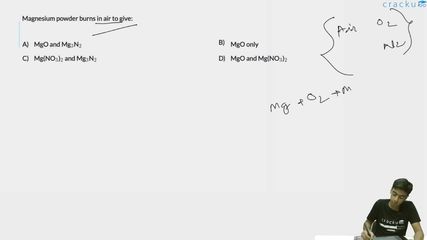
We begin by recalling that air is a mixture composed chiefly of dioxygen, $$\text{O}_2$$, and dinitrogen, $$\text{N}_2$$. When magnesium metal is heated strongly, it becomes highly reactive because the lattice energy released on forming its ionic compounds is very large. Therefore, hot magnesium can reduce or combine with both $$\text{O}_2$$ and $$\text{N}_2$$ present in air.
First, we look at the combination of magnesium with dioxygen. The general reaction for the formation of a metal oxide is stated as:
$$\text{Metal} + \dfrac{1}{2}\text{O}_2 \longrightarrow \text{Metal oxide}$$
Applying this formula to magnesium, we write:
$$\text{Mg} + \dfrac{1}{2}\text{O}_2 \longrightarrow \text{MgO}$$
To balance with integer coefficients, we multiply the entire equation by 2. This gives:
$$2\text{Mg} + \text{O}_2 \longrightarrow 2\text{MgO}$$
So, one product formed is magnesium oxide, $$\text{MgO}$$.
Next, we consider the reaction of hot magnesium with dinitrogen. The general pattern for a reactive metal forming its nitride is:
$$3\text{Metal} + \text{N}_2 \longrightarrow \text{Metal}_3\text{N}_2$$
Substituting magnesium for the generic metal, we obtain:
$$3\text{Mg} + \text{N}_2 \longrightarrow \text{Mg}_3\text{N}_2$$
This equation is already balanced. Thus, the second product is magnesium nitride, $$\text{Mg}_3\text{N}_2$$.
We note that no conditions in ordinary air combustion allow direct formation of magnesium nitrate, $$\text{Mg(NO}_3)_2$$, because that compound would require an oxidizing environment rich in $$\text{NO}_3^-$$ ions, which are absent during simple burning. Therefore, the only substances formed are the oxide and the nitride.
Combining both balanced reactions, we may write the simultaneous overall process as:
$$2\text{Mg} + \text{O}_2 \longrightarrow 2\text{MgO}$$
$$3\text{Mg} + \text{N}_2 \longrightarrow \text{Mg}_3\text{N}_2$$
These two equations together account for all the magnesium reacting in air. Hence, magnesium powder burns in air to give $$\text{MgO}$$ and $$\text{Mg}_3\text{N}_2$$.
Hence, the correct answer is Option A.
Was this solution helpful?
Click on the Email ☝️ to Watch the Video Solution
Create a FREE account and get:
_1.webp)

Educational materials for JEE preparation

Ask our AI anything

AI can make mistakes. Please verify important information.
AI can make mistakes. Please verify important information.
