
Join Our JEE Preparation Group
Prep with like-minded aspirants; Get access to free daily tests and study material.
Sign in
Please select an account to continue using cracku.in
↓ →
Join Our JEE Preparation Group
Prep with like-minded aspirants; Get access to free daily tests and study material.
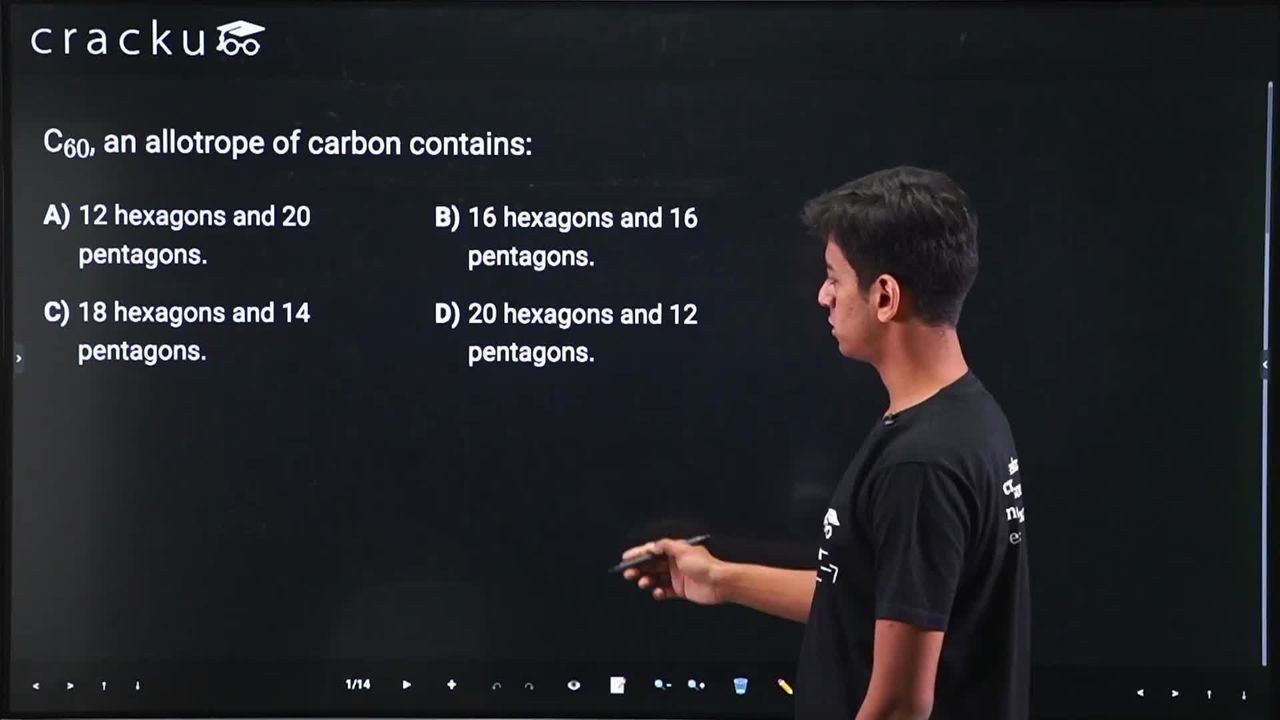
We are asked to find how many pentagonal and hexagonal rings are present in the molecule C60, also called buckminsterfullerene. Let us treat the molecule as a closed polyhedron whose vertices are the 60 carbon atoms and whose faces are only pentagons or hexagons.
First, we recall a well-known fact about the geometry of a truncated icosahedron (the shape of a soccer ball): every vertex is the meeting point of exactly three polygons, namely one pentagon and two hexagons. We shall now translate this verbal information into algebra.
Let $$P$$ be the number of pentagons and $$H$$ the number of hexagons on the surface. The total number of faces is then $$F = P + H.$$
Because each pentagon has 5 vertices and each vertex belongs to exactly one pentagon, we have
$$5P = 60 \; \Longrightarrow \; P = \frac{60}{5} = 12.$$
Next, we need a second relation that links $$H$$ with the known quantities. For any convex polyhedron, we can use Euler’s famous formula
$$V - E + F = 2,$$
where $$V$$ is the number of vertices, $$E$$ the number of edges, and $$F$$ the number of faces. We already know $$V = 60$$ and have just obtained $$P = 12$$, so $$F = P + H = 12 + H.$$
To express $$E$$ in terms of $$P$$ and $$H$$, observe that each pentagon contributes 5 edges and each hexagon contributes 6 edges, but every edge is shared by exactly two faces. Therefore
$$E = \frac{5P + 6H}{2}.$$
We now substitute all these expressions into Euler’s relation:
$$V - E + F = 2$$
$$\Longrightarrow 60 - \frac{5P + 6H}{2} + (P + H) = 2.$$
Substituting $$P = 12$$ gives
$$60 - \frac{5 \times 12 + 6H}{2} + (12 + H) = 2.$$
First compute the numerator in the fraction:
$$5 \times 12 = 60,$$
so $$5 \times 12 + 6H = 60 + 6H.$$
Hence
$$\frac{60 + 6H}{2} = 30 + 3H.$$
Substituting back, we have
$$60 - (30 + 3H) + (12 + H) = 2.$$
Now perform the subtractions and additions step by step:
$$60 - 30 - 3H + 12 + H = 2,$$
$$42 - 2H = 2,$$
$$-2H = 2 - 42 = -40,$$
$$H = \frac{-40}{-2} = 20.$$
We have finally obtained
$$P = 12, \qquad H = 20.$$
That is, C60 contains exactly 12 pentagons and 20 hexagons.
Hence, the correct answer is Option D.
Was this solution helpful?
Click on the Email ☝️ to Watch the Video Solution
Create a FREE account and get:
_1.webp)

Educational materials for JEE preparation

Ask our AI anything

AI can make mistakes. Please verify important information.
AI can make mistakes. Please verify important information.
