
Join Our JEE Preparation Group
Prep with like-minded aspirants; Get access to free daily tests and study material.
Sign in
Please select an account to continue using cracku.in
↓ →
Join Our JEE Preparation Group
Prep with like-minded aspirants; Get access to free daily tests and study material.
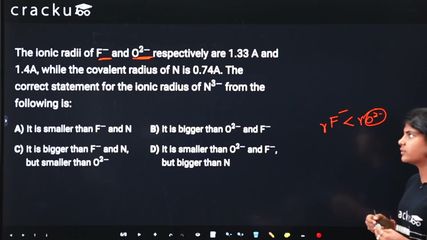
The ionic radii of F$$^-$$ and O$$^{2-}$$ respectively are 1.33 A and 1.4A, while the covalent radius of N is 0.74A. The correct statement for the ionic radius of N$$^{3-}$$ from the following is:
We have to compare the ionic radius of the nitride ion $$\mathrm{N^{3-}}$$ with the already-given radii of $$\mathrm{F^-}$$ and $$\mathrm{O^{2-}}$$ and with the covalent radius of neutral nitrogen.
First, notice that $$\mathrm{N^{3-}},\; \mathrm{O^{2-}},\; \mathrm{F^-},$$ and $$\mathrm{Ne}$$ all possess the same total number of electrons:
$$\begin{aligned} \mathrm{N^{3-}} &:& 7 + 3 = 10 \text{ electrons},\\ \mathrm{O^{2-}} &:& 8 + (-2) = 10 \text{ electrons},\\ \mathrm{F^-} &:& 9 + (-1) = 10 \text{ electrons},\\ \mathrm{Ne} &:& 10 \text{ electrons}. \end{aligned}$$
Species holding the same electron count form what is called an isoelectronic series. In such a series, all ions (or atoms) have an identical electronic cloud, but their nuclear charge $$Z$$ differs. The rule for an isoelectronic series is stated as follows:
Rule. Within an isoelectronic series, the ionic radius decreases as the nuclear charge $$Z$$ increases, because more‐positive nuclei pull the same electron cloud closer.
Now, list the atomic numbers (nuclear charges):
$$\begin{aligned} Z(\mathrm{N}) &= 7,\\ Z(\mathrm{O}) &= 8,\\ Z(\mathrm{F}) &= 9,\\ Z(\mathrm{Ne}) &= 10. \end{aligned}$$
Hence, for the isoelectronic sequence
$$\mathrm{N^{3-}} \; (\!Z=7) \; \lt \; \mathrm{O^{2-}} \; (\!Z=8) \; \lt \; \mathrm{F^-} \; (\!Z=9) \; \lt \; \mathrm{Ne} \; (\!Z=10)$$
the magnitude of the radii follows the opposite order:
$$r(\mathrm{N^{3-}}) \; \gt \; r(\mathrm{O^{2-}}) \; \gt \; r(\mathrm{F^-}) \; \gt \; r(\mathrm{Ne}).$$
We are given the actual experimental values
$$r(\mathrm{O^{2-}}) = 1.40\;\text{Å}, \qquad r(\mathrm{F^-}) = 1.33\;\text{Å},$$
so by the above ordering we must have
$$r(\mathrm{N^{3-}}) \; \gt \; 1.40\;\text{Å}.$$
Consequently $$r(\mathrm{N^{3-}})$$ is certainly larger than both $$r(\mathrm{O^{2-}})$$ and $$r(\mathrm{F^-})$$. In addition, the covalent radius of neutral nitrogen is only $$0.74\;\text{Å},$$ so $$r(\mathrm{N^{3-}})$$ is also larger than that.
Therefore, the correct qualitative statement is: “It is bigger than $$\mathrm{O^{2-}}$$ and $$\mathrm{F^-}$$.” This corresponds to Option B.
Hence, the correct answer is Option B.
Was this solution helpful?
Click on the Email ☝️ to Watch the Video Solution
Create a FREE account and get:
_1.webp)

Educational materials for JEE preparation

Ask our AI anything

AI can make mistakes. Please verify important information.
AI can make mistakes. Please verify important information.
