
Join Our JEE Preparation Group
Prep with like-minded aspirants; Get access to free daily tests and study material.
Sign in
Please select an account to continue using cracku.in
↓ →
Join Our JEE Preparation Group
Prep with like-minded aspirants; Get access to free daily tests and study material.
First, let us recall the basic idea of hydration enthalpy. Hydration enthalpy (symbol $$\Delta H_{hyd}$$) is the enthalpy change when one mole of gaseous ions is surrounded by water molecules to form the hydrated ion. The magnitude of $$\Delta H_{hyd}$$ depends on the electrostatic attraction between the ion and the polar water molecules.
The general proportionality that chemists use is
$$\Delta H_{hyd} \;\propto\; \dfrac{Z^{2}}{r}$$
where $$Z$$ is the charge on the ion and $$r$$ is its ionic radius. We state this relationship because, from Coulomb’s law, a small, highly charged ion has a large charge density, produces a strong electric field, and therefore attracts the water dipoles more strongly; this releases more energy, giving a larger (more negative) hydration enthalpy.
In the alkali-metal family every ion carries the same charge magnitude, namely $$Z = +1$$. Because $$Z$$ is identical for $$Li^{+}$$, $$Na^{+}$$, $$K^{+}$$, $$Rb^{+}$$ and $$Cs^{+}$$, we can simplify the proportionality to
$$\Delta H_{hyd} \;\propto\; \dfrac{1}{r}$$
So, now the rule becomes extremely clear: the smaller the ionic radius, the larger (more exothermic) the hydration enthalpy.
Let us write the experimentally established order of ionic radii for the alkali-metal ions. Going down the group, extra shells of electrons are added, so the radius increases:
$$r(Li^{+}) \lt r(Na^{+}) \lt r(K^{+}) \lt r(Rb^{+}) \lt r(Cs^{+})$$
Because hydration enthalpy varies inversely with radius, we simply reverse this radius order to obtain the hydration-enthalpy order:
$$\Delta H_{hyd}(Li^{+}) \gt \Delta H_{hyd}(Na^{+}) \gt \Delta H_{hyd}(K^{+}) \gt \Delta H_{hyd}(Rb^{+}) \gt \Delta H_{hyd}(Cs^{+})$$
Removing the symbols and writing the ions one after another, we have
$$Li^{+} \;>\; Na^{+} \;>\; K^{+} \;>\; Rb^{+} \;>\; Cs^{+}$$
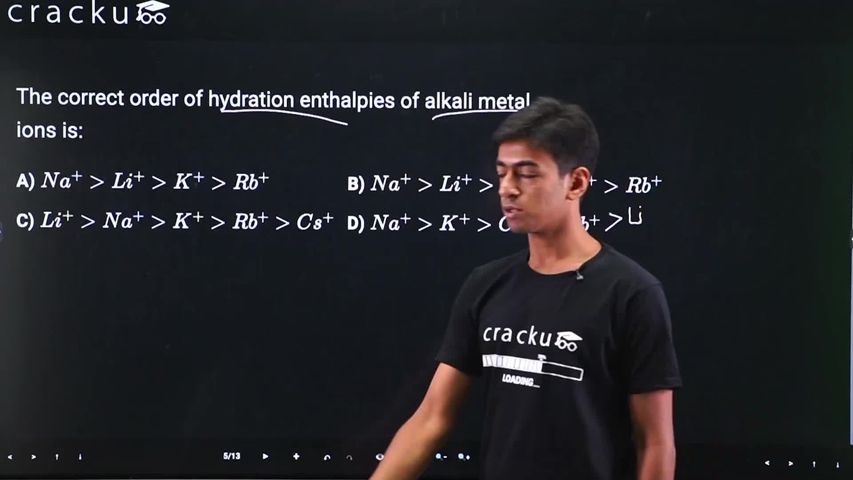
We now compare this logically derived sequence with the four answer choices. Option 3 (often labelled option C) shows exactly this order:
$$Li^{+} \gt Na^{+} \gt K^{+} \gt Rb^{+} \gt Cs^{+}$$
None of the other options match the correct theoretical trend. Therefore our deduction is consistent with experimental data and textbook reasoning.
Hence, the correct answer is Option 3.
Was this solution helpful?
Click on the Email ☝️ to Watch the Video Solution
Create a FREE account and get:
_1.webp)

Educational materials for JEE preparation

Ask our AI anything

AI can make mistakes. Please verify important information.
AI can make mistakes. Please verify important information.
