
Join Our JEE Preparation Group
Prep with like-minded aspirants; Get access to free daily tests and study material.
Sign in
Please select an account to continue using cracku.in
↓ →
Join Our JEE Preparation Group
Prep with like-minded aspirants; Get access to free daily tests and study material.
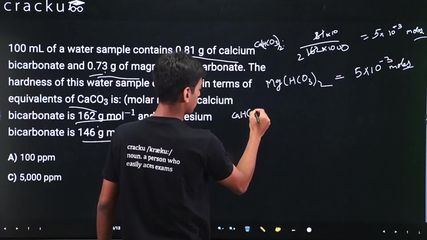
100 mL of a water sample contains 0.81 g of calcium bicarbonate and 0.73 g of magnesium bicarbonate. The hardness of this water sample expressed in terms of equivalents of CaCO$$_3$$ is: (molar mass of calcium bicarbonate is 162 g mol$$^{-1}$$ and magnesium bicarbonate is 146 g mol$$^{-1}$$)
We begin by recalling that the hardness of water is expressed as the mass of calcium carbonate that would furnish the same amount of divalent metal ions. In symbols,
$$\text{Hardness (as CaCO}_3\text{)} = n_{\text{(divalent ions)}} \times M_{\text{CaCO}_3}$$
where $$n_{\text{(divalent ions)}}$$ is the number of moles of Ca2+ or Mg2+ supplied by the salts present and $$M_{\text{CaCO}_3}=100\ \text{g mol}^{-1}$$ is the molar mass of calcium carbonate.
The sample volume is 100 mL, i.e. $$0.1\ \text{L}$$.
Contribution of calcium bicarbonate. We have 0.81 g of calcium bicarbonate, Ca(HCO3)2. Its molar mass is given as 162 g mol−1, so
$$n_{\text{Ca(HCO}_3)_2}=\frac{0.81\ \text{g}}{162\ \text{g mol}^{-1}}=0.005\ \text{mol}.$$
Each mole of Ca(HCO3)2 furnishes one mole of Ca2+, which is equivalent to one mole of CaCO3. Hence the CaCO3-equivalent mass is
$$m_{\text{Ca, as CaCO}_3}=0.005\ \text{mol}\times100\ \text{g mol}^{-1}=0.50\ \text{g}=500\ \text{mg}.$$
Contribution of magnesium bicarbonate. We have 0.73 g of magnesium bicarbonate, Mg(HCO3)2. Its molar mass is 146 g mol−1, hence
$$n_{\text{Mg(HCO}_3)_2}=\frac{0.73\ \text{g}}{146\ \text{g mol}^{-1}}=0.005\ \text{mol}.$$
Each mole of Mg(HCO3)2 gives one mole of Mg2+, again equivalent to one mole of CaCO3. Therefore,
$$m_{\text{Mg, as CaCO}_3}=0.005\ \text{mol}\times100\ \text{g mol}^{-1}=0.50\ \text{g}=500\ \text{mg}.$$
Total CaCO3-equivalent mass.
$$m_{\text{total}}=500\ \text{mg}+500\ \text{mg}=1000\ \text{mg}=1\ \text{g}.$$
This 1000 mg of CaCO3 is present in 100 mL of water. To find the concentration in parts per million (ppm), we need milligrams per litre. Because 100 mL is one-tenth of a litre, we multiply by 10:
$$\text{Hardness}=\frac{1000\ \text{mg}}{0.1\ \text{L}}=10000\ \text{mg L}^{-1}=10000\ \text{ppm}.$$
Hence, the correct answer is Option D.
Was this solution helpful?
Click on the Email ☝️ to Watch the Video Solution
Create a FREE account and get:
_1.webp)

Educational materials for JEE preparation

Ask our AI anything

AI can make mistakes. Please verify important information.
AI can make mistakes. Please verify important information.
