
Join Our JEE Preparation Group
Prep with like-minded aspirants; Get access to free daily tests and study material.
Sign in
Please select an account to continue using cracku.in
↓ →
Join Our JEE Preparation Group
Prep with like-minded aspirants; Get access to free daily tests and study material.
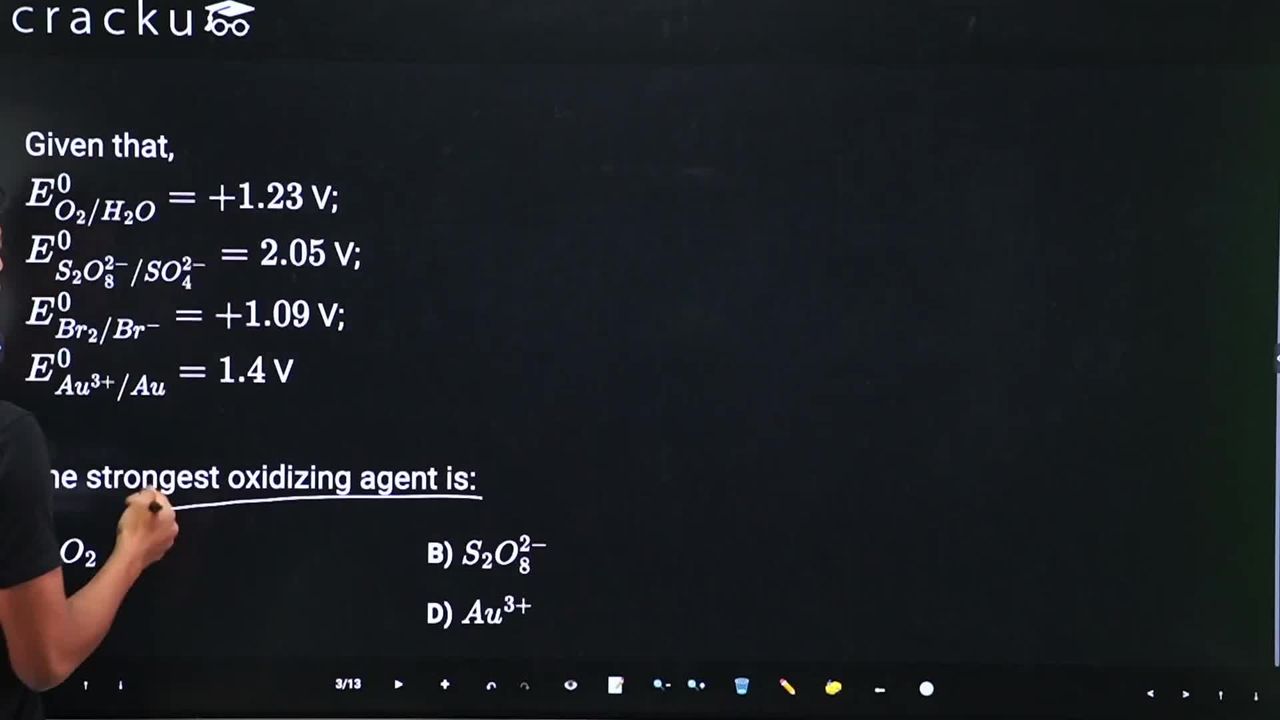
Given that,
$$E^{0}_{O_2/H_2O} = +1.23$$ V;
$$E^{0}_{S_2O_8^{2-}/SO_4^{2-}} = 2.05$$ V;
$$E^{0}_{Br_2/Br^{-}} = +1.09$$ V;
$$E^{0}_{Au^{3+}/Au} = 1.4$$ V
The strongest oxidizing agent is:
First, recall the fundamental relation between standard reduction potential and oxidising strength.
Statement of principle: “The larger (more positive) the standard reduction potential $$E^{0}$$ of a half-cell, the greater is the tendency of the species on the left side of the reduction half-reaction to accept electrons; therefore, that species is the stronger oxidising agent.”
For each species in the question the relevant reduction half-reaction, written in the conventional “reduction” direction (electrons on the left), is as follows. We shall write the value of $$E^{0}$$ alongside each equation.
$$O_2 + 4H^{+} + 4e^{-} \longrightarrow 2H_2O \qquad E^{0}_{O_2/H_2O} = +1.23\ \text{V}$$
$$S_2O_8^{2-} + 2e^{-} \longrightarrow 2SO_4^{2-} \qquad E^{0}_{S_2O_8^{2-}/SO_4^{2-}} = +2.05\ \text{V}$$
$$Br_2 + 2e^{-} \longrightarrow 2Br^{-} \qquad E^{0}_{Br_2/Br^{-}} = +1.09\ \text{V}$$
$$Au^{3+} + 3e^{-} \longrightarrow Au \qquad E^{0}_{Au^{3+}/Au} = +1.40\ \text{V}$$
Now we compare the numerical values:
$$\begin{aligned} E^{0}_{S_2O_8^{2-}/SO_4^{2-}} &= +2.05\ \text{V} \\ E^{0}_{Au^{3+}/Au} &= +1.40\ \text{V} \\ E^{0}_{O_2/H_2O} &= +1.23\ \text{V} \\ E^{0}_{Br_2/Br^{-}} &= +1.09\ \text{V} \end{aligned}$$
Because $$+2.05\ \text{V}$$ is the highest (most positive) among all the listed potentials, the species on the left of that particular half-reaction, namely $$S_2O_8^{2-}$$ (peroxodisulphate ion), possesses the greatest tendency to be reduced.
Hence, according to the principle stated earlier, $$S_2O_8^{2-}$$ is the strongest oxidising agent in the given set.
Therefore, the option corresponding to $$S_2O_8^{2-}$$ is correct.
Hence, the correct answer is Option B.
Was this solution helpful?
Click on the Email ☝️ to Watch the Video Solution
Create a FREE account and get:
_1.webp)

Educational materials for JEE preparation

Ask our AI anything

AI can make mistakes. Please verify important information.
AI can make mistakes. Please verify important information.
