
Join Our JEE Preparation Group
Prep with like-minded aspirants; Get access to free daily tests and study material.
Sign in
Please select an account to continue using cracku.in
↓ →
Join Our JEE Preparation Group
Prep with like-minded aspirants; Get access to free daily tests and study material.
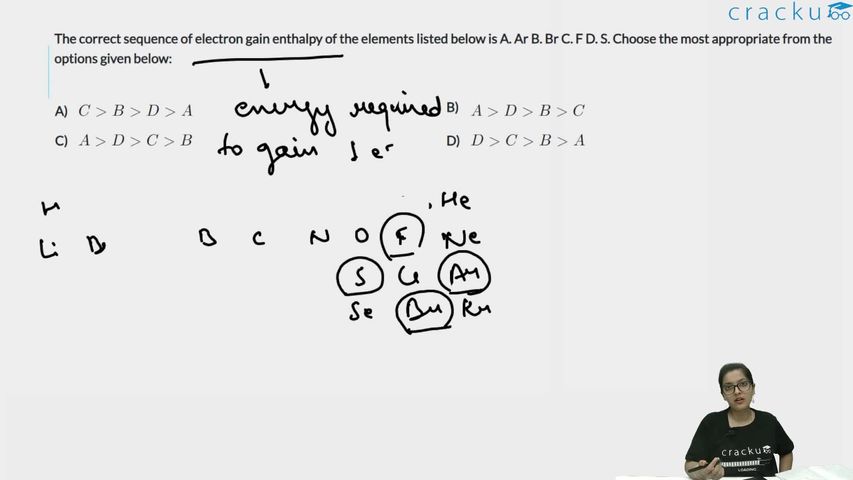
The correct sequence of electron gain enthalpy of the elements listed below is A. Ar B. Br C. F D. S. Choose the most appropriate from the options given below:
Electron gain enthalpy is the enthalpy change associated with the addition of an electron to an isolated gaseous atom.
Noble gases possess completely filled valence shells and strongly resist the addition of an extra electron. Therefore, electron gain enthalpy for argon is positive.
Among the given elements, argon has the highest electron gain enthalpy.
Sulfur belongs to Group 16 and releases energy upon gaining an electron. Its electron gain enthalpy is negative, but less negative than that of the halogens.
Bromine belongs to Group 17 and has a greater tendency to accept an electron than sulfur. Consequently, its electron gain enthalpy is more negative.
Fluorine is also a halogen and has an electron gain enthalpy that is slightly more negative than that of bromine. Therefore, fluorine has the lowest electron gain enthalpy value among the given elements.
Hence, the electron gain enthalpy decreases in the order
$$Ar>S>Br>F$$
Using the given labels
$$A>D>B>C$$
Hence, the correct answer is
$$A>D>B>C$$
Was this solution helpful?
Click on the Email ☝️ to Watch the Video Solution
Create a FREE account and get:
_1.webp)

Educational materials for JEE preparation

Ask our AI anything

AI can make mistakes. Please verify important information.
AI can make mistakes. Please verify important information.
