
Join Our JEE Preparation Group
Prep with like-minded aspirants; Get access to free daily tests and study material.
Sign in
Please select an account to continue using cracku.in
↓ →
Join Our JEE Preparation Group
Prep with like-minded aspirants; Get access to free daily tests and study material.
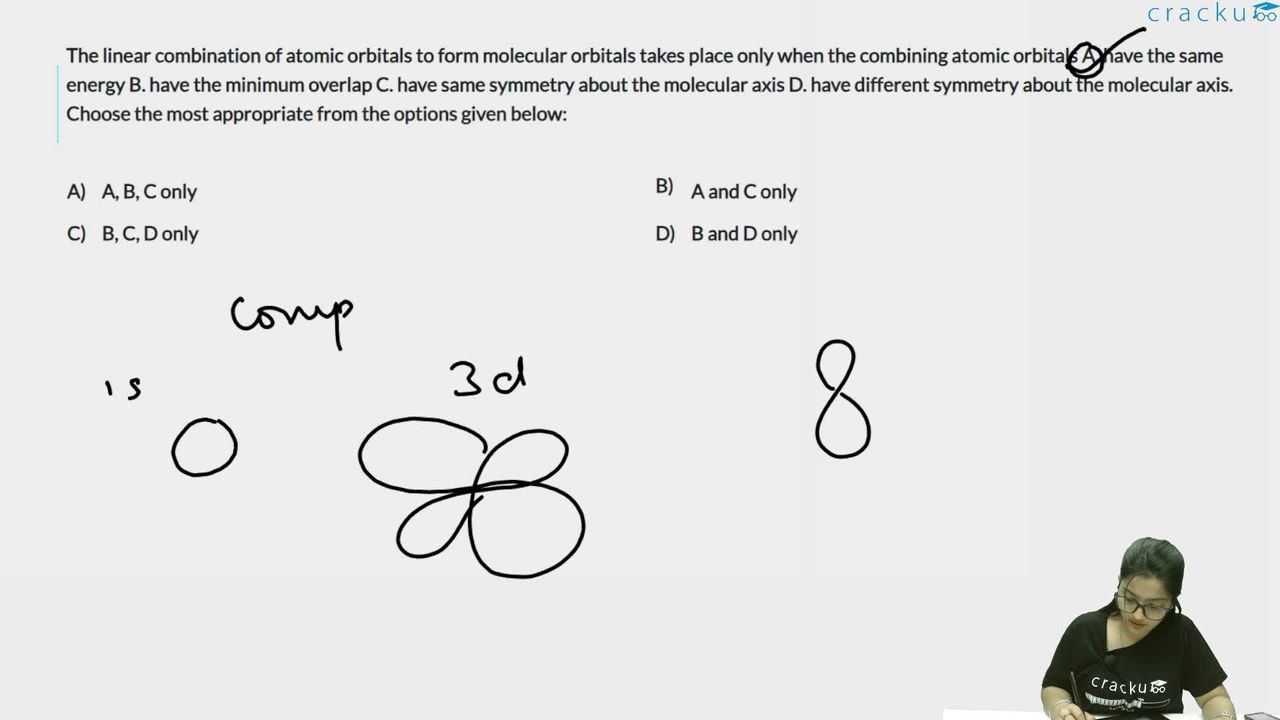
The linear combination of atomic orbitals to form molecular orbitals takes place only when the combining atomic orbitals A. have the same energy B. have the minimum overlap C. have same symmetry about the molecular axis D. have different symmetry about the molecular axis. Choose the most appropriate from the options given below:
We need to identify the correct conditions for linear combination of atomic orbitals (LCAO) to form molecular orbitals.
The three essential conditions for LCAO are:
Condition A: Same energy. The combining atomic orbitals must have comparable (similar or same) energies. For example, the 1s orbital of one atom can effectively combine with the 1s orbital of the other atom, but not with a 2s orbital (which has very different energy). This condition ensures effective orbital mixing. This is CORRECT.
Condition B: Minimum overlap. This is INCORRECT. The correct condition is that the atomic orbitals must have maximum overlap. Greater overlap between atomic orbitals leads to stronger bonding (or antibonding) molecular orbitals. Minimum overlap would result in negligible interaction and no effective molecular orbital formation.
Condition C: Same symmetry about the molecular axis. The combining atomic orbitals must have the same symmetry with respect to the molecular (internuclear) axis. For example, a $$2p_z$$ orbital (symmetric about the bond axis) combines with another $$2p_z$$ orbital to form $$\sigma$$ molecular orbitals, and $$2p_x$$ orbitals combine with $$2p_x$$ orbitals to form $$\pi$$ molecular orbitals. A $$2p_z$$ orbital cannot effectively combine with a $$2p_x$$ orbital because they have different symmetries. This is CORRECT.
Condition D: Different symmetry about the molecular axis. This is INCORRECT — it is the opposite of the correct condition (Condition C).
The correct conditions are A and C.
The correct answer is Option (2): A and C only.
Was this solution helpful?
Click on the Email ☝️ to Watch the Video Solution
Create a FREE account and get:
_1.webp)

Educational materials for JEE preparation

Ask our AI anything

AI can make mistakes. Please verify important information.
AI can make mistakes. Please verify important information.
