
Join Our JEE Preparation Group
Prep with like-minded aspirants; Get access to free daily tests and study material.
Sign in
Please select an account to continue using cracku.in
↓ →
Join Our JEE Preparation Group
Prep with like-minded aspirants; Get access to free daily tests and study material.
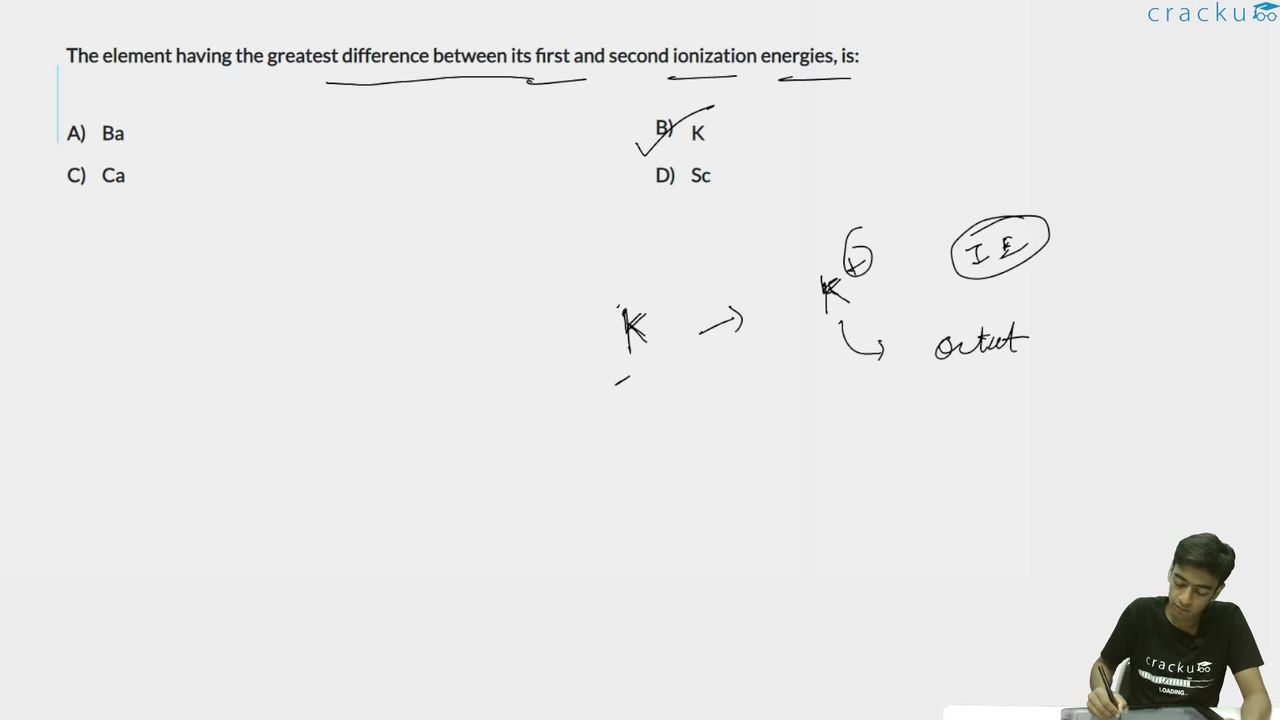
The element having the greatest difference between its first and second ionization energies, is:
To decide which element exhibits the largest jump between its first ionisation energy $$\left(IE_{1}\right)$$ and its second ionisation energy $$\left(IE_{2}\right)$$, we first recall the definition: the $$n^{\text{th}}$$ ionisation energy is the energy required to remove the $$n^{\text{th}}$$ electron from an isolated gaseous atom or ion.
We also recall an important qualitative rule: an exceptionally large increase from $$IE_{1}$$ to $$IE_{2}$$ is observed when the first electron removed leaves behind a stable noble-gas (octet) configuration. In such a case the second electron has to be taken from a completely filled, lower-energy shell, which demands much higher energy.
Let us now inspect the electronic configurations of each given element.
For barium, $$Z=56$$. Its ground-state configuration is $$[Xe]\,6s^{2}.$$ The first electron comes from the $$6s$$ orbital and after its removal the ion $$\text{Ba}^{+}$$ still has the configuration $$[Xe]\,6s^{1}.$$ This is not a noble-gas core, so although $$IE_{2}$$ will be higher than $$IE_{1}$$, the jump is moderate.
For potassium, $$Z=19$$. Its configuration is $$[Ar]\,4s^{1}.$$ Removing the first electron gives $$\text{K}^{+}:\;[Ar],$$ which is exactly the argon noble-gas configuration. Any further electron has to be pulled out of this completely filled shell. Therefore $$IE_{2}$$ for potassium is enormously larger than $$IE_{1}$$.
For calcium, $$Z=20$$. The configuration is $$[Ar]\,4s^{2}.$$ After one electron is removed, the ion $$\text{Ca}^{+}$$ has $$[Ar]\,4s^{1},$$ still not a noble-gas core. Thus the second ionisation does not break into a closed shell yet, and the jump is again moderate.
For scandium, $$Z=21$$. The configuration is $$[Ar]\,3d^{1}4s^{2}.$$ The first removal may take a $$4s$$ electron, leaving $$\text{Sc}^{+}:\;[Ar]\,3d^{1}4s^{1}.$$ This is also not a noble-gas core, so the increase to $$IE_{2}$$ is not extraordinarily large.
Comparing all four cases, only potassium attains a stable noble-gas structure after the first ionisation, so the second ionisation energy shoots up the most.
Hence, the correct answer is Option B.
Was this solution helpful?
Click on the Email ☝️ to Watch the Video Solution
Create a FREE account and get:
_1.webp)

Educational materials for JEE preparation

Ask our AI anything

AI can make mistakes. Please verify important information.
AI can make mistakes. Please verify important information.
