
Join Our JEE Preparation Group
Prep with like-minded aspirants; Get access to free daily tests and study material.
Sign in
Please select an account to continue using cracku.in
↓ →
Join Our JEE Preparation Group
Prep with like-minded aspirants; Get access to free daily tests and study material.
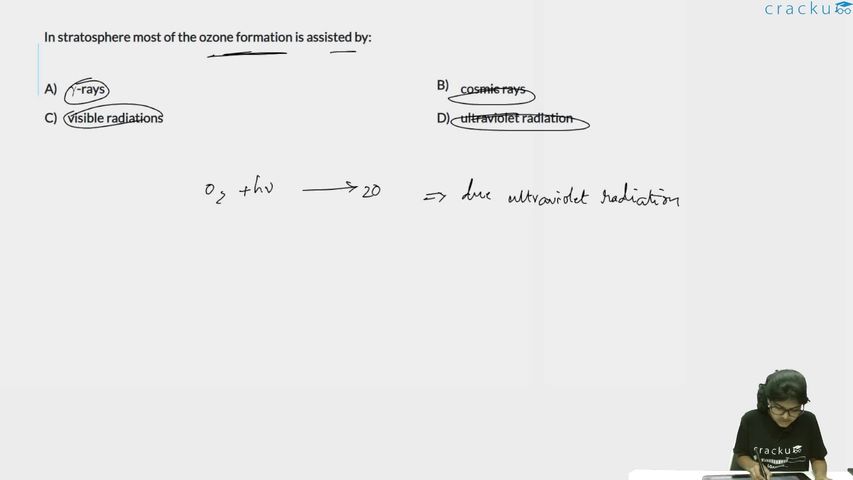
We begin by recalling how ozone $$(\mathrm{O_3})$$ is naturally produced in the Earth’s stratosphere. Molecular oxygen $$(\mathrm{O_2})$$ absorbs electromagnetic radiation of a suitable energy and undergoes a process called photodissociation, breaking into two oxygen atoms:
$$\mathrm{O_2}\;+\;h\nu\;\longrightarrow\;2\,\mathrm{O}$$
Here $$h\nu$$ denotes a photon whose energy is $$E = h\nu$$, where $$h$$ is Planck’s constant and $$\nu$$ is the frequency of the radiation.
Now, each oxygen atom that has just been formed is highly reactive. It quickly combines with another molecule of oxygen to yield ozone:
$$\mathrm{O}\;+\;\mathrm{O_2}\;+\;M\;\longrightarrow\;\mathrm{O_3}\;+\;M$$
In the above step $$M$$ represents a third body (often $$\mathrm{N_2}$$ or $$\mathrm{O_2}$$ itself) which carries away the excess energy and stabilises the newly formed ozone molecule.
The crucial point is the wavelength or, equivalently, the energy of the radiation that can split $$\mathrm{O_2}$$. Only photons whose energy exceeds the bond dissociation energy of $$\mathrm{O_2}$$ can accomplish this. The bond dissociation energy of $$\mathrm{O_2}$$ is approximately $$498\;\text{kJ mol}^{-1}$$. Converting this energy to wavelength using the relation $$E = h c/\lambda$$, we get
$$\lambda \;=\;\frac{h\,c}{E}$$
Substituting $$h = 6.626\times10^{-34}\,\text{J s}$$, $$c = 3.00\times10^{8}\,\text{m s}^{-1}$$, and $$E = 498\times10^{3}\,\text{J mol}^{-1}\Big/\;N_\text{A}$$ where $$N_\text{A} = 6.022\times10^{23}\,\text{mol}^{-1}$$, the calculated wavelength comes out to be roughly $$\lambda \approx 240\;\text{nm}$$.
A wavelength of about $$240\;\text{nm}$$ lies squarely in the ultraviolet (UV) region of the electromagnetic spectrum, which spans roughly $$10\;\text{nm} \lt \lambda \lt 400\;\text{nm}$$. Hence, ultraviolet radiation has exactly the right amount of energy to break the $$\mathrm{O_2}$$ bond and initiate ozone formation.
Neither $$\gamma$$-rays nor cosmic rays are required for this routine atmospheric chemistry; they are far more energetic and occur much less frequently in the stratosphere. Visible light, on the other hand, does not possess sufficient energy to cleave the $$\mathrm{O_2}$$ bond.
So, the dominant agent that assists ozone formation in the stratosphere is ultraviolet radiation.
Hence, the correct answer is Option D.
Click on the Email ☝️ to Watch the Video Solution
Create a FREE account and get:
_1.webp)

Educational materials for JEE preparation

Ask our AI anything

AI can make mistakes. Please verify important information.
AI can make mistakes. Please verify important information.


