Join Our JEE Preparation Group
Prep with like-minded aspirants; Get access to free daily tests and study material.
Sign in
Please select an account to continue using cracku.in
↓ →
Join Our JEE Preparation Group
Prep with like-minded aspirants; Get access to free daily tests and study material.
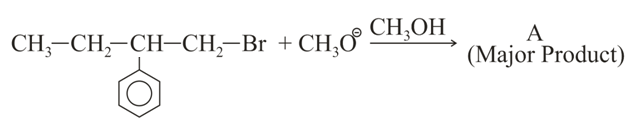
The given substrate is 1-bromo-2-phenylbutane, in which the bromine atom is attached to a primary carbon.
Although primary alkyl halides generally undergo $$S_N2$$ substitution with strong nucleophiles, the adjacent $$\beta$$-carbon in this molecule is highly substituted, bearing both a phenyl group and an ethyl group. This creates significant steric hindrance around the reaction center.
The reagent used is methoxide ion $$\mathrm{CH_3O^-}$$ in methanol, which acts as both a strong nucleophile and a strong base.
Because backside attack required for the $$S_N2$$ mechanism is hindered by the bulky substituents on the adjacent carbon, substitution becomes unfavorable. Instead, the methoxide ion abstracts the $$\beta$$-hydrogen, leading to an $$E2$$ elimination.
During the elimination process:
The resulting product is
$$\mathrm{CH_3CH_2C(Ph)=CH_2}$$
This alkene is especially stable because the newly formed double bond is conjugated with the phenyl ring, allowing resonance stabilization of the $$\pi$$-system. The additional stability of the conjugated alkene strongly favors elimination over substitution.
Hence, the major product is 2-phenylbut-1-ene,
$$\mathrm{CH_3CH_2C(Ph)=CH_2}$$
Therefore, the correct answer is Option (A).
Create a FREE account and get:
_1.webp)

Educational materials for JEE preparation

Ask our AI anything

AI can make mistakes. Please verify important information.
AI can make mistakes. Please verify important information.