For the following questions answer them individually
Match List-(I) with List-(II).
List-(I) List-(II)
(a) R$$_H$$ (Rydberg constant) (i) kg m$$^{-1}$$ s$$^{-1}$$
(b) $$h$$ (Planck's constant) (ii) kg m$$^2$$ s$$^{-1}$$
(c) $$\mu_B$$ (Magnetic field energy density) (iii) m$$^{-1}$$
(d) $$\eta$$ (coefficient of viscosity) (iv) kg m$$^{-1}$$ s$$^{-2}$$
Choose the most appropriate answer from the options given below:
If force (F), length (L) and time (T) are taken as the fundamental quantities. Then what will be the dimension of density:
Water drops are falling from a nozzle of a shower onto the floor from a height of 9.8 m. The drops fall at a regular interval of time. When the first drop strikes the floor, at that instant, the third drop begins to fall. Locate the position of second drop from the floor when the first drop strikes the floor.
A player kicks a football with an initial speed of 25 m s$$^{-1}$$ at an angle of 45° from the ground. What are the maximum height and the time taken by the football to reach at the highest point during motion? (Take g = 10 m s$$^{-2}$$)
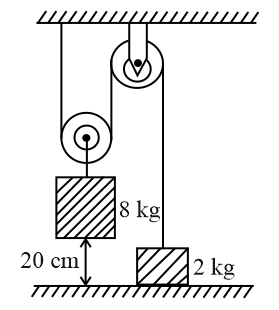
The boxes of masses 2 kg and 8 kg are connected by a massless string passing over smooth pulleys. Calculate the time taken by box of mass 8 kg to strike the ground starting from rest. (g = 10 m s$$^{-2}$$)
The height of victoria's falls is 63 m. What is the difference in the temperature of water at the top and at the bottom of the fall? [Given 1 cal = 4.2 J and specific heat of water = 1 cal g$$^{-1}$$ °C$$^{-1}$$]
Two discs have moments of inertia $$I_1$$ and $$I_2$$ about their respective axes perpendicular to the plane and passing through the centre. They are rotating with angular speeds, $$\omega_1$$ and $$\omega_2$$ respectively and are brought into contact face to face with their axes of rotation coaxial. The loss in kinetic energy of the system in the process is given by:
A mass of 50 kg is placed at the center of a uniform spherical shell of mass 100 kg and radius 50 m. If the gravitational potential at a point, 25 m from the center is $$V$$ kg m$$^{-1}$$. The value of $$V$$ is:
If the R.M.S. speed of oxygen molecules at 0°C is 160 m s$$^{-1}$$. Find the R.M.S. speed of hydrogen molecules at 0°C.
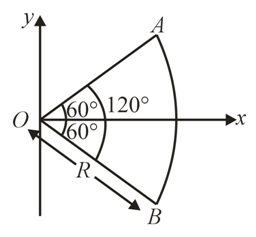
Figure shows a rod $$AB$$, which is bent in a 120° circular arc of radius $$R$$. A charge $$(-Q)$$ is uniformly distributed over rod AB. What is the electric field $$\vec{E}$$ at the centre of curvature O?