
Join Our JEE Preparation Group
Prep with like-minded aspirants; Get access to free daily tests and study material.
Sign in
Please select an account to continue using cracku.in
↓ →
Join Our JEE Preparation Group
Prep with like-minded aspirants; Get access to free daily tests and study material.
A player kicks a football with an initial speed of 25 m s$$^{-1}$$ at an angle of 45° from the ground. What are the maximum height and the time taken by the football to reach at the highest point during motion? (Take g = 10 m s$$^{-2}$$)
Initial speed of the football, $$u = 25 \text{ m s}^{-1}$$.
Projection angle, $$\theta = 45^{\circ}$$.
Acceleration due to gravity, $$g = 10 \text{ m s}^{-2}$$ (downward).
Step 1 - Resolve the initial velocity into horizontal and vertical components.
Formula: $$u_x = u \cos \theta, \quad u_y = u \sin \theta$$.
Since $$\cos 45^{\circ} = \sin 45^{\circ} = \frac{1}{\sqrt{2}}$$,
$$u_y = 25 \sin 45^{\circ} = 25 \left(\frac{1}{\sqrt{2}}\right) = \frac{25}{\sqrt{2}} \text{ m s}^{-1}$$.
Step 2 - Time taken to reach the highest point.
At the highest point, the vertical velocity becomes zero: $$v_y = 0$$.
Equation of uniformly accelerated motion: $$v_y = u_y - g t_{\text{up}}$$.
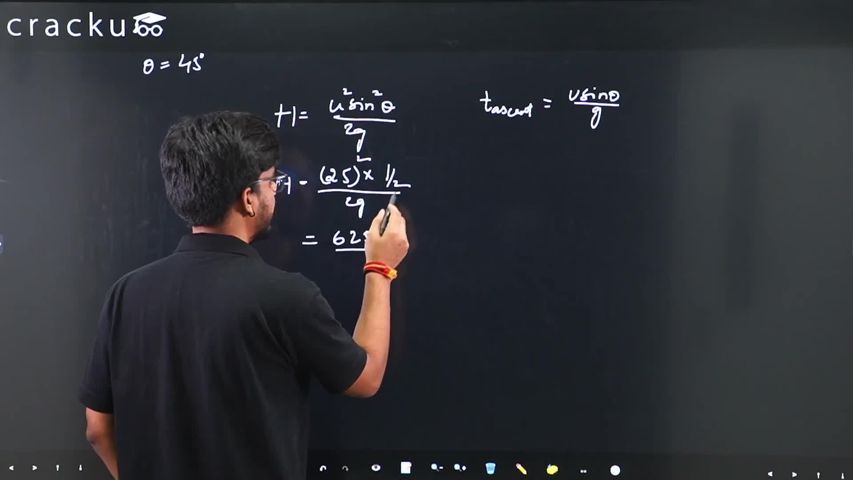
Putting $$v_y = 0$$ gives $$0 = u_y - g t_{\text{up}}$$ ⇒ $$t_{\text{up}} = \frac{u_y}{g}$$.
Substitute $$u_y = \frac{25}{\sqrt{2}}$$ and $$g = 10$$:
$$t_{\text{up}} = \frac{\dfrac{25}{\sqrt{2}}}{10} = \frac{25}{10\sqrt{2}} = \frac{2.5}{\sqrt{2}} \text{ s}$$.
Numeric value: $$t_{\text{up}} \approx 1.77 \text{ s}$$.
Step 3 - Maximum height reached.
Formula: $$h_{\text{max}} = \frac{u_y^{2}}{2g}$$.
Compute $$u_y^{2}$$ first: $$u_y^{2} = \left(\frac{25}{\sqrt{2}}\right)^{2} = \frac{625}{2} = 312.5$$.
Now, $$h_{\text{max}} = \frac{312.5}{2 \times 10} = \frac{312.5}{20} = 15.625 \text{ m}$$.
Results
Maximum height: $$h_{\text{max}} = 15.625 \text{ m}$$.
Time to reach that height: $$t_{\text{up}} \approx 1.77 \text{ s}$$.
These match Option A.
Was this solution helpful?
Click on the Email ☝️ to Watch the Video Solution
Create a FREE account and get:
_1.webp)

Educational materials for JEE preparation

Ask our AI anything

AI can make mistakes. Please verify important information.
AI can make mistakes. Please verify important information.
