
Join Our JEE Preparation Group
Prep with like-minded aspirants; Get access to free daily tests and study material.
Sign in
Please select an account to continue using cracku.in
↓ →
Join Our JEE Preparation Group
Prep with like-minded aspirants; Get access to free daily tests and study material.
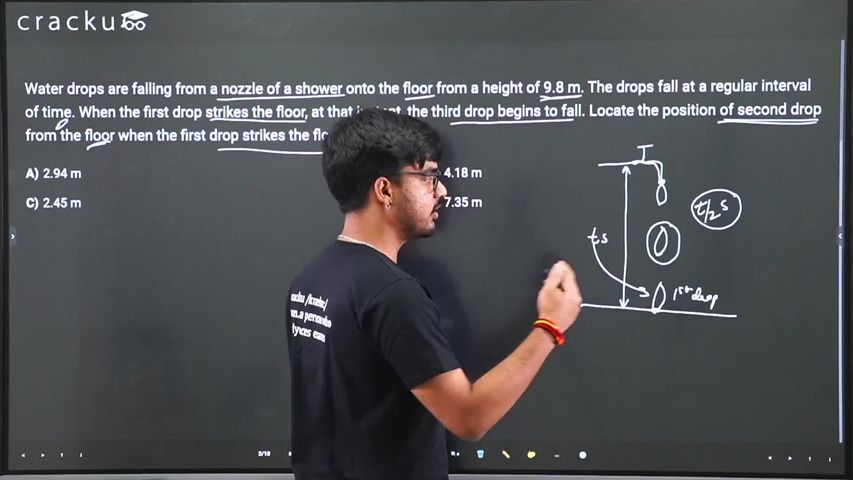
Water drops are falling from a nozzle of a shower onto the floor from a height of 9.8 m. The drops fall at a regular interval of time. When the first drop strikes the floor, at that instant, the third drop begins to fall. Locate the position of second drop from the floor when the first drop strikes the floor.
Let the height of the shower above the floor be $$h = 9.8\text{ m}$$ and let the acceleration due to gravity be $$g = 9.8\text{ m s}^{-2}$$ (standard value given in JEE problems).
Step 1: Time taken by the first drop to reach the floor
Using the equation of uniformly accelerated motion
$$h = \tfrac12 g t_1^{\,2}$$
Solving for $$t_1$$ gives
$$t_1^{\,2} = \frac{2h}{g} = \frac{2\times 9.8}{9.8} = 2 \quad\Rightarrow\quad t_1 = \sqrt{2}\text{ s} \approx 1.414\text{ s} \;-(1)$$
Step 2: Interval between successive drops
Let the drops leave the nozzle at a constant time gap $$\Delta t$$.
Drop 1 is released at $$t = 0$$, Drop 2 at $$t = \Delta t$$, and Drop 3 at $$t = 2\Delta t$$.
According to the statement, “when the first drop strikes the floor, the third drop begins to fall”, so
$$t_1 = 2\Delta t \;-(2)$$
Substituting $$t_1 = \sqrt{2}\text{ s}$$ from $$(1)$$ into $$(2)$$: $$\Delta t = \frac{t_1}{2} = \frac{\sqrt{2}}{2}\text{ s} \approx 0.707\text{ s}$$
Step 3: Time for which the second drop has been in air
At the instant the first drop hits the floor ($$t = t_1$$), the second drop has already been falling for
$$t_2 = t_1 - \Delta t = \sqrt{2} - \frac{\sqrt{2}}{2} = \frac{\sqrt{2}}{2}\text{ s}$$
Notice that $$t_2 = \Delta t$$ because the releases are equally spaced.
Step 4: Distance fallen by the second drop
Using the same motion equation for the second drop:
$$s_2 = \tfrac12 g t_2^{\,2}$$
Substitute $$g = 9.8\text{ m s}^{-2}$$ and $$t_2 = \tfrac{\sqrt{2}}{2}\text{ s}$$:
$$s_2 = \frac12 \times 9.8 \times \left(\frac{\sqrt{2}}{2}\right)^{2}$$
$$s_2 = 4.9 \times \frac{2}{4} = 4.9 \times 0.5 = 2.45\text{ m}$$
Step 5: Position of the second drop from the floor
Total height from nozzle to floor is $$h = 9.8\text{ m}$$.
Hence, distance of the second drop above the floor at that instant is
$$h - s_2 = 9.8 - 2.45 = 7.35\text{ m}$$.
Therefore, the second drop is $$7.35\text{ m}$$ above the floor when the first drop strikes the floor.
Option D.
Was this solution helpful?
Click on the Email ☝️ to Watch the Video Solution
Create a FREE account and get:
_1.webp)

Educational materials for JEE preparation

Ask our AI anything

AI can make mistakes. Please verify important information.
AI can make mistakes. Please verify important information.
