A bag contains (N + 1) coins - N fair coins, and one coin with 'Head' on both sides. A coin is selected at random and tossed. If the probability of getting 'Head' is $$\frac{9}{16}$$, then N is equal to:
JEE Probability Questions
Two distinct numbers a and b are selected at random from 1, 2, 3, ... , 50. The probability, that their product ab is divisible by 3, is
The product ab will be divisibe by 3 only if one of a or b is divisible by 3.
An easier approach to solving this would be to find the complement and then subtract it from 1. We count the complement: probability that $$ ab$$ is not divisible by 3, i.e., neither $$ a$$ nor $$ b$$ is divisible by 3.
From 1 to 50, Multiples of 3 = $$ \lfloor 50/3 \rfloor = 16 $$ . Hence, numbers not divisible by 3 = 50 - 16 = 34.
Now the total number of ways to choose 2 distinct numbers is $$ \binom{50}{2} $$
And the number of ways to select 2 numbers where both are not divisible by 3 is $$ \binom{34}{2} $$
So, $$ P(\text{not divisible by 3}) = \dfrac{\binom{34}{2}}{\binom{50}{2}} = \dfrac{34 \cdot 33}{50 \cdot 49} $$
Hence, $$ P(\text{divisible by 3}) = 1 - \dfrac{34 \cdot 33}{50 \cdot 49} = 1 - \dfrac{1122}{2450}= \dfrac{2450 - 1122}{2450} = \dfrac{1328}{2450} = \dfrac{664}{1225} $$
From a lot containing 10 defective and 90 non-defective bulbs, 8 bulbs are selected one by one with replacement. Then the probability of getting at least 7 defective bulbs is
Probability of selecting a defective bulb ($$p$$) = $$\frac{10}{100} = 0.1$$
Probability of selecting a non-defective bulb ($$q$$) = $$1 - p = 0.9$$
Number of trials ($$n$$) = 8 (Because 8 bulbs are selected)
Let $$X$$ be the random variable representing the number of defective bulbs.
$$X$$ follows a binomial distribution: $$X \sim B(n, p)$$.
$$P(X = k) = \binom{n}{k} p^k q^{n-k}$$
We need to find $$P(X \ge 7)$$, which is the sum of the probabilities of getting exactly 7 or exactly 8 defective bulbs:
$$P(X \ge 7) = P(X = 7) + P(X = 8)$$
For $$k = 7$$: $$P(X = 7) = \binom{8}{7} (0.1)^7 (0.9)^{8-7}$$
$$P(X = 7) = 8 \times (0.1)^7 \times 0.9$$
$$P(X = 7) = 7.2 \times (0.1)^7$$
$$P(X = 7) = 0.00000072$$
For $$k = 8$$: $$P(X = 8) = \binom{8}{8} (0.1)^8 (0.9)^{8-8}$$
$$P(X = 8) = 1 \times (0.1)^8 \times 1$$
$$P(X = 8) = 0.1 \times (0.1)^7$$
$$P(X = 8) = 0.00000001$$
Final Sum: $$P(X \ge 7) = 7.2 \times 10^{-7} + 0.1 \times 10^{-7}$$
$$P(X \ge 7) = 7.3 \times 10^{-7}$$
The probability of getting at least 7 defective bulbs is $$7.3 \times 10^{-7}$$ (or $$\frac{73}{10^8}$$).
A coin is tossed 8 times. If the probability that exactly 4 heads appear in the first six tosses and exactly 3 heads appear in the last five tosses is $$p$$, then $$96p$$ is equal to _____.
Label the eight tosses as 1 2 3 4 5 6 7 8.
Two conditions are imposed:
• Exactly 4 heads in the first six tosses (positions 1-6).
• Exactly 3 heads in the last five tosses (positions 4-8).
Split the eight positions into three non-overlapping blocks:
A: positions 1,2,3 (size 3)
B: positions 4,5,6 (size 3)
C: positions 7,8 (size 2)
Let $$a,b,c$$ denote the number of heads in blocks A, B, C respectively.
Translate the two conditions:
• Heads in positions 1-6 ⇒ $$a+b=4$$ $$-(1)$$
• Heads in positions 4-8 ⇒ $$b+c=3$$ $$-(2)$$
Because each block size limits its heads:
0 ≤ $$a$$ ≤ 3, 0 ≤ $$b$$ ≤ 3, 0 ≤ $$c$$ ≤ 2.
Solving $$(1),(2)$$ simultaneously:
From $$(1):\;a=4-b$$ (so $$b=1,2,3$$).
From $$(2):\;c=3-b$$.
The admissible triples $$(a,b,c)$$ are therefore:
Case 1: $$b=1 \;\Rightarrow\; a=3,\;c=2$$ (possible)
Case 2: $$b=2 \;\Rightarrow\; a=2,\;c=1$$ (possible)
Case 3: $$b=3 \;\Rightarrow\; a=1,\;c=0$$ (possible)
Count sequences for each case using combinations.
Case 1: $$C(3,3)\,C(3,1)\,C(2,2)=1\cdot3\cdot1=3$$ sequences.
Case 2: $$C(3,2)\,C(3,2)\,C(2,1)=3\cdot3\cdot2=18$$ sequences.
Case 3: $$C(3,1)\,C(3,3)\,C(2,0)=3\cdot1\cdot1=3$$ sequences.
Total favourable sequences $$=3+18+3=24$$.
Total possible sequences of 8 tosses $$=2^8=256$$.
Hence $$p=\frac{24}{256}=\frac{3}{32}$$.
Required value: $$96p = 96 \times \frac{3}{32}=9$$.
Therefore, the answer is 9.
From a month of 31 days, 3 dates are selected at random. If the probability that these dates are in an increasing A.P. is equal to $$\frac{a}{b}$$, where $$ a , b \in N$$ and $$\gcd(a, b) = 1$$. Then $$a + b$$ is equal to :
Label the three chosen dates in increasing order as $$a,\,a+d,\,a+2d$$, where $$a\ge 1$$ and the common difference $$d\ge 1$$ is an integer.
The largest date must not exceed 31, so $$a+2d\le 31 \; \Longrightarrow\; a\le 31-2d$$.
For a fixed $$d$$, the number of admissible first terms $$a$$ is therefore $$31-2d$$.
The common difference can take every integer value from $$1$$ up to $$15$$ because if $$d=16$$ we would need $$a\le -1$$, which is impossible. Thus $$d=1,2,\dots ,15$$.
Total number of favourable arithmetic progressions:
$$N_f=\sum_{d=1}^{15}\bigl(31-2d\bigr)=31\sum_{d=1}^{15}1-2\sum_{d=1}^{15}d.$$
Evaluate the two sums:
$$\sum_{d=1}^{15}1=15,\qquad \sum_{d=1}^{15}d=\frac{15\cdot16}{2}=120.$$
Hence
$$N_f=31\cdot15-2\cdot120=465-240=225.$$
The total number of ways to choose any three distinct dates from the 31-day month is the combination $$\binom{31}{3}$$:
$$N_t=\binom{31}{3}=\frac{31\cdot30\cdot29}{6}=4495.$$
Therefore the required probability is
$$P=\frac{N_f}{N_t}=\frac{225}{4495}.$$
Simplify the fraction. Both numerator and denominator are divisible by $$5$$:
$$\frac{225}{4495}=\frac{45}{899}.$$
The prime factorisation of $$45$$ is $$3^2\cdot5$$, while $$899=29\cdot31$$; no further common factor exists, so the fraction is already in lowest terms with
$$a=45,\; b=899.$$
Finally,
$$a+b=45+899=944.$$
Hence the required value is 944.
Let $$a, b, c \in \{1, 2, 3, 4\}$$. If the probability, that $$ax^2 + 2\sqrt{2}bx + c > 0$$ for all $$x \in \mathbb{R}$$, is $$\frac{m}{n}$$, $$\gcd(m, n) = 1$$, then $$m + n$$ is equal to __________.
The quadratic is $$f(x)= ax^{2}+2\sqrt{2}\,bx+c$$ with $$a,b,c \in\{1,2,3,4\}$$.
For $$f(x) \gt 0$$ for all real $$x$$, two conditions must hold:
1. Leading coefficient $$a \gt 0$$ (already true because $$a \ge 1$$).
2. Discriminant $$\Delta$$ is negative.
Compute the discriminant:
$$\Delta =(2\sqrt{2}b)^{2}-4ac = 8b^{2}-4ac =4\bigl(2b^{2}-ac\bigr).$$
Hence $$\Delta \lt 0 \Longleftrightarrow 2b^{2}-ac \lt 0 \Longleftrightarrow 2b^{2} \lt ac.$$
Total number of ordered triples $$(a,b,c)$$ is $$4^{3}=64.$$ We now count the favourable triples that satisfy $$2b^{2} \lt ac$$.
Case a = 1:Condition becomes $$2b^{2} \lt c.$$
• $$b=1$$: $$2\lt c\Rightarrow c=3,4\;(2\text{ choices})$$
• $$b=2,3,4$$: $$2b^{2}\ge 8 \gt 4$$, no solutions.
Favourable triples = 2.
Condition becomes $$b^{2} \lt c.$$
• $$b=1$$: $$1\lt c\Rightarrow c=2,3,4\;(3\text{ choices})$$
• $$b=2,3,4$$ give $$b^{2}\ge 4$$, but $$c\le 4$$; no solutions.
Favourable triples = 3.
Condition becomes $$2b^{2} \lt 3c.$$ Check each $$c$$:
• $$c=1$$: need $$2b^{2}\lt 3 \Rightarrow b=1\;(1\text{ choice})$$
• $$c=2$$: need $$2b^{2}\lt 6 \Rightarrow b=1\;(1)$$
• $$c=3$$: need $$2b^{2}\lt 9 \Rightarrow b=1,2\;(2)$$
• $$c=4$$: need $$2b^{2}\lt 12 \Rightarrow b=1,2\;(2)$$
Favourable triples = $$1+1+2+2 = 6.$$\
Condition becomes $$b^{2} \lt 2c.$$ Check each $$c$$:
• $$c=1$$: $$b^{2}\lt 2 \Rightarrow b=1\;(1)$$
• $$c=2$$: $$b^{2}\lt 4 \Rightarrow b=1\;(1)$$
• $$c=3$$: $$b^{2}\lt 6 \Rightarrow b=1,2\;(2)$$
• $$c=4$$: $$b^{2}\lt 8 \Rightarrow b=1,2\;(2)$$
Favourable triples = $$1+1+2+2 = 6.$$\
Total favourable triples = $$2+3+6+6 = 17.$$
Therefore, required probability $$= \dfrac{17}{64}.$$ Here $$\gcd(17,64)=1$$, so $$m=17,\; n=64.$$ Finally, $$m+n = 17+64 = 81.$$
Answer: 81
From the first 100 natural numbers, two numbers first a and then b are selected randomly without replacement. If the probability that $$a-b \geq 10$$ is $$\frac{m}{n}$$, gcd (m, n) = 1, then m + n is equal to______.
We select two numbers, $$a$$ and then $$b$$ from the first 100 natural numbers without replacement.
Thus the total number of ordered selections is $$100\times\ 99=9900$$
We need $$P\left(a-b\ge\ 10\right)$$
$$\therefore$$ $$\left(a\ge b+\ 10\right)$$
So for every chosen $$a$$, the value of $$b$$ must be at least 10 or less than $$a$$.
The smallest possible $$a$$ satisfying the condition is 11.
For each $$a$$, the possible values of $$b$$ are:
1,2,3,…,a−10
Number of choices for $$b$$: $$a-10$$
Favourable outcomes:
$$\Sigma_{a=11}^{a=100}\left(a-10\right)$$
Let k=a-10
$$\therefore$$ $$\Sigma_{k=1}^{k=90}\left(k\right)$$
$$sum=\dfrac{\left(90\left(90+1\right)\right)}{2}=4095$$
$$P=\dfrac{4095}{9900}$$
When we simplify for coprime, we get $$\dfrac{4095}{9900}=\dfrac{91}{220}$$
$$\therefore$$ m=91 and n=220
$$m+n=91+220=311$$
Hence, our answer is 311.
Let S be a set of 5 elements and P(S) denote the power set of S. Let E be an event of choosing an ordered pair (A, B) from the set P(S) x P(S) such that $$A\cap B=\phi.$$ If
the probability of the event E is $$\frac{3^{p}}{2^{q}}$$, where p,q $$\in$$ N, then p + q is equal to __________
$$S$$ has 5 elements. We choose an ordered pair $$(A, B)$$ from $$P(S) \times P(S)$$. We need the probability that $$A \cap B = \phi$$.
• Total Number of Pairs: Each set $$A$$ and $$B$$ is a subset of $$S$$. Since $$S$$ has 5 elements, $$P(S)$$ has $$2^5$$ elements. The total number of ordered pairs $$(A, B)$$ is $$2^5 \times 2^5 = 2^{10}$$.
• Favorable Outcomes: For each element $$x \in S$$, there are 4 possibilities for its "membership" in the pair $$(A, B)$$:
1. $$x \in A$$ and $$x \in B$$
2. $$x \in A$$ and $$x \notin B$$
3. $$x \notin A$$ and $$x \in B$$
4. $$x \notin A$$ and $$x \notin B$$
• For $$A \cap B = \phi$$, the first case ($$x$$ in both) is impossible. This leaves 3 choices for each of the 5 elements.
• Total favorable pairs $$= 3^5$$.
• Probability: $$P(E) = \frac{3^5}{2^{10}}$$.
• Comparing this to $$\frac{3^p}{2^q}$$, we get $$p = 5$$ and $$q = 10$$.
• Final Answer: $$p + q = 5 + 10 = \mathbf{15}$$.
A candidate has to go to the examination centre to appear in an examination. The candidate uses only one means of transportation for the entire distance out of bus, scooter and car. The probabilities of the candidate going by bus, scooter and car, respectively, are $$\frac{2}{5}$$, $$\frac{1}{5}$$ and $$\frac{2}{5}$$. The probabilities that the candidate reaches late at the examination centre are $$\frac{1}{5}$$, $$\frac{1}{3}$$ and $$\frac{1}{4}$$ if the candidate uses bus, scooter and car, respectively. Given that the candidate reached late at the examination centre, the probability that the candidate travelled by bus is :
A letter is known to have arrived by post either from KANPUR or from ANANTPUR. On the envelope just two consecutive letters AN are visible. The probability, that the letter came from ANANTPUR, is :
To solve this, we use Bayes' Theorem. We need to find the probability that the letter came from ANANTPUR, given that "AN" was visible.
- $$E_1$$: The letter is from KANPUR.
- $$E_2$$: The letter is from ANANTPUR.
- $$A$$: The visible consecutive letters are "AN".
Assume $$P(E_1) = P(E_2) = \frac{1}{2}$$.
We look at the total possible pairs of consecutive letters in each word:
- KANPUR: Total pairs = 5 (KA, AN, NP, PU, UR).
- $$P(A|E_1) = \frac{1}{5}$$
- ANANTPUR: Total pairs = 7 (AN, NA, AN, NT, TP, PU, UR).
- $$P(A|E_2) = \frac{2}{7}$$
We want to find $$P(E_2|A)$$:
$$P(E_2|A) = \frac{P(E_2) \cdot P(A|E_2)}{P(E_1) \cdot P(A|E_1) + P(E_2) \cdot P(A|E_2)}$$
Substitute the values:
$$P(E_2|A) = \frac{\frac{1}{2} \cdot \frac{2}{7}}{\left(\frac{1}{2} \cdot \frac{1}{5}\right) + \left(\frac{1}{2} \cdot \frac{2}{7}\right)}$$
Cancel the common $$\frac{1}{2}$$ factor:
$$P(E_2|A) = \frac{\frac{2}{7}}{\frac{1}{5} + \frac{2}{7}} = \frac{\frac{2}{7}}{\frac{7 + 10}{35}} = \frac{2}{7} \cdot \frac{35}{17} = \frac{10}{17}$$
Correct Answer: B ($$\frac{10}{17}$$)
A man throws a fair coin repeatedly. He gets 10 points for each head and 5 points for each tail he throws. If the probability that he gets exactly 30 points is $$\frac{m}{n}$$, $$\gcd(m, n) = 1$$, then $$m + n$$ is equal to :
Let $$h$$ be the number of heads and $$t$$ the number of tails obtained before the total reaches 30 points.
Each head gives 10 points and each tail gives 5 points, so
$$10h + 5t = 30 \;\Longrightarrow\; 2h + t = 6$$
The non-negative integer solutions of $$2h + t = 6$$ are found by assigning values to $$h$$:
$$\begin{array}{c|c} h & t = 6 - 2h \\ \hline 0 & 6\\ 1 & 4\\ 2 & 2\\ 3 & 0 \end{array}$$
Thus four ordered pairs $$(h,t)$$ are possible: $$(0,6),\,(1,4),\,(2,2),\,(3,0).$$
For each pair, the tosses are arranged in $$(h+t)$$ positions. Number of favourable sequences $$= \binom{h+t}{h},$$ and since the coin is fair, the probability of any specific sequence of $$h+t$$ tosses is $$\left(\tfrac12\right)^{h+t}.$$ Therefore the probability contribution of a pair $$(h,t)$$ is $$\binom{h+t}{h}\left(\tfrac12\right)^{h+t}.$$
Compute each term:
$$\begin{aligned} (h,t)=(0,6):&\; \binom{6}{0}\left(\tfrac12\right)^6 = \frac{1}{64}\\[4pt] (h,t)=(1,4):&\; \binom{5}{1}\left(\tfrac12\right)^5 = \frac{5}{32}\\[4pt] (h,t)=(2,2):&\; \binom{4}{2}\left(\tfrac12\right)^4 = \frac{6}{16} = \frac{3}{8}\\[4pt] (h,t)=(3,0):&\; \binom{3}{3}\left(\tfrac12\right)^3 = \frac{1}{8} \end{aligned}$$
Add the four contributions:
$$\frac{1}{64} + \frac{5}{32} + \frac{3}{8} + \frac{1}{8} = \frac{1}{64} + \frac{10}{64} + \frac{24}{64} + \frac{8}{64} = \frac{43}{64}$$
The required probability is $$\dfrac{43}{64},$$ already in lowest terms, so $$m = 43,\; n = 64.$$ Hence $$m + n = 43 + 64 = 107.$$
Option C which is: 107
The probabilities that players A and B of a team are selected for the captaincy for a tournament are 0.6 and 0.4, respectively. If A is selected the captain, the probability that the team wins the tournament is 0.8 and if B is selected the captain, the probability that the team wins the tournament is 0.7. Then the probability, that the team wins the tournament, is :
Let the events be defined as follows:
• $$C_A$$ : A is chosen as captain, with $$P(C_A)=0.6$$.
• $$C_B$$ : B is chosen as captain, with $$P(C_B)=0.4$$.
• $$W$$ : team wins the match.
The conditional probabilities of winning are given by:
• $$P(W\,\lvert\,C_A)=0.8$$ (win if A is captain)
• $$P(W\,\lvert\,C_B)=0.7$$ (win if B is captain)
Because exactly one of A or B is made captain, the events $$C_A$$ and $$C_B$$ form a partition of the sample space. Therefore, by the Law of Total Probability, the overall probability of winning is
$$\begin{aligned} P(W) &= P(W\,\lvert\,C_A)\,P(C_A) + P(W\,\lvert\,C_B)\,P(C_B)\\ &= 0.8 \times 0.6 \;+\; 0.7 \times 0.4\\ &= 0.48 + 0.28\\ &= 0.76. \end{aligned}$$
Hence, the required probability of winning is $$0.76$$.
Option B which is: $$0.76$$
A bag contains 6 blue and 6 green balls. Pairs of balls are drawn without replacement until the bag is empty. The probability that each drawn pair consists of one blue and one green ball is :
Bag $$B_{1}$$ contains 6 white and 4 blue balls, Bag $$B_{2}$$ contains 4 white and 6 blue balls, and Bag $$B_{3}$$ contains 5 white and 5 blue balls. One of the bags is selected at random and a ball is drawn from it. If the ball is white, then the probability, that the ball is drawn from Bag $$B_{2}$$, is :
P(B₁)=P(B₂)=P(B₃)=1/3
P(W|B₁)=6/10, P(W|B₂)=4/10, P(W|B₃)=5/10
P(W) = (1/3)(6/10+4/10+5/10) = (1/3)(15/10) = 1/2
P(B₂|W) = P(W|B₂)P(B₂)/P(W) = (4/10)(1/3)/(1/2) = (4/30)/(1/2) = 8/30 = 4/15
The correct answer is Option 1: 4/15.
Given three identical bags each containing 10 balls, whose colours are as follows :
Bag I : 3 Red, 2 Blue, 5 Green
Bag II : 4 Red, 3 Blue, 3 Green
Bag III : 5 Red, 1 Blue, 4 Green
A person chooses a bag at random and takes out a ball. If the ball is Red, the probability that it is from bag I is p and if the ball is Green, the probability that it is from bag III is q, then the value of $$\left(\frac{1}{p} + \frac{1}{q}\right)$$ is :
Let the events be:
$$B_1$$ : bag I is selected, $$B_2$$ : bag II is selected, $$B_3$$ : bag III is selected.
$$R$$ : the ball drawn is Red, $$G$$ : the ball drawn is Green.
Because the person picks a bag at random, $$P(B_1)=P(B_2)=P(B_3)=\frac13$$.
Conditional probabilities for drawing a Red ball from the three bags are
$$P(R\mid B_1)=\frac{3}{10},\qquad P(R\mid B_2)=\frac{4}{10},\qquad P(R\mid B_3)=\frac{5}{10}$$
1. Total probability of drawing a Red ball (use the law of total probability):
$$P(R)=P(B_1)P(R\mid B_1)+P(B_2)P(R\mid B_2)+P(B_3)P(R\mid B_3)$$
$$=\frac13\left(\frac{3}{10}+\frac{4}{10}+\frac{5}{10}\right)=\frac13\cdot\frac{12}{10}=\frac{12}{30}=\frac25\;-(1)$$
2. Probability that the Red ball came from bag I (Bayes’ theorem):
$$p=P(B_1\mid R)=\frac{P(B_1)P(R\mid B_1)}{P(R)}=\frac{\frac13\cdot\frac{3}{10}}{\frac25}=\frac{1}{10}\cdot\frac{5}{2}=\frac14\;-(2)$$
Similarly, for Green balls we have the conditional probabilities
$$P(G\mid B_1)=\frac{5}{10},\qquad P(G\mid B_2)=\frac{3}{10},\qquad P(G\mid B_3)=\frac{4}{10}$$
3. Total probability of drawing a Green ball:
$$P(G)=\frac13\left(\frac{5}{10}+\frac{3}{10}+\frac{4}{10}\right)=\frac13\cdot\frac{12}{10}=\frac{12}{30}=\frac25\;-(3)$$
4. Probability that the Green ball came from bag III:
$$q=P(B_3\mid G)=\frac{P(B_3)P(G\mid B_3)}{P(G)}=\frac{\frac13\cdot\frac{4}{10}}{\frac25}=\frac{4}{30}\cdot\frac{5}{2}=\frac13\;-(4)$$
5. Required expression:
$$\frac1p+\frac1q=\frac1{\frac14}+\frac1{\frac13}=4+3=7$$
Therefore, $$\left(\frac1p+\frac1q\right)=7$$, which corresponds to Option C.
A factory has a total of three manufacturing units, $$M_1$$, $$M_2$$, and $$M_3$$, which produce bulbs independent of each other. The units $$M_1$$, $$M_2$$, and $$M_3$$ produce bulbs in the proportions of $$2:2:1$$, respectively. It is known that $$20\%$$ of the bulbs produced in the factory are defective. It is also known that, of all the bulbs produced by $$M_1$$, $$15\%$$ are defective. Suppose that, if a randomly chosen bulb produced in the factory is found to be defective, the probability that it was produced by $$M_2$$ is $$\frac{2}{5}$$.
If a bulb is chosen randomly from the bulbs produced by $$M_3$$, then the probability that it is defective is ______.
Let the events be defined as follows:
$$M_1, M_2, M_3$$ : the bulb is produced by unit $$M_1, M_2, M_3$$ respectively.
$$D$$ : the bulb is defective.
Production proportions (given as $$2:2:1$$) give the prior probabilities
$$P(M_1)=\frac{2}{5},\quad P(M_2)=\frac{2}{5},\quad P(M_3)=\frac{1}{5}$$
Overall defective rate in the factory is $$P(D)=0.20$$.
Defective rates for two of the units are known:
$$P(D\mid M_1)=0.15,\qquad P(M_2\mid D)=\frac{2}{5}=0.40$$
Step 1: Find $$P(D\mid M_2)$$ using Bayes’ theorem.
Bayes’ theorem gives
$$P(M_2\mid D)=\frac{P(D\mid M_2)P(M_2)}{P(D)}$$
Therefore
$$P(D\mid M_2)=\frac{P(M_2\mid D)\,P(D)}{P(M_2)}
=\frac{0.40\times0.20}{\tfrac{2}{5}}
=\frac{0.08}{0.40}=0.20$$
Step 2: Use the overall defective rate to solve for $$P(D\mid M_3)$$. The law of total probability gives $$P(D)=P(D\mid M_1)P(M_1)+P(D\mid M_2)P(M_2)+P(D\mid M_3)P(M_3)$$ Substituting the known numbers: $$0.20=0.15\left(\frac{2}{5}\right)+0.20\left(\frac{2}{5}\right)+P(D\mid M_3)\left(\frac{1}{5}\right)$$ Compute the first two terms: $$0.15\left(\frac{2}{5}\right)=0.06,\qquad 0.20\left(\frac{2}{5}\right)=0.08$$ Thus $$0.20=0.06+0.08+\frac{1}{5}P(D\mid M_3)$$ $$0.20-0.14=\frac{1}{5}P(D\mid M_3)$$ $$0.06=\frac{1}{5}P(D\mid M_3)$$ $$P(D\mid M_3)=0.06\times5=0.30$$
Hence, the probability that a bulb produced by $$M_3$$ is defective is $$0.30$$, which lies in the required range $$0.27-0.33$$.
If the probability that the random variable X takes the value x is given by $$P(X = x) = k(x + 1)3^{-x}$$, $$x = 0, 1, 2, 3, \ldots$$, where k is a constant, then $$P(X \ge 3)$$ is equal to
We are given $$P(X = x) = k(x+1)3^{-x}$$ for $$x = 0, 1, 2, 3, \ldots$$
Since the total probability must equal 1: $$\displaystyle\sum_{x=0}^{\infty} k(x+1)3^{-x} = 1$$.
We know that $$\displaystyle\sum_{x=0}^{\infty} (x+1)r^x = \dfrac{1}{(1-r)^2}$$ for $$|r| \lt 1$$.
With $$r = 1/3$$: $$\displaystyle\sum_{x=0}^{\infty} (x+1)\left(\dfrac{1}{3}\right)^x = \dfrac{1}{(1 - 1/3)^2} = \dfrac{1}{(2/3)^2} = \dfrac{9}{4}$$.
So $$k \cdot \dfrac{9}{4} = 1$$, giving $$k = \dfrac{4}{9}$$.
Now, $$P(X \ge 3) = 1 - P(X = 0) - P(X = 1) - P(X = 2)$$.
$$P(X = 0) = \dfrac{4}{9} \cdot 1 \cdot 1 = \dfrac{4}{9}$$
$$P(X = 1) = \dfrac{4}{9} \cdot 2 \cdot \dfrac{1}{3} = \dfrac{8}{27}$$
$$P(X = 2) = \dfrac{4}{9} \cdot 3 \cdot \dfrac{1}{9} = \dfrac{12}{81} = \dfrac{4}{27}$$
$$P(X = 0) + P(X = 1) + P(X = 2) = \dfrac{4}{9} + \dfrac{8}{27} + \dfrac{4}{27} = \dfrac{12}{27} + \dfrac{8}{27} + \dfrac{4}{27} = \dfrac{24}{27} = \dfrac{8}{9}$$
Therefore, $$P(X \ge 3) = 1 - \dfrac{8}{9} = \dfrac{1}{9}$$.
Hence, the correct answer is Option D.
A and B alternately throw a pair of dice. A wins if he throws a sum of 5 before B throws a sum of 8, and B wins if he throws a sum of 8 before A throws a sum of 5. The probability that A wins if A makes the first throw, is:
When a pair of dice is thrown, the ways in which we can get a sum of $$5$$ are: $$(1,4)$$, $$(4,1)$$, $$(2,3)$$ and $$(3,2)$$, giving the total probability among all the $$6\times 6$$ possibilities as $$\dfrac{4}{36}$$
When a pair of dice is thrown, the ways in which we can get a sum of $$8$$ are: $$(2,6)$$, $$(6,2)$$, $$(5,3)$$, $$(3,5)$$, and $$(4,4)$$, giving the total probability among all the $$6\times 6$$ possibilities as $$\dfrac{5}{36}$$
The probability that A wins in the very first throw is $$\dfrac{4}{36}$$
The probability that A wins in the second time he throws is $$\dfrac{36-4}{36}\times \dfrac{36-5}{36} \times \dfrac{4}{36}$$
The probability that A wins in the third time he throws is $$\dfrac{36-4}{36}\times \dfrac{36-5}{36} \times \dfrac{36-4}{36}\times \dfrac{36-5}{36} \times \dfrac{4}{36}$$
And so on,
The cases form a GP with the first term $$\dfrac{4}{36}$$ and the common ratio of $$\dfrac{36-4}{36}\times \dfrac{36-5}{36}$$
Thus, the combined probability will be;
$$\dfrac{4/36}{1- \left(\dfrac{36-4}{36}\times \dfrac{36-5}{36}\right)} = \dfrac{144}{304} = \dfrac{36}{76} = \dfrac{9}{19}$$
Option B is the correct answer.
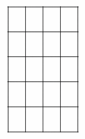
A board has 16 squares as shown in the figure:
Out of these 16 squares, two squares are chosen at random. The probability that they have no side in common is:
Total ways to choose 2 squares: $$\binom{16}{2} = \frac{16 \times 15}{2} = 120$$.
Number of pairs with a common side (Adjacent pairs):
Horizontal adjacencies: In each of the 4 rows, there are 3 pairs $$\implies 4 \times 3 = 12$$.
Vertical adjacencies: In each of the 4 columns, there are 3 pairs $$\implies 4 \times 3 = 12$$.
Total common side pairs = $$12 + 12 = 24$$.
Pairs with NO common side: $$120 - 24 = 96$$.
Probability: $$P = \frac{96}{120} = \frac{4}{5}$$.
Bag 1 contains 4 white balls and 5 black balls, and Bag 2 contains n white balls and 3 black balls. One ball is drawn randomly from Bag 1 and transferred to Bag 2. A ball is then drawn randomly from Bag 2. If the probability, that the ball drawn is white, is 29/45 , then n is equal to :
Bag 1: 4 white, 5 black (total 9). Bag 2: n white, 3 black (total n+3).
Case 1: White ball transferred from Bag 1 to Bag 2.
Probability = $$\frac{4}{9}$$. Bag 2 becomes: (n+1) white, 3 black (total n+4).
P(white from Bag 2) = $$\frac{n+1}{n+4}$$
Case 2: Black ball transferred from Bag 1 to Bag 2.
Probability = $$\frac{5}{9}$$. Bag 2 becomes: n white, 4 black (total n+4).
P(white from Bag 2) = $$\frac{n}{n+4}$$
Total probability of drawing white from Bag 2:
$$ P = \frac{4}{9} \cdot \frac{n+1}{n+4} + \frac{5}{9} \cdot \frac{n}{n+4} = \frac{4(n+1) + 5n}{9(n+4)} = \frac{9n+4}{9(n+4)} $$
Setting equal to $$\frac{29}{45}$$:
$$ \frac{9n+4}{9(n+4)} = \frac{29}{45} $$
Cross-multiplying: $$45(9n+4) = 29 \times 9(n+4)$$
$$405n + 180 = 261n + 1044$$
$$144n = 864$$
$$n = 6$$
The correct answer is Option 1: 6.
A box contains 10 pens of which 3 are defective. A sample of 2 pens is drawn at random and let X denote the number of defective pens. Then the variance of X is
Let the random variable $$X$$ be the number of defective pens obtained when 2 pens are drawn without replacement from a box containing 10 pens, out of which 3 are defective.
Because the draws are without replacement, $$X$$ follows a hypergeometric distribution with parameters
Population size $$N = 10$$
Number of defectives (successes) $$M = 3$$
Sample size $$n = 2$$.
The variance formula for a hypergeometric distribution is
$$\text{Var}(X)= n\,\frac{M}{N}\left(1-\frac{M}{N}\right)\frac{N-n}{N-1} \quad -(1)$$
Substitute the given numbers into $$(1)$$:
$$\frac{M}{N} = \frac{3}{10}, \quad 1-\frac{M}{N} = \frac{7}{10}, \quad \frac{N-n}{N-1} = \frac{10-2}{10-1} = \frac{8}{9}.$$
Therefore
$$\text{Var}(X)= 2 \times \frac{3}{10} \times \frac{7}{10} \times \frac{8}{9}$$
Simplify step by step:
$$2 \times \frac{3}{10} = \frac{6}{10},$$
$$\frac{6}{10} \times \frac{7}{10} = \frac{42}{100} = \frac{21}{50},$$
$$\frac{21}{50} \times \frac{8}{9} = \frac{168}{450} = \frac{28}{75}.$$
Hence, the variance of $$X$$ equals $$\dfrac{28}{75}$$.
So the correct choice is Option B.
One die has two faces marked 1, two faces marked 2, one face marked 3 and one face marked 4. Another die has one face marked 1, two faces marked 2, two faces marked 3 and one face marked 4. The probability of getting the sum of numbers to be 4 or 5, when both the dice are thrown together, is
The following are the cases possible when the dies are thrown and the sum of the numbers on the two faces is $$4$$:
1 and 3
First die 1 and the second die 3 = $$\dfrac{2}{6}\times \dfrac{2}{6} = \dfrac{4}{26}$$
First die 3 and the second die 1 = $$\dfrac{1}{6}\times \dfrac{1}{6} = \dfrac{1}{36}$$
2 and 2
First die 2 and the second die 2 = $$\dfrac{2}{6}\times \dfrac{2}{6} = \dfrac{4}{36}$$
The probability of getting a sum of $$4$$ in all: $$\dfrac{4+1+4}{36} = \dfrac{1}{4}$$
The following are the cases possible when the dies are thrown and the sum of the numbers on the two faces is $$5$$:
1 and 4
First die 1 and the second die 4: $$\dfrac{2}{6}\times \dfrac{1}{6} = \dfrac{2}{36}$$
First die 4 and the second die 1: $$\dfrac{1}{6}\times \dfrac{1}{6} = \dfrac{1}{36}$$
2 and 3
First die 2 and the second die 3: $$\dfrac{2}{6}\times \dfrac{2}{6} = \dfrac{4}{36}$$
First die 3 and the second die 2: $$\dfrac{1}{6}\times \dfrac{2}{6} = \dfrac{2}{36}$$
The probability of getting a sum of $$5$$ in all: $$\dfrac{2+1+4+2}{36} = \dfrac{1}{4}$$
Thus, the combined probability of getting a sum of either $$4$$ or $$5$$ when the two dice are thrown is $$\dfrac{1}{4}+\dfrac{1}{4}=\dfrac{1}{2}$$
Three students $$S_1, S_2,$$ and $$S_3$$ are given a problem to solve. Consider the following events:
$$U$$: At least one of $$S_1, S_2,$$ and $$S_3$$ can solve the problem,
$$V$$: $$S_1$$ can solve the problem, given that neither $$S_2$$ nor $$S_3$$ can solve the problem,
$$W$$: $$S_2$$ can solve the problem and $$S_3$$ cannot solve the problem,
$$T$$: $$S_3$$ can solve the problem.
For any event $$E$$, let $$P(E)$$ denote the probability of $$E$$. If
$$P(U) = \frac{1}{2}, \quad P(V) = \frac{1}{10}, \quad$$ and $$\quad P(W) = \frac{1}{12},$$
then $$P(T)$$ is equal to
Let the individual events be
$$A$$ : $$S_1$$ solves the problem, $$B$$ : $$S_2$$ solves the problem, $$C$$ : $$S_3$$ solves the problem.
Write the probabilities of all eight possible outcome-combinations as
$$\begin{aligned} P(A\,B'\,C') &= x_1, & P(A\,B\,C') &= x_2, & P(A\,B'\,C) &= x_3, & P(A\,B\,C) &= x_4,\\[2pt] P(A'\,B\,C') &= x_5, & P(A'\,B\,C) &= x_6, & P(A'\,B'\,C) &= x_7, & P(A'\,B'\,C') &= x_8. \end{aligned}$$
The eight numbers $$x_1,\dots ,x_8$$ are non-negative and satisfy
$$x_1+x_2+x_3+x_4+x_5+x_6+x_7+x_8 = 1 \qquad -(1)$$
Step 1 Using $$P(U)=\dfrac12$$
Event $$U$$ is “at least one of $$S_1,S_2,S_3$$ solves”, i.e. $$U = A\cup B\cup C$$, whose complement is $$A'B'C'$$. Hence
$$P(U) = 1-P(A'B'C') = 1-x_8 = \frac12 \;\;\Longrightarrow\;\; x_8 = \frac12. \qquad -(2)$$
Step 2 Using $$P(V)=\dfrac1{10}$$
Event $$V$$ is “$$S_1$$ solves given that neither $$S_2$$ nor $$S_3$$ solves”, that is
$$P(V)=P\!\bigl(A\,|\,B'C'\bigr)=\frac{P(A\,B'\,C')}{P(B'\,C')}=\frac{x_1}{x_1+x_8} =\frac1{10}. $$
Substituting $$x_8=\dfrac12$$ from (2):
$$\frac{x_1}{x_1+\dfrac12}=\frac1{10} \;\;\Longrightarrow\;\;10x_1 = x_1+\frac12 \;\;\Longrightarrow\;\;9x_1 = \frac12 \;\;\Longrightarrow\;\; x_1 = \frac1{18}. \qquad -(3)$$
Step 3 Using $$P(W)=\dfrac1{12}$$
Event $$W$$ is “$$S_2$$ solves and $$S_3$$ does not”, i.e.
$$P(W)=P(B\,C') = P(A\,B\,C') + P(A'\,B\,C') = x_2 + x_5 = \frac1{12}. \qquad -(4)$$
Step 4 Total probability still unaccounted for
From (1), (2) and (3)
$$x_2+x_3+x_4+x_5+x_6+x_7 = 1 - x_8 - x_1 = 1 - \frac12 - \frac1{18} = \frac{4}{9}. \qquad -(5)$$
Step 5 Probability that $$S_3$$ solves
$$S_3$$ succeeds in the four cases $$A\,B'\,C,\;A\,B\,C,\;A'\,B\,C,\;A'\,B'\,C$$ whose probabilities are $$x_3,x_4,x_6,x_7$$ respectively. Adding them, and using (4) and (5):
$$\begin{aligned} P(T) &= x_3+x_4+x_6+x_7 \\[2pt] &= \bigl(x_2+x_3+x_4+x_5+x_6+x_7\bigr) - (x_2+x_5) \\[2pt] &= \frac{4}{9} - \frac{1}{12} \\[2pt] &= \frac{16}{36} - \frac{3}{36} \\[2pt] &= \frac{13}{36}. \end{aligned}$$
Therefore $$P(T)=\dfrac{13}{36}$$.
Option A which is: $$\dfrac{13}{36}$$
All five letter words are made using all the letters A, B, C, D, E and arranged as in an English dictionary with serial numbers. Let the word at serial number $$n$$ be denoted by $$W_n$$. Let the probability $$P(W_n)$$ of choosing the word $$W_n$$ satisfy $$P(W_n) = 2P(W_{n-1})$$, $$n \gt 1$$. If $$P(CDBEA) = \frac{2^{\alpha}}{2^{\beta} - 1}$$, $$\alpha, \beta \in \mathbb{N}$$, then $$\alpha + \beta$$ is equal to __________.
There are $$5! = 120$$ different five-letter words that can be formed by using each of the letters A, B, C, D, E exactly once. These words are arranged in ordinary English (lexicographic) order and numbered $$W_1, W_2,\,\dots ,W_{120}$$.
Case 1: Determining the serial number of $$CDBEA$$
Stepwise counting in lexicographic order:
• First letter
A-words: $$4! = 24$$ words (serial numbers $$1\!-\!24$$)
B-words: $$4! = 24$$ words (serial numbers $$25\!-\!48$$)
So words beginning with C start at serial $$49$$.
• First two letters $$C\_x$$ (remaining letters A, B, D, E):
CA-words: $$3! = 6$$ words (serial $$49\!-\!54$$)
CB-words: $$3! = 6$$ words (serial $$55\!-\!60$$)
CD-words therefore start at serial $$61$$.
• First three letters $$CD\_x$$ (remaining letters A, B, E):
CDA-words: $$2! = 2$$ words (serial $$61, 62$$)
CDB-words therefore start at serial $$63$$.
• First four letters $$CDB\_x$$ (remaining letters A, E):
CDBA-word: $$1$$ word (serial $$63$$)
CDBE-words therefore start at serial $$64$$.
The only CDBE-word is $$CDBEA$$ itself, so
$$n = 64.$$
Case 2: Writing the probability model
Let $$P(W_1)=p.$$ Given $$P(W_n)=2P(W_{n-1})$$ for $$n \gt 1$$, the probabilities form a geometric progression: $$P(W_n)=2^{\,n-1}p.$$
The total probability equals $$1$$: $$\sum_{n=1}^{120}P(W_n)=p\sum_{k=0}^{119}2^k =p\,(2^{120}-1)=1.$$ Hence $$p=\frac{1}{2^{120}-1}.$$
Case 3: Probability of the word $$CDBEA$$
The required probability is $$P(CDBEA)=P(W_{64})=2^{64-1}\,p =\frac{2^{63}}{2^{120}-1}.$$
Comparing with $$P(CDBEA)=\dfrac{2^{\alpha}}{2^{\beta}-1}$$ gives $$\alpha = 63,\quad \beta = 120.$$ Therefore, $$\alpha + \beta = 63 + 120 = 183.$$
Final answer: $$183.$$
A card from a pack of 52 cards is lost. From the remaining 51 cards, n cards are drawn and are found to be spades. If the probability of the lost card to be a spade is $$\frac{11}{50}$$, the n is equal to
Let
A : the lost card is a spade,
B : all the $$n$$ cards drawn from the remaining $$51$$ cards are spades.
We are given $$P(A\mid B)=\dfrac{11}{50}$$ and we have to find $$n$$.
First write Bayes’ theorem:
$$P(A\mid B)=\dfrac{P(B\mid A)\,P(A)}{P(B\mid A)\,P(A)+P(B\mid \overline{A})\,P(\overline{A})}\,\,\,-(1)$$
Initial probabilities before any card is lost:
Total spades in a full pack = $$13$$ out of $$52$$.
Hence $$P(A)=\dfrac{13}{52}=\dfrac14$$ and $$P(\overline{A})=\dfrac{39}{52}=\dfrac34$$.
Case 1 (event A happens): the lost card itself is a spade.
Spades left in the remaining $$51$$ cards = $$12$$.
So
$$P(B\mid A)=\dfrac{{}^{12}C_{n}}{{}^{51}C_{n}}\,\,\,-(2)$$
Case 2 (event $$\overline{A}$$ happens): the lost card is not a spade.
Spades left in the remaining $$51$$ cards = $$13$$.
So
$$P(B\mid \overline{A})=\dfrac{{}^{13}C_{n}}{{}^{51}C_{n}}\,\,\,-(3)$$
Substitute $$(2)$$ and $$(3)$$ into $$(1)$$:
$$P(A\mid B)=\dfrac{\displaystyle \frac{{}^{12}C_{n}}{{}^{51}C_{n}}\cdot \frac14}{\displaystyle \frac{{}^{12}C_{n}}{{}^{51}C_{n}}\cdot \frac14+\frac{{}^{13}C_{n}}{{}^{51}C_{n}}\cdot \frac34}$$
Cancel the common factor $${}^{51}C_{n}$$ and multiply numerator and denominator by $$4$$ to simplify:
$$P(A\mid B)=\dfrac{{}^{12}C_{n}}{{}^{12}C_{n}+3\,{}^{13}C_{n}}\,\,\,-(4)$$
The question tells us that $$(4)=\dfrac{11}{50}$$, therefore
$$\dfrac{{}^{12}C_{n}}{{}^{12}C_{n}+3\,{}^{13}C_{n}}=\dfrac{11}{50}$$
Cross-multiply:
$$50\,{}^{12}C_{n}=11\bigl({}^{12}C_{n}+3\,{}^{13}C_{n}\bigr)$$
$$50\,{}^{12}C_{n}=11\,{}^{12}C_{n}+33\,{}^{13}C_{n}$$
Subtract $$11\,{}^{12}C_{n}$$ from both sides:
$$39\,{}^{12}C_{n}=33\,{}^{13}C_{n}$$
Divide by $$3$$:
$$13\,{}^{12}C_{n}=11\,{}^{13}C_{n}\,\,\,-(5)$$
Use the identity relating the two combinations:
$${}^{13}C_{n}=\dfrac{13}{13-n}\,{}^{12}C_{n}$$
Substitute this into $$(5)$$:
$$13\,{}^{12}C_{n}=11\left(\dfrac{13}{13-n}\,{}^{12}C_{n}\right)$$
Cancel the common factor $${}^{12}C_{n}$$:
$$13=\dfrac{143}{13-n}$$
Multiply both sides by $$(13-n)$$:
$$13(13-n)=143$$
$$169-13n=143$$
$$13n=169-143=26$$
$$n=2$$
Hence the number of cards drawn that turned out to be spades is $$n=2$$.
Three distinct numbers are selected randomly from the set $$\{1, 2, 3, \ldots, 40\}$$. If the probability, that the selected numbers are in an increasing G.P. is $$\frac{m}{n}$$, $$\gcd(m, n) = 1$$, then $$m + n$$ is equal to _____.
The problem asks for the probability that three numbers chosen from $\{1, 2, \dots, 40\}$ form an increasing G.P.
1. Total Sample Space
The total number of ways to select 3 distinct numbers from 40 is:
$$n(S) = \binom{40}{3} = \frac{40 \times 39 \times 38}{3 \times 2 \times 1} = 9880$$
2. General Form of the G.P.
For the terms to be integers, they must follow the form $(kp^2, kpq, kq^2)$, where $\text{gcd}(p, q) = 1$ and $q > p$. The constraint is that the largest term $kq^2 \leq 40$.
3. Counting Favorable Cases
We iterate through possible values of $p$ and $q$:
- $p=1$: $q \in \{2, 3, 4, 5, 6\}$ yields $10 + 4 + 2 + 1 + 1 = 18$ cases.
- $p=2$: $q \in \{3, 5\}$ yields $4 + 1 = 5$ cases.
- $p=3$: $q \in \{4, 5\}$ yields $2 + 1 = 3$ cases.
- $p=4$: $q=5$ yields $1$ case.
- $p=5$: $q=6$ yields $1$ case.
- Total Favorable Cases:$$n(E) = 18 + 5 + 3 + 1 + 1 = 28$$
4. Final Probability and Result
The probability $P$ is given by:
$$P = \frac{28}{9880} = \frac{7}{2470} = \frac{m}{n}$$
Since $\text{gcd}(7, 2470) = 1$, we identify $m = 7$ and $n = 2470$.
$$m + n = 7 + 2470 = 2477$$
Two balls are selected at random one by one without replacement from a bag containing 4 white and 6 black balls. If the probability that the first selected ball is black, given that the second selected ball is also black, is $$\frac{m}{n}$$, where $$gcd(m,n)=1$$, then $$m+n$$ is equal to :
We need to find $$ P(\text{first black} \mid \text{second black}) $$
We know, for conditional probability, $$ P(A|B) = \frac{P(A \cap B)}{P(B)} $$
Let, $$ A$$ be the event that the first ball is black, and $$ B$$ be that the second ball is black
So, probability both balls are black (without replacement) is $$ P(A \cap B) = \dfrac{6}{10} \cdot \dfrac{5}{9} = \dfrac{1}{3} $$
Probability second ball is black is
$$ P(B) = P(\text{second black | first black}) \cdot P(\text{first black}) + P(\text{second black | first white}) \cdot P(\text{first white}) $$
$$ = \dfrac{5}{9} \cdot \dfrac{6}{10} + \dfrac{6}{9} \cdot \dfrac{4}{10} = \dfrac{30}{90} + \dfrac{24}{90} = \dfrac{3}{5} $$
Now, $$ P(A|B) = \dfrac{P(A \cap B)}{P(B)} = \dfrac{1/3}{3/5} = \dfrac{5}{9} $$
Thus, $$ m+n = 5+9 =14$$ .
If A and B are two events such that $$P(A) = 0.7$$, $$P(B) = 0.4$$ and $$P(A \cap \bar{B}) = 0.5$$, where $$\bar{B}$$ denotes the complement of B, then $$P\left(B\mid(A \cup \bar{B})\right)$$ is equal to :
We want the conditional probability of $$B$$ given $$A \cup \bar{B}$$, written as $$P\left(B \; \bigl|\; A \cup \bar{B}\right)$$.
By definition of conditional probability,
$$P\left(B \;\bigl|\; A \cup \bar{B}\right)=\dfrac{P\!\left(B \cap (A \cup \bar{B})\right)}{P\!\left(A \cup \bar{B}\right)} \quad -(1)$$
Step 1: Simplify the numerator
Inside the intersection, $$B \cap (A \cup \bar{B}) = (B \cap A)\, \cup\, (B \cap \bar{B})$$.
But $$B \cap \bar{B} = \varnothing$$, so
$$B \cap (A \cup \bar{B}) = A \cap B \quad -(2)$$
Hence the numerator in $$(1)$$ is $$P(A \cap B)$$.
Step 2: Find $$P(A \cap B)$$
Use $$P(A)=P(A \cap B)+P(A \cap \bar{B}) \quad -(3)$$.
Given $$P(A)=0.7$$ and $$P(A \cap \bar{B})=0.5$$, substitute in $$(3)$$:
$$P(A \cap B)=0.7-0.5=0.2 \quad -(4)$$
Step 3: Find $$P(A \cup \bar{B})$$ (the denominator)
The addition theorem states
$$P(A \cup \bar{B}) = P(A) + P(\bar{B}) - P(A \cap \bar{B}) \quad -(5)$$
We already know $$P(A)=0.7$$ and $$P(A \cap \bar{B})=0.5$$. Also, $$P(\bar{B}) = 1 - P(B) = 1 - 0.4 = 0.6$$.
Substitute into $$(5)$$:
$$P(A \cup \bar{B}) = 0.7 + 0.6 - 0.5 = 0.8 \quad -(6)$$
Step 4: Compute the conditional probability
Insert $$(4)$$ and $$(6)$$ into $$(1)$$:
$$P\left(B \; \bigl|\; A \cup \bar{B}\right)=\dfrac{0.2}{0.8}=0.25=\dfrac{1}{4}$$
Therefore, the required probability equals $$\dfrac{1}{4}$$.
Hence, Option A is correct.
A bag contains 19 unbiased coins and one coin with head on both sides. One coin drawn at random is tossed and head turns up. If the probability that the drawn coin was unbiased, is $$\frac{m}{n}$$, $$\gcd(m, n) = 1$$, then $$n^2 - m^2$$ is equal to :
Let
$$U$$ : the drawn coin is unbiased (ordinary coin)
$$D$$ : the drawn coin is double-headed
$$H$$ : head turns up on the toss
Bayes’ theorem states
$$P(U\,|\,H)=\dfrac{P(U)\,P(H\,|\,U)}{P(U)\,P(H\,|\,U)+P(D)\,P(H\,|\,D)}$$ $$-(1)$$
Step 1: Prior probabilities of choosing a coin
There are 20 coins in all (19 unbiased + 1 double-headed).
$$P(U)=\frac{19}{20},\qquad P(D)=\frac{1}{20}$$
Step 2: Probabilities of getting head from each type
For an unbiased coin, head appears with probability $$\frac12$$: $$P(H\,|\,U)=\frac12$$.
For a double-headed coin, head always appears: $$P(H\,|\,D)=1$$.
Step 3: Use Bayes’ theorem
Substituting the values into $$(1)$$:
$$P(U\,|\,H)=\dfrac{\frac{19}{20}\times\frac12}{\frac{19}{20}\times\frac12+\frac{1}{20}\times1}$$
Simplify numerator and denominator separately:
Numerator $$=\frac{19}{20}\times\frac12=\frac{19}{40}$$
Denominator $$=\frac{19}{40}+\frac{1}{20}=\frac{19}{40}+\frac{2}{40}=\frac{21}{40}$$
Hence
$$P(U\,|\,H)=\frac{\frac{19}{40}}{\frac{21}{40}}=\frac{19}{21}$$
Step 4: Identify $$m$$ and $$n$$
The required probability is $$\frac{m}{n}=\frac{19}{21}$$ with $$\gcd(19,21)=1$$, so $$m=19$$ and $$n=21$$.
Step 5: Compute $$n^2-m^2$$
$$n^2-m^2=21^2-19^2=(21-19)(21+19)=2\times40=80$$
Therefore, $$n^2 - m^2 = 80$$.
Option A is correct.
If and are two events such that P(A ∩ B) = 0.1. and P(A | B) and P(B ∣ A) are the roots of the equation $$12x^{2} − 7x + 1 = 0$$, then the value of $$\frac{P(\overline{A} \cup \overline{B})}{P(\overline{A} \cap \overline{B}}$$ is:
Given that $$A$$ and $$B$$ are two events with $$P(A \cap B) = 0.1$$, and $$P(A \mid B)$$ and $$P(B \mid A)$$ are the roots of the equation $$12x^2 - 7x + 1 = 0$$. We need to find $$\frac{P(\overline{A} \cup \overline{B})}{P(\overline{A} \cap \overline{B})}$$.
First, solve the quadratic equation $$12x^2 - 7x + 1 = 0$$ to find the roots. Using the quadratic formula:
$$x = \frac{7 \pm \sqrt{(-7)^2 - 4 \cdot 12 \cdot 1}}{2 \cdot 12} = \frac{7 \pm \sqrt{49 - 48}}{24} = \frac{7 \pm \sqrt{1}}{24} = \frac{7 \pm 1}{24}$$
So, the roots are $$x = \frac{8}{24} = \frac{1}{3}$$ and $$x = \frac{6}{24} = \frac{1}{4}$$. Therefore, $$P(A \mid B)$$ and $$P(B \mid A)$$ are $$\frac{1}{3}$$ and $$\frac{1}{4}$$, in some order.
Recall the conditional probability formulas:
$$P(A \mid B) = \frac{P(A \cap B)}{P(B)} \quad \text{and} \quad P(B \mid A) = \frac{P(A \cap B)}{P(A)}$$
Given $$P(A \cap B) = 0.1$$, we consider the two possible cases.
Case 1: $$P(A \mid B) = \frac{1}{3}$$ and $$P(B \mid A) = \frac{1}{4}$$
Then,
$$P(B) = \frac{P(A \cap B)}{P(A \mid B)} = \frac{0.1}{\frac{1}{3}} = 0.1 \times 3 = 0.3$$
$$P(A) = \frac{P(A \cap B)}{P(B \mid A)} = \frac{0.1}{\frac{1}{4}} = 0.1 \times 4 = 0.4$$
Case 2: $$P(A \mid B) = \frac{1}{4}$$ and $$P(B \mid A) = \frac{1}{3}$$
Then,
$$P(B) = \frac{P(A \cap B)}{P(A \mid B)} = \frac{0.1}{\frac{1}{4}} = 0.1 \times 4 = 0.4$$
$$P(A) = \frac{P(A \cap B)}{P(B \mid A)} = \frac{0.1}{\frac{1}{3}} = 0.1 \times 3 = 0.3$$
In both cases, $$P(A) + P(B) = 0.4 + 0.3 = 0.7$$ or $$0.3 + 0.4 = 0.7$$, same sum.
Now, find $$P(A \cup B)$$ using the formula:
$$P(A \cup B) = P(A) + P(B) - P(A \cap B)$$
In Case 1: $$P(A \cup B) = 0.4 + 0.3 - 0.1 = 0.6$$
In Case 2: $$P(A \cup B) = 0.3 + 0.4 - 0.1 = 0.6$$
So, $$P(A \cup B) = 0.6$$ in both cases.
Using De Morgan's laws:
$$\overline{A} \cup \overline{B} = (A \cap B)^c \quad \text{and} \quad \overline{A} \cap \overline{B} = (A \cup B)^c$$
Therefore,
$$P(\overline{A} \cup \overline{B}) = P((A \cap B)^c) = 1 - P(A \cap B) = 1 - 0.1 = 0.9$$
$$P(\overline{A} \cap \overline{B}) = P((A \cup B)^c) = 1 - P(A \cup B) = 1 - 0.6 = 0.4$$
The ratio is:
$$\frac{P(\overline{A} \cup \overline{B})}{P(\overline{A} \cap \overline{B})} = \frac{0.9}{0.4} = \frac{9}{10} \times \frac{5}{2} = \frac{9}{4}$$
Using fractions for clarity:
$$P(A \cap B) = \frac{1}{10}$$
Case 1: $$P(A) = \frac{2}{5}$$, $$P(B) = \frac{3}{10}$$
$$P(A \cup B) = \frac{2}{5} + \frac{3}{10} - \frac{1}{10} = \frac{4}{10} + \frac{3}{10} - \frac{1}{10} = \frac{6}{10} = \frac{3}{5}$$
$$P(\overline{A} \cup \overline{B}) = 1 - \frac{1}{10} = \frac{9}{10}$$
$$P(\overline{A} \cap \overline{B}) = 1 - \frac{3}{5} = \frac{2}{5}$$
Ratio $$= \frac{\frac{9}{10}}{\frac{2}{5}} = \frac{9}{10} \times \frac{5}{2} = \frac{45}{20} = \frac{9}{4}$$
Same result in Case 2.
Thus, the ratio is $$\frac{9}{4}$$, which corresponds to option D.
The probability, of forming a 12 persons committee from 4 engineers, 2 doctors and 10 professors containing at least 3 engineers and at least 1 doctor, is:
Total number of persons available: 4 engineers (E), 2 doctors (D) and 10 professors (P).
Hence total persons = $$4+2+10 = 16$$.
We have to form a committee of 12 persons subject to the two constraints:
• at least 3 engineers
• at least 1 doctor.
Probability $$= \dfrac{\text{number of favourable committees}}{\text{total number of possible committees}}$$.
Total committees
Choosing any 12 out of 16 persons gives $$\binom{16}{12} = \binom{16}{4} = 1820$$ committees.
Favourable committees
Let the committee contain $$e$$ engineers, $$d$$ doctors and $$p$$ professors.
We need $$e \ge 3$$, $$d \ge 1$$ and $$e+d+p = 12$$ with the limits $$0 \le p \le 10$$.
Possible integer triples $$(e,d,p)$$ satisfying these conditions are:
• $$e = 3,\; d = 1,\; p = 8$$
• $$e = 3,\; d = 2,\; p = 7$$
• $$e = 4,\; d = 1,\; p = 7$$
• $$e = 4,\; d = 2,\; p = 6$$
For each case count the committees using $$\binom{n}{r}$$.
Case 1: $$(e,d,p) = (3,1,8)$$
$$\binom{4}{3}\binom{2}{1}\binom{10}{8} = 4 \times 2 \times 45 = 360$$
Case 2: $$(e,d,p) = (3,2,7)$$
$$\binom{4}{3}\binom{2}{2}\binom{10}{7} = 4 \times 1 \times 120 = 480$$
Case 3: $$(e,d,p) = (4,1,7)$$
$$\binom{4}{4}\binom{2}{1}\binom{10}{7} = 1 \times 2 \times 120 = 240$$
Case 4: $$(e,d,p) = (4,2,6)$$
$$\binom{4}{4}\binom{2}{2}\binom{10}{6} = 1 \times 1 \times 210 = 210$$
Add the favourable counts:
$$360 + 480 + 240 + 210 = 1290$$.
Probability
$$\text{P} = \dfrac{1290}{1820} = \dfrac{129}{182}$$ (dividing numerator and denominator by 10).
Thus the required probability is $$\dfrac{129}{182}$$, which matches Option A.
Let S be the set of all the words that can be formed by arranging all the letters of the word GARDEN. From the set S, one word is selected at random. The probability that the selected word will NOT have vowels in alphabetical order is :
We need to find the probability that a randomly selected word from all arrangements of GARDEN does NOT have vowels in alphabetical order.
The word GARDEN has 6 distinct letters: G, A, R, D, E, N. The vowels are A and E.
Total arrangements = $$6! = 720$$.
In any arrangement of the 6 letters, the two vowels A and E occupy 2 of the 6 positions. These two vowels can appear in only 2 orders: A before E (alphabetical) or E before A (non-alphabetical).
By symmetry, exactly half of all arrangements have A before E (vowels in alphabetical order), and exactly half have E before A.
The probability that vowels are NOT in alphabetical order (i.e., E appears before A) is:
$$P = \frac{1}{2}$$
The correct answer is Option (1): $$\frac{1}{2}$$.
Let $$X$$ be a random variable, and let $$P(X = x)$$ denote the probability that $$X$$ takes the value $$x$$. Suppose that the points $$(x, P(X = x))$$, $$x = 0, 1, 2, 3, 4$$, lie on a fixed straight line in the $$xy$$-plane, and $$P(X = x) = 0$$ for all $$x \in \mathbb{R} - \{0, 1, 2, 3, 4\}$$. If the mean of $$X$$ is $$\frac{5}{2}$$, and the variance of $$X$$ is $$\alpha$$, then the value of $$24\alpha$$ is ________.
The five probabilities are $$P(X = 0), P(X = 1), P(X = 2), P(X = 3), P(X = 4)$$. Because the points $$(x, P(X = x))$$ for $$x = 0,1,2,3,4$$ lie on a straight line, the probability is an affine (linear) function of $$x$$:
$$P(X = x) = a + bx,\qquad x = 0,1,2,3,4$$
Here $$a$$ and $$b$$ are constants to be determined. Outside these five values the probability is zero, so the total probability is
$$\sum_{x=0}^{4} P(X = x) = 1$$ $$\Rightarrow \sum_{x=0}^{4} (a + bx) = 1$$
The useful sums are $$\sum_{x=0}^{4} 1 = 5,\qquad \sum_{x=0}^{4} x = 0+1+2+3+4 = 10$$
Therefore $$5a + 10b = 1 \qquad -(1)$$
Next use the given mean $$E[X] = \dfrac{5}{2} = 2.5$$:
$$E[X] = \sum_{x=0}^{4} x\,P(X = x) = \sum_{x=0}^{4} x(a + bx)$$ Break the sum into two parts:
$$\sum_{x=0}^{4} xa = a\sum_{x=0}^{4} x = a\cdot10$$ $$\sum_{x=0}^{4} bx^{2} = b\sum_{x=0}^{4} x^{2}$$ Since $$\sum_{x=0}^{4} x^{2} = 0^{2}+1^{2}+2^{2}+3^{2}+4^{2} = 30$$,
$$E[X] = 10a + 30b = 2.5 \qquad -(2)$$
Solve the simultaneous equations. Divide $$(1)$$ by $$5$$: $$a + 2b = 0.2$$ Divide $$(2)$$ by $$10$$: $$a + 3b = 0.25$$ Subtract the first from the second:
$$b = 0.25 - 0.2 = 0.05 = \frac{1}{20}$$ Back-substitute into $$a + 2b = 0.2$$:
$$a = 0.2 - 2(0.05) = 0.2 - 0.1 = 0.1$$
Compute $$E[X^{2}]$$ to obtain the variance. First, $$E[X^{2}] = \sum_{x=0}^{4} x^{2}P(X = x) = \sum_{x=0}^{4} x^{2}(a + bx)$$
Break it again: $$\sum_{x=0}^{4} x^{2}a = a\sum_{x=0}^{4} x^{2} = a\cdot30$$ $$\sum_{x=0}^{4} x^{3}b = b\sum_{x=0}^{4} x^{3}$$ Here $$\sum_{x=0}^{4} x^{3} = 0^{3}+1^{3}+2^{3}+3^{3}+4^{3} = 100$$
Thus $$E[X^{2}] = 30a + 100b = 30(0.1) + 100(0.05) = 3 + 5 = 8$$
The variance is $$\alpha = \operatorname{Var}(X) = E[X^{2}] - (E[X])^{2} = 8 - (2.5)^{2} = 8 - 6.25 = 1.75 = \frac{7}{4}$$
Finally, $$24\alpha = 24 \times \frac{7}{4} = 6 \times 7 = 42$$
Therefore, the required value is 42.
A student appears for a quiz consisting of only true-false type questions and answers all the questions. The student knows the answers of some questions and guesses the answers for the remaining questions. Whenever the student knows the answer of a question, he gives the correct answer. Assume that the probability of the student giving the correct answer for a question, given that he has guessed it, is $$\frac{1}{2}$$. Also assume that the probability of the answer for a question being guessed, given that the student's answer is correct, is $$\frac{1}{6}$$. Then the probability that the student knows the answer of a randomly chosen question is
Let us define three events for a randomly chosen question:
$$K$$ : the student knows the answer.
$$G$$ : the student guesses the answer. (So $$G = K^{\,c}$$)
$$C$$ : the student’s answer is correct.
Given data in probability notation:
$$P(C \mid K)=1$$ (if he knows, he is always correct)
$$P(C \mid G)=\frac12$$ (probability of a correct guess)
$$P(G \mid C)=\frac16$$ (a correct answer is guessed with probability $$\tfrac16$$)
We want $$P(K)$$, the probability that the student knows a randomly chosen question.
Step 1 - Express $$P(G \cap C)$$ in two ways.
By the definition of conditional probability,
$$P(G \mid C)=\frac{P(G \cap C)}{P(C)}$$ $$-(1)$$
But, for the joint event,
$$P(G \cap C)=P(C \mid G)\,P(G)=\frac12\,P(G)$$ $$-(2)$$
Insert $$(2)$$ into $$(1)$$ and use the given value $$P(G \mid C)=\tfrac16$$:
$$\frac12\,P(G) \;=\; \frac16\,P(C)$$
$$\Rightarrow\; P(G)=\frac{1}{3}\,P(C)$$ $$-(3)$$
Step 2 - Write $$P(C)$$ via the law of total probability.
$$P(C)=P(C \mid K)\,P(K)+P(C \mid G)\,P(G)$$
$$\;\;\; = 1\cdot P(K)+\frac12\,P(G)$$
$$\;\;\; = P(K)+\frac12\,P(G)$$ $$-(4)$$
Step 3 - Substitute $$P(G)=\tfrac13 P(C)$$ from $$(3)$$ into $$(4)$$.
$$P(C)=P(K)+\frac12\left(\frac13 P(C)\right)=P(K)+\frac16\,P(C)$$
Rearrange:
$$P(C)-\frac16 P(C)=P(K)$$
$$\frac56\,P(C)=P(K)$$ $$-(5)$$
Step 4 - Use $$P(K)+P(G)=1$$ with $$(3)$$ and $$(5)$$ to find $$P(C)$$.
$$P(K)+P(G)=1$$
$$\frac56\,P(C)+\frac13\,P(C)=1$$
$$\left(\frac56+\frac26\right)P(C)=1$$
$$\frac76\,P(C)=1$$
$$\Rightarrow\; P(C)=\frac67$$
Step 5 - Obtain the required probability $$P(K)$$.
From $$(5)$$:
$$P(K)=\frac56\,P(C)=\frac56\left(\frac67\right)=\frac57$$
Therefore, the probability that the student knows the answer of a randomly chosen question is $$\frac57$$.
Option C which is: $$\frac{5}{7}$$
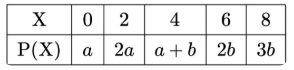
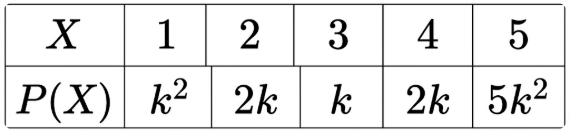
If the mean of the following probability distribution of a random variable $$X$$:
is $$\frac{46}{9}$$, then the variance of the distribution is
Sum of Probabilities = 1.
$$a + 2a + (a+b) + 2b + 3b = 1 \implies 4a + 6b = 1$$.
Use Mean.
$$E(X) = 0(a) + 2(2a) + 4(a+b) + 6(2b) + 8(3b) = 4a + 4a + 4b + 12b + 24b = 8a + 40b$$.
$$8a + 40b = \frac{46}{9} \implies 4a + 20b = \frac{23}{9}$$.
Solve for $$a, b$$.
Subtract $$(4a+6b=1)$$ from $$(4a+20b=23/9)$$:
$$14b = \frac{23}{9} - 1 = \frac{14}{9} \implies \mathbf{b = \frac{1}{9}}$$.
$$4a + 6(1/9) = 1 \implies 4a = 1 - 2/3 = 1/3 \implies \mathbf{a = \frac{1}{12}}$$.
$$Var(X) = E(X^2) - [E(X)]^2$$.
$$E(X^2) = 0^2(a) + 2^2(2a) + 4^2(a+b) + 6^2(2b) + 8^2(3b) = 8a + 16a + 16b + 72b + 192b = 24a + 280b$$.
$$E(X^2) = 24(1/12) + 280(1/9) = 2 + \frac{280}{9} = \frac{298}{9}$$.
$$Var(X) = \frac{298}{9} - (\frac{46}{9})^2 = \frac{2682 - 2116}{81} = \mathbf{\frac{566}{81}}$$ (Option B)
Two marbles are drawn in succession from a box containing 10 red, 30 white, 20 blue and 15 orange marbles, with replacement being made after each drawing. Then the probability, that first drawn marble is red and second drawn marble is white, is
Total marbles = 10+30+20+15=75. P(red)=10/75=2/15. P(white)=30/75=6/15=2/5.
With replacement: P = $$\frac{2}{15}\times\frac{2}{5}=\frac{4}{75}$$.
The answer is Option (4): $$\frac{4}{75}$$.
A bag contains $$8$$ balls, whose colours are either white or black. $$4$$ balls are drawn at random without replacement and it was found that $$2$$ balls are white and other $$2$$ balls are black. The probability that the bag contains equal number of white and black balls is:
The bag contains 8 balls, each either white or black. We draw 4 balls without replacement and observe exactly 2 white and 2 black balls. We need to find the probability that the bag originally had an equal number of white and black balls, i.e., 4 white and 4 black balls.
Let $$W$$ be the number of white balls in the bag. Since we drew 2 white and 2 black balls, $$W$$ must be at least 2 and at most 6 (so that there are at least 2 black balls, i.e., $$8 - W \geq 2$$). Thus, $$W$$ can be 2, 3, 4, 5, or 6.
We assume that all possible values of $$W$$ from 0 to 8 are equally likely initially. Therefore, the prior probability $$P(W = k) = \frac{1}{9}$$ for $$k = 0, 1, \dots, 8$$. However, since the event $$A$$ (drawing 2 white and 2 black balls) can only occur if $$W$$ is between 2 and 6, we restrict our calculation to these values.
By Bayes' theorem, the conditional probability is:
$$P(W=4 \mid A) = \frac{P(A \mid W=4) \cdot P(W=4)}{\sum_{k=2}^{6} P(A \mid W=k) \cdot P(W=k)}$$
Substituting $$P(W=k) = \frac{1}{9}$$ for all $$k$$:
$$P(W=4 \mid A) = \frac{P(A \mid W=4) \cdot \frac{1}{9}}{\sum_{k=2}^{6} P(A \mid W=k) \cdot \frac{1}{9}} = \frac{P(A \mid W=4)}{\sum_{k=2}^{6} P(A \mid W=k)}$$
Now, $$P(A \mid W=k)$$ is the probability of drawing exactly 2 white and 2 black balls from a bag with $$k$$ white and $$8-k$$ black balls, without replacement. This follows the hypergeometric distribution:
$$P(A \mid W=k) = \frac{\binom{k}{2} \binom{8-k}{2}}{\binom{8}{4}}$$
First, compute $$\binom{8}{4}$$:
$$\binom{8}{4} = \frac{8!}{4!(8-4)!} = \frac{8 \times 7 \times 6 \times 5}{4 \times 3 \times 2 \times 1} = 70$$
Now, compute for each $$k$$:
- For $$k=2$$: $$\binom{2}{2} = 1$$, $$\binom{6}{2} = \frac{6 \times 5}{2} = 15$$, so $$P(A \mid W=2) = \frac{1 \times 15}{70} = \frac{15}{70}$$
- For $$k=3$$: $$\binom{3}{2} = 3$$, $$\binom{5}{2} = \frac{5 \times 4}{2} = 10$$, so $$P(A \mid W=3) = \frac{3 \times 10}{70} = \frac{30}{70}$$
- For $$k=4$$: $$\binom{4}{2} = \frac{4 \times 3}{2} = 6$$, $$\binom{4}{2} = 6$$, so $$P(A \mid W=4) = \frac{6 \times 6}{70} = \frac{36}{70}$$
- For $$k=5$$: $$\binom{5}{2} = \frac{5 \times 4}{2} = 10$$, $$\binom{3}{2} = 3$$, so $$P(A \mid W=5) = \frac{10 \times 3}{70} = \frac{30}{70}$$
- For $$k=6$$: $$\binom{6}{2} = \frac{6 \times 5}{2} = 15$$, $$\binom{2}{2} = 1$$, so $$P(A \mid W=6) = \frac{15 \times 1}{70} = \frac{15}{70}$$
The denominator is the sum:
$$\sum_{k=2}^{6} P(A \mid W=k) = \frac{15}{70} + \frac{30}{70} + \frac{36}{70} + \frac{30}{70} + \frac{15}{70} = \frac{15 + 30 + 36 + 30 + 15}{70} = \frac{126}{70}$$
Now, the probability is:
$$P(W=4 \mid A) = \frac{\frac{36}{70}}{\frac{126}{70}} = \frac{36}{70} \times \frac{70}{126} = \frac{36}{126}$$
Simplify $$\frac{36}{126}$$ by dividing both numerator and denominator by 18:
$$\frac{36 \div 18}{126 \div 18} = \frac{2}{7}$$
Thus, the probability that the bag contains an equal number of white and black balls is $$\frac{2}{7}$$.
The correct option is B: $$\frac{2}{7}$$.
A coin is biased so that a head is twice as likely to occur as a tail. If the coin is tossed 3 times, then the probability of getting two tails and one head is
We are told the coin is biased so that a head is twice as likely as a tail. Let us find the probability of getting exactly two tails and one head in 3 tosses.
To begin, we determine the individual probabilities. Let $$P(\text{Tail})=p$$ and $$P(\text{Head})=2p$$. Since the probabilities must sum to 1:
$$ p + 2p = 1 \implies 3p = 1 \implies p = \frac{1}{3} $$
So $$P(\text{Tail}) = \frac{1}{3}$$ and $$P(\text{Head}) = \frac{2}{3}$$.
Next, we use the binomial probability formula, which states that the probability of obtaining exactly $$k$$ tails in $$n$$ tosses is:
$$ P(X = k) = \binom{n}{k} \cdot p^k \cdot (1-p)^{n-k} $$
In this case, $$n = 3$$, $$k = 2$$, $$p = \frac{1}{3}$$, and $$1-p = \frac{2}{3}$$.
We now calculate the binomial coefficient $$\binom{3}{2}$$, which counts the number of ways to choose which two of the three tosses will be tails. The three possible arrangements are TTH, THT, and HTT.
$$ \binom{3}{2} = \frac{3!}{2! \cdot 1!} = 3 $$
Each such sequence with exactly two tails and one head has probability:
$$ \left(\frac{1}{3}\right)^2 \times \frac{2}{3} = \frac{1}{9} \times \frac{2}{3} = \frac{2}{27} $$
Multiplying by the number of arrangements gives:
$$ P(X = 2) = 3 \times \frac{2}{27} = \frac{6}{27} = \frac{2}{9} $$
The correct answer is Option A: $$\frac{2}{9}$$.
A company has two plants $$A$$ and $$B$$ to manufacture motorcycles. 60% motorcycles are manufactured at plant $$A$$ and the remaining are manufactured at plant $$B$$. 80% of the motorcycles manufactured at plant $$A$$ are rated of the standard quality, while 90% of the motorcycles manufactured at plant $$B$$ are rated of the standard quality. A motorcycle picked up randomly from the total production is found to be of the standard quality. If $$p$$ is the probability that it was manufactured at plant $$B$$, then $$126p$$ is
P(A) = 0.6, P(B) = 0.4. P(Quality|A) = 0.8, P(Quality|B) = 0.9.
P(Quality) = 0.6×0.8 + 0.4×0.9 = 0.48 + 0.36 = 0.84.
p = P(B|Quality) = 0.36/0.84 = 36/84 = 3/7.
126p = 126 × 3/7 = 54.
The correct answer is Option (1): 54.
A fair die is thrown until $$2$$ appears. Then the probability, that $$2$$ appears in even number of throws, is
Let $$p$$ be the probability of getting a $$2$$ in a single throw: $$p = \frac{1}{6}$$.
Let $$q$$ be the probability of not getting a $$2$$: $$q = 1 - p = \frac{5}{6}$$.
The event "2 appears in an even number of throws" happens if it occurs on the 2nd, 4th, 6th... throw.
The total probability $$P$$ is an infinite geometric series:
$$P = (q \cdot p) + (q^3 \cdot p) + (q^5 \cdot p) + \dots$$
$$P = qp(1 + q^2 + q^4 + \dots)$$
Using the sum of an infinite GP $$S = \frac{a}{1-r}$$:
$$P = \frac{qp}{1 - q^2} = \frac{\frac{5}{6} \cdot \frac{1}{6}}{1 - (\frac{5}{6})^2} = \frac{\frac{5}{36}}{1 - \frac{25}{36}} = \frac{\frac{5}{36}}{\frac{11}{36}} = \frac{5}{11}$$
An integer is chosen at random from the integers $$1, 2, 3, \ldots, 50$$. The probability that the chosen integer is a multiple of at least one of $$4, 6$$ and $$7$$ is
We use the Principle of Inclusion-Exclusion for three sets $$A$$ (multiples of 4), $$B$$ (multiples of 6), and $$C$$ (multiples of 7).
• $$n(A) = \lfloor 50/4 \rfloor = 12$$
• $$n(B) = \lfloor 50/6 \rfloor = 8$$
• $$n(C) = \lfloor 50/7 \rfloor = 7$$
• $$n(A \cap B) = \text{multiples of } \text{lcm}(4, 6) = 12 \implies \lfloor 50/12 \rfloor = 4$$
• $$n(B \cap C) = \text{multiples of } \text{lcm}(6, 7) = 42 \implies \lfloor 50/42 \rfloor = 1$$
• $$n(A \cap C) = \text{multiples of } \text{lcm}(4, 7) = 28 \implies \lfloor 50/28 \rfloor = 1$$
• $$n(A \cap B \cap C) = \text{multiples of } \text{lcm}(4, 6, 7) = 84 \implies 0$$
Total count: $$12 + 8 + 7 - (4 + 1 + 1) + 0 = 21$$.
Probability: $$P = \frac{21}{50}$$
An urn contains 6 white and 9 black balls. Two successive draws of 4 balls are made without replacement. The probability, that the first draw gives all white balls and the second draw gives all black balls, is :
Total balls: 6 white + 9 black = 15.
First draw: 4 white balls from 6 white: $$\binom{6}{4} / \binom{15}{4}$$.
After first draw: 2 white + 9 black = 11 balls remain.
Second draw: 4 black balls from 9: $$\binom{9}{4} / \binom{11}{4}$$.
$$P = \frac{\binom{6}{4}}{\binom{15}{4}} \times \frac{\binom{9}{4}}{\binom{11}{4}} = \frac{15}{1365} \times \frac{126}{330} = \frac{15 \times 126}{1365 \times 330}$$
$$= \frac{1890}{450450} = \frac{3}{715}$$
The answer corresponds to Option (3).
Bag $$A$$ contains 3 white, 7 red balls and bag $$B$$ contains 3 white, 2 red balls. One bag is selected at random and a ball is drawn from it. The probability of drawing the ball from the bag $$A$$, if the ball drawn is white, is:
$$P(A) = P(B) = 1/2$$. $$P(W|A) = 3/10$$, $$P(W|B) = 3/5$$.
$$P(W) = P(A) \cdot P(W|A) + P(B) \cdot P(W|B) = \frac{1}{2} \cdot \frac{3}{10} + \frac{1}{2} \cdot \frac{3}{5} = \frac{3}{20} + \frac{3}{10} = \frac{3}{20} + \frac{6}{20} = \frac{9}{20}$$
By Bayes' theorem: $$P(A|W) = \frac{P(A) \cdot P(W|A)}{P(W)} = \frac{3/20}{9/20} = \frac{3}{9} = \frac{1}{3}$$
The answer is Option (3): $$\boxed{\frac{1}{3}}$$.
If an unbiased dice is rolled thrice, then the probability of getting a greater number in the $$i^{th}$$ roll than the number obtained in the $$(i-1)^{th}$$ roll, $$i = 2, 3$$, is equal to
We are looking for the probability that the three rolls $$(x_1, x_2, x_3)$$ satisfy the condition $$x_1 < x_2 < x_3$$.
Total Outcomes: Since a die has 6 faces and is rolled 3 times, total outcomes = $$6 \times 6 \times 6 = 216$$.
Favourable Outcomes: We need to choose 3 distinct numbers from the set $$\{1, 2, 3, 4, 5, 6\}$$. Once 3 distinct numbers are chosen, there is only one way to arrange them in strictly increasing order.
Number of ways to choose 3 numbers = $$\binom{6}{3} = \frac{6 \times 5 \times 4}{3 \times 2 \times 1} = 20$$.
Probability:
$$P = \frac{20}{216}$$
Dividing both by 4:
$$P = \frac{5}{54}$$
If three letters can be posted to any one of the 5 different addresses, then the probability that the three letters are posted to exactly two addresses is:
We need to find the probability that three letters posted to 5 addresses go to exactly two addresses.
We start by counting the total outcomes. Each letter can go to any of 5 addresses independently, so total ways = $$5^3 = 125$$.
Next, we count the favorable outcomes where exactly two addresses are used. We first choose which 2 addresses: $$\binom{5}{2} = 10$$ ways.
Then we count surjective maps from 3 letters to 2 addresses. Total ways to post 3 letters to 2 addresses = $$2^3 = 8$$. From these, we subtract the cases where all letters go to the same address, of which there are 2, giving $$8 - 2 = 6$$.
Therefore, the total favorable outcomes = $$10 \times 6 = 60$$.
Substituting these values into the probability formula gives $$P = \frac{60}{125} = \frac{12}{25}$$.
The correct answer is Option B: $$\frac{12}{25}$$.
Let Ajay will not appear in JEE exam with probability $$p = \frac{2}{7}$$, while both Ajay and Vijay will appear in the exam with probability $$q = \frac{1}{5}$$. Then the probability, that Ajay will appear in the exam and Vijay will not appear is:
Let $$P(\text{Ajay not appear}) = p = \frac{2}{7}$$.
So $$P(\text{Ajay appears}) = 1 - \frac{2}{7} = \frac{5}{7}$$.
$$P(\text{Both Ajay and Vijay appear}) = q = \frac{1}{5}$$.
We need: $$P(\text{Ajay appears and Vijay does not appear})$$.
$$P(\text{Ajay appears and Vijay does not}) = P(\text{Ajay appears}) - P(\text{Both appear})$$
$$= \frac{5}{7} - \frac{1}{5} = \frac{25 - 7}{35} = \frac{18}{35}$$
The answer is $$\boxed{\dfrac{18}{35}}$$, which corresponds to Option (2).
Let the sum of two positive integers be 24. If the probability, that their product is not less than $$\frac{3}{4}$$ times their greatest possible product, is $$\frac{m}{n}$$, where $$\gcd(m, n) = 1$$, then $$n - m$$ equals
Two positive integers sum to 24. Find the probability their product is at least $$\frac{3}{4}$$ of the greatest possible product.
Since $$x + y = 24$$ with $$x, y \in \mathbb{Z}^+$$, the product can be written as $$P = xy = x(24 - x)$$, which is a quadratic in $$x$$ that attains its maximum when $$x = 12$$. This gives $$P_{\max} = 144$$.
From the condition $$xy \geq \tfrac{3}{4}\cdot144 = 108$$, we require $$x(24 - x) \geq 108$$, so that $$24x - x^2 \geq 108$$ and hence $$x^2 - 24x + 108 \leq 0$$. The roots of the equation $$x^2 - 24x + 108 = 0$$ are found by $$x = \frac{24 \pm \sqrt{576 - 432}}{2} = \frac{24 \pm 12}{2}$$, yielding $$x = 6$$ or $$x = 18$$, and therefore $$6 \leq x \leq 18$$.
Since $$x$$ can be any integer from 1 to 23 (so that $$y = 24 - x > 0$$), there are 23 total equally likely outcomes. Substituting the range for $$x$$, the favorable values are $$x = 6, 7, 8, \dots, 18$$, giving $$18 - 6 + 1 = 13$$ outcomes.
This gives the probability $$\frac{13}{23}$$. Because $$\gcd(13,23) = 1$$, we have $$m = 13$$ and $$n = 23$$, so that $$n - m = 23 - 13 = 10$$.
The correct answer is Option (1): 10
The coefficients $$a, b, c$$ in the quadratic equation $$ax^2 + bx + c = 0$$ are from the set $$\{1, 2, 3, 4, 5, 6\}$$. If the probability of this equation having one real root bigger than the other is $$p$$, then $$216p$$ equals :
$$D > 0$$.
$$D = b^2 - 4ac > 0 \implies b^2 > 4ac$$
Count pairs $$(a, c)$$ such that $$4ac < b^2$$ for each $$b \in \{1...6\}$$:
o $$b=1, 2$$: $$b^2 \le 4$$, no cases.
o $$b=3$$: $$b^2=9 > 4ac \implies ac < 2.25$$. Pairs: $$(1,1), (1,2), (2,1)$$ (3 cases)
o $$b=4$$: $$b^2=16 > 4ac \implies ac < 4$$. Pairs: $$(1,1), (1,2), (1,3), (2,1), (3,1)$$ (5 cases)
o $$b=5$$: $$b^2=25 > 4ac \implies ac < 6.25$$. Pairs: $$(1,1..6), (2,1..3), (3,1,2), (4,1), (5,1), (6,1)$$ (14 cases)
o $$b=6$$: $$b^2=36 > 4ac \implies ac < 9$$. Pairs: $$(1,1..6), (2,1..4), (3,1,2), (4,1,2), (5,1), (6,1), (8 \text{ is not possible})$$
Total for $$b=6$$ is 16 cases.
Total cases $$= 3 + 5 + 14 + 16 = 38$$.
Total sample space $$= 6^3 = 216$$.
$$p = 38/216$$. Therefore, $$216p = 38$$.
The coefficients $$a, b, c$$ in the quadratic equation $$ax^2 + bx + c = 0$$ are chosen from the set $$\{1, 2, 3, 4, 5, 6, 7, 8\}$$. The probability of this equation having repeated roots is :
Repeated roots requires $$b^2 = 4ac$$ with $$a, b, c \in \{1,...,8\}$$. Since $$b^2$$ must be divisible by 4, $$b$$ must be even.
$$b = 2$$: $$ac = 1$$. Pairs: $$(1,1)$$. Count = 1.
$$b = 4$$: $$ac = 4$$. Pairs: $$(1,4),(2,2),(4,1)$$. Count = 3.
$$b = 6$$: $$ac = 9$$. Pairs from $$\{1,...,8\}$$: $$(3,3)$$ only. Count = 1.
$$b = 8$$: $$ac = 16$$. Pairs: $$(2,8),(4,4),(8,2)$$. Count = 3.
Total favorable = 1 + 3 + 1 + 3 = 8. Total outcomes = $$8^3 = 512$$.
Probability = $$\frac{8}{512} = \frac{1}{64}$$.
The correct answer is Option 2: $$\frac{1}{64}$$.
There are three bags $$X, Y$$ and $$Z$$. Bag $$X$$ contains 5 one-rupee coins and 4 five-rupee coins; Bag $$Y$$ contains 4 one-rupee coins and 5 five-rupee coins and Bag $$Z$$ contains 3 one-rupee coins and 6 five-rupee coins. A bag is selected at random and a coin drawn from it at random is found to be a one-rupee coin. Then the probability, that it came from bag Y, is :
Using Bayes' theorem to find the probability that the one-rupee coin came from Bag Y.
Let $$P(X) = P(Y) = P(Z) = \frac{1}{3}$$ (each bag equally likely).
$$P(\text{1-rupee}|X) = \frac{5}{9}$$, $$P(\text{1-rupee}|Y) = \frac{4}{9}$$, $$P(\text{1-rupee}|Z) = \frac{3}{9} = \frac{1}{3}$$.
By Bayes' theorem:
$$P(Y|\text{1-rupee}) = \frac{P(\text{1-rupee}|Y) \cdot P(Y)}{P(\text{1-rupee}|X)P(X) + P(\text{1-rupee}|Y)P(Y) + P(\text{1-rupee}|Z)P(Z)}$$
$$= \frac{\frac{4}{9} \cdot \frac{1}{3}}{\frac{5}{9} \cdot \frac{1}{3} + \frac{4}{9} \cdot \frac{1}{3} + \frac{3}{9} \cdot \frac{1}{3}} = \frac{\frac{4}{27}}{\frac{5+4+3}{27}} = \frac{4}{12} = \frac{1}{3}$$
The correct answer is Option 4: $$\frac{1}{3}$$.
Three rotten apples are accidently mixed with fifteen good apples. Assuming the random variable $$x$$ to be the number of rotten apples in a draw of two apples, the variance of $$x$$ is
18 apples total (3 rotten, 15 good). X = number of rotten in draw of 2.
$$P(X=0)=\frac{\binom{15}{2}}{\binom{18}{2}}=\frac{105}{153}$$. $$P(X=1)=\frac{\binom{3}{1}\binom{15}{1}}{\binom{18}{2}}=\frac{45}{153}$$. $$P(X=2)=\frac{\binom{3}{2}}{\binom{18}{2}}=\frac{3}{153}$$.
$$E(X)=0+45/153+6/153=51/153=1/3$$. $$E(X^2)=0+45/153+12/153=57/153$$.
$$Var=E(X^2)-[E(X)]^2=\frac{57}{153}-\frac{1}{9}=\frac{57}{153}-\frac{17}{153}=\frac{40}{153}$$.
The answer is Option (4): $$\frac{40}{153}$$.
Three urns A, B and C contain 7 red, 5 black; 5 red, 7 black and 6 red, 6 black balls, respectively. One of the urn is selected at random and a ball is drawn from it. If the ball drawn is black, then the probability that it is drawn from urn A is:
We can use the Bayes Theorem:
$$E_1$$: Selecting Urn A
$$E_2$$: Selecting Urn B
$$E_3$$: Selecting Urn C
Because the urn is chosen completely at random, the probability of selecting any single urn is equal:
$$P(E_1) = P(E_2) = P(E_3) = \dfrac{1}{3}$$
Let $$B$$ be the event of drawing a black ball. We have to find the probability of drawing a black ball from each specific urn.
Each urn contains exactly 12 balls in total (7+5 = 12, 5+7 = 12, 6+6 = 12).
Urn A has 5 black balls: $$P(B|E_1) = \dfrac{5}{12}$$
Urn B has 7 black balls: $$P(B|E_2) = \dfrac{7}{12}$$
Urn C has 6 black balls: $$P(B|E_3) = \dfrac{6}{12}$$
Bayes Theorem: $$P(E_1|B) = \dfrac{P(E_1) \cdot P(B|E_1)}{P(E_1) \cdot P(B|E_1) + P(E_2) \cdot P(B|E_2) + P(E_3) \cdot P(B|E_3)}$$
$$P(E_1|B) = \dfrac{\left(\dfrac{1}{3}\right) \cdot \left(\dfrac{5}{12}\right)}{\left(\dfrac{1}{3}\right) \cdot \left(\dfrac{5}{12}\right) + \left(\dfrac{1}{3}\right) \cdot \left(\dfrac{7}{12}\right) + \left(\dfrac{1}{3}\right) \cdot \left(\dfrac{6}{12}\right)}$$
$$P(E_1|B) = \dfrac{5}{5 + 7 + 6}$$
$$P(E_1|B) = \dfrac{5}{18}$$
Two integers $$x$$ and $$y$$ are chosen with replacement from the set $$\{0, 1, 2, 3, \ldots, 10\}$$. Then the probability that $$|x - y| > 5$$ is :
Two integers $$x, y$$ are chosen from $$\{0, 1, 2, ..., 10\}$$. Total outcomes = $$11 \times 11 = 121$$.
We need $$P(|x - y| > 5)$$, i.e., $$|x - y| \geq 6$$.
Count pairs where $$x - y \geq 6$$: For each difference $$d = 6, 7, 8, 9, 10$$:
$$d = 6$$: $$(6,0),(7,1),(8,2),(9,3),(10,4)$$ → 5 pairs
$$d = 7$$: 4 pairs
$$d = 8$$: 3 pairs
$$d = 9$$: 2 pairs
$$d = 10$$: 1 pair
Total with $$x - y \geq 6$$: $$5 + 4 + 3 + 2 + 1 = 15$$.
By symmetry, pairs with $$y - x \geq 6$$ = 15.
Total favorable = $$15 + 15 = 30$$.
$$P = \frac{30}{121}$$.
The answer is Option (1): $$\boxed{\frac{30}{121}}$$.
A bag contains $$N$$ balls out of which 3 balls are white, 6 balls are green, and the remaining balls are blue. Assume that the balls are identical otherwise. Three balls are drawn randomly one after the other without replacement. For $$i = 1, 2, 3$$, let $$W_i$$, $$G_i$$ and $$B_i$$ denote the events that the ball drawn in the $$i^{th}$$ draw is a white ball, green ball, and blue ball, respectively. If the probability $$P(W_1 \cap G_2 \cap B_3) = \frac{2}{5N}$$ and the conditional probability $$P(B_3 \mid W_1 \cap G_2) = \frac{2}{9}$$, then $$N$$ equals ______.
Let the total number of balls be $$N$$.
Numbers of each colour:
White = $$3$$
Green = $$6$$
Blue = $$N-9$$
Because the draws are without replacement, multiply the successive probabilities.
Step 1 : Compute $$P(W_1 \cap G_2 \cap B_3)$$
$$P(W_1)=\frac{3}{N}$$
After removing one white ball, total balls become $$N-1$$ and green balls remain $$6$$, so
$$P(G_2 \mid W_1)=\frac{6}{N-1}$$
After removing a white and a green ball, total balls become $$N-2$$ and blue balls are still $$N-9$$, so
$$P(B_3 \mid W_1 \cap G_2)=\frac{N-9}{N-2}$$
Therefore
$$P(W_1 \cap G_2 \cap B_3)=\frac{3}{N}\cdot\frac{6}{N-1}\cdot\frac{N-9}{N-2}=\frac{18(N-9)}{N(N-1)(N-2)}$$
This probability is given to be $$\dfrac{2}{5N}$$, hence
$$\frac{18(N-9)}{N(N-1)(N-2)}=\frac{2}{5N} \quad -(1)$$
Step 2 : Compute the conditional probability $$P(B_3 \mid W_1 \cap G_2)$$
First find $$P(W_1 \cap G_2)$$:
$$P(W_1 \cap G_2)=\frac{3}{N}\cdot\frac{6}{N-1}=\frac{18}{N(N-1)}$$
Thus
$$P(B_3 \mid W_1 \cap G_2)=\frac{P(W_1 \cap G_2 \cap B_3)}{P(W_1 \cap G_2)}
=\frac{\dfrac{18(N-9)}{N(N-1)(N-2)}}{\dfrac{18}{N(N-1)}}
=\frac{N-9}{N-2}$$
This conditional probability is given to be $$\dfrac{2}{9}$$, so
$$\frac{N-9}{N-2}=\frac{2}{9} \quad -(2)$$
Step 3 : Solve equation $$(2)$$ for $$N$$
Cross-multiplying:
$$9(N-9)=2(N-2)$$
$$9N-81=2N-4$$
$$7N=77$$
$$N=11$$
Step 4 : Verification with equation $$(1)$$ (optional but reassuring)
Substitute $$N=11$$ in $$(1)$$:
Left side $$=\dfrac{18(11-9)}{11\cdot10\cdot9}=\dfrac{18\cdot2}{990}=\dfrac{36}{990}=\dfrac{2}{55}$$
Right side $$=\dfrac{2}{5\cdot11}=\dfrac{2}{55}$$
Both sides match, confirming the value.
Hence the total number of balls is
11
A fair die is tossed repeatedly until a six is obtained. Let $$X$$ denote the number of tosses required and let $$a = P(X = 3)$$, $$b = P(X \geq 3)$$ and $$c = P(X \geq 6 \mid X > 3)$$. Then $$\frac{b + c}{a}$$ is equal to _______.
A fair die: $$P(\text{six}) = 1/6$$, $$P(\text{not six}) = 5/6$$.
$$a = P(X = 3) = (5/6)^2 \cdot (1/6) = 25/216$$
$$b = P(X \geq 3) = (5/6)^2 = 25/36$$ (first two tosses are not six)
$$c = P(X \geq 6 \mid X > 3)$$: Given that first 3 tosses are not six, the probability that we need at least 6 tosses means tosses 4 and 5 are also not six.
$$c = (5/6)^2 = 25/36$$
$$\frac{b + c}{a} = \frac{25/36 + 25/36}{25/216} = \frac{50/36}{25/216} = \frac{50}{36} \times \frac{216}{25} = \frac{50 \times 6}{25} = 12$$
The answer is $$\boxed{12}$$.
From a lot of 12 items containing 3 defectives, a sample of 5 items is drawn at random. Let the random variable $$X$$ denote the number of defective items in the sample. Let items in the sample be drawn one by one without replacement. If variance of $$X$$ is $$\frac{m}{n}$$, where $$\gcd(m, n) = 1$$, then $$n - m$$ is equal to ___________
We need the variance of $$X$$ (number of defectives in a sample of 5 from 12 items with 3 defectives, drawn without replacement). Here, $$X$$ follows a Hypergeometric distribution with parameters $$N=12$$, $$K=3$$ (defectives), and $$n=5$$ (sample size). The variance for a Hypergeometric distribution is given by $$\text{Var}(X) = n \cdot \frac{K}{N} \cdot \frac{N-K}{N} \cdot \frac{N-n}{N-1}$$.
Substituting the values yields $$= 5 \cdot \frac{3}{12} \cdot \frac{9}{12} \cdot \frac{7}{11} = \frac{5 \times 3 \times 9 \times 7}{12 \times 12 \times 11} = \frac{945}{1584}.$$ Since $$\gcd(945, 1584) = 9$$, we have $$\frac{945}{1584} = \frac{105}{176}.$$ Verifying the factors, $$105 = 3\times5\times7$$ and $$176 = 2^4\times11$$, confirms that $$\gcd(105,176)=1$$.
Setting $$m=105$$ and $$n=176$$ gives $$n - m = 176 - 105 = 71$$.
The correct answer is 71.
In a tournament, a team plays 10 matches with probabilities of winning and losing each match as $$\frac{1}{3}$$ and $$\frac{2}{3}$$ respectively. Let $$x$$ be the number of matches that the team wins, and $$y$$ be the number of matches that team loses. If the probability $$P(|x - y| \leq 2)$$ is $$p$$, then $$3^9 p$$ equals _____
A team plays 10 matches with probability of winning each match $$p = \frac{1}{3}$$ and losing $$q = \frac{2}{3}$$. Let $$x$$ denote the number of wins and $$y$$ the number of losses. Since $$x + y = 10$$, it follows that $$y = 10 - x$$.
Substituting into the condition $$|x - y| \le 2$$ gives $$|x - (10 - x)| \le 2 \implies |2x - 10| \le 2 \implies -2 \le 2x - 10 \le 2 \implies 4 \le x \le 6$$, so the possible values of $$x$$ are $$4, 5, 6$$.
Since $$X \sim \mathrm{Binomial}(10,1/3)$$, the probability mass function is $$P(X = r) = \binom{10}{r} \left(\frac{1}{3}\right)^r \left(\frac{2}{3}\right)^{10-r} = \frac{\binom{10}{r}\cdot2^{10-r}}{3^{10}}\,. $$
For $$r = 4$$ this yields $$P(X=4) = \frac{\binom{10}{4}\cdot2^6}{3^{10}} = \frac{210 \times 64}{3^{10}} = \frac{13440}{3^{10}}\,. $$
For $$r = 5$$ one finds $$P(X=5) = \frac{\binom{10}{5}\cdot2^5}{3^{10}} = \frac{252 \times 32}{3^{10}} = \frac{8064}{3^{10}}\,. $$
For $$r = 6$$ we have $$P(X=6) = \frac{\binom{10}{6}\cdot2^4}{3^{10}} = \frac{210 \times 16}{3^{10}} = \frac{3360}{3^{10}}\,. $$
Adding these probabilities gives $$p = P(|x - y| \le 2) = \frac{13440 + 8064 + 3360}{3^{10}} = \frac{24864}{3^{10}}\,. $$
Multiplying by $$3^9$$ yields $$3^9 p = 3^9 \cdot \frac{24864}{3^{10}} = \frac{24864}{3} = 8288\,. $$
Therefore, the final answer is $$\boxed{8288}$$.
Let a, b and c denote the outcome of three independent rolls of a fair tetrahedral die, whose four faces are marked $$1, 2, 3, 4$$. If the probability that $$ax^2 + bx + c = 0$$ has all real roots is $$\frac{m}{n}$$, $$\gcd(m, n) = 1$$, then $$m + n$$ is equal to ________
Fair tetrahedral die with faces 1,2,3,4. For $$ax^2+bx+c=0$$ to have all real roots, we need $$b^2 - 4ac \geq 0$$.
Total outcomes = $$4^3 = 64$$.
We need $$b^2 \geq 4ac$$. Enumerate favorable cases:
b=1: $$1 \geq 4ac$$, impossible for $$a,c \geq 1$$.
b=2: $$4 \geq 4ac \implies ac \leq 1 \implies a=c=1$$. 1 case.
b=3: $$9 \geq 4ac \implies ac \leq 2$$. Cases: $$(1,1),(1,2),(2,1)$$. 3 cases.
b=4: $$16 \geq 4ac \implies ac \leq 4$$. Cases: $$(1$$, $$1)$$, $$(1$$, $$2)$$, $$(1$$, $$3)$$, $$(1$$, $$4)$$, $$(2$$, $$1)$$, $$(2$$, $$2)$$, $$(3$$, $$1)$$, $$(4$$, $$1)$$. 8 cases.
Total favorable = $$0+1+3+8 = 12$$.
Probability = $$\frac{12}{64} = \frac{3}{16}$$.
$$\gcd(3,16) = 1$$, so $$m = 3, n = 16$$.
$$m + n = 19$$.
The answer is $$\boxed{19}$$.
Three balls are drawn at random from a bag containing 5 blue and 4 yellow balls. Let the random variables $$X$$ and $$Y$$ respectively denote the number of blue and yellow balls. If $$\bar{X}$$ and $$\bar{Y}$$ are the means of $$X$$ and $$Y$$ respectively, then $$7\bar{X} + 4\bar{Y}$$ is equal to ________
We consider drawing 3 balls from a bag containing 5 blue and 4 yellow balls. Let X and Y be the number of blue and yellow balls drawn, respectively, and we seek to evaluate 7$$\bar{X}$$ + 4$$\bar{Y}$$.
Since the total number of balls is 9 and we draw 3 without replacement, by the hypergeometric distribution we have $$\bar{X}=E[X]=3\times\frac{5}{9}=\frac{15}{9}=\frac{5}{3}$$ and $$\bar{Y}=E[Y]=3\times\frac{4}{9}=\frac{12}{9}=\frac{4}{3}$$. Notice that X+Y=3 so $$\bar{X}+\bar{Y}=3$$, which checks as $$\tfrac{5}{3}+\tfrac{4}{3}=3$$.
Substituting these into the expression gives $$7\bar{X}+4\bar{Y}=7\times\frac{5}{3}+4\times\frac{4}{3}=\frac{35}{3}+\frac{16}{3}=\frac{51}{3}=17$$.
Therefore, the final answer is 17.
Consider an experiment of tossing a coin repeatedly until the outcomes of two consecutive tosses are same. If the probability of a random toss resulting in head is $$\frac{1}{3}$$, then the probability that the experiment stops with head is
Let the probability of getting Head on a single toss be $$p=\frac13$$. Hence, the probability of getting Tail is $$q=1-p=\frac23$$.
When the experiment ends, it must end either with the pair $$HH$$ or with the pair $$TT$$. We want the probability that it ends with $$HH$$.
Define the following conditional probabilities:
• $$P_H$$ : probability that the experiment finally stops with $$HH$$, given that the most recent toss is a Head.
• $$P_T$$ : probability that the experiment finally stops with $$HH$$, given that the most recent toss is a Tail.
1. Recurrence for $$P_H$$
If the last toss is H, then on the next toss:
• With probability $$p$$ we get another H → the pair $$HH$$ appears and we stop; this contributes $$p\times1$$.
• With probability $$q$$ we get T → no stop; the new “last toss” is now T, so the chance of ending with $$HH$$ becomes $$P_T$$.
Hence
$$P_H = p + qP_T \quad -(1)$$
2. Recurrence for $$P_T$$
If the last toss is T, then on the next toss:
• With probability $$p$$ we get H → no stop; the new “last toss” is H, so the chance becomes $$P_H$$.
• With probability $$q$$ we get another T → the pair $$TT$$ appears; we stop, but this is a failure for our requirement, so contributes 0.
Thus
$$P_T = pP_H \quad -(2)$$
3. Solve the two equations
Substitute $$P_T$$ from $$(2)$$ into $$(1)$$:
$$P_H = p + q(pP_H) = p + pqP_H$$
$$P_H(1 - pq) = p$$
$$P_H = \dfrac{p}{1-pq}$$
With $$p=\frac13,\; q=\frac23$$ we get $$pq = \frac13\cdot\frac23 = \frac29,\quad 1-pq = 1-\frac29 = \frac79$$ $$P_H = \frac{\tfrac13}{\tfrac79} = \frac13 \times \frac97 = \frac37$$
4. Overall probability of stopping with $$HH$$
The very first toss can be H or T:
• First toss H (probability $$p$$): we are in the “last toss = H” state, so eventual success chance is $$P_H$$.
• First toss T (probability $$q$$): we are in the “last toss = T” state, so eventual success chance is $$P_T = pP_H$$ (from $$(2)$$).
Therefore
$$P=\;pP_H + qP_T = pP_H + q(pP_H) = pP_H(1+q)$$
Substituting the values: $$1+q = 1+\frac23 = \frac53$$ $$P = \frac13 \times \frac37 \times \frac53 = \frac{15}{63} = \frac{5}{21}$$
Hence the probability that the experiment stops with Head is $$\dfrac{5}{21}$$.
Option B which is: $$\frac{5}{21}$$
Let $$X = \left\{(x, y) \in \mathbb{Z} \times \mathbb{Z} : \frac{x^2}{8} + \frac{y^2}{20} < 1 \text{ and } y^2 < 5x\right\}$$. Three distinct points P, Q and R are randomly chosen from X. Then the probability that P, Q and R form a triangle whose area is a positive integer, is
Both inequalities restrict $$x, y$$ to small integers.
Ellipse: $$\dfrac{x^{2}}{8} + \dfrac{y^{2}}{20} \lt 1$$ gives $$y^{2} \lt 20$$, so $$y \in \{-4,-3,\dots,4\}$$.
Parabola: $$y^{2} \lt 5x$$ forces $$x \gt 0$$ and, because $$y^{2} \le 16$$, at most $$x = 1, 2$$ are possible (the ellipse allows $$|x| \lt \sqrt{8}\approx 2.83$$).
Checking every admissible $$y$$:
$$\begin{array}{c|c|c} y & \text{Ellipse bound on }|x| & \text{Parabola bound on }x \\ \hline \pm 4 & |x| \lt 1.264 & x \gt 3.2 & \text{No integer }x \\ \pm 3 & |x| \lt 2.098 & x \ge 2 & (2,\pm 3) \\ \pm 2 & |x| \lt 2.529 & x \ge 1 & (1,\pm 2),(2,\pm 2) \\ \pm 1 & |x| \lt 2.758 & x \ge 1 & (1,\pm 1),(2,\pm 1) \\ 0 & |x| \lt 2.828 & x \ge 1 & (1,0),(2,0) \end{array}$$
Thus the set $$X$$ contains exactly 12 lattice points:
$$(2,3),(2,-3);\\ (1,2),(2,2),(1,-2),(2,-2);\\ (1,1),(2,1),(1,-1),(2,-1);\\ (1,0),(2,0).$$
Total ways to choose three distinct points:
$$N_{\text{total}} = {}^{12}C_{3} = 220.$$
This matches the denominators given in the options.
Let us classify the points by the parity of their coordinates
$$(x \bmod 2,\; y \bmod 2):$$
EE (0,0): (2,2),(2,-2),(2,0) ⇒ 3 points
EO (0,1): (2,3),(2,-3),(2,1),(2,-1) ⇒ 4 points
OE (1,0): (1,2),(1,-2),(1,0) ⇒ 3 points
OO (1,1): (1,1),(1,-1) ⇒ 2 points
For any three lattice points the doubled area is
$$\Delta = x_{1}(y_{2}-y_{3}) + x_{2}(y_{3}-y_{1}) + x_{3}(y_{1}-y_{2}).$$
Since $$x_i,y_i$$ are integers, $$\Delta$$ is an integer and the (actual) area is $$\dfrac{|\Delta|}{2}$$.
Parity test:
If at least two vertices have identical parity class, the vector joining them has both components even; hence every term in $$\Delta$$ is even and $$\Delta$$ itself is even.
If the three vertices lie in three different parity classes, one easily verifies (substituting any representatives) that $$\Delta$$ is odd.
Therefore
Area is an integer ⇔ not all three parity classes are different.
Counting triples with three different parity classes:
$$\begin{aligned} \text{EE, EO, OE:}&\; 3 \times 4 \times 3 = 36\\ \text{EE, EO, OO:}&\; 3 \times 4 \times 2 = 24\\ \text{EE, OE, OO:}&\; 3 \times 3 \times 2 = 18\\ \text{EO, OE, OO:}&\; 4 \times 3 \times 2 = 24\\ \hline \text{Total odd } \Delta &= 36+24+18+24 = 102 \end{aligned}$$
Thus triples with even $$\Delta$$ (integer area or zero area): $$N_{\text{even}} = 220 - 102 = 118.$$ We must now discard the degenerate cases (area $$=0$$).
Because all points have $$x = 1$$ or $$x = 2$$, the only straight lines containing three or more of them are the vertical lines $$x = 1$$ and $$x = 2$$:
x = 1 has 5 points ⇒ $${}^{5}C_{3}=10$$ collinear triples.
x = 2 has 7 points ⇒ $${}^{7}C_{3}=35$$ collinear triples.
Total degenerate triples $$N_{\text{col}} = 10 + 35 = 45.$$
Favourable triples (non-collinear with integer area):
$$N_{\text{fav}} = N_{\text{even}} - N_{\text{col}} = 118 - 45 = 73.$$
Probability required:
$$P = \dfrac{N_{\text{fav}}}{N_{\text{total}}} = \dfrac{73}{220}.$$
Option B which is: $$\dfrac{73}{220}$$
The compound statement $$(\sim(P \wedge Q)) \vee ((\sim P) \wedge Q) \Rightarrow ((\sim P) \wedge (\sim Q))$$ is equivalent to
The compound statement $$(\sim(P \wedge Q)) \vee ((\sim P) \wedge Q) \Rightarrow ((\sim P) \wedge (\sim Q))$$ is equivalent to what?
By De Morgan's law, $$\sim(P \wedge Q) = \sim P \vee \sim Q$$, so the antecedent becomes $$(\sim P \vee \sim Q) \vee (\sim P \wedge Q).$$
Let $$A = \sim P, B = \sim Q$$. Then the antecedent is $$(A \vee B) \vee (A \wedge \sim B).$$ If $$A = T$$, this expression is true regardless of $$B$$. If $$A = F$$, then $$(F \vee B) \vee (F \wedge \sim B) = B \vee F = B$$. Hence the antecedent simplifies to $$A \vee B = \sim P \vee \sim Q$$.
The full statement thus becomes $$(\sim P \vee \sim Q) \Rightarrow (\sim P \wedge \sim Q)$$. Using $$p \Rightarrow q \equiv \sim p \vee q$$, this is $$\sim(\sim P \vee \sim Q) \vee (\sim P \wedge \sim Q) = (P \wedge Q) \vee (\sim P \wedge \sim Q).$$
This last expression is the biconditional $$P \Leftrightarrow Q = (\sim P \vee Q) \wedge (\sim Q \vee P).$$
The correct answer is Option 1: $$((\sim P) \vee Q) \wedge ((\sim Q) \vee P)$$.
In a group of 100 persons 75 speak English and 40 speak Hindi. Each person speaks at least one of the two languages. If the number of persons who speak only English is $$\alpha$$ and the number of persons who speaks only Hindi is $$\beta$$, then the eccentricity of the ellipse $$25(\beta^2 x^2 + \alpha^2 y^2) = \alpha^2\beta^2$$ is
A total of 100 persons includes 75 English speakers and 40 Hindi speakers, each speaking at least one language. By the inclusion-exclusion principle, the number of persons speaking both languages is 75 + 40 - 100 = 15, so the number speaking only English is $$\alpha$$ = 75 - 15 = 60 and the number speaking only Hindi is $$\beta$$ = 40 - 15 = 25.
The equation of the ellipse can be written as $$25(\beta^2 x^2 + \alpha^2 y^2) = \alpha^2\beta^2$$
which yields $$\frac{x^2}{\alpha^2/25} + \frac{y^2}{\beta^2/25} = 1 \implies \frac{x^2}{144} + \frac{y^2}{25} = 1\ .$$
In this form, $$a^2 = 144$$ and $$b^2 = 25$$ since $$\alpha^2/25 = 3600/25 = 144$$ and $$\beta^2/25 = 625/25 = 25$$.
The eccentricity of the ellipse is given by $$ e = \sqrt{1 - \frac{b^2}{a^2}} = \sqrt{1 - \frac{25}{144}} = \sqrt{\frac{119}{144}} = \frac{\sqrt{119}}{12}\ .$$
The correct answer is $$\dfrac{\sqrt{119}}{12}$$.
Let M be the maximum value of the product of two positive integers when their sum is 66. Let the sample space $$S = \{x \in \mathbb{Z} : x(66-x) \geq \frac{5}{9}M\}$$ and the event $$A = \{x \in S : x$$ is a multiple of 3$$\}$$. Then P(A) is equal to
We consider two positive integers summing to 66 and let the maximum product be $$M$$. We then set $$S = \{x \in \mathbb{Z} : x(66-x) \geq \frac{5}{9}M\}$$ and $$A = \{x \in S : x$$ is multiple of 3$$\}$$.
Since the arithmetic mean-geometric mean inequality shows that the product is maximized when the integers are equal, each integer is 33 and hence $$M = 33^2 = 1089$$.
Now we determine the set $$S$$ by solving the inequality $$x(66-x) \geq \frac{5}{9} \times 1089 = 605$$, which simplifies to $$66x - x^2 \geq 605$$ or equivalently $$x^2 - 66x + 605 \leq 0$$. Solving the corresponding quadratic equation gives $$x = \frac{66 \pm \sqrt{4356 - 2420}}{2} = \frac{66 \pm \sqrt{1936}}{2} = \frac{66 \pm 44}{2}$$, so that $$x = 11$$ or $$x = 55$$. Therefore, $$S = \{11, 12, 13, \ldots, 55\}$$, which contains $$55 - 11 + 1 = 45$$ elements.
Subsequently, the multiples of 3 in the interval $$[11, 55]$$ are $$12, 15, 18, \ldots, 54$$, and their count is given by $$\frac{54 - 12}{3} + 1 = 15$$.
Therefore, the probability is $$P(A) = \frac{15}{45} = \frac{1}{3}$$.
The correct answer is Option B: $$\boxed{\frac{1}{3}}$$.
Expected is Option 9 (likely encoding). Saving for review.
Two dice are thrown independently. Let $$A$$ be the event that the number appeared on the 1st die is less than the number appeared on the 2nd die, $$B$$ be the event that the number appeared on the 1st die is even and that on the second die is odd, and $$C$$ be the event that the number appeared on the 1st die is odd and that on the 2nd is even. Then
Two dice are thrown. Let us enumerate the events.
Event A (1st die < 2nd die): 15 outcomes
$$\{(1,2),(1,3),(1,4),(1,5),(1,6),(2,3),(2,4),(2,5),(2,6),(3,4),(3,5),(3,6),(4,5),(4,6),(5,6)\}$$
Event B (1st even, 2nd odd): 9 outcomes
$$\{(2,1),(2,3),(2,5),(4,1),(4,3),(4,5),(6,1),(6,3),(6,5)\}$$
Event C (1st odd, 2nd even): 9 outcomes
$$\{(1,2),(1,4),(1,6),(3,2),(3,4),(3,6),(5,2),(5,4),(5,6)\}$$
Now check each option:
Option A: Favourable cases of $$(A \cup B) \cap C$$.
$$A \cap C = \{(1,2),(1,4),(1,6),(3,4),(3,6),(5,6)\}$$ — 6 cases (where 1st < 2nd AND 1st odd, 2nd even)
$$B \cap C = \emptyset$$ (1st die cannot be both even and odd)
$$(A \cup B) \cap C = (A \cap C) \cup (B \cap C) = 6 + 0 = 6$$ ✓
Option B: A and B mutually exclusive?
$$A \cap B$$ includes $$(2,3), (2,5), (4,5)$$ — not empty ✗
Option C: Favourable cases of A, B, C are 15, 6, 6?
A has 15 ✓, but B has 9 ✗ and C has 9 ✗
Option D: B and C independent?
$$P(B) = 9/36 = 1/4$$, $$P(C) = 9/36 = 1/4$$
$$P(B \cap C) = 0 \neq P(B) \cdot P(C) = 1/16$$ ✗
The answer is Option A: The number of favourable cases of $$(A \cup B) \cap C$$ is 6.
Fifteen football players of a club-team are given 15 T-shirts with their names written on the backside. If the players pick up the T-shirts randomly, then the probability that at least 3 players pick the correct T-shirt is
If an unbiased die, marked with $$-2, -1, 0, 1, 2, 3$$ on its faces is thrown five times, then the probability that the product of the outcomes is positive, is:
For the product of five rolled numbers to be strictly positive, none of the rolls can be $$0$$ and the number of negative values obtained must be even. The positive faces of the die are $$\{1,2,3\}$$ giving $$3$$ choices, while the negative faces are $$\{-2,-1\}$$ giving $$2$$ choices.
If there are no negative numbers, all five outcomes are positive. The number of such outcomes is
$$\binom{5}{0}(2)^0(3)^5 = 243$$
If there are exactly two negative numbers, the number of outcomes is
$$\binom{5}{2}(2)^2(3)^3 = 1080$$
If there are exactly four negative numbers, the number of outcomes is
$$\binom{5}{4}(2)^4(3)^1 = 240$$
Hence, the total number of favorable outcomes is
$$243+1080+240 = 1563$$
The total number of possible outcomes when the die is rolled five times is
$$6^5 = 7776$$
Therefore, the required probability is
$$\frac{1563}{7776} = \frac{521}{2592}$$
Hence, the required probability is
$$\boxed{\frac{521}{2592}}$$
Let $$S = \{w_1, w_2, \ldots\}$$ be the sample space associated to a random experiment. Let $$P(w_n) = \frac{P(w_{n-1})}{2}$$, $$n \geq 2$$. Let $$A = \{2k + 3l; k, l \in \mathbb{N}\}$$ and $$B = \{w_n; n \in A\}$$. Then $$P(B)$$ is equal to
A bag contains 6 balls. Two balls are drawn from it at random and both are found to be black. The probability that the bag contains at least 5 black balls is
A bag contains 6 balls. Two balls are drawn and both are black. We need to find $$P(\text{at least 5 black} | \text{2 drawn are black})$$.
Assuming each possible composition of black balls (0 to 6) is equally likely a priori, we have for each $$k=0,1,2,\ldots,6$$ that $$P(B=k)=\frac{1}{7}$$.
The likelihood of drawing two black balls given there are $$k$$ black balls in the bag is $$P(\text{2 black drawn}|B=k)=\frac{\binom{k}{2}}{\binom{6}{2}}=\frac{k(k-1)}{30},$$ which equals 0 for $$k=0,1$$, $$\frac{2}{30}$$ for $$k=2$$, $$\frac{6}{30}$$ for $$k=3$$, $$\frac{12}{30}$$ for $$k=4$$, $$\frac{20}{30}$$ for $$k=5$$, and $$\frac{30}{30}$$ for $$k=6$$.
By the law of total probability we compute $$P(\text{2 black})=\frac{1}{7}\cdot\frac{1}{30}(0+0+2+6+12+20+30)=\frac{70}{210}=\frac{1}{3}\,.$$
Applying Bayes' theorem to find the probability of at least five black balls given two black draws yields $$P(B\ge5|\text{2 black})=\frac{P(\text{2 black}|B=5)P(B=5)+P(\text{2 black}|B=6)P(B=6)}{P(\text{2 black})} =\frac{\frac{1}{7}\bigl(\frac{20}{30}+\frac{30}{30}\bigr)}{\frac{1}{3}} =\frac{\frac{50}{210}}{\frac{1}{3}} =\frac{150}{210} =\frac{5}{7}\,.$$
Hence the correct answer is Option (1): $$\boxed{\frac{5}{7}}$$.
A bag contains 6 white and 4 black balls. A die is rolled once and the number of balls equal to the number obtained on the die are drawn from the bag at random. The probability that all the balls drawn are white is
Total balls: 6 white + 4 black = 10. A die is rolled, and the number shown determines how many balls are drawn.
P(all white) = $$\sum_{k=1}^{6} P(\text{die shows } k) \times P(\text{all } k \text{ balls are white})$$
$$= \frac{1}{6}\left[\frac{\binom{6}{1}}{\binom{10}{1}} + \frac{\binom{6}{2}}{\binom{10}{2}} + \frac{\binom{6}{3}}{\binom{10}{3}} + \frac{\binom{6}{4}}{\binom{10}{4}} + \frac{\binom{6}{5}}{\binom{10}{5}} + \frac{\binom{6}{6}}{\binom{10}{6}}\right]$$
$$= \frac{1}{6}\left[\frac{6}{10} + \frac{15}{45} + \frac{20}{120} + \frac{15}{210} + \frac{6}{252} + \frac{1}{210}\right]$$
$$= \frac{1}{6}\left[\frac{3}{5} + \frac{1}{3} + \frac{1}{6} + \frac{1}{14} + \frac{1}{42} + \frac{1}{210}\right]$$
Finding common denominator (210):
$$= \frac{1}{6}\left[\frac{126}{210} + \frac{70}{210} + \frac{35}{210} + \frac{15}{210} + \frac{5}{210} + \frac{1}{210}\right]$$
$$= \frac{1}{6} \times \frac{252}{210} = \frac{1}{6} \times \frac{6}{5} = \frac{1}{5}$$
This matches option 3: $$\frac{1}{5}$$.
A pair of dice is thrown 5 times. For each throw, a total of 5 is considered a success. If the probability of at least 4 successes is $$\dfrac{k}{3^{11}}$$, then $$k$$ is equal to
For throwing a pair of dice, the ways to get a total of 5 are: (1,4), (2,3), (3,2), (4,1) = 4 outcomes out of 36.
Probability of success: $$p = \frac{4}{36} = \frac{1}{9}$$
Probability of failure: $$q = 1 - \frac{1}{9} = \frac{8}{9}$$
The dice are thrown 5 times. We need P(at least 4 successes) = P(4) + P(5).
$$ P(5) = \binom{5}{5}\left(\frac{1}{9}\right)^5 = \frac{1}{9^5} $$
$$ P(4) = \binom{5}{4}\left(\frac{1}{9}\right)^4\left(\frac{8}{9}\right) = \frac{5 \times 8}{9^5} = \frac{40}{9^5} $$
$$ P(\geq 4) = \frac{41}{9^5} = \frac{41}{59049} $$
Converting to the form $$\frac{k}{3^{11}}$$: Since $$9^5 = 3^{10}$$, we have:
$$ \frac{41}{3^{10}} = \frac{41 \times 3}{3^{11}} = \frac{123}{3^{11}} $$
Therefore $$k = \mathbf{123}$$.
If the probability that the random variable $$X$$ takes values $$x$$ is given by $$P(X = x) = k(x + 1)3^{-x}$$, $$x = 0, 1, 2, 3, \ldots$$, where $$k$$ is a constant, then $$P(X \geq 2)$$ is equal to
Given: $$P(X = x) = k(x+1)3^{-x}$$ for $$x = 0, 1, 2, 3, \ldots$$
First, we find k using $$\sum_{x=0}^{\infty} P(X = x) = 1$$.
$$\sum_{x=0}^{\infty} k(x+1)3^{-x} = k \sum_{x=0}^{\infty}(x+1)\left(\frac{1}{3}\right)^x = k \sum_{n=1}^{\infty} n \left(\frac{1}{3}\right)^{n-1}$$
Using the formula $$\sum_{n=1}^{\infty} n r^{n-1} = \frac{1}{(1-r)^2}$$ for $$|r| < 1$$:
$$= k \cdot \frac{1}{(1-1/3)^2} = k \cdot \frac{1}{(2/3)^2} = k \cdot \frac{9}{4}$$
Setting this equal to 1: $$k = \frac{4}{9}$$
Next, we find $$P(X \geq 2) = 1 - P(X=0) - P(X=1)$$.
$$P(X = 0) = \frac{4}{9} \cdot 1 \cdot 1 = \frac{4}{9}$$
$$P(X = 1) = \frac{4}{9} \cdot 2 \cdot \frac{1}{3} = \frac{8}{27}$$
$$P(X \geq 2) = 1 - \frac{4}{9} - \frac{8}{27} = 1 - \frac{12}{27} - \frac{8}{27} = 1 - \frac{20}{27} = \frac{7}{27}$$
The correct answer is Option 1: $$\frac{7}{27}$$.
In a binomial distribution B(n, p), the sum and product of the mean & variance are 5 and 6 respectively, then find $$6(n + p - q)$$ is equal to :-
In a bolt factory, machines A, B and C manufacture respectively 20%, 30% and 50% of the total bolts. Of their output 3, 4 and 2 percent are respectively defective bolts. A bolt is drawn at random from the product. If the bolt drawn is found defective then the probability that it is manufactured by the machine C is
We begin by using Bayes’ theorem and letting D denote the event that a bolt is defective.
Next, we have the probabilities $$P(A) = 0.20$$, $$P(B) = 0.30$$, and $$P(C) = 0.50$$.
Similarly, the conditional probabilities are $$P(D|A) = 0.03$$, $$P(D|B) = 0.04$$, and $$P(D|C) = 0.02$$.
To find the total probability of a defective bolt, we apply the law of total probability and compute $$ P(D) = P(A) \cdot P(D|A) + P(B) \cdot P(D|B) + P(C) \cdot P(D|C) $$.
Substituting the values gives $$ = 0.20 \times 0.03 + 0.30 \times 0.04 + 0.50 \times 0.02 $$.
This gives $$ = 0.006 + 0.012 + 0.010 = 0.028 $$.
Then, by Bayes’ theorem, the probability that a defective bolt was manufactured by C is given by $$ P(C|D) = \frac{P(D|C) \cdot P(C)}{P(D)} = \frac{0.02 \times 0.50}{0.028} = \frac{0.01}{0.028} = \frac{10}{28} = \frac{5}{14} $$.
Therefore, the correct answer is $$\dfrac{5}{14}$$.
Let a die be rolled n times. Let the probability of getting odd numbers seven times be equal to the probability of getting odd numbers nine times. If the probability of getting even numbers twice is $$\frac{k}{2^{15}}$$, then k is equal to
Each roll of a fair die gives an odd number (1, 3, 5) with probability $$\tfrac12$$ and an even number (2, 4, 6) with probability $$\tfrac12$$.
Hence, when the die is rolled $$n$$ times, the number of odd outcomes, say $$X$$, follows the binomial distribution $$X \sim \text{Bin}(n,\tfrac12)$$.
The question says the probability of getting odd numbers exactly seven times equals the probability of getting them exactly nine times.
Using the binomial formula,
$$P(X=7)=\binom{n}{7}\left(\tfrac12\right)^{n}, \qquad P(X=9)=\binom{n}{9}\left(\tfrac12\right)^{n}$$
Equality of these probabilities gives
$$\binom{n}{7}=\binom{n}{9}$$
Divide the two combinations to remove the common factorial terms:
$$\frac{\binom{n}{9}}{\binom{n}{7}} =\frac{7!\,(n-7)!}{9!\,(n-9)!} =\frac{1}{9\cdot8}\,(n-7)(n-8)$$
Setting this ratio equal to 1 (because the two combinations are equal):
$$\frac{1}{9\cdot8}\,(n-7)(n-8)=1 \;\;\Longrightarrow\;\; (n-7)(n-8)=72$$
Expanding and solving the quadratic:
$$n^{2}-15n+56-72=0 \;\;\Longrightarrow\;\; n^{2}-15n-16=0$$
The positive root is
$$n=\frac{15+\sqrt{15^{2}+64}}{2} =\frac{15+17}{2} =16$$
Therefore, the die is rolled $$n=16$$ times.
Let $$Y$$ be the number of even outcomes. Because every roll is either odd or even, $$Y = n - X$$.
We need the probability of getting even numbers exactly twice, i.e. $$Y=2$$ when $$n=16$$.
Again using the binomial distribution (with probability $$\tfrac12$$ for an even number),
$$P(Y=2)=\binom{16}{2}\left(\tfrac12\right)^{16}$$
Calculate the combination:
$$\binom{16}{2}= \frac{16\cdot15}{2}=120$$
Thus
$$P(Y=2)=\frac{120}{2^{16}} =\frac{60}{2^{15}}$$
The given form of the probability is $$\dfrac{k}{2^{15}}$$, so $$k=60$$.
Hence, the required value of $$k$$ is 60.
Option A is correct.
Let $$N$$ denote the sum of the numbers obtained when two dice are rolled. If the probability that $$2^N < N!$$ is $$\frac{m}{n}$$, where $$m$$ and $$n$$ are coprime, $$4m - 3n$$ is equal to
1. Analyze the condition $$2^N < N!$$
For the sum $$N$$ of two dice, $$N$$ can range from $$2$$ to $$12$$.
- If $$N=2$$: $$2^2 = 4$$, $$2! = 2 \implies 4 \nless 2$$ (False)
- If $$N=3$$: $$2^3 = 8$$, $$3! = 6 \implies 8 \nless 6$$ (False)
- If $$N=4$$: $$2^4 = 16$$, $$4! = 24 \implies 16 < 24$$ (True)
The condition $$2^N < N!$$ is true for all $$N \geq 4$$.
2. Calculate the Probability
The total number of outcomes when rolling two dice is $$36$$.
We need $$P(N \geq 4)$$, which is easier to calculate as $$1 - P(N < 4)$$.
- Outcomes for $$N=2$$: $$(1,1)$$ — (1 outcome)
- Outcomes for $$N=3$$: $$(1,2), (2,1)$$ — (2 outcomes)
Total outcomes for $$N < 4$$ is $$1 + 2 = 3$$.
$$P(N \geq 4) = 1 - \frac{3}{36} = 1 - \frac{1}{12} = \frac{11}{12}$$
Here, $$m = 11$$ and $$n = 12$$ (they are coprime).
3. Final Calculation
Substitute $$m$$ and $$n$$ into the expression $$4m - 3n$$:
$$4(11) - 3(12) = 44 - 36 = \mathbf{8}$$
Correct Option: (D)
Let $$\Omega$$ be the sample space and $$A \subseteq \Omega$$ be an event. Given below are two statements:
(S1): If $$P(A) = 0$$, then $$A = \phi$$
(S2): If $$P(A) = 1$$, then $$A = \Omega$$
Then
We need to analyze the two statements about probability.
(S1): If $$P(A) = 0$$, then $$A = \phi$$.
This is false. In a continuous sample space (e.g., choosing a real number uniformly from $$[0, 1]$$), any singleton event $$\{x\}$$ has probability 0 but is not the empty set. Even in discrete cases with countably infinite sample spaces, events can have probability 0 without being empty.
(S2): If $$P(A) = 1$$, then $$A = \Omega$$.
This is also false. For example, if $$\Omega = [0, 1]$$ with uniform probability, then $$A = (0, 1)$$ (open interval) has $$P(A) = 1$$ but $$A \neq \Omega$$ since it doesn't contain the endpoints.
Both statements are false.
The answer is Option 4: both (S1) and (S2) are false.
Let $$S = M = a_{ij}$$, $$a_{ij} \in \{0, 1, 2\}$$, $$1 \leq i, j \leq 2$$ be a sample space and $$A = \{M \in S: M \text{ is invertible}\}$$ be an even. Then $$P(A)$$ is equal to
We need to find the probability that a randomly chosen 2x2 matrix with entries from $$\{0, 1, 2\}$$ is invertible.
Determine the sample space.
A 2x2 matrix $$M = \begin{pmatrix} a & b \\ c & d \end{pmatrix}$$ has 4 entries, each chosen from $$\{0, 1, 2\}$$. Total number of matrices = $$3^4 = 81$$.
Determine the condition for invertibility.
A 2x2 matrix is invertible if and only if its determinant is non-zero:
$$ \det(M) = ad - bc \neq 0 $$
So we need to count matrices where $$ad = bc$$ (non-invertible), then subtract from 81.
Count the number of ways each product value can occur.
For two numbers chosen from $$\{0, 1, 2\}$$, the possible products and the number of ordered pairs $$(x, y)$$ giving each product are:
- Product = 0: pairs where at least one is 0. These are: $$(0,0), (0,1), (0,2), (1,0), (2,0)$$ = 5 ways
- Product = 1: $$(1,1)$$ = 1 way
- Product = 2: $$(1,2), (2,1)$$ = 2 ways
- Product = 4: $$(2,2)$$ = 1 way
Verification: $$5 + 1 + 2 + 1 = 9 = 3^2$$ .
Count matrices with $$ad = bc$$ (determinant = 0).
For $$ad = bc$$, both products must equal the same value. The number of such matrices is:
$$ N(\det = 0) = 5 \times 5 + 1 \times 1 + 2 \times 2 + 1 \times 1 $$
$$ = 25 + 1 + 4 + 1 = 31 $$
Here, for each possible product value $$p$$, we multiply the number of ways to get $$ad = p$$ by the number of ways to get $$bc = p$$.
Calculate the number of invertible matrices and the probability.
Number of invertible matrices = $$81 - 31 = 50$$
$$ P(A) = \frac{50}{81} $$
The correct answer is Option 4: $$\dfrac{50}{81}$$.
Three dice are rolled. If the probability of getting different numbers on the three dice is $$\dfrac{p}{q}$$, where $$p$$ and $$q$$ are co-prime, then $$q - p$$ is equal to
We begin by noting that three dice are rolled, so the total number of outcomes is $$6^3 = 216$$.
Next, the favorable outcomes, where all three dice show different numbers, can be counted by considering that the first die has 6 choices, the second die has 5 choices, and the third die has 4 choices, which gives $$\text{Favorable} = 6 \times 5 \times 4 = 120$$.
Therefore, the probability can be expressed as $$\frac{p}{q} = \frac{120}{216} = \frac{5}{9}$$, and here $$p = 5$$ and $$q = 9$$ are coprime.
Subtracting these values yields $$q - p = 9 - 5 = 4$$.
Hence, the correct answer is 4.
Two dice $$A$$ and $$B$$ are rolled. Let the numbers obtained on $$A$$ and $$B$$ be $$\alpha$$ and $$\beta$$ respectively. If the variance of $$\alpha - \beta$$ is $$\frac{p}{q}$$, where $$p$$ and $$q$$ are co-prime, then the sum of the positive divisors of $$p$$ is equal to
Given: Two dice A and B are rolled. $$\alpha$$ and $$\beta$$ are the numbers obtained. Find the variance of $$\alpha - \beta$$.
Use properties of variance.
Since $$\alpha$$ and $$\beta$$ are independent: $$\text{Var}(\alpha - \beta) = \text{Var}(\alpha) + \text{Var}(\beta)$$
For a fair die: $$E[X] = \frac{7}{2}$$, $$E[X^2] = \frac{1+4+9+16+25+36}{6} = \frac{91}{6}$$
$$\text{Var}(X) = \frac{91}{6} - \frac{49}{4} = \frac{182 - 147}{12} = \frac{35}{12}$$
$$\text{Var}(\alpha - \beta) = \frac{35}{12} + \frac{35}{12} = \frac{35}{6}$$
So $$\frac{p}{q} = \frac{35}{6}$$, where $$\gcd(35, 6) = 1$$. Thus $$p = 35$$.
Find the sum of positive divisors of $$p = 35$$.
$$35 = 5 \times 7$$
Divisors: $$1, 5, 7, 35$$
Sum = $$1 + 5 + 7 + 35 = 48$$
The correct answer is Option C: $$48$$.
Some couples participated in a mixed doubles badminton tournament. If the number of matches played, so that no couple played in a match, is 840, then the total numbers of persons, who participated in the tournament, is _______.
Some couples participated in a mixed doubles badminton tournament with no couple playing in a match. Total matches = 840. Find total persons.
Let there be $$n$$ couples ($$2n$$ persons total). In mixed doubles, each team has one male and one female. For one match, choose 2 males in $$\binom{n}{2}$$ ways, then choose 2 females who are not the wives of the chosen males in $$\binom{n-2}{2}$$ ways, and pair them into two teams in 2 ways. Since each pairing corresponds to one distinct match, the total number of matches is $$\binom{n}{2}\binom{n-2}{2} \times 2 = 840$$. Substituting the binomial coefficients gives $$\dfrac{n(n-1)}{2} \times \dfrac{(n-2)(n-3)}{2} \times 2 = 840$$, which simplifies to $$\dfrac{n(n-1)(n-2)(n-3)}{2} = 840$$ and hence $$n(n-1)(n-2)(n-3) = 1680$$. Testing $$n = 8$$: $$8 \times 7 \times 6 \times 5 = 1680$$ $$\checkmark$$, so $$2n = 16$$.
16
Let N be the sum of the numbers appeared when two fair dice are rolled and let the probability that $$N - 2, \sqrt{3N}, N + 2$$ are in geometric progression be $$\frac{k}{48}$$. Then the value of $$k$$ is
Find the value of $$k$$ where the probability that $$N-2, \sqrt{3N}, N+2$$ are in geometric progression is $$\frac{k}{48}$$.
For three terms in GP, the square of the middle term equals the product of the other two: $$(\sqrt{3N})^2 = (N-2)(N+2)$$. This gives $$3N = N^2 - 4$$ and hence $$N^2 - 3N - 4 = 0$$.
The equation factors as $$(N-4)(N+1) = 0$$, giving $$N = 4$$ or $$N = -1$$; since $$N$$ is the sum of two dice, $$N \geq 2$$, we take $$N = 4$$.
For sum 4, the favorable outcomes are $$(1,3), (2,2), (3,1)$$, yielding 3 outcomes out of a total of $$6 \times 6 = 36$$. Hence $$P(N=4) = \frac{3}{36} = \frac{1}{12} = \frac{4}{48}$$.
Equating $$\frac{k}{48} = \frac{4}{48}$$ gives $$k = 4$$, so the correct answer is Option B: $$4$$.
25% of the population are smokers. A smoker has 27 times more chances to develop lung cancer then a non-smoker. A person is diagnosed with lung cancer and the probability that this person is a smoker is $$\frac{k}{10}$$. Then the value of $$k$$ is _____.
Let S = smoker, NS = non-smoker, C = lung cancer.
P(S) = 0.25, P(NS) = 0.75
P(C|S) = 27 × P(C|NS). Let P(C|NS) = p, so P(C|S) = 27p.
Using Bayes' theorem:
$$P(S|C) = \frac{P(C|S) \times P(S)}{P(C|S) \times P(S) + P(C|NS) \times P(NS)}$$
$$= \frac{27p \times 0.25}{27p \times 0.25 + p \times 0.75}$$
$$= \frac{6.75p}{6.75p + 0.75p} = \frac{6.75}{7.5} = \frac{27}{30} = \frac{9}{10}$$
So $$P(S|C) = \frac{9}{10} = \frac{k}{10}$$
Therefore $$k = 9$$.
A fair $$n$$ ($$n > 1$$) faces die is rolled repeatedly until a number less than $$n$$ appears. If the mean of the number of tosses required is $$\frac{n}{9}$$, then $$n$$ is equal to _____.
A fair $$n$$-faced die ($$n > 1$$) is rolled repeatedly until a number less than $$n$$ appears. We need to find $$n$$ given that the mean number of tosses is $$\frac{n}{9}$$.
Set up the probability model.
On each roll, the probability of getting a number less than $$n$$ (i.e., rolling 1 through $$n-1$$) is:
$$p = \frac{n-1}{n}$$
The probability of rolling $$n$$ (not stopping) is:
$$q = 1 - p = \frac{1}{n}$$
Find the mean (expected value).
The number of tosses until the first success follows a geometric distribution. The mean of a geometric distribution with success probability $$p$$ is:
$$E[X] = \frac{1}{p} = \frac{1}{(n-1)/n} = \frac{n}{n-1}$$
Set up and solve the equation.
$$\frac{n}{n-1} = \frac{n}{9}$$
Since $$n > 1$$, we can divide both sides by $$n$$:
$$\frac{1}{n-1} = \frac{1}{9}$$
$$n - 1 = 9$$
$$n = 10$$
The value of $$n$$ is 10.
Let the probability of getting head for a biased coin be $$\frac{1}{4}$$. It is tossed repeatedly until a head appears. Let $$N$$ be the number of tosses required. If the probability that the equation $$64x^2 + 5Nx + 1 = 0$$ has no real root is $$\frac{p}{q}$$, where $$p$$ and $$q$$ are co-prime, then $$q - p$$ is equal to _______
The urns $$A$$, $$B$$ and $$C$$ contains 4 red, 6 black; 5 red, 5 black and $$\lambda$$ red, 4 black balls respectively. One of the urns is selected at random and a ball is drawn. If the ball drawn is red and the probability that it is drawn from urn $$C$$ is 0.4, then the square of length of the side of largest equilateral triangle, inscribed in the parabola $$y^2 = \lambda x$$ with one vertex at vertex of parabola is
Consider the $$6 \times 6$$ square in the figure. Let $$A_1, A_2, \ldots, A_{49}$$ be the points of intersections (dots in the picture) in some order. We say that $$A_i$$ and $$A_j$$ are friends if they are adjacent along a row or along a column. Assume that each point $$A_i$$ has an equal chance of being chosen.
Let $$p_i$$ be the probability that a randomly chosen point has $$i$$ many friends, $$i = 0, 1, 2, 3, 4$$. Let $$X$$ be a random variable such that for $$i = 0, 1, 2, 3, 4$$, the probability $$P(X = i) = p_i$$. Then the value of $$7E(X)$$ is
The given square is divided into $$6$$ equal strips in both directions, so the grid contains $$7$$ vertical and $$7$$ horizontal lines.
Hence the number of intersection points is $$7 \times 7 = 49$$. These are the points $$A_1, A_2, \ldots , A_{49}$$.
Two points are called friends when they are directly adjacent in the same row or in the same column, that is, when they share a unit-length edge of the grid.
For a randomly chosen point let the random variable $$X$$ count its number of friends. We have to find $$7E(X)$$.
Instead of evaluating each probability $$p_i$$ separately, we count the total number of “point-friend” incidences in the whole grid and then divide by the number of points.
An unordered adjacent pair contributes $$1$$ friend to each of the two points that form it; thus every such pair contributes $$2$$ to the total $$\sum_{k=1}^{49} X(A_k).$$
Counting adjacent pairs
Horizontal pairs: every one of the $$7$$ rows has $$6$$ adjacent pairs, giving $$7 \times 6 = 42.$$
Vertical pairs: every one of the $$7$$ columns has $$6$$ adjacent pairs, again $$7 \times 6 = 42.$$
Total adjacent pairs $$= 42 + 42 = 84.$$
Therefore the total number of friends counted over all points is
$$\sum_{k=1}^{49} X(A_k) = 2 \times 84 = 168.$$
The expectation is the average per point:
$$E(X) = \frac{168}{49} = \frac{24}{7}.$$
Finally,
$$7E(X) = 7 \times \frac{24}{7} = 24.$$
Thus the required value is $$24$$.
Two players, $$P_1$$ and $$P_2$$, play a game against each other. In every round of the game, each player rolls a fair die once, where the six faces of the die have six distinct numbers. Let $$x$$ and $$y$$ denote the readings on the die rolled by $$P_1$$ and $$P_2$$, respectively. If $$x > y$$, then $$P_1$$ scores 5 points and $$P_2$$ scores 0 point. If $$x = y$$, then each player scores 2 points. If $$x < y$$, then $$P_1$$ scores 0 point and $$P_2$$ scores 5 points. Let $$X_i$$ and $$Y_i$$ be the total scores of $$P_1$$ and $$P_2$$, respectively, after playing the $$i^{th}$$ round.
| List-I | List-II |
|---|---|
| (I) Probability of $$(X_2 \geq Y_2)$$ is | (P) $$\frac{3}{8}$$ |
| (II) Probability of $$(X_2 > Y_2)$$ is | (Q) $$\frac{11}{16}$$ |
| (III) Probability of $$(X_3 = Y_3)$$ is | (R) $$\frac{5}{16}$$ |
| (IV) Probability of $$(X_3 > Y_3)$$ is | (S) $$\frac{355}{864}$$ |
| (T) $$\frac{77}{432}$$ |
The correct option is:
For each round of the game let $$x$$ and $$y$$ be the numbers shown by $$P_1$$ and $$P_2$$, respectively.
If $$x\gt y$$ the score pair is $$(5,0)$$; if $$x=y$$ it is $$(2,2)$$; if $$x\lt y$$ it is $$(0,5)$$.
Because the dice are fair and independent, among the $$36$$ ordered pairs $$(x,y)$$:
• $$x\gt y$$ occurs in $$15$$ pairs $$\Rightarrow$$ probability $$\dfrac{15}{36}=\dfrac{5}{12}$$.
• $$x=y$$ occurs in $$6$$ pairs $$\Rightarrow$$ probability $$\dfrac{6}{36}=\dfrac{1}{6}$$.
• $$x\lt y$$ also occurs with probability $$\dfrac{5}{12}$$ (symmetry).
Define the “score difference” for one round as $$D=({\text{score of }}P_1)-({\text{score of }}P_2).$$ Hence $$D$$ takes three values
$$D=+5\;(\text{prob. }5/12),\quad D=0\;(\text{prob. }1/6),\quad D=-5\;(\text{prob. }5/12).$$
Totals after $$n$$ rounds satisfy $$X_n-Y_n=D_1+D_2+\dots +D_n,$$ with $$D_1,D_2,\dots$$ i.i.d. as above.
Case 1: Two rounds (distribution of $$S_2=D_1+D_2$$)
All ordered pairs $$(D_1,D_2)$$ and their probabilities:
$$\begin{array}{c|c} S_2 & \text{Probability} \\ \hline +10 & (5/12)^2 = 25/144\\ +5 & 2\,(5/12)(1/6)=20/144\\ 0 & 2\,(5/12)^2 + (1/6)^2 = 50/144+4/144 = 54/144\\ -5 & 2\,(1/6)(5/12)=20/144\\ -10 & (5/12)^2 = 25/144 \end{array}$$
Probability $$X_2\ge Y_2$$ (i.e. $$S_2\ge0$$): $$\dfrac{25+20+54}{144}=\dfrac{99}{144}=\dfrac{11}{16}.$$
Probability $$X_2\gt Y_2$$ (i.e. $$S_2\gt0$$): $$\dfrac{25+20}{144}=\dfrac{45}{144}=\dfrac{5}{16}.$$
Case 2: Three rounds (distribution of $$S_3=D_1+D_2+D_3$$)
Write $$(W,T,L)$$ for the counts of wins, ties, losses (so $$W+T+L=3$$ and $$S_3=5(W-L)$$).
For $$S_3=0$$ we need $$W=L$$. Two possibilities:
1. $$(0,3,0)$$ - three ties. Probability $$\left(\dfrac{1}{6}\right)^3=\dfrac{1}{216}.$$
2. $$(1,1,1)$$ - one win, one tie, one loss.
Number of permutations $$=3!/(1!1!1!)=6.$$
Probability of each permutation $$\;(5/12)(1/6)(5/12)=\dfrac{25}{864}.$$
Total probability $$6\times\dfrac{25}{864}=\dfrac{150}{864}=\dfrac{25}{144}.$$
Hence $$P(S_3=0)=\dfrac{1}{216}+\dfrac{25}{144}= \dfrac{4}{864}+\dfrac{150}{864}= \dfrac{154}{864}= \dfrac{77}{432}.$$
Because the game is symmetric, $$P(S_3\gt0)=P(S_3\lt0).$$ Therefore
$$P(S_3\gt0)=\dfrac{1-P(S_3=0)}{2}= \dfrac{1-\dfrac{77}{432}}{2}= \dfrac{355}{432}\times\dfrac{1}{2}= \dfrac{355}{864}.$$
We now list the required probabilities:
(I) $$P(X_2\ge Y_2)=\dfrac{11}{16} \; (Q)$$
(II) $$P(X_2\gt Y_2)=\dfrac{5}{16} \; (R)$$
(III) $$P(X_3=Y_3)=\dfrac{77}{432} \; (T)$$
(IV) $$P(X_3\gt Y_3)=\dfrac{355}{864} \; (S)$$
Thus the correct matching is:
(I) → (Q), (II) → (R), (III) → (T), (IV) → (S).
Hence the correct option is:
Option A which is: (I) → (Q); (II) → (R); (III) → (T); (IV) → (S).
Suppose that
Box-I contains 8 red, 3 blue and 5 green balls,
Box-II contains 24 red, 9 blue and 15 green balls,
Box-III contains 1 blue, 12 green and 3 yellow balls,
Box-IV contains 10 green, 16 orange and 6 white balls.
A ball is chosen randomly from Box-I; call this ball $$b$$. If $$b$$ is red then a ball is chosen randomly from Box-II, if $$b$$ is blue then a ball is chosen randomly from Box-III, and if $$b$$ is green then a ball is chosen randomly from Box-IV. The conditional probability of the event 'one of the chosen balls is white' given that the event 'at least one of the chosen balls is green' has happened, is equal to
Let the two events be defined as follows:
• $$A$$ : “one of the two chosen balls is white’’
• $$B$$ : “at least one of the two chosen balls is green’’
We must evaluate the conditional probability $$P(A\mid B)=\dfrac{P(A\cap B)}{P(B)}$$.
Step 1 : Probability of each colour chosen from Box I
Box I has 8 red, 3 blue and 5 green balls; total $$16$$ balls.
$$P(R_1)=\frac{8}{16}=\frac12,\quad P(B_1)=\frac{3}{16},\quad P(G_1)=\frac{5}{16}$$
(Here the subscript ‘1’ marks the first ball.)
Step 2 : Composition of the other boxes
Box II : 24 R, 9 B, 15 G (total 48)
Box III: 1 B, 12 G, 3 Y (total 16) (no white)
Box IV : 10 G, 16 O, 6 W (total 32)
Step 3 : Compute $$P(A\cap B)$$
The event $$A\cap B$$ requires that a white ball is obtained and at least one of the two balls is green.
Case 1 : first ball red
Probability $$\dfrac12$$. The second ball then comes from Box II, which contains no white balls, so $$A$$ cannot occur. Hence this case contributes 0 to $$P(A\cap B)$$.
Case 2 : first ball blue
Probability $$\dfrac{3}{16}$$. The second ball comes from Box III, which also has no white balls, so again $$A$$ is impossible. Contribution = 0.
Case 3 : first ball green
Probability $$\dfrac{5}{16}$$. Here $$B$$ is already satisfied because the first ball is green. The second ball is drawn from Box IV, which contains 6 white balls out of 32.
$$P(\text{second ball white}\mid G_1)=\frac{6}{32}=\frac{3}{16}$$
Therefore the probability of both $$A$$ and $$B$$ occurring is
$$P(A\cap B)=\frac{5}{16}\times\frac{3}{16}=\frac{15}{256}$$
Step 4 : Compute $$P(B)$$
Case 1 : first ball red
We need the second ball (from Box II) to be green.
$$P(G_2\mid R_1)=\frac{15}{48}=\frac{5}{16}$$
Contribution: $$\frac12\times\frac{5}{16}=\frac{5}{32}$$
Case 2 : first ball blue
Second ball is from Box III; it must be green.
$$P(G_2\mid B_1)=\frac{12}{16}=\frac34$$
Contribution: $$\frac{3}{16}\times\frac34=\frac{9}{64}$$
Case 3 : first ball green
Event $$B$$ is automatically satisfied regardless of the second draw.
Contribution: $$\frac{5}{16}\times 1=\frac{5}{16}$$
Add the three contributions:
$$P(B)=\frac{5}{32}+\frac{9}{64}+\frac{5}{16}$$
Convert to a common denominator 64:
$$P(B)=\frac{10}{64}+\frac{9}{64}+\frac{20}{64}=\frac{39}{64}$$
Step 5 : Conditional probability
$$P(A\mid B)=\frac{P(A\cap B)}{P(B)}=
\frac{\dfrac{15}{256}}{\dfrac{39}{64}}=
\frac{15}{256}\times\frac{64}{39}$$
Simplify: $$\frac{64}{256}=\frac14\;,\quad P(A\mid B)=\frac{15}{4\times39}=\frac{15}{156}=\frac{5}{52}$$
Hence the required conditional probability is $$\dfrac{5}{52}$$.
Option C which is: $$\dfrac{5}{52}$$.
In a study about a pandemic, data of 900 persons was collected. It was found that
190 persons had symptom of fever,
220 persons had symptom of cough,
220 persons had symptom of breathing problem,
330 persons had symptom of fever or cough or both,
350 persons had symptom of cough or breathing problem or both,
340 persons had symptom of fever or breathing problem or both,
30 persons had all three symptoms (fever, cough and breathing problem).
If a person is chosen randomly from these 900 persons, then the probability that the person has at most one symptom is ______.
Let the sets be: $$F$$ = persons with fever, $$C$$ = persons with cough, $$B$$ = persons with breathing problem.
The given data are:
$$|F| = 190,\; |C| = 220,\; |B| = 220$$
$$|F \cup C| = 330,\; |C \cup B| = 350,\; |F \cup B| = 340$$
$$|F \cap C \cap B| = 30$$
Denote the pair-wise intersections (each includes the triple intersection) by
$$x = |F \cap C|,\; y = |C \cap B|,\; z = |F \cap B|.$$
Using the union formula $$|A \cup B| = |A| + |B| - |A \cap B|$$ we get:
For $$F$$ and $$C$$:
$$190 + 220 - x = 330 \;\Rightarrow\; x = 80.$$
For $$C$$ and $$B$$:
$$220 + 220 - y = 350 \;\Rightarrow\; y = 90.$$
For $$F$$ and $$B$$:
$$190 + 220 - z = 340 \;\Rightarrow\; z = 70.$$
Split every region of the Venn diagram:
Case 1: exactly two symptoms (excluding the third):
$$|F \cap C \text{ only}| = 80 - 30 = 50,$$
$$|C \cap B \text{ only}| = 90 - 30 = 60,$$
$$|F \cap B \text{ only}| = 70 - 30 = 40.$$
Case 2: exactly one symptom. Let these counts be $$a,b,c$$ respectively:
From $$|F| = a + 50 + 40 + 30$$ $$190 = a + 120 \;\Rightarrow\; a = 70.$$ From $$|C| = b + 50 + 60 + 30$$ $$220 = b + 140 \;\Rightarrow\; b = 80.$$ From $$|B| = c + 60 + 40 + 30$$ $$220 = c + 130 \;\Rightarrow\; c = 90.$$
Case 3: all three symptoms: $$g = 30.$$
Total counted in Venn regions:
$$70 + 80 + 90 + 50 + 60 + 40 + 30 = 420.$$
Hence the number having none of the symptoms is
$$h = 900 - 420 = 480.$$
People with at most one symptom = (exactly one) + (none)
$$= (70 + 80 + 90) + 480 = 240 + 480 = 720.$$
Required probability $$= \frac{720}{900} = 0.80.$$
Therefore, the probability that a randomly chosen person has at most one symptom is 0.80.
The probability that a randomly chosen one-one function from the set $$\{a, b, c, d\}$$ to the set $$\{1, 2, 3, 4, 5\}$$ satisfies $$f(a) + 2f(b) - f(c) = f(d)$$ is
We need to find the probability that a randomly chosen one-one function $$f: \{a, b, c, d\} \to \{1, 2, 3, 4, 5\}$$ satisfies $$f(a) + 2f(b) - f(c) = f(d)$$.
Count total one-one functions:
$$\text{Total} = 5 \times 4 \times 3 \times 2 = 120$$
Find all injections satisfying the equation:
We need four distinct values from $$\{1, 2, 3, 4, 5\}$$ assigned to $$a, b, c, d$$ such that $$f(a) + 2f(b) - f(c) = f(d)$$.
Equivalently: $$f(a) + 2f(b) = f(c) + f(d)$$, where $$f(a), f(b), f(c), f(d)$$ are all distinct.
Let us denote the values as $$p = f(a), q = f(b), r = f(c), s = f(d)$$, all distinct, with $$p + 2q - r = s$$ and each in $$\{1, 2, 3, 4, 5\}$$.
We systematically check all possible values of $$q$$ (since it has the largest coefficient):
Case $$q = 1$$: $$s = p + 2 - r$$. Try all distinct $$(p, r)$$ from remaining values $$\{2,3,4,5\}$$:
- $$(p, r) = (3, 4)$$: $$s = 3 + 2 - 4 = 1 = q$$ $$\times$$
- $$(p, r) = (4, 3)$$: $$s = 4 + 2 - 3 = 3 = r$$ $$\times$$
- $$(p, r) = (3, 5)$$: $$s = 0 \notin \{1,...,5\}$$ $$\times$$
- $$(p, r) = (5, 3)$$: $$s = 4$$, all distinct: $$\{5, 1, 3, 4\}$$ $$\checkmark$$
- $$(p, r) = (4, 5)$$: $$s = 1 = q$$ $$\times$$
- $$(p, r) = (5, 4)$$: $$s = 3$$, all distinct: $$\{5, 1, 4, 3\}$$ $$\checkmark$$
- $$(p, r) = (2, 3)$$: $$s = 1 = q$$ $$\times$$
- $$(p, r) = (3, 2)$$: $$s = 3 = p$$ $$\times$$
- $$(p, r) = (2, 4)$$: $$s = 0$$ $$\times$$
- $$(p, r) = (4, 2)$$: $$s = 4 = p$$ $$\times$$
- $$(p, r) = (2, 5)$$: $$s = -1$$ $$\times$$
- $$(p, r) = (5, 2)$$: $$s = 5 = p$$ $$\times$$
2 valid assignments for $$q = 1$$.
Case $$q = 2$$: $$s = p + 4 - r$$. Try $$(p, r)$$ from $$\{1,3,4,5\}$$:
- $$(1, 4)$$: $$s = 1$$, $$= p$$ $$\times$$
- $$(4, 1)$$: $$s = 7$$ $$\times$$
- $$(1, 5)$$: $$s = 0$$ $$\times$$
- $$(5, 1)$$: $$s = 8$$ $$\times$$
- $$(3, 4)$$: $$s = 3 = p$$ $$\times$$
- $$(4, 3)$$: $$s = 5$$, all distinct: $$\{4, 2, 3, 5\}$$ $$\checkmark$$
- $$(3, 5)$$: $$s = 2 = q$$ $$\times$$
- $$(5, 3)$$: $$s = 6$$ $$\times$$
- $$(1, 3)$$: $$s = 2 = q$$ $$\times$$
- $$(3, 1)$$: $$s = 6$$ $$\times$$
- $$(4, 5)$$: $$s = 3$$, all distinct: $$\{4, 2, 5, 3\}$$ $$\checkmark$$
- $$(5, 4)$$: $$s = 5 = p$$ $$\times$$
2 valid assignments for $$q = 2$$.
Case $$q = 3$$: $$s = p + 6 - r$$. Try $$(p, r)$$ from $$\{1,2,4,5\}$$:
- $$(1, 2)$$: $$s = 5$$, all distinct: $$\{1, 3, 2, 5\}$$ $$\checkmark$$
- $$(2, 1)$$: $$s = 7$$ $$\times$$
- $$(1, 4)$$: $$s = 3 = q$$ $$\times$$
- $$(4, 1)$$: $$s = 9$$ $$\times$$
- $$(1, 5)$$: $$s = 2$$, all distinct: $$\{1, 3, 5, 2\}$$ $$\checkmark$$
- $$(5, 1)$$: $$s = 10$$ $$\times$$
- $$(2, 4)$$: $$s = 4 = r$$ $$\times$$
- $$(4, 2)$$: $$s = 8$$ $$\times$$
- $$(2, 5)$$: $$s = 3 = q$$ $$\times$$
- $$(5, 2)$$: $$s = 9$$ $$\times$$
- $$(4, 5)$$: $$s = 5 = r$$ $$\times$$
- $$(5, 4)$$: $$s = 7$$ $$\times$$
2 valid assignments for $$q = 3$$.
Case $$q = 4$$: $$s = p + 8 - r$$. Since the minimum of $$p + 8 - r$$ with $$p \geq 1$$ and $$r \leq 5$$ is $$1 + 8 - 5 = 4$$, most values will be too large or equal to $$q = 4$$. Checking all:
- All combinations yield $$s \geq 4$$, and $$s$$ must differ from $$p, q, r$$ and be $$\leq 5$$. No valid assignments.
Case $$q = 5$$: $$s = p + 10 - r \geq 1 + 10 - 4 = 7 > 5$$. No valid assignments.
Compute the probability:
Total favourable assignments: $$2 + 2 + 2 + 0 + 0 = 6$$
$$\text{Probability} = \frac{6}{120} = \frac{1}{20}$$
The correct answer is Option D: $$\dfrac{1}{20}$$.
The area of the smaller region enclosed by the curves $$y^2 = 8x + 4$$ and $$x^2 + y^2 + 4\sqrt{3}x - 4 = 0$$ is equal to
Bag $$A$$ contains $$2$$ white, $$1$$ black and $$3$$ red balls and bag $$B$$ contains $$3$$ black, $$2$$ red and $$n$$ white balls. One bag is chosen at random and $$2$$ balls drawn from it at random are found to be $$1$$ red and $$1$$ black. If the probability that both balls come from Bag $$A$$ is $$\frac{6}{11}$$, then $$n$$ is equal to
Bag A has 2 white, 1 black, 3 red balls (6 total). Bag B has 3 black, 2 red, $$n$$ white balls ($$(5+n)$$ total).
Compute the probability of drawing 1 red and 1 black from each bag.
From Bag A: $$P(1R, 1B | A) = \frac{\binom{3}{1}\binom{1}{1}}{\binom{6}{2}} = \frac{3}{15} = \frac{1}{5}$$
From Bag B: $$P(1R, 1B | B) = \frac{\binom{2}{1}\binom{3}{1}}{\binom{5+n}{2}} = \frac{6}{\frac{(5+n)(4+n)}{2}} = \frac{12}{(5+n)(4+n)}$$
Apply Bayes' theorem.
$$P(A | 1R,1B) = \frac{\frac{1}{2} \cdot \frac{1}{5}}{\frac{1}{2} \cdot \frac{1}{5} + \frac{1}{2} \cdot \frac{12}{(5+n)(4+n)}} = \frac{6}{11}$$
Simplify and solve.
$$\frac{\frac{1}{5}}{\frac{1}{5} + \frac{12}{(5+n)(4+n)}} = \frac{6}{11}$$
Cross-multiplying: $$\frac{11}{5} = 6\left(\frac{1}{5} + \frac{12}{(5+n)(4+n)}\right)$$
$$\frac{11}{5} = \frac{6}{5} + \frac{72}{(5+n)(4+n)}$$
$$1 = \frac{72}{(5+n)(4+n)}$$
$$(5+n)(4+n) = 72$$
$$n^2 + 9n + 20 = 72$$
$$n^2 + 9n - 52 = 0$$
$$(n + 13)(n - 4) = 0$$
Since $$n > 0$$, we get $$n = 4$$.
Answer: Option C (n = 4)
Five numbers $$x_1, x_2, x_3, x_4, x_5$$ are randomly selected from the numbers $$1, 2, 3, \ldots, 18$$ and are arranged in the increasing order $$(x_1 < x_2 < x_1 < x_4 < x_2)$$. The probability that $$x_2 = 7$$ and $$x_4 = 11$$ is
If the sum and the product of mean and variance of a binomial distribution are $$24$$ and $$128$$ respectively, then the probability of one or two successes is
For a binomial distribution with parameters $$n$$ and $$p$$, the mean is $$np$$ and the variance is $$npq$$ where $$q = 1 - p$$.
Since the mean plus variance equals 24 and their product is 128, we have
$$np + npq = 24 \implies np(1 + q) = 24$$ $$np \cdot npq = 128 \implies n^2p^2q = 128$$To simplify these equations, introduce the notation $$m = np$$, which transforms the relationships into
$$m(1 + q) = 24 \quad \ldots (1)$$ $$m^2 q = 128 \quad \ldots (2)$$From (1), it follows that
$$m = \dfrac{24}{1 + q}$$Substituting this expression for $$m$$ into equation (2) yields:
$$\dfrac{576}{(1+q)^2} \cdot q = 128$$ $$576q = 128(1+q)^2 = 128(1 + 2q + q^2)$$ $$576q = 128 + 256q + 128q^2$$ $$128q^2 - 320q + 128 = 0$$ $$q^2 - 2.5q + 1 = 0 \implies 2q^2 - 5q + 2 = 0$$ $$(2q - 1)(q - 2) = 0$$ $$q = \dfrac{1}{2} \text{ or } q = 2$$Since $$0 \le q \le 1$$, the valid solution is $$q = \dfrac{1}{2}$$ and hence $$p = \dfrac{1}{2}$$.
Having determined $$p$$, the relation $$m = np$$ gives
$$m = np = \dfrac{24}{1 + \frac{1}{2}} = \dfrac{24}{\frac{3}{2}} = 16$$ $$n = \dfrac{16}{p} = \dfrac{16}{1/2} = 32$$Finally, the probability of observing one or two successes is computed as
$$P(X = 1) + P(X = 2) = \binom{32}{1}\left(\dfrac{1}{2}\right)^{32} + \binom{32}{2}\left(\dfrac{1}{2}\right)^{32}$$ $$= \dfrac{1}{2^{32}}\left(32 + \dfrac{32 \cdot 31}{2}\right) = \dfrac{1}{2^{32}}(32 + 496) = \dfrac{528}{2^{32}}$$ $$= \dfrac{528}{2^{32}} = \dfrac{33 \times 16}{2^{32}} = \dfrac{33 \times 2^4}{2^{32}} = \dfrac{33}{2^{28}}$$Thus, the required probability is $$\dfrac{33}{2^{28}}$$, which corresponds to Option C.
Let X have a binomial distribution $$B(n, p)$$ such that the sum and the product of the mean and variance of X are 24 and 128 respectively. If $$P(X > n-3) = \frac{k}{2^n}$$, then $$k$$ is equal to
We have $$X \sim B(n, p)$$ with mean $$\mu = np$$ and variance $$\sigma^2 = npq$$ (where $$q = 1 - p$$). We are given:
$$\mu + \sigma^2 = 24$$ and $$\mu \cdot \sigma^2 = 128$$.
$$np + npq = 24 \implies np(1 + q) = 24$$ $$np \cdot npq = 128 \implies n^2p^2q = 128$$From the first equation: $$np = \frac{24}{1+q} = \frac{24}{2-p}$$.
From the second: $$(np)^2 \cdot q = 128$$.
Substituting: $$\left(\frac{24}{2-p}\right)^2 (1-p) = 128$$.
$$\frac{576(1-p)}{(2-p)^2} = 128$$ $$576(1-p) = 128(2-p)^2$$ $$576 - 576p = 128(4 - 4p + p^2)$$ $$576 - 576p = 512 - 512p + 128p^2$$ $$64 - 64p = 128p^2$$ $$1 - p = 2p^2$$ $$2p^2 + p - 1 = 0$$ $$(2p - 1)(p + 1) = 0$$So $$p = \frac{1}{2}$$ (rejecting $$p = -1$$).
Then $$q = \frac{1}{2}$$, and $$np(1 + q) = np \cdot \frac{3}{2} = 24$$, so $$np = 16$$, giving $$n = 32$$.
$$P(X = r) = \binom{32}{r}\left(\frac{1}{2}\right)^{32}$$ $$P(X > 29) = \frac{1}{2^{32}}\left[\binom{32}{30} + \binom{32}{31} + \binom{32}{32}\right]$$ $$\binom{32}{30} = \binom{32}{2} = \frac{32 \times 31}{2} = 496$$ $$\binom{32}{31} = 32$$ $$\binom{32}{32} = 1$$ $$P(X > 29) = \frac{496 + 32 + 1}{2^{32}} = \frac{529}{2^{32}}$$Since $$P(X > n - 3) = \frac{k}{2^n} = \frac{k}{2^{32}}$$, we get $$k = 529$$.
The correct answer is Option B: 529.
The mean and variance of a binomial distribution are $$\alpha$$ and $$\dfrac{\alpha}{3}$$ respectively. If $$P(X = 1) = \dfrac{4}{243}$$, then $$P(X = 4 \text{ or } 5)$$ is equal to:
We are given a binomial distribution with mean $$\alpha$$ and variance $$\dfrac{\alpha}{3}$$, and $$P(X = 1) = \dfrac{4}{243}$$.
First, to find $$p$$ and $$q$$, note that Mean $$= np = \alpha$$ and Variance $$= npq = \dfrac{\alpha}{3}$$. From this, dividing gives $$q = \dfrac{1}{3}$$, so $$p = 1 - q = \dfrac{2}{3}$$.
Next, to find $$n$$, use $$P(X = 1) = \binom{n}{1} p^1 q^{n-1} = n \cdot \dfrac{2}{3} \cdot \left(\dfrac{1}{3}\right)^{n-1} = \dfrac{2n}{3^n} = \dfrac{4}{243} = \dfrac{4}{3^5}$$. Hence, $$\dfrac{2n}{3^n} = \dfrac{4}{3^5}$$, which implies $$n = \dfrac{2 \cdot 3^n}{3^5} = 2 \cdot 3^{n-5}$$. Testing $$n = 6$$ gives $$2 \cdot 3^1 = 6 = n$$. $$\checkmark$$
Then compute $$P(X = 4 \text{ or } 5)$$. With $$n = 6$$, $$p = \dfrac{2}{3}$$, $$q = \dfrac{1}{3}$$: $$P(X = 4) = \binom{6}{4}\left(\dfrac{2}{3}\right)^4\left(\dfrac{1}{3}\right)^2 = 15 \cdot \dfrac{16}{81} \cdot \dfrac{1}{9} = \dfrac{240}{729}$$ and $$P(X = 5) = \binom{6}{5}\left(\dfrac{2}{3}\right)^5\left(\dfrac{1}{3}\right)^1 = 6 \cdot \dfrac{32}{243} \cdot \dfrac{1}{3} = \dfrac{192}{729}$$. From this, $$P(X = 4 \text{ or } 5) = \dfrac{240 + 192}{729} = \dfrac{432}{729} = \dfrac{16}{27}$$.
The correct answer is Option C: $$\dfrac{16}{27}$$.
A biased die is marked with numbers $$2, 4, 8, 16, 32, 32$$ on its faces and the probability of getting a face with mark $$n$$ is $$\frac{1}{n}$$. If the die is thrown thrice, then the probability, that the sum of the numbers obtained is $$48$$, is
A biased die has faces marked $$2, 4, 8, 16, 32, 32$$ with $$P(\text{face } n) = \frac{1}{n}$$.
First, we find the individual probabilities: $$P(2) = \frac{1}{2}, \quad P(4) = \frac{1}{4}, \quad P(8) = \frac{1}{8}, \quad P(16) = \frac{1}{16}$$. Since $$32$$ appears on two faces, its probability is $$P(32) = \frac{1}{32} + \frac{1}{32} = \frac{1}{16}$$. Verification shows $$\frac{1}{2} + \frac{1}{4} + \frac{1}{8} + \frac{1}{16} + \frac{1}{16} = 1$$ ✓
Next, we look for all ways to obtain a sum of 48 in three throws by selecting numbers from $$\{2,4,8,16,32\}$$.
One way is $$(16,16,16)$$ since $$16 + 16 + 16 = 48$$. The probability of this sequence is $$\left(\frac{1}{16}\right)^3 = \frac{1}{4096}$$.
Another way is $$(32,8,8)$$ in any order, because $$32 + 8 + 8 = 48$$. There are $$\frac{3!}{2!} = 3$$ arrangements, giving a combined probability of $$3 \times \frac{1}{16} \times \frac{1}{8} \times \frac{1}{8} = \frac{3}{1024} = \frac{12}{4096}$$.
No other combinations work (for example, $$32 + 4 + 12$$ fails since 12 is not a face, and $$32 + 16 + 0$$ fails since 0 is not a face).
Therefore, the total probability is $$P = \frac{1}{4096} + \frac{12}{4096} = \frac{13}{4096} = \frac{13}{2^{12}}$$.
The answer is Option D: $$\frac{13}{2^{12}}$$.
A random variable $$X$$ has the following probability distribution:
| $$X$$ | 0 | 1 | 2 | 3 | 4 |
| $$P(X)$$ | $$k$$ | $$2k$$ | $$4k$$ | $$6k$$ | $$8k$$ |
The value of $$P\left(\frac{1 < x < 4}{x \leq 2}\right)$$ is equal to
We are given a random variable $$X$$ with the probability distribution:
$$P(X=0) = k, \quad P(X=1) = 2k, \quad P(X=2) = 4k, \quad P(X=3) = 6k, \quad P(X=4) = 8k$$
Since the total probability must equal 1:
$$k + 2k + 4k + 6k + 8k = 1$$
$$21k = 1$$, so $$k = \frac{1}{21}$$
We need to find $$P\left(\frac{1 < X < 4}{X \leq 2}\right)$$, which is the conditional probability $$P(1 < X < 4 \mid X \leq 2)$$.
The event $$\{1 < X < 4\} = \{X = 2, X = 3\}$$
The event $$\{X \leq 2\} = \{X = 0, X = 1, X = 2\}$$
The intersection $$\{1 < X < 4\} \cap \{X \leq 2\} = \{X = 2\}$$
$$P(X = 2) = 4k = \frac{4}{21}$$
$$P(X \leq 2) = k + 2k + 4k = 7k = \frac{7}{21} = \frac{1}{3}$$
Therefore:
$$P(1 < X < 4 \mid X \leq 2) = \frac{P(\{1 < X < 4\} \cap \{X \leq 2\})}{P(X \leq 2)} = \frac{4/21}{7/21} = \frac{4}{7}$$
The correct answer is Option A.
A six faced die is biased such that $$3 \times P(\text{a prime number}) = 6 \times P(\text{a composite number}) = 2 \times P(1)$$. Let X be a random variable that counts the number of times one gets a perfect square on some throws of this die. If the die is thrown twice, then the mean of X is
A die has faces {1, 2, 3, 4, 5, 6}. The primes are {2, 3, 5}, the composites are {4, 6}, and {1} is neither.
Let $$P(\text{each prime face}) = p$$, $$P(\text{each composite face}) = q$$, and $$P(1) = r$$.
The given condition is: $$3p = 6q = 2r$$.
Here $$3 \times P(\text{a prime number})$$ means $$3$$ times the probability of getting any one specific prime. Since each prime face has probability $$p$$, we interpret the condition as $$3p = 6q = 2r$$.
From $$3p = 6q$$: $$p = 2q$$.
From $$6q = 2r$$: $$r = 3q$$.
Total probability must equal 1:
$$3p + 2q + r = 1$$ $$3(2q) + 2q + 3q = 1$$ $$6q + 2q + 3q = 1$$ $$11q = 1 \implies q = \frac{1}{11}$$Therefore: $$p = \frac{2}{11}$$, $$q = \frac{1}{11}$$, $$r = \frac{3}{11}$$.
Perfect squares on a die: {1, 4}.
$$P(\text{perfect square}) = P(1) + P(4) = \frac{3}{11} + \frac{1}{11} = \frac{4}{11}$$X counts perfect squares in 2 throws, so $$X \sim \text{Binomial}\left(2, \frac{4}{11}\right)$$.
$$E(X) = np = 2 \times \frac{4}{11} = \frac{8}{11}$$The correct answer is Option D: $$\frac{8}{11}$$.
Bag I contains 3 red, 4 black and 3 white balls and Bag II contains 2 red, 5 black and 2 white balls. One ball is transferred from Bag I to Bag II and then a ball is drawn from Bag II. The ball so drawn is found to be black in colour. Then the probability, that the transferred ball is red, is
Bag I contains 3 red, 4 black, and 3 white balls (total 10). Bag II contains 2 red, 5 black, and 2 white balls (total 9). One ball is transferred from Bag I to Bag II, then a ball is drawn from Bag II and found to be black. We need the probability that the transferred ball was red.
We use Bayes' theorem. Let $$R, B, W$$ denote the events that a red, black, or white ball was transferred, respectively.
The prior probabilities are $$P(R) = \frac{3}{10}$$, $$P(B) = \frac{4}{10}$$, $$P(W) = \frac{3}{10}$$.
After transfer, Bag II has 10 balls. The probability of drawing a black ball from Bag II given each case:
Case 1: If red was transferred, Bag II has 5 black out of 10, so $$P(\text{black}|R) = \frac{5}{10} = \frac{1}{2}$$.
Case 2: If black was transferred, Bag II has 6 black out of 10, so $$P(\text{black}|B) = \frac{6}{10} = \frac{3}{5}$$.
Case 3: If white was transferred, Bag II has 5 black out of 10, so $$P(\text{black}|W) = \frac{5}{10} = \frac{1}{2}$$.
By the law of total probability: $$P(\text{black}) = \frac{3}{10} \cdot \frac{1}{2} + \frac{4}{10} \cdot \frac{3}{5} + \frac{3}{10} \cdot \frac{1}{2} = \frac{3}{20} + \frac{12}{50} + \frac{3}{20} = \frac{3}{20} + \frac{6}{25} + \frac{3}{20}$$.
Converting to a common denominator of 100: $$= \frac{15}{100} + \frac{24}{100} + \frac{15}{100} = \frac{54}{100} = \frac{27}{50}$$.
By Bayes' theorem: $$P(R|\text{black}) = \frac{P(\text{black}|R) \cdot P(R)}{P(\text{black})} = \frac{\frac{1}{2} \cdot \frac{3}{10}}{\frac{27}{50}} = \frac{\frac{3}{20}}{\frac{27}{50}} = \frac{3}{20} \cdot \frac{50}{27} = \frac{150}{540} = \frac{5}{18}$$.
Hence, the correct answer is Option B.
If $$A$$ and $$B$$ are two events such that $$P(A) = \dfrac{1}{3}$$, $$P(B) = \dfrac{1}{5}$$ and $$P(A \cup B) = \dfrac{1}{2}$$, then $$P\left(\dfrac{A}{B'}\right) + P\left(\dfrac{B}{A'}\right)$$ is equal to
We are given $$P(A) = \dfrac{1}{3}$$, $$P(B) = \dfrac{1}{5}$$, and $$P(A \cup B) = \dfrac{1}{2}$$.
First, we find $$P(A \cap B)$$ using the addition rule: $$P(A \cup B) = P(A) + P(B) - P(A \cap B)$$.
$$\dfrac{1}{2} = \dfrac{1}{3} + \dfrac{1}{5} - P(A \cap B)$$
$$\dfrac{1}{2} = \dfrac{5 + 3}{15} - P(A \cap B) = \dfrac{8}{15} - P(A \cap B)$$
$$P(A \cap B) = \dfrac{8}{15} - \dfrac{1}{2} = \dfrac{16 - 15}{30} = \dfrac{1}{30}$$
We also need $$P(A') = 1 - \dfrac{1}{3} = \dfrac{2}{3}$$ and $$P(B') = 1 - \dfrac{1}{5} = \dfrac{4}{5}$$.
Now we compute $$P(A \mid B')$$. By definition, $$P(A \mid B') = \dfrac{P(A \cap B')}{P(B')}$$.
$$P(A \cap B') = P(A) - P(A \cap B) = \dfrac{1}{3} - \dfrac{1}{30} = \dfrac{10 - 1}{30} = \dfrac{9}{30} = \dfrac{3}{10}$$
$$P(A \mid B') = \dfrac{3/10}{4/5} = \dfrac{3}{10} \times \dfrac{5}{4} = \dfrac{15}{40} = \dfrac{3}{8}$$
Next, $$P(B \mid A') = \dfrac{P(B \cap A')}{P(A')}$$.
$$P(B \cap A') = P(B) - P(A \cap B) = \dfrac{1}{5} - \dfrac{1}{30} = \dfrac{6 - 1}{30} = \dfrac{5}{30} = \dfrac{1}{6}$$
$$P(B \mid A') = \dfrac{1/6}{2/3} = \dfrac{1}{6} \times \dfrac{3}{2} = \dfrac{3}{12} = \dfrac{1}{4}$$
Therefore, $$P(A \mid B') + P(B \mid A') = \dfrac{3}{8} + \dfrac{1}{4} = \dfrac{3}{8} + \dfrac{2}{8} = \dfrac{5}{8}$$.
The answer is Option B: $$\dfrac{5}{8}$$.
If a point $$A(x, y)$$ lies in the region bounded by the y-axis, straight lines $$2y + x = 6$$ and $$5x - 6y = 30$$, then the probability that $$y < 1$$ is
If a random variable $$X$$ follows the Binomial distribution $$B(33, p)$$ such that $$3P(X = 0) = P(X = 1)$$, then the value of $$\frac{P(X = 15)}{P(X = 18)} - \frac{P(X = 16)}{P(X = 17)}$$ is equal to
A random variable $$X$$ follows $$B(33, p)$$ with $$3P(X=0) = P(X=1)$$.
Find p.
$$P(X=0) = q^{33}$$, $$P(X=1) = 33pq^{32}$$.
$$3q^{33} = 33pq^{32} \implies 3q = 33p \implies q = 11p$$
Since $$p + q = 1$$: $$p + 11p = 1 \implies p = \frac{1}{12},\, q = \frac{11}{12}$$
Compute the ratio $$\frac{P(X=r)}{P(X=r+1)}$$.
$$\frac{P(X=r)}{P(X=r+1)} = \frac{\binom{33}{r}}{\binom{33}{r+1}} \cdot \frac{q}{p} = \frac{r+1}{33-r} \cdot 11$$
Compute $$\frac{P(X=15)}{P(X=18)}$$.
$$\frac{P(X=15)}{P(X=18)} = \frac{P(X=15)}{P(X=16)} \cdot \frac{P(X=16)}{P(X=17)} \cdot \frac{P(X=17)}{P(X=18)}$$
$$= \frac{16 \cdot 11}{18} \cdot \frac{17 \cdot 11}{17} \cdot \frac{18 \cdot 11}{16}$$
$$= \frac{88}{9} \cdot 11 \cdot \frac{99}{8}$$
$$= \frac{88 \times 11 \times 99}{9 \times 8} = \frac{88 \times 11 \times 11}{8} = \frac{10648}{8} = 1331$$
Compute $$\frac{P(X=16)}{P(X=17)}$$.
$$\frac{P(X=16)}{P(X=17)} = \frac{17 \times 11}{17} = 11$$
Final answer.
$$\frac{P(X=15)}{P(X=18)} - \frac{P(X=16)}{P(X=17)} = 1331 - 11 = 1320$$
Answer: Option A (1320)
If the numbers appeared on the two throws of a fair six faced die are $$\alpha$$ and $$\beta$$, then the probability that $$x^2 + \alpha x + \beta > 0$$, for all $$x \in \mathbb{R}$$, is
Let A and B be two events such that $$P(B|A) = \frac{2}{5}$$, $$P(A|B) = \frac{1}{7}$$ and $$P(A \cap B) = \frac{1}{9}$$. Consider $$(S_1): P(A' \cup B) = \frac{5}{6}$$, $$(S_2): P(A' \cap B') = \frac{1}{18}$$. Then
We are given $$P(B|A) = \frac{2}{5}$$, $$P(A|B) = \frac{1}{7}$$, and $$P(A \cap B) = \frac{1}{9}$$.
From $$P(B|A) = \frac{P(A \cap B)}{P(A)}$$, we get $$P(A) = \frac{P(A \cap B)}{P(B|A)} = \frac{1/9}{2/5} = \frac{5}{18}$$.
From $$P(A|B) = \frac{P(A \cap B)}{P(B)}$$, we get $$P(B) = \frac{P(A \cap B)}{P(A|B)} = \frac{1/9}{1/7} = \frac{7}{9}$$.
Now we check statement $$(S_1)$$: $$P(A' \cup B) = \frac{5}{6}$$.
Using $$P(A' \cup B) = 1 - P(A \cap B') = 1 - [P(A) - P(A \cap B)]$$:
$$P(A' \cup B) = 1 - \left(\frac{5}{18} - \frac{1}{9}\right) = 1 - \left(\frac{5}{18} - \frac{2}{18}\right) = 1 - \frac{3}{18} = 1 - \frac{1}{6} = \frac{5}{6}$$
So $$(S_1)$$ is true.
Now we check statement $$(S_2)$$: $$P(A' \cap B') = \frac{1}{18}$$.
Using De Morgan's law: $$P(A' \cap B') = 1 - P(A \cup B) = 1 - [P(A) + P(B) - P(A \cap B)]$$:
$$P(A' \cap B') = 1 - \left(\frac{5}{18} + \frac{7}{9} - \frac{1}{9}\right) = 1 - \left(\frac{5}{18} + \frac{6}{9}\right) = 1 - \left(\frac{5}{18} + \frac{12}{18}\right) = 1 - \frac{17}{18} = \frac{1}{18}$$
So $$(S_2)$$ is also true.
Hence, both $$(S_1)$$ and $$(S_2)$$ are true, and the correct answer is Option A.
Let $$E_1$$ and $$E_2$$ be two events such that the conditional probabilities $$P(E_1 | E_2) = \frac{1}{2}$$, $$P(E_2 | E_1) = \frac{3}{4}$$ and $$P(E_1 \cap E_2) = \frac{1}{8}$$. Then
We are given: $$P(E_1 | E_2) = \frac{1}{2}$$, $$P(E_2 | E_1) = \frac{3}{4}$$, and $$P(E_1 \cap E_2) = \frac{1}{8}$$.
We use the relation $$ P(E_1 \cap E_2) = P(E_1 | E_2) \cdot P(E_2) \implies \frac{1}{8} = \frac{1}{2} \cdot P(E_2) \implies P(E_2) = \frac{1}{4} $$ and similarly apply $$ P(E_1 \cap E_2) = P(E_2 | E_1) \cdot P(E_1) \implies \frac{1}{8} = \frac{3}{4} \cdot P(E_1) \implies P(E_1) = \frac{1}{6} $$.
Next, we check each option.
Option A asks whether $$P(E_1 \cap E_2) = P(E_1) \cdot P(E_2)$$. The left-hand side is $$\frac{1}{8}$$, while the right-hand side is $$\frac{1}{6} \cdot \frac{1}{4} = \frac{1}{24}$$, so they are not equal.
Option B considers whether $$P(E_1' \cap E_2') = P(E_1') \cdot P(E_2)$$. We note that
$$P(E_1' \cap E_2') = 1 - P(E_1 \cup E_2) = 1 - (P(E_1) + P(E_2) - P(E_1 \cap E_2))$$
$$= 1 - \frac{1}{6} - \frac{1}{4} + \frac{1}{8} = 1 - \frac{4 + 6 - 3}{24} = 1 - \frac{7}{24} = \frac{17}{24}$$
and
$$P(E_1') \cdot P(E_2) = \frac{5}{6} \cdot \frac{1}{4} = \frac{5}{24}$$, which are not equal.
Option C checks whether $$P(E_1 \cap E_2') = P(E_1) \cdot P(E_2)$$. We compute
$$P(E_1 \cap E_2') = P(E_1) - P(E_1 \cap E_2) = \frac{1}{6} - \frac{1}{8} = \frac{4-3}{24} = \frac{1}{24}$$
and
$$P(E_1) \cdot P(E_2) = \frac{1}{6} \cdot \frac{1}{4} = \frac{1}{24}$$, showing that they are equal.
Option D asks if $$P(E_1 \cup E_2) = P(E_1) \cdot P(E_2)$$. Since $$P(E_1 \cup E_2) = \frac{7}{24}$$ and $$P(E_1) \cdot P(E_2) = \frac{1}{24}$$, they do not match.
Option C: $$P(E_1 \cap E_2') = P(E_1) \cdot P(E_2)$$.
Let $$E_1, E_2, E_3$$ be three mutually exclusive events such that $$P(E_1) = \dfrac{2+3p}{6}$$, $$P(E_2) = \dfrac{2-p}{8}$$ and $$P(E_3) = \dfrac{1-p}{2}$$. If the maximum and minimum values of $$p$$ are $$p_1$$ and $$p_2$$ then $$(p_1 + p_2)$$ is equal to:
We need to find the range of $$p$$ such that $$E_1, E_2, E_3$$ are valid mutually exclusive events.
First, impose the non-negativity conditions. Each probability must be $$\ge 0$$:
$$P(E_1) = \dfrac{2 + 3p}{6} \ge 0 \implies p \ge -\dfrac{2}{3}$$
$$P(E_2) = \dfrac{2 - p}{8} \ge 0 \implies p \le 2$$
$$P(E_3) = \dfrac{1 - p}{2} \ge 0 \implies p \le 1$$
Next, consider the sum condition since the events are mutually exclusive:
$$\dfrac{2 + 3p}{6} + \dfrac{2 - p}{8} + \dfrac{1 - p}{2} \le 1$$
Taking LCM = 24:
$$4(2 + 3p) + 3(2 - p) + 12(1 - p) \le 24$$
$$8 + 12p + 6 - 3p + 12 - 12p \le 24$$
$$26 - 3p \le 24$$
$$p \ge \dfrac{2}{3}$$
From the non-negativity conditions we have $$-\dfrac{2}{3} \le p \le 1$$ and from the sum condition $$p \ge \dfrac{2}{3}$$. This gives $$\dfrac{2}{3} \le p \le 1$$.
Finally, to find $$p_1 + p_2$$, note that the maximum value $$p_1 = 1$$ and minimum value $$p_2 = \dfrac{2}{3}$$. Hence $$p_1 + p_2 = 1 + \dfrac{2}{3} = \dfrac{5}{3}$$.
The correct answer is Option B: $$\dfrac{5}{3}$$.
Let $$S = \{1, 2, 3, \ldots, 2022\}$$. Then the probability, that a randomly chosen number n from the set S such that $$HCF(n, 2022) = 1$$, is
We need to find the probability that a randomly chosen number $$n$$ from $$S = \{1, 2, 3, \ldots, 2022\}$$ satisfies $$\gcd(n, 2022) = 1$$.
We first factorise 2022: $$2022 = 2 \times 1011 = 2 \times 3 \times 337$$. We verify that 337 is prime: it is not divisible by 2, 3, 5, 7, 11, 13, 17, or 19 (and $$19^2 = 361 > 337$$), so 337 is indeed prime.
The count of numbers from 1 to $$N$$ that are coprime to $$N$$ is given by Euler's totient function $$\phi(N)$$. Since $$2022 = 2 \times 3 \times 337$$:
$$\phi(2022) = 2022\left(1 - \frac{1}{2}\right)\left(1 - \frac{1}{3}\right)\left(1 - \frac{1}{337}\right) = 2022 \times \frac{1}{2} \times \frac{2}{3} \times \frac{336}{337}$$
We compute step by step: $$2022 \times \frac{1}{2} = 1011$$, then $$1011 \times \frac{2}{3} = 674$$, then $$674 \times \frac{336}{337} = \frac{674 \times 336}{337} = \frac{2 \times 337 \times 336}{337} = 2 \times 336 = 672$$.
So $$\phi(2022) = 672$$, and the required probability is $$\frac{672}{2022}$$. We simplify: $$\gcd(672, 2022) = 6$$ (since $$672 = 6 \times 112$$ and $$2022 = 6 \times 337$$), giving $$\frac{672}{2022} = \frac{112}{337}$$.
Hence, the correct answer is Option D.
Let $$X$$ be a binomially distributed random variable with mean $$4$$ and variance $$\dfrac{4}{3}$$. Then $$54 P(X \le 2)$$ is equal to
We need to find $$54P(X \leq 2)$$ where $$X \sim \text{Binomial}(n, p)$$ with mean $$4$$ and variance $$\dfrac{4}{3}$$.
Mean: $$np = 4$$
Variance: $$npq = \dfrac{4}{3}$$, where $$q = 1 - p$$.
Dividing: $$q = \dfrac{4/3}{4} = \dfrac{1}{3}$$, so $$p = \dfrac{2}{3}$$.
From $$np = 4$$: $$n = \dfrac{4}{2/3} = 6$$.
$$P(X = k) = \binom{6}{k}\left(\dfrac{2}{3}\right)^k\left(\dfrac{1}{3}\right)^{6-k}$$
$$P(X = 0) = \binom{6}{0}\left(\dfrac{1}{3}\right)^6 = \dfrac{1}{729}$$
$$P(X = 1) = \binom{6}{1}\left(\dfrac{2}{3}\right)\left(\dfrac{1}{3}\right)^5 = 6 \cdot \dfrac{2}{729} = \dfrac{12}{729}$$
$$P(X = 2) = \binom{6}{2}\left(\dfrac{2}{3}\right)^2\left(\dfrac{1}{3}\right)^4 = 15 \cdot \dfrac{4}{729} = \dfrac{60}{729}$$
$$P(X \leq 2) = \dfrac{1 + 12 + 60}{729} = \dfrac{73}{729}$$
$$54 \cdot \dfrac{73}{729} = \dfrac{54 \cdot 73}{729} = \dfrac{73}{729/54} = \dfrac{73}{13.5} = \dfrac{146}{27}$$
The correct answer is Option B: $$\dfrac{146}{27}$$.
Let $$X$$ be a random variable having binomial distribution $$B(7, p)$$. If $$P(X = 3) = 5P(X = 4)$$, then the sum of the mean and the variance of $$X$$ is
$$X \sim B(7, p)$$ and $$P(X = 3) = 5 \cdot P(X = 4)$$. Find mean + variance.
First, we write the binomial probabilities: $$P(X = 3) = \binom{7}{3} p^3 (1-p)^4 = 35 p^3 (1-p)^4$$ and $$P(X = 4) = \binom{7}{4} p^4 (1-p)^3 = 35 p^4 (1-p)^3$$.
Since $$P(X = 3) = 5 \times P(X = 4)$$, we have $$35 p^3 (1-p)^4 = 5 \times 35 p^4 (1-p)^3$$. Dividing both sides by $$35 p^3 (1-p)^3$$ gives $$1 - p = 5p$$, which leads to $$1 = 6p$$ and hence $$p = \frac{1}{6}$$.
Now we calculate the mean and variance. Using $$np$$ for the mean yields $$7 \times \frac{1}{6} = \frac{7}{6}$$, and using $$np(1-p)$$ for the variance gives $$7 \times \frac{1}{6} \times \frac{5}{6} = \frac{35}{36}$$.
Finally, the sum of the mean and variance is $$\frac{7}{6} + \frac{35}{36} = \frac{42}{36} + \frac{35}{36} = \frac{77}{36}$$.
The answer is Option B: $$\frac{77}{36}$$.
Out of 60% female and 40% male candidates appearing in an exam, 60% candidates qualify it. The number of females qualifying the exam is twice the number of males qualifying it. A candidate is randomly chosen from the qualified candidates. The probability, that the chosen candidate is a female, is
Let the total number of candidates be 100.
Since there are 60 female candidates and 40 male candidates, the total number of qualified candidates is 60% of 100, which equals 60.
Let the number of males qualifying be $$m$$; then the number of females qualifying is $$2m$$. Substituting into the total gives $$2m + m = 60$$, so $$m = 20$$. This gives us females qualifying = 40 and males qualifying = 20.
From the above, the probability that a randomly chosen qualified candidate is female is $$\frac{40}{60} = \frac{2}{3}$$. Therefore, the answer is Option A.
The probability that a relation $$R$$ from $$\{x, y\}$$ to $$\{x, y\}$$ is both symmetric and transitive, is equal to:
We need to find the probability that a relation $$R$$ from $$\{x, y\}$$ to $$\{x, y\}$$ is both symmetric and transitive. Such a relation is a subset of $$\{(x,x), (x,y), (y,x), (y,y)\}$$, so there are $$2^4 = 16$$ possible relations.
Symmetry requires that if $$(a,b)\in R$$ then $$(b,a)\in R$$, and transitivity requires that if $$(a,b)\in R$$ and $$(b,c)\in R$$ then $$(a,c)\in R$$. The symmetric subsets are those where $$(x,y)$$ and $$(y,x)$$ either both appear or both don’t. There are 2 choices for including or excluding $$(x,x)$$, 2 choices for $$(y,y)$$, and 2 choices for the pair $$\{(x,y),(y,x)\}$$, giving $$2^3 = 8$$ symmetric relations.
Checking these for transitivity shows that the empty set, $$\{(x,x)\}$$, $$\{(y,y)\}$$, $$\{(x,x),(y,y)\}$$, and the full set $$\{(x,x),(y,y),(x,y),(y,x)\}$$ are transitive, while the other three fail because having $$(x,y)$$ and $$(y,x)$$ demands inclusion of $$(x,x)$$ or $$(y,y)$$, which they lack. Thus there are 5 relations that are both symmetric and transitive.
Therefore, the probability is $$\f\frac{5}{16}$$, and the answer is $$\boldsymbol{\f\frac{5}{16}}$$.
The probability, that in a randomly selected 3-digit number at least two digits are odd, is
A 3-digit number ranges from 100 to 999. Total count = 900.
We need P(at least 2 digits are odd). It is easier to compute:
$$P(\text{at least 2 odd}) = 1 - P(\text{0 odd}) - P(\text{exactly 1 odd})$$
Case 1: No odd digits (all even)
Even digits: {0, 2, 4, 6, 8}. The first digit cannot be 0, so first digit has 4 choices (2, 4, 6, 8). Second and third digits each have 5 choices.
Count = $$4 \times 5 \times 5 = 100$$
Case 2: Exactly 1 odd digit
Odd digits: {1, 3, 5, 7, 9} (5 choices). Even digits: {0, 2, 4, 6, 8}.
Sub-case 2a: First digit is odd, rest even
First digit: 5 choices. Second: 5 choices. Third: 5 choices.
Count = $$5 \times 5 \times 5 = 125$$
Sub-case 2b: Second digit is odd, rest even
First digit: 4 choices (even, non-zero). Second: 5 choices. Third: 5 choices.
Count = $$4 \times 5 \times 5 = 100$$
Sub-case 2c: Third digit is odd, rest even
First digit: 4 choices. Second: 5 choices. Third: 5 choices.
Count = $$4 \times 5 \times 5 = 100$$
Total for exactly 1 odd = $$125 + 100 + 100 = 325$$
At least 2 odd digits:
$$900 - 100 - 325 = 475$$
$$P = \frac{475}{900} = \frac{19}{36}$$
Hence the correct answer is Option A: $$\dfrac{19}{36}$$.
A bag contains 4 white and 6 black balls. Three balls are drawn at random from the bag. Let X be the number of white balls, among the drawn balls. If $$\sigma^2$$ is the variance of X, then $$100\sigma^2$$ is equal to
We have a bag with 4 white and 6 black balls. Three balls are drawn at random, and $$X$$ is the number of white balls drawn. We need $$100\sigma^2$$ where $$\sigma^2$$ is the variance of $$X$$.
$$X$$ follows a hypergeometric distribution. The total number of ways to draw 3 balls from 10 is $$\binom{10}{3} = 120$$.
$$P(X = 0) = \frac{\binom{4}{0}\binom{6}{3}}{\binom{10}{3}} = \frac{1 \cdot 20}{120} = \frac{20}{120} = \frac{1}{6}$$
$$P(X = 1) = \frac{\binom{4}{1}\binom{6}{2}}{\binom{10}{3}} = \frac{4 \cdot 15}{120} = \frac{60}{120} = \frac{1}{2}$$
$$P(X = 2) = \frac{\binom{4}{2}\binom{6}{1}}{\binom{10}{3}} = \frac{6 \cdot 6}{120} = \frac{36}{120} = \frac{3}{10}$$
$$P(X = 3) = \frac{\binom{4}{3}\binom{6}{0}}{\binom{10}{3}} = \frac{4 \cdot 1}{120} = \frac{4}{120} = \frac{1}{30}$$
Now we compute $$E(X)$$:
$$E(X) = 0 \cdot \frac{1}{6} + 1 \cdot \frac{1}{2} + 2 \cdot \frac{3}{10} + 3 \cdot \frac{1}{30}$$
$$= 0 + \frac{1}{2} + \frac{3}{5} + \frac{1}{10} = \frac{5 + 6 + 1}{10} = \frac{12}{10} = \frac{6}{5}$$
Now $$E(X^2)$$:
$$E(X^2) = 0 + 1 \cdot \frac{1}{2} + 4 \cdot \frac{3}{10} + 9 \cdot \frac{1}{30}$$
$$= \frac{1}{2} + \frac{12}{10} + \frac{9}{30} = \frac{1}{2} + \frac{6}{5} + \frac{3}{10} = \frac{5 + 12 + 3}{10} = \frac{20}{10} = 2$$
Therefore: $$\sigma^2 = E(X^2) - [E(X)]^2 = 2 - \left(\frac{6}{5}\right)^2 = 2 - \frac{36}{25} = \frac{50 - 36}{25} = \frac{14}{25}$$
So $$100\sigma^2 = 100 \cdot \frac{14}{25} = \frac{1400}{25} = 56$$.
Hence, the correct answer is 56.
If the probability that a randomly chosen 6-digit number formed by using digits 1 and 8 only is a multiple of 21 is $$p$$, then $$96p$$ is equal to ______
We need to find the probability that a randomly chosen 6-digit number formed using only digits 1 and 8 is a multiple of 21, and then compute $$96p$$.
First, each of the 6 positions can be either 1 or 8, so the total number of such 6-digit numbers is $$2^6 = 64$$.
Next, a 6-digit number with digits $$d_1d_2d_3d_4d_5d_6$$ where each $$d_i \in \{1,8\}$$ can be written as
$$N = \sum_{i=1}^{6} d_i \cdot 10^{6-i}\;.$$
Now we set $$d_i = 1 + 7b_i$$ where $$b_i \in \{0,1\}$$ to obtain
$$N = \sum_{i=1}^{6}(1 + 7b_i)\cdot 10^{6-i} = 111111 + 7\sum_{i=1}^{6} b_i \cdot 10^{6-i}\;.$$
Now we check divisibility by 21, noting that $$21 = 3 \times 7$$. For divisibility by 3, the digit sum must be divisible by 3. If $$k$$ of the digits are 8 and the remaining $$(6-k)$$ are 1, then the digit sum is
$$8k + (6-k) = 6 + 7k\;.$$
Since
$$6 + 7k \equiv 0 \pmod{3} \iff 7k \equiv 0 \pmod{3} \iff k \equiv 0 \pmod{3}\;,$$
we conclude that $$k \in \{0,3,6\}$$.
For divisibility by 7, observe that
$$N = 111111 + 7M\quad\text{where}\quad M = \sum_{i=1}^6 b_i\cdot 10^{6-i}\;,$$
and since $$111111 = 7 \times 15873\,$$ it follows that $$N$$ is always divisible by 7.
Therefore, the favorable outcomes occur when $$k \in \{0,3,6\}$$, giving
$$\binom{6}{0} + \binom{6}{3} + \binom{6}{6} = 1 + 20 + 1 = 22\;.$$
Finally, the required probability is
$$p = \frac{22}{64} = \frac{11}{32}\;,$$
and hence
$$96p = 96 \times \frac{11}{32} = 3 \times 11 = 33\;.$$
Hence the answer is $$33$$.
In an examination, there are $$10$$ true-false type questions. Out of $$10$$, a student can guess the answer of $$4$$ questions correctly with probability $$\frac{3}{4}$$ and the remaining $$6$$ questions correctly with probability $$\frac{1}{4}$$. If the probability that the student guesses the answers of exactly $$8$$ questions correctly out of $$10$$ is $$\frac{27k}{4^{10}}$$, then $$k$$ is equal to ______.
There are 10 true-false questions. For 4 of them, the student guesses correctly with probability $$\frac{3}{4}$$, and for the remaining 6, the probability of a correct guess is $$\frac{1}{4}$$.
We need $$P(\text{exactly 8 correct out of 10})$$.
Let $$X$$ = number of correct answers among the 4 questions (probability $$\frac{3}{4}$$ each).
Let $$Y$$ = number of correct answers among the 6 questions (probability $$\frac{1}{4}$$ each).
We need $$P(X + Y = 8) = \sum_{i} P(X = i) \cdot P(Y = 8-i)$$.
Since $$X \leq 4$$ and $$Y \leq 6$$, we need $$i \geq 2$$ and $$8 - i \leq 6$$, so $$i \geq 2$$. Also $$i \leq 4$$.
Case $$i = 2$$, $$Y = 6$$:
$$P(X=2) = \binom{4}{2}\left(\frac{3}{4}\right)^2\left(\frac{1}{4}\right)^2 = 6 \cdot \frac{9}{16} \cdot \frac{1}{16} = \frac{54}{256}$$
$$P(Y=6) = \binom{6}{6}\left(\frac{1}{4}\right)^6 = \frac{1}{4096}$$
Product: $$\frac{54}{256} \cdot \frac{1}{4096} = \frac{54}{4^{10}}$$
Case $$i = 3$$, $$Y = 5$$:
$$P(X=3) = \binom{4}{3}\left(\frac{3}{4}\right)^3\left(\frac{1}{4}\right)^1 = 4 \cdot \frac{27}{64} \cdot \frac{1}{4} = \frac{108}{256}$$
$$P(Y=5) = \binom{6}{5}\left(\frac{1}{4}\right)^5\left(\frac{3}{4}\right)^1 = 6 \cdot \frac{1}{1024} \cdot \frac{3}{4} = \frac{18}{4096}$$
Product: $$\frac{108}{256} \cdot \frac{18}{4096} = \frac{1944}{4^{10}}$$
Case $$i = 4$$, $$Y = 4$$:
$$P(X=4) = \left(\frac{3}{4}\right)^4 = \frac{81}{256}$$
$$P(Y=4) = \binom{6}{4}\left(\frac{1}{4}\right)^4\left(\frac{3}{4}\right)^2 = 15 \cdot \frac{1}{256} \cdot \frac{9}{16} = \frac{135}{4096}$$
Product: $$\frac{81}{256} \cdot \frac{135}{4096} = \frac{10935}{4^{10}}$$
Total probability: $$\frac{54 + 1944 + 10935}{4^{10}} = \frac{12933}{4^{10}}$$
We are told this equals $$\frac{27k}{4^{10}}$$.
$$27k = 12933$$
$$k = \frac{12933}{27} = 479$$
The correct answer is $$479$$.
Let $$S = \{E, E_2 \ldots E_8\}$$ be a sample space of a random experiment such that $$P(E_n) = \frac{n}{36}$$ for every $$n = 1, 2 \ldots 8$$. Then the number of elements in the set $$\{A \subset S : P(A) \geq \frac{4}{5}\}$$ is ______
Given $$S = \{E_1, E_2, \ldots, E_8\}$$ with $$P(E_n) = \frac{n}{36}$$, and noting that $$\sum_{n=1}^{8} \frac{n}{36} = \frac{36}{36} = 1$$, for a subset $$A$$ we have $$P(A) = \frac{1}{36}\sum_{E_n \in A} n$$, so the condition $$P(A) \geq \frac{4}{5}$$ translates into $$\sum_{E_n \in A} n \geq \frac{4}{5}\times 36 = 28.8$$, i.e., $$\sum_{E_n \in A} n \geq 29$$.
If $$A^c$$ denotes the complement, then $$\sum_{A} n + \sum_{A^c} n = 36$$, so $$\sum_{A} n \geq 29 \iff \sum_{A^c} n \leq 7$$. We count subsets $$B \subseteq \{1,2,\ldots,8\}$$ with $$\text{sum}(B) \leq 7$$.
For $$|B| = 0$$ there is $$\emptyset$$ with sum 0 (1 subset). For $$|B| = 1$$ the subsets are $$\{1\}$$, $$\{2\}$$, $$\{3\}$$, $$\{4\}$$, $$\{5\}$$, $$\{6\}$$, $$\{7\}$$ (7 subsets).
For $$|B| = 2$$ the pairs with sum $$\leq 7$$ are $$\{1,2\}$$, $$\{1,3\}$$, $$\{1,4\}$$, $$\{1,5\}$$, $$\{1,6\}$$, $$\{2,3\}$$, $$\{2,4\}$$, $$\{2,5\}$$, $$\{3,4\}$$ (9 subsets). For $$|B| = 3$$ the triples with sum $$\leq 7$$ are $$\{1,2,3\}, \{1,2,4\}$$ (2 subsets). For $$|B| \geq 4$$ the minimum sum is $$1+2+3+4 = 10 > 7$$, so there are none.
$$1 + 7 + 9 + 2 = 19$$ so the answer is 19.
The plane passing through the line $$L:l 𝑥 - 𝑦 + 31 - 𝑙 𝑧 = 1, 𝑥 + 2𝑦 - 𝑧 = 2$$ and perpendicular to the plane $$3𝑥 + 2𝑦 + 𝑧 = 6$$ is $$3𝑥 - 8𝑦 + 7𝑧 = 4$$. If $$\theta$$ is the acute angle between the line $$𝐿$$ and the 𝑦-axis, then $$415 \cos^{2}\theta $$ is equal to_______.
The line $$L$$ is defined by the intersection of two planes:
Plane 1: $$l x - y + (31 - l) z = 1$$, with normal vector $$\vec{n_1} = (l, -1, 31 - l)$$
Plane 2: $$x + 2y - z = 2$$, with normal vector $$\vec{n_2} = (1, 2, -1)$$
The direction vector $$\vec{d}$$ of line $$L$$ is given by the cross product $$\vec{n_1} \times \vec{n_2}$$:
$$$\vec{d} = \begin{vmatrix} \vec{i} & \vec{j} & \vec{k} \\ l & -1 & 31 - l \\ 1 & 2 & -1 \\ \end{vmatrix} = \vec{i}((-1)(-1) - (31 - l)(2)) - \vec{j}((l)(-1) - (31 - l)(1)) + \vec{k}((l)(2) - (-1)(1))$$$
Simplifying each component:
$$\vec{i}$$-component: $$1 - 2(31 - l) = 1 - 62 + 2l = 2l - 61$$
$$\vec{j}$$-component: $$-\left(-l - (31 - l)\right) = -\left(-31\right) = 31$$
$$\vec{k}$$-component: $$2l - (-1) = 2l + 1$$
Thus, $$\vec{d} = (2l - 61, 31, 2l + 1)$$.
The plane $$3x - 8y + 7z = 4$$ passes through line $$L$$ and is perpendicular to the plane $$3x + 2y + z = 6$$. The normal vector of the given perpendicular plane is $$\vec{n} = (3, -8, 7)$$. Since the plane contains line $$L$$, the direction vector $$\vec{d}$$ must be perpendicular to $$\vec{n}$$, so $$\vec{d} \cdot \vec{n} = 0$$:
$$$(2l - 61)(3) + (31)(-8) + (2l + 1)(7) = 0$$$
Expanding:
$$$6l - 183 - 248 + 14l + 7 = 0$$$
Combining like terms:
$$$20l - 424 = 0$$$
Solving for $$l$$:
$$$20l = 424 \implies l = \frac{424}{20} = \frac{106}{5}$$$
Substitute $$l = \frac{106}{5}$$ into $$\vec{d}$$:
$$$2l - 61 = 2\left(\frac{106}{5}\right) - 61 = \frac{212}{5} - \frac{305}{5} = -\frac{93}{5}$$$
$$$2l + 1 = 2\left(\frac{106}{5}\right) + 1 = \frac{212}{5} + \frac{5}{5} = \frac{217}{5}$$$
So $$\vec{d} = \left(-\frac{93}{5}, 31, \frac{217}{5}\right)$$. Factor out $$\frac{1}{5}$$:
$$$\vec{d} = \frac{1}{5}(-93, 155, 217)$$$
Notice that $$-93 = -3 \times 31$$, $$155 = 5 \times 31$$, and $$217 = 7 \times 31$$, so:
$$$\vec{d} = \frac{31}{5}(-3, 5, 7)$$$
The direction vector can be simplified to $$\vec{d} = (-3, 5, 7)$$ by scaling.
The acute angle $$\theta$$ between line $$L$$ and the $$y$$-axis (direction vector $$\vec{j} = (0, 1, 0)$$) is given by:
$$$\cos \theta = \frac{|\vec{d} \cdot \vec{j}|}{|\vec{d}| \cdot |\vec{j}|}$$$
Since $$|\vec{j}| = 1$$:
$$$\vec{d} \cdot \vec{j} = (-3)(0) + (5)(1) + (7)(0) = 5$$$
$$$|\vec{d}| = \sqrt{(-3)^2 + 5^2 + 7^2} = \sqrt{9 + 25 + 49} = \sqrt{83}$$$
Thus:
$$$\cos \theta = \frac{|5|}{\sqrt{83}} = \frac{5}{\sqrt{83}}$$$
Then:
$$$\cos^2 \theta = \left(\frac{5}{\sqrt{83}}\right)^2 = \frac{25}{83}$$$
Now compute $$415 \cos^2 \theta$$:
$$$415 \times \frac{25}{83} = \frac{415 \times 25}{83}$$$
Since $$415 \div 83 = 5$$:
$$$\frac{415}{83} \times 25 = 5 \times 25 = 125$$$
Therefore, $$415 \cos^2 \theta = 125$$.
The sum and product of the mean and variance of a binomial distribution are 82.5 and 1350 respectively. Then the number of trials in the binomial distribution is
For a binomial distribution with parameters $$n$$ (trials) and $$p$$ (probability of success), the mean is $$\mu = np$$ and the variance is $$\sigma^2 = npq$$ where $$q = 1 - p$$.
We are given that $$\mu + \sigma^2 = 82.5$$ and $$\mu \cdot \sigma^2 = 1350$$. That is, $$np + npq = 82.5$$ and $$np \cdot npq = 1350$$.
From the first equation: $$np(1 + q) = 82.5$$, i.e., $$np(2 - p) = 82.5$$. From the second: $$(np)^2 q = 1350$$, i.e., $$(np)^2(1-p) = 1350$$.
Let $$m = np$$. Then $$m(2-p) = 82.5$$ and $$m^2(1-p) = 1350$$. From the first: $$p = 2 - \frac{82.5}{m}$$, so $$1 - p = \frac{82.5}{m} - 1 = \frac{82.5 - m}{m}$$.
Substituting into the second: $$m^2 \cdot \frac{82.5 - m}{m} = 1350$$, giving $$m(82.5 - m) = 1350$$, so $$82.5m - m^2 = 1350$$, i.e., $$m^2 - 82.5m + 1350 = 0$$.
Multiplying by 2: $$2m^2 - 165m + 2700 = 0$$. Using the quadratic formula: $$m = \frac{165 \pm \sqrt{165^2 - 4 \cdot 2 \cdot 2700}}{4} = \frac{165 \pm \sqrt{27225 - 21600}}{4} = \frac{165 \pm \sqrt{5625}}{4} = \frac{165 \pm 75}{4}$$.
So $$m = \frac{240}{4} = 60$$ or $$m = \frac{90}{4} = 22.5$$.
Case 1: $$m = np = 60$$. Then $$p = 2 - \frac{82.5}{60} = 2 - 1.375 = 0.625 = \frac{5}{8}$$. So $$n = \frac{60}{5/8} = 96$$.
Case 2: $$m = np = 22.5$$. Then $$p = 2 - \frac{82.5}{22.5} = 2 - \frac{11}{3} = -\frac{5}{3}$$, which is negative and invalid.
Hence $$n = 96$$.
Hence, the correct answer is $$\boxed{96}$$.
The probability of selecting integers $$a \in [-5, 30]$$ such that $$x^2 + 2(a+4)x - 5a + 64 > 0$$, for all $$x \in R$$, is:
For the quadratic $$x^2 + 2(a+4)x - 5a + 64 > 0$$ to hold for all $$x \in \mathbb{R}$$, the discriminant must be strictly negative (since the leading coefficient is positive):
$$\Delta = [2(a+4)]^2 - 4 \cdot 1 \cdot (-5a + 64) < 0$$
$$4(a+4)^2 + 4(5a - 64) < 0$$
$$(a+4)^2 + 5a - 64 < 0$$
$$a^2 + 8a + 16 + 5a - 64 < 0$$
$$a^2 + 13a - 48 < 0$$
Factoring: $$(a + 16)(a - 3) < 0$$
This inequality holds for $$-16 < a < 3$$.
Now, $$a$$ is an integer selected from $$[-5, 30]$$. The integers in this range are: $$-5, -4, -3, \ldots, 30$$, giving a total of $$30 - (-5) + 1 = 36$$ integers.
The integers satisfying $$-16 < a < 3$$ within $$[-5, 30]$$ are: $$-5, -4, -3, -2, -1, 0, 1, 2$$, which is 8 integers (from $$-5$$ to $$2$$ inclusive).
The required probability is $$\frac{8}{36} = \frac{2}{9}$$.
This corresponds to Option 2.
Out of all the patients in a hospital 89% are found to be suffering from heart ailment and 98% are suffering from lungs infection. If $$K$$% of them are suffering from both ailments, then $$K$$ can not belong to the set:
Let us denote by $$H$$ the set of patients having a heart ailment and by $$L$$ the set of patients having a lung infection.
We are told that $$P(H)=89\%$$ and $$P(L)=98\%$$, where $$P(\cdot)$$ represents the percentage of the total number of patients.
For two sets, the Inclusion-Exclusion Principle states first:
$$P(H\cup L)=P(H)+P(L)-P(H\cap L).$$
Secondly, because a percentage cannot exceed the whole, we have the bound:
$$P(H\cup L)\le 100\%.$$
Combining these two facts, we write
$$P(H)+P(L)-P(H\cap L)\le 100.$$
Substituting the given values,
$$89+98-K\le 100,$$
where $$K$$ is exactly $$P(H\cap L)$$, the percentage suffering from both ailments.
Now we simplify step by step:
$$187-K\le 100,$$
so
$$-K\le 100-187,$$
hence
$$-K\le -87,$$
and multiplying both sides by $$-1$$ (remembering to reverse the inequality sign) we obtain
$$K\ge 87.$$
Next, we recall another elementary bound: the intersection of two sets can never exceed either of the individual sets. Symbolically,
$$P(H\cap L)\le \min\{P(H),P(L)\}.$$
Because $$P(H)=89\%$$ and $$P(L)=98\%,$$ the smaller of the two is $$89\%,$$ so
$$K\le 89.$$
Putting the two inequalities together, we get the precise interval
$$87\le K\le 89.$$
Thus the only possible integral values of $$K$$ are $$87, 88, 89.$$ Any value outside this closed interval is impossible.
Now we inspect each given option:
Option A: $$\{79,81,83,85\}$$ - none of these values lie in $$[87,89].$$
Option B: $$\{84,87,90,93\}$$ - the element $$87$$ does lie in $$[87,89].$$
Option C: $$\{80,83,86,89\}$$ - the element $$89$$ does lie in $$[87,89].$$
Option D: $$\{84,86,88,90\}$$ - the element $$88$$ does lie in $$[87,89].$$
Therefore, the only set in which $$K$$ cannot possibly fall is Option A.
Hence, the correct answer is Option A.
In a group of 400 people, 160 are smokers and non-vegetarian; 100 are smokers and vegetarian and the remaining 140 are non-smokers and vegetarian. Their chances of getting a particular chest disorder are 35%, 20% and 10% respectively. A person is chosen from the group at random and is found to be suffering from the chest disorder. The probability that the selected person is a smoker and non-vegetarian is:
We are given 400 people divided into three groups: 160 smokers and non-vegetarian (group I), 100 smokers and vegetarian (group II), and 140 non-smokers and vegetarian (group III). Their probabilities of getting a chest disorder are 35%, 20%, and 10% respectively.
Using Bayes' theorem, we need $$P(\text{group I} \mid \text{disorder})$$. The total probability of a randomly chosen person having the disorder is $$P(D) = \frac{160}{400} \times 0.35 + \frac{100}{400} \times 0.20 + \frac{140}{400} \times 0.10$$.
Computing each term: $$\frac{160}{400} \times 0.35 = 0.4 \times 0.35 = 0.14$$, $$\frac{100}{400} \times 0.20 = 0.25 \times 0.20 = 0.05$$, and $$\frac{140}{400} \times 0.10 = 0.35 \times 0.10 = 0.035$$.
So $$P(D) = 0.14 + 0.05 + 0.035 = 0.225$$.
By Bayes' theorem, $$P(\text{group I} \mid D) = \frac{0.14}{0.225} = \frac{140}{225} = \frac{28}{45}$$.
Therefore, the probability that the selected person is a smoker and non-vegetarian is $$\dfrac{28}{45}$$.
The coefficients $$a, b$$ and $$c$$ of the quadratic equation, $$ax^2 + bx + c = 0$$ are obtained by throwing a dice three times. The probability that this equation has equal roots is:
The coefficients $$a, b, c$$ are each obtained by throwing a dice, so each takes values from $$\{1, 2, 3, 4, 5, 6\}$$. The total number of outcomes is $$6^3 = 216$$.
For the quadratic $$ax^2 + bx + c = 0$$ to have equal roots, the discriminant must be zero, i.e., $$b^2 - 4ac = 0$$, which gives $$b^2 = 4ac$$.
We now enumerate all valid $$(a, b, c)$$ with $$a, b, c \in \{1, 2, 3, 4, 5, 6\}$$ satisfying $$b^2 = 4ac$$.
If $$b = 2$$, then $$4 = 4ac$$, so $$ac = 1$$. The only possibility is $$(a, c) = (1, 1)$$. That gives 1 case.
If $$b = 4$$, then $$16 = 4ac$$, so $$ac = 4$$. The pairs $$(a, c)$$ with values in $$\{1, 2, 3, 4, 5, 6\}$$ are: $$(1, 4), (2, 2), (4, 1)$$. That gives 3 cases.
If $$b = 6$$, then $$36 = 4ac$$, so $$ac = 9$$. The only valid pair is $$(3, 3)$$, since $$(1, 9)$$ or $$(9, 1)$$ are out of range. That gives 1 case.
For odd values of $$b$$ (i.e., $$b = 1, 3, 5$$), $$b^2$$ is odd, but $$4ac$$ is always even, so no solutions exist.
The total number of favourable outcomes is $$1 + 3 + 1 = 5$$.
Therefore, the required probability is $$\frac{5}{216}$$.
A fair die is tossed until six is obtained on it. Let $$X$$ be the number of required tosses, then the conditional probability $$P(X \geq 5 \mid X \gt 2)$$ is:
We have a fair die, so the probability of getting a six on any single toss is $$p=\dfrac16$$ and the probability of not getting a six is $$q=\dfrac56$$.
The random variable $$X$$ counts the number of tosses needed until the first six appears. Such a random variable follows the geometric distribution with parameter $$p=\dfrac16$$. For a geometric distribution we know the formula
$$P(X=k)=q^{\,k-1}\,p \quad (k=1,2,3,\ldots).$$
Another useful fact is the “tail” probability. To stay tossing for at least $$n$$ throws, the first $$n-1$$ throws must all be failures (i.e. not six), so
$$P(X\ge n)=q^{\,n-1}.$$
The question asks for the conditional probability
$$P(X\ge5\;|\;X\gt 2).$$
By the definition of conditional probability,
$$P(X\ge5\;|\;X\gt 2)=\dfrac{P(X\ge5\ \text{and}\ X\gt 2)}{P(X\gt 2)}.$$
Notice that the event $$X\ge5$$ automatically implies $$X\gt 2$$, so the intersection “$$X\ge5$$ and $$X\gt 2$$” is simply $$X\ge5$$ itself. Hence
$$P(X\ge5\;|\;X\gt 2)=\dfrac{P(X\ge5)}{P(X\ge3)}.$$
Now we evaluate both probabilities using the tail formula stated above.
First,
$$P(X\ge5)=q^{\,5-1}=q^{\,4}=\left(\dfrac56\right)^4=\dfrac{5^4}{6^4}=\dfrac{625}{1296}.$$
Next,
$$P(X\ge3)=q^{\,3-1}=q^{\,2}=\left(\dfrac56\right)^2=\dfrac{5^2}{6^2}=\dfrac{25}{36}.$$
Substituting these values into the conditional probability expression, we get
$$P(X\ge5\;|\;X\gt 2)=\dfrac{\dfrac{625}{1296}}{\dfrac{25}{36}} =\dfrac{625}{1296}\times\dfrac{36}{25}.$$
We now perform the algebraic simplification step by step. First cancel the common factor $$36$$ between numerator and denominator:
$$\dfrac{625}{1296}\times\dfrac{36}{25} =\dfrac{625}{36\cdot36}\times\dfrac{36}{25} =\dfrac{625}{36}\times\dfrac1{25}.$$
Multiplying the numerators and denominators gives
$$\dfrac{625}{36\times25}=\dfrac{625}{900}.$$
Finally, dividing both numerator and denominator by $$25$$ yields
$$\dfrac{625/25}{900/25}=\dfrac{25}{36}.$$
So the required conditional probability is
$$P(X\ge5\;|\;X\gt 2)=\dfrac{25}{36}.$$
Hence, the correct answer is Option A.
A pack of cards has one card missing. Two cards are drawn randomly and are found to be spades. The probability that the missing card is not a spade, is:
A standard pack has 52 cards with 13 spades. One card is missing. We draw two cards and both are spades. We need to find the probability that the missing card is not a spade.
Let $$S$$ be the event that the missing card is a spade and $$S'$$ that it is not. Let $$E$$ be the event that two drawn cards are both spades.
Using Bayes' theorem: $$P(S' | E) = \frac{P(E | S') \cdot P(S')}{P(E | S') \cdot P(S') + P(E | S) \cdot P(S)}$$.
We have $$P(S) = \frac{13}{52} = \frac{1}{4}$$ and $$P(S') = \frac{39}{52} = \frac{3}{4}$$.
If the missing card is a spade, the remaining deck has 51 cards with 12 spades: $$P(E | S) = \frac{\binom{12}{2}}{\binom{51}{2}} = \frac{66}{1275}$$.
If the missing card is not a spade, the remaining deck has 51 cards with 13 spades: $$P(E | S') = \frac{\binom{13}{2}}{\binom{51}{2}} = \frac{78}{1275}$$.
Substituting: $$P(S' | E) = \frac{\frac{78}{1275} \cdot \frac{3}{4}}{\frac{78}{1275} \cdot \frac{3}{4} + \frac{66}{1275} \cdot \frac{1}{4}} = \frac{78 \times 3}{78 \times 3 + 66 \times 1} = \frac{234}{234 + 66} = \frac{234}{300} = \frac{39}{50}$$.
The required probability is $$\frac{39}{50}$$, which corresponds to option (3).
A seven digit number is formed using digits 3, 3, 4, 4, 4, 5, 5. The probability, that number so formed is divisible by 2, is
The digits available are $$3, 3, 4, 4, 4, 5, 5$$. The total number of distinct seven-digit arrangements is $$\frac{7!}{2! \cdot 3! \cdot 2!} = \frac{5040}{2 \cdot 6 \cdot 2} = 210$$.
For the number to be divisible by 2, the last digit must be even. The only even digit available is 4.
Fixing one 4 in the last position, the remaining six digits are $$3, 3, 4, 4, 5, 5$$. The number of distinct arrangements of these six digits is $$\frac{6!}{2! \cdot 2! \cdot 2!} = \frac{720}{8} = 90$$.
Therefore, the probability that the number is divisible by 2 is $$\frac{90}{210} = \frac{3}{7}$$.
A student appeared in an examination consisting of 8 true-false type questions. The student guesses the answers with equal probability. The smallest value of $$n$$, so that the probability of guessing at least $$n$$ correct answers is less than $$\frac{1}{2}$$, is:
We are told that the student answers 8 true-false questions purely by guessing. For every single question the probability of being correct is $$\tfrac12$$ and the probability of being wrong is also $$\tfrac12$$. Therefore, if we let the random variable $$X$$ denote “number of correct answers”, then $$X$$ follows a binomial distribution with parameters $$n=8$$ and $$p=\tfrac12$$, which we write as $$X\sim\text{Binomial}(8,\tfrac12)$$.
The probability mass function of a binomial random variable is given by the formula
$$P(X=k)=\binom{8}{k}\,p^{\,k}(1-p)^{8-k}.$$
Because $$p=\tfrac12$$, the factor $$p^{\,k}(1-p)^{8-k}=(\tfrac12)^8=\tfrac1{256}$$ is the same for every value of $$k$$. Hence
$$P(X=k)=\frac{\binom{8}{k}}{256}.$$
We need the smallest integer $$n$$ such that the probability of getting at least $$n$$ correct answers is less than $$\tfrac12$$. Symbolically we want
$$P(X\ge n)<\frac12,$$
and $$n$$ must be the least integer for which this inequality holds.
We start testing from the middle of the distribution because a binomial with $$p=\tfrac12$$ is symmetric around its mean $$\mu=8\!\times\!\tfrac12=4$$. First record the individual probabilities for $$k=0$$ through $$k=8$$:
$$\begin{aligned} P(X=0)&=\frac{\binom80}{256}=\frac1{256},\\ P(X=1)&=\frac{\binom81}{256}=\frac8{256},\\ P(X=2)&=\frac{\binom82}{256}=\frac{28}{256},\\ P(X=3)&=\frac{\binom83}{256}=\frac{56}{256},\\ P(X=4)&=\frac{\binom84}{256}=\frac{70}{256},\\ P(X=5)&=\frac{\binom85}{256}=\frac{56}{256},\\ P(X=6)&=\frac{\binom86}{256}=\frac{28}{256},\\ P(X=7)&=\frac{\binom87}{256}=\frac8{256},\\ P(X=8)&=\frac{\binom88}{256}=\frac1{256}. \end{aligned}$$
Now accumulate the probabilities from the top down until the total becomes less than $$\tfrac12$$.
Case $$n=4$$:
$$P(X\ge4)=P(X=4)+P(X=5)+P(X=6)+P(X=7)+P(X=8)$$
$$=\frac{70+56+28+8+1}{256}=\frac{163}{256}\approx0.6367>\frac12.$$
The condition is not satisfied for $$n=4$$.
Case $$n=5$$:
$$P(X\ge5)=P(X=5)+P(X=6)+P(X=7)+P(X=8)$$
$$=\frac{56+28+8+1}{256}=\frac{93}{256}\approx0.3633<\frac12.$$
The inequality $$P(X\ge5)<\tfrac12$$ is now satisfied, so $$n=5$$ works.
To be sure that 5 is indeed the smallest such integer, we already saw that $$n=4$$ fails; therefore $$n=5$$ is minimal.
Hence, the correct answer is Option A.
An ordinary dice is rolled for a certain number of times. If the probability of getting an odd number 2 times is equal to the probability of getting an even number 3 times, then the probability of getting an odd number for odd number of times is:
We are told that a dice is rolled $$n$$ times. The probability of getting an odd number on a single roll is $$\frac{1}{2}$$ and similarly for an even number.
The probability of getting an odd number exactly $$k$$ times follows a binomial distribution: $$P(X = k) = \binom{n}{k} \left(\frac{1}{2}\right)^n$$.
We are given that the probability of getting an odd number 2 times equals the probability of getting an even number 3 times. So $$\binom{n}{2}\left(\frac{1}{2}\right)^n = \binom{n}{3}\left(\frac{1}{2}\right)^n$$.
This simplifies to $$\binom{n}{2} = \binom{n}{3}$$, that is, $$\frac{n(n-1)}{2} = \frac{n(n-1)(n-2)}{6}$$.
Dividing both sides by $$\frac{n(n-1)}{2}$$, we get $$1 = \frac{n - 2}{3}$$, so $$n = 5$$.
Now we need the probability of getting an odd number an odd number of times, i.e., $$P(X = 1) + P(X = 3) + P(X = 5)$$ with $$n = 5$$.
$$= \left(\frac{1}{2}\right)^5 \left[\binom{5}{1} + \binom{5}{3} + \binom{5}{5}\right] = \frac{1}{32}(5 + 10 + 1) = \frac{16}{32} = \frac{1}{2}$$
Hence, the correct answer is Option D.
Each of the persons $$A$$ and $$B$$ independently tosses three fair coins. The probability that both of them get the same number of heads is:
We have two persons, $$A$$ and $$B$$. Each of them tosses three fair coins independently. For every single coin, the probability of getting a head is $$\tfrac12$$ and the probability of getting a tail is also $$\tfrac12$$.
Let the random variable $$X$$ denote “number of heads obtained by $$A$$ in the three tosses,” and let $$Y$$ denote “number of heads obtained by $$B$$ in the three tosses.” Both $$X$$ and $$Y$$ follow the same binomial distribution with parameters $$n = 3$$ and $$p = \tfrac12$$.
First we recall the binomial probability formula. For a binomially distributed random variable,
$$\Pr(X = k) \;=\; {^nC_k}\, p^{\,k}\, (1-p)^{\,n-k}.$$
Here $$n = 3$$ and $$p = \tfrac12$$, so for every admissible value $$k = 0,1,2,3$$ we have
$$\Pr(X = k) \;=\; {^3C_k}\,\Bigl(\tfrac12\Bigr)^{k}\,\Bigl(\tfrac12\Bigr)^{3-k} \;=\; {^3C_k}\,\Bigl(\tfrac12\Bigr)^{3} \;=\; {^3C_k}\,\frac{1}{8}.$$
We now list these four probabilities explicitly:
$$$ \begin{aligned} \Pr(X = 0) &= {^3C_0}\,\frac18 \;=\; 1 \times \frac18 \;=\; \frac18,\\[4pt] \Pr(X = 1) &= {^3C_1}\,\frac18 \;=\; 3 \times \frac18 \;=\; \frac38,\\[4pt] \Pr(X = 2) &= {^3C_2}\,\frac18 \;=\; 3 \times \frac18 \;=\; \frac38,\\[4pt] \Pr(X = 3) &= {^3C_3}\,\frac18 \;=\; 1 \times \frac18 \;=\; \frac18. \end{aligned} $$$
The same four numbers are also the probabilities for $$Y$$, because $$B$$ performs the same experiment independently.
The event of interest is “both obtain the same number of heads.” This equality can happen in four mutually exclusive ways:
$$$ (X=0,\,Y=0),\; (X=1,\,Y=1),\; (X=2,\,Y=2),\; (X=3,\,Y=3). $$$
Because the two persons toss their coins independently, the joint probability of any pair $$(X=k,\;Y=k)$$ is the product of the two individual probabilities:
$$$ \Pr(X=k \text{ and } Y=k) \;=\; \Pr(X=k)\,\Pr(Y=k). $$$
We compute these four products one by one:
$$$ \begin{aligned} \Pr(X=0,\,Y=0) &= \frac18 \times \frac18 \;=\; \frac{1}{64},\\[4pt] \Pr(X=1,\,Y=1) &= \frac38 \times \frac38 \;=\; \frac{9}{64},\\[4pt] \Pr(X=2,\,Y=2) &= \frac38 \times \frac38 \;=\; \frac{9}{64},\\[4pt] \Pr(X=3,\,Y=3) &= \frac18 \times \frac18 \;=\; \frac{1}{64}. \end{aligned} $$$
Now we add these four mutually exclusive probabilities to get the total probability that $$A$$ and $$B$$ have the same number of heads:
$$$ \begin{aligned} \Pr(\text{same number of heads}) &= \frac{1}{64} + \frac{9}{64} + \frac{9}{64} + \frac{1}{64}\\[4pt] &= \frac{1 + 9 + 9 + 1}{64}\\[4pt] &= \frac{20}{64}. \end{aligned} $$$
Next we simplify $$\frac{20}{64}$$ by dividing numerator and denominator by their greatest common divisor, $$4$$:
$$$ \frac{20}{64} \;=\; \frac{20 \div 4}{64 \div 4} \;=\; \frac{5}{16}. $$$
So, the probability that both persons get exactly the same number of heads is $$\dfrac{5}{16}$$.
Hence, the correct answer is Option C.
Four dice are thrown simultaneously and the numbers shown on these dice are recorded in $$2 \times 2$$ matrices. The probability that such formed matrices have all different entries and are non-singular, is:
Four dice are thrown and the four numbers are arranged in a $$2 \times 2$$ matrix $$M = \begin{pmatrix} a & b \\ c & d \end{pmatrix}$$. Since each die shows a value in $$\{1, 2, 3, 4, 5, 6\}$$ and the four positions in the matrix are ordered, the total number of outcomes is $$6^4 = 1296$$.
We need all four entries to be different and $$\det(M) = ad - bc \neq 0$$. The number of ordered arrangements of 4 distinct values chosen from 6 is $$P(6, 4) = 6 \times 5 \times 4 \times 3 = 360$$ (we pick 4 values from 6 in order, since positions $$a, b, c, d$$ are distinguishable).
Now we count how many of these 360 matrices are singular ($$ad = bc$$). We need two disjoint unordered pairs from $$\{1, \ldots, 6\}$$ with the same product. Listing all products of pairs of distinct elements: $$1 \times 2 = 2$$, $$1 \times 3 = 3$$, $$1 \times 4 = 4$$, $$1 \times 5 = 5$$, $$1 \times 6 = 6$$, $$2 \times 3 = 6$$, $$2 \times 4 = 8$$, $$2 \times 5 = 10$$, $$2 \times 6 = 12$$, $$3 \times 4 = 12$$, $$3 \times 5 = 15$$, $$3 \times 6 = 18$$, $$4 \times 5 = 20$$, $$4 \times 6 = 24$$, $$5 \times 6 = 30$$.
The only products that appear for two disjoint pairs are: product $$6$$ from $$\{1, 6\}$$ and $$\{2, 3\}$$, and product $$12$$ from $$\{2, 6\}$$ and $$\{3, 4\}$$. (Other repeated products, if any, would share a common element.)
For each such pair of disjoint pairs, we assign one pair to positions $$(a, d)$$ and the other to $$(b, c)$$: there are 2 ways to decide which pair goes to $$(a, d)$$. Each pair can be placed in its two positions in $$2$$ ways (e.g., $$(a, d) = (1, 6)$$ or $$(6, 1)$$). So each product class gives $$2 \times 2 \times 2 = 8$$ singular matrices.
Total singular matrices with all distinct entries: $$8 + 8 = 16$$. Hence the number of non-singular matrices with all distinct entries is $$360 - 16 = 344$$.
The required probability is $$\frac{344}{1296}$$. Simplify by dividing numerator and denominator by 8: $$\frac{43}{162}$$.
Let 9 distinct balls be distributed among 4 boxes $$B_1$$, $$B_2$$, $$B_3$$ and $$B_4$$. If the probability that $$B_3$$ contains exactly 3 balls is $$k\left(\frac{3}{4}\right)^9$$ then $$k$$ lies in the set:
We have 9 distinct balls, and each ball can be dropped in any one of the 4 boxes with equal probability. Thus every ball has 4 independent choices, giving a total of $$4^9$$ equally likely distributions.
We want the event that box $$B_3$$ ends up with exactly 3 balls. To achieve this, we must first select which 3 of the 9 distinct balls enter $$B_3$$. Using the combination formula $$\,^nC_r=\dfrac{n!}{r!(n-r)!}\,$$, the number of ways to make this selection is
$$\binom{9}{3}=84.$$
After fixing those 3 balls in $$B_3$$, the remaining 6 balls are free to go to any of the other three boxes $$B_1, B_2, B_4$$. Each of these 6 balls has 3 choices, so the number of ways to place the remaining balls is $$3^6$$.
Therefore, the total number of favourable distributions is
$$\binom{9}{3}\,3^6.$$
The required probability is hence
$$P=\dfrac{\binom{9}{3}\,3^6}{4^9}.$$
To express this probability in the form $$k\left(\dfrac34\right)^9$$, first note that
$$3^6=\dfrac{3^9}{3^3}.$$
Substituting this inside the expression for $$P$$ we get
$$P=\dfrac{\binom{9}{3}}{3^3}\,\dfrac{3^9}{4^9}= \left(\dfrac{\binom{9}{3}}{3^3}\right)\left(\dfrac34\right)^9.$$
We can now read off
$$k=\dfrac{\binom{9}{3}}{3^3}=\dfrac{84}{27}=\dfrac{28}{9}\approx 3.11.$$
This value of $$k$$ clearly satisfies $$2<k<4,$$ which is exactly the interval described by the set $$\{x\in\mathbb R:\,|x-3|<1\}.$$
Hence, the correct answer is Option A.
Let A and B be independent events such that P(A) = p, P(B) = 2p. The largest value of p, for which P(exactly one of A, B occurs) = $$\frac{5}{9}$$, is:
We have two independent events A and B with probabilities $$P(A)=p$$ and $$P(B)=2p$$. Because the events are independent, their complements are also independent. Our first task is to express the probability that exactly one of the two events occurs.
By definition, “exactly one of A or B occurs” means the outcome is either “A occurs and B does not” or “B occurs and A does not.” For independent events, we use the multiplication rule $$P(X\cap Y)=P(X)\,P(Y)$$. Hence
$$P(\text{exactly one of }A,B)=P(A\cap B')+P(B\cap A').$$
Substituting the given probabilities and the complements $$P(B')=1-P(B) \quad\text{and}\quad P(A')=1-P(A),$$ we write
$$P(\text{exactly one}) \;=\; P(A)\,P(B') + P(B)\,P(A')$$
$$=\; p\,[1-2p] + (2p)\,[1-p].$$
Expanding each product gives
$$p(1-2p)=p-2p^{2},$$
$$2p(1-p)=2p-2p^{2}.$$
Adding these two expressions we obtain
$$P(\text{exactly one})=(p-2p^{2})+(2p-2p^{2})$$ $$=p-2p^{2}+2p-2p^{2}$$ $$=3p-4p^{2}.$$
The problem states that this probability equals $$\dfrac59$$. Therefore we set
$$3p-4p^{2}=\dfrac59.$$
To clear the fraction, multiply both sides by 9:
$$9(3p-4p^{2})=5,$$ $$27p-36p^{2}=5.$$
Now bring all terms to one side to form a quadratic equation in the standard form $$ax^{2}+bx+c=0$$:
$$-36p^{2}+27p-5=0.$$
Multiplying by -1 (so the leading coefficient is positive) yields
$$36p^{2}-27p+5=0.$$
We next solve this quadratic equation using the quadratic formula. Recall the formula:
For $$ax^{2}+bx+c=0,$$ the roots are $$x=\dfrac{-b\pm\sqrt{b^{2}-4ac}}{2a}.$$
Here, $$a=36,\; b=-27,\; c=5$$ (note that b is -27 because the middle term is -27p). Substituting:
Discriminant
$$\Delta=b^{2}-4ac=(-27)^{2}-4(36)(5)=729-720=9.$$
Square root of the discriminant
$$\sqrt{\Delta}=\sqrt{9}=3.$$
Now the two possible roots are
$$p=\dfrac{-(-27)\pm 3}{2\cdot 36}=\dfrac{27\pm 3}{72}.$$
Simplifying each root:
First root: $$p_{1}=\dfrac{27+3}{72}=\dfrac{30}{72}=\dfrac{5}{12}.$$
Second root: $$p_{2}=\dfrac{27-3}{72}=\dfrac{24}{72}=\dfrac{1}{3}.$$
Probabilities must satisfy $$0\le p\le 1$$ and, because $$P(B)=2p,$$ we also need $$2p\le 1,$$ or $$p\le\dfrac12.$$ Both values $$\dfrac{5}{12}\;(=0.416\dots)$$ and $$\dfrac13\;(=0.333\dots)$$ lie in the allowed interval. The question asks for the largest such value, so we choose
$$p=\dfrac{5}{12}.$$
Comparing with the options given, $$\dfrac{5}{12}$$ corresponds to Option C.
Hence, the correct answer is Option C.
Let $$A$$, $$B$$, $$C$$ be three events such that the probability that exactly one of $$A$$ and $$B$$ occurs is $$(1-k)$$, the probability that exactly one of $$B$$ and $$C$$ occurs is $$(1-2k)$$, the probability that exactly one of $$C$$ and $$A$$ occurs is $$(1-k)$$ and the probability of all $$A$$, $$B$$ and $$C$$ occur simultaneously is $$k^2$$, where $$0 < k < 1$$. Then the probability that at least one of $$A$$, $$B$$ and $$C$$ occurs is:
Let $$A$$ be a set of all 4-digit natural numbers whose exactly one digit is 7. Then the probability that a randomly chosen element of $$A$$ leaves remainder 2 when divided by 5 is:
We need to find the set $$A$$ of all 4-digit natural numbers with exactly one digit equal to 7. A 4-digit number has digits $$d_1 d_2 d_3 d_4$$ where $$d_1 \in \{1, 2, \ldots, 9\}$$ and $$d_2, d_3, d_4 \in \{0, 1, \ldots, 9\}$$. Exactly one of these digits is 7.
We count $$|A|$$ by considering which position has the digit 7. If $$d_1 = 7$$: the remaining 3 digits are chosen from $$\{0,1,\ldots,9\} \setminus \{7\}$$, giving $$9^3 = 729$$ numbers. If $$d_2 = 7$$ (or $$d_3 = 7$$ or $$d_4 = 7$$): $$d_1$$ is from $$\{1,\ldots,9\}\setminus\{7\} = 8$$ choices, and the other two non-7 positions each have 9 choices. So each gives $$8 \times 9^2 = 648$$ numbers.
Thus $$|A| = 729 + 3 \times 648 = 729 + 1944 = 2673$$.
For the number to leave remainder 2 when divided by 5, the last digit $$d_4$$ must be 2 or 7 (since $$2 \equiv 2 \pmod{5}$$ and $$7 \equiv 2 \pmod{5}$$).
Case 1: $$d_4 = 7$$ (so the 7 is in the units place). Then $$d_1 \in \{1,\ldots,9\}\setminus\{7\}$$ (8 choices), $$d_2, d_3 \in \{0,\ldots,9\}\setminus\{7\}$$ (9 choices each). This gives $$8 \times 9 \times 9 = 648$$ numbers.
Case 2: $$d_4 = 2$$ (so the 7 is in one of the other three positions). Sub-case (a): $$d_1 = 7$$, then $$d_2, d_3 \in \{0,\ldots,9\}\setminus\{7\}$$ giving $$9 \times 9 = 81$$ numbers. Sub-case (b): $$d_2 = 7$$, then $$d_1 \in \{1,\ldots,9\}\setminus\{7\}$$ (8 choices), $$d_3 \in \{0,\ldots,9\}\setminus\{7\}$$ (9 choices), giving $$8 \times 9 = 72$$. Sub-case (c): $$d_3 = 7$$, similarly gives $$8 \times 9 = 72$$.
So Case 2 total = $$81 + 72 + 72 = 225$$.
Total favorable = $$648 + 225 = 873$$.
The probability = $$\frac{873}{2673} = \frac{97}{297}$$ (dividing numerator and denominator by 9).
Therefore, the required probability is $$\dfrac{97}{297}$$.
Let a computer program generate only the digits 0 and 1 to form a string of binary numbers with probability of occurrence of 0 at even places be $$\frac{1}{2}$$ and probability of occurrence of 0 at the odd place be $$\frac{1}{3}$$. Then the probability that 10 is followed by 01 is equal to:
Let $$A$$ denote the event that a 6-digit integer formed by 0, 1, 2, 3, 4, 5, 6 without repetitions, be divisible by 3. Then probability of event $$A$$ is equal to:
We need to form a 6-digit integer using digits from $$\{0, 1, 2, 3, 4, 5, 6\}$$ without repetition, and the number must be divisible by 3.
The total sum of all 7 digits is $$0+1+2+3+4+5+6 = 21$$. To form a 6-digit number, we exclude one digit. For the number to be divisible by 3, the sum of the 6 chosen digits must be divisible by 3. Since $$21$$ is divisible by 3, the excluded digit must also be divisible by 3. The digits divisible by 3 from the set are $$\{0, 3, 6\}$$.
The total number of valid 6-digit integers (no repetition, first digit non-zero) from 7 digits: we exclude one digit out of 7. If 0 is excluded, the remaining digits are $$\{1,2,3,4,5,6\}$$, giving $$6! = 720$$ six-digit numbers. If a non-zero digit is excluded, the remaining 6 digits include 0, giving $$6! - 5! = 720 - 120 = 600$$ valid six-digit numbers (subtracting those starting with 0). Total = $$720 + 6 \times 600 = 720 + 3600 = 4320$$.
Now we count favorable cases where we exclude a digit divisible by 3. Case 1: Exclude 0. Remaining digits $$\{1,2,3,4,5,6\}$$, sum = 21, divisible by 3. Number of 6-digit numbers = $$6! = 720$$. Case 2: Exclude 3. Remaining $$\{0,1,2,4,5,6\}$$, sum = 18, divisible by 3. Number of valid 6-digit numbers = $$6! - 5! = 600$$. Case 3: Exclude 6. Remaining $$\{0,1,2,3,4,5\}$$, sum = 15, divisible by 3. Number of valid 6-digit numbers = $$6! - 5! = 600$$.
Total favorable = $$720 + 600 + 600 = 1920$$.
Probability = $$\frac{1920}{4320} = \frac{4}{9}$$.
The answer is $$\frac{4}{9}$$, which corresponds to Option (2).
Let in a Binomial distribution, consisting of 5 independent trials, probabilities of exactly 1 and 2 successes be 0.4096 and 0.2048 respectively. Then the probability of getting exactly 3 successes is equal to :
In a Binomial distribution with $$n = 5$$ trials, let the probability of success be $$p$$ and failure be $$q = 1 - p$$. We are given $$P(X=1) = \binom{5}{1}p\,q^4 = 5p\,q^4 = 0.4096$$ and $$P(X=2) = \binom{5}{2}p^2q^3 = 10p^2q^3 = 0.2048$$.
Dividing the second equation by the first: $$\dfrac{10p^2q^3}{5p\,q^4} = \dfrac{2p}{q} = \dfrac{0.2048}{0.4096} = \dfrac{1}{2}$$. This gives $$q = 4p$$. Substituting into $$p + q = 1$$ yields $$5p = 1$$, so $$p = \dfrac{1}{5}$$ and $$q = \dfrac{4}{5}$$.
We can verify: $$5 \cdot \dfrac{1}{5} \cdot \left(\dfrac{4}{5}\right)^4 = \dfrac{256}{625} = 0.4096$$ and $$10 \cdot \dfrac{1}{25} \cdot \dfrac{64}{125} = \dfrac{640}{3125} = 0.2048$$, both correct.
The probability of exactly 3 successes is $$P(X=3) = \binom{5}{3}p^3q^2 = 10 \cdot \dfrac{1}{125} \cdot \dfrac{16}{25} = \dfrac{160}{3125} = \dfrac{32}{625}$$.
Let $$S = \{1, 2, 3, 4, 5, 6\}$$. Then the probability that a randomly chosen onto function $$g$$ from $$S$$ to $$S$$ satisfies $$g(3) = 2g(1)$$ is:
We have the finite set $$S=\{1,2,3,4,5,6\}$$ as both domain and co-domain. An “onto” function from a finite set to itself must be bijective, so every such function is simply a permutation of the six elements. The total number of permutations of six distinct objects is given by the factorial formula $$n!$$; putting $$n=6$$ we obtain the total number of onto functions
$$6!\;=\;720.$$
Now we impose the condition $$g(3)=2g(1).$$ Because the image of $$g(1)$$ must lie in $$S$$, and because doubling that image must also lie in $$S$$, we list the possibilities one by one.
If $$g(1)=1$$, then $$2g(1)=2$$, so we must have $$g(3)=2.$$
If $$g(1)=2$$, then $$2g(1)=4$$, so we must have $$g(3)=4.$$
If $$g(1)=3$$, then $$2g(1)=6$$, so we must have $$g(3)=6.$$
For $$g(1)=4,5,6$$ the number $$2g(1)$$ would be outside $$S$$, so no further choices are admissible. Thus there are exactly three admissible ordered pairs $$\bigl(g(1),g(3)\bigr)$$:
$$\bigl(1,2\bigr),\qquad\bigl(2,4\bigr),\qquad\bigl(3,6\bigr).$$
Fix any one of these three pairs. Two images have now been used up, leaving four distinct images in $$S$$ and four remaining domain elements, namely $$2,4,5,6.$$ To keep the function bijective we must match these four elements with the four unused images in a one-to-one fashion. The number of ways to arrange a bijection between two four-element sets is given by $$4!$$, and we compute
$$4!\;=\;24.$$
Hence, for each of the three admissible choices for $$\bigl(g(1),g(3)\bigr)$$ there are $$24$$ complete bijections. Multiplying, the total number of favorable functions is
$$3\times24\;=\;72.$$
The required probability is therefore the ratio of favorable cases to total cases:
$$\text{Probability} \;=\;\dfrac{72}{720}\;=\;\dfrac{1}{10}.$$
Hence, the correct answer is Option D.
Let $$X$$ be a random variable such that the probability function of a distribution is given by $$P(X = 0) = \frac{1}{2}$$, $$P(X = j) = \frac{1}{3^j}$$ $$(j = 1, 2, 3, \ldots, \infty)$$. Then the mean of the distribution and $$P(X$$ is positive and even) respectively, are:
We have a discrete random variable $$X$$ whose probability mass function is given as follows:
$$P(X = 0) = \frac{1}{2}, \qquad P(X = j) = \frac{1}{3^{\,j}} \; \text{for} \; j = 1,2,3,\ldots$$
First we verify that the total probability is $$1$$. For the strictly positive values we must sum the geometric series
$$\sum_{j = 1}^{\infty} \frac{1}{3^{\,j}}.$$
We recall the infinite geometric‐series formula: if $$|r| < 1$$, then
$$\sum_{j = 1}^{\infty} r^{\,j} \;=\; \frac{r}{1 - r}.$$
Here $$r = \dfrac13$$, so
$$\sum_{j = 1}^{\infty} \frac1{3^{\,j}} = \frac{\tfrac13}{1 - \tfrac13} = \frac{\tfrac13}{\tfrac23} = \frac{1}{2}.$$
Adding the probability at $$j = 0$$ gives
$$P(X=0) + \sum_{j=1}^{\infty} P(X=j) = \frac12 + \frac12 = 1,$$
so the distribution is valid.
Now we find the mean (expected value) $$E[X]$$. By definition, for a discrete variable,
$$E[X] \;=\; \sum_{x} x\,P(X=x).$$
Because the term at $$x=0$$ contributes nothing, we have
$$E[X] = \sum_{j = 1}^{\infty} j \,\frac1{3^{\,j}}.$$
Again we use a standard result for an infinite geometric‐like sum. For $$|r| < 1$$,
$$\sum_{j = 1}^{\infty} j\,r^{\,j} \;=\; \frac{r}{(1 - r)^{2}}.$$
Setting $$r = \dfrac13$$ gives
$$E[X] = \frac{\tfrac13}{(1 - \tfrac13)^{2}} = \frac{\tfrac13}{\left(\tfrac23\right)^{2}} = \frac{\tfrac13}{\tfrac49} = \tfrac13 \times \tfrac94 = \frac34.$$
Next we need the probability that $$X$$ is both positive and even. Let us write the positive even values as $$2,4,6,\ldots$$, that is $$X = 2k$$ where $$k = 1,2,3,\ldots$$. Therefore
$$P(X \text{ is positive and even}) = \sum_{k = 1}^{\infty} P(X = 2k) = \sum_{k = 1}^{\infty} \frac1{3^{\,2k}} = \sum_{k = 1}^{\infty} \left(\frac1{3^{2}}\right)^{k} = \sum_{k = 1}^{\infty} \left(\frac1{9}\right)^{k}.$$
This is another geometric series with common ratio $$\dfrac19$$. Using the same formula for the sum, we get
$$\sum_{k = 1}^{\infty} \left(\frac19\right)^{k} = \frac{\tfrac19}{1 - \tfrac19} = \frac{\tfrac19}{\tfrac89} = \frac{1}{8}.$$
We have now obtained both required quantities: the mean $$E[X] = \dfrac34$$ and the probability that $$X$$ is positive and even $$= \dfrac18$$.
Hence, the correct answer is Option B.
The probability that a randomly selected 2-digit number belongs to the set $$\{n \in N : (2^n - 2)$$ is a multiple of 3$$\}$$ is equal to
First, let us interpret the condition. We want those natural numbers $$n$$ for which the expression $$2^{\,n}-2$$ is a multiple of $$3$$. Writing this in modular arithmetic language, “is a multiple of $$3$$” means “is congruent to $$0$$ modulo $$3$$”. So we require
$$2^{\,n}-2 \equiv 0 \pmod 3.$$
Adding $$2$$ to both sides keeps the equivalence true, therefore
$$2^{\,n}\equiv 2 \pmod 3.$$
Now we study the powers of $$2$$ modulo $$3$$. We begin with the smallest exponents and proceed step by step.
$$\begin{aligned} 2^{1}&=2 &\Longrightarrow&\; 2^{1}\equiv 2 \pmod 3,\\[2pt] 2^{2}&=4 &\Longrightarrow&\; 2^{2}\equiv 1 \pmod 3,\\[2pt] 2^{3}&=8 &\Longrightarrow&\; 2^{3}\equiv 2 \pmod 3,\\[2pt] 2^{4}&=16 &\Longrightarrow&\; 2^{4}\equiv 1 \pmod 3. \end{aligned}$$
We notice a repeating pattern: $$2,\,1,\,2,\,1,\ldots$$ Thus the remainder alternates between $$2$$ and $$1$$ every time we increase the exponent by $$1$$. Consequently,
$$\boxed{2^{\,n}\equiv 2 \pmod 3 \;\Longleftrightarrow\; n \text{ is odd}.}$$
So the given condition is satisfied exactly when $$n$$ is an odd integer.
But the problem restricts us to two-digit numbers. The set of all two-digit natural numbers is $$\{10,11,12,\ldots,99\}$$, and its size is
$$99-10+1 \;=\;90.$$
Among these, we list the odd ones: $$11,13,15,\ldots,99.$$ This is an arithmetic progression with first term $$11$$, common difference $$2$$, and last term $$99$$. Using the standard counting formula for such a progression,
$$\text{Number of odd terms}= \frac{99-11}{2}+1 = \frac{88}{2}+1 =44+1 =45.$$
Therefore, exactly $$45$$ out of the $$90$$ two-digit numbers meet the required criterion.
Probability is defined as $$\text{Probability}= \frac{\text{favourable cases}}{\text{total cases}}.$$ Substituting the values we have just obtained,
$$\text{Probability}= \frac{45}{90}= \frac{1}{2}.$$
Hence, the correct answer is Option C.
The probability that two randomly selected subsets of the set $$\{1, 2, 3, 4, 5\}$$ have exactly two elements in their intersection, is:
For each element of the set $$\{1, 2, 3, 4, 5\}$$, there are four equally likely possibilities when two subsets $$A$$ and $$B$$ are chosen randomly: the element is in both $$A$$ and $$B$$, in $$A$$ only, in $$B$$ only, or in neither. Each possibility has probability $$\frac{1}{4}$$, since each element is independently included in $$A$$ with probability $$\frac{1}{2}$$ and in $$B$$ with probability $$\frac{1}{2}$$.
The total number of ways to choose two subsets is $$2^5 \times 2^5 = 2^{10}$$. We need exactly 2 elements in the intersection $$A \cap B$$. An element belongs to $$A \cap B$$ with probability $$\frac{1}{4}$$, and does not belong to $$A \cap B$$ (i.e., is in at most one of the two subsets) with probability $$\frac{3}{4}$$.
The required probability is $$\binom{5}{2} \left(\frac{1}{4}\right)^2 \left(\frac{3}{4}\right)^3 = 10 \cdot \frac{1}{16} \cdot \frac{27}{64} = \frac{270}{1024} = \frac{135}{512} = \frac{135}{2^9}$$.
The correct answer is $$\frac{135}{2^9}$$.
Two dices are rolled. If both dices have six faces numbered 1, 2, 3, 5, 7 and 11, then the probability that the sum of the numbers on the top faces is less than or equal to 8 is:
Both dice have faces numbered $$1, 2, 3, 5, 7, 11$$. The total number of outcomes is $$6 \times 6 = 36$$.
We count pairs $$(a, b)$$ with $$a + b \leq 8$$:
When $$a = 1$$: $$b$$ can be $$1, 2, 3, 5, 7$$ (sums: 2, 3, 4, 6, 8 — all $$\leq 8$$; $$1+11=12 > 8$$). That gives 5 outcomes.
When $$a = 2$$: $$b$$ can be $$1, 2, 3, 5$$ (sums: 3, 4, 5, 7; $$2+7=9 > 8$$). That gives 4 outcomes.
When $$a = 3$$: $$b$$ can be $$1, 2, 3, 5$$ (sums: 4, 5, 6, 8; $$3+7=10 > 8$$). That gives 4 outcomes.
When $$a = 5$$: $$b$$ can be $$1, 2, 3$$ (sums: 6, 7, 8; $$5+5=10 > 8$$). That gives 3 outcomes.
When $$a = 7$$: $$b = 1$$ only ($$7+1=8$$; $$7+2=9 > 8$$). That gives 1 outcome.
When $$a = 11$$: no valid $$b$$ ($$11+1=12 > 8$$). That gives 0 outcomes.
Total favourable = $$5 + 4 + 4 + 3 + 1 = 17$$. The probability is $$\frac{17}{36}$$.
The answer is Option B: $$\frac{17}{36}$$.
Two squares are chosen at random on a chessboard (see figure). The probability that they have a side in common is:
When a certain biased die is rolled, a particular face occurs with probability $$\frac{1}{6} - x$$ and its opposite face occurs with probability $$\frac{1}{6} + x$$. All other faces occur with probability $$\frac{1}{6}$$. Note that opposite faces sum to 7 in any die. If $$0 < x < \frac{1}{6}$$, and the probability of obtaining total sum = 7, when such a die is rolled twice, is $$\frac{13}{96}$$, then the value of $$x$$ is
Let us denote the six faces of the die by $$1,2,3,4,5,6$$. In an ordinary die the opposite faces are $$1\leftrightarrow 6,\;2\leftrightarrow 5,\;3\leftrightarrow 4$$ so that the numbers on opposite faces always add up to $$7$$. According to the statement, exactly one face is made a little less likely and its opposite face is made equally more likely. Concretely, for some face (let us call it the “particular face”) the probability is $$\dfrac16-x$$, for its opposite face the probability is $$\dfrac16+x$$, while the remaining four faces all keep the usual probability $$\dfrac16$$. We are also told that $$0<x<\dfrac16$$.
Without loss of generality we may assume that the face with reduced probability is $$1$$ and therefore its opposite face $$6$$ has the increased probability. (If we had chosen any other pair, the final calculation of the probability of the total sum $$7$$ would be identical because the set of ordered pairs giving a total of $$7$$ remains the same.) Hence we have
$$\begin{aligned} P(1)&=\frac16-x,\\ P(6)&=\frac16+x,\\ P(2)&=P(3)=P(4)=P(5)=\frac16. \end{aligned}$$
When two such dice are rolled independently, the total equals $$7$$ exactly when the ordered pair of results is one of
$$\bigl(1$$, $$6\bigr)$$, $$\;\bigl(2$$, $$5\bigr)$$, $$\;\bigl(3$$, $$4\bigr)$$, $$\;\bigl(4$$, $$3\bigr)$$, $$\;\bigl(5$$, $$2\bigr)$$, $$\;\bigl(6$$, $$1\bigr).$$
Because the two rolls are independent, the probability of a specific ordered pair is the product of the single-roll probabilities. Therefore the total probability of obtaining a sum of $$7$$ is
$$\begin{aligned} P(\text{sum}=7)&=P(1)P(6)+P(2)P(5)+P(3)P(4)+P(4)P(3)+P(5)P(2)+P(6)P(1)\\ &=2\Bigl[P(1)P(6)+P(2)P(5)+P(3)P(4)\Bigr]. \end{aligned}$$
Now we substitute the individual probabilities:
$$\begin{aligned} P(1)P(6)&=\left(\frac16-x\right)\left(\frac16+x\right) =\left(\frac16\right)^2-x^2 =\frac1{36}-x^2,\\[6pt] P(2)P(5)&=\frac16\cdot\frac16=\frac1{36},\\[6pt] P(3)P(4)&=\frac16\cdot\frac16=\frac1{36}. \end{aligned}$$
Adding these three products we get
$$\begin{aligned} P(1)P(6)+P(2)P(5)+P(3)P(4) =\left(\frac1{36}-x^2\right)+\frac1{36}+\frac1{36} =\frac3{36}-x^2 =\frac1{12}-x^2. \end{aligned}$$
Multiplying by the prefactor $$2$$, the desired probability is
$$P(\text{sum}=7)=2\left(\frac1{12}-x^2\right)=\frac16-2x^2.$$
The problem states that this probability equals $$\dfrac{13}{96}$$. Setting the two expressions equal gives
$$\frac16-2x^2=\frac{13}{96}.$$
To solve for $$x$$ we first write $$\dfrac16$$ with denominator $$96$$:
$$\frac16=\frac{16}{96}.$$
Substituting this, we have
$$\frac{16}{96}-2x^2=\frac{13}{96}.$$
Subtracting $$\dfrac{13}{96}$$ from both sides:
$$\frac{16}{96}-\frac{13}{96}=2x^2.$$
$$\frac{3}{96}=2x^2.$$
Dividing both sides by $$2$$:
$$x^2=\frac{3}{96}\cdot\frac12=\frac{3}{192}=\frac1{64}.$$
Because $$x>0$$, we take the positive square root:
$$x=\sqrt{\frac1{64}}=\frac18.$$
Since $$\dfrac18=\dfrac{1}{8}$$ corresponds to Option C, we conclude:
Hence, the correct answer is Option C.
When a missile is fired from a ship, the probability that it is intercepted is $$\frac{1}{3}$$ and the probability that the missile hits the target, given that it is not intercepted, is $$\frac{3}{4}$$. If three missiles are fired independently from the ship, then the probability that all three hit the target, is:
The probability that a missile is intercepted is $$\frac{1}{3}$$, so the probability that it is not intercepted is $$1 - \frac{1}{3} = \frac{2}{3}$$.
Given that a missile is not intercepted, the probability that it hits the target is $$\frac{3}{4}$$.
Therefore, the probability that a single missile hits the target is $$P(\text{hit}) = P(\text{not intercepted}) \times P(\text{hit} \mid \text{not intercepted}) = \frac{2}{3} \times \frac{3}{4} = \frac{1}{2}$$.
Since three missiles are fired independently, the probability that all three hit the target is $$\left(\frac{1}{2}\right)^3 = \frac{1}{8}$$.
Words with or without meaning are to be formed using all the letters of the word EXAMINATION. The probability that the letter M appears at the fourth position in any such word is:
The word EXAMINATION has 11 letters: E, X, A, M, I, N, A, T, I, O, N — with A appearing twice, I appearing twice, and N appearing twice, and the remaining letters M, E, X, T, O each appearing once.
The total number of distinct arrangements of all 11 letters is $$\frac{11!}{2! \cdot 2! \cdot 2!}$$.
To count arrangements where M is fixed at the 4th position, we arrange the remaining 10 letters (E, X, A, I, N, A, T, I, O, N) in the remaining 10 positions. The number of such arrangements is $$\frac{10!}{2! \cdot 2! \cdot 2!}$$.
The required probability is:
$$P = \frac{\dfrac{10!}{2! \cdot 2! \cdot 2!}}{\dfrac{11!}{2! \cdot 2! \cdot 2!}} = \frac{10!}{11!} = \frac{1}{11}$$
A fair coin is tossed $$n-$$ times such that the probability of getting at least one head is at least 0.9. Then the minimum value of $$n$$ is _________.
We begin with a single throw of a fair coin. In one throw, the probability of getting a head is $$\dfrac12$$ and the probability of getting a tail is also $$\dfrac12$$ because the coin is fair.
When the coin is tossed $$n$$ times, all the throws are independent. The easiest way to find the probability of “at least one head” is to use the complementary event “no head at all,” that is, getting tails in every single throw.
For one throw, the probability of a tail is $$\dfrac12$$. Hence, when the coin is tossed $$n$$ times, the probability of getting a tail on every single throw (that is, zero heads) is $$\left(\dfrac12\right)^n.$$ This uses the multiplication rule for independent events.
Therefore, the probability of getting at least one head in $$n$$ throws is $$ 1-\left(\dfrac12\right)^n. $$
The question tells us that this probability must be at least $$0.9$$, so we set up the inequality: $$ 1-\left(\dfrac12\right)^n \ge 0.9. $$
Rearranging the terms, we isolate the power of $$\dfrac12$$: $$ \left(\dfrac12\right)^n \le 1-0.9 = 0.1. $$
To solve for $$n$$, we take natural logarithms on both sides. (Any logarithm base would work; natural logarithm is convenient.) We state first that for any positive numbers $$a$$ and $$b$$, if $$a<1$$ then $$\ln a<0$$, and dividing by a negative number reverses the inequality sign.
Applying $$\ln$$, we get $$ \ln\!\left(\left(\dfrac12\right)^n\right) \le \ln(0.1). $$ Using the power rule $$\ln(a^k)=k\ln a$$, this becomes $$ n\,\ln\!\left(\dfrac12\right) \le \ln(0.1). $$
Because $$\ln\!\left(\dfrac12\right)<0$$, dividing both sides by this negative number reverses the inequality: $$ n \ge \dfrac{\ln(0.1)}{\ln\!\left(\dfrac12\right)}. $$
We now evaluate the right-hand side numerically: $$ \ln(0.1) \approx -2.302585, \qquad \ln\!\left(\dfrac12\right) \approx -0.693147. $$ Therefore $$ n \ge \dfrac{-2.302585}{-0.693147} \approx 3.321928. $$
Since $$n$$ must be an integer (you cannot toss the coin a fractional number of times), we take the smallest integer not less than $$3.321928$$, which is $$4$$.
We may confirm quickly: for $$n=3$$, the probability of at least one head is $$1-\left(\dfrac12\right)^3 = 1-\dfrac18 = 0.875$$, which is less than $$0.9$$; for $$n=4$$, the probability is $$1-\left(\dfrac12\right)^4 = 1-\dfrac{1}{16} = 0.9375$$, which indeed satisfies the requirement.
So, the answer is $$4$$.
An electric instrument consists of two units. Each unit must function independently for the instrument to operate. The probability that the first unit functions is 0.9 and that of the second unit is 0.8. The instrument is switched on and it fails to operate. If the probability that only the first unit failed and second unit is functioning is $$p$$, then $$98p$$ is equal to _________.
Let us denote the events as follows: $$A$$ is the event that the first unit works and $$B$$ is the event that the second unit works. We are told that the two units behave independently, so their probabilities multiply when we need the intersection of their events.
We have the probabilities of each unit functioning:
$$P(A)=0.9,\qquad P(B)=0.8.$$
If a unit does not work, we denote its failure with a prime. Thus
$$P(A')=1-P(A)=1-0.9=0.1,$$
$$P(B')=1-P(B)=1-0.8=0.2.$$
The instrument fails to operate whenever at least one of the units fails. The failure event for the whole instrument is therefore the union $$A'\cup B'$$. By the Addition Law of Probability, for independent events, we can compute
$$P(A'\cup B')=P(A')+P(B')-P(A'B').$$
But independence gives $$P(A'B')=P(A')P(B')=0.1\times0.2=0.02,$$ so
$$P(A'\cup B')=0.1+0.2-0.02=0.28.$$
There is a simpler equivalent route: the instrument works only when both units work, i.e. on $$AB$$. Hence
$$P(A'\cup B')=1-P(AB)=1-P(A)P(B)=1-0.9\times0.8=1-0.72=0.28,$$
which matches the previous calculation.
We want the conditional probability that only the first unit failed while the second unit still works, given that the instrument has failed. Symbolically, this is
$$p=P(A'B\mid A'\cup B').$$
By definition of conditional probability,
$$P(A'B\mid A'\cup B')=\frac{P(A'B)}{P(A'\cup B')}.$$
Again using independence,
$$P(A'B)=P(A')P(B)=0.1\times0.8=0.08.$$
Substituting the values we have just obtained,
$$p=\frac{0.08}{0.28}=\frac{8}{28}=\frac{2}{7}.$$
The question asks for the value of $$98p$$, so we multiply:
$$98p=98\times\frac{2}{7}=14\times2=28.$$
Hence, the correct answer is Option 28.
Let $$B_i$$ ($$i = 1, 2, 3$$) be three independent events in a sample space. The probability that only $$B_1$$ occur is $$\alpha$$, only $$B_2$$ occurs is $$\beta$$ and only $$B_3$$ occurs is $$\gamma$$. Let $$p$$ be the probability that none of the events $$B_i$$ occurs and these 4 probabilities satisfy the equations $$(\alpha - 2\beta)p = \alpha\beta$$ and $$(\beta - 3\gamma)p = 2\beta\gamma$$ (All the probabilities are assumed to lie in the interval (0, 1)). Then $$\frac{P(B_1)}{P(B_3)}$$ is equal to ______.
Let $$P(B_i) = p_i$$ and $$P(\overline{B_i}) = 1 - p_i = q_i$$ for $$i = 1, 2, 3$$. Since the events are independent, we have:
$$\alpha = p_1 q_2 q_3$$ (only $$B_1$$ occurs), $$\beta = q_1 p_2 q_3$$ (only $$B_2$$ occurs), $$\gamma = q_1 q_2 p_3$$ (only $$B_3$$ occurs), and $$p = q_1 q_2 q_3$$ (none occurs).
We note that $$\frac{\alpha}{p} = \frac{p_1}{q_1}$$, $$\frac{\beta}{p} = \frac{p_2}{q_2}$$, and $$\frac{\gamma}{p} = \frac{p_3}{q_3}$$.
Let $$a = \frac{p_1}{q_1}$$, $$b = \frac{p_2}{q_2}$$, $$c = \frac{p_3}{q_3}$$. Then $$\alpha = ap$$, $$\beta = bp$$, $$\gamma = cp$$.
Substituting into the first equation $$(\alpha - 2\beta)p = \alpha\beta$$, we get $$(ap - 2bp)p = ap \cdot bp$$, which simplifies to $$p^2(a - 2b) = abp^2$$. Since $$p \neq 0$$, we get $$a - 2b = ab$$, so $$a(1 - b) = 2b$$, giving $$a = \frac{2b}{1 - b}$$.
Substituting into the second equation $$(\beta - 3\gamma)p = 2\beta\gamma$$, we get $$(bp - 3cp)p = 2bp \cdot cp$$, which simplifies to $$b - 3c = 2bc$$, so $$b(1 - 2c) = 3c$$, giving $$b = \frac{3c}{1 - 2c}$$.
Now $$1 - b = 1 - \frac{3c}{1 - 2c} = \frac{1 - 5c}{1 - 2c}$$. So $$a = \frac{2 \cdot \frac{3c}{1 - 2c}}{\frac{1 - 5c}{1 - 2c}} = \frac{6c}{1 - 5c}$$.
We need $$\frac{P(B_1)}{P(B_3)} = \frac{p_1}{p_3}$$. Since $$p_i = \frac{a_i}{1 + a_i}$$ (where $$a_1 = a$$, $$a_3 = c$$), we get:
$$\frac{p_1}{p_3} = \frac{a}{1 + a} \cdot \frac{1 + c}{c} = \frac{a(1 + c)}{c(1 + a)}$$
Now $$1 + a = 1 + \frac{6c}{1 - 5c} = \frac{1 + c}{1 - 5c}$$.
So $$\frac{p_1}{p_3} = \frac{\frac{6c}{1 - 5c} \cdot (1 + c)}{c \cdot \frac{1 + c}{1 - 5c}} = \frac{6c(1 + c)(1 - 5c)}{c(1 + c)(1 - 5c)} = 6$$.
Hence, the answer is $$6$$.
Let there be three independent events $$E_1, E_2$$ and $$E_3$$. The probability that only $$E_1$$ occurs is $$\alpha$$, only $$E_2$$ occurs is $$\beta$$ and only $$E_3$$ occurs is $$\gamma$$. Let '$$p$$' denote the probability of none of events occurs that satisfies the equations $$(\alpha - 2\beta)p = \alpha\beta$$ and $$(\beta - 3\gamma)p = 2\beta\gamma$$. All the given probabilities are assumed to lie in the interval $$(0, 1)$$. Then, $$\frac{\text{Probability of occurrence of } E_1}{\text{Probability of occurrence of } E_3}$$ is equal to ________.
Let the probabilities of $$E_1, E_2, E_3$$ be $$p_1, p_2, p_3$$. Since the events are independent:
$$\alpha = p_1(1-p_2)(1-p_3)$$, $$\beta = (1-p_1)p_2(1-p_3)$$, $$\gamma = (1-p_1)(1-p_2)p_3$$, and $$p = (1-p_1)(1-p_2)(1-p_3)$$.
Observe that $$\frac{\alpha}{p} = \frac{p_1}{1-p_1}$$, $$\frac{\beta}{p} = \frac{p_2}{1-p_2}$$, $$\frac{\gamma}{p} = \frac{p_3}{1-p_3}$$.
Let $$x = \frac{p_1}{1-p_1}$$, $$y = \frac{p_2}{1-p_2}$$, $$z = \frac{p_3}{1-p_3}$$.
From $$(\alpha - 2\beta)p = \alpha\beta$$, dividing by $$p^2$$: $$x - 2y = xy$$, so $$x(1-y) = 2y$$, giving $$x = \frac{2y}{1-y}$$ $$-(1)$$.
From $$(\beta - 3\gamma)p = 2\beta\gamma$$, dividing by $$p^2$$: $$y - 3z = 2yz$$, so $$y(1-2z) = 3z$$, giving $$y = \frac{3z}{1-2z}$$ $$-(2)$$.
From $$(2)$$: $$1 - y = \frac{1-2z-3z}{1-2z} = \frac{1-5z}{1-2z}$$. Substituting into $$(1)$$: $$x = \frac{2 \cdot \frac{3z}{1-2z}}{\frac{1-5z}{1-2z}} = \frac{6z}{1-5z}$$.
Now $$1+x = \frac{1-5z+6z}{1-5z} = \frac{1+z}{1-5z}$$ and $$1+z = 1+z$$.
Since $$p_1 = \frac{x}{1+x}$$ and $$p_3 = \frac{z}{1+z}$$: $$\frac{p_1}{p_3} = \frac{x}{1+x} \cdot \frac{1+z}{z} = \frac{x(1+z)}{z(1+x)}$$.
$$= \frac{\frac{6z}{1-5z} \cdot (1+z)}{z \cdot \frac{1+z}{1-5z}} = \frac{6z(1+z)(1-5z)}{z(1+z)(1-5z)} = 6$$.
The answer is 6.
The probability distribution of random variable $$X$$ is given by

Let $$p = P(1 < X < 4 | X < 3)$$. If $$5p = \lambda K$$, then $$\lambda$$ is equal to _________.
We have a discrete random variable $$X$$ that can take the five values $$1, 2, 3, 4, 5$$ with probabilities $$K, 2K, 2K, 3K, K$$ respectively.
Because these five probabilities must add up to $$1$$, we first write the normalisation condition:
$$K + 2K + 2K + 3K + K = 1.$$
Combining like terms on the left-hand side gives
$$9K = 1.$$
Dividing both sides by $$9$$, we obtain
$$K = \frac{1}{9}.$$
Now we define two events that appear in the required conditional probability.
Event $$A : (1 < X < 4).$$ In words, $$X$$ must be strictly greater than $$1$$ and strictly less than $$4$$, so the possible values are $$X = 2$$ or $$X = 3$$.
Event $$B : (X < 3).$$ This means $$X$$ can be $$1$$ or $$2$$.
The conditional probability we want is
$$p = P\!\bigl(1 < X < 4 \,\bigl|\, X < 3\bigr) = P(A\,|\,B).$$
The definition of conditional probability says
$$P(A\,|\,B) = \frac{P(A \cap B)}{P(B)}.$$
So, we need both $$P(A \cap B)$$ and $$P(B).$$
The intersection $$A \cap B$$ consists of those $$X$$ that satisfy both conditions simultaneously. Event $$A$$ allows $$X = 2, 3,$$ while event $$B$$ allows $$X = 1, 2.$$ The only common value is $$X = 2.$$ Therefore
$$P(A \cap B) = P(X = 2) = 2K.$$
Next, for the denominator, we compute the probability of $$B$$:
$$P(B) = P(X = 1) + P(X = 2) = K + 2K = 3K.$$
Substituting these two results into the conditional-probability formula, we have
$$p = \frac{P(A \cap B)}{P(B)} = \frac{2K}{3K}.$$
The factor $$K$$ cancels, giving
$$p = \frac{2}{3}.$$
Now the problem states that $$5p = \lambda K$$. Substituting $$p = \dfrac{2}{3}$$ on the left and $$K = \dfrac{1}{9}$$ on the right, we get
$$5 \times \frac{2}{3} = \lambda \times \frac{1}{9}.$$
This simplifies to
$$\frac{10}{3} = \frac{\lambda}{9}.$$
Multiplying both sides by $$9$$ to isolate $$\lambda$$, we obtain
$$\lambda = 9 \times \frac{10}{3} = 3 \times 10 = 30.$$
So, the answer is $$30$$.
A survey shows that 63% of the people in a city read newspaper A whereas 76% read news paper B. If $$x$$% of the people read both the newspapers, then a possible value of $$x$$ can be:
Let us denote by $$A$$ the set of people who read newspaper A and by $$B$$ the set of people who read newspaper B.
We are told that
$$\text{Percentage in }A = 63\%,$$
$$\text{Percentage in }B = 76\%,$$
and we wish to find a possible value of
$$x\% = \text{Percentage in }A\cap B,$$
that is, the percentage of people who read both newspapers.
We begin with the well-known principle of inclusion-exclusion for two sets. It states
$$|A\cup B| = |A| + |B| - |A\cap B|.$$
Replacing absolute values by percentages, we can write
$$\underbrace{($$ percentage that read at least one of A or B $$)}_{\le 100\%} = 63\% + 76\% - x\%.$$
Because a percentage cannot exceed $$100\%,$$ the left side is at most $$100\%.$$ Hence we obtain the inequality
$$63 + 76 - x \le 100.$$
Simplifying, we have
$$139 - x \le 100,$$
so
$$-x \le 100 - 139 = -39,$$
and multiplying both sides by $$-1$$ (which reverses the inequality sign) gives
$$x \ge 39.$$
Therefore the minimum possible value of $$x$$ is $$39\%.$$ Any smaller value would force the union $$A\cup B$$ above $$100\%,$$ which is impossible.
Next, observe that the intersection cannot be larger than the smaller of the two individual percentages, because one cannot have more people in both sets than are present in a single set. Formally,
$$x \le \min(63,\,76) = 63.$$
Putting the two bounds together, the percentage $$x$$ has to satisfy
$$39 \le x \le 63.$$
Now we test the four answer choices:
A. $$29\%$$ (which is < 39) → impossible, reject.
B. $$37\%$$ (which is < 39) → impossible, reject.
C. $$65\%$$ (which is > 63) → impossible, reject.
D. $$55\%$$ (which lies between 39 and 63) → possible, accept.
Hence, the correct answer is Option D.
If 10 different balls are to be placed in 4 distinct boxes at random, then the probability that two of these boxes contain exactly 2 and 3 balls is:
We have $$10$$ different balls and $$4$$ distinct boxes. When a single ball is dropped, it can go into any one of the four boxes, so for each ball there are $$4$$ choices. Hence, by the Fundamental Principle of Counting, the total number of possible arrangements of the ten balls is
$$4^{10}.$$
Next we count the favourable arrangements in which some two boxes end up with exactly $$2$$ and $$3$$ balls respectively. All other balls can be distributed in any manner among the remaining two boxes.
First, choose which box will finally contain exactly $$2$$ balls. There are $$4$$ possible boxes. After that, choose which different box will finally contain exactly $$3$$ balls. Now only $$3$$ boxes are left, so altogether
$$4 \times 3 = 12$$
ways of selecting the two special boxes.
From the $$10$$ distinct balls we must now pick the two balls that will go into the first chosen box. Stating the combination formula, for selecting $$r$$ objects from $$n$$ distinct objects we use
$$^nC_r \;=\; \frac{n!}{r!(\,n-r\,)!}.$$
Applying it, the number of ways of choosing those two balls is
$$^{10}C_{2}= \frac{10!}{2!\,8!}= \frac{10\times9}{2}=45.$$
After removing these two balls, $$8$$ balls remain. We now select the three balls that will go into the second chosen box:
$$^{8}C_{3}= \frac{8!}{3!\,5!}= \frac{8\times7\times6}{6}=56.$$
Five balls are still left. Each of these five balls can independently be placed in either of the two remaining boxes. Using the rule “each of the $$k$$ objects has $$m$$ choices” we get
$$2^{5}=32$$
ways to arrange the last five balls.
Putting all factors together, the total number of favourable arrangements is
$$ \underbrace{4\times3}_{\text{choice of boxes}} \times \underbrace{^{10}C_{2}}_{\text{choose 2 balls}} \times \underbrace{^{8}C_{3}}_{\text{choose 3 balls}} \times \underbrace{2^{5}}_{\text{arrange last 5 balls}} $$
Substituting the numerical values, we have
$$ 12 \times 45 \times 56 \times 32. $$
Let us multiply step by step:
$$45 \times 56 = 2520,$$
$$12 \times 2520 = 30240,$$
$$30240 \times 32 = 967680.$$
Therefore, the number of favourable cases is $$967\,680.$$
The required probability is the ratio of favourable cases to total cases:
$$ \text{Probability}= \frac{967\,680}{4^{10}}. $$
Now we simplify the denominator. Since $$4 = 2^{2},$$ we have
$$4^{10} = (2^{2})^{10}=2^{20}.$$
So
$$ \text{Probability}= \frac{967\,680}{2^{20}}. $$
To reduce the fraction, notice that $$2^{10}=1024.$$ We divide the numerator and the denominator simultaneously by this factor:
$$ \frac{967\,680}{2^{20}} = \frac{967\,680 \div 1024}{2^{20}\div 1024} = \frac{945}{2^{10}}. $$
No further cancellation is possible, so the simplified probability is
$$\frac{945}{2^{10}}.$$
This matches Option C.
Hence, the correct answer is Option C.
A die is thrown two times and the sum of the scores appearing on the die is observed to be a multiple of 4. Then the conditional probability that the score 4 has appeared at least once is
Let us denote by $$A$$ the event “the sum of the two throws is a multiple of 4” and by $$B$$ the event “the score 4 appears at least once”. We wish to find the conditional probability $$P(B\mid A)$$, that is, the probability of $$B$$ given that $$A$$ has already occurred.
By definition of conditional probability we have
$$P(B\mid A)=\dfrac{P(A\cap B)}{P(A)}.$$
First we list every ordered pair $$(x,y)$$, where $$x$$ is the first throw and $$y$$ is the second throw, that belongs to $$A$$. A sum is a multiple of 4 precisely when it equals $$4,8$$ or $$12$$, so we examine these three cases one by one.
For the sum $$4$$:
$$x+y=4\;\Rightarrow\;(x,y)=(1,3),(2,2),(3,1).$$
Hence there are $$3$$ favourable ordered pairs here.
For the sum $$8$$:
$$x+y=8\;\Rightarrow\;(x,y)=(2,6),(3,5),(4,4),(5,3),(6,2).$$
This time we obtain $$5$$ favourable ordered pairs.
For the sum $$12$$:
$$x+y=12\;\Rightarrow\;(x,y)=(6,6).$$
So we get $$1$$ favourable ordered pair in this case.
Summing up all three cases, the total number of elementary outcomes in event $$A$$ is
$$3+5+1=9.$$
Since each ordered pair of two fair die throws is equally likely out of the complete sample space of $$36$$ pairs, we find
$$P(A)=\dfrac{9}{36}=\dfrac{1}{4}.$$
Now we need $$A\cap B$$, the ordered pairs whose sum is a multiple of $$4$$ and that contain at least one $$4$$. Looking back at our list, a score of $$4$$ appears only in the ordered pair $$(4,4)$$ (it belongs to the sum $$8$$ group). No other pair inside $$A$$ contains a $$4$$. Therefore only one outcome satisfies both $$A$$ and $$B$$:
$$(4,4).$$
Consequently, the number of elementary outcomes in $$A\cap B$$ is $$1$$, so
$$P(A\cap B)=\dfrac{1}{36}.$$
Substituting the values of $$P(A\cap B)$$ and $$P(A)$$ into the conditional probability formula, we obtain
$$P(B\mid A)=\dfrac{\dfrac{1}{36}}{\dfrac{1}{4}}=\dfrac{1}{36}\times\dfrac{4}{1}=\dfrac{4}{36}=\dfrac{1}{9}.$$
Hence, the correct answer is Option D.
A random variable $$X$$ has the following probability distribution:

Then, $$P(X > 2)$$ is equal to:
For a discrete random variable the very first property we use is: “The sum of all the probabilities is equal to 1.” Stated mathematically, if the possible values of $$X$$ are $$x_1,x_2,\dots ,x_n$$ with respective probabilities $$p_1,p_2,\dots ,p_n,$$ then
$$\displaystyle \sum_{i=1}^{n} p_i \;=\;1.$$
Here the values and probabilities are given as
$$\begin{aligned} X &: \;1 \quad 2 \quad 3 \quad 4 \quad 5,\\[2mm] P(X) &: \;k^{2}\quad 2k \quad k \quad 2k \quad 5k^{2}. \end{aligned}$$
Applying the above property, we write
$$k^{2}+2k+k+2k+5k^{2}=1.$$
Now we collect like terms:
$$\bigl(k^{2}+5k^{2}\bigr)+\bigl(2k+k+2k\bigr)=1,$$
$$6k^{2}+5k=1.$$
Next we transpose the 1 to the left side so that every term lies on the same side of the equality:
$$6k^{2}+5k-1=0.$$
This is a quadratic equation in $$k$$ of the standard form $$ax^{2}+bx+c=0.$$ We now invoke the quadratic-formula, which states
$$x=\dfrac{-b\pm\sqrt{\,b^{2}-4ac\,}}{2a},\quad\text{for}\;ax^{2}+bx+c=0.$$
With $$a=6,\;b=5,\;c=-1$$ we substitute:
$$k=\frac{-5\pm\sqrt{\,5^{2}-4\cdot6\cdot(-1)\,}}{2\cdot6}.$$
Inside the square root we simplify step by step:
$$5^{2}=25,\quad -4\cdot6\cdot(-1)=24,$$
so
$$\sqrt{\,25+24\,}=\sqrt{49}=7.$$
Hence
$$k=\frac{-5\pm7}{12}.$$
This yields two numerical possibilities:
$$k=\frac{-5+7}{12}=\frac{2}{12}=\frac16,\qquad k=\frac{-5-7}{12}=\frac{-12}{12}=-1.$$
Because probability values must be non-negative, we discard the negative root. Therefore
$$k=\frac16.$$
We now proceed to the requested probability $$P(X>2).$$ The condition $$X>2$$ corresponds to the outcomes $$X=3,4,5.$$ Using the definition of probability for mutually exclusive events, we add their individual probabilities:
$$P(X>2)=P(X=3)+P(X=4)+P(X=5).$$
Substituting the expressions given in the table, we get
$$P(X>2)=k+2k+5k^{2}.$$
First we combine like terms:
$$k+2k=3k,$$
so
$$P(X>2)=3k+5k^{2}.$$
Now we replace $$k$$ by the value already obtained, $$k=\dfrac16$$:
$$P(X>2)=3\left(\frac16\right)+5\left(\frac16\right)^{2}.$$
We simplify each term separately. For the linear term,
$$3\left(\frac16\right)=\frac36=\frac12.$$
For the quadratic term, first square the denominator: $$\left(\frac16\right)^{2}=\frac1{36}.$$ Then multiply by 5:
$$5\left(\frac1{36}\right)=\frac5{36}.$$
Adding the two fractions with a common denominator of 36, we have
$$\frac12+\frac5{36}=\frac{18}{36}+\frac5{36}=\frac{23}{36}.$$
Thus
$$P(X>2)=\frac{23}{36}.$$
Consulting the options given, the fraction $$\dfrac{23}{36}$$ corresponds to Option D.
Hence, the correct answer is Option D.
An unbiased coin is tossed 5 times. Suppose that a variable X is assigned the value k when k consecutive heads are obtained for $$k = 3, 4, 5$$, otherwise X takes the value $$-1$$. Then the expected value of X, is
We begin by recalling the fundamental fact that tossing an unbiased coin five times produces $$2^{5}=32$$ equally likely sequences.
The random variable $$X$$ takes only four possible values:
$$X=5$$ if the sequence contains five consecutive heads,
$$X=4$$ if it contains four but not five consecutive heads,
$$X=3$$ if it contains exactly three consecutive heads and never four or five in a row,
$$X=-1$$ in every other case.
We now find the probability of each of these four mutually exclusive events.
1. Probability that $$X=5$$
Five consecutive heads can occur in only one way, namely the single sequence $$\text{HHHHH}$$. Thus
$$P(X=5)=\frac{1}{32}.$$
2. Probability that $$X=4$$
We need four heads in a row but not five. The block of four heads can start either at the first toss or at the second toss.
• If it starts at toss 1 we have $$\text{HHHHT}.$$
• If it starts at toss 2 we have $$\text{THHHH}.$$
There are exactly two such sequences and none of them equals the string of five heads already counted, so
$$P(X=4)=\frac{2}{32}=\frac{1}{16}.$$
3. Probability that $$X=3$$
We require a block of exactly three consecutive heads while forbidding any block of four or five. Let the block HHH start at position k.
(i) k = 1 ⇒ pattern $$\text{HHH}x_{4}x_{5}.$$
To avoid four heads, $$x_{4}=\text{T}.$$ The fifth toss can be either H or T, giving the two strings
$$\text{HHHTH},\; \text{HHHTT}.$$
(ii) k = 2 ⇒ pattern $$x_{1}\text{HHH}x_{5}.$$
Here $$x_{1}=\text{T}$$ (otherwise we would have four heads) and $$x_{5}=\text{T}$$ for the same reason, yielding the single string
$$\text{THHHT}.$$
(iii) k = 3 ⇒ pattern $$x_{1}x_{2}\text{HHH}.$$
To avoid a block of four heads, $$x_{2}=\text{T}.$$ The first toss $$x_{1}$$ can be H or T, giving
$$\text{HTHHH},\; \text{TTHHH}.$$
Counting them all, we have
$$5$$ sequences: \;$$$\text{HHHTH},\, \text{HHHTT},\, \text{THHHT},\, \text{HTHHH}$$$, $$\text{TTHHH}.$$
Thus
$$P(X=3)=\frac{5}{32}.$$
4. Probability that $$X=-1$$
This is simply the complement of the three cases already counted:
$$$P(X=-1)=1-\Bigl[\frac{1}{32}+\frac{2}{32}+\frac{5}{32}\Bigr] =1-\frac{8}{32} =\frac{24}{32} =\frac{3}{4}.$$$
5. Expected value of $$X$$
By definition, the expectation of a discrete random variable is $$E[X]=\sum x_{i}\,P(X=x_{i}).$$ Substituting our four values we get
$$$ \begin{aligned} E[X] &= 5\!\left(\frac{1}{32}\right) +4\!\left(\frac{2}{32}\right) +3\!\left(\frac{5}{32}\right) +(-1)\!\left(\frac{24}{32}\right) \\[6pt] &= \frac{5}{32}+\frac{8}{32}+\frac{15}{32}-\frac{24}{32} \\[6pt] &= \frac{28-24}{32} \\[6pt] &= \frac{4}{32} \\[6pt] &= \frac{1}{8}. \end{aligned} $$$
Hence, the correct answer is Option B.
Box 1 contains 30 cards numbered 1 to 30 and Box 2 contains 20 cards numbered 31 to 50. A box is selected at random and a card is drawn from it. The number on the card is found to be a non-prime number. The probability that the card was drawn from Box 1 is:
We are asked to find the probability that the chosen card came from Box 1 after we have been told that the number on the card is a non-prime. This is a question of conditional probability, so we begin by recalling Bayes’ theorem.
Bayes’ theorem for two events $$A$$ and $$B$$ is stated as
$$P(A\mid B)=\dfrac{P(B\mid A)\,P(A)}{P(B\mid A)\,P(A)+P(B\mid A^{\!\!c})\,P(A^{\!\!c})}.$$
In the present situation:
- Event $$A$$ is “the card is drawn from Box 1.”
- Event $$B$$ is “the number on the card is non-prime.”
- Event $$A^{\!\!c}$$ is “the card is drawn from Box 2.”
Thus we want $$P(A\mid B)$$, the probability that the card came from Box 1 given that it is non-prime.
First we note that the choice between the two boxes is made at random, so
$$P(A)=\dfrac12,\qquad P(A^{\!\!c})=\dfrac12.$$
Next we must compute $$P(B\mid A)$$, the probability that the number is non-prime when the card is taken from Box 1. Box 1 contains the integers from $$1$$ to $$30$$.
We list all primes up to $$30$$:
$$2,\,3,\,5,\,7,\,11,\,13,\,17,\,19,\,23,\,29.$$
There are $$10$$ such primes. Since Box 1 has $$30$$ cards altogether, the number of non-primes (including the number $$1$$ and all composites) is
$$30-10=20.$$
Hence
$$P(B\mid A)=\dfrac{20}{30}=\dfrac23.$$
Now we find $$P(B\mid A^{\!\!c})$$, the probability that the number is non-prime when the card comes from Box 2. Box 2 contains the integers from $$31$$ to $$50$$, a total of $$20$$ numbers.
We list the primes between $$31$$ and $$50$$:
$$31,\,37,\,41,\,43,\,47.$$
There are $$5$$ such primes. Therefore the count of non-primes in Box 2 is
$$20-5=15.$$
So
$$P(B\mid A^{\!\!c})=\dfrac{15}{20}=\dfrac34.$$
We have gathered all the ingredients needed for Bayes’ theorem. Substituting into the formula gives
$$P(A\mid B)=\dfrac{\,P(B\mid A)\,P(A)\,}{P(B\mid A)\,P(A)+P(B\mid A^{\!\!c})\,P(A^{\!\!c})}=\dfrac{\left(\dfrac23\right)\!\left(\dfrac12\right)}{\left(\dfrac23\right)\!\left(\dfrac12\right)+\left(\dfrac34\right)\!\left(\dfrac12\right)}.$$
We simplify the numerator first:
$$\left(\dfrac23\right)\!\left(\dfrac12\right)=\dfrac{2}{3}\times\dfrac{1}{2}=\dfrac{2}{6}=\dfrac13.$$
Now we simplify each part of the denominator:
First term in the denominator:
$$\left(\dfrac23\right)\!\left(\dfrac12\right)=\dfrac13$$
Second term in the denominator:
$$\left(\dfrac34\right)\!\left(\dfrac12\right)=\dfrac{3}{4}\times\dfrac{1}{2}=\dfrac{3}{8}.$$
Add the two terms to complete the denominator:
$$\dfrac13+\dfrac38=\dfrac{8}{24}+\dfrac{9}{24}=\dfrac{17}{24}.$$
Thus the conditional probability becomes
$$P(A\mid B)=\dfrac{\dfrac13}{\dfrac{17}{24}}=\dfrac13\times\dfrac{24}{17}=\dfrac{24}{51}=\dfrac{8}{17}.$$
Hence, the correct answer is Option B.
In a box, there are 20 cards, out of which 10 are labelled as $$A$$ and the remaining 10 are labelled as $$B$$. Cards are drawn at random, one after the other and with replacement, till a second $$A$$ card is obtained. The probability that the second $$A$$ card appears before the third $$B$$ card is:
We begin by noting that at every draw the probability of getting an $$A$$ is $$\dfrac{10}{20}= \dfrac12$$ and, similarly, the probability of getting a $$B$$ is also $$\dfrac12$$. Because the card is replaced after each draw, each trial is independent and the two probabilities remain constant throughout the experiment.
We have to keep drawing cards until the second $$A$$ appears. During this process a third $$B$$ may or may not appear. We are asked to find the probability that the second $$A$$ comes before the third $$B$$. In other words, we must calculate the probability that two $$A$$’s are obtained earlier than three $$B$$’s in an infinite sequence of independent trials with $$P(A)=P(B)=\dfrac12$$.
To attack such “race” problems systematically, we introduce a state variable. Let
$$$P(i,j)=\text{Probability that the second }A\text{ beats the third }B\text{ when }i\text{ $$$A$$’s and }j\text{ $$B$$’s have already been drawn.}$$
At the start of the experiment no card has been recorded, so we ultimately want $$P(0,0)$$.
There are obvious boundary states:
• If we ever reach $$i=2$$ (two $$A$$’s) we have already succeeded, so $$P(2,j)=1\quad\text{for }j=0,1,2.$$
• If we ever reach $$j=3$$ (three $$B$$’s) before the second $$A$$, we have failed, so $$P(i,3)=0\quad\text{for }i=0,1.$$
For an interior state $$(i,j)$$ with $$i\lt 2$$ and $$j\lt 3$$, the next draw can be either $$A$$ or $$B$$. Using the Law of Total Probability we write the recursion
$$$P(i,j)=\dfrac12\;P(i+1,\,j)\;+\;\dfrac12\;P(i,\,j+1).$$$
Now we solve these equations step by step, beginning with states closest to the boundaries and working backwards to $$(0,0).$$
1. State $$(1,2)$$
Exactly one $$A$$ and two $$B$$’s have already appeared.
Next draw:
• $$A$$ with probability $$\dfrac12$$ $$\Longrightarrow$$ state $$(2,2)$$ (success).
• $$B$$ with probability $$\dfrac12$$ $$\Longrightarrow$$ state $$(1,3)$$ (failure).
Hence $$P(1,2)=\dfrac12(1)+\dfrac12(0)=\dfrac12.$$
2. State $$(0,2)$$
No $$A$$ yet, two $$B$$’s so far.
Next draw:
• $$A$$ $$\Longrightarrow$$ $$(1,2)$$.
• $$B$$ $$\Longrightarrow$$ $$(0,3)$$ (failure).
Thus $$$P(0,2)=\dfrac12\,P(1,2)+\dfrac12\,(0)=\dfrac12\left(\dfrac12\right)=\dfrac14.$$$
3. State $$(1,1)$$
One $$A$$ and one $$B$$ so far.
Next draw:
• $$A$$ $$\Longrightarrow$$ $$(2,1)$$ (success).
• $$B$$ $$\Longrightarrow$$ $$(1,2)$$.
Hence $$$P(1,1)=\dfrac12(1)+\dfrac12\left(\dfrac12\right)=\dfrac12+\dfrac14=\dfrac34.$$$
4. State $$(0,1)$$
No $$A$$ and one $$B$$ so far.
Next draw:
• $$A$$ $$\Longrightarrow$$ $$(1,1)$$.
• $$B$$ $$\Longrightarrow$$ $$(0,2)$$.
Therefore $$$P(0,1)=\dfrac12\left(\dfrac34\right)+\dfrac12\left(\dfrac14\right)=\dfrac38+\dfrac18=\dfrac12.$$$
5. State $$(1,0)$$
One $$A$$ and no $$B$$ yet.
Next draw:
• $$A$$ $$\Longrightarrow$$ $$(2,0)$$ (success).
• $$B$$ $$\Longrightarrow$$ $$(1,1)$$.
Thus $$$P(1,0)=\dfrac12(1)+\dfrac12\left(\dfrac34\right)=\dfrac12+\dfrac38=\dfrac78.$$$
6. Starting state $$(0,0)$$
No $$A$$ and no $$B$$ have been drawn yet.
Next draw:
• $$A$$ $$\Longrightarrow$$ $$(1,0)$$.
• $$B$$ $$\Longrightarrow$$ $$(0,1)$$.
Therefore $$$P(0,0)=\dfrac12\left(\dfrac78\right)+\dfrac12\left(\dfrac12\right)=\dfrac{7}{16}+\dfrac{4}{16}=\dfrac{11}{16}.$$$
So the probability that the second $$A$$ appears before the third $$B$$ is $$\dfrac{11}{16}$$.
Hence, the correct answer is Option B.
In a game two players A and B take turns in throwing a pair of fair dice starting with player A and total of scores on the two dice, in each throw is noted. A wins the game if he throws a total of 6 before B throws a total of 7 and B wins the game if he throws a total of 7 before A throws a total of six. The game stops as soon as either of the players wins. The probability of A winning the game is:
Each throw of a pair of fair dice has $$36$$ equally likely outcomes. We first list the numbers of favourable outcomes for the two critical totals.
$$\displaystyle \text{Sum }6 : (1,5),(2,4),(3,3),(4,2),(5,1)$$ $$\Rightarrow$$ $$5$$ ways $$\displaystyle \text{Sum }7 : (1,6),(2,5),(3,4),(4,3),(5,2),(6,1)$$ $$\Rightarrow$$ $$6$$ ways
So we have
$$p=\Pr(\text{sum }6)=\frac{5}{36},\qquad q=\Pr(\text{sum }7)=\frac{6}{36}=\frac16,\qquad r=\Pr(\text{neither }6\text{ nor }7)=1-(p+q)=1-\frac{11}{36}=\frac{25}{36}.$$
A starts the game. The rules are:
• A wins the moment he throws a $$6$$. • B wins the moment he throws a $$7$$. • Any other result leaves the game undecided and the next player throws. • A result of $$7$$ on A’s throw or $$6$$ on B’s throw has no special effect.
On A’s turn the probability that he wins immediately is simply
$$p=\frac{5}{36}.$$
If A fails to throw a $$6$$ (probability $$1-p=\frac{31}{36}$$), B now gets a turn. On B’s turn the probability that he wins immediately is
$$q=\frac{6}{36}=\frac16.$$
If B also fails to win (probability $$1-q=\frac{30}{36}$$), the game returns to exactly the same situation that existed just before A’s first throw: nobody has yet won and it is again A’s turn. We call the pair of throws “A then B” a round.
The probability that a whole round passes without a winner is therefore
$$s=(1-p)(1-q)=\frac{31}{36}\times\frac{30}{36}=\frac{930}{1296}=\frac{155}{216}.$$
The probability that A wins in the first round is $$p$$. If the first round is neutral (probability $$s$$) and the game enters a second round, A can again win on his next throw with probability $$p$$, and so on. Thus the overall probability that A finally wins is the infinite geometric sum
$$\Pr(A\text{ wins})=p\bigl(1+s+s^{2}+s^{3}+\dots\bigr).$$
For an infinite geometric series with first term $$1$$ and common ratio $$s$$ ($$|s|\lt 1$$), the sum is $$\dfrac{1}{1-s}$$. Stating the formula:
$$1+s+s^{2}+s^{3}+\dots=\frac{1}{1-s}.$$ Substituting $$p=\dfrac{5}{36}$$ and $$s=\dfrac{155}{216}$$:
$$\Pr(A\text{ wins})=\frac{5}{36}\times\frac{1}{1-\frac{155}{216}} =\frac{5}{36}\times\frac{1}{\frac{61}{216}} =\frac{5}{36}\times\frac{216}{61} =\frac{5\times216}{36\times61} =\frac{5\times6}{61} =\frac{30}{61}.$$
Hence, the correct answer is Option D.
In a workshop, there are five machines and the probability of any one of them to be out of service on a day is $$\frac{1}{4}$$. If the probability that at most two machines will be out of service on the same day is $$\left(\frac{3}{4}\right)^3 k$$, then $$k$$ is equal to
We are told that each of the five machines fails independently and that for any single machine the probability of being out of service on a particular day is $$\frac14$$. Therefore, for one machine the probability of being in service is $$1-\frac14=\frac34$$.
If we let the random variable $$X$$ denote the number of machines that are out of service on a given day, then $$X$$ follows a binomial distribution with parameters $$n=5$$ and $$p=\frac14$$. The general binomial probability formula is
$$P(X=r)=\binom{n}{r}\,p^{\,r}\,(1-p)^{\,n-r}.$$
Here the phrase “at most two machines will be out of service’’ means the event $$X\le 2$$, i.e. $$X=0,1,2$$. Thus we need
$$P(X\le 2)=P(X=0)+P(X=1)+P(X=2).$$
We now evaluate each of these three terms one by one.
For $$r=0$$ machines out of service we have
$$P(X=0)=\binom{5}{0}\Bigl(\tfrac14\Bigr)^{0}\Bigl(\tfrac34\Bigr)^{5} =1\cdot1\cdot\Bigl(\tfrac34\Bigr)^{5} =\Bigl(\tfrac34\Bigr)^{5}.$$
For $$r=1$$ machine out of service we have
$$P(X=1)=\binom{5}{1}\Bigl(\tfrac14\Bigr)^{1}\Bigl(\tfrac34\Bigr)^{4} =5\cdot\Bigl(\tfrac14\Bigr)\cdot\Bigl(\tfrac34\Bigr)^{4}.$$
For $$r=2$$ machines out of service we have
$$P(X=2)=\binom{5}{2}\Bigl(\tfrac14\Bigr)^{2}\Bigl(\tfrac34\Bigr)^{3} =10\cdot\Bigl(\tfrac14\Bigr)^{2}\cdot\Bigl(\tfrac34\Bigr)^{3}.$$
Adding these three results gives the total probability:
$$ \begin{aligned} P(X\le 2) &=\Bigl(\tfrac34\Bigr)^{5} +5\Bigl(\tfrac14\Bigr)\Bigl(\tfrac34\Bigr)^{4} +10\Bigl(\tfrac14\Bigr)^{2}\Bigl(\tfrac34\Bigr)^{3}.\\ \end{aligned} $$
Because the final answer must be expressed in the form $$\bigl(\tfrac34\bigr)^{3}k$$, we factor $$\bigl(\tfrac34\bigr)^{3}$$ from every term:
$$ \begin{aligned} P(X\le 2) &=\Bigl(\tfrac34\Bigr)^{3} \left[ \Bigl(\tfrac34\Bigr)^{2} +5\Bigl(\tfrac14\Bigr)\Bigl(\tfrac34\Bigr) +10\Bigl(\tfrac14\Bigr)^{2} \right]. \end{aligned} $$
We now simplify each bracketed expression separately.
First term inside brackets:
$$\Bigl(\tfrac34\Bigr)^{2}=\frac{9}{16}.$$
Second term inside brackets:
$$5\Bigl(\tfrac14\Bigr)\Bigl(\tfrac34\Bigr) =5\cdot\frac14\cdot\frac34 =5\cdot\frac{3}{16} =\frac{15}{16}.$$
Third term inside brackets:
$$10\Bigl(\tfrac14\Bigr)^{2} =10\cdot\frac{1}{16} =\frac{10}{16} =\frac{5}{8}.$$
Now we add these three fractions, being careful to use a common denominator of 16:
$$ \begin{aligned} \frac{9}{16} + \frac{15}{16} + \frac{5}{8} &=\frac{9}{16} + \frac{15}{16} + \frac{10}{16}\\ &=\frac{9+15+10}{16}\\ &=\frac{34}{16}\\ &=\frac{17}{8}. \end{aligned} $$
Therefore
$$P(X\le 2)=\Bigl(\tfrac34\Bigr)^{3}\cdot\frac{17}{8}.$$
Comparing with the required form $$\Bigl(\frac34\Bigr)^{3}k$$ we see directly that
$$k=\frac{17}{8}.$$
Hence, the correct answer is Option A.
Let $$A$$ and $$B$$, be two events such that the probability that exactly one of them occurs is $$\frac{2}{5}$$, and the probability that $$A$$ or $$B$$, occurs is $$\frac{1}{2}$$, then the probability of both of them occur together is.
Let us denote the probability of an event by the symbol $$\text P(\,\cdot\,)$$.
We have two events $$A$$ and $$B$$. The statement “exactly one of them occurs” refers to the event in which either $$A$$ happens alone or $$B$$ happens alone, but not both together. In probability notation, this “exactly one” event is $$A \triangle B=(A\setminus B)\cup(B\setminus A)$$, and its probability is known to be $$\frac{2}{5}$$, that is
$$\text P(A\triangle B)=\frac{2}{5}.$$
Next, the phrase “$$A$$ or $$B$$ occurs” means the union $$A\cup B$$. Its probability is given as $$\frac12$$, so we know
$$\text P(A\cup B)=\frac12.$$
We now translate the verbal conditions into algebraic equations involving the unknown probability $$\text P(A\cap B)$$, which is what we want to find.
First, recall the relation that expresses the probability of the union of two events:
$$\text P(A\cup B)=\text P(A)+\text P(B)-\text P(A\cap B).$$
Second, recall the formula for the probability that exactly one of the two events occurs. Exactly one occurs when we add the individual probabilities and then subtract twice the overlap (because the overlap contributes to both $$A$$ and $$B$$ but must be excluded entirely in the “exactly one” count). Thus,
$$\text P(A\triangle B)=\text P(A)+\text P(B)-2\,\text P(A\cap B).$$
Let us set
$$x=\text P(A)+\text P(B)\quad\text{and}\quad y=\text P(A\cap B).$$
The two factual statements now become a pair of linear equations:
1. From the “exactly one” condition $$x-2y=\frac25.$$
2. From the “union” condition $$x-y=\frac12.$$
We have a very small system of two equations in the two unknowns $$x$$ and $$y$$:
$$\begin{aligned} x-2y &=\frac25,\\ x-y &=\frac12. \end{aligned}$$
To isolate $$y$$, subtract the first equation from the second. Performing that subtraction step by step, we have
$$\bigl(x-y\bigr)-\bigl(x-2y\bigr)=\frac12-\frac25.$$
Expanding the left‐hand side, the $$x$$ terms cancel and we get
$$-y+2y\;=\;y.$$
On the right‐hand side, put both fractions over the common denominator $$10$$:
$$\frac12=\frac5{10},\quad\frac25=\frac4{10},\quad\text{so}\quad\frac12-\frac25=\frac5{10}-\frac4{10}=\frac1{10}.$$
Therefore, the entire subtraction gives
$$y=\frac1{10}.$$
But $$y=\text P(A\cap B)$$, so we have found
$$\text P(A\cap B)=\frac1{10}=0.10.$$
Hence, the correct answer is Option D.
Let A and B be two independent events such that $$P(A) = \frac{1}{3}$$ and $$P(B) = \frac{1}{6}$$. Then, which of the following is true?
We are given two independent events A and B with probabilities
$$P(A)=\frac13, \qquad P(B)=\frac16.$$
Because A and B are independent, the fundamental fact we shall use again and again is
$$P(A\cap B)=P(A)\,P(B).$$
Independence also carries over to complements; that is, A is independent of B′ and A′ is independent of both B and B′. Now we test each option one by one.
Option A asks for the conditional probability $$P\!\left(A\;|\;B\right).$$ The definition of conditional probability is
$$P\!\left(A\;|\;B\right)=\frac{P(A\cap B)}{P(B)}.$$
Substituting the values, we have
$$P(A\cap B)=P(A)\,P(B)=\frac13\cdot\frac16=\frac1{18},$$
so
$$P\!\left(A\;|\;B\right)=\frac{\dfrac1{18}}{\dfrac16}=\frac1{18}\times\frac61=\frac6{18}=\frac13.$$
The option claims $$\frac23,$$ therefore Option A is false.
Option B requires the conditional probability $$P\!\left(A\;|\;B'\right),$$ where B′ is the complement of B. First, evaluate $$P(B')$$:
$$P(B')=1-P(B)=1-\frac16=\frac56.$$
Because A is independent of B′, we write
$$P(A\cap B')=P(A)\,P(B')=\frac13\cdot\frac56=\frac5{18}.$$
Applying the conditional-probability formula,
$$P\!\left(A\;|\;B'\right)=\frac{P(A\cap B')}{P(B')}=\frac{\dfrac5{18}}{\dfrac56}=\frac5{18}\times\frac65=\frac6{18}=\frac13.$$
This exactly matches the value stated in Option B, so Option B is true.
Option C asks for $$P\!\left(A'\;|\;B'\right).$$ First compute $$P(A')$$:
$$P(A')=1-P(A)=1-\frac13=\frac23.$$
Since A′ and B′ are independent,
$$P(A'\cap B')=P(A')\,P(B')=\frac23\cdot\frac56=\frac{10}{18}=\frac59.$$
Then
$$P\!\left(A'\;|\;B'\right)=\frac{P(A'\cap B')}{P(B')}=\frac{\dfrac59}{\dfrac56}=\frac59\times\frac65=\frac{30}{45}=\frac23.$$
Option C claims $$\frac13,$$ so it is incorrect.
Option D involves $$P\!\left(A\;|\;A\cup B\right).$$ First, notice that
$$A\cap(A\cup B)=A,$$
so the numerator of the conditional probability is simply $$P(A)=\frac13.$$ Next we need $$P(A\cup B).$$ Using the addition rule,
$$P(A\cup B)=P(A)+P(B)-P(A\cap B).$$
We already have $$P(A\cap B)=\frac1{18},$$ hence
$$P(A\cup B)=\frac13+\frac16-\frac1{18}=\frac6{18}+\frac3{18}-\frac1{18}=\frac8{18}=\frac49.$$
Now compute the conditional probability:
$$P\!\left(A\;|\;A\cup B\right)=\frac{P(A)}{P(A\cup B)}=\frac{\dfrac13}{\dfrac49}=\frac13\times\frac94=\frac{9}{12}=\frac34.$$
The option lists $$\frac14,$$ so Option D is false.
Only Option B agrees with the actual calculation.
Hence, the correct answer is Option 2.
Let $$E^C$$ denote the complement of an event $$E$$. Let $$E_1$$, $$E_2$$ and $$E_3$$ be any pairwise independent events with $$P(E_1) > 0$$ and $$P(E_1 \cap E_2 \cap E_3) = 0$$ then $$P\left((E_2^C \cap E_3^C)/E_1\right)$$ is equal to:
We have to determine the conditional probability $$P\!\left((E_2^{\,C}\cap E_3^{\,C})\,\big/\,E_1\right)\!.$$
First recall the definition of conditional probability:
$$P(A/B)=\dfrac{P(A\cap B)}{P(B)},\qquad\text{provided }P(B)>0.$$
Taking $$A=(E_2^{\,C}\cap E_3^{\,C})\quad\text{and}\quad B=E_1,$$ we obtain
$$P\!\left((E_2^{\,C}\cap E_3^{\,C})\big/ E_1\right)=\dfrac{P\!\left(E_1\cap E_2^{\,C}\cap E_3^{\,C}\right)}{P(E_1)}.$$
Hence our immediate task is to evaluate $$P\!\left(E_1\cap E_2^{\,C}\cap E_3^{\,C}\right).$$ Observe that
$$E_1\cap E_2^{\,C}\cap E_3^{\,C}=E_1\setminus(E_2\cup E_3),$$
so by the subtraction rule of probability,
$$P\!\left(E_1\cap E_2^{\,C}\cap E_3^{\,C}\right)=P(E_1)-P\!\left(E_1\cap(E_2\cup E_3)\right).$$
Using the formula for the probability of a union,
$$P(X\cup Y)=P(X)+P(Y)-P(X\cap Y),$$
with $$X=E_1\cap E_2,\;Y=E_1\cap E_3,$$ we have
$$P\!\left(E_1\cap(E_2\cup E_3)\right)=P(E_1\cap E_2)+P(E_1\cap E_3)-P(E_1\cap E_2\cap E_3).$$
The problem states that $$P(E_1\cap E_2\cap E_3)=0,$$ so the last term vanishes. Therefore
$$P\!\left(E_1\cap(E_2\cup E_3)\right)=P(E_1\cap E_2)+P(E_1\cap E_3).$$
Because the events are pairwise independent, we can employ the independence property $$P(E_i\cap E_j)=P(E_i)\,P(E_j)$$ for every pair. Thus
$$P(E_1\cap E_2)=P(E_1)P(E_2),\qquad P(E_1\cap E_3)=P(E_1)P(E_3).$$
Substituting into the previous expression,
$$P\!\left(E_1\cap(E_2\cup E_3)\right)=P(E_1)P(E_2)+P(E_1)P(E_3).$$
Now place this back into the earlier subtraction expression:
$$P\!\left(E_1\cap E_2^{\,C}\cap E_3^{\,C}\right)=P(E_1)-\big[P(E_1)P(E_2)+P(E_1)P(E_3)\big].$$
Factoring out the common term $$P(E_1)$$ yields
$$P\!\left(E_1\cap E_2^{\,C}\cap E_3^{\,C}\right)=P(E_1)\Bigl[1-P(E_2)-P(E_3)\Bigr].$$
Returning to the conditional probability and dividing by $$P(E_1)\;(\text{which is}>0),$$ we get
$$P\!\left((E_2^{\,C}\cap E_3^{\,C})/E_1\right)=\dfrac{P(E_1)\bigl[1-P(E_2)-P(E_3)\bigr]}{P(E_1)}=1-P(E_2)-P(E_3).$$
Noting that the complement of $$E_3$$ has probability $$P(E_3^{\,C})=1-P(E_3),$$ we can rewrite the expression as
$$1-P(E_2)-P(E_3)=\bigl[1-P(E_3)\bigr]-P(E_2)=P(E_3^{\,C})-P(E_2).$$
This matches option D in the list provided.
Hence, the correct answer is Option D.
Out of 11 consecutive natural numbers if three numbers are selected at random (without repetition), then the probability that they are in A.P. with positive common difference is:
Let us denote the 11 consecutive natural numbers by $$1,2,3,\dots ,11$$. Because only the relative positions matter, any other block of 11 consecutive numbers would give exactly the same count, so this labelling is allowed.
The total number of unordered selections of three numbers from these 11 is given by the combination formula
$$^nC_r=\frac{n!}{r!\,(n-r)!},$$
where $$n=11$$ and $$r=3$$. Substituting, we obtain
$$^{11}C_3=\frac{11!}{3!\,8!}=\frac{11\times10\times9}{3\times2\times1}=165.$$
Now we must count how many of those 165 triplets form an increasing arithmetic progression (A.P.) with positive common difference. Suppose the first term of such a progression is $$x$$ and the common difference is $$d$$, where $$d\ge 1$$. Then the three terms are
$$x,\;x+d,\;x+2d.$$
All three terms must lie in the set $$\{1,2,\dots ,11\}$$, so the largest term must satisfy
$$x+2d\le 11.$$
For a given positive integer $$d$$, the smallest permissible value of $$x$$ is $$1$$, and the largest is $$11-2d$$. Hence, for that particular $$d$$, the number of admissible values of $$x$$ equals
$$11-2d.$$
This quantity is positive only as long as $$11-2d\ge 1\; \Longrightarrow\; 2d\le 10\; \Longrightarrow\; d\le 5.$$ Therefore $$d$$ can take the integer values $$1,2,3,4,5$$. We now list the counts for each $$d$$ and add them.
For $$d=1$$: admissible $$x=1\text{ to }9$$, giving $$11-2(1)=9$$ progressions.
For $$d=2$$: admissible $$x=1\text{ to }7$$, giving $$11-2(2)=7$$ progressions.
For $$d=3$$: admissible $$x=1\text{ to }5$$, giving $$11-2(3)=5$$ progressions.
For $$d=4$$: admissible $$x=1\text{ to }3$$, giving $$11-2(4)=3$$ progressions.
For $$d=5$$: admissible $$x=1\text{ to }1$$, giving $$11-2(5)=1$$ progression.
Adding these gives the total number of favourable triplets:
$$9+7+5+3+1 = 25.$$
The required probability is therefore
$$\text{Probability}=\frac{\text{favourable cases}}{\text{total cases}}=\frac{25}{165}.$$
Simplifying the fraction, we divide numerator and denominator by their highest common factor, which is $$5$$:
$$\frac{25}{165}=\frac{25\div5}{165\div5}=\frac{5}{33}.$$
Hence, the correct answer is Option C.
The probabilities of three events A, B and C are given $$P(A) = 0.6$$, $$P(B) = 0.4$$ and $$P(C) = 0.5$$. If $$P(A \cup B) = 0.8$$, $$P(A \cap C) = 0.3$$, $$P(A \cap B \cap C) = 0.2$$, $$P(B \cap C) = \beta$$ and $$P(A \cup B \cup C) = \alpha$$, where $$0.85 \leq \alpha \leq 0.95$$, then $$\beta$$ lies in the interval:
We have the individual probabilities
$$P(A)=0.6,\qquad P(B)=0.4,\qquad P(C)=0.5.$$
First, from the union of A and B we can determine their intersection. The addition (union) rule of two events is
$$P(A\cup B)=P(A)+P(B)-P(A\cap B).$$
Substituting the given numbers,
$$0.8 = 0.6 + 0.4 - P(A\cap B).$$
So
$$P(A\cap B)=0.6+0.4-0.8 = 0.2.$$
The triple intersection is given directly:
$$P(A\cap B\cap C)=0.2.$$
The intersection of A and C is also supplied:
$$P(A\cap C)=0.3.$$
Let us denote
$$\beta = P(B\cap C),\qquad \alpha = P(A\cup B\cup C).$$
To involve $$\beta$$ and $$\alpha$$ simultaneously, we invoke the general addition (union) rule for three events:
$$P(A\cup B\cup C)=P(A)+P(B)+P(C)-P(A\cap B)-P(A\cap C)-P(B\cap C)+P(A\cap B\cap C).$$
Substituting every known value step by step,
$$\alpha = 0.6 + 0.4 + 0.5 \;-\; 0.2 \;-\; 0.3 \;-\; \beta \;+\; 0.2.$$
Simplifying the numeric part carefully,
$$\alpha = 1.5 - 0.2 - 0.3 - \beta + 0.2 = 1.2 - \beta.$$
The problem states that $$\alpha$$ must satisfy
$$0.85 \le \alpha \le 0.95.$$
Replacing $$\alpha$$ by $$1.2-\beta$$, we obtain the compound inequality
$$0.85 \le 1.2 - \beta \le 0.95.$$
We solve each side separately.
Left-hand side:
$$0.85 \le 1.2 - \beta \;\;\Longrightarrow\;\; -\beta \le 1.2 - 0.85 = 0.35 \;\;\Longrightarrow\;\; \beta \le 0.35.$$
Right-hand side:
$$1.2 - \beta \le 0.95 \;\;\Longrightarrow\;\; -\beta \le 0.95 - 1.2 = -0.25 \;\;\Longrightarrow\;\; \beta \ge 0.25.$$
Combining the two inequalities we get
$$0.25 \le \beta \le 0.35.$$
Finally, we should check that this range is also permissible with elementary constraints such as
$$\beta \le P(B)=0.4,\qquad \beta \le P(C)=0.5,\qquad \beta \ge P(A\cap B\cap C)=0.2,$$
all of which are clearly satisfied by every value in the interval $$[0.25,0.35]$$.
Therefore $$\beta$$ must lie in the interval $$[0.25,0.35].$$
Among the given choices, this corresponds precisely to Option B.
Hence, the correct answer is Option B.
The probability that a randomly chosen 5-digit number is made from exactly two digits is:
First we note that a 5-digit number runs from 10000 to 99999, so its left-most digit can be 1,2,…,9. Hence the total number of 5-digit numbers is
$$9\times10^4=90000.$$
Our task is to count how many of these 90000 numbers use exactly two distinct digits. Both chosen digits must appear at least once inside the 5 positions.
We begin by choosing the two digits. Choosing two different digits out of the ten possible digits 0-9 is done by the combination formula
$$\,^nC_r=\frac{n!}{r!(n-r)!},$$
so
$$\binom{10}{2}=45$$
unordered pairs of digits are possible. Now we split these 45 pairs into two convenient classes, depending on whether 0 is one of the chosen digits.
Class 1: Neither digit is 0. There are 9 non-zero digits, so the number of such unordered pairs is
$$\binom{9}{2}=36.$$
Fix any one of these 36 pairs, say {a,b} with a≠b and both a,b∈{1,…,9}. We form 5-length strings from {a,b} such that both a and b occur and the first digit is non-zero (already guaranteed here). Without any restriction each of the 5 positions could be chosen in 2 ways, giving
$$2^5=32$$
strings. From these 32 we must discard the two monochromatic strings aaaaa and bbbbb in which both digits do not appear. Hence
$$32-2=30$$
valid numbers arise from any fixed pair {a,b}. Multiplying by the 36 choices of the pair gives
$$36\times30=1080$$
valid 5-digit numbers in Class 1.
Class 2: Exactly one digit is 0. Here the pair is {0,b} with b∈{1,…,9}. There are
$$9$$
such pairs. For each pair the first digit of the number cannot be 0 (otherwise we would not have a 5-digit number), so the first digit is forced to be b. The remaining four positions can be filled with either 0 or b, but 0 must appear at least once among them so that both digits occur. For the last four places we have
$$2^4=16$$
total strings, of which exactly one, namely bbbb, contains no 0. Therefore the admissible strings for the last four places are
$$16-1=15.$$\
Thus each pair {0,b} contributes 15 numbers, and altogether Class 2 supplies
$$9\times15=135$$
valid 5-digit numbers.
Adding the two classes together, the number of favourable 5-digit numbers is
$$1080+135=1215.$$
The required probability is therefore
$$\frac{\text{favourable}}{\text{total}}=\frac{1215}{90000}.$$
We now simplify this fraction. Both numerator and denominator are divisible by 45, because
$$1215=45\times27,\qquad 90000=45\times2000.$$
So we get
$$\frac{1215}{90000}=\frac{27}{2000}.$$
To match the form given in the options we multiply numerator and denominator by 5:
$$\frac{27}{2000}=\frac{27\times5}{2000\times5}=\frac{135}{10000}=\frac{135}{10^4}.$$
This expression appears as Option A.
Hence, the correct answer is Option A.
Four fair dice are thrown independently 27 times. Then the expected number of times, at least two dice show up a three or a five, is
We throw four fair dice in one go and we are interested in the event that “at least two dice show a three or a five”. Let us first analyse a single throw of the four dice and then extend the result to the 27 independent repetitions.
For any single die, a face can be $$1,2,3,4,5,6$$, all equally likely. The favourable faces for our event are $$3$$ or $$5$$, so for one die we have
$$P(\text{face is }3\text{ or }5)=\frac{2}{6}=\frac13.$$
Correspondingly,
$$P(\text{face is neither }3\text{ nor }5)=1-\frac13=\frac23.$$
Let the random variable $$X$$ denote “the number of dice (out of four) that show a 3 or a 5” in one single throw of the four dice. Because each die acts independently, $$X$$ follows a binomial distribution with parameters $$n=4$$ and $$p=\frac13$$. Symbolically,
$$X\sim\text{Binomial}(4,\tfrac13).$$
We need the probability that at least two dice among the four are favourable, i.e.
$$P(\,X\ge 2\,)=1-P(\,X=0\,)-P(\,X=1\,).$$
Using the binomial probability formula $$P(X=k)=\binom{n}{k}p^{\,k}(1-p)^{\,n-k},$$ we compute each term step-by-step:
First, $$P(X=0)=\binom{4}{0}\Bigl(\tfrac13\Bigr)^{0}\Bigl(\tfrac23\Bigr)^{4}=1\cdot1\cdot\Bigl(\tfrac23\Bigr)^{4}=\left(\frac23\right)^{4}=\frac{16}{81}.$$
Next, $$P(X=1)=\binom{4}{1}\Bigl(\tfrac13\Bigr)^{1}\Bigl(\tfrac23\Bigr)^{3}=4\cdot\frac13\cdot\left(\frac23\right)^{3}=4\cdot\frac13\cdot\frac{8}{27}=4\cdot\frac{8}{81}=\frac{32}{81}.$$
Now we combine these values:
$$P(X\ge 2)=1-\frac{16}{81}-\frac{32}{81}=1-\frac{48}{81}=\frac{33}{81}=\frac{11}{27}.$$
This probability represents the chance of a “success” (at least two favourable faces) in one four-dice throw. Let us denote this success probability by $$p_s=\frac{11}{27}.$$
We are told that the four dice are thrown independently a total of 27 times. Let the random variable $$Y$$ count “the number of throws (out of 27) in which at least two dice show a three or a five.” Each throw is independent and has success probability $$p_s$$, so
$$Y\sim\text{Binomial}(27, p_s).$$
For a binomial random variable, the expected value is given by the well-known formula
$$E(Y)=n\,p,$$
where $$n$$ is the number of trials and $$p$$ the success probability per trial. Substituting $$n=27$$ and $$p=p_s=\frac{11}{27},$$ we obtain
$$E(Y)=27\left(\frac{11}{27}\right)=11.$$
So, on average, we expect the desired event to occur eleven times in the 27 repetitions.
So, the answer is $$11$$.
In a bombing attack, there is 50% chance that a bomb will hit the target. At least two independent hits are required to destroy the target completely. Then the minimum number of bombs, that must be dropped to ensure that there is at least 99% chance of completely destroying the target, is.....
We are told that every bomb hits the target with probability $$p = 0.5$$, and each bomb acts independently of the others. Let us drop $$n$$ bombs and define a random variable $$X$$ that counts the number of hits among these $$n$$ bombs. Because each bomb can be thought of as a Bernoulli trial (Hit = success, Miss = failure), $$X$$ follows the binomial distribution with parameters $$n$$ and $$p$$. The probability mass function for a binomially distributed variable is stated by the formula
$$\Pr(X = k) = \binom{n}{k}\,p^{\,k}\,(1-p)^{\,n-k}, \qquad k = 0,1,2,\dots ,n.$$
The target is completely destroyed if we obtain at least two hits, i.e. if $$X \ge 2$$. We therefore want
$$\Pr(X \ge 2) \ge 0.99.$$
Instead of summing many terms to find $$\Pr(X \ge 2)$$ directly, it is easier to use the complement rule. We have the basic identity
$$\Pr(X \ge 2) = 1 - \Pr(X \le 1) = 1 - \bigl[\Pr(X = 0) + \Pr(X = 1)\bigr].$$
So our requirement translates into
$$1 - \bigl[\Pr(X = 0) + \Pr(X = 1)\bigr] \;\ge\; 0.99.$$
Rearranging, this is equivalent to
$$\Pr(X = 0) + \Pr(X = 1) \;\le\; 0.01.$$
Now we calculate the two individual probabilities using the binomial formula.
First, for zero hits:
$$\Pr(X = 0) = \binom{n}{0}\,p^{\,0}\,(1-p)^{\,n} = 1 \times 1 \times (1-0.5)^{\,n} = 0.5^{\,n}.$$
Next, for exactly one hit:
$$\Pr(X = 1) = \binom{n}{1}\,p^{\,1}\,(1-p)^{\,n-1} = n \times 0.5 \times 0.5^{\,n-1} = n \times 0.5^{\,n}.$$
Adding these two probabilities gives
$$\Pr(X = 0) + \Pr(X = 1) = 0.5^{\,n} + n \times 0.5^{\,n} = (1+n)\,0.5^{\,n}.$$
Our inequality $$\Pr(X = 0) + \Pr(X = 1) \le 0.01$$ therefore becomes
$$(1+n)\,0.5^{\,n} \;\le\; 0.01.$$
Because $$0.5^{\,n} = \dfrac{1}{2^{\,n}}$$, we can rewrite the left side as
$$(1+n)\,\dfrac{1}{2^{\,n}} = \dfrac{1+n}{2^{\,n}},$$
so the inequality we need to satisfy is
$$\dfrac{1+n}{2^{\,n}} \;\le\; 0.01.$$
To find the minimum integer $$n$$ meeting this condition, we test successive values of $$n$$ starting from small integers and stop as soon as the inequality holds.
• For $$n = 10$$, $$\dfrac{1+10}{2^{\,10}} = \dfrac{11}{1024} \approx 0.010742 \;>\; 0.01.$$ This is slightly larger than $$0.01$$, so ten bombs are not enough.
• For $$n = 11$$, $$\dfrac{1+11}{2^{\,11}} = \dfrac{12}{2048} \approx 0.005859 \;<\; 0.01.$$ Now the inequality is satisfied and we have reached the required confidence level.
Because $$n = 10$$ fails while $$n = 11$$ succeeds, the smallest possible number of bombs that achieves the desired $$99\%$$ chance of completely destroying the target is $$n = 11$$.
So, the answer is $$11$$.
The probability of a man hitting a target is $$\frac{1}{10}$$. The least number of shots required, so that the probability of his hitting the target at least once is greater than $$\frac{1}{4}$$, is ____
First, we note that the probability of the man hitting the target in one shot is given as $$\dfrac{1}{10}$$. Therefore, the probability of his missing the target in a single shot is
$$1-\dfrac{1}{10}=\dfrac{9}{10}\,.$$
Now, assume he fires $$n$$ independent shots. Because the shots are independent, the probability that he misses every one of the $$n$$ shots is the product of the individual miss-probabilities. Hence, the required probability of missing all $$n$$ shots is
$$\left(\dfrac{9}{10}\right)^n\,.$$
We are interested in the complementary event, namely, the event that he hits the target at least once in those $$n$$ shots. For any two complementary events $$A$$ and $$\overline{A}$$, we have the basic rule
$$P(A)=1-P(\overline{A}).$$
Applying this rule with $$A$$ = “at least one hit” and $$\overline{A}$$ = “no hit at all,” we obtain
$$P(\text{at least one hit}) = 1-\left(\dfrac{9}{10}\right)^n.$$
The question demands that this probability be greater than $$\dfrac{1}{4}$$. Therefore, we set up the inequality
$$1-\left(\dfrac{9}{10}\right)^n > \dfrac{1}{4}.$$
Subtracting $$1$$ from both sides (and remembering to change the sign), we get
$$-\left(\dfrac{9}{10}\right)^n > -\dfrac{3}{4}.$$
Multiplying both sides by $$-1$$ reverses the inequality sign, giving
$$\left(\dfrac{9}{10}\right)^n < \dfrac{3}{4}.$$
To isolate $$n$$ we take natural logarithms (or common logarithms; any positive base other than 1 works). Writing with natural logs, we have
$$\ln\!\left(\dfrac{9}{10}\right)^n < \ln\!\left(\dfrac{3}{4}\right).$$
Using the power rule for logarithms, $$\ln(a^b)=b\ln a$$, we get
$$n\;\ln\!\left(\dfrac{9}{10}\right) < \ln\!\left(\dfrac{3}{4}\right).$$
Observe that $$\dfrac{9}{10}=0.9$$ and $$\dfrac{3}{4}=0.75,$$ both of which lie between 0 and 1. Hence their natural logarithms are negative. When dividing by a negative number, the direction of the inequality reverses. Therefore, dividing both sides by $$\ln(0.9)$$ gives
$$n > \dfrac{\ln\!\left(\dfrac{3}{4}\right)}{\ln\!\left(\dfrac{9}{10}\right)}.$$
We now compute the numerical value:
$$\ln\!\left(\dfrac{3}{4}\right)=\ln(0.75)\approx -0.287682072,$$
$$\ln\!\left(\dfrac{9}{10}\right)=\ln(0.9)\approx -0.105360516.$$
Substituting these into the inequality, we get
$$n > \dfrac{-0.287682072}{-0.105360516}\approx 2.731.$$ Since $$n$$ must be a whole number (the man cannot fire a fractional shot), we choose the least integer greater than $$2.731$$, which is $$3$$.
So, the answer is $$3$$.
If three of the six vertices of a regular hexagon are chosen at random, then the probability that the triangle formed with these chosen vertices is equilateral is:
Consider the following three statements:
P: 5 is a prime number
Q: 7 is a factor of 192
R: LCM of 5 and 7 is 35
Then the truth value of which one of the following statements is true?
First, we list the three simple statements exactly as given and decide whether each one is true or false.
$$P : \; 5 \text{ is a prime number}$$ Because a prime number has exactly two distinct positive divisors, namely 1 and itself, and $$5$$ satisfies this definition, we have $$P = \text{True}.$$
$$Q : \; 7 \text{ is a factor of } 192$$ A number $$a$$ is a factor of $$b$$ if and only if $$b \div a$$ is an integer. Computing $$\dfrac{192}{7}=27.428571\ldots$$ which is not an integer, so $$7$$ is not a factor of $$192$$. Hence $$Q = \text{False}.$$
$$R : \; \text{LCM of } 5 \text{ and } 7 \text{ is } 35$$ Since $$5$$ and $$7$$ are coprime, their least common multiple equals their product, i.e. $$\text{LCM}(5,7)=5 \times 7 = 35.$$ Therefore $$R = \text{True}.$$
Next, we evaluate each compound statement in the options by substituting these truth values and applying the standard logical rules.
Option A: $$P \vee (\sim Q \wedge R)$$ First find each component: $$\sim Q = \text{not False} = \text{True},$$ so $$\sim Q \wedge R = \text{True} \wedge \text{True} = \text{True}.$$ Now use the value of $$P$$ together with the disjunction rule: $$P \vee (\sim Q \wedge R) = \text{True} \vee \text{True} = \text{True}.$$
Option B: $$(P \wedge Q) \vee (\sim R)$$ Compute the conjunction $$P \wedge Q$$: $$P \wedge Q = \text{True} \wedge \text{False} = \text{False}.$$ Next negate $$R$$: $$\sim R = \text{not True} = \text{False}.$$ Finally take their disjunction: $$(P \wedge Q) \vee (\sim R) = \text{False} \vee \text{False} = \text{False}.$$
Option C: $$(\sim P) \vee (Q \wedge R)$$ Negate $$P$$: $$\sim P = \text{not True} = \text{False}.$$ Find $$Q \wedge R$$: $$Q \wedge R = \text{False} \wedge \text{True} = \text{False}.$$ Now the disjunction: $$(\sim P) \vee (Q \wedge R) = \text{False} \vee \text{False} = \text{False}.$$
Option D: $$(\sim P) \wedge (\sim Q \wedge R)$$ From above, $$\sim P = \text{False}$$ and $$\sim Q \wedge R = \text{True}$$. Therefore the conjunction gives $$(\sim P) \wedge (\sim Q \wedge R) = \text{False} \wedge \text{True} = \text{False}.$$
Summarizing the evaluations:
$$\text{Option A} = \text{True}, \quad \text{Option B} = \text{False}, \quad \text{Option C} = \text{False}, \quad \text{Option D} = \text{False}.$$
Only Option A yields the truth value “True”.
Hence, the correct answer is Option A.
Consider the statement: "$$P(n): n^2 - n + 41$$ is prime". Then which one of the following is true?
We have the statement $$P(n): n^{2}-n+41$$ is prime, and we wish to test it for the two particular natural numbers $$n = 3$$ and $$n = 5$$ that appear in the options.
First we take $$n = 3$$. Substituting $$3$$ into the expression we get
$$\begin{aligned} P(3) &= 3^{2}-3+41 \\ &= 9-3+41 \\ &= 6+41 \\ &= 47. \end{aligned}$$
Now we check whether $$47$$ is prime. A prime number is a positive integer greater than $$1$$ that has no positive divisors other than $$1$$ and itself. The possible prime divisors less than $$\sqrt{47}$$ are $$2,3,5$$. Clearly, $$47$$ is not divisible by $$2$$ because it is odd, not divisible by $$3$$ because the sum of its digits $$4+7=11$$ is not a multiple of $$3$$, and not divisible by $$5$$ because it does not end in $$0$$ or $$5$$. Hence $$47$$ has no divisors other than $$1$$ and $$47$$, so $$47$$ is prime. Therefore $$P(3)$$ is true.
Next we take $$n = 5$$. Substituting $$5$$ into the expression gives
$$\begin{aligned} P(5) &= 5^{2}-5+41 \\ &= 25-5+41 \\ &= 20+41 \\ &= 61. \end{aligned}$$
We again test for primality. The square root of $$61$$ is a little less than $$8$$, so we only need to test divisibility by the primes $$2,3,5,7$$. The number $$61$$ is odd, so it is not divisible by $$2$$. The sum of its digits is $$6+1=7$$, which is not a multiple of $$3$$, so it is not divisible by $$3$$. It does not end in $$0$$ or $$5$$, so it is not divisible by $$5$$. Finally, dividing by $$7$$ gives $$61/7 = 8.714\ldots$$, which is not an integer, so it is not divisible by $$7$$. Thus $$61$$ has no divisors other than $$1$$ and $$61$$, so $$61$$ is prime. Therefore $$P(5)$$ is also true.
We have shown that $$P(3)$$ is true and $$P(5)$$ is true. Comparing with the given options, the only option that matches this outcome is:
Option C: Both $$P(3)$$ and $$P(5)$$ are true.
Hence, the correct answer is Option C.
If the Boolean expression $$p \oplus q \wedge \sim p \odot q$$ is equivalent to $$p \wedge q$$, where $$\oplus$$, $$\odot \in \{\wedge, \vee\}$$, then the ordered pair $$(\oplus, \odot)$$ is:
We begin with the symbolic sentence
$$p \;\oplus\; q \wedge \sim p \;\odot\; q$$
The tilde $$\sim$$ (negation) always has the highest precedence. Among the binary connectives we remember the usual rule “AND binds more strongly than OR”. Therefore the fixed connective $$\wedge$$ (which is written explicitly in the statement) is evaluated before whichever symbol will finally be placed in $$\oplus$$. In the same way, the symbol $$\odot$$ will first be replaced by either $$\wedge$$ or $$\vee$$ and then be evaluated inside the parentheses that we shall introduce for clarity.
So, whatever the final choice of $$\oplus$$ and $$\odot$$ is, the expression can be read as
$$p \;\oplus\; \bigl(q \wedge (\sim p \;\odot\; q)\bigr).$$
We are told that, after the two replacements are made, the above statement must be identically equal to the simple conjunction $$p \wedge q$$. There are only four possible ordered pairs
$$(\oplus,\;\odot)\;=\; (\vee,\wedge),\; (\wedge,\wedge),\; (\vee,\vee),\; (\wedge,\vee).$$
We shall substitute each pair one by one, simplify by ordinary Boolean algebra, and see which pair really gives $$p\wedge q$$.
1. $$(\oplus,\odot)=(\vee,\wedge)$$
$$\begin{aligned} p\vee\bigl(q\wedge(\sim p\wedge q)\bigr) &=p\vee\bigl(q\wedge\sim p\wedge q\bigr)\\[2mm] &=p\vee\bigl(q\wedge q\wedge\sim p\bigr)\\[2mm] &=p\vee(q\wedge\sim p)\\[2mm] &\;=\;(p\vee q)\wedge(p\vee\sim p)\qquad\text{[distributive law]}\\[2mm] &=p\vee q. \end{aligned}$$
This is $$p\vee q$$, not $$p\wedge q$$, so the first pair fails.
2. $$(\oplus,\odot)=(\wedge,\wedge)$$
$$\begin{aligned} p\wedge\bigl(q\wedge(\sim p\wedge q)\bigr) &=p\wedge q\wedge\sim p\wedge q\\[2mm] &=p\wedge\sim p\wedge q\\[2mm] &=\text{False}. \end{aligned}$$
This is the zero (contradiction) function, not $$p\wedge q$$, so the second pair is also rejected.
3. $$(\oplus,\odot)=(\vee,\vee)$$
$$\begin{aligned} p\vee\bigl(q\wedge(\sim p\vee q)\bigr) &=p\vee\bigl((q\wedge\sim p)\vee(q\wedge q)\bigr)\\[2mm] &=p\vee\bigl((q\wedge\sim p)\vee q\bigr)\\[2mm] &=p\vee q. \end{aligned}$$
Again the result is $$p\vee q\neq p\wedge q$$, so the third pair does not work either.
4. $$(\oplus,\odot)=(\wedge,\vee)$$
$$\begin{aligned} p\wedge\bigl(q\wedge(\sim p\vee q)\bigr) &=p\wedge\Bigl(q\wedge\bigl[(\sim p\vee q)\bigr]\Bigr)\\[2mm] &\text{Use the distributive law inside the square brackets:}\\[2mm] &\qquad q\wedge(\sim p\vee q) =(q\wedge\sim p)\vee(q\wedge q) =(q\wedge\sim p)\vee q\\[2mm] &\qquad\qquad =q\vee(q\wedge\sim p)=q.\\[4mm] \therefore\; p\wedge\bigl(q\wedge(\sim p\vee q)\bigr) &=p\wedge q. \end{aligned}$$
This time the simplified form is exactly $$p\wedge q$$, the target expression. Hence only the ordered pair $$\bigl(\wedge,\;\vee\bigr)$$ satisfies the requirement.
Therefore the Boolean sentence is equivalent to $$p\wedge q$$ only when
$$ (\oplus,\;\odot)=\;(\wedge,\;\vee). $$
Hence, the correct answer is Option 4.
The logical statement $$[\sim(\sim p \vee q) \vee (p \wedge r)] \wedge (\sim q \wedge r)$$ is equivalent to:
We have to simplify the statement $$[\sim(\sim p \vee q) \vee (p \wedge r)] \wedge (\sim q \wedge r).$$
First recall De Morgan’s law, which states $$\sim(A \vee B)\equiv (\sim A)\wedge(\sim B).$$ Applying this with $$A=\sim p$$ and $$B=q,$$ we obtain
$$\sim(\sim p \vee q)\equiv (\sim(\sim p))\wedge(\sim q)\equiv p \wedge \sim q.$$
Substituting this result back, the expression becomes
$$[(p \wedge \sim q) \vee (p \wedge r)] \wedge (\sim q \wedge r).$$
Now we focus on the disjunction inside the first bracket. Taking out the common factor $$p,$$ we use the distributive law $$X\wedge Y \,\vee\, X\wedge Z \equiv X\wedge(Y\vee Z).$$ Thus,
$$(p \wedge \sim q) \vee (p \wedge r)\equiv p \wedge (\sim q \vee r).$$
Hence the whole statement is now
$$\bigl[p \wedge (\sim q \vee r)\bigr] \wedge (\sim q \wedge r).$$
The connective $$\wedge$$ is associative and commutative, so we can rearrange terms without changing truth-value:
$$p \wedge (\sim q \vee r) \wedge \sim q \wedge r.$$
Observe that the factor $$\sim q \wedge r$$ already guarantees both $$\sim q$$ and $$r$$ are true, and whenever these two are true, the disjunction $$\sim q \vee r$$ is automatically true. Consequently the extra factor $$\sim q \vee r$$ is redundant inside the conjunction. Formally,
$$\bigl(\sim q \wedge r\bigr)\ \wedge\ (\sim q \vee r)\ \equiv\ \sim q \wedge r.$$
So the expression simplifies further to
$$p \wedge \sim q \wedge r.$$
Finally we may write this in the same order as option B:
$$(p \wedge r) \wedge \sim q.$$
This is exactly the statement given in option B. Hence, the correct answer is Option B.
A person throws two fair dice. He wins Rs. 15 for throwing a doublet (same numbers on the two dice), wins Rs 12 when the throw results in the sum of 9, and loses Rs. 6 for any other outcome on the throw. Then the expected gain/loss (in Rs.) of the person is:
We have two fair dice, each die showing one of the numbers 1 to 6 with equal probability. Because the dice are independent, the total number of equally likely ordered outcomes is $$6 \times 6 = 36.$$
First we identify the three mutually exclusive cases mentioned in the question and count how many outcomes belong to each case.
Case 1 - Doublet (both dice show the same number)
The possible doublets are $$(1,1),(2,2),(3,3),(4,4),(5,5),(6,6).$$
So, the number of favourable outcomes is $$6.$$
Case 2 - Sum equals 9
We list all ordered pairs giving a total of 9:
$$(3,6),\;(4,5),\;(5,4),\;(6,3).$$
Hence, the number of favourable outcomes is $$4.$$
(Notice that none of these are doublets, so there is no overlap with Case 1.)
Case 3 - Any other outcome
The remaining outcomes are $$36-6-4 = 26.$$
Next we assign the monetary result to each case:
• Doublet → gain of Rs. 15
• Sum 9 → gain of Rs. 12
• Any other outcome → loss of Rs. 6
The expectation (expected gain) is calculated using the formula for the expected value of a discrete random variable: $$E = \sum (\text{gain or loss}) \times (\text{probability of that outcome}).$$
We now compute the probabilities and the corresponding contributions one by one.
Probability of a doublet $$P(\text{doublet}) = \dfrac{6}{36} = \dfrac16.$$ Contribution to expectation $$\dfrac16 \times 15 = \dfrac{15}{6} = 2.5.$$
Probability of sum 9 $$P(\text{sum }9) = \dfrac{4}{36} = \dfrac19.$$ Contribution to expectation $$\dfrac19 \times 12 = \dfrac{12}{9} = \dfrac43 \approx 1.333\ldots$$
Probability of any other outcome $$P(\text{other}) = \dfrac{26}{36} = \dfrac{13}{18}.$$ Contribution to expectation $$\dfrac{13}{18} \times (-6) = -\dfrac{78}{18} = -\dfrac{13}{3} \approx -4.333\ldots$$
Now we add all three contributions to obtain the overall expected gain:
$$E = 2.5 + \dfrac43 - \dfrac{13}{3}.$$ We first convert every term to a common denominator of 6: $$2.5 = \dfrac{15}{6},\qquad \dfrac43 = \dfrac{8}{6},\qquad -\dfrac{13}{3} = -\dfrac{26}{6}.$$ So, $$E = \dfrac{15}{6} + \dfrac{8}{6} - \dfrac{26}{6} = \dfrac{15 + 8 - 26}{6} = \dfrac{-3}{6} = -\dfrac12.$$
The expectation is $$-\dfrac12,$$ i.e., an average loss of Rs. 0.50 per throw.
Hence, the correct answer is Option A.
In a class of 60 students, 40 opted for NCC, 30 opted for NSS and 20 opted for both NCC and NSS. If one of these students is selected at random, then the probability that the student selected has opted neither for NCC nor for NSS is:
Let the universal set be the whole class of 60 students. We denote by $$n(\text{NCC})$$ the number of students who opted for NCC, by $$n(\text{NSS})$$ the number who opted for NSS, and by $$n(\text{NCC} \cap \text{NSS})$$ the number who opted for both NCC and NSS.
According to the question, we have $$n(\text{NCC}) = 40,$$ $$n(\text{NSS}) = 30,$$ $$n(\text{NCC} \cap \text{NSS}) = 20.$$
First, we find the total number of students who opted for at least one of the two activities. For two sets, the principle of inclusion-exclusion states
$$n(\text{NCC} \cup \text{NSS}) = n(\text{NCC}) + n(\text{NSS}) - n(\text{NCC} \cap \text{NSS}).$$
Substituting the given numbers, we get $$n(\text{NCC} \cup \text{NSS}) = 40 + 30 - 20 = 50.$$
Now, the students who opted for neither NCC nor NSS are outside this union. So their count is obtained by subtracting the size of the union from the total class strength:
$$n(\text{neither}) = 60 - n(\text{NCC} \cup \text{NSS}) = 60 - 50 = 10.$$
The experiment is to choose one student at random from the class. The probability that the selected student belongs to the “neither” category equals the ratio of favourable outcomes to total outcomes, namely
$$\text{Probability} = \frac{n(\text{neither})}{\text{total students}} = \frac{10}{60} = \frac{1}{6}.$$
Hence, the correct answer is Option A.
Let $$S = \{1, 2, \ldots, 20\}$$. A subset B of S is said to be "nice" if the sum of the elements of B is 203. Then the probability that a randomly chosen subset of S is "nice" is:
Let us place the ground set in front of us: $$S=\{1,2,3,\ldots ,20\}.$$
The task is to pick a subset $$B\subseteq S$$ whose elements add up to $$203.$$ Because every element of $$S$$ is either in $$B$$ or in its complement $$B^c,$$ the following identity of sums holds:
$$\displaystyle\sum_{x\in S}x=\sum_{x\in B}x+\sum_{x\in B^c}x.$$
The left-hand sum is the total of the first twenty natural numbers. Using the familiar formula for an arithmetic progression,
$$1+2+\cdots +20=\frac{20\cdot 21}{2}=210.$$
We are demanding $$\displaystyle\sum_{x\in B}x=203,$$ so substitution gives
$$210=203+\sum_{x\in B^c}x,$$
which rearranges step by step to
$$\sum_{x\in B^c}x=210-203=7.$$
Thus a subset $$B$$ is “nice’’ exactly when its complement has total $$7.$$ The mapping $$B\longleftrightarrow B^c$$ is a perfect one-to-one correspondence between subsets of sum $$203$$ and subsets of sum $$7,$$ so counting either family gives the same result. Because $$7$$ is a very small number, it is far easier to enumerate the complements.
We now list every subset of $$S$$ whose elements are distinct and add to $$7.$$ Begin with singletons:
$$\{7\}\quad\text{sum}=7.$$
Move on to pairs of distinct elements. We require $$a+b=7,$$ with $$1\le a
$$1+6=7\;\Longrightarrow\;\{1,6\},$$ $$2+5=7\;\Longrightarrow\;\{2,5\},$$ $$3+4=7\;\Longrightarrow\;\{3,4\}.$$
Next, examine triples. We need three different positive integers whose sum is $$7.$$ The only possibility is
$$1+2+4=7\;\Longrightarrow\;\{1,2,4\}.$$
Trying to use four or more distinct numbers fails immediately, because $$1+2+3+4=10>7,$$ and any larger collection would have an even bigger sum.
Therefore the entire catalogue of subsets of $$S$$ whose sum is $$7$$ consists of
$$\bigl\{\; \{7\},\; \{1,6\},\; \{2,5\},\; \{3,4\},\; \{1,2,4\}\;\bigr\}.$$
Exactly five subsets appear in that list, so there are $$5$$ “nice’’ complements and consequently $$5$$ “nice’’ subsets whose sum is $$203.$$
The sample space in the problem is the set of all subsets of $$S,$$ and a set with $$20$$ elements has exactly $$2^{20}$$ subsets. The required probability is therefore
$$\text{Probability}=\frac{\text{number of nice subsets}}{\text{total number of subsets}}=\frac{5}{2^{20}}.$$
Hence, the correct answer is Option B.
An unbiased coin is tossed. If the outcome is a head then a pair of unbiased dice is rolled and the sum of the numbers obtained on them is noted. If the toss of the coin results in tail then a card from a well-shuffled pack of nine cards numbered 1, 2, 3, ..., 9 is randomly picked and the number on the card is noted. The probability that the noted number is either 7 or 8 is:
Let us begin with the very first random event. An unbiased coin is tossed. For any unbiased coin we have the fundamental fact $$P(\text{Head})=\frac12 \quad\text{and}\quad P(\text{Tail})=\frac12.$$
Now, we split the entire experiment into two separate branches because what happens after the coin depends on whether we see a head or a tail.
Branch 1 (Head): A pair of unbiased dice is rolled. Each die has six faces, so the ordered pair of results has $$6\times 6 = 36$$ equally likely possibilities. We are asked to find the probability that the sum of the two dice is either $$7$$ or $$8$$.
First we list all ordered pairs giving these sums.
Sum $$7$$: $$(1,6),(2,5),(3,4),(4,3),(5,2),(6,1)\,$$ ⇒ $$6$$ ways.
Sum $$8$$: $$(2,6),(3,5),(4,4),(5,3),(6,2)\,$$ ⇒ $$5$$ ways.
So the count of favourable outcomes on the dice is $$6+5=11.$$ Therefore, using $$P=\dfrac{\text{favourable outcomes}}{\text{total outcomes}},$$ we get
$$P(\text{sum is }7\text{ or }8\;|\;\text{Head})=\frac{11}{36}.$$
Multiplying with the earlier coin probability, the overall contribution from this branch is
$$P(\text{noted number is }7\text{ or }8\;\&\;\text{Head}) \;=\; P(\text{Head})\times P(\text{sum }7\text{ or }8|\text{Head}) \;=\; \frac12 \times \frac{11}{36} \;=\; \frac{11}{72}.$$
Branch 2 (Tail): A single card is drawn at random from nine cards numbered $$1,2,3,\dots,9.$$ Because the deck is well-shuffled, every card is equally likely, so
$$P(\text{any specified card})=\frac19.$$
There are exactly two favourable cards—those showing $$7$$ or $$8$$—so by adding the probabilities (or simply counting favourable numbers) we have
$$P(\text{card is }7\text{ or }8\;|\;\text{Tail})=\frac{2}{9}.$$
Multiplying by the coin probability for a tail, the total contribution from this branch equals
$$P(\text{noted number is }7\text{ or }8\;\&\;\text{Tail}) \;=\; P(\text{Tail})\times P(\text{card }7\text{ or }8|\text{Tail}) \;=\; \frac12 \times \frac{2}{9} \;=\; \frac19.$$
For a common denominator, rewrite $$\frac19=\frac{8}{72}.$$
Finally, because the two branches are mutually exclusive and cover all possibilities, we add their probabilities:
$$\begin{aligned} P(\text{noted number is }7\text{ or }8) &= \frac{11}{72} + \frac{8}{72} \\ &= \frac{19}{72}. \end{aligned}$$
Hence, the correct answer is Option 2.
An urn contains 5 red and 2 green balls. A ball is drawn at random from the urn. If the drawn ball is green, then a red ball is added to the urn and if the drawn ball is red, then a green ball is added to the urn; the original ball is not returned to the urn. Now, a second ball is drawn at random from it. The probability that the second ball is red, is:
First we note the contents of the urn at the beginning. There are $$5$$ red balls and $$2$$ green balls, so in all $$7$$ balls.
We name the events so that the later algebra will be clear:
$$R_1 : \text{``the first ball drawn is red''}$$
$$G_1 : \text{``the first ball drawn is green''}$$
$$R_2 : \text{``the second ball drawn is red''}$$
We are required to find the probability $$P(R_2)$$, that is, the probability that the second ball is red.
According to the Law of Total Probability (which states $$P(B)=P(A_1)P(B|A_1)+P(A_2)P(B|A_2)+\dots$$ for a complete set of events $$A_i$$), we can write
$$ P(R_2)=P(R_1)\,P(R_2|R_1)+P(G_1)\,P(R_2|G_1). $$
So we shall calculate each factor step by step.
First-draw probabilities:
$$ P(R_1)=\frac{5}{7}, \qquad P(G_1)=\frac{2}{7}. $$
Now we handle the composition changes that happen after the first draw.
Case 1: The first ball is red ($$R_1$$). A red ball is removed, and a green ball is added. So the urn now contains:
Red balls: $$5-1=4$$
Green balls: $$2+1=3$$
Total balls remain $$7$$ (because one was taken out and one was put in).
Hence, given $$R_1$$, the conditional probability that the second ball is red is
$$ P(R_2|R_1)=\frac{4}{7}. $$
Case 2: The first ball is green ($$G_1$$). A green ball is removed, and a red ball is added. So the urn now contains:
Red balls: $$5+1=6$$
Green balls: $$2-1=1$$
Total balls again $$7$$.
Hence, given $$G_1$$, the conditional probability that the second ball is red is
$$ P(R_2|G_1)=\frac{6}{7}. $$
We now substitute all these numbers into the total-probability expression:
$$ P(R_2)=\frac{5}{7}\times\frac{4}{7}+\frac{2}{7}\times\frac{6}{7}. $$
We multiply term by term:
$$ \frac{5}{7}\times\frac{4}{7}=\frac{20}{49},\qquad \frac{2}{7}\times\frac{6}{7}=\frac{12}{49}. $$
Adding the two fractions (same denominator $$49$$) gives
$$ P(R_2)=\frac{20}{49}+\frac{12}{49}=\frac{32}{49}. $$
Therefore the probability that the second ball is red equals $$\dfrac{32}{49}$$.
Hence, the correct answer is Option C.
Assume that each born child is equally likely to be a boy or girl. If two families have two children each, then the conditional probability that all children are girls given that at least two are girls is:
Let us list every assumption clearly. Each child is equally likely to be a boy (B) or a girl (G), so the probability of either outcome for a single birth is $$\tfrac12$$. There are two families and each family has two children, giving altogether $$2+2=4$$ children whose genders are independent.
First we establish the complete sample space. Because each of the four children can be B or G, the total number of possible gender strings is $$2^4 = 16.$$ We may write a convenient enumeration:
$$\begin{array}{cccc} 1:&\; GGGG &\quad& 9:&\; BGGG\\ 2:&\; GGGB && 10:&\; GBGG\\ 3:&\; GGBG && 11:&\; GGBB\\ 4:&\; GBGG && 12:&\; BGBG\\ 5:&\; GBGB && 13:&\; BBBG\\ 6:&\; GBBG && 14:&\; BBGB\\ 7:&\; BGGB && 15:&\; BGBB\\ 8:&\; BG BG && 16:&\; BBBB \end{array}$$
Now we introduce two relevant events:
Event $$A$$: “all four children are girls”.
Event $$B$$: “at least two of the four children are girls”.
We want $$P(A\mid B)$$, the conditional probability of $$A$$ given $$B$$. By the definition of conditional probability,
$$P(A\mid B)=\frac{P(A\cap B)}{P(B)}.$$
Observe that if all four children are girls, the condition “at least two are girls” is automatically satisfied, so $$A\subseteq B$$ and therefore $$A\cap B=A$$. Thus the numerator simplifies to $$P(A)$$.
We now compute the cardinalities (counts) of the events inside the 16-point sample space.
Counting the outcomes of event A:
There is exactly one outcome in which every child is a girl, namely $$GGGG$$. Hence
$$|A|=1.$$
Counting the outcomes of event B:
“At least two girls” means “two, three, or four girls.” It is usually easier to count its complement, “fewer than two girls,” i.e. either zero or one girl, and subtract from the total.
• Zero girls: all boys, $$BBBB$$ - that is 1 outcome.
• Exactly one girl: choose which of the four positions is G; there are $$\binom{4}{1}=4$$ such arrangements.
Hence the number of outcomes with fewer than two girls is $$1+4=5.$$
Therefore the number with at least two girls is
$$|B| = 16 - 5 = 11.$$
Converting counts to probabilities:
Because every outcome among the 16 is equally likely, the probability of any specific set of outcomes is simply (number of favorable outcomes)/16. Thus
$$P(A)=\frac{|A|}{16} = \frac{1}{16}, \qquad P(B)=\frac{|B|}{16} = \frac{11}{16}.$$
Applying the conditional-probability formula:
$$ P(A\mid B)=\frac{P(A\cap B)}{P(B)} =\frac{P(A)}{P(B)} =\frac{\tfrac{1}{16}}{\tfrac{11}{16}} =\frac{1}{11}. $$
Hence, the correct answer is Option C.
For an initial screening of an admission test, a candidate is given fifty problems to solve. If the probability that the candidate can solve any problem is $$\frac{4}{5}$$, then the probability that he is unable to solve less than two problems is
We have an admission-test screening in which a candidate attempts $$n=50$$ independent problems. For every single problem, the probability that the candidate solves it is given as $$\tfrac45$$. Consequently, the probability that the candidate does not solve (fails to solve) a problem is
$$q=1-\tfrac45=\tfrac15.$$
Let the random variable $$X$$ denote the number of problems the candidate is unable to solve out of the fifty. Because each problem is independent and has the same probability of failure $$q=\tfrac15$$, the distribution of $$X$$ is binomial with parameters $$n=50$$ and $$p=q=\tfrac15$$. The probability-mass function of a binomial random variable is stated first:
$$P(X=k)=\binom{n}{k}p^{\,k}(1-p)^{\,n-k}.$$
Here we require the probability that the candidate is unable to solve less than two problems, i.e.
$$P(X<2)=P(X=0)+P(X=1).$$
First term: $$P(X=0)$$. Substituting $$k=0$$ in the formula, we get
$$P(X=0)=\binom{50}{0}\Bigl(\tfrac15\Bigr)^{0}\Bigl(1-\tfrac15\Bigr)^{50} =1\cdot1\cdot\Bigl(\tfrac45\Bigr)^{50} =\Bigl(\tfrac45\Bigr)^{50}.$$
Second term: $$P(X=1)$$. Substituting $$k=1$$ gives
$$P(X=1)=\binom{50}{1}\Bigl(\tfrac15\Bigr)^{1}\Bigl(1-\tfrac15\Bigr)^{49} =50\cdot\tfrac15\cdot\Bigl(\tfrac45\Bigr)^{49} =10\Bigl(\tfrac45\Bigr)^{49}.$$
Adding the two probabilities. Factorising the common power $$\Bigl(\tfrac45\Bigr)^{49}$$ we have
$$P(X<2)=\Bigl(\tfrac45\Bigr)^{50}+10\Bigl(\tfrac45\Bigr)^{49} =\Bigl(\tfrac45\Bigr)^{49}\!\left[\tfrac45+10\right].$$
Convert the bracket to a single fraction:
$$\tfrac45+10=\tfrac45+\tfrac{50}{5}=\tfrac{4+50}{5}=\tfrac{54}{5}.$$
So,
$$P(X<2)=\frac{54}{5}\Bigl(\tfrac45\Bigr)^{49}.$$
This expression matches Option D in the given choices.
Hence, the correct answer is Option D.
Four persons can hit a target correctly with probabilities $$\frac{1}{2}$$, $$\frac{1}{3}$$, $$\frac{1}{4}$$ and $$\frac{1}{8}$$ respectively. If all hit at the target independently, then the probability that the target would be hit, is:
Let us denote the probabilities of the four persons hitting the target by $$p_1=\dfrac12,\;p_2=\dfrac13,\;p_3=\dfrac14,\;p_4=\dfrac18.$$
We want the probability that the target is hit by at least one of them. A convenient way to calculate this is to first find the probability that none of them hits the target, and then subtract that value from 1.
The probability that a person misses the target is obtained by subtracting the probability of a hit from 1. Thus we have
$$q_1 = 1 - p_1 = 1 - \dfrac12 = \dfrac12,$$
$$q_2 = 1 - p_2 = 1 - \dfrac13 = \dfrac23,$$
$$q_3 = 1 - p_3 = 1 - \dfrac14 = \dfrac34,$$
$$q_4 = 1 - p_4 = 1 - \dfrac18 = \dfrac78.$$
Because the shots are independent, the probability that all four persons miss the target is the product of their individual miss-probabilities:
$$P(\text{all miss}) \;=\; q_1 \times q_2 \times q_3 \times q_4 \;=\; \dfrac12 \times \dfrac23 \times \dfrac34 \times \dfrac78.$$
Step-by-step multiplication gives
$$\dfrac12 \times \dfrac23 = \dfrac{1}{3},$$
$$\dfrac{1}{3} \times \dfrac34 = \dfrac14,$$
$$\dfrac14 \times \dfrac78 = \dfrac{7}{32}.$$
So we have
$$P(\text{all miss}) = \dfrac{7}{32}.$$
Now we apply the complementary probability formula
$$P(\text{at least one hit}) = 1 - P(\text{all miss}).$$
Substituting the value just obtained,
$$P(\text{at least one hit}) = 1 - \dfrac{7}{32} = \dfrac{32}{32} - \dfrac{7}{32} = \dfrac{25}{32}.$$
Hence, the correct answer is Option D.
If the probability of hitting a target by a shooter, in any shot is $$\frac{1}{3}$$, then the minimum number of independent shots at the target required by him so that the probability of hitting the target at least once is greater than $$\frac{5}{6}$$, is:
We are told that the probability of the shooter hitting the target in a single, independent shot is $$p=\frac{1}{3}$$.
First, we recall the complementary rule of probability: if an event has probability $$p$$ of occurring in one trial, then the probability of it not occurring in that trial is $$1-p$$. Hence, the probability of missing the target in one shot is
$$q \;=\; 1-p \;=\; 1-\frac{1}{3} \;=\; \frac{2}{3}.$$
Because the shots are independent, the probability of missing the target in every one of $$n$$ shots is the product of the individual miss-probabilities, that is
$$q^n \;=\;\left(\frac{2}{3}\right)^n.$$
The probability of hitting the target at least once in those $$n$$ shots is obtained by subtracting the “miss-all” probability from $$1$$. Stated formally,
$$P(\text{at least one hit}) \;=\; 1 - P(\text{no hit in }n\text{ shots}) \;=\; 1 - \left(\frac{2}{3}\right)^n.$$
The problem demands that this probability be greater than $$\frac{5}{6}$$. Therefore we must solve the inequality
$$1 - \left(\frac{2}{3}\right)^n \;>\; \frac{5}{6}.$$
Now we move the term $$\left(\frac{2}{3}\right)^n$$ to the right:
$$-\left(\frac{2}{3}\right)^n \;>\; \frac{5}{6} - 1.$$
Since $$\frac{5}{6} - 1 = -\frac{1}{6}$$, we can multiply both sides by $$-1$$, remembering to reverse the inequality sign:
$$\left(\frac{2}{3}\right)^n \;<\; \frac{1}{6}.$$
To discover the smallest integer $$n$$ that satisfies this strict inequality, we now examine successive powers of $$\frac{2}{3}$$ and compare each to $$\frac{1}{6}$$.
For $$n=1$$:
$$\left(\frac{2}{3}\right)^1 = \frac{2}{3} \approx 0.667 \;>\; \frac{1}{6}\approx0.167.$$ So the inequality is not satisfied.
For $$n=2$$:
$$\left(\frac{2}{3}\right)^2 = \frac{4}{9} \approx 0.444 \;>\; 0.167.$$ Still not satisfied.
For $$n=3$$:
$$\left(\frac{2}{3}\right)^3 = \frac{8}{27} \approx 0.296 \;>\; 0.167.$$ Still too large.
For $$n=4$$:
$$\left(\frac{2}{3}\right)^4 = \frac{16}{81} \approx 0.198 \;>\; 0.167.$$ Again the inequality fails.
For $$n=5$$:
$$\left(\frac{2}{3}\right)^5 = \frac{32}{243} \approx 0.132 \;<\; 0.167.$$ Here, the inequality is finally satisfied.
Thus, the smallest integer $$n$$ that makes $$\left(\frac{2}{3}\right)^n < \frac{1}{6}$$ true is $$n=5$$.
Therefore, the shooter must fire at least $$5$$ independent shots for the probability of hitting the target at least once to exceed $$\frac{5}{6}$$.
Hence, the correct answer is Option B.
In a game, a man wins Rs. 100 if he gets 5 or 6 on a throw of a fair die and loses Rs. 50 for getting any other number on the die. If he decides to throw the die either till he gets a five or a six or to a maximum of three throws, then his expected gain/loss (in rupees) is:
For a single throw of a fair die, the probability of getting either 5 or 6 is $$\dfrac{2}{6}=\dfrac13$$ and the probability of getting any other number (1, 2, 3, 4) is $$\dfrac{4}{6}=\dfrac23.$$
The man follows this rule: he stops at the first appearance of 5 or 6, but in any case throws at most three times. We compute every possible stopping scenario, its probability, and the total money won or lost in that scenario.
Let $$p=\dfrac13 \;(\text{success}), \qquad q=\dfrac23 \;(\text{failure}).$$
Case 1: Success on the first throw.
Probability $$=p=\dfrac13,$$
Money outcome $$=+100.$$
Case 2: Failure on the first throw and success on the second.
Probability $$=q\,p=\dfrac23\cdot\dfrac13=\dfrac29,$$
Money outcome $$=-50 \;(\text{first throw}) + 100 \;(\text{second throw}) = +50.$$
Case 3: Failures on the first two throws and success on the third.
Probability $$=q^{2}p=\left(\dfrac23\right)^{2}\!\!\cdot\dfrac13=\dfrac49\cdot\dfrac13=\dfrac{4}{27},$$
Money outcome $$=-50-50+100=0.$$
Case 4: Failures on all three throws.
Probability $$=q^{3}=\left(\dfrac23\right)^{3}=\dfrac{8}{27},$$
Money outcome $$=-50-50-50=-150.$$
Now we apply the definition of expected value: $$E=\sum (\text{probability})\times(\text{money outcome}).$$
So,
$$\begin{aligned} E &= \left(\dfrac13\right)(100) \;+\; \left(\dfrac29\right)(50) \;+\; \left(\dfrac{4}{27}\right)(0) \;+\; \left(\dfrac{8}{27}\right)(-150) \\[6pt] &= \dfrac{100}{3} \;+\; \dfrac{100}{9} \;+\; 0 \;-\; \dfrac{1200}{27}. \end{aligned}$$
To add these, we convert each term to a common denominator of 27:
$$ \dfrac{100}{3}=\dfrac{900}{27},\qquad \dfrac{100}{9}=\dfrac{300}{27},\qquad -\dfrac{1200}{27} \text{ is already over } 27. $$
Adding, we obtain
$$E=\dfrac{900}{27}+\dfrac{300}{27}-\dfrac{1200}{27}=0.$$
The expected value is zero rupees; the game is fair in the long run.
Hence, the correct answer is Option D.
In a random experiment, a fair die is rolled until two fours are obtained in succession. The probability that the experiment will end in the fifth throw of the die is equal to:
First recall the definition of “the experiment ends on the fifth throw.” It means that
$$\text{4th throw}=4,\qquad \text{5th throw}=4$$
and that no pair of consecutive throws equal to $$4,4$$ has appeared before this pair. In other words, the pair made by the 4th and 5th throws must be the first occurrence of two successive fours.
Denote the five outcomes by $$x_1,x_2,x_3,x_4,x_5.$$ We have the two fixed conditions
$$x_4=4,\qquad x_5=4.$$
To prevent an earlier “double four,” the following extra conditions are necessary:
1. The pair $$(x_1,x_2)$$ must not be $$(4,4).$$ 2. Because $$x_4=4$$, the pair $$(x_3,x_4)$$ would be $$(4,4)$$ if $$x_3=4$$. Therefore we must force
$$x_3\ne 4.$$
No other restriction is needed, because once $$x_3\ne4$$ the pair $$(x_2,x_3)$$ automatically cannot be $$(4,4).$$
We now count the number of possible ordered triples $$(x_1,x_2,x_3)$$ satisfying these two conditions.
A. Start with the unrestricted count: each $$x_i$$ (for $$i=1,2$$) can be any of the six faces, while $$x_3$$ can be any face except 4. Hence
$$6 \times 6 \times 5 = 180$$
total triples before exclusion.
B. Next exclude the forbidden triples where $$(x_1,x_2)=(4,4).$$ If $$x_1=4$$ and $$x_2=4$$, then $$x_3$$ still has the same five possibilities (1,2,3,5,6). Thus the number of disallowed triples is
$$1 \times 1 \times 5 = 5.$$
C. Subtracting, the number of valid triples is
$$180-5=175.$$
For every one of these 175 admissible triples, the fourth and fifth throws are already fixed as $$4,4$$, giving exactly one full sequence of five throws. Therefore the total number of favourable five-throw sequences equals
$$175.$$
Because the die is fair, all $$6^5$$ sequences of five throws are equally likely, and the desired probability is
$$\dfrac{175}{6^5}.$$
Hence, the correct answer is Option B.
Let $$A$$ and $$B$$ be two non-null events such that $$A \subset B$$. Then, which of the following statements is always correct?
Let a random variable X has a binomial distribution with mean 8 and variance 4. If $$P(X \leq 2) = \frac{k}{2^{16}}$$, then the value of k is equal to
We know that if a random variable $$X$$ follows a binomial distribution, we write $$X \sim \text{Binomial}(n,p)$$, where
$$\text{Mean} = np \quad\text{and}\quad \text{Variance} = npq,$$
with $$q = 1-p$$.
According to the statement, the mean equals $$8$$ and the variance equals $$4$$. So we set up the two standard relations:
$$np = 8 \qquad\text{(1)}$$
$$npq = 4 \qquad\text{(2)}$$
From equation (1) we already have $$np = 8$$. Now divide equation (2) by equation (1):
$$\frac{npq}{np} \;=\; \frac{4}{8} \;\Longrightarrow\; q = \frac{1}{2}.$$
Because $$p + q = 1$$, we immediately get
$$p = 1 - q = 1 - \frac12 = \frac12.$$
Substituting $$p = \dfrac12$$ into equation (1), we find $$n$$:
$$n \Bigl(\frac12\Bigr) = 8 \;\Longrightarrow\; n = 16.$$
Thus $$X \sim \text{Binomial}(16,\tfrac12).$$ For such a distribution each term has probability
$$P(X = r) = \binom{16}{r}\Bigl(\frac12\Bigr)^r\Bigl(\frac12\Bigr)^{16-r} = \frac{\binom{16}{r}}{2^{16}}.$$
We are asked for $$P(X \leq 2)$$, i.e. the sum of the probabilities for $$r = 0,1,2$$:
$$P(X \le 2) = P(X=0) + P(X=1) + P(X=2)$$
$$\;\;\;= \frac{\binom{16}{0}}{2^{16}} + \frac{\binom{16}{1}}{2^{16}} + \frac{\binom{16}{2}}{2^{16}}.$$
Now we compute each binomial coefficient explicitly:
$$\binom{16}{0} = 1,$$
$$\binom{16}{1} = 16,$$
$$\binom{16}{2} = \frac{16 \times 15}{2} = 120.$$
Adding them gives
$$1 + 16 + 120 = 137.$$
Hence
$$P(X \le 2) = \frac{137}{2^{16}}.$$
Comparing with the required form $$\dfrac{k}{2^{16}},$$ we identify
$$k = 137.$$
Hence, the correct answer is Option D.
Minimum number of times a fair coin must be tossed so that the probability of getting at least one head is more than 99% is:
Let us denote by $$n$$ the number of independent tosses of a fair coin we plan to make. Because the coin is fair, the probability of getting a head in a single toss is $$\dfrac12$$, and the probability of getting a tail is also $$\dfrac12$$.
We wish to find the smallest $$n$$ for which the probability of obtaining at least one head exceeds $$99\%$$, that is, is greater than $$0.99$$.
Instead of counting heads directly, it is easier to count the complementary event: “no head at all”, which means all tosses show tails. The rule of complementary probability states
$$P(\text{at least one head}) \;=\; 1 \;-\; P(\text{no head}).$$
For $$n$$ independent tosses, getting a tail every time has probability
$$P(\text{no head}) \;=\; \Bigl(\dfrac12\Bigr)^n,$$
because we multiply $$\dfrac12$$ with itself $$n$$ times.
Hence, using the complementary rule,
$$P(\text{at least one head}) \;=\; 1 \;-\; \Bigl(\dfrac12\Bigr)^n.$$
The requirement that this probability be more than $$99\%$$ translates to the inequality
$$1 \;-\; \Bigl(\dfrac12\Bigr)^n \;>\; 0.99.$$ Subtracting $$1$$ from both sides and changing the sign gives
$$-\Bigl(\dfrac12\Bigr)^n \;>\; -0.01,$$
which simplifies to
$$\Bigl(\dfrac12\Bigr)^n \;<\; 0.01.$$
To solve for $$n$$, we take logarithms. Stating the logarithm rule first: for any positive number $$a$$ and any base, $$\log(a^n)=n\log a.$$ Applying this rule, we write
$$\log\!\Bigl(\Bigl(\dfrac12\Bigr)^n\Bigr) \;<\; \log(0.01).$$
Using the logarithm rule mentioned above, we obtain
$$n\,\log\!\Bigl(\dfrac12\Bigr) \;<\; \log(0.01).$$
Now, $$\log\!\Bigl(\dfrac12\Bigr)$$ is negative (since $$\dfrac12<1$$). Dividing by a negative number reverses the inequality sign. Hence,
$$n \;>\; \dfrac{\log(0.01)}{\log\!\bigl(\dfrac12\bigr)}.$$
We evaluate the logs in base 10 for convenience:
$$\log_{10}(0.01) \;=\; -2,$$
$$\log_{10}\!\Bigl(\dfrac12\Bigr) \;=\; \log_{10}(1) - \log_{10}(2) \;=\; 0 - 0.3010 \;=\; -0.3010.$$
Substituting these numerical values, we have
$$n \;>\; \dfrac{-2}{-0.3010} \;=\; \dfrac{2}{0.3010} \;\approx\; 6.644.$$
The inequality demands $$n$$ be strictly greater than $$6.644$$, so the smallest integer satisfying it is
$$n = 7.$$
Therefore, we must toss the fair coin at least seven times to make the probability of getting at least one head exceed $$99\%$$.
Hence, the correct answer is Option D.
The minimum number of times one has to toss a fair coin so that the probability of observing at least one head is at least 90% is:
We want the probability of getting at least one head to be at least 90 %. A fair coin has probability $$\tfrac12$$ of showing a head and the same probability $$\tfrac12$$ of showing a tail on every toss.
It is often easier to work with the complementary event. The complementary event to “at least one head in $$n$$ tosses” is “no head at all in $$n$$ tosses”, i.e. all the $$n$$ tosses show tails.
For a single toss, the probability of getting a tail is $$\tfrac12$$. Because successive tosses are independent, the probability that all $$n$$ tosses are tails is
$$\left(\tfrac12\right)^n.$$
The required probability of getting at least one head is therefore
$$1-\left(\tfrac12\right)^n.$$
We are told this probability must be at least 90 %, that is $$0.90$$. Translating the verbal condition into an inequality, we write
$$1-\left(\tfrac12\right)^n \;\ge\; 0.9.$$
Rearranging, we subtract 1 from both sides and then multiply by −1; remembering that multiplying an inequality by a negative reverses the inequality sign, we get
$$\left(\tfrac12\right)^n \;\le\; 0.1.$$
To solve for $$n$$ we take natural logarithms (any logarithm base could be used, but using one base consistently is essential). First we state the logarithm rule we are about to use:
If $$a>0$$ and $$0<b<1$$, then $$b^a=c$$ implies $$a=\dfrac{\ln c}{\ln b}.$$
Applying this rule to our inequality
$$\left(\tfrac12\right)^n \le 0.1,$$
we obtain
$$n \,\ln\!\left(\tfrac12\right) \;\le\; \ln(0.1).$$
Because $$\ln\!\left(\tfrac12\right)$$ is negative, dividing by it reverses the inequality once again:
$$n \;\ge\; \dfrac{\ln(0.1)}{\ln\!\left(\tfrac12\right)}.$$
Now we evaluate the logarithms numerically:
$$\ln(0.1) = -2.302585\ldots,$$
$$\ln\!\left(\tfrac12\right) = -0.693147\ldots.$$
Substituting these values, $$ n \ge \dfrac{-2.302585\ldots}{-0.693147\ldots} = 3.321928\ldots $$
The number of tosses $$n$$ must be an integer, and it must be at least the value just obtained, so we round up to the next whole number:
$$n = 4.$$
We can verify quickly: with 4 tosses the probability of at least one head is
$$1-\left(\tfrac12\right)^4 =1-\dfrac1{16} =\dfrac{15}{16} =0.9375,$$ which indeed exceeds 0.90. For 3 tosses the probability is only $$1-\tfrac18=0.875,$$ which is insufficient.
Hence, the correct answer is Option B.
Two cards are drawn successively with replacement from a well-shuffled deck of 52 cards. Let X denote the random variable of number of aces obtained in the two drawn cards. Then $$P(X = 1) + P(X = 2)$$ equals:
First we remind ourselves of the basic facts about a standard deck. A full deck has 52 cards in total, out of which exactly 4 are aces. When we draw a card and then replace it before the next draw, the two draws are statistically independent and each draw is always made from a fresh 52-card deck. Hence the single-draw probabilities never change.
Let us denote by $$p$$ the probability of drawing an ace in one single draw. Because there are 4 aces out of 52 cards, we have
$$ p \;=\; \frac{\text{number of favourable cards}}{\text{total number of cards}} \;=\; \frac{4}{52} \;=\; \frac{1}{13}. $$
Correspondingly, the probability of not drawing an ace in a single draw is
$$ 1-p \;=\; 1-\frac{1}{13} \;=\; \frac{12}{13}. $$
The random variable $$X$$ counts how many aces appear in the two independent draws. It can take the values 0, 1, or 2. The exercise asks us to find
$$ P(X=1) + P(X=2). $$
We shall compute the two probabilities separately and then add them.
Computation of $$P(X=2)$$: Both draws must show an ace. Because the draws are independent, we multiply the single-draw probabilities:
$$ P(X=2) \;=\; p \times p \;=\; \left(\frac{1}{13}\right)\!\left(\frac{1}{13}\right) \;=\; \frac{1}{169}. $$
Computation of $$P(X=1)$$: Exactly one draw must show an ace and the other draw must not. There are two distinct orders in which this can happen—
(i) ace on the first draw and non-ace on the second draw, or
(ii) non-ace on the first draw and ace on the second draw.
We add the probabilities of these two mutually exclusive cases.
For case (i):
$$ \text{Prob(case (i))} \;=\; p \times (1-p) \;=\; \frac{1}{13}\times\frac{12}{13} \;=\; \frac{12}{169}. $$
For case (ii):
$$ \text{Prob(case (ii))} \;=\; (1-p) \times p \;=\; \frac{12}{13}\times\frac{1}{13} \;=\; \frac{12}{169}. $$
Adding these two gives
$$ P(X=1) \;=\; \frac{12}{169} + \frac{12}{169} \;=\; \frac{24}{169}. $$
Now we find the required sum:
$$ P(X=1) + P(X=2) \;=\; \frac{24}{169} + \frac{1}{169} \;=\; \frac{25}{169}. $$
Hence, the correct answer is Option D.
Two integers are selected at random from the set $$\{1, 2, \ldots, 11\}$$. Given that the sum of selected numbers is even, the conditional probability that both the numbers are even is:
We have the finite set $$\{1,2,3,\ldots ,11\}$$ from which two distinct integers are chosen at random, each unordered pair being equally likely.
The total of the two selected numbers is already known to be even. An even sum can arise in exactly two ways: either both chosen numbers are even or both are odd. Our task is to find the probability that the first of these possibilities occurs, under the condition that the sum is even.
Let us list the parity composition of the set. The even numbers are $$2,4,6,8,10,$$ so there are $$5$$ evens. The odd numbers are $$1,3,5,7,9,11,$$ so there are $$6$$ odds.
Number of unordered pairs where both numbers are even:
First, we state the combination formula: choosing $$r$$ objects from $$n$$ distinct objects is counted by $$\displaystyle \binom{n}{r}=\frac{n!}{r!(n-r)!}.$$ Using this, the count of pairs of evens is
$$\binom{5}{2}=\frac{5!}{2!\,3!}=10.$$
Number of unordered pairs where both numbers are odd:
$$\binom{6}{2}=\frac{6!}{2!\,4!}=15.$$
Because an even sum must be obtained from either two evens or two odds, every pair with even sum has now been enumerated. Hence the total number of unordered pairs whose sum is even equals
$$10+15=25.$$
Now we invoke the definition of conditional probability. If event $$E$$ denotes “sum is even” and event $$A$$ denotes “both numbers are even,” then
$$P(A\mid E)=\frac{\text{Number of pairs in }A}{\text{Number of pairs in }E} =\frac{10}{25} =\frac{2}{5}.$$
So the conditional probability that both selected numbers are even, given that their sum is even, equals $$\dfrac{2}{5}.$$
Hence, the correct answer is Option C.
Two newspapers A and B are published in a city. It is known that 25% of the city population reads A and 20% reads B while 8% reads both A and B. Further, 30% of those who read A but not B look into advertisements and 40% of those who read B but not A look into advertisements, while 50% of those who read both A and B look into advertisements. Then the percentage of the population who look into advertisements is:
Let us begin by taking the total population of the city as $$100$$ units so that every percentage mentioned in the question can be treated directly as that many “people out of 100”.
We are told that $$25\%$$ of the population reads newspaper A and $$20\%$$ reads newspaper B, while $$8\%$$ reads both A and B. Using these figures we first separate the population into mutually exclusive groups.
For the readers of only A, we subtract the overlap from the total A-readers:
We have $$\text{Only A readers}=25-8=17.$$ Thus $$17\%$$ of the population reads A but not B.
Similarly, for the readers of only B we subtract the overlap from the total B-readers:
We have $$\text{Only B readers}=20-8=12.$$ Thus $$12\%$$ of the population reads B but not A.
The readers of both papers have already been given as $$8\%.$$ All the above groups account for $$17+12+8=37$$ out of the $$100$$ people. The remaining $$100-37=63$$ people read neither A nor B, but they will not concern us further because the advertisement-looking percentages are given only for the three reading groups.
Now we incorporate the information about advertisements. The question specifies three different percentages:
• $$30\%$$ of those who read A but not B look into advertisements.
• $$40\%$$ of those who read B but not A look into advertisements.
• $$50\%$$ of those who read both A and B look into advertisements.
We multiply each percentage with the corresponding group size to find the actual proportion of the whole population that looks into advertisements from each group.
For the “only A” group:
$$\text{Ads from only A}=30\%\times17=\frac{30}{100}\times17=5.1.$$
For the “only B” group:
$$\text{Ads from only B}=40\%\times12=\frac{40}{100}\times12=4.8.$$
For the “both A and B” group:
$$\text{Ads from both}=50\%\times8=\frac{50}{100}\times8=4.$$
We now add these three mutually exclusive contributions to obtain the overall percentage of the city’s population that looks into advertisements:
$$\text{Total ad-lookers}=5.1+4.8+4=13.9.$$
So, $$13.9\%$$ of the entire population looks into advertisements.
Hence, the correct answer is Option C.
If $$(p \wedge \sim q) \wedge (p \wedge r) \rightarrow \sim p \vee q$$ is false, then the truth values of p, q and r are respectively:
We are given the compound statement $$\bigl((p \wedge \sim q) \wedge (p \wedge r)\bigr)\;\rightarrow\;(\sim p \,\vee\, q)$$ and we are told that this entire implication is false.
First, recall the fundamental truth-table rule for an implication:
$$A \rightarrow B$$ is false exactly when $$A$$ is true and $$B$$ is false.
Applying this rule, let us denote
$$A = (p \wedge \sim q) \wedge (p \wedge r), \qquad B = \sim p \,\vee\, q.$$
Because the whole implication is false, we must have
$$A \text{ is true} \quad\text{and}\quad B \text{ is false.}$$
We analyse these two conditions one after another.
Condition 1: antecedent $$A$$ is true.
Write $$A$$ more clearly:
$$A = (p \wedge \sim q) \wedge (p \wedge r).$$
For a conjunction to be true, every part must be true. So we need
$$p \wedge \sim q \text{ is true} \quad\text{and}\quad p \wedge r \text{ is true.}$$
Each of these is itself a conjunction, so we split further:
• From $$p \wedge \sim q$$ being true we get
$$p \text{ is true} \quad\text{and}\quad \sim q \text{ is true.}$$
• From $$p \wedge r$$ being true we get
$$p \text{ is true} \quad\text{and}\quad r \text{ is true.}$$
Combining all these sub-conditions we have so far
$$p = \text{T}, \quad \sim q = \text{T}, \quad r = \text{T}.$$
The statement $$\sim q = \text{T}$$ immediately gives
$$q = \text{F}.$$
Condition 2: consequent $$B$$ is false.
Now look at
$$B = \sim p \,\vee\, q.$$
For a disjunction $$X \vee Y$$ to be false, both $$X$$ and $$Y$$ must be false. Therefore
$$\sim p = \text{F} \quad\text{and}\quad q = \text{F}.$$
We already have $$q = \text{F}$$ from the first condition, so that part is consistent. The requirement $$\sim p = \text{F}$$ means
$$p = \text{T},$$
which also matches what we obtained earlier. Thus both conditions are satisfied simultaneously by exactly one set of truth values:
$$p = \text{T}, \quad q = \text{F}, \quad r = \text{T}.$$
These correspond to the option <T, F, T>.
Hence, the correct answer is Option B.
The Boolean expression $$\sim(p \vee q) \vee (\sim p \wedge q)$$ is equivalent to:
We are given the Boolean expression $$\sim(p \vee q) \vee (\sim p \wedge q)$$ and we must find an equivalent, simpler form.
First recall De Morgan’s law, which states that $$\sim (A \vee B)=\sim A \wedge \sim B.$$
Applying this law to the first part, we have:
$$\sim(p \vee q)=\sim p \wedge \sim q.$$
Substituting this result into the original expression, we get
$$\bigl(\sim p \wedge \sim q\bigr)\;\; \vee \;\;(\sim p \wedge q).$$
Now observe that $$\sim p$$ is common in both terms of the disjunction. Using the distributive law $$A\wedge B \;\; \vee \;\; A\wedge C = A\wedge (B\vee C),$$ we factor out $$\sim p$$:
$$\bigl(\sim p \wedge \sim q\bigr)\;\; \vee \;\;(\sim p \wedge q) = \sim p \wedge \bigl(\,\sim q \vee q\bigr).$$
Inside the parentheses we have $$\sim q \vee q,$$ which is always true (a tautology). Denote the Boolean constant “true” by $$T$$. Hence
$$\sim q \vee q = T.$$
Substituting this back, we obtain
$$\sim p \wedge T.$$
In Boolean algebra, any proposition ANDed with $$T$$ remains unchanged, so
$$\sim p \wedge T = \sim p.$$
Thus, the original expression simplifies completely to $$\sim p.$$
Looking at the given options, $$\sim p$$ corresponds to Option B.
Hence, the correct answer is Option B.
Two different families A and B are blessed with equal number of children. There are 3 tickets to be distributed amongst the children of these families so that no child gets more than one ticket. If the probability that all the tickets go to the children of the family B is $$\frac{1}{12}$$, then the number of children in each family is:
Let the number of children in each family be $$n$$. Hence, the total number of children belonging to the two families together is $$2n$$.
Because no child can receive more than one ticket, distributing the three tickets is equivalent to choosing exactly three distinct children out of the total pool. Thus,
$$\text{Total ways} \;=\;\binom{2n}{3}.$$
The required event is that all the tickets go only to the children of family B. Since family B has $$n$$ children, the number of favourable selections equals the number of ways of choosing any three children out of these $$n$$, namely
$$\text{Favourable ways} \;=\;\binom{n}{3}.$$
By definition of probability,
$$P(\text{all three to B}) \;=\;\frac{\binom{n}{3}}{\binom{2n}{3}}.$$
We are told that this probability equals $$\dfrac{1}{12}$$. Therefore,
$$\frac{\binom{n}{3}}{\binom{2n}{3}} \;=\;\frac{1}{12}.$$
First we write the combinations in factorial form. Recalling the formula $$\binom{r}{k}=\dfrac{r!}{k!(r-k)!},$$ we get
$$\frac{\dfrac{n(n-1)(n-2)}{6}}{\dfrac{2n(2n-1)(2n-2)}{6}}=\frac{1}{12}.$$
The common factor $$6$$ cancels out, giving
$$\frac{n(n-1)(n-2)}{2n(2n-1)(2n-2)}=\frac{1}{12}.$$
We now cancel one factor of $$n$$ present in both numerator and denominator:
$$\frac{(n-1)(n-2)}{2(2n-1)(2n-2)}=\frac{1}{12}.$$
Cross-multiplying,
$$12(n-1)(n-2)=2(2n-1)(2n-2).$$
Dividing both sides by $$2$$ to simplify,
$$6(n-1)(n-2)=(2n-1)(2n-2).$$
Now we expand each side. First,
$$(n-1)(n-2)=n^{2}-3n+2,$$
so
$$6(n-1)(n-2)=6(n^{2}-3n+2)=6n^{2}-18n+12.$$
Next,
$$(2n-1)(2n-2)=4n^{2}-6n+2.$$
Equating the two expressions, we have
$$6n^{2}-18n+12=4n^{2}-6n+2.$$
Moving every term to the left side yields
$$6n^{2}-18n+12-4n^{2}+6n-2=0,$$
which simplifies to
$$2n^{2}-12n+10=0.$$
Dividing by $$2$$ throughout,
$$n^{2}-6n+5=0.$$
We solve the quadratic equation $$n^{2}-6n+5=0$$ using the quadratic-formula result $$n=\dfrac{-b\pm\sqrt{b^{2}-4ac}}{2a}.$$ Here $$a=1,\,b=-6,\,c=5$$, so
$$n=\frac{6\pm\sqrt{(-6)^{2}-4\cdot1\cdot5}}{2}=\frac{6\pm\sqrt{36-20}}{2}=\frac{6\pm4}{2}.$$
This gives two possible roots:
$$n=\frac{6+4}{2}=5 \quad\text{or}\quad n=\frac{6-4}{2}=1.$$
However, $$n=1$$ is impossible because we must be able to hand all three tickets to children of family B, so family B must have at least three children. Consequently, the only viable solution is $$n=5$$.
Therefore, each family has $$5$$ children.
Hence, the correct answer is Option B.
A bag contains 4 red and 6 black balls. A ball is drawn at random from the bag, its color is observed and this ball along with two additional balls of the same color are returned to the bag. If now a ball is drawn at random from the bag, then the probability that this drawn ball is red, is:
First, we note the contents of the bag before any drawing takes place. There are $$4$$ red balls and $$6$$ black balls, giving a total of $$10$$ balls.
We draw one ball at random and observe its colour. Let us compute the probability of each possible colour for this first draw. Since all balls are equally likely to be chosen, we have
$$P(\text{first ball is red})=\frac{4}{10}=\frac{2}{5},\qquad P(\text{first ball is black})=\frac{6}{10}=\frac{3}{5}.$$
After seeing the colour, we return that same ball and also place two extra balls of the same colour back into the bag. We now follow both cases separately in complete detail.
Case 1 - The first ball is red.
We removed one red, so the reds momentarily drop to $$3$$, but we immediately return the original red along with two more red balls. Thus the count of red balls becomes
$$3+3=6.$$
The black balls remain unchanged at $$6.$$ Hence the total number of balls in the bag is now
$$6+6=12.$$
The probability that the second (new) draw gives a red ball under this condition is therefore
$$P(\text{second red}\mid\text{first red})=\frac{6}{12}=\frac{1}{2}.$$
Case 2 - The first ball is black.
We removed one black, leaving $$5$$ black balls. Putting the original black back along with two more blacks adds $$3$$ blacks, so the black count increases to
$$5+3=8.$$
The number of red balls stays at $$4.$$ Thus the total number of balls is again
$$4+8=12.$$
The probability that the second draw gives a red ball in this situation is
$$P(\text{second red}\mid\text{first black})=\frac{4}{12}=\frac{1}{3}.$$
Now we combine these two conditional probabilities using the Law of Total Probability, which states
$$P(A)=P(B_1)\,P(A\mid B_1)+P(B_2)\,P(A\mid B_2)$$
when $$\{B_1,B_2\}$$ form a partition of the sample space. Here, $$A$$ is “second ball is red”, $$B_1$$ is “first ball is red”, and $$B_2$$ is “first ball is black”. Substituting the numbers we have already calculated,
$$\begin{aligned} P(\text{second red}) &=P(\text{first red})\,P(\text{second red}\mid\text{first red}) +P(\text{first black})\,P(\text{second red}\mid\text{first black})\\[6pt] &=\left(\frac{2}{5}\right)\left(\frac{1}{2}\right) +\left(\frac{3}{5}\right)\left(\frac{1}{3}\right)\\[6pt] &=\frac{2}{5}\cdot\frac{1}{2}+\frac{3}{5}\cdot\frac{1}{3}\\[6pt] &=\frac{1}{5}+\frac{1}{5}\\[6pt] &=\frac{2}{5}. \end{aligned}$$
Thus the probability that the ball drawn in the second draw is red equals $$\frac{2}{5}.$$
Hence, the correct answer is Option C.
A box 'A' contains 2 white, 3 red and 2 black balls. Another box 'B' contains 4 white, 2 red and 3 black balls. If two balls are drawn at random, without replacement, from a randomly selected box and one ball turns out to be white while the other ball turns out to be red, then the probability that both balls are drawn from box 'B' is:
We have two boxes and the first action is to pick one of them at random. Because no preference is mentioned, the probability of choosing either box is $$\frac12$$.
Let the event $$E$$ denote “exactly one white ball and one red ball are obtained in the two draws.” Let the event $$B$$ denote “the chosen box is box B.” Our aim is to find the conditional probability $$P(B\,|\,E)$$.
According to the definition of conditional probability,
$$P(B\,|\,E)=\dfrac{P(B\cap E)}{P(E)}.$$
We now compute the two probabilities in the fraction, first for “one white and one red” from each box, and then for the overall event.
Step 1: Probability of drawing one white and one red from box A.
Box A contains 2 white, 3 red and 2 black balls, a total of $$2+3+2 = 7$$ balls.
The number of ways of choosing any 2 balls from 7 is given by the combination formula $$^nC_r=\dfrac{n!}{r!\,(n-r)!},$$ so $$\binom{7}{2}.$$ Evaluating, $$\binom{7}{2}=\dfrac{7\cdot6}{2\cdot1}=21.$$
The favourable ways for exactly one white and one red are obtained by choosing 1 white out of 2 and 1 red out of 3, so $$\binom{2}{1}\binom{3}{1}=2\cdot3=6.$$
Thus,
$$P(E\text{ from }A)=\dfrac{6}{21}=\dfrac{2}{7}.$$
Step 2: Probability of drawing one white and one red from box B.
Box B contains 4 white, 2 red and 3 black balls, a total of $$4+2+3 = 9$$ balls.
The total number of pairs that can be chosen is $$\binom{9}{2}=\dfrac{9\cdot8}{2\cdot1}=36.$$
The favourable selections (1 white, 1 red) are counted by $$\binom{4}{1}\binom{2}{1}=4\cdot2=8.$$
Therefore,
$$P(E\text{ from }B)=\dfrac{8}{36}=\dfrac{2}{9}.$$
Step 3: Probability of the event $$E$$ overall.
Because each box is chosen with probability $$\frac12$$ and draws are made independently thereafter, the law of total probability gives
$$P(E)=P(A)\,P(E\text{ from }A)+P(B)\,P(E\text{ from }B).$$
Substituting $$P(A)=P(B)=\frac12$$ along with the results from Steps 1 and 2, we get
$$P(E)=\frac12\cdot\frac{2}{7}+\frac12\cdot\frac{2}{9}.$$
Combine the two fractions inside the parentheses first:
$$\frac{2}{7}+\frac{2}{9}=\frac{2\cdot9}{7\cdot9}+\frac{2\cdot7}{9\cdot7}=\frac{18+14}{63}=\frac{32}{63}.$$
Now multiply by $$\frac12$$:
$$P(E)=\frac12\cdot\frac{32}{63}=\frac{16}{63}.$$
Step 4: Joint probability $$P(B\cap E).$$
This is simply the product of choosing box B and then getting the desired colour combination:
$$P(B\cap E)=P(B)\,P(E\text{ from }B)=\frac12\cdot\frac{2}{9}=\frac{1}{9}.$$
Step 5: Required conditional probability.
Using the formula from the beginning,
$$P(B\,|\,E)=\dfrac{P(B\cap E)}{P(E)}=\dfrac{\frac{1}{9}}{\frac{16}{63}}.$$
To simplify, multiply numerator and denominator:
$$P(B\,|\,E)=\frac{1}{9}\times\frac{63}{16}=\frac{63}{144}.$$
We now reduce the fraction by dividing numerator and denominator by their greatest common divisor, which is 9:
$$\frac{63\div9}{144\div9}=\frac{7}{16}.$$
Hence, the correct answer is Option A.
A player X has a biased coin whose probability of showing heads is p and a player Y has a fair coin. They start playing a game with their own coins and play alternately. The player who throws a head first is a winner. If X starts the game, and the probability of winning the game by both the players is equal, then the value of 'p' is:
Let us denote by $$P_X$$ the probability that player X finally wins the game and by $$P_Y$$ the probability that player Y finally wins the game. Because somebody must eventually show a head, we obviously have
$$P_X+P_Y=1.$$
According to the statement, the chances of the two players are the same, that is
$$P_X=P_Y.$$
Substituting $$P_Y=1-P_X$$ into the above equality we get
$$P_X=1-P_X \;\;\Longrightarrow\;\; 2P_X=1 \;\;\Longrightarrow\;\; P_X=\dfrac12.$$
So our task is to find the value of $$p$$ (the probability of head for X’s biased coin) that makes $$P_X=\dfrac12.$$
Now we analyse the game step by step. Player X starts the first toss.
Formula we use: When a process can return to its initial state, we can write a recurrence $$P_X=\text{(probability X wins immediately)}+\text{(probability game resets)}\times P_X.$$
We have:
1. X wins right away if he tosses a head on his first attempt. The probability of this event is simply $$p.$$
2. If X fails (i.e. gets a tail) and Y also fails (i.e. gets a tail), the situation is exactly the same as at the very beginning, with X to play next. • Probability that X fails = $$1-p.$$ • Probability that Y fails = $$1-\dfrac12=\dfrac12.$$ • Hence, probability that both fail consecutively = $$(1-p)\times\dfrac12.$$ • After this double failure, the game is in its initial state, so the chance that X eventually wins from there is again $$P_X.$$
Putting these cases together, the recurrence relation becomes
$$P_X \;=\; p + \Bigl[(1-p)\times\dfrac12\Bigr]\;P_X.$$
We now solve this equation for $$P_X$$ in terms of $$p.$$
First distribute the bracket:
$$P_X = p + \dfrac{1-p}{2}\,P_X.$$
Bring the term containing $$P_X$$ on the right to the left-hand side:
$$P_X - \dfrac{1-p}{2}\,P_X = p.$$
Factor out $$P_X$$ on the left:
$$P_X\Bigl[\,1-\dfrac{1-p}{2}\Bigr]=p.$$
Simplify the expression inside the brackets:
$$1-\dfrac{1-p}{2}=\dfrac{2}{2}-\dfrac{1-p}{2}= \dfrac{2-(1-p)}{2}= \dfrac{1+p}{2}.$$
So the equation now reads
$$P_X \times \dfrac{1+p}{2}=p.$$
Isolate $$P_X$$:
$$P_X=\dfrac{2p}{1+p}.$$
But earlier we proved that $$P_X=\dfrac12.$$ Setting the two expressions equal gives
$$\dfrac{2p}{1+p}=\dfrac12.$$
Cross-multiplying, we get
$$4p = 1 + p.$$
Subtract $$p$$ from both sides:
$$4p - p = 1 \;\;\Longrightarrow\;\; 3p = 1.$$
Finally, dividing by 3 gives
$$p = \dfrac13.$$
This value exactly matches Option A.
Hence, the correct answer is Option A.
Let A, B and C be three events, which are pair-wise independent and $$\bar{E}$$ denotes the complement of an event E. If $$P(A \cap B \cap C) = 0$$ and $$P(C) > 0$$, then $$P\left[(\bar{A} \cap \bar{B}) | C\right]$$ is equal to:
We have three events $$A,\;B,\;C$$ that are pair-wise independent, so by definition we know
$$P(A\cap B)=P(A)\,P(B),\qquad P(A\cap C)=P(A)\,P(C),\qquad P(B\cap C)=P(B)\,P(C).$$
It is given that the simultaneous occurrence of all three events is impossible, that is
$$P(A\cap B\cap C)=0,$$
and also that $$P(C)>0.$$
We are asked to find the conditional probability
$$P\!\left[(\bar A\cap\bar B)\mid C\right].$$
By the definition of conditional probability,
$$P\!\left[(\bar A\cap\bar B)\mid C\right]= \frac{P\!\big((\bar A\cap\bar B)\cap C\big)}{P(C)}.$$
We now compute the numerator $$P((\bar A\cap\bar B)\cap C).$$ Observe that
$$(\bar A\cap\bar B)\cap C = C\setminus\big((A\cup B)\cap C\big) = C-\big((A\cap C)\cup(B\cap C)\big).$$
Using the addition rule for probabilities, we have
$$P\!\big((A\cap C)\cup(B\cap C)\big) = P(A\cap C)+P(B\cap C)-P(A\cap B\cap C).$$
Substituting the given information and the results from pair-wise independence:
$$P(A\cap C)=P(A)P(C),\qquad P(B\cap C)=P(B)P(C),\qquad P(A\cap B\cap C)=0.$$
So
$$P\!\big((A\cap C)\cup(B\cap C)\big) = P(A)P(C)+P(B)P(C)-0 = P(C)\big(P(A)+P(B)\big).$$
Hence
$$P\big((\bar A\cap\bar B)\cap C\big) = P(C)-P\!\big((A\cap C)\cup(B\cap C)\big) = P(C)-P(C)\big(P(A)+P(B)\big).$$
Taking $$P(C)$$ common, we get
$$P\big((\bar A\cap\bar B)\cap C\big) = P(C)\big[1-P(A)-P(B)\big] = P(C)\big[(1-P(A))-P(B)\big].$$
Recalling that $$1-P(A)=P(\bar A),$$ we have
$$P\big((\bar A\cap\bar B)\cap C\big) = P(C)\big[P(\bar A)-P(B)\big].$$
Now divide by $$P(C)$$ to obtain the desired conditional probability:
$$P\!\left[(\bar A\cap\bar B)\mid C\right] = \frac{P(C)\big[P(\bar A)-P(B)\big]}{P(C)} = P(\bar A)-P(B).$$
Thus, the required value equals $$P(\bar A)-P(B),$$ which matches Option A.
Hence, the correct answer is Option A.
An unbiased coin is tossed eight times. The probability of obtaining at least one head and at least one tail is:
We are asked to find the probability that, when an unbiased coin is tossed eight times, we get at least one Head and at least one Tail.
First, recall the basic probability formula: if all outcomes are equally likely, then
Probability $$=\frac{$$ Number of favourable outcomes $$}{$$ Total number of possible outcomes $$}.$$
However, counting directly the “favourable outcomes” (all sequences that contain both Heads and Tails) is lengthy. A common technique is to use the Complement Rule, which states:
$$P($$ Event $$) = 1 - P($$ Complement of the event $$).$$
Here the event we want is “at least one Head and at least one Tail.” Its complement is “no Head or no Tail,” which translates to “all Heads” or “all Tails.”
Now, let us determine the total number of possible outcomes when a coin is tossed eight times. Each toss has 2 possible results (H or T). Hence, by the rule of product, the total number of sequences of length 8 is
$$2^8 = 256.$$
Because the coin is unbiased, every sequence is equally likely, so the probability of any single sequence is
$$\frac{1}{256}.$$
Next, we count the outcomes in the complement:
• All eight tosses are Heads: there is exactly one such sequence, namely HHHHHHHH.
• All eight tosses are Tails: again, there is exactly one sequence, namely TTTTTTTT.
Thus, the number of complementary outcomes is
$$1 + 1 = 2.$$
Therefore, the probability of the complement event (“all Heads or all Tails”) is
$$P(\text{all Heads or all Tails}) = \frac{2}{256}.$$
We can simplify this fraction step by step:
First divide numerator and denominator by 2:
$$\frac{2}{256} = \frac{1}{128}.$$
Now we apply the Complement Rule:
$$\begin{aligned} P(\text{at least one Head and at least one Tail}) &= 1 - P(\text{all Heads or all Tails}) \\[4pt] &= 1 - \frac{1}{128}. \end{aligned}$$
We convert the whole number 1 to a fraction with denominator 128 to combine easily:
$$1 = \frac{128}{128}.$$
Subtracting term-by-term, we obtain
$$\frac{128}{128} - \frac{1}{128} = \frac{127}{128}.$$
So the required probability is
$$\frac{127}{128}.$$
Hence, the correct answer is Option A.
For three events, $$A$$, $$B$$ and $$C$$, $$P$$(Exactly one of $$A$$ or $$B$$ occurs) = $$P$$(Exactly one of $$B$$ or $$C$$ occurs) = $$P$$(Exactly one of $$C$$ or $$A$$ occurs) = $$\frac{1}{4}$$ and $$P$$(All the three events occur simultaneously) = $$\frac{1}{16}$$. Then the probability that at least one of the events occurs, is:
Let us denote the single-event probabilities as $$P(A),\;P(B),\;P(C)$$ and the pairwise intersection probabilities as $$P(A\cap B),\;P(B\cap C),\;P(C\cap A)$$. For ease of writing we put
$$x=P(A)+P(B)+P(C),\qquad y=P(A\cap B)+P(B\cap C)+P(C\cap A).$$
First recall the standard result for two events:
Probability that exactly one of the two events $$A$$ or $$B$$ occurs is given by
$$P(\text{exactly one of }A\text{ or }B)=P(A)+P(B)-2P(A\cap B).$$
We now apply this formula to the three statements given in the question.
For $$A$$ and $$B$$ we have
$$P(A)+P(B)-2P(A\cap B)=\frac14.$$ For $$B$$ and $$C$$ we have
$$P(B)+P(C)-2P(B\cap C)=\frac14.$$ For $$C$$ and $$A$$ we have
$$P(C)+P(A)-2P(C\cap A)=\frac14.$$
Adding these three equations term-by-term, we obtain
$$\bigl[P(A)+P(B)+P(C)\bigr]+\bigl[P(A)+P(B)+P(C)\bigr]\; -\;2\bigl[P(A\cap B)+P(B\cap C)+P(C\cap A)\bigr] =\frac14+\frac14+\frac14.$$
That is
$$2\bigl[x-y\bigr]=\frac34\quad\Longrightarrow\quad x-y=\frac38.$$ Hence
$$x-y=\frac38. \quad -(1)$$
Now use the inclusion-exclusion formula for three events:
$$P(A\cup B\cup C)=x-y+P(A\cap B\cap C).$$
We are given $$P(A\cap B\cap C)=\dfrac1{16},$$ so substituting this and the value from (1) gives
$$P(A\cup B\cup C)=\frac38+\frac1{16} =\frac{6}{16}+\frac{1}{16} =\frac{7}{16}.$$
Thus the probability that at least one of the three events occurs equals $$\dfrac{7}{16}.$$
Hence, the correct answer is Option B.
From a group of 10 men and 5 women, four member committees are to be formed each of which must contain at least one woman. Then the probability for these committees to have more women than men, is:
The group contains $$10$$ men and $$5$$ women, so in total $$15$$ people. Four-member committees are to be formed with the condition that each committee must contain at least one woman. We wish to find the probability that such a committee has more women than men.
When a committee of four has more women than men, the number of women $$W$$ is greater than the number of men $$M$$. Because $$W+M=4$$, the only possible distributions are:
$$\begin{aligned} W=3,\;M=1 \quad\text{or}\quad W=4,\;M=0 \end{aligned}$$
First, the size of the sample space is the total number of four-member committees that contain at least one woman. Start with the number of unrestricted four-member committees chosen from all $$15$$ people:
$$\binom{15}{4}=\frac{15\times14\times13\times12}{4\times3\times2\times1}=1365\qquad -(1)$$
The only committees that violate the “at least one woman” condition are the all-male committees. The number of such all-male committees is:
$$\binom{10}{4}=\frac{10\times9\times8\times7}{4\times3\times2\times1}=210\qquad -(2)$$
Subtracting equation $$-(2)$$ from equation $$-(1)$$ gives the size of the sample space:
$$1365-210=1155\qquad -(3)$$
Next, count the favourable committees.
Case 1: 3 women and 1 man.
Choose $$3$$ women out of $$5$$ and $$1$$ man out of $$10$$:
$$\binom{5}{3}\times\binom{10}{1}=10\times10=100\qquad -(4)$$
Case 2: 4 women and 0 men.
Choose $$4$$ women out of $$5$$:
$$\binom{5}{4}=5\qquad -(5)$$
Adding equations $$-(4)$$ and $$-(5)$$ gives the total number of favourable committees:
$$100+5=105\qquad -(6)$$
The required probability is the quotient of equations $$-(6)$$ and $$-(3)$$:
$$\frac{105}{1155}\qquad -(7)$$
Simplify the fraction by dividing numerator and denominator by $$105$$:
$$\frac{105\div105}{1155\div105}=\frac{1}{11}\qquad -(8)$$
Therefore, the probability that a four-member committee satisfying the “at least one woman” condition has more women than men is $$\dfrac{1}{11}$$.
Hence, the correct answer is Option C.
If two different numbers are taken from the set $$\{0, 1, 2, 3, \ldots, 10\}$$; then the probability that their sum as well as absolute difference are both multiple of 4, is:
We have to choose two different numbers from the finite set $$\{0,1,2,3,\ldots ,10\}$$ and we want both their sum and their absolute difference to be multiples of $$4$$.
First, let us count the total number of unordered pairs of distinct numbers that can be chosen from the eleven-element set. The formula for combinations gives
$$^ {11}C_{2} \;=\;\frac{11\times10}{2}=55.$$
So there are $$55$$ possible pairs in all.
Now we must find how many of these pairs satisfy both conditions simultaneously:
$$a+b\equiv0\;(\text{mod }4)\quad\text{and}\quad|a-b|\equiv0\;(\text{mod }4).$$
Because the absolute difference is a multiple of $$4$$, the two numbers must give the same remainder when divided by $$4$$; in other words, they lie in the same congruence class modulo $$4$$. Let us therefore write the common remainder as $$r$$, with
$$r\in\{0,1,2,3\}\quad\text{and}\quad a\equiv r\;(\text{mod }4),\; b\equiv r\;(\text{mod }4).$$
Next, insist that their sum is also a multiple of $$4$$:
$$a+b\equiv r+r=2r\equiv0\;(\text{mod }4).$$
So we need $$2r\equiv0\;(\text{mod }4).$$ Let us examine the four possible values of $$r$$:
$$\begin{aligned} r=0&\;:\;2r=0\equiv0\pmod4\quad\text{(allowed)},\\ r=1&\;:\;2r=2\not\equiv0\pmod4\quad\text{(rejected)},\\ r=2&\;:\;2r=4\equiv0\pmod4\quad\text{(allowed)},\\ r=3&\;:\;2r=6\equiv2\pmod4\quad\text{(rejected)}. \end{aligned}$$
Hence only the two residue classes $$r=0$$ and $$r=2$$ satisfy both conditions. We must therefore list the members of the original set that fall into these two classes:
Residue $$0$$ modulo $$4$$: $$0,4,8$$
Residue $$2$$ modulo $$4$$: $$2,6,10$$
All pairs chosen from within the same class already have a difference divisible by $$4$$, and since the class itself is admissible, their sum is automatically a multiple of $$4$$ as well. Thus every distinct pair drawn from each of these two groups is favourable.
Number of favourable pairs from the residue-$$0$$ group:
$$^3C_2=\frac{3\times2}{2}=3.$$
Number of favourable pairs from the residue-$$2$$ group:
$$^3C_2=3.$$
Total favourable pairs:
$$3+3=6.$$
Finally, the required probability equals the ratio of favourable pairs to total pairs:
$$\text{Probability}=\frac{6}{55}.$$
Hence, the correct answer is Option A.
Let $$E$$ & $$F$$ be two independent events. The probability that $$E$$ & $$F$$ happen is $$\frac{1}{12}$$ and the probability that neither $$E$$ nor $$F$$ happens is $$\frac{1}{2}$$, then a value of $$\frac{P(E)}{P(F)}$$ is:
Let the probabilities of the two independent events be denoted by
$$P(E)=p,\;P(F)=q\qquad -(1)$$
Because the events are independent, the probability of their simultaneous occurrence is simply the product of their individual probabilities. The question tells us that this probability equals $$\frac{1}{12}$$, so
$$pq=\frac{1}{12}\qquad -(2)$$
It is also given that neither event happens with probability $$\frac{1}{2}$$. For independent events, the probability that both fail is the product of their individual failure probabilities:
$$P(E'\cap F')=(1-p)(1-q)=\frac{1}{2}\qquad -(3)$$
Now expand the left‐hand side of $$(3)$$:
$$(1-p)(1-q)=1-p-q+pq\qquad -(4)$$
Substituting $$pq$$ from $$(2)$$ into $$(4)$$ gives
$$1-p-q+\frac{1}{12}=\frac{1}{2}\qquad -(5)$$
Move all constant terms to one side and the variables to the other:
$$1+\frac{1}{12}-\frac{1}{2}=p+q\qquad -(6)$$
Convert everything to a common denominator $$12$$ inside $$(6)$$:
$$\frac{12}{12}+\frac{1}{12}-\frac{6}{12}=p+q\qquad -(7)$$
Simplifying $$(7)$$ gives
$$\frac{7}{12}=p+q\qquad -(8)$$
So we now have two simultaneous relations, $$(2)$$ and $$(8)$$:
$$pq=\frac{1}{12},\qquad p+q=\frac{7}{12}\qquad -(9)$$
Solve for one variable in terms of the other using $$(8)$$; let us write
$$q=\frac{7}{12}-p\qquad -(10)$$
Substitute $$(10)$$ into $$(2)$$:
$$p\left(\frac{7}{12}-p\right)=\frac{1}{12}\qquad -(11)$$
Multiply both sides of $$(11)$$ by $$12$$ to remove denominators:
$$7p-12p^{2}=1\qquad -(12)$$
Rearrange $$(12)$$ into the standard quadratic form:
$$12p^{2}-7p+1=0\qquad -(13)$$
Compute the discriminant $$D$$ of $$(13)$$:
$$D=(-7)^{2}-4(12)(1)=49-48=1\qquad -(14)$$
The square root of the discriminant is $$\sqrt{D}=1$$, so the quadratic formula yields
$$p=\frac{7\pm1}{2\cdot12}=\frac{7\pm1}{24}\qquad -(15)$$
This gives two possible values:
$$p=\frac{8}{24}=\frac{1}{3}\quad\text{or}\quad p=\frac{6}{24}=\frac{1}{4}\qquad -(16)$$
Using $$(10)$$ to find the corresponding $$q$$ values:
If $$p=\frac{1}{3}$$, then $$q=\frac{7}{12}-\frac{1}{3}=\frac{7}{12}-\frac{4}{12}=\frac{3}{12}=\frac{1}{4}\qquad -(17)$$
If $$p=\frac{1}{4}$$, then $$q=\frac{7}{12}-\frac{1}{4}=\frac{7}{12}-\frac{3}{12}=\frac{4}{12}=\frac{1}{3}\qquad -(18)$$
Thus the unordered pair $$\{p,q\}$$ is $$\left\{\frac{1}{3},\frac{1}{4}\right\}$$, and either event could take either value. The required ratio is
$$\frac{P(E)}{P(F)}=\frac{p}{q}\qquad -(19)$$
When $$p=\frac{1}{3},\;q=\frac{1}{4}$$, equation $$(19)$$ gives
$$\frac{1/3}{1/4}=\frac{1}{3}\times4=\frac{4}{3}\qquad -(20)$$
If the roles are reversed, $$(19)$$ would give $$\frac{1}{4}/\frac{1}{3}=\frac{3}{4}$$, which is not among the answer choices. Hence the admissible value that matches an option is
$$\frac{P(E)}{P(F)}=\frac{4}{3}\qquad -(21)$$
Hence, the correct answer is Option A.
Three persons P, Q and R independently try to hit a target. If the probabilities of their hitting the target are $$\frac{3}{4}$$, $$\frac{1}{2}$$ and $$\frac{5}{8}$$ respectively, then the probability that the target is hit by P or Q but not by R is:
The probability that person P hits the target is given to be $$\dfrac{3}{4}$$.
Similarly, the probability that person Q hits the target is $$\dfrac{1}{2}$$, and the probability that person R hits the target is $$\dfrac{5}{8}$$.
All three persons act independently, so the probabilities of their individual successes or failures can be multiplied when we need a combined (joint) probability.
We are asked to find the probability that the target is hit by P or Q, but not by R.
First, we consider R’s failure, because the phrase “but not by R” makes R’s missing the target a compulsory condition.
The probability that R misses the target is the complement of the probability that R hits it.
Using the complementary rule $$P(\text{miss}) = 1 - P(\text{hit})$$, we have
$$P(\text{R misses}) = 1 - \dfrac{5}{8} = \dfrac{3}{8}.$$
Next, we need the probability that the target is hit by at least one of P or Q.
Again we use the complementary rule. It is easier to find the probability that neither P nor Q hits, and then subtract that from 1.
The probability that P misses is $$1 - \dfrac{3}{4} = \dfrac{1}{4},$$
and the probability that Q misses is $$1 - \dfrac{1}{2} = \dfrac{1}{2}.$$
Because P and Q act independently, the probability that both miss is the product
$$P(\text{P misses and Q misses}) = \dfrac{1}{4} \times \dfrac{1}{2} = \dfrac{1}{8}.$$
Therefore, the probability that at least one of P or Q hits is
$$P(\text{P or Q (at least one) hits}) = 1 - \dfrac{1}{8} = \dfrac{7}{8}.$$
Now we combine the two independent requirements:
(i) R must miss, which occurs with probability $$\dfrac{3}{8},$$ and
(ii) at least one of P or Q must hit, which occurs with probability $$\dfrac{7}{8}.$$
Multiplying these independent probabilities, we obtain
$$P(\text{desired event}) = \dfrac{3}{8} \times \dfrac{7}{8} = \dfrac{21}{64}.$$
Hence, the correct answer is Option B.
An experiment succeeds twice as often as it fails. The probability of at least 5 successes in the six trials of this experiment is
We are told that the experiment “succeeds twice as often as it fails.” Let the probability of one success be $$p$$ and the probability of one failure be $$q$$. The statement “twice as often” translates to the ratio
$$p : q = 2 : 1.$$ So we have the relationship
$$p = 2q.$$
Because every individual trial must result in either success or failure, the two probabilities add up to $$1$$. Hence
$$p + q = 1.$$
Substituting $$p = 2q$$ into this equation gives
$$2q + q = 1 \;\;\Longrightarrow\;\; 3q = 1 \;\;\Longrightarrow\;\; q = \frac{1}{3}.$$
Now we find $$p$$ using $$p = 2q$$:
$$p = 2 \left(\frac{1}{3}\right) = \frac{2}{3}.$$
Thus, for each independent trial,
$$p = \frac{2}{3}, \quad q = \frac{1}{3}.$$
We perform $$n = 6$$ independent trials. Let the random variable $$X$$ denote the number of successes in these six trials. Because each trial is independent and has the same success probability, $$X$$ follows the binomial distribution. The probability mass function of a binomially distributed variable is
$$P(X = r) = \binom{n}{r} p^{\,r} q^{\,n-r},$$
where $$\binom{n}{r}$$ is the binomial coefficient.
The question asks for the probability of “at least 5 successes,” which means either 5 successes or 6 successes. We therefore need
$$P(X \ge 5) = P(X = 5) + P(X = 6).$$
First we compute $$P(X = 5)$$. Using the formula with $$n = 6$$ and $$r = 5$$:
$$P(X = 5) = \binom{6}{5} \left(\frac{2}{3}\right)^5 \left(\frac{1}{3}\right)^{6-5}.$$
The binomial coefficient is
$$\binom{6}{5} = 6.$$ Therefore
$$P(X = 5) = 6 \left(\frac{2}{3}\right)^5 \left(\frac{1}{3}\right)^1 = 6 \cdot \frac{2^5}{3^5} \cdot \frac{1}{3} = 6 \cdot \frac{32}{243} \cdot \frac{1}{3} = 6 \cdot \frac{32}{729} = \frac{192}{729}.$$
Next, we compute $$P(X = 6)$$ with $$r = 6$$:
$$P(X = 6) = \binom{6}{6} \left(\frac{2}{3}\right)^6 \left(\frac{1}{3}\right)^{6-6}.$$
Since $$\binom{6}{6} = 1$$ and $$\left(\frac{1}{3}\right)^0 = 1,$$ we get
$$P(X = 6) = 1 \cdot \left(\frac{2}{3}\right)^6 = \frac{2^6}{3^6} = \frac{64}{729}.$$
Now we add the two probabilities:
$$P(X \ge 5) = \frac{192}{729} + \frac{64}{729} = \frac{256}{729}.$$
Hence, the correct answer is Option D.
If A and B are any two events such that $$P(A) = \frac{2}{5}$$ and $$P(A \cap B) = \frac{3}{20}$$, then the conditional probability, $$P(A|(A' \cup B'))$$, where $$A'$$ denotes the complement of A, is equal to:
We are given that $$P(A) = \frac{2}{5}$$ and $$P(A \cap B) = \frac{3}{20}$$. We need to find $$P(A \mid (A' \cup B'))$$, where $$A'$$ and $$B'$$ are the complements of events $$A$$ and $$B$$ respectively.
The conditional probability is defined as $$P(A \mid C) = \frac{P(A \cap C)}{P(C)}$$, where $$C = A' \cup B'$$. So, we have:
$$P(A \mid (A' \cup B')) = \frac{P(A \cap (A' \cup B'))}{P(A' \cup B')}$$
First, simplify the numerator $$P(A \cap (A' \cup B'))$$. Using the distributive law of sets:
$$A \cap (A' \cup B') = (A \cap A') \cup (A \cap B')$$
Since $$A \cap A' = \emptyset$$ (the empty set, as $$A$$ and its complement are disjoint), this simplifies to:
$$A \cap (A' \cup B') = \emptyset \cup (A \cap B') = A \cap B'$$
Thus, $$P(A \cap (A' \cup B')) = P(A \cap B')$$.
Now, $$A \cap B'$$ represents the event that $$A$$ occurs but $$B$$ does not. This can also be written as $$A \setminus (A \cap B)$$. Since $$A \cap B \subseteq A$$, we have:
$$P(A \cap B') = P(A) - P(A \cap B)$$
Substitute the given probabilities:
$$P(A) = \frac{2}{5} = \frac{8}{20}, \quad P(A \cap B) = \frac{3}{20}$$
So,
$$P(A \cap B') = \frac{8}{20} - \frac{3}{20} = \frac{5}{20} = \frac{1}{4}$$
Therefore, the numerator is $$\frac{1}{4}$$.
Next, simplify the denominator $$P(A' \cup B')$$. Using De Morgan's law:
$$A' \cup B' = (A \cap B)'$$
So,
$$P(A' \cup B') = P((A \cap B)') = 1 - P(A \cap B)$$
Substitute $$P(A \cap B) = \frac{3}{20}$$:
$$P(A' \cup B') = 1 - \frac{3}{20} = \frac{20}{20} - \frac{3}{20} = \frac{17}{20}$$
Therefore, the denominator is $$\frac{17}{20}$$.
Now, the conditional probability is:
$$P(A \mid (A' \cup B')) = \frac{\frac{1}{4}}{\frac{17}{20}}$$
Dividing fractions is equivalent to multiplying by the reciprocal:
$$\frac{\frac{1}{4}}{\frac{17}{20}} = \frac{1}{4} \times \frac{20}{17} = \frac{1 \times 20}{4 \times 17} = \frac{20}{68}$$
Simplify $$\frac{20}{68}$$ by dividing both numerator and denominator by 4:
$$\frac{20 \div 4}{68 \div 4} = \frac{5}{17}$$
Thus, $$P(A \mid (A' \cup B')) = \frac{5}{17}$$.
Comparing with the options:
- A. $$\frac{11}{20}$$
- B. $$\frac{5}{17}$$
- C. $$\frac{8}{17}$$
- D. $$\frac{1}{4}$$
Hence, the correct answer is Option B.
Let two fair six-faced dice $$A$$ and $$B$$ be thrown simultaneously. If $$E_1$$ is the event that die $$A$$ shows up four, $$E_2$$ is the event that die $$B$$ shows up two and $$E_3$$ is the event that the sum of numbers on both dice is odd, then which of the following statements is not true?
We begin by noting that each of the two dice is fair and six-faced, so the ordered pairs of outcomes $$\bigl(A,B\bigr)=(1,1),(1,2),\dots,(6,6)$$ are all equally likely. There are in total $$6\times 6=36$$ such pairs, each having probability $$\dfrac1{36}$$.
The three events are defined as follows:
$$E_1:\;A=4,\qquad E_2:\;B=2,\qquad E_3:\;A+B\text{ is odd.}$$
First, we compute the individual probabilities.
For $$E_1$$ we require the first die to show four. The second die may show any of the six numbers, giving $$6$$ favourable pairs: $$(4,1),(4,2),(4,3),(4,4),(4,5),(4,6).$$ Hence $$P(E_1)=\dfrac6{36}=\dfrac16.$$ Exactly the same reasoning applies to $$E_2$$, so $$P(E_2)=\dfrac16.$$ For $$E_3$$, the sum is odd exactly when one die is even and the other odd. There are $$3$$ even numbers and $$3$$ odd numbers on a die, so the number of favourable pairs is $$3\times 3+3\times 3=18.$$ Thus $$P(E_3)=\dfrac{18}{36}=\dfrac12.$$
Now we examine pairwise intersections in order to check pairwise independence.
Intersection of $$E_1$$ and $$E_2$$. Both $$A=4$$ and $$B=2$$ must hold, leaving the single outcome $$(4,2).$$ Therefore $$P(E_1\cap E_2)=\dfrac1{36},\qquad P(E_1)\,P(E_2)=\dfrac16\cdot\dfrac16=\dfrac1{36}.$$ Because these two numbers are equal, $$E_1$$ and $$E_2$$ are independent.
Intersection of $$E_1$$ and $$E_3$$. We already have $$A=4$$ (an even number). For the sum to be odd, $$B$$ must be odd, i.e. $$B=1,3,5.$$ The three favourable outcomes are $$(4,1),(4,3),(4,5).$$ Thus $$P(E_1\cap E_3)=\dfrac3{36}=\dfrac1{12},\qquad P(E_1)\,P(E_3)=\dfrac16\cdot\dfrac12=\dfrac1{12}.$$ The equality confirms that $$E_1$$ and $$E_3$$ are independent.
Intersection of $$E_2$$ and $$E_3$$. Now $$B=2$$ (even), and we need the sum to be odd, so $$A$$ must be odd: $$A=1,3,5.$$ The three favourable pairs are $$(1,2),(3,2),(5,2).$$ Hence $$P(E_2\cap E_3)=\dfrac3{36}=\dfrac1{12},\qquad P(E_2)\,P(E_3)=\dfrac16\cdot\dfrac12=\dfrac1{12}.$$ Again the two values match, so $$E_2$$ and $$E_3$$ are independent.
So far, every pair of events is independent. To see whether all three events are mutually independent, we must consider the triple intersection.
Intersection of $$E_1,$$ $$E_2,$$ and $$E_3$$. Imposing $$A=4$$ and $$B=2$$ fixes the only possible outcome to be $$(4,2).$$ However, for this outcome the sum is $$4+2=6,$$ which is even, not odd. Therefore no single ordered pair satisfies all three conditions simultaneously, and $$P(E_1\cap E_2\cap E_3)=0.$$ On the other hand, $$P(E_1)\,P(E_2)\,P(E_3)=\dfrac16\cdot\dfrac16\cdot\dfrac12=\dfrac1{72}.$$ Because $$0\neq\dfrac1{72},$$ the three events $$E_1,E_2,E_3$$ are not mutually independent.
We have now gathered all the information required to assess the given statements:
- Statement A: “$$E_1$$ and $$E_3$$ are independent.” — True.
- Statement B: “$$E_1$$, $$E_2$$ and $$E_3$$ are independent.” — Not true (they are not mutually independent).
- Statement C: “$$E_1$$ and $$E_2$$ are independent.” — True.
- Statement D: “$$E_2$$ and $$E_3$$ are independent.” — True.
Hence, the correct answer is Option B.
In a certain town, 25% of the families own a phone and 15% own a car; 65% families own neither a phone nor a car and 2000 families own both a car and a phone. Consider the following three statements:
(i) 5% families own both a car and a phone.
(ii) 35% families own either a car or a phone.
(iii) 40000 families live in the town.
Then,
Let us denote the following events for the families of the town:
$$P:\text{ the family owns a phone}$$ $$C:\text{ the family owns a car}$$
We are told that
$$P(P)=25\% = 0.25,\qquad P(C)=15\% = 0.15,\qquad P(\text{neither }P\text{ nor }C)=65\% = 0.65.$$
Because a family must belong either to the union of the two ownership groups or to the “neither” group, we have
$$P(P\cup C) = 1 - P(\text{neither }P\text{ nor }C).$$
Substituting the given value,
$$P(P\cup C)=1-0.65=0.35=35\%.$$
Thus, 35% of the families own either a phone or a car (or both). This immediately verifies statement (ii).
Now we want the percentage of families that own both a phone and a car. We use the well-known principle of inclusion-exclusion, which in probability form states
$$P(P\cup C)=P(P)+P(C)-P(P\cap C).$$
Solving this relation for $$P(P\cap C)$$, we have
$$P(P\cap C)=P(P)+P(C)-P(P\cup C).$$
Substituting the numerical percentages,
$$P(P\cap C)=0.25+0.15-0.35=0.40-0.35=0.05=5\%.$$
Therefore 5% of the families own both items, confirming statement (i).
We are also told that exactly 2000 families are in this “both” category. Let the total number of families in the town be $$N$$. Then
$$0.05N=2000.$$
Dividing by $$0.05$$ (which is $$\tfrac5{100}$$) gives
$$N=\frac{2000}{0.05}=2000\times20=40000.$$
Hence the town contains 40000 families, validating statement (iii).
We have now shown that statements (i), (ii) and (iii) are all correct. The option that lists all three statements as correct is Option C.
Hence, the correct answer is Option C.
If the mean and the variance of a binomial variate $$X$$ are 2 and 1 respectively, then the probability that $$X$$ takes a value greater than or equal to one is:
Given that the mean and variance of a binomial variate $$X$$ are 2 and 1 respectively, we need to find the probability that $$X$$ is greater than or equal to one.
For a binomial distribution, the mean $$\mu$$ is given by $$\mu = n \cdot p$$, and the variance $$\sigma^2$$ is given by $$\sigma^2 = n \cdot p \cdot (1 - p)$$, where $$n$$ is the number of trials and $$p$$ is the probability of success.
We have:
Mean: $$n \cdot p = 2$$ ...(1)
Variance: $$n \cdot p \cdot (1 - p) = 1$$ ...(2)
Substituting equation (1) into equation (2):
$$2 \cdot (1 - p) = 1$$
Solving for $$p$$:
Divide both sides by 2: $$1 - p = \frac{1}{2}$$
Then, $$p = 1 - \frac{1}{2} = \frac{1}{2}$$
Now substitute $$p = \frac{1}{2}$$ back into equation (1):
$$n \cdot \frac{1}{2} = 2$$
Multiply both sides by 2: $$n = 4$$
So, the binomial distribution has parameters $$n = 4$$ and $$p = \frac{1}{2}$$.
We need $$P(X \geq 1)$$. This is equal to $$1 - P(X = 0)$$, since $$X$$ is non-negative.
The probability mass function for binomial distribution is:
$$P(X = k) = \binom{n}{k} \cdot p^k \cdot (1 - p)^{n - k}$$
For $$k = 0$$:
$$P(X = 0) = \binom{4}{0} \cdot \left(\frac{1}{2}\right)^0 \cdot \left(1 - \frac{1}{2}\right)^{4 - 0}$$
$$\binom{4}{0} = 1$$, $$\left(\frac{1}{2}\right)^0 = 1$$, and $$\left(\frac{1}{2}\right)^4 = \frac{1}{16}$$
So, $$P(X = 0) = 1 \cdot 1 \cdot \frac{1}{16} = \frac{1}{16}$$
Therefore,
$$P(X \geq 1) = 1 - P(X = 0) = 1 - \frac{1}{16} = \frac{16}{16} - \frac{1}{16} = \frac{15}{16}$$
Hence, the probability that $$X$$ takes a value greater than or equal to one is $$\frac{15}{16}$$.
Comparing with the options:
A. $$\frac{1}{16}$$
B. $$\frac{9}{16}$$
C. $$\frac{3}{4}$$
D. $$\frac{15}{16}$$
So, the correct answer is Option D.
If 12 identical balls are to be placed in 3 identical boxes, then the probability that one of the boxes contains exactly 3 balls is
We are given 12 identical balls to be placed in 3 identical boxes. We need to find the probability that at least one box contains exactly 3 balls. Since the boxes are identical, the distributions are unordered, meaning that the order of the boxes does not matter. Therefore, we consider the partitions of the number 12 into up to 3 parts, where each part represents the number of balls in a box, and the parts are in non-decreasing order to avoid counting permutations of the same distribution multiple times.
First, we find the total number of ways to distribute the balls. This is equivalent to the number of partitions of 12 into at most 3 parts. We list all possible partitions:
- (0, 0, 12)
- (0, 1, 11)
- (0, 2, 10)
- (0, 3, 9)
- (0, 4, 8)
- (0, 5, 7)
- (0, 6, 6)
- (1, 1, 10)
- (1, 2, 9)
- (1, 3, 8)
- (1, 4, 7)
- (1, 5, 6)
- (2, 2, 8)
- (2, 3, 7)
- (2, 4, 6)
- (2, 5, 5)
- (3, 3, 6)
- (3, 4, 5)
- (4, 4, 4)
Counting these, we have 19 distinct distributions. Therefore, the total number of possible outcomes is 19.
Next, we find the favorable outcomes where at least one box has exactly 3 balls. We look for partitions that include the number 3:
- (0, 3, 9) — contains one 3
- (1, 3, 8) — contains one 3
- (2, 3, 7) — contains one 3
- (3, 3, 6) — contains two 3's
- (3, 4, 5) — contains one 3
We have 5 such distributions. Note that the partition (3, 3, 6) is included because it has at least one box with exactly 3 balls.
The number of favorable outcomes is 5.
Probability is defined as the ratio of the number of favorable outcomes to the total number of outcomes. Therefore, the probability is:
$$ \frac{\text{Number of favorable outcomes}}{\text{Total number of outcomes}} = \frac{5}{19} $$
Hence, the correct answer is Option B.
If the lengths of the sides of a triangle are decided by the three throws of a single fair die, then the probability that the triangle is of maximum area given that it is an isosceles triangle, is:
The problem involves finding the probability that a triangle formed by the lengths from three throws of a fair die has maximum area, given that it is isosceles. A fair die has six faces, so each throw yields a number from 1 to 6. The total number of possible outcomes for three throws is $$6 \times 6 \times 6 = 216$$. However, we must consider only those outcomes that form an isosceles triangle satisfying the triangle inequality.
An isosceles triangle has at least two sides equal. We consider two cases: equilateral triangles (all three sides equal) and triangles with exactly two sides equal.
Case 1: Equilateral triangles
The sides are $$(a, a, a)$$ for $$a = 1, 2, 3, 4, 5, 6$$. The triangle inequality $$a + a > a$$ simplifies to $$2a > a$$, which holds for all $$a > 0$$. Thus, there are 6 such ordered triples: $$(1,1,1)$$, $$(2,2,2)$$, $$(3,3,3)$$, $$(4,4,4)$$, $$(5,5,5)$$, and $$(6,6,6)$$.
Case 2: Exactly two sides equal
Let the equal sides be $$a$$ and the different side be $$b$$, with $$a \neq b$$. The triangle inequality requires $$a + a > b$$, which simplifies to $$2a > b$$. The ordered triple can have the two equal sides in any two positions, so for each pair $$(a, b)$$, there are three ordered triples: $$(a, a, b)$$, $$(a, b, a)$$, and $$(b, a, a)$$.
We fix $$a$$ and find valid $$b$$ (from 1 to 6, $$b \neq a$$, and $$b < 2a$$):
- For $$a = 1$$: $$2a = 2$$, $$b \neq 1$$ and $$b < 2$$. No integer $$b$$ satisfies this.
- For $$a = 2$$: $$2a = 4$$, $$b \neq 2$$ and $$b < 4$$. So $$b = 1, 3$$ (2 choices).
- For $$a = 3$$: $$2a = 6$$, $$b \neq 3$$ and $$b < 6$$. So $$b = 1, 2, 4, 5$$ (4 choices).
- For $$a = 4$$: $$2a = 8$$, $$b \neq 4$$ and $$b < 8$$. Since $$b \leq 6$$, $$b = 1, 2, 3, 5, 6$$ (5 choices).
- For $$a = 5$$: $$2a = 10$$, $$b \neq 5$$ and $$b < 10$$. So $$b = 1, 2, 3, 4, 6$$ (5 choices).
- For $$a = 6$$: $$2a = 12$$, $$b \neq 6$$ and $$b < 12$$. So $$b = 1, 2, 3, 4, 5$$ (5 choices).
The number of pairs $$(a, b)$$ is $$2 + 4 + 5 + 5 + 5 = 21$$. Each pair gives three ordered triples, so the total for this case is $$21 \times 3 = 63$$.
The total number of isosceles triangles (ordered triples) is the sum of equilateral and two-equal cases: $$6 + 63 = 69$$.
Given that the triangle is isosceles, we find the one with maximum area. The area of a triangle increases with side lengths for a given type, so we consider triangles with the largest possible sides. The maximum side length is 6.
Equilateral triangle $$(6,6,6)$$ has area $$\frac{\sqrt{3}}{4} \times 6^2 = 9\sqrt{3} \approx 15.588$$.
Isosceles triangles with two sides 6 and base $$b \neq 6$$ must satisfy $$2 \times 6 > b$$ (i.e., $$b < 12$$) and $$b \neq 6$$, so $$b = 1, 2, 3, 4, 5$$. The area is $$\frac{1}{2} \times b \times \sqrt{6^2 - \left(\frac{b}{2}\right)^2} = \frac{b}{4} \sqrt{144 - b^2}$$.
- For $$b = 5$$: area $$\frac{5}{4} \sqrt{144 - 25} = \frac{5}{4} \sqrt{119} \approx 13.636$$.
- For $$b = 4$$: area $$\frac{4}{4} \sqrt{144 - 16} = \sqrt{128} \approx 11.313$$.
Other isosceles triangles, like $$(5,5,6)$$, have area $$\frac{1}{2} \times 6 \times \sqrt{5^2 - 3^2} = 3 \times \sqrt{16} = 12$$.
Comparing areas: $$9\sqrt{3} \approx 15.588 > 13.636 > 12 > 11.313$$, and smaller triangles like $$(5,5,5)$$ have area $$\frac{\sqrt{3}}{4} \times 25 \approx 10.825$$. Thus, $$(6,6,6)$$ has the maximum area and is unique.
The favorable outcome is only the ordered triple $$(6,6,6)$$. The total number of isosceles triangles is 69, so the probability is $$\frac{1}{69}$$.
Hence, the correct answer is Option A.
Let X be a set containing 10 elements and P(X) be its power set. If A and B are picked up at random from P(X), with replacement, then the probability that A and B have equal number of elements is:
We are given a set X with 10 elements. The power set P(X) contains all subsets of X, and since each element can be included or excluded independently, the total number of subsets is $$2^{10} = 1024$$.
We pick two sets A and B from P(X) with replacement. This means each pick is independent, and the total number of possible pairs (A, B) is $$|P(X)| \times |P(X)| = 2^{10} \times 2^{10} = 2^{20}$$.
We need the probability that A and B have the same number of elements. Let this common size be k, where k can range from 0 to 10. For each fixed k, the number of subsets with exactly k elements is given by the binomial coefficient $$\binom{10}{k}$$, which is the number of ways to choose k elements from 10.
For a specific k, the number of choices for A with size k is $$\binom{10}{k}$$, and similarly for B. Since the choices are independent, the number of pairs (A, B) where both have size k is $$\binom{10}{k} \times \binom{10}{k} = \left(\binom{10}{k}\right)^2$$.
Since k can be any integer from 0 to 10, we sum over all possible k to get the total number of favorable pairs:
$$\sum_{k=0}^{10} \left(\binom{10}{k}\right)^2$$
There is a known combinatorial identity: $$\sum_{k=0}^{n} \left(\binom{n}{k}\right)^2 = \binom{2n}{n}$$. For n = 10, this becomes:
$$\sum_{k=0}^{10} \left(\binom{10}{k}\right)^2 = \binom{20}{10}$$
Therefore, the total number of favorable pairs is $$\binom{20}{10}$$.
The probability is the number of favorable pairs divided by the total number of possible pairs:
$$\frac{\binom{20}{10}}{2^{20}}$$
Comparing with the options:
- Option A: $$\frac{(2^{10}-1)}{2^{20}}$$
- Option B: $$\frac{\binom{20}{10}}{2^{20}}$$
- Option C: $$\frac{\binom{20}{10}}{2^{10}}$$
- Option D: $$\frac{(2^{10}-1)}{2^{10}}$$
Our result matches option B.
Hence, the correct answer is Option B.
A set S contains 7 elements. A non-empty subset A of S and an element x of S are chosen at random. Then the probability that $$x \in A$$ is:
The set S has 7 elements. We need to find the probability that a randomly chosen non-empty subset A of S and a randomly chosen element x of S satisfy the condition that x is in A.
First, we determine the total number of possible outcomes. The total number of subsets of S is $$2^7 = 128$$, which includes the empty set. Since we are choosing a non-empty subset, we exclude the empty set. Therefore, the number of non-empty subsets is $$128 - 1 = 127$$.
For each non-empty subset A, we can choose any element x from S. Since S has 7 elements, there are 7 choices for x. Therefore, the total number of ways to choose a non-empty subset A and an element x is $$127 \times 7 = 889$$.
Next, we find the number of favorable outcomes where x is in A. We fix an element x. The number of non-empty subsets that contain x is calculated by noting that if x is included, we can choose any subset of the remaining 6 elements. The number of subsets of 6 elements is $$2^6 = 64$$. Since each of these subsets includes x, they are all non-empty. Thus, for each fixed x, there are 64 non-empty subsets containing x.
Since there are 7 possible choices for x, the total number of favorable pairs (A, x) is $$7 \times 64 = 448$$.
The probability is the ratio of the number of favorable outcomes to the total number of outcomes, which is $$\frac{448}{889}$$. Simplifying this fraction, we divide both the numerator and denominator by 7: $$448 \div 7 = 64$$ and $$889 \div 7 = 127$$, so the probability is $$\frac{64}{127}$$.
Alternatively, we can verify by fixing x and computing the probability that A contains x. For a fixed x, the number of non-empty subsets containing x is 64, and the total number of non-empty subsets is 127. Thus, the probability is $$\frac{64}{127}$$, which is the same for any x due to symmetry.
Comparing with the options, $$\frac{64}{127}$$ corresponds to Option B.
Hence, the correct answer is Option B.
A number x is chosen at random from the set {1, 2, 3, 4, ..., 100}. Define the event: A = the chosen number x satisfies $$\frac{(x-10)(x-50)}{(x-30)} \geq 0$$. Then P(A) is:
We are given a set of numbers from 1 to 100, and we choose a number $$x$$ at random. The event $$A$$ is defined by the inequality $$\frac{(x-10)(x-50)}{(x-30)} \geq 0$$. We need to find the probability $$P(A)$$, which is the number of integers $$x$$ in $$\{1, 2, \ldots, 100\}$$ that satisfy this inequality divided by 100.
First, note that the expression is undefined when the denominator is zero, i.e., at $$x = 30$$. Therefore, $$x = 30$$ cannot satisfy the inequality and must be excluded from the favorable outcomes.
The critical points where the numerator or denominator is zero are $$x = 10$$, $$x = 50$$, and $$x = 30$$. These points divide the real number line into intervals. We will test the sign of the expression in each interval to determine where the inequality holds. The intervals are:
- $$x < 10$$
- $$10 < x < 30$$
- $$30 < x < 50$$
- $$x > 50$$
We analyze each interval by picking a test point and evaluating the sign of each factor:
- For $$x < 10$$ (e.g., $$x = 5$$):
- $$(x-10) = 5-10 = -5 < 0$$
- $$(x-50) = 5-50 = -45 < 0$$
- $$(x-30) = 5-30 = -25 < 0$$
- Numerator: $$(-) \times (-) = +$$
- Denominator: $$-$$
- Fraction: $$\frac{+}{-} = -$$ (negative)
- For $$10 < x < 30$$ (e.g., $$x = 20$$):
- $$(x-10) = 20-10 = 10 > 0$$
- $$(x-50) = 20-50 = -30 < 0$$
- $$(x-30) = 20-30 = -10 < 0$$
- Numerator: $$(+) \times (-) = -$$
- Denominator: $$-$$
- Fraction: $$\frac{-}{-} = +$$ (positive)
- For $$30 < x < 50$$ (e.g., $$x = 40$$):
- $$(x-10) = 40-10 = 30 > 0$$
- $$(x-50) = 40-50 = -10 < 0$$
- $$(x-30) = 40-30 = 10 > 0$$
- Numerator: $$(+) \times (-) = -$$
- Denominator: $$+$$
- Fraction: $$\frac{-}{+} = -$$ (negative)
- For $$x > 50$$ (e.g., $$x = 60$$):
- $$(x-10) = 60-10 = 50 > 0$$
- $$(x-50) = 60-50 = 10 > 0$$
- $$(x-30) = 60-30 = 30 > 0$$
- Numerator: $$(+) \times (+) = +$$
- Denominator: $$+$$
- Fraction: $$\frac{+}{+} = +$$ (positive)
Next, we check the critical points:
- At $$x = 10$$: $$\frac{(10-10)(10-50)}{(10-30)} = \frac{0 \times (-40)}{-20} = \frac{0}{-20} = 0 \geq 0$$, so it satisfies.
- At $$x = 50$$: $$\frac{(50-10)(50-50)}{(50-30)} = \frac{40 \times 0}{20} = \frac{0}{20} = 0 \geq 0$$, so it satisfies.
- At $$x = 30$$: The expression is undefined, so it does not satisfy.
Combining the results, the inequality holds for:
- $$x = 10$$
- $$10 < x < 30$$
- $$x = 50$$
- $$x > 50$$
In interval notation, this is $$x \in [10, 30) \cup [50, \infty)$$. Since our set is $$\{1, 2, \ldots, 100\}$$, we consider integers from 1 to 100.
The favorable integers are:
- From 10 to 29 inclusive (since 30 is excluded): $$x = 10, 11, \ldots, 29$$.
- From 50 to 100 inclusive: $$x = 50, 51, \ldots, 100$$.
Now, we count these integers:
- Number of integers from 10 to 29: First term is 10, last term is 29, so the count is $$29 - 10 + 1 = 20$$.
- Number of integers from 50 to 100: First term is 50, last term is 100, so the count is $$100 - 50 + 1 = 51$$.
Total favorable outcomes = $$20 + 51 = 71$$.
Total possible outcomes = 100 (since the set has 100 integers).
Therefore, $$P(A) = \frac{71}{100} = 0.71$$.
Comparing with the options:
- A. 0.71
- B. 0.70
- C. 0.51
- D. 0.20
Hence, the correct answer is Option A.
If $$A$$ and $$B$$ are two events such that $$P(A \cup B) = P(A \cap B)$$, then the incorrect statement amongst the following statements is:
We are given that for two events $$A$$ and $$B$$, $$P(A \cup B) = P(A \cap B)$$. Let $$P(A \cap B) = x$$. Then, $$P(A \cup B) = x$$.
Recall the formula for the probability of the union of two events: $$P(A \cup B) = P(A) + P(B) - P(A \cap B)$$. Substituting the given values, we get:
$$x = P(A) + P(B) - x$$
Adding $$x$$ to both sides:
$$x + x = P(A) + P(B)$$
$$2x = P(A) + P(B)$$
So, $$P(A) + P(B) = 2x$$, which means $$P(A) + P(B) = 2P(A \cap B)$$. Let this be equation (1).
Now, we examine each option to find which one is incorrect.
Option A: $$P(A) + P(B) = 1$$
From equation (1), $$P(A) + P(B) = 2P(A \cap B)$$. This equals 1 only if $$2P(A \cap B) = 1$$, i.e., $$P(A \cap B) = \frac{1}{2}$$. However, this is not necessarily true. For example, if $$A$$ and $$B$$ are the entire sample space, then $$P(A) = 1$$, $$P(B) = 1$$, $$P(A \cap B) = 1$$, and $$P(A \cup B) = 1$$, so $$P(A \cup B) = P(A \cap B)$$ holds, but $$P(A) + P(B) = 2 \neq 1$$. Thus, this statement is not always true.
Option B: $$P(A \cap B') = 0$$
Note that $$A \cap B'$$ is the set of elements in $$A$$ but not in $$B$$. We can express $$P(A)$$ as:
$$P(A) = P(A \cap B) + P(A \cap B')$$
Similarly, for $$B$$:
$$P(B) = P(A \cap B) + P(A' \cap B)$$
Substituting into equation (1):
$$P(A) + P(B) = [P(A \cap B) + P(A \cap B')] + [P(A \cap B) + P(A' \cap B)] = 2P(A \cap B) + P(A \cap B') + P(A' \cap B)$$
But from equation (1), $$P(A) + P(B) = 2P(A \cap B)$$, so:
$$2P(A \cap B) + P(A \cap B') + P(A' \cap B) = 2P(A \cap B)$$
Subtracting $$2P(A \cap B)$$ from both sides:
$$P(A \cap B') + P(A' \cap B) = 0$$
Since probabilities are non-negative, each term must be zero. Therefore, $$P(A \cap B') = 0$$ and $$P(A' \cap B) = 0$$. Hence, this statement is true.
Option C: $$A$$ and $$B$$ are equally likely
This means $$P(A) = P(B)$$. From option B, we have $$P(A \cap B') = 0$$ and $$P(A' \cap B) = 0$$. This implies that the event $$A - B$$ (elements in $$A$$ but not in $$B$$) has probability zero, and similarly, $$B - A$$ has probability zero. Therefore, $$A$$ and $$B$$ are equal except possibly on a set of probability zero, so $$P(A) = P(B)$$. Thus, this statement is true.
Option D: $$P(A' \cap B) = 0$$
As derived in option B, $$P(A' \cap B) = 0$$. Hence, this statement is true.
Only option A is not always true, as it depends on the specific value of $$P(A \cap B)$$. Therefore, the incorrect statement is option A.
Hence, the correct answer is Option A.
If X has a binomial distribution, B(n, p) with parameters n and p such that P(X = 2) = P(X = 3), then E(X), the mean of variable X, is:
We are given that $$X$$ follows a binomial distribution $$B(n, p)$$, so the probability $$P(X = k)$$ is given by the formula:
$$ P(X = k) = \binom{n}{k} p^k (1-p)^{n-k} \quad \text{for} \quad k = 0, 1, 2, \ldots, n $$We are told that $$P(X = 2) = P(X = 3)$$. Substituting the binomial probability formula, we get:
$$ \binom{n}{2} p^2 (1-p)^{n-2} = \binom{n}{3} p^3 (1-p)^{n-3} $$Expressing the binomial coefficients, $$\binom{n}{2} = \frac{n!}{2!(n-2)!}$$ and $$\binom{n}{3} = \frac{n!}{3!(n-3)!}$$, the equation becomes:
$$ \frac{n!}{2!(n-2)!} p^2 (1-p)^{n-2} = \frac{n!}{3!(n-3)!} p^3 (1-p)^{n-3} $$Since $$n!$$ is common and non-zero (assuming $$n \geq 3$$ for the probabilities to be non-trivial), we can divide both sides by $$n!$$:
$$ \frac{1}{2!(n-2)!} p^2 (1-p)^{n-2} = \frac{1}{3!(n-3)!} p^3 (1-p)^{n-3} $$We know $$2! = 2$$ and $$3! = 6$$, so:
$$ \frac{1}{2(n-2)!} p^2 (1-p)^{n-2} = \frac{1}{6(n-3)!} p^3 (1-p)^{n-3} $$Rearranging terms, we move everything to one side:
$$ \frac{p^2 (1-p)^{n-2}}{2(n-2)!} - \frac{p^3 (1-p)^{n-3}}{6(n-3)!} = 0 $$Factoring out common terms $$p^2 (1-p)^{n-3}$$ (assuming $$0 < p < 1$$ and $$n \geq 3$$ so that this factor is non-zero):
$$ p^2 (1-p)^{n-3} \left[ \frac{1-p}{2(n-2)!} - \frac{p}{6(n-3)!} \right] = 0 $$This implies:
$$ \frac{1-p}{2(n-2)!} - \frac{p}{6(n-3)!} = 0 $$So:
$$ \frac{1-p}{2(n-2)!} = \frac{p}{6(n-3)!} $$Noting that $$(n-2)! = (n-2)(n-3)!$$, substitute:
$$ \frac{1-p}{2(n-2)(n-3)!} = \frac{p}{6(n-3)!} $$Since $$(n-3)!$$ is common and non-zero, multiply both sides by $$(n-3)!$$:
$$ \frac{1-p}{2(n-2)} = \frac{p}{6} $$Cross-multiplying:
$$ 6(1-p) = 2(n-2)p $$Expanding both sides:
$$ 6 - 6p = 2p(n-2) $$Bringing all terms to one side:
$$ 6 - 6p - 2p(n-2) = 0 $$Factoring $$p$$:
$$ 6 = 6p + 2p(n-2) $$Simplifying the right side:
$$ 6 = p \left[ 6 + 2(n-2) \right] $$Expanding inside the brackets:
$$ 6 + 2(n-2) = 6 + 2n - 4 = 2n + 2 $$So:
$$ 6 = p(2n + 2) $$Factor out 2:
$$ 6 = 2p(n + 1) $$Dividing both sides by 2:
$$ 3 = p(n + 1) $$Therefore:
$$ p(n + 1) = 3 \quad \text{(Equation 1)} $$The mean of $$X$$, denoted $$E(X)$$, for a binomial distribution is $$E(X) = np$$. From Equation 1, we solve for $$n$$:
$$ n + 1 = \frac{3}{p} $$So:
$$ n = \frac{3}{p} - 1 = \frac{3 - p}{p} $$Now substitute into $$E(X) = np$$:
$$ E(X) = \left( \frac{3 - p}{p} \right) p = 3 - p $$Thus, the mean $$E(X)$$ is $$3 - p$$. Comparing with the options:
A. $$2 - p$$
B. $$3 - p$$
C. $$\frac{p}{2}$$
D. $$\frac{p}{3}$$
Hence, the correct answer is Option B.
Let $$A$$ and $$B$$ be two events such that $$P\left(\overline{A \cup B}\right) = \frac{1}{6}$$, $$P(A \cap B) = \frac{1}{4}$$ and $$P(\bar{A}) = \frac{1}{4}$$, where $$\bar{A}$$ stands for the complement of the event $$A$$. Then the events $$A$$ and $$B$$ are:
We are given three probability values involving the events $$A$$ and $$B$$:
$$P\!\left(\overline{A \cup B}\right)=\dfrac16, \qquad P(A\cap B)=\dfrac14, \qquad P(\bar A)=\dfrac14.$$
First, we recall the complement rule:
$$P(\overline{E}) = 1 - P(E) \quad\text{for any event }E.$$ Applying this to the event $$A\cup B,$$ we write
$$P(A\cup B)=1-P\!\left(\overline{A\cup B}\right)=1-\dfrac16=\dfrac56.$$ So, $$P(A\cup B)=\dfrac56.$$
Next, we use the complement of $$A$$ to obtain $$P(A).$$ By the same rule,
$$P(A)=1-P(\bar A)=1-\dfrac14=\dfrac34.$$
To find $$P(B),$$ we employ the addition (union) formula for two events:
$$P(A\cup B)=P(A)+P(B)-P(A\cap B).$$
Substituting the values already known, we have
$$\dfrac56=P(A)+P(B)-P(A\cap B).$$
Now we insert $$P(A)=\dfrac34$$ and $$P(A\cap B)=\dfrac14$$:
$$\dfrac56=\dfrac34+P(B)-\dfrac14.$$
We simplify the right-hand side step by step. First combine the two fractions involving quarters:
$$\dfrac34-\dfrac14=\dfrac{3-1}{4}=\dfrac24=\dfrac12.$$
So the equation becomes
$$\dfrac56=\dfrac12+P(B).$$
To isolate $$P(B),$$ subtract $$\dfrac12$$ from both sides:
$$P(B)=\dfrac56-\dfrac12.$$
We bring both fractions to a common denominator of $$6$$:
$$\dfrac56-\dfrac12=\dfrac56-\dfrac36=\dfrac{5-3}{6}=\dfrac26=\dfrac13.$$
Thus, $$P(B)=\dfrac13.$$
With $$P(A)=\dfrac34$$ and $$P(B)=\dfrac13,$$ we can now investigate the required properties of the events.
(i) Testing for independence. Two events $$A$$ and $$B$$ are independent when the following condition holds:
$$P(A\cap B)=P(A)\,P(B).$$
We calculate the product on the right:
$$P(A)\,P(B)=\left(\dfrac34\right)\!\left(\dfrac13\right)=\dfrac{3}{4}\cdot\dfrac{1}{3}=\dfrac14.$$
The left side, given in the question, is $$P(A\cap B)=\dfrac14.$$ Both sides are equal:
$$P(A\cap B)=P(A)\,P(B)=\dfrac14.$$
Therefore, the events $$A$$ and $$B$$ are independent.
(ii) Checking whether the events are equally likely. Events are called equally likely when their probabilities are equal, that is, when $$P(A)=P(B).$$ Here, $$P(A)=\dfrac34$$ and $$P(B)=\dfrac13,$$ which are clearly different. Hence $$A$$ and $$B$$ are not equally likely.
(iii) Checking whether the events are mutually exclusive. Events are mutually exclusive if they cannot occur together, which translates to
$$P(A\cap B)=0.$$
But we know $$P(A\cap B)=\dfrac14\neq0,$$ so $$A$$ and $$B$$ are not mutually exclusive.
Combining all the above conclusions, the events are independent but not equally likely.
Hence, the correct answer is Option A.
Let A and E be any two events with positive probabilities.
Statement I: $$P(E/A) \geq P(A/E)P(E)$$.
Statement II: $$P(A/E) \geq P(A \cap E)$$.
Let us solve the given problem step by step. We have two events, A and E, both with positive probabilities. We need to evaluate two statements.
First, recall the definition of conditional probability. The conditional probability of E given A is defined as:
$$P(E|A) = \frac{P(A \cap E)}{P(A)}$$
provided that $$P(A) > 0$$. Similarly, the conditional probability of A given E is:
$$P(A|E) = \frac{P(A \cap E)}{P(E)}$$
provided that $$P(E) > 0$$. Since both events have positive probabilities, these definitions are valid.
Now, let us analyze Statement I: $$P(E|A) \geq P(A|E)P(E)$$.
Substitute the expressions for the conditional probabilities:
Left side: $$P(E|A) = \frac{P(A \cap E)}{P(A)}$$
Right side: $$P(A|E)P(E) = \left( \frac{P(A \cap E)}{P(E)} \right) \times P(E) = P(A \cap E)$$
So, Statement I becomes:
$$\frac{P(A \cap E)}{P(A)} \geq P(A \cap E)$$
Let $$x = P(A \cap E)$$ and $$a = P(A)$$. Since probabilities are non-negative, $$x \geq 0$$, and given that $$P(A) > 0$$, $$a > 0$$. Also, since $$P(A) \leq 1$$, $$a \leq 1$$. The inequality is:
$$\frac{x}{a} \geq x$$
We can rearrange this as:
$$\frac{x}{a} - x \geq 0$$
$$x \left( \frac{1}{a} - 1 \right) \geq 0$$
Since $$a \leq 1$$, $$\frac{1}{a} \geq 1$$, so $$\frac{1}{a} - 1 \geq 0$$. Also, $$x \geq 0$$. Therefore, the product $$x \left( \frac{1}{a} - 1 \right)$$ is non-negative. This holds for all values of $$x$$ and $$a$$:
- If $$x = 0$$, both sides are 0, so $$0 \geq 0$$ is true.
- If $$x > 0$$, since $$\frac{1}{a} - 1 \geq 0$$, the inequality holds.
Thus, Statement I is always true.
Now, consider Statement II: $$P(A|E) \geq P(A \cap E)$$.
Substitute the expression for $$P(A|E)$$:
$$P(A|E) = \frac{P(A \cap E)}{P(E)}$$
So, Statement II becomes:
$$\frac{P(A \cap E)}{P(E)} \geq P(A \cap E)$$
Let $$x = P(A \cap E)$$ and $$e = P(E)$$. Since $$P(E) > 0$$, $$e > 0$$, and $$P(E) \leq 1$$, so $$e \leq 1$$. The inequality is:
$$\frac{x}{e} \geq x$$
Rearrange this as:
$$\frac{x}{e} - x \geq 0$$
$$x \left( \frac{1}{e} - 1 \right) \geq 0$$
Since $$e \leq 1$$, $$\frac{1}{e} \geq 1$$, so $$\frac{1}{e} - 1 \geq 0$$. Also, $$x \geq 0$$. Therefore, the product $$x \left( \frac{1}{e} - 1 \right)$$ is non-negative. This holds for all values of $$x$$ and $$e$$:
- If $$x = 0$$, both sides are 0, so $$0 \geq 0$$ is true.
- If $$x > 0$$, since $$\frac{1}{e} - 1 \geq 0$$, the inequality holds.
Thus, Statement II is also always true.
Since both statements are true, the correct option is B.
Hence, the correct answer is Option B.
A, B, C try to hit a target simultaneously but independently. Their respective probabilities of hitting the targets are $$\frac{3}{4}$$, $$\frac{1}{2}$$, $$\frac{5}{8}$$. The probability that the target is hit by A or B but not by C is :
We are given the probabilities of A, B, and C hitting the target independently:
- Probability that A hits, P(A) = $$\frac{3}{4}$$
- Probability that B hits, P(B) = $$\frac{1}{2}$$
- Probability that C hits, P(C) = $$\frac{5}{8}$$
We need the probability that the target is hit by A or B but not by C. This means at least one of A or B hits the target, and C does not hit. We can write this event as (A ∪ B) ∩ C'. Since A, B, and C are independent, the events A ∪ B and C' are also independent. Therefore, we can compute:
P((A ∪ B) ∩ C') = P(A ∪ B) × P(C')
First, find P(C'), the probability that C does not hit:
P(C') = 1 - P(C) = 1 - $$\frac{5}{8}$$ = $$\frac{8}{8}$$ - $$\frac{5}{8}$$ = $$\frac{3}{8}$$
Next, find P(A ∪ B), the probability that at least one of A or B hits. Using the inclusion-exclusion principle:
P(A ∪ B) = P(A) + P(B) - P(A ∩ B)
Since A and B are independent, P(A ∩ B) = P(A) × P(B):
P(A ∩ B) = $$\frac{3}{4}$$ × $$\frac{1}{2}$$ = $$\frac{3}{8}$$
Now substitute:
P(A ∪ B) = $$\frac{3}{4}$$ + $$\frac{1}{2}$$ - $$\frac{3}{8}$$
Convert to a common denominator of 8:
$$\frac{3}{4}$$ = $$\frac{3 \times 2}{4 \times 2}$$ = $$\frac{6}{8}$$
$$\frac{1}{2}$$ = $$\frac{1 \times 4}{2 \times 4}$$ = $$\frac{4}{8}$$
So, P(A ∪ B) = $$\frac{6}{8}$$ + $$\frac{4}{8}$$ - $$\frac{3}{8}$$ = $$\frac{6 + 4 - 3}{8}$$ = $$\frac{7}{8}$$
Now, compute P((A ∪ B) ∩ C') = P(A ∪ B) × P(C') = $$\frac{7}{8}$$ × $$\frac{3}{8}$$ = $$\frac{7 \times 3}{8 \times 8}$$ = $$\frac{21}{64}$$
To verify, we can break the event into mutually exclusive cases:
- A hits, B misses, C misses: P(A) × P(B') × P(C')
- A misses, B hits, C misses: P(A') × P(B) × P(C')
- A hits, B hits, C misses: P(A) × P(B) × P(C')
Find the probabilities:
P(B') = 1 - P(B) = 1 - $$\frac{1}{2}$$ = $$\frac{1}{2}$$
P(A') = 1 - P(A) = 1 - $$\frac{3}{4}$$ = $$\frac{1}{4}$$
P(C') = $$\frac{3}{8}$$ (as before)
Case 1: $$\frac{3}{4}$$ × $$\frac{1}{2}$$ × $$\frac{3}{8}$$ = $$\frac{3 \times 1 \times 3}{4 \times 2 \times 8}$$ = $$\frac{9}{64}$$
Case 2: $$\frac{1}{4}$$ × $$\frac{1}{2}$$ × $$\frac{3}{8}$$ = $$\frac{1 \times 1 \times 3}{4 \times 2 \times 8}$$ = $$\frac{3}{64}$$
Case 3: $$\frac{3}{4}$$ × $$\frac{1}{2}$$ × $$\frac{3}{8}$$ = $$\frac{3 \times 1 \times 3}{4 \times 2 \times 8}$$ = $$\frac{9}{64}$$
Sum the probabilities: $$\frac{9}{64}$$ + $$\frac{3}{64}$$ + $$\frac{9}{64}$$ = $$\frac{9 + 3 + 9}{64}$$ = $$\frac{21}{64}$$
Both methods give the same result. Therefore, the probability is $$\frac{21}{64}$$.
Hence, the correct answer is Option A.
A multiple choice examination has 5 questions. Each question has three alternative answers out of which exactly one is correct. The probability that a student will get 4 or more correct answers just by guessing is :
We are told that the test has $$n = 5$$ questions and that each question offers three alternatives, of which exactly one is correct. Therefore for every single question, the probability of marking the correct alternative purely by guessing is
$$p = \frac{1}{3},$$
while the probability of marking a wrong alternative is
$$q = 1 - p = 1 - \frac{1}{3} = \frac{2}{3}.$$
Let the random variable $$X$$ denote “the number of correct answers obtained by the student.” Because the questions are independent and the probability of success on each question is the same, $$X$$ follows a binomial distribution. The formula for the probability of getting exactly $$r$$ successes in $$n$$ independent trials is
$$P(X = r) \;=\; {n \choose r}\, p^{\,r}\, q^{\,n-r},$$
where $${n \choose r} = \dfrac{n!}{r!\,(n-r)!}$$ is the binomial coefficient. In our problem, $$n = 5, \; p = \dfrac{1}{3}, \; q = \dfrac{2}{3}.$$
We are asked to find the probability that the student gets “4 or more correct answers,” that is, $$X \ge 4.$$ Hence we must compute
$$P(X \ge 4) = P(X = 4) + P(X = 5).$$
First we evaluate $$P(X = 4):$$
$$\begin{aligned} P(X = 4) &= {5 \choose 4}\, p^{\,4}\, q^{\,5-4} \\ &= 5 \left(\frac{1}{3}\right)^{4} \left(\frac{2}{3}\right)^{1} \\ &= 5 \cdot \frac{1}{3^{4}} \cdot \frac{2}{3} \\ &= 5 \cdot \frac{2}{3^{5}} \\ &= \frac{10}{3^{5}}. \end{aligned}$$
Next we evaluate $$P(X = 5):$$
$$\begin{aligned} P(X = 5) &= {5 \choose 5}\, p^{\,5}\, q^{\,5-5} \\ &= 1 \left(\frac{1}{3}\right)^{5} \left(\frac{2}{3}\right)^{0} \\ &= 1 \cdot \frac{1}{3^{5}} \cdot 1 \\ &= \frac{1}{3^{5}}. \end{aligned}$$
Now we add these two probabilities to obtain $$P(X \ge 4):$$
$$\begin{aligned} P(X \ge 4) &= P(X = 4) + P(X = 5) \\ &= \frac{10}{3^{5}} + \frac{1}{3^{5}} \\ &= \frac{11}{3^{5}}. \end{aligned}$$
Thus the probability that the student will mark at least four answers correctly purely by guessing is
$$\boxed{\dfrac{11}{3^{5}}}.$$
Hence, the correct answer is Option A.
Given two independent events, if the probability that exactly one of them occurs is $$\frac{26}{49}$$ and the probability that none of them occurs is $$\frac{15}{49}$$, then the probability of more probable of the two events is :
Let the two independent events be $$A$$ and $$B$$ with probabilities $$P(A)=p$$ and $$P(B)=q$$, where we take $$p \ge q$$ so that $$p$$ will be the probability of the more probable event.
Step 1 : Write equations from the given data
Because the events are independent, we have
• Probability that none of them occurs: $$P(A^c \cap B^c)=(1-p)(1-q)=\tfrac{15}{49}$$ $$-(1)$$
• Probability that exactly one occurs:
$$P(A \cap B^c)+P(A^c \cap B)=p(1-q)+q(1-p)=p+q-2pq=\tfrac{26}{49}$$ $$-(2)$$
Step 2 : Convert to sums and products
Set $$S=p+q$$ and $$P=pq$$.
From $$(1)$$: $$1-S+P=\tfrac{15}{49}\;\Longrightarrow\;P-S=-\tfrac{34}{49}$$ $$-(3)$$
From $$(2)$$: $$S-2P=\tfrac{26}{49}$$ $$-(4)$$
Step 3 : Solve for $$S$$ and $$P$$
From $$(3)$$, $$P=S-\tfrac{34}{49}$$. Substitute this in $$(4)$$:
$$S-2\Bigl(S-\tfrac{34}{49}\Bigr)=\tfrac{26}{49}$$
$$S-2S+\tfrac{68}{49}=\tfrac{26}{49}$$
$$-S=-\tfrac{42}{49}\;\Longrightarrow\;S=\tfrac{42}{49}=\tfrac{6}{7}$$
Now from $$(3)$$, $$P=S-\tfrac{34}{49}=\tfrac{42}{49}-\tfrac{34}{49}=\tfrac{8}{49}$$.
Step 4 : Find individual probabilities
The numbers $$p$$ and $$q$$ are roots of $$t^2-St+P=0$$, i.e.
$$t^2-\tfrac{6}{7}t+\tfrac{8}{49}=0$$
Multiplying by $$49$$: $$49t^2-42t+8=0$$.
Using the quadratic formula:
$$t=\frac{42\pm\sqrt{(-42)^2-4\cdot49\cdot8}}{2\cdot49}=\frac{42\pm\sqrt{1764-1568}}{98}=\frac{42\pm14}{98}$$
Thus $$t_1=\tfrac{56}{98}=\tfrac{4}{7}$$ and $$t_2=\tfrac{28}{98}=\tfrac{2}{7}$$.
Step 5 : Identify the more probable event
Since $$p \ge q$$, we take $$p=\tfrac{4}{7}$$.
Answer
The probability of the more probable event is $$\tfrac{4}{7}$$, which corresponds to Option A.
If the events A and B are mutually exclusive events such that $$P(A) = \frac{3x+1}{3}$$ and $$P(B) = \frac{1-x}{4}$$, then the set of possible values of x lies in the interval :
We are given that events A and B are mutually exclusive, meaning they cannot occur simultaneously. Therefore, the probability of their intersection is zero: $$P(A \cap B) = 0$$. Additionally, since they are mutually exclusive, the probability of their union is the sum of their individual probabilities: $$P(A \cup B) = P(A) + P(B)$$.
The probabilities are given as:
$$P(A) = \frac{3x+1}{3}$$
$$P(B) = \frac{1-x}{4}$$
As probabilities, they must satisfy the following conditions:
- $$0 \leq P(A) \leq 1$$
- $$0 \leq P(B) \leq 1$$
- $$0 \leq P(A \cup B) \leq 1$$, which simplifies to $$0 \leq P(A) + P(B) \leq 1$$ because $$P(A \cup B) = P(A) + P(B)$$.
Since probabilities are non-negative, the condition $$P(A) + P(B) \geq 0$$ is automatically satisfied when both $$P(A) \geq 0$$ and $$P(B) \geq 0$$. Thus, we focus on the upper bound: $$P(A) + P(B) \leq 1$$.
We now derive the constraints step by step.
Constraint from $$P(A) \geq 0$$:
$$\frac{3x+1}{3} \geq 0$$
Multiply both sides by 3 (positive, so inequality direction remains the same):
$$3x + 1 \geq 0$$
$$3x \geq -1$$
$$x \geq -\frac{1}{3}$$
Constraint from $$P(A) \leq 1$$:
$$\frac{3x+1}{3} \leq 1$$
Multiply both sides by 3:
$$3x + 1 \leq 3$$
$$3x \leq 2$$
$$x \leq \frac{2}{3}$$
Constraint from $$P(B) \geq 0$$:
$$\frac{1-x}{4} \geq 0$$
Multiply both sides by 4:
$$1 - x \geq 0$$
$$x \leq 1$$
Constraint from $$P(B) \leq 1$$:
$$\frac{1-x}{4} \leq 1$$
Multiply both sides by 4:
$$1 - x \leq 4$$
$$-x \leq 3$$
Multiply both sides by -1 (reverse inequality direction):
$$x \geq -3$$
Constraint from $$P(A) + P(B) \leq 1$$:
$$\frac{3x+1}{3} + \frac{1-x}{4} \leq 1$$
Find a common denominator (12):
$$\frac{4(3x+1) + 3(1-x)}{12} \leq 1$$
Simplify the numerator:
$$4(3x+1) = 12x + 4$$
$$3(1-x) = 3 - 3x$$
So,
$$12x + 4 + 3 - 3x = 9x + 7$$
Thus,
$$\frac{9x + 7}{12} \leq 1$$
Multiply both sides by 12:
$$9x + 7 \leq 12$$
$$9x \leq 5$$
$$x \leq \frac{5}{9}$$
Now, we combine all constraints:
- From $$P(A) \geq 0$$: $$x \geq -\frac{1}{3}$$
- From $$P(A) \leq 1$$: $$x \leq \frac{2}{3}$$
- From $$P(B) \geq 0$$: $$x \leq 1$$
- From $$P(B) \leq 1$$: $$x \geq -3$$
- From $$P(A) + P(B) \leq 1$$: $$x \leq \frac{5}{9}$$
The most restrictive lower bound is the maximum of the lower limits: $$\max\left(-\frac{1}{3}, -3\right) = -\frac{1}{3}$$ (since $$-\frac{1}{3} > -3$$).
The most restrictive upper bound is the minimum of the upper limits: $$\min\left(\frac{2}{3}, 1, \frac{5}{9}\right)$$. Since $$\frac{5}{9} \approx 0.555$$, $$\frac{2}{3} \approx 0.666$$, and 1, the smallest is $$\frac{5}{9}$$.
Therefore, the combined constraints are:
$$-\frac{1}{3} \leq x \leq \frac{5}{9}$$
We verify the endpoints:
- At $$x = -\frac{1}{3}$$:
$$P(A) = \frac{3\left(-\frac{1}{3}\right) + 1}{3} = \frac{-1 + 1}{3} = 0$$
$$P(B) = \frac{1 - \left(-\frac{1}{3}\right)}{4} = \frac{1 + \frac{1}{3}}{4} = \frac{\frac{4}{3}}{4} = \frac{1}{3}$$
$$P(A) + P(B) = 0 + \frac{1}{3} = \frac{1}{3} \leq 1$$
All probabilities are valid.
- At $$x = \frac{5}{9}$$:
$$P(A) = \frac{3\left(\frac{5}{9}\right) + 1}{3} = \frac{\frac{15}{9} + \frac{9}{9}}{3} = \frac{\frac{24}{9}}{3} = \frac{\frac{8}{3}}{3} = \frac{8}{9}$$
$$P(B) = \frac{1 - \frac{5}{9}}{4} = \frac{\frac{4}{9}}{4} = \frac{4}{36} = \frac{1}{9}$$
$$P(A) + P(B) = \frac{8}{9} + \frac{1}{9} = 1 \leq 1$$
All probabilities are valid.
Values outside this interval violate the constraints. For example:
- If $$x < -\frac{1}{3}$$, say $$x = -0.4$$, then $$P(A) = \frac{3(-0.4) + 1}{3} = \frac{-1.2 + 1}{3} = \frac{-0.2}{3} < 0$$, invalid.
- If $$x > \frac{5}{9}$$, say $$x = 0.6$$, then $$P(A) = \frac{3(0.6) + 1}{3} = \frac{1.8 + 1}{3} = \frac{2.8}{3} \approx 0.933$$, $$P(B) = \frac{1 - 0.6}{4} = 0.1$$, and $$P(A) + P(B) \approx 1.033 > 1$$, invalid.
Thus, the set of possible values of x is the interval $$\left[-\frac{1}{3}, \frac{5}{9}\right]$$.
Comparing with the options:
A. [0, 1]
B. $$\left[\frac{1}{3}, \frac{2}{3}\right]$$
C. $$\left[-\frac{1}{3}, \frac{5}{9}\right]$$
D. $$\left[-\frac{7}{9}, \frac{4}{9}\right]$$
The interval $$\left[-\frac{1}{3}, \frac{5}{9}\right]$$ matches option C.
Hence, the correct answer is Option C.
The probability of a man hitting a target is $$\frac{2}{5}$$. He fires at the target $$k$$ times ($$k$$, a given number). Then the minimum $$k$$, so that the probability of hitting the target at least once is more than $$\frac{7}{10}$$, is :
The probability of hitting the target in one shot is given as $$ \frac{2}{5} $$. Therefore, the probability of missing the target in one shot is $$ 1 - \frac{2}{5} = \frac{3}{5} $$.
The man fires $$ k $$ times independently. We need the probability that he hits the target at least once to be greater than $$ \frac{7}{10} $$. The event of hitting at least once is the complement of missing every shot. So, the probability of at least one hit is $$ 1 - \text{(probability of all misses)} $$.
The probability of missing all $$ k $$ shots is $$ \left( \frac{3}{5} \right)^k $$. Therefore, the probability of at least one hit is $$ 1 - \left( \frac{3}{5} \right)^k $$.
We set up the inequality:
$$ 1 - \left( \frac{3}{5} \right)^k > \frac{7}{10} $$
Subtract $$ \frac{7}{10} $$ from both sides:
$$ 1 - \frac{7}{10} > \left( \frac{3}{5} \right)^k $$
$$ \frac{3}{10} > \left( \frac{3}{5} \right)^k $$
Since both sides are positive and less than 1, we can take reciprocals and reverse the inequality sign:
$$ \frac{10}{3} < \left( \frac{5}{3} \right)^k $$
Now, $$ \frac{10}{3} \approx 3.333 $$ and $$ \frac{5}{3} \approx 1.6667 $$. We need the smallest integer $$ k $$ such that $$ \left( \frac{5}{3} \right)^k > \frac{10}{3} $$.
Check for $$ k = 1 $$:
$$ \left( \frac{5}{3} \right)^1 = \frac{5}{3} \approx 1.6667 $$
Since $$ 1.6667 < 3.333 $$, it does not satisfy.
Check for $$ k = 2 $$:
$$ \left( \frac{5}{3} \right)^2 = \frac{25}{9} \approx 2.7778 $$
Since $$ 2.7778 < 3.333 $$, it does not satisfy.
Check for $$ k = 3 $$:
$$ \left( \frac{5}{3} \right)^3 = \frac{125}{27} \approx 4.6296 $$
Since $$ 4.6296 > 3.333 $$, it satisfies the inequality.
Now, verify the original condition for $$ k = 3 $$:
Probability of all misses: $$ \left( \frac{3}{5} \right)^3 = \frac{27}{125} = 0.216 $$
Probability of at least one hit: $$ 1 - 0.216 = 0.784 $$
Since $$ 0.784 > 0.7 $$ (which is $$ \frac{7}{10} $$), it is correct.
Check if $$ k = 2 $$ works to ensure minimality:
Probability of all misses: $$ \left( \frac{3}{5} \right)^2 = \frac{9}{25} = 0.36 $$
Probability of at least one hit: $$ 1 - 0.36 = 0.64 $$
Since $$ 0.64 < 0.7 $$, it does not satisfy. Thus, $$ k = 3 $$ is the minimum.
The options are: A. 3, B. 5, C. 2, D. 4. Therefore, the correct option is A.
Hence, the correct answer is Option A.
Let $$X$$ and $$Y$$ are two events such that $$P(X \cup Y) = P(X \cap Y)$$. Statement 1: $$P(X \cap Y') = P(X' \cap Y) = 0$$ Statement 2: $$P(X) + P(Y) = 2 P(X \cap Y)$$
A number $$n$$ is randomly selected from the set $$\{1, 2, 3, \ldots, 1000\}$$. The probability that $$\dfrac{\sum_{i=1}^{n} i^2}{\sum_{i=1}^{n} i}$$ is an integer is
If six students, including two particular students $$A$$ and $$B$$, stand in a row, then the probability that $$A$$ and $$B$$ are separated with one student in between them is
There are two balls in an urn. Each ball can be either white or black. If a white ball is put into the urn and there after a ball is drawn at random from the urn, then the probability that it is white is
Three numbers are chosen at random without replacement from $$\{1, 2, 3, \ldots, 8\}$$. The probability that their minimum is $$3$$, given that their maximum is $$6$$, is
Consider 5 independent Bernoulli's trials each with probability of success $$p$$. If the probability of at least one failure is greater than or equal to $$\dfrac{31}{32}$$, then $$p$$ lies in the interval:
If $$C$$ and $$D$$ are two events such that $$C \subset D$$ and $$P(D) \neq 0$$, then the correct statement among the following is:
Four numbers are chosen at random (without replacement) from the set $$\{1, 2, 3, \ldots, 20\}$$. Statement-1: The probability that the chosen numbers when arranged in some order will form an AP is $$\frac{1}{85}$$. Statement-2: If the four chosen numbers form an AP, then the set of all possible values of common difference is $$\{\pm 1, \pm 2, \pm 3, \pm 4, \pm 5\}$$.
An urn contains nine balls of which three are red, four are blue and two are green. Three balls are drawn at random without replacement from the urn. The probability that the three balls have different colours is
In a binomial distribution $$B\left(n, p = \frac{1}{4}\right)$$, if the probability of at least one success is greater than or equal to $$\frac{9}{10}$$, then $$n$$ is greater than
One ticket is selected at random from $$50$$ tickets numbered $$00, 01, 02, \ldots, 49$$. Then the probability that the sum of the digits on the selected ticket is $$8$$, given that the product of these digits is zero, equals
It is given that the events $$A$$ and $$B$$ are such that $$P(A) = \frac{1}{4},\ P\left(\frac{A}{B}\right) = \frac{1}{2}$$ and $$P\left(\frac{B}{A}\right) = \frac{2}{3}$$. Then $$P(B)$$ is
A die is thrown. Let $$A$$ be the event that the number obtained is greater than 3. Let $$B$$ be the event that the number obtained is less than 5. Then $$P(A \cup B)$$ is
A pair of fair dice is thrown independently three times. The probability of getting a score of exactly 9 twice is
Two aeroplanes I and II bomb a target in succession. The probabilities of I and II scoring a hit correctly are 0.3 and 0.2, respectively. The second plane will bomb only if the first misses the target. The probability that the target is hit by the second plane is
At a telephone enquiry system the number of phone cells regarding relevant enquiry follow Poisson distribution with an average of $$5$$ phone calls during $$10$$-minute time intervals. The probability that there is at the most one phone call during a $$10$$-minute time period is
Three houses are available in a locality. Three persons apply for the houses. Each applies for one house without consulting others. The probability that all the three apply for the same house is
A random variable $$X$$ has Poisson distribution with mean $$2$$. Then $$P(X > 1.5)$$ equals
Let $$A$$ and $$B$$ be two events such that $$P(\overline{A \cup B}) = \frac{1}{6}, P(A \cap B) = \frac{1}{4}$$ and $$P(\bar{A}) = \frac{1}{4}$$, where $$\bar{A}$$ stands for complement of event $$A$$. Then events $$A$$ and $$B$$ are
The probability that $$A$$ speaks truth is $$\frac{4}{5}$$, while this probability for $$B$$ is $$\frac{3}{4}$$. The probability that they contradict each other when asked to speak on a fact is
A random variable $$X$$ has the probability distribution: $$X: 1, 2, 3, 4, 5, 6, 7, 8$$; $$p(X): 0.15, 0.23, 0.12, 0.10, 0.20, 0.08, 0.07, 0.05$$. For the events $$E = \{X$$ is a prime number$$\}$$ and $$F = \{X < 4\}$$, the probability $$P(E \cup F)$$ is
The mean and the variance of a binomial distribution are $$4$$ and $$2$$ respectively. Then the probability of $$2$$ successes is