
Join Our JEE Preparation Group
Prep with like-minded aspirants; Get access to free daily tests and study material.
Sign in
Please select an account to continue using cracku.in
↓ →
Join Our JEE Preparation Group
Prep with like-minded aspirants; Get access to free daily tests and study material.
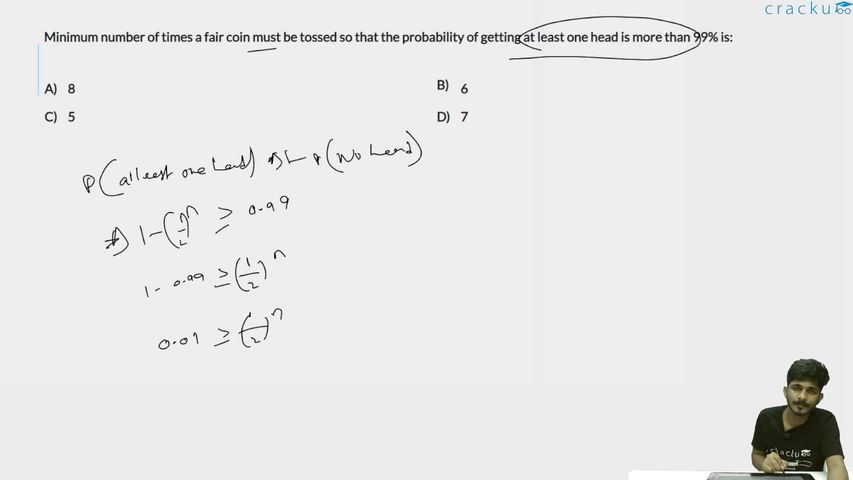
Minimum number of times a fair coin must be tossed so that the probability of getting at least one head is more than 99% is:
Let us denote by $$n$$ the number of independent tosses of a fair coin we plan to make. Because the coin is fair, the probability of getting a head in a single toss is $$\dfrac12$$, and the probability of getting a tail is also $$\dfrac12$$.
We wish to find the smallest $$n$$ for which the probability of obtaining at least one head exceeds $$99\%$$, that is, is greater than $$0.99$$.
Instead of counting heads directly, it is easier to count the complementary event: “no head at all”, which means all tosses show tails. The rule of complementary probability states
$$P(\text{at least one head}) \;=\; 1 \;-\; P(\text{no head}).$$
For $$n$$ independent tosses, getting a tail every time has probability
$$P(\text{no head}) \;=\; \Bigl(\dfrac12\Bigr)^n,$$
because we multiply $$\dfrac12$$ with itself $$n$$ times.
Hence, using the complementary rule,
$$P(\text{at least one head}) \;=\; 1 \;-\; \Bigl(\dfrac12\Bigr)^n.$$
The requirement that this probability be more than $$99\%$$ translates to the inequality
$$1 \;-\; \Bigl(\dfrac12\Bigr)^n \;>\; 0.99.$$ Subtracting $$1$$ from both sides and changing the sign gives
$$-\Bigl(\dfrac12\Bigr)^n \;>\; -0.01,$$
which simplifies to
$$\Bigl(\dfrac12\Bigr)^n \;<\; 0.01.$$
To solve for $$n$$, we take logarithms. Stating the logarithm rule first: for any positive number $$a$$ and any base, $$\log(a^n)=n\log a.$$ Applying this rule, we write
$$\log\!\Bigl(\Bigl(\dfrac12\Bigr)^n\Bigr) \;<\; \log(0.01).$$
Using the logarithm rule mentioned above, we obtain
$$n\,\log\!\Bigl(\dfrac12\Bigr) \;<\; \log(0.01).$$
Now, $$\log\!\Bigl(\dfrac12\Bigr)$$ is negative (since $$\dfrac12<1$$). Dividing by a negative number reverses the inequality sign. Hence,
$$n \;>\; \dfrac{\log(0.01)}{\log\!\bigl(\dfrac12\bigr)}.$$
We evaluate the logs in base 10 for convenience:
$$\log_{10}(0.01) \;=\; -2,$$
$$\log_{10}\!\Bigl(\dfrac12\Bigr) \;=\; \log_{10}(1) - \log_{10}(2) \;=\; 0 - 0.3010 \;=\; -0.3010.$$
Substituting these numerical values, we have
$$n \;>\; \dfrac{-2}{-0.3010} \;=\; \dfrac{2}{0.3010} \;\approx\; 6.644.$$
The inequality demands $$n$$ be strictly greater than $$6.644$$, so the smallest integer satisfying it is
$$n = 7.$$
Therefore, we must toss the fair coin at least seven times to make the probability of getting at least one head exceed $$99\%$$.
Hence, the correct answer is Option D.
Was this solution helpful?
Click on the Email ☝️ to Watch the Video Solution
Create a FREE account and get:
_1.webp)

Educational materials for JEE preparation

Ask our AI anything

AI can make mistakes. Please verify important information.
AI can make mistakes. Please verify important information.
