For the following questions answer them individually
In the formula X = 5YZ$$^2$$, X and Z have dimensions of capacitance and magnetic field, respectively. What are the dimensions of Y in SI units?
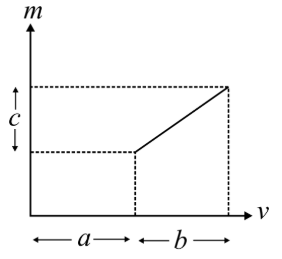
A bullet of mass 20 g has an initial speed of 1 m s$$^{-1}$$, just before it starts penetrating a mud wall of thickness 20 cm. If the wall offers a mean resistance of $$2.5 \times 10^{-2}$$ N, the speed of the bullet after emerging from the other side of the wall is close to:
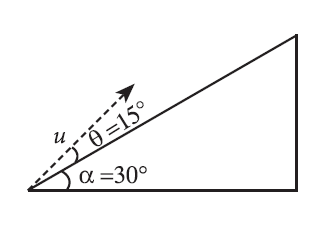
A plane is inclined at an angle $$\alpha = 30$$° with respect to the horizontal. A particle is projected with a speed u = 2 m s$$^{-1}$$, from the base of the plane, making an angle $$\theta = 15$$° with respect to the plane as shown in the figure. The distance from the base, at which the particle hits the plane is close to: (Take g = $$10\ m \ s^{-2}$$)
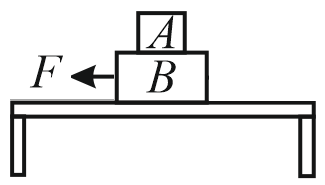
Two blocks A and B of masses m$$_A$$ = 1 kg and m$$_B$$ = 3 kg are kept on the table as shown in figure. The coefficients of friction between A and B is 0.2 and between B and the surface of the table is also 0.2. The maximum force F that can be applied on B horizontally, so that the block A does not slide over the block B is:
[Take g = 10 m/s$$^2$$]
A solid sphere of mass M and radius R is divided into two unequal parts. The first part has a mass of $$\frac{7M}{8}$$ and is converted into uniform disc of radius 2R. The second part is converted into a uniform solid sphere. Let I$$_1$$ be the moment of inertia of the disc about its axis and I$$_2$$ be the moment of inertia of the new sphere about its axis. The ratio I$$_1$$/I$$_2$$ is given by:
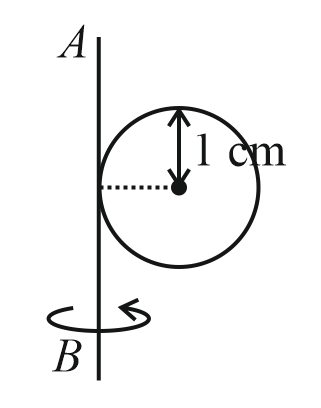
A metal coin of mass 5 g and radius 1 cm is fixed to a thin stick AB of negligible mass as shown in the figure. The system is initially at rest. The constant torque, that will make the system rotate about AB at 25 rotations per second in 5 s, is close to:
The time dependence of the position of a particle of mass m = 2 is given by $$\vec{r}(t) = 2t\hat{i} - 3t^2\hat{j}$$. Its angular momentum, with respect to the origin, at time t = 2 is:
A spaceship orbits around a planet at a height of 20 km from its surface. Assuming that only gravitational field of the planet acts on the spaceship, what will be the number of complete revolutions made by the spaceship in 24 hours around the planet?
[Given: Mass of planet = $$8 \times 10^{22}$$ kg, Radius of planet = $$2 \times 10^6$$ m, Gravitational constant G = $$6.67 \times 10^{-11}$$ Nm$$^2$$/kg$$^2$$]
The elastic limit of brass is 379 MPa. The minimum diameter of a brass rod if it is to support a 400 N load without exceeding its elastic limit will be
In an experiment, brass and steel wires of length 1 m each with areas of cross section 1 mm$$^2$$ are used. The wires are connected in series and one end of the combined wire is connected to a rigid support and other end is subjected to elongation. The stress required to produce a net elongation of 0.2 mm is,
[Given, the Young's Modulus for steel and brass are, respectively, $$120 \times 10^9$$ N/m$$^2$$ and $$60 \times 10^9$$ N/m$$^2$$]