
Join Our JEE Preparation Group
Prep with like-minded aspirants; Get access to free daily tests and study material.
Sign in
Please select an account to continue using cracku.in
↓ →
Join Our JEE Preparation Group
Prep with like-minded aspirants; Get access to free daily tests and study material.
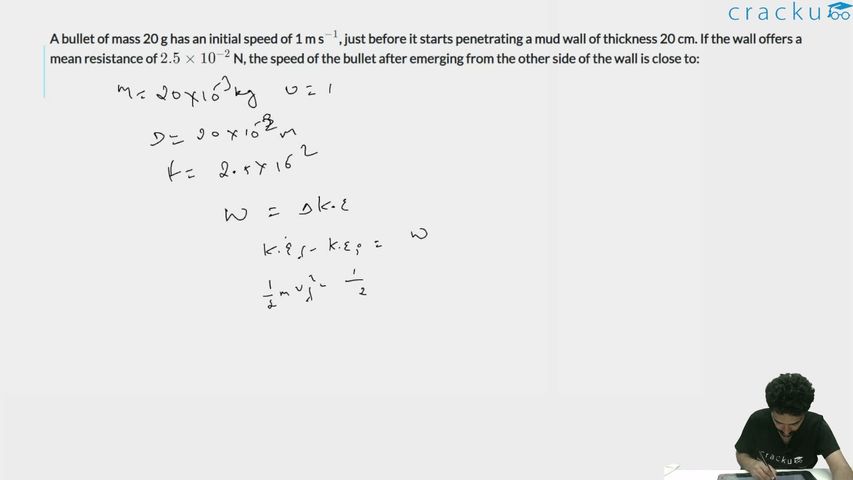
A bullet of mass 20 g has an initial speed of 1 m s$$^{-1}$$, just before it starts penetrating a mud wall of thickness 20 cm. If the wall offers a mean resistance of $$2.5 \times 10^{-2}$$ N, the speed of the bullet after emerging from the other side of the wall is close to:
First, we translate every given quantity into standard SI units. The mass of the bullet is 20 g, and since $$1\ \text{kg}=1000\ \text{g}$$, we have
$$m = 20\ \text{g} = 20 \times 10^{-3}\ \text{kg}=0.02\ \text{kg}.$$
The initial speed of the bullet, just before entering the wall, is already given in metres per second:
$$u = 1\ \text{m s}^{-1}.$$
The thickness of the mud wall is 20 cm. Converting centimetres to metres (because $$1\ \text{m}=100\ \text{cm}$$):
$$s = 20\ \text{cm}=20 \times 10^{-2}\ \text{m}=0.20\ \text{m}.$$
The wall offers a mean resistive force of $$2.5 \times 10^{-2}\ \text{N}$$, so
$$F = 2.5 \times 10^{-2}\ \text{N}.$$
Now we invoke the Work-Energy Theorem, which states:
$$\text{Work done by all forces} = \text{Change in kinetic energy}.$$
The resistive force does negative work (it removes energy from the bullet). The magnitude of the work done by this constant resistive force while the bullet travels the full thickness of the wall is
$$W = F \, s.$$
Substituting the known values, we obtain
$$W = \left(2.5 \times 10^{-2}\ \text{N}\right)\left(0.20\ \text{m}\right) = 0.5 \times 10^{-2}\ \text{J} = 5.0 \times 10^{-3}\ \text{J}.$$
The bullet’s initial kinetic energy is found from the standard formula $$K = \tfrac12 m u^2$$:
$$K_{\text{initial}} = \frac12 (0.02\ \text{kg}) (1\ \text{m s}^{-1})^{2} = \frac12 (0.02)\,(1) = 0.01\ \text{J}.$$
Because the wall’s resistive force removes energy, the final kinetic energy of the bullet after it just emerges is
$$K_{\text{final}} = K_{\text{initial}} - W.$$
Substituting the numerical results,
$$K_{\text{final}} = 0.01\ \text{J} - 5.0 \times 10^{-3}\ \text{J} = 5.0 \times 10^{-3}\ \text{J}.$$
Let $$v$$ denote the bullet’s speed on emerging. Using the kinetic-energy relation once more,
$$K_{\text{final}} = \frac12 m v^{2}.$$
Therefore,
$$\frac12 m v^{2} = 5.0 \times 10^{-3}\ \text{J}.$$
Solving explicitly for $$v^{2}$$:
$$v^{2} = \frac{2 \times 5.0 \times 10^{-3}\ \text{J}}{0.02\ \text{kg}} = \frac{1.0 \times 10^{-2}}{0.02} = 0.50.$$
Taking the positive square root (speed is positive by definition),
$$v = \sqrt{0.50}\ \text{m s}^{-1} \approx 0.707\ \text{m s}^{-1}.$$
This value is most nearly $$0.7\ \text{m s}^{-1}$$ among the listed choices.
Hence, the correct answer is Option A.
Was this solution helpful?
Click on the Email ☝️ to Watch the Video Solution
Create a FREE account and get:
_1.webp)

Educational materials for JEE preparation

Ask our AI anything

AI can make mistakes. Please verify important information.
AI can make mistakes. Please verify important information.
