
Join Our JEE Preparation Group
Prep with like-minded aspirants; Get access to free daily tests and study material.
Sign in
Please select an account to continue using cracku.in
↓ →
Join Our JEE Preparation Group
Prep with like-minded aspirants; Get access to free daily tests and study material.
A plane is inclined at an angle $$\alpha = 30$$° with respect to the horizontal. A particle is projected with a speed u = 2 m s$$^{-1}$$, from the base of the plane, making an angle $$\theta = 15$$° with respect to the plane as shown in the figure. The distance from the base, at which the particle hits the plane is close to: (Take g = $$10\ m \ s^{-2}$$)
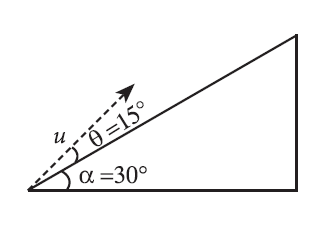
To find the distance from the base at which the particle hits the inclined plane (the range along the incline, $$R$$), we can break down the motion parallel and perpendicular to the inclined surface.
Here is the step-by-step formatting and solution of your approach.
1. Given Data
2. Components of Motion
By choosing the $$x$$-axis along the inclined plane (upwards) and the $$y$$-axis perpendicular to the inclined plane:
Initial Velocity Components
Acceleration Components
3. Calculation of Time of Flight ($$T$$)
The particle returns to the inclined plane when its displacement perpendicular to the plane is zero ($$y = 0$$):
$$y = u_y T + \frac{1}{2} a_y T^2 = 0$$
$$(2 \sin 15^\circ) T - \frac{1}{2} (g \cos 30^\circ) T^2 = 0$$
Solving for non-zero time $$T$$:
$$T = \frac{2 u \sin\theta}{g \cos\alpha} = \frac{2 \times 2 \sin 15^\circ}{10 \cos 30^\circ}$$
4. Range Along the Incline ($$R$$)
The displacement along the incline is given by:
$$R = u_x T + \frac{1}{2} a_x T^2$$
Substituting $$u_x = 2 \cos 15^\circ$$ and $$a_x = -g \sin 30^\circ$$:
$$R = (2 \cos 15^\circ) T - \frac{1}{2} (10 \sin 30^\circ) T^2$$
Alternative Standard Formula
Instead of plugging numbers into both terms manually, we can use the simplified standard formula for the range up an inclined plane:
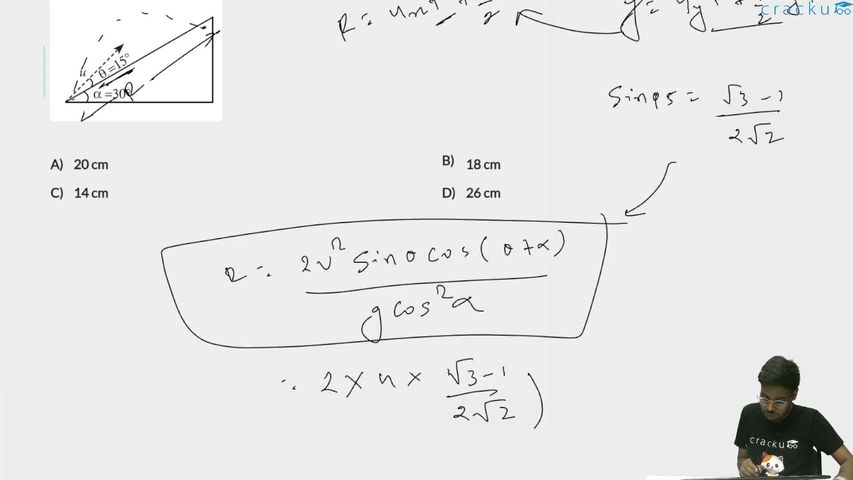
$$R = \frac{2 u^2 \sin\theta \cos(\theta + \alpha)}{g \cos^2\alpha}$$
Substituting the values into this formula makes it much cleaner:
$$R = \frac{2 \times (2)^2 \times \sin 15^\circ \times \cos(15^\circ + 30^\circ)}{10 \times \cos^2 30^\circ}$$
$$R = \frac{8 \times \sin 15^\circ \times \cos 45^\circ}{10 \times \left(\frac{\sqrt{3}}{2}\right)^2}$$
$$R = \frac{8 \times \sin 15^\circ \times \frac{1}{\sqrt{2}}}{10 \times \frac{3}{4}} = \frac{32 \sin 15^\circ}{30\sqrt{2}}$$
Using the known value $$\sin 15^\circ = \frac{\sqrt{3}-1}{2\sqrt{2}}$$:
$$R = \frac{32 \times (\sqrt{3} - 1)}{30 \times 2 \times \sqrt{2} \times \sqrt{2}} = \frac{32(\sqrt{3}-1)}{120} = \frac{4(\sqrt{3}-1)}{15}\text{ meters}$$
5. Final Numeric Approximation
Using $$\sqrt{3} \approx 1.732$$:
$$R \approx \frac{4 \times (1.732 - 1)}{15} = \frac{4 \times 0.732}{15} = \frac{2.928}{15} \approx 0.1952\text{ m}$$
Converting meters to centimeters:
$$R \approx 0.1952 \times 100\text{ cm} = 19.52\text{ cm} \approx 20\text{ cm}$$
Correct Answer: A (20 cm)
Was this solution helpful?
Click on the Email ☝️ to Watch the Video Solution
Create a FREE account and get:
_1.webp)

Educational materials for JEE preparation

Ask our AI anything

AI can make mistakes. Please verify important information.
AI can make mistakes. Please verify important information.
