
Join Our JEE Preparation Group
Prep with like-minded aspirants; Get access to free daily tests and study material.
Sign in
Please select an account to continue using cracku.in
↓ →
Join Our JEE Preparation Group
Prep with like-minded aspirants; Get access to free daily tests and study material.
Two blocks A and B of masses m$$_A$$ = 1 kg and m$$_B$$ = 3 kg are kept on the table as shown in figure. The coefficients of friction between A and B is 0.2 and between B and the surface of the table is also 0.2. The maximum force F that can be applied on B horizontally, so that the block A does not slide over the block B is:
[Take g = 10 m/s$$^2$$]
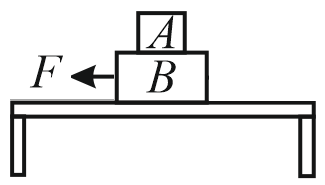
To solve for the maximum force $$F$$ such that block $$A$$ does not slide over block $$B$$, we need to analyze the friction limits and the maximum common acceleration they can share.
Here is the structured, step-by-step breakdown of the solution.
1. Identify the Maximum Acceleration of Block A
Block $$A$$ moves forward solely due to the static friction acting between it and block $$B$$.
The maximum static friction force ($$f_{max, A}$$) that can act on block $$A$$ is:
$$f_{max, A} = \mu_1 \cdot m_A \cdot g$$
$$f_{max, A} = 0.2 \times 1\text{ kg} \times 10\text{ m/s}^2 = 2\text{ N}$$
Using Newton's second law ($$F = m \cdot a$$), the maximum acceleration ($$a_{max}$$) block $$A$$ can achieve without slipping is:
$$a_{max} = \frac{f_{max, A}}{m_A} = \frac{2\text{ N}}{1\text{ kg}} = 2\text{ m/s}^2$$
If the system accelerates faster than $$2\text{ m/s}^2$$, block $$A$$ will begin to slide backward relative to block $$B$$.
2. Analyze the Whole System (A + B)
To find the maximum force $$F$$ required to achieve this common acceleration, we treat both blocks as a single combined system of mass:
$$M_{total} = m_A + m_B = 1\text{ kg} + 3\text{ kg} = 4\text{ kg}$$
Friction from the Table Surface
The table exerts a kinetic/limiting friction force ($$f_{table}$$) opposing the motion of the combined mass:
$$f_{table} = \mu_2 \cdot N_{table} = 0.2 \times 40\text{ N} = 8\text{ N}$$
3. Calculate the Maximum Force ($$F$$)
Using the equation of motion for the entire combined system:
$$F - f_{table} = M_{total} \cdot a_{max}$$
Substitute the values we calculated:
$$F - 8\text{ N} = 4\text{ kg} \times 2\text{ m/s}^2$$
$$F - 8 = 8$$
$$F = 16\text{ N}$$
Final Answer
The maximum horizontal force $$F$$ that can be applied to block $$B$$ without causing block $$A$$ to slide is 16 N.
Was this solution helpful?
Create a FREE account and get:
_1.webp)

Educational materials for JEE preparation

Ask our AI anything

AI can make mistakes. Please verify important information.
AI can make mistakes. Please verify important information.
