NTA JEE Main 10th April 2019 Shift 2
For the following questions answer them individually
NTA JEE Main 10th April 2019 Shift 2 - Question 11
A cubical block of side 0.5 m floats on water with 30% of its volume under water. What is the maximum weight that can be put on the block without fully submerging it under water?
[Take, density of water = 10$$^3$$ kg/m$$^3$$]
NTA JEE Main 10th April 2019 Shift 2 - Question 12
Water from a tap emerges vertically downwards with an initial speed of 1.0 ms$$^{-1}$$. The cross-sectional area of the tap is $$10^{-4}$$ m$$^2$$. Assume that the pressure is constant throughout the stream of water and that the flow is streamlined. The cross-sectional area of the stream, 0.15 m below the tap would be:
(Take g = 10 ms$$^{-2}$$)
NTA JEE Main 10th April 2019 Shift 2 - Question 13
A submarine experiences a pressure of $$5.05 \times 10^6$$ Pa at a depth of d$$_1$$ in a sea. When it goes further to a depth of d$$_2$$, it experiences a pressure of $$8.08 \times 10^6$$ Pa. Then d$$_2$$ - d$$_1$$ is approximately (density of water = 10$$^3$$ kg/m$$^3$$ and acceleration due to gravity = 10 ms$$^{-2}$$):

NTA JEE Main 10th April 2019 Shift 2 - Question 14
One mole of an ideal gas passes through a process where pressure and volume obey the relation P = P$$_0$$[1 - $$\frac{1}{2}\left(\frac{V_0}{V}\right)^2$$]. Here P$$_0$$ and V$$_0$$ are constants. Calculate the change in the temperature of the gas if its volume changes from V$$_0$$ to 2V$$_0$$.
NTA JEE Main 10th April 2019 Shift 2 - Question 15
When heat Q is supplied to a diatomic gas of rigid molecules, at constant volume its temperature increases by $$\Delta T$$. The heat required to produce the same change in temperature, at a constant pressure is:
NTA JEE Main 10th April 2019 Shift 2 - Question 16
A source of sound S is moving with a velocity of 50 m s$$^{-1}$$ towards a stationary observer. The observer measures the frequency of the source as 1000 Hz. What will be the apparent frequency of the source when it is moving away from the observer after crossing him? (Take velocity of sound in air is 350 m s$$^{-1}$$)
NTA JEE Main 10th April 2019 Shift 2 - Question 17
The correct figure that shows, schematically, the wave pattern produced by the superposition of two waves of frequencies 9 Hz and 11 Hz, is
NTA JEE Main 10th April 2019 Shift 2 - Question 18
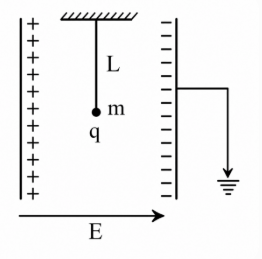
A simple pendulum of length L is placed between the plates of a parallel plate capacitor having electric field E, as shown in figure. Its bob has mass m and charge q. The time period of the pendulum is given by:
NTA JEE Main 10th April 2019 Shift 2 - Question 19
In free space, a particle A of charge 1 μC is held fixed at point P. Another particle B of the same charge and mass 4 μg is kept at a distance of 1 mm from P. If B is released, then its velocity at a distance of 9 mm from P is:
[Take $$\frac{1}{4\pi\varepsilon_0} = 9 \times 10^9$$ N m$$^2$$ C$$^{-2}$$]
NTA JEE Main 10th April 2019 Shift 2 - Question 20
Space between two concentric conducting spheres of radii a and b (b > a) is filled with a medium of resistivity $$\rho$$. The resistance between the two spheres will be: