
Join Our JEE Preparation Group
Prep with like-minded aspirants; Get access to free daily tests and study material.
Sign in
Please select an account to continue using cracku.in
↓ →
Join Our JEE Preparation Group
Prep with like-minded aspirants; Get access to free daily tests and study material.
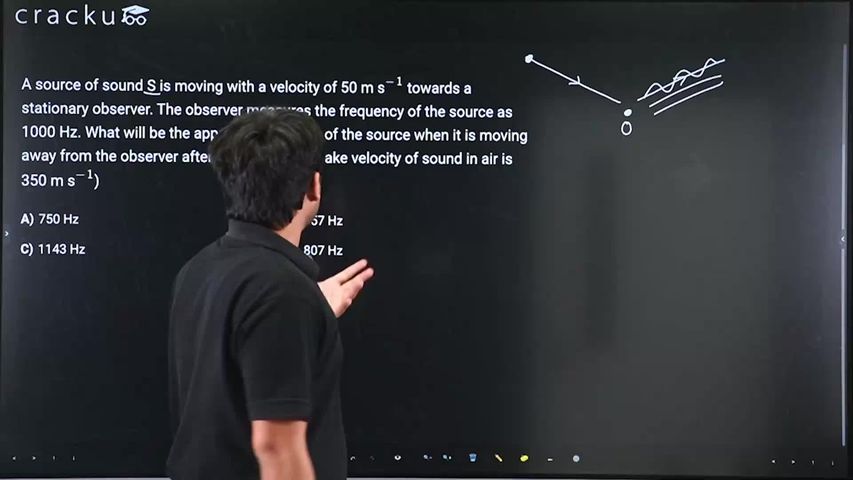
A source of sound S is moving with a velocity of 50 m s$$^{-1}$$ towards a stationary observer. The observer measures the frequency of the source as 1000 Hz. What will be the apparent frequency of the source when it is moving away from the observer after crossing him? (Take velocity of sound in air is 350 m s$$^{-1}$$)
We have a stationary observer, so the observer’s speed is $$v_o = 0\text{ m s}^{-1}.$$ The speed of sound in air is given as $$v = 350\text{ m s}^{-1},$$ and the source S is moving with speed $$v_s = 50\text{ m s}^{-1}.$$
The observer hears a frequency of $$1000\ \text{Hz}$$ when the source is moving towards him. For a stationary observer and a source moving towards the observer, the Doppler-effect formula is first stated:
$$f' = f \;\frac{v}{\,v - v_s\,}$$
Here $$f' = 1000\ \text{Hz}$$ is the apparent (heard) frequency, and $$f$$ is the true frequency emitted by the source.
We now solve this expression for the true frequency $$f.$$ Taking the denominator to the left side,
$$f'\,(v - v_s) = f\,v$$
Dividing both sides by $$v,$$ we obtain
$$f = f'\,\frac{v - v_s}{v}$$
Substituting the numerical values,
$$f = 1000\ \text{Hz}\;\frac{350\ \text{m s}^{-1} - 50\ \text{m s}^{-1}}{350\ \text{m s}^{-1}}$$ $$\;\;\; = 1000\ \text{Hz}\;\frac{300}{350}$$ $$\;\;\; = 1000\ \text{Hz}\;\times\;\frac{6}{7}$$ $$\;\;\; = 857.142857\ldots\ \text{Hz}$$
So, the true frequency of the source is
$$f \approx 857\ \text{Hz}.$$
After crossing the observer, the source now moves away. For a stationary observer and a source moving away, the Doppler-effect formula becomes
$$f'' = f \;\frac{v}{\,v + v_s\,}$$
where $$f''$$ is the new apparent frequency to be found.
Substituting the known values,
$$f'' = 857.142857\ \text{Hz}\;\frac{350\ \text{m s}^{-1}}{350\ \text{m s}^{-1} + 50\ \text{m s}^{-1}}$$ $$\;\;\; = 857.142857\ \text{Hz}\;\frac{350}{400}$$ $$\;\;\; = 857.142857\ \text{Hz}\;\times\;0.875$$ $$\;\;\; = 750\ \text{Hz}$$
Hence, the apparent frequency heard by the observer after the source has crossed him and is moving away is
$$f'' = 750\ \text{Hz}.$$
Hence, the correct answer is Option A.
Was this solution helpful?
Click on the Email ☝️ to Watch the Video Solution
Create a FREE account and get:
_1.webp)

Educational materials for JEE preparation

Ask our AI anything

AI can make mistakes. Please verify important information.
AI can make mistakes. Please verify important information.
