
Join Our JEE Preparation Group
Prep with like-minded aspirants; Get access to free daily tests and study material.
Sign in
Please select an account to continue using cracku.in
↓ →
Join Our JEE Preparation Group
Prep with like-minded aspirants; Get access to free daily tests and study material.
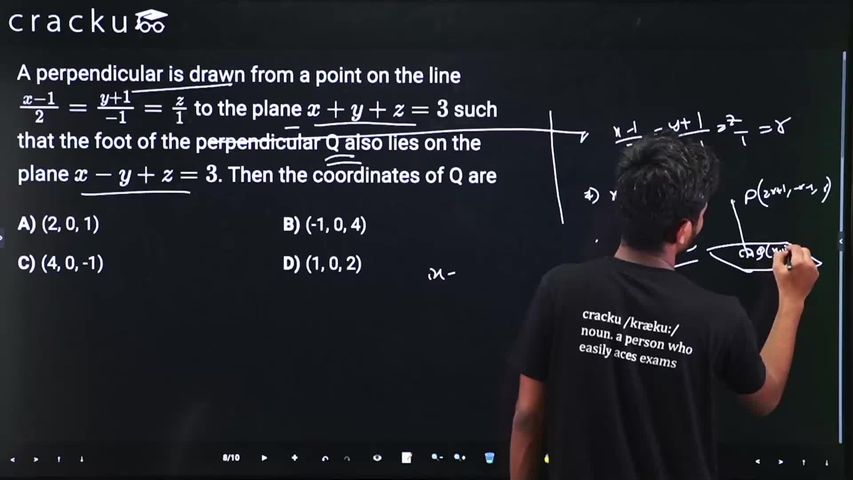
A perpendicular is drawn from a point on the line $$\frac{x-1}{2} = \frac{y+1}{-1} = \frac{z}{1}$$ to the plane $$x + y + z = 3$$ such that the foot of the perpendicular Q also lies on the plane $$x - y + z = 3$$. Then the coordinates of Q are
We have the given line written in symmetric form as $$\frac{x-1}{2}=\frac{y+1}{-1}=\frac{z}{1}$$.
To obtain the coordinates of any point $$P$$ on this line, we introduce a parameter, say $$t$$, and equate each ratio to $$t$$:
$$\frac{x-1}{2}=t,\qquad\frac{y+1}{-1}=t,\qquad\frac{z}{1}=t.$$
Thus,
$$x=1+2t,\qquad y=-1-\,t,\qquad z=t.$$
So the point on the line is $$P(1+2t,\,-1-t,\,t).$$
The plane to which we draw the perpendicular is $$x+y+z=3$$.
A perpendicular from any point to a plane must travel in the direction of the plane’s normal vector.
The normal vector of $$x+y+z=3$$ is clearly $$\mathbf n=(1,\,1,\,1).$$
Hence, the foot of the perpendicular $$Q$$ can be reached from $$P$$ by moving some scalar amount $$s$$ along this normal:
$$Q = P + s\,\mathbf n.$$
Writing the coordinates of $$Q(x_Q,y_Q,z_Q)$$ explicitly, we get
$$\begin{aligned} x_Q &= (1+2t) + s,\\ y_Q &= (-1-t) + s,\\ z_Q &= t + s. \end{aligned}$$
The point $$Q$$ must satisfy two independent plane conditions:
(i) It lies on the first plane $$x+y+z=3$$,
(ii) It also lies on the second plane $$x - y + z = 3$$ (this is an extra piece of information given in the question).
We now substitute the coordinates of $$Q$$ into each plane equation one by one.
Condition (i): $$x_Q + y_Q + z_Q = 3$$
$$\bigl[\,1+2t+s\bigr]+\bigl[-1-t+s\bigr]+\bigl[t+s\bigr]=3.$$
Combining like terms,
$$1-1 + 2t - t + t + 3s = 3 \;\Longrightarrow\; 2t + 3s = 3. \quad -(1)$$
Condition (ii): $$x_Q - y_Q + z_Q = 3$$
$$\bigl[\,1+2t+s\bigr]-\bigl[-1-t+s\bigr]+\bigl[t+s\bigr]=3.$$
Simplifying term-by-term,
$$1+2t+s + 1 + t - s + t + s = 3 \;\Longrightarrow\; 2 + 4t + s = 3.$$
This reduces to
$$4t + s = 1. \quad -(2)$$
We now have a system of two linear equations in the two unknowns $$t$$ and $$s$$:
$$\begin{aligned} 2t + 3s &= 3,&\quad (1)\\[2pt] 4t + s &= 1.&\quad (2) \end{aligned}$$
We solve these simultaneously.
From (2) we can express $$s$$ in terms of $$t$$:
$$s = 1 - 4t.$$
Substituting this into (1):
$$2t + 3(1 - 4t) = 3.$$
Expanding,
$$2t + 3 - 12t = 3.$$
Combining like terms,
$$-10t + 3 = 3.$$
Subtracting $$3$$ from both sides gives
$$-10t = 0 \;\Longrightarrow\; t = 0.$$
Returning to $$s = 1 - 4t$$ and inserting $$t = 0$$, we get
$$s = 1 - 4(0) = 1.$$
With $$t = 0$$ and $$s = 1$$, we now find the final coordinates of $$Q$$:
$$\begin{aligned} x_Q &= 1 + 2(0) + 1 = 2,\\ y_Q &= -1 - 0 + 1 = 0,\\ z_Q &= 0 + 1 = 1. \end{aligned}$$
Hence $$Q(2,\,0,\,1).$$
Among the given options, this corresponds to Option A.
Hence, the correct answer is Option A.
Was this solution helpful?
Click on the Email ☝️ to Watch the Video Solution
Create a FREE account and get:
_1.webp)

Educational materials for JEE preparation

Ask our AI anything

AI can make mistakes. Please verify important information.
AI can make mistakes. Please verify important information.
