
Join Our JEE Preparation Group
Prep with like-minded aspirants; Get access to free daily tests and study material.
Sign in
Please select an account to continue using cracku.in
↓ →
Join Our JEE Preparation Group
Prep with like-minded aspirants; Get access to free daily tests and study material.
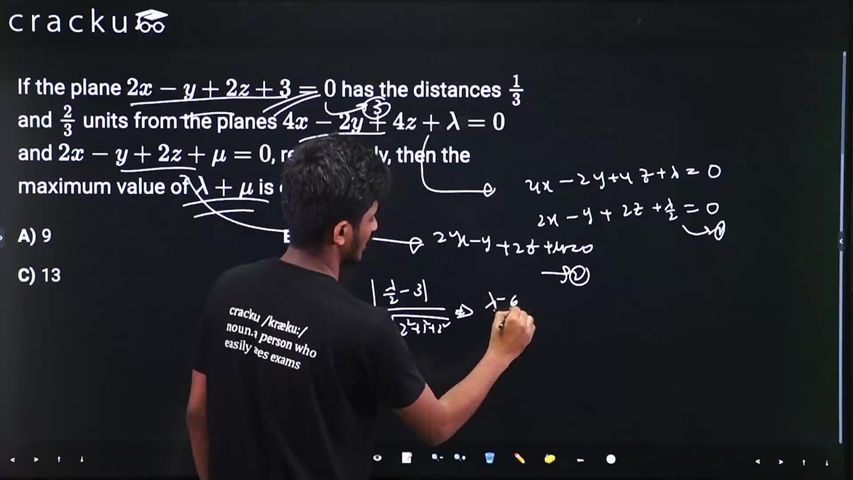
If the plane $$2x - y + 2z + 3 = 0$$ has the distances $$\frac{1}{3}$$ and $$\frac{2}{3}$$ units from the planes $$4x - 2y + 4z + \lambda = 0$$ and $$2x - y + 2z + \mu = 0$$, respectively, then the maximum value of $$\lambda + \mu$$ is equal to:
We have the fixed plane $$2x - y + 2z + 3 = 0$$. To determine the distance between this plane and any other parallel plane, we shall use the standard formula
$$\text{Distance} \;=\; \dfrac{|d_2 - d_1|}{\sqrt{a^2 + b^2 + c^2}},$$
where the two parallel planes are written in the form $$ax + by + cz + d_1 = 0$$ and $$ax + by + cz + d_2 = 0$$. Here the normal vector $$(a,\,b,\,c)$$ is identical for both planes.
For the given fixed plane the normal vector is $$\bigl(2,\,-1,\,2\bigr)$$, so $$a^2 + b^2 + c^2 = 2^2 + (-1)^2 + 2^2 = 4 + 1 + 4 = 9,$$ and hence $$\sqrt{a^2 + b^2 + c^2} = 3.$$
Now, consider the first variable plane $$4x - 2y + 4z + \lambda = 0.$$ Because all its coefficients are exactly twice those of the fixed plane, we divide the entire equation by $$2$$ to obtain an equivalent plane with the same normal vector:
$$2x - y + 2z + \dfrac{\lambda}{2} = 0.$$
This puts the two planes in the required comparable form. Therefore, for these two planes we have $$d_1 = 3$$ and $$d_2 = \dfrac{\lambda}{2}$$. Using the distance formula, and noting that the given distance is $$\dfrac{1}{3}$$ unit, we write
$$\dfrac{\bigl|\,\dfrac{\lambda}{2} - 3\bigr|}{3} = \dfrac{1}{3}.$$
Multiplying both sides by $$3$$ gives
$$\bigl|\,\dfrac{\lambda}{2} - 3\bigr| = 1.$$
Hence,
$$\dfrac{\lambda}{2} - 3 = \pm 1 \quad\Longrightarrow\quad \dfrac{\lambda}{2} = 3 \pm 1.$$
So we obtain the two possible values
$$\lambda = 2(3 + 1) = 8 \quad\text{or}\quad \lambda = 2(3 - 1) = 4.$$
Next, we turn to the second variable plane $$2x - y + 2z + \mu = 0.$$ Its coefficients already match those of the fixed plane, so we can directly apply the formula with $$d_1 = 3$$ and $$d_2 = \mu$$. The given distance this time is $$\dfrac{2}{3}$$ units, hence
$$\dfrac{|\,\mu - 3\,|}{3} = \dfrac{2}{3}.$$
Multiplying both sides by $$3$$ yields
$$|\,\mu - 3\,| = 2.$$
Therefore,
$$\mu - 3 = \pm 2 \quad\Longrightarrow\quad \mu = 3 \pm 2.$$
This gives the two possible values
$$\mu = 5 \quad\text{or}\quad \mu = 1.$$
We now form all possible sums $$\lambda + \mu$$ from the pairs derived above:
$$\begin{aligned} \lambda = 4,\; \mu = 1 &\;\Longrightarrow\; \lambda + \mu = 5,\\ \lambda = 4,\; \mu = 5 &\;\Longrightarrow\; \lambda + \mu = 9,\\ \lambda = 8,\; \mu = 1 &\;\Longrightarrow\; \lambda + \mu = 9,\\ \lambda = 8,\; \mu = 5 &\;\Longrightarrow\; \lambda + \mu = 13. \end{aligned}$$
The maximum of these four sums is $$13$$.
Hence, the correct answer is Option C.
Was this solution helpful?
Click on the Email ☝️ to Watch the Video Solution
Create a FREE account and get:
_1.webp)

Educational materials for JEE preparation

Ask our AI anything

AI can make mistakes. Please verify important information.
AI can make mistakes. Please verify important information.
