
Join Our JEE Preparation Group
Prep with like-minded aspirants; Get access to free daily tests and study material.
Sign in
Please select an account to continue using cracku.in
↓ →
Join Our JEE Preparation Group
Prep with like-minded aspirants; Get access to free daily tests and study material.
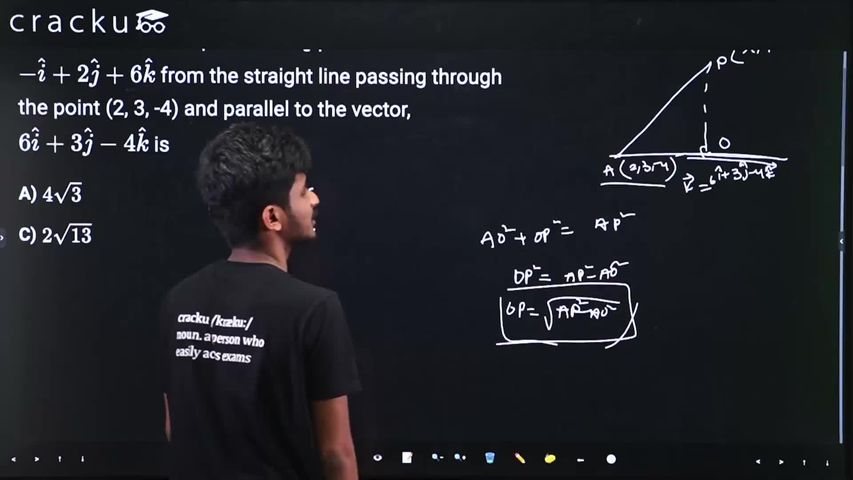
The distance of the point having position vector $$-\hat{i} + 2\hat{j} + 6\hat{k}$$ from the straight line passing through the point (2, 3, -4) and parallel to the vector, $$6\hat{i} + 3\hat{j} - 4\hat{k}$$ is
We are asked to find the perpendicular distance of the point whose position vector is $$\,-\hat i + 2\hat j + 6\hat k$$ from the straight line which passes through the point $$(2,\,3,\,-4)$$ and is parallel to the vector $$\,6\hat i + 3\hat j - 4\hat k.$$
In vector form, the distance $$d$$ of a point with position vector $$\vec r_0$$ from a line that passes through a point with position vector $$\vec a$$ and is parallel to a direction vector $$\vec b$$ is given by the well-known formula
$$d \;=\; \frac{\bigl\lvert\,\vec b \times (\vec r_0 - \vec a)\bigr\rvert}{\lvert\vec b\rvert}.$$
First we identify all the required vectors clearly.
For the given point: $$\vec r_0 \;=\; -\hat i + 2\hat j + 6\hat k.$$
For a fixed point on the line: $$\vec a \;=\; 2\hat i + 3\hat j - 4\hat k.$$
For the direction of the line: $$\vec b \;=\; 6\hat i + 3\hat j - 4\hat k.$$
Now we form the vector joining the point on the line to the given external point:
$$\vec{AP} \;=\; \vec r_0 - \vec a \;=\;(-\hat i + 2\hat j + 6\hat k)\;-\;(2\hat i + 3\hat j - 4\hat k).$$
We subtract component-wise:
$$\vec{AP} = (-1 - 2)\hat i \;+\; (2 - 3)\hat j \;+\; (6 - (-4))\hat k = -3\hat i - \hat j + 10\hat k.$$
Next we evaluate the cross product $$\vec b \times \vec{AP}.$$ Writing it using the determinant expansion, we get
$$\vec b \times \vec{AP} \;=\; \begin{vmatrix} \hat i & \hat j & \hat k\\[2pt] 6 & 3 & -4 \\[2pt] -3 & -1 & 10 \end{vmatrix}.$$
Expanding this determinant along the first row:
$$\begin{aligned} \vec b \times \vec{AP} &= \hat i\bigl(3 \cdot 10 \;-\; (-4)(-1)\bigr)\;-\; \hat j\bigl(6 \cdot 10 \;-\; (-4)(-3)\bigr)\;+\; \hat k\bigl(6(-1) \;-\; 3(-3)\bigr)\\[4pt] &= \hat i(30 - 4)\;-\;\hat j(60 - 12)\;+\;\hat k(-6 + 9)\\[4pt] &= 26\hat i \;-\; 48\hat j \;+\; 3\hat k. \end{aligned}$$
Hence
$$ \vec b \times \vec{AP} \;=\; 26\hat i - 48\hat j + 3\hat k. $$
We now compute its magnitude:
$$\bigl\lvert\vec b \times \vec{AP}\bigr\rvert = \sqrt{26^{2} + (-48)^{2} + 3^{2}} = \sqrt{676 + 2304 + 9} = \sqrt{2989}.$$
Next we need the magnitude of the direction vector $$\vec b$$ itself:
$$\lvert\vec b\rvert = \sqrt{6^{2} + 3^{2} + (-4)^{2}} = \sqrt{36 + 9 + 16} = \sqrt{61}.$$
Substituting these magnitudes into the distance formula, we obtain
$$ d = \frac{\sqrt{2989}}{\sqrt{61}} = \sqrt{\frac{2989}{61}}. $$
Now we perform the exact division inside the square root. Observe that
$$ 61 \times 49 \;=\; 2989. $$
So
$$\frac{2989}{61} \;=\; 49,$$ $$\text{and therefore}$$ $$d \;=\; \sqrt{49} \;=\; 7.$$
Hence, the correct answer is Option D.
Was this solution helpful?
Click on the Email ☝️ to Watch the Video Solution
Create a FREE account and get:
_1.webp)

Educational materials for JEE preparation

Ask our AI anything

AI can make mistakes. Please verify important information.
AI can make mistakes. Please verify important information.
