
Join Our JEE Preparation Group
Prep with like-minded aspirants; Get access to free daily tests and study material.
Sign in
Please select an account to continue using cracku.in
↓ →
Join Our JEE Preparation Group
Prep with like-minded aspirants; Get access to free daily tests and study material.
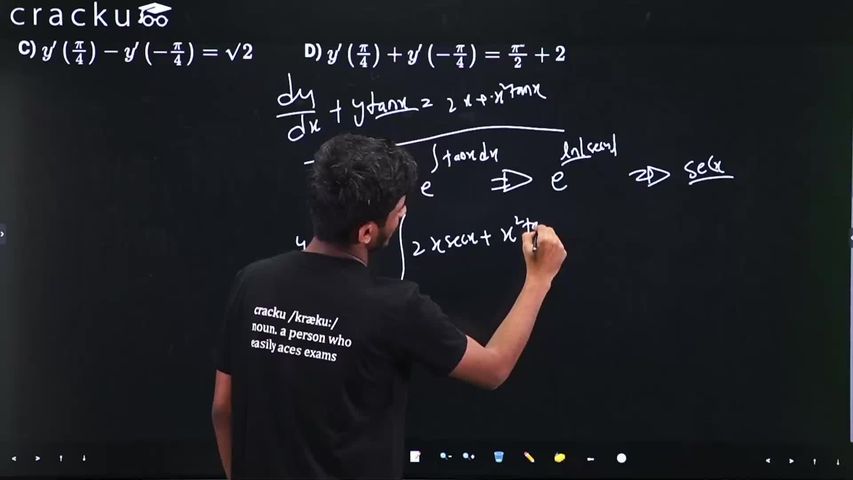
Let $$y = yx$$ be the solution of the differential equation, $$\frac{dy}{dx} + y\tan x = 2x + x^2\tan x$$, $$x \in \left(-\frac{\pi}{2}, \frac{\pi}{2}\right)$$, such that $$y(0) = 1$$. Then
We begin with the given linear differential equation
$$\frac{dy}{dx}+y\tan x=2x+x^{2}\tan x,\qquad x\in\left(-\frac{\pi}{2},\frac{\pi}{2}\right).$$
The standard form is $$\frac{dy}{dx}+P(x)\,y=Q(x),$$ where here we have $$P(x)=\tan x \quad\text{and}\quad Q(x)=2x+x^{2}\tan x.$$
For such an equation the integrating factor is defined by
$$\text{I.F.}=e^{\displaystyle\int P(x)\,dx}.$$
Evaluating the integral, we note that $$\int\tan x\,dx=-\ln|\cos x|,$$ so
$$\text{I.F.}=e^{-\ln|\cos x|}=\frac{1}{\cos x}=\sec x.$$
Multiplying every term of the differential equation by this integrating factor gives
$$\sec x\,\frac{dy}{dx}+y\sec x\tan x=(2x)\sec x+x^{2}\sec x\tan x.$$
Because $$\frac{d}{dx}(\sec x)=\sec x\tan x,$$ the left-hand side is recognized as the derivative of the product $$y\sec x$$:
$$\frac{d}{dx}\bigl(y\sec x\bigr)=2x\sec x+x^{2}\sec x\tan x.$$
We now integrate both sides with respect to $$x$$:
$$y\sec x=\int\bigl(2x\sec x+x^{2}\sec x\tan x\bigr)\,dx+C,$$
where $$C$$ is the constant of integration. To evaluate the integral we observe that
$$\frac{d}{dx}\bigl(x^{2}\sec x\bigr)=2x\sec x+x^{2}\sec x\tan x,$$
which is exactly the integrand. Therefore
$$\int\bigl(2x\sec x+x^{2}\sec x\tan x\bigr)\,dx=x^{2}\sec x.$$
Substituting back, we obtain
$$y\sec x=x^{2}\sec x+C.$$
Multiplying by $$\cos x$$ gives the explicit solution
$$y=x^{2}+C\cos x.$$
To determine $$C$$ we use the initial condition $$y(0)=1$$. Since $$\cos 0=1,$$ we have
$$1=0^{2}+C\cdot1\;\Longrightarrow\;C=1.$$
Hence the required function is
$$y(x)=x^{2}+\cos x.$$
We now differentiate to find $$y'(x)$$:
$$y'(x)=\frac{d}{dx}\bigl(x^{2}\bigr)+\frac{d}{dx}\bigl(\cos x\bigr)=2x-\sin x.$$
First, evaluate at $$x=\frac{\pi}{4}:$$
$$y'\!\left(\frac{\pi}{4}\right)=2\left(\frac{\pi}{4}\right)-\sin\!\left(\frac{\pi}{4}\right)=\frac{\pi}{2}-\frac{1}{\sqrt{2}}=\frac{\pi}{2}-\frac{\sqrt{2}}{2}.$$
Next, evaluate at $$x=-\frac{\pi}{4}:$$
$$\sin\!\left(-\frac{\pi}{4}\right)=-\frac{1}{\sqrt{2}},$$
so
$$y'\!\left(-\frac{\pi}{4}\right)=2\!\left(-\frac{\pi}{4}\right)-\!\left(-\frac{1}{\sqrt{2}}\right)=-\frac{\pi}{2}+\frac{1}{\sqrt{2}}=-\frac{\pi}{2}+\frac{\sqrt{2}}{2}.$$
We now form the required difference:
$$\begin{aligned} y'\!\left(\frac{\pi}{4}\right)-y'\!\left(-\frac{\pi}{4}\right) &=\left(\frac{\pi}{2}-\frac{\sqrt{2}}{2}\right)-\left(-\frac{\pi}{2}+\frac{\sqrt{2}}{2}\right)\\[4pt] &=\frac{\pi}{2}-\frac{\sqrt{2}}{2}+\frac{\pi}{2}-\frac{\sqrt{2}}{2}\\[4pt] &=\pi-\sqrt{2}. \end{aligned}$$
Thus
$$y'\!\left(\frac{\pi}{4}\right)-y'\!\left(-\frac{\pi}{4}\right)=\pi-\sqrt{2}.$$
None of the other stated combinations match this value, so the option that asserts this exact difference is the true one.
Hence, the correct answer is Option A.
Was this solution helpful?
Click on the Email ☝️ to Watch the Video Solution
Create a FREE account and get:
_1.webp)

Educational materials for JEE preparation

Ask our AI anything

AI can make mistakes. Please verify important information.
AI can make mistakes. Please verify important information.
